International Climate Change Law in Domestic Courts.
Explore the role of domestic courts in enforcing Principle 10-originated environmental rights, with a focus on cases like Urgenda in the Netherlands and Leghari in Pakistan. Understand the impact on enforcement and policy, and the emergence of a legitimate method of enforcement in international environmental law.

Download Presentation

Please find below an Image/Link to download the presentation.
The content on the website is provided AS IS for your information and personal use only. It may not be sold, licensed, or shared on other websites without obtaining consent from the author.If you encounter any issues during the download, it is possible that the publisher has removed the file from their server.
You are allowed to download the files provided on this website for personal or commercial use, subject to the condition that they are used lawfully. All files are the property of their respective owners.
The content on the website is provided AS IS for your information and personal use only. It may not be sold, licensed, or shared on other websites without obtaining consent from the author.
E N D
Presentation Transcript
International Climate Change Law in Domestic Courts. A New Trend of Cases for Boosting Principle 10 of the Rio Declaration? ESMERALDA COLOMBO U N I V E R S I T Y O F B E R G E N ANNUAL EELF CONFERENCE WROC AW SEPTEMBER 15, 2016
Research Question What is the role of domestic courts in enforcing Principle 10-originated environmental rights?
Looking Glass i) Principle 10 Rio Declaration: Access to justice in climate matters ii) Domestic Courts as Enforcers of International Law: National judges double role iii) Impact on Enforcement and Policy
1) Boosting Principle 10 by Indirect Application URGENDA A N D LEGHARI
1.A) Urgenda (the Netherlands) Standing: - Sustainable development; - Intergenerational equity. Ruling: - Tort law and the Dutch Constitution; - no harm principle, intergenerational equity ( fairness ), the precautionary principle, the principle of sustainable development, and Art. 191(1) TFEU; - Arts. 2 and 3 UNFCCC, IPCC science and high risk.
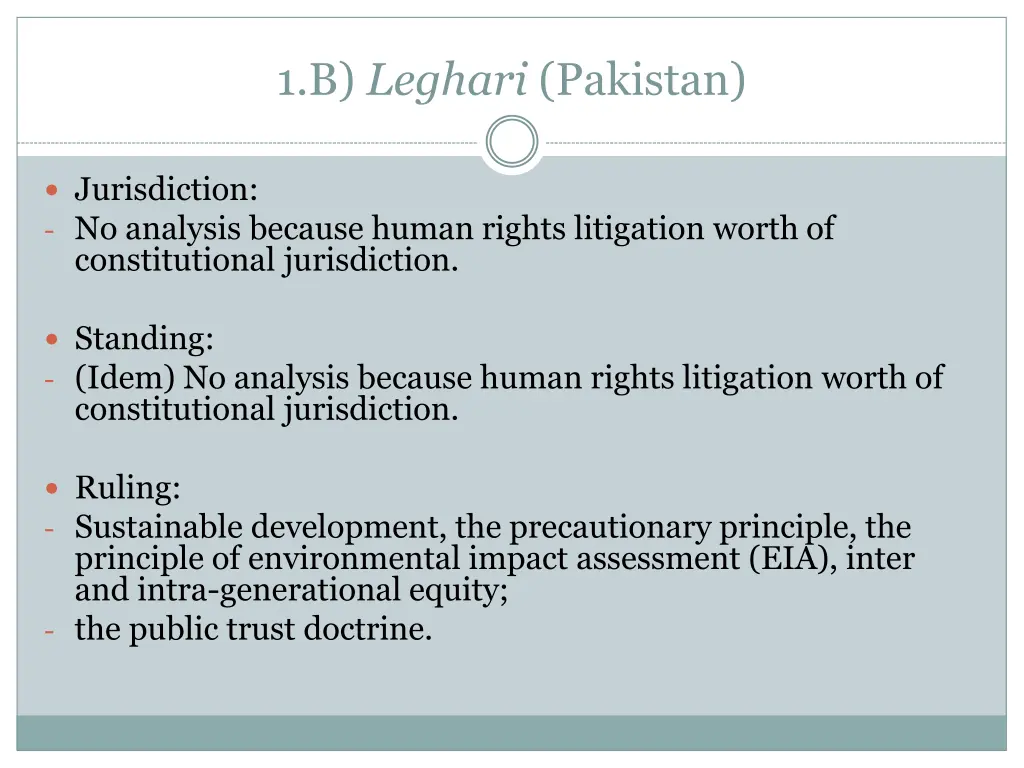
1.B) Leghari (Pakistan) Jurisdiction: - No analysis because human rights litigation worth of constitutional jurisdiction. Standing: - (Idem) No analysis because human rights litigation worth of constitutional jurisdiction. Ruling: - Sustainable development, the precautionary principle, the principle of environmental impact assessment (EIA), inter and intra-generational equity; - the public trust doctrine.
2) Impact on Enforcement A LEGITIMATE METHOD OF ENFORCEMENT AND THE PROSPECTIVE USE OF THE PARIS AGREEMENT
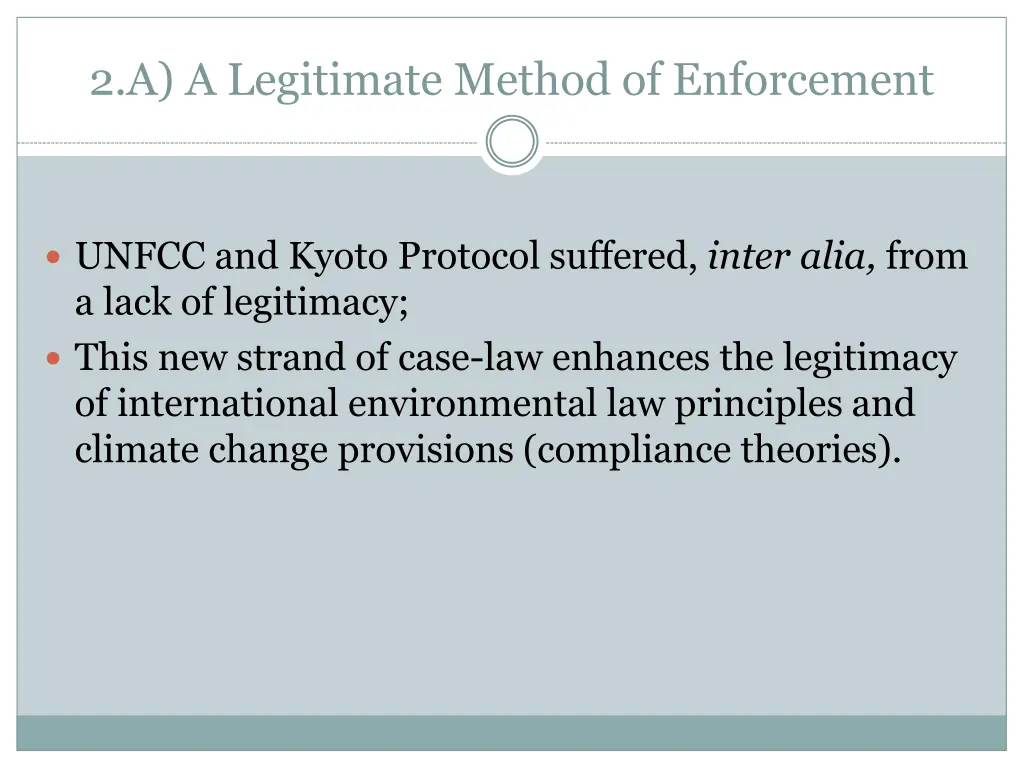
2.A) A Legitimate Method of Enforcement UNFCC and Kyoto Protocol suffered, inter alia, from a lack of legitimacy; This new strand of case-law enhances the legitimacy of international environmental law principles and climate change provisions (compliance theories).
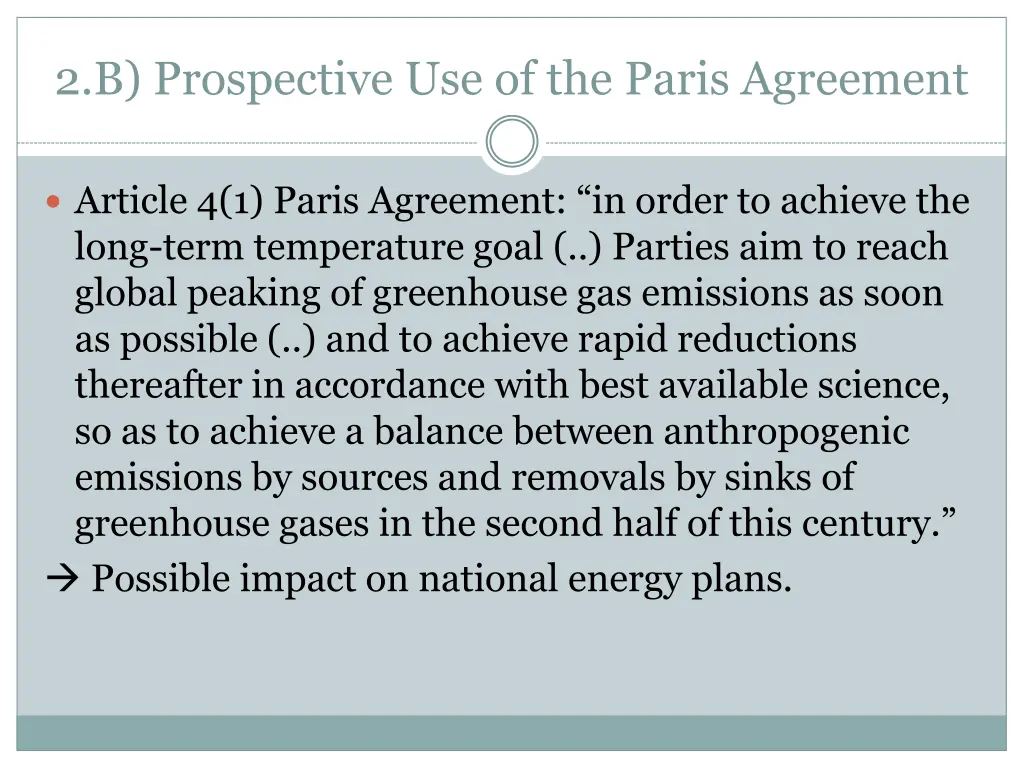
2.B) Prospective Use of the Paris Agreement Article 4(1) Paris Agreement: in order to achieve the long-term temperature goal (..) Parties aim to reach global peaking of greenhouse gas emissions as soon as possible (..) and to achieve rapid reductions thereafter in accordance with best available science, so as to achieve a balance between anthropogenic emissions by sources and removals by sinks of greenhouse gases in the second half of this century. Possible impact on national energy plans.
3. Impact on Policy CRITICISM
3. Criticism Skeptic views from governments, also supreme courts? Risk of a backlash on climate change policy and the implementation of the Paris Agreement at governmental level.