Introduction --- Part2
The course COSC 4335, taught by Ch. Eick, focuses on Knowledge Discovery in Data (KDD) and the processes involved in identifying useful patterns in data. KDD is a systematic approach that encompasses data mining, and it requires an understanding of various techniques and methodologies. The course emphasizes the significance of distinguishing interesting patterns and explores different tools available in the field. Key components include objective vs. subjective interestingness measures and the interdisciplinary nature of data mining.

Download Presentation

Please find below an Image/Link to download the presentation.
The content on the website is provided AS IS for your information and personal use only. It may not be sold, licensed, or shared on other websites without obtaining consent from the author.If you encounter any issues during the download, it is possible that the publisher has removed the file from their server.
You are allowed to download the files provided on this website for personal or commercial use, subject to the condition that they are used lawfully. All files are the property of their respective owners.
The content on the website is provided AS IS for your information and personal use only. It may not be sold, licensed, or shared on other websites without obtaining consent from the author.
E N D
Presentation Transcript
Ch. Eick: Course Information COSC 4335 Introduction --- Part2 1. Another Introduction to Data Mining 2. Course Information 1
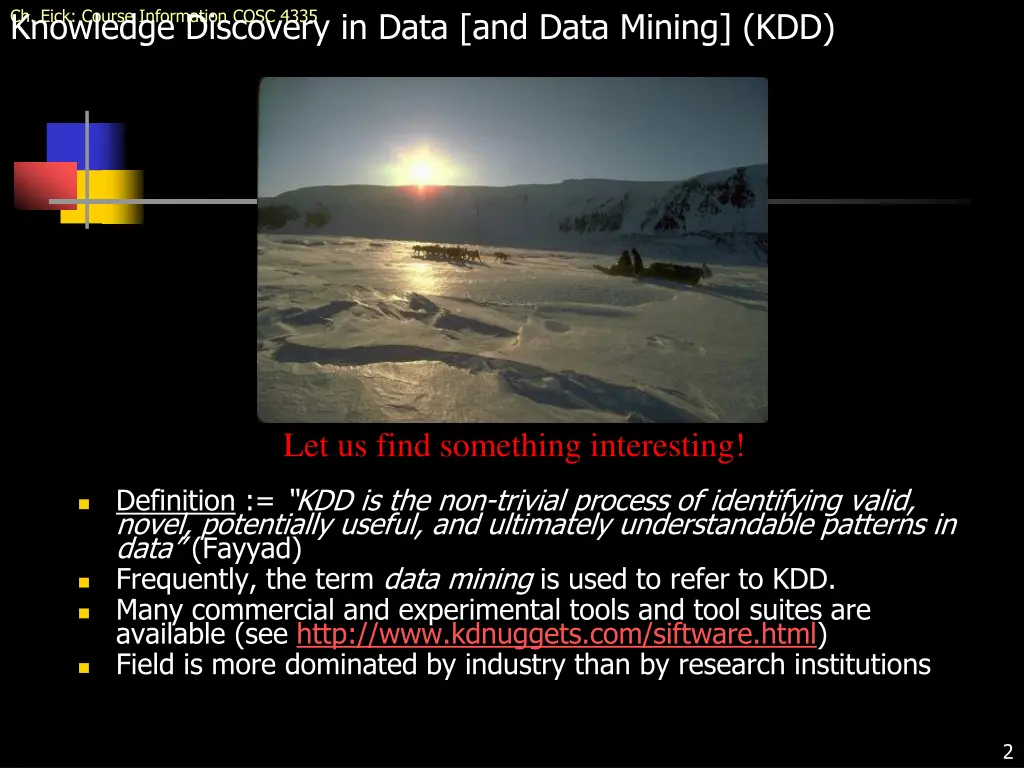
Ch. Eick: Course Information COSC 4335 Knowledge Discovery in Data [and Data Mining] (KDD) Let us find something interesting! Definition := KDD is the non-trivial process of identifying valid, novel, potentially useful, and ultimately understandable patterns in data (Fayyad) Frequently, the term data mining is used to refer to KDD. Many commercial and experimental tools and tool suites are available (see http://www.kdnuggets.com/siftware.html) Field is more dominated by industry than by research institutions 2
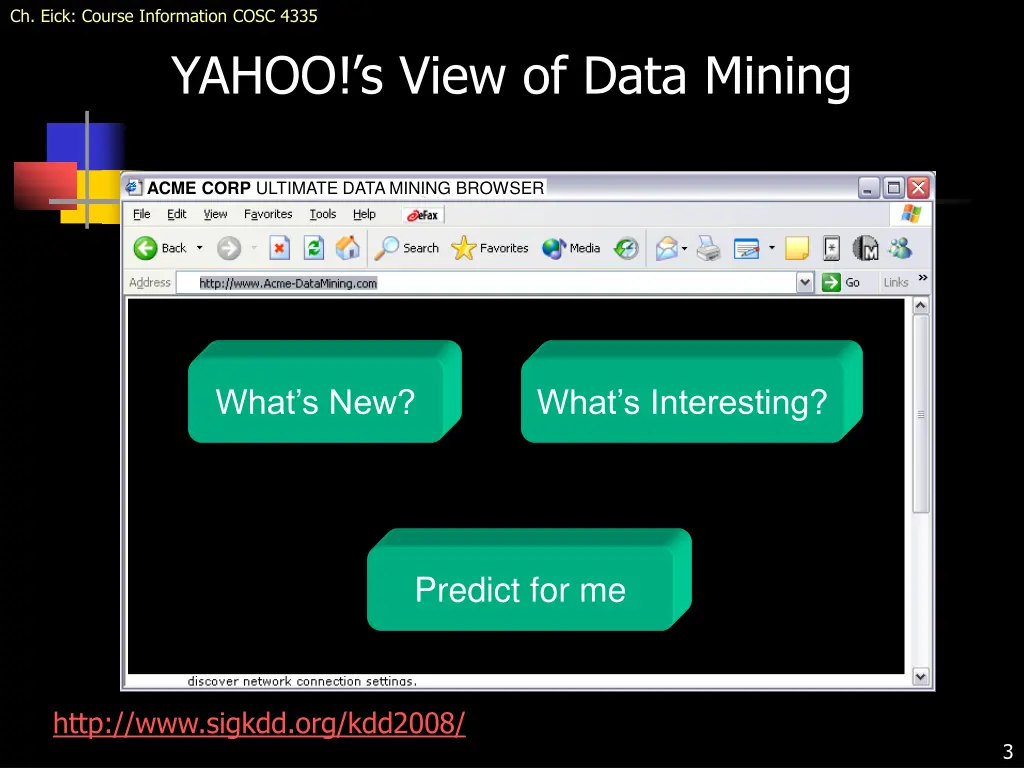
Ch. Eick: Course Information COSC 4335 YAHOO! s View of Data Mining ACME CORP ULTIMATE DATA MINING BROWSER What s New? What s Interesting? Predict for me http://www.sigkdd.org/kdd2008/ 3
Ch. Eick: Course Information COSC 4335 Are All the Discovered Patterns Interesting? A data mining system/query may generate thousands of patterns, not all of them are interesting. Suggested approach: Human-centered, query-based, focused mining Interestingness measures: A pattern is interesting if it is easily understood by humans, valid on new or test data with some degree of certainty, potentially useful, novel, or validates some hypothesis that a user seeks to confirm Objective vs. subjective interestingness measures: Objective: based on statistics and structures of patterns, e.g., support, confidence, etc. Subjective: based on user s belief in the data, e.g., unexpectedness, novelty, actionability, etc. 4
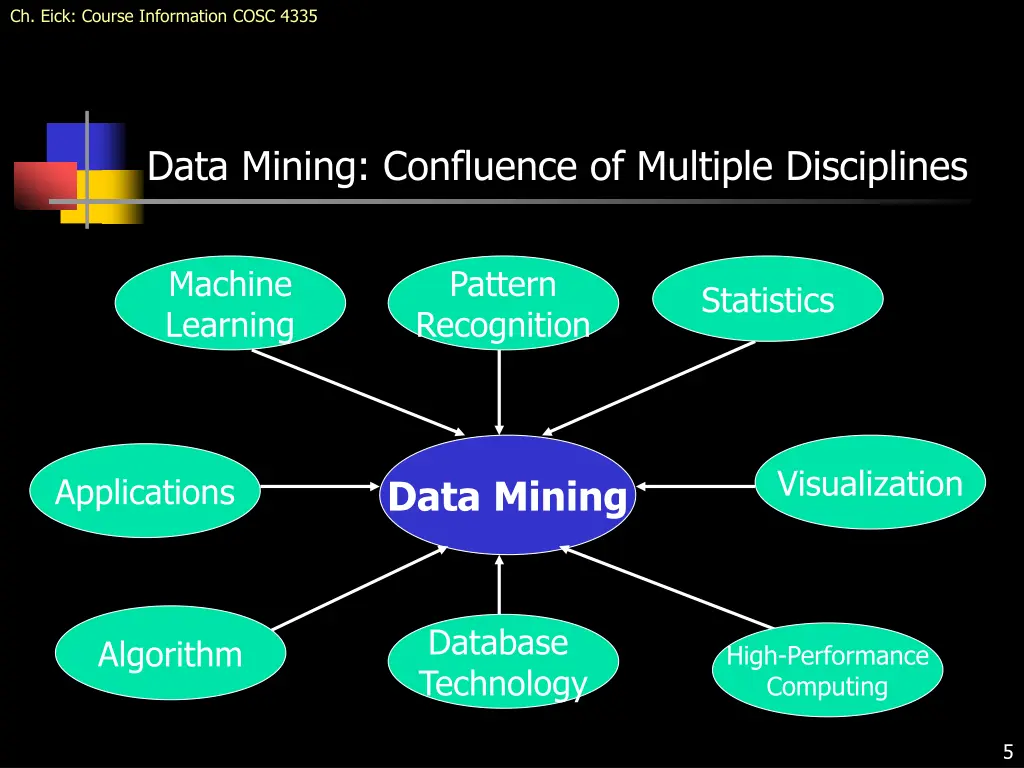
Ch. Eick: Course Information COSC 4335 Data Mining: Confluence of Multiple Disciplines Machine Learning Pattern Recognition Statistics Visualization Applications Data Mining Database Technology Algorithm High-Performance Computing 5
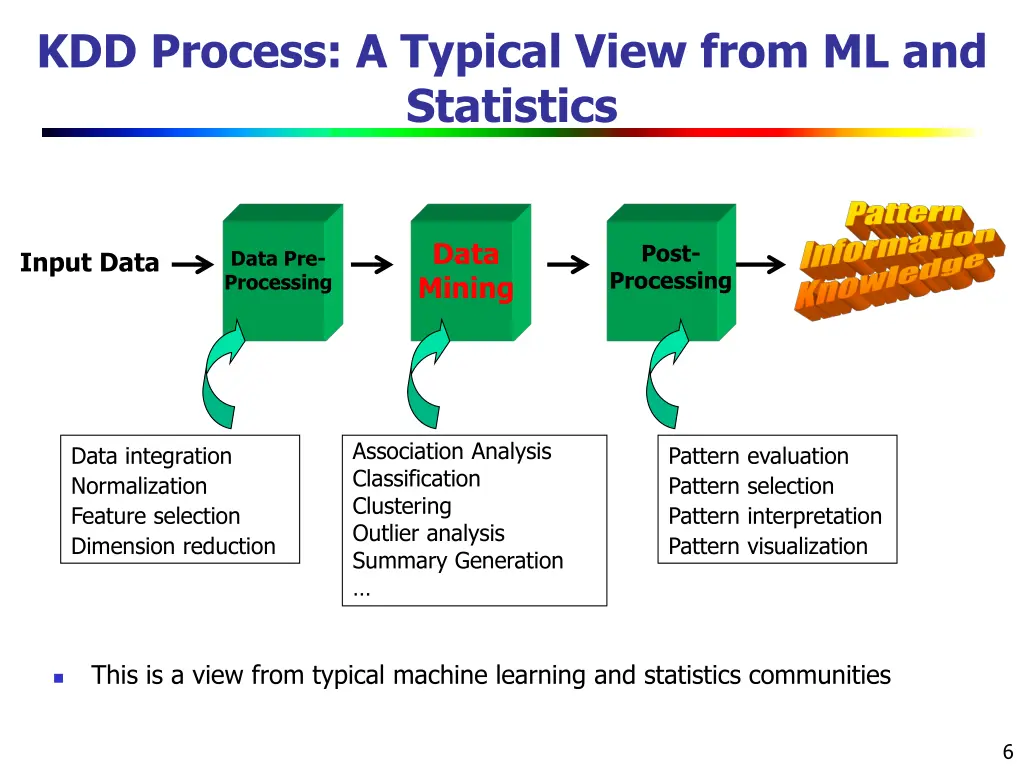
KDD Process: A Typical View from ML and Statistics Data Mining Post- Data Pre- Processing Input Data Processing Association Analysis Classification Clustering Outlier analysis Summary Generation Data integration Normalization Feature selection Dimension reduction Pattern evaluation Pattern selection Pattern interpretation Pattern visualization This is a view from typical machine learning and statistics communities 6
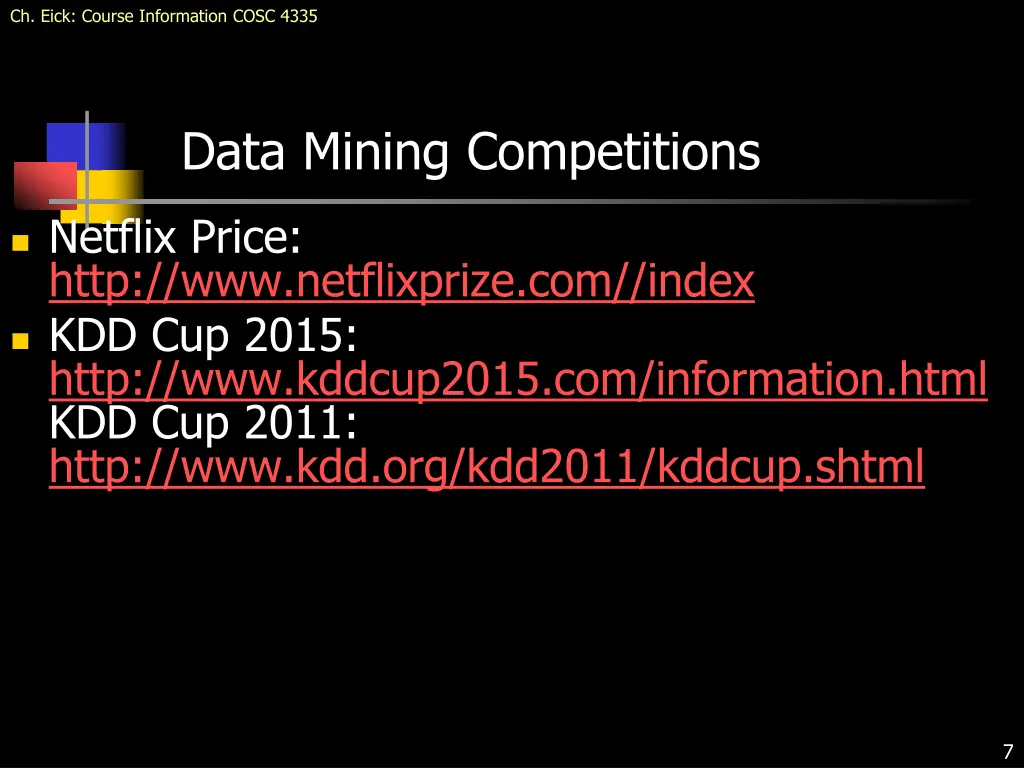
Ch. Eick: Course Information COSC 4335 Data Mining Competitions Netflix Price: http://www.netflixprize.com//index KDD Cup 2015: http://www.kddcup2015.com/information.html KDD Cup 2011: http://www.kdd.org/kdd2011/kddcup.shtml 7
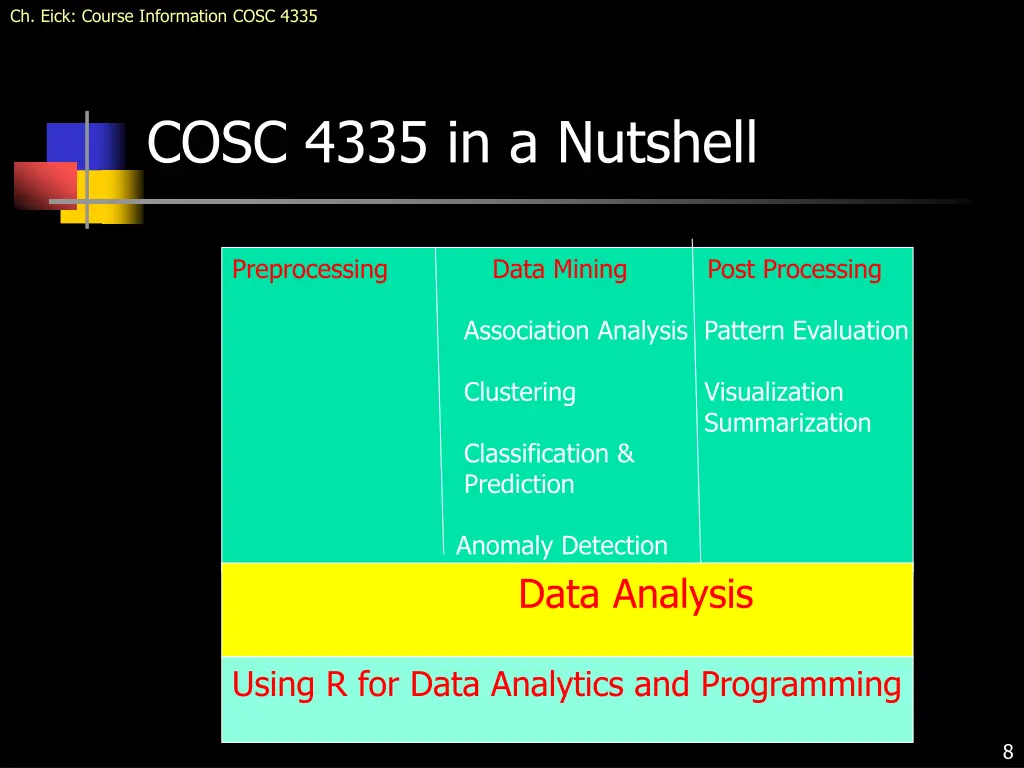
Ch. Eick: Course Information COSC 4335 COSC 4335 in a Nutshell Preprocessing Data Mining Post Processing Association Analysis Pattern Evaluation Clustering Visualization Summarization Classification & Prediction Anomaly Detection Data Analysis Using R for Data Analytics and Programming 8
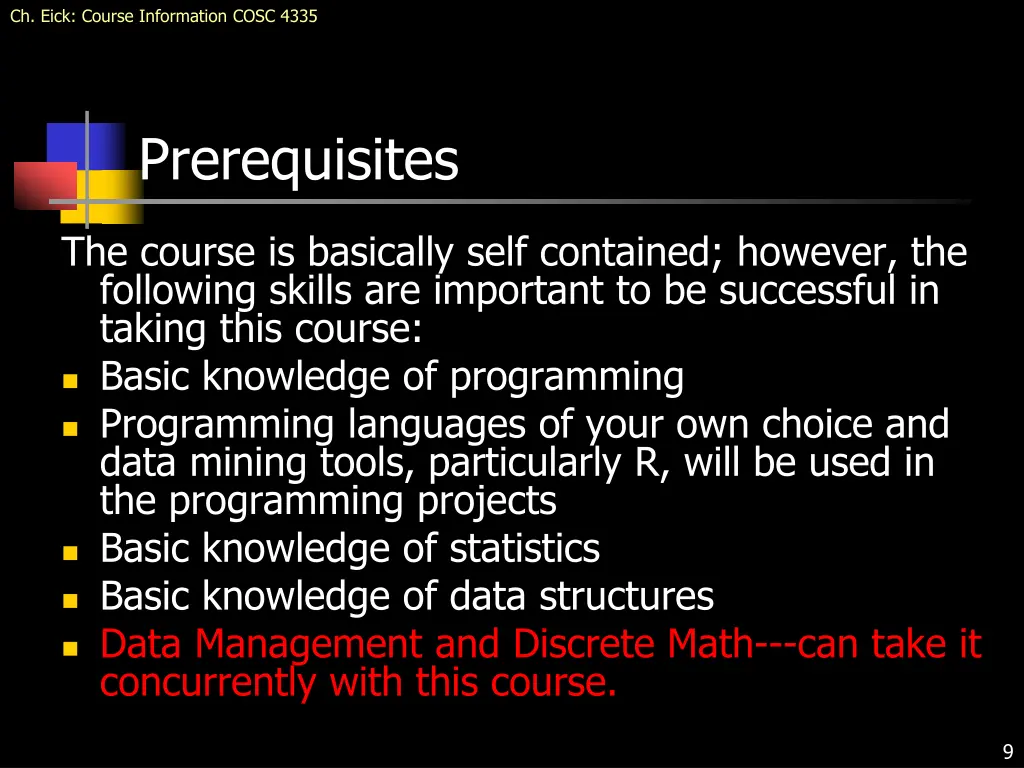
Ch. Eick: Course Information COSC 4335 Prerequisites The course is basically self contained; however, the following skills are important to be successful in taking this course: Basic knowledge of programming Programming languages of your own choice and data mining tools, particularly R, will be used in the programming projects Basic knowledge of statistics Basic knowledge of data structures Data Management and Discrete Math---can take it concurrently with this course. 9
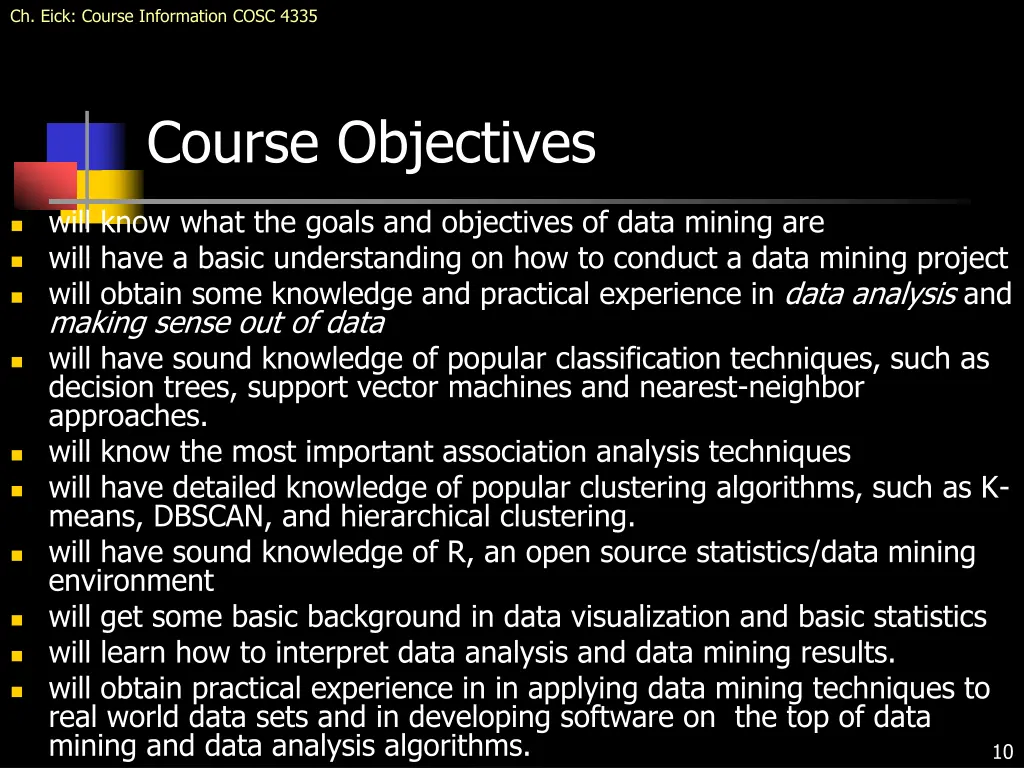
Ch. Eick: Course Information COSC 4335 Course Objectives will know what the goals and objectives of data mining are will have a basic understanding on how to conduct a data mining project will obtain some knowledge and practical experience in data analysis and making sense out of data will have sound knowledge of popular classification techniques, such as decision trees, support vector machines and nearest-neighbor approaches. will know the most important association analysis techniques will have detailed knowledge of popular clustering algorithms, such as K- means, DBSCAN, and hierarchical clustering. will have sound knowledge of R, an open source statistics/data mining environment will get some basic background in data visualization and basic statistics will learn how to interpret data analysis and data mining results. will obtain practical experience in in applying data mining techniques to real world data sets and in developing software on the top of data mining and data analysis algorithms. 10
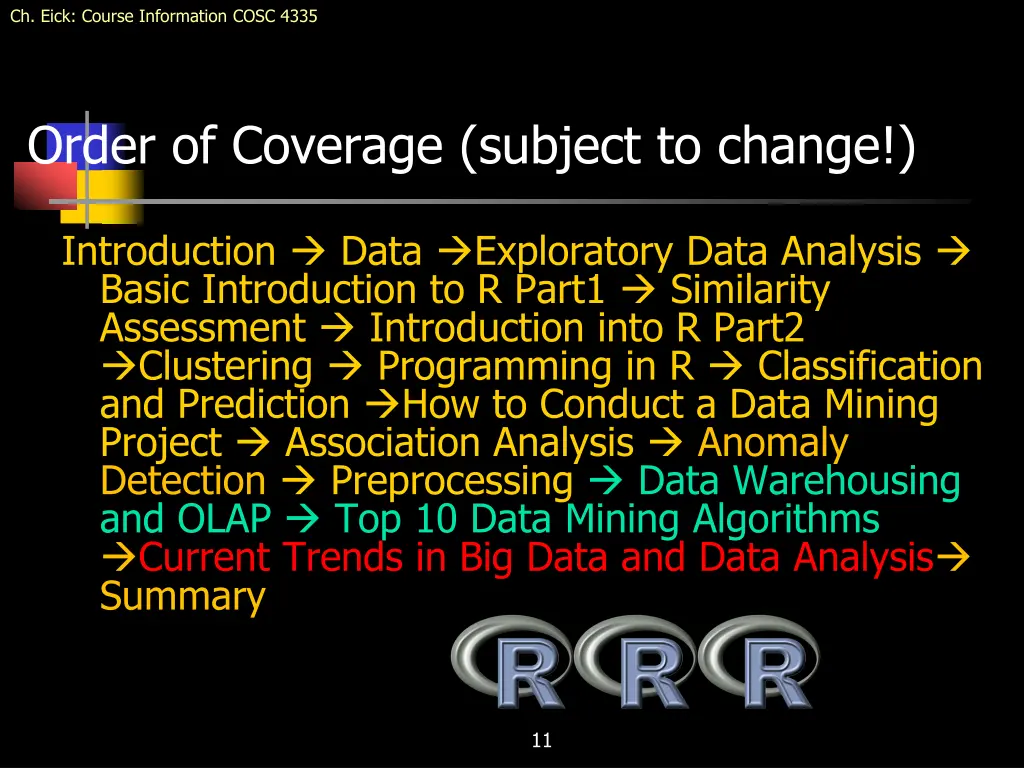
Ch. Eick: Course Information COSC 4335 Order of Coverage (subject to change!) Introduction Data Exploratory Data Analysis Basic Introduction to R Part1 Similarity Assessment Introduction into R Part2 Clustering Programming in R Classification and Prediction How to Conduct a Data Mining Project Association Analysis Anomaly Detection Preprocessing Data Warehousing and OLAP Top 10 Data Mining Algorithms Current Trends in Big Data and Data Analysis Summary 11
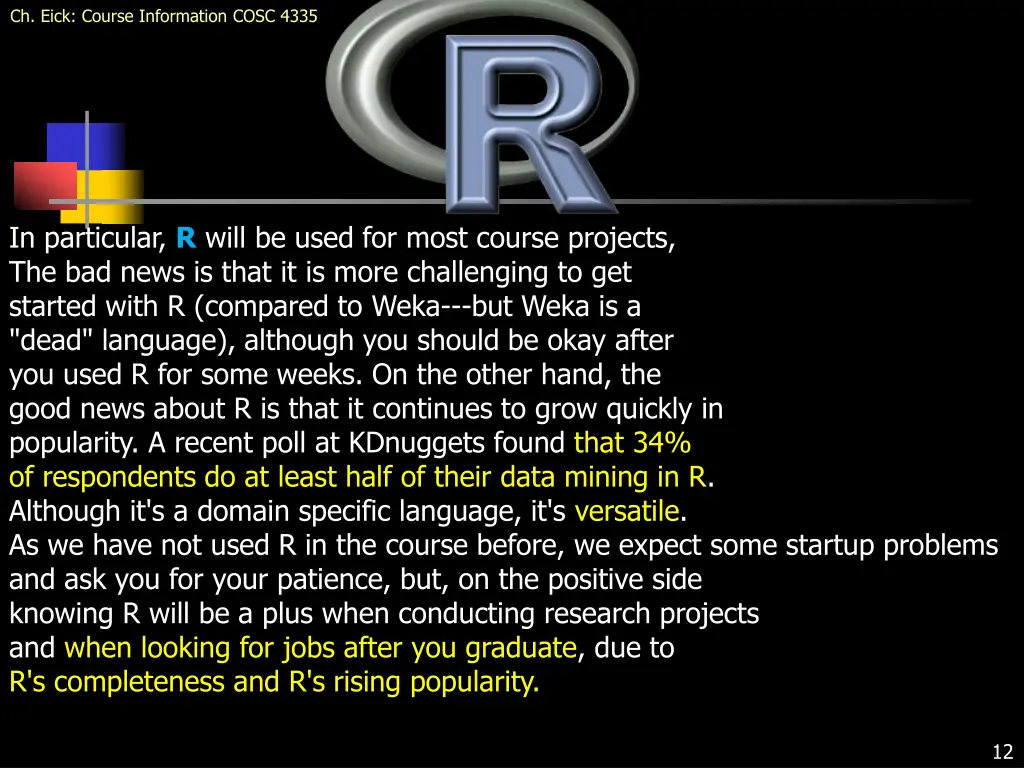
Ch. Eick: Course Information COSC 4335 In particular, R will be used for most course projects, The bad news is that it is more challenging to get started with R (compared to Weka---but Weka is a "dead" language), although you should be okay after you used R for some weeks. On the other hand, the good news about R is that it continues to grow quickly in popularity. A recent poll at KDnuggets found that 34% of respondents do at least half of their data mining in R. Although it's a domain specific language, it's versatile. As we have not used R in the course before, we expect some startup problems and ask you for your patience, but, on the positive side knowing R will be a plus when conducting research projects and when looking for jobs after you graduate, due to R's completeness and R's rising popularity. 12
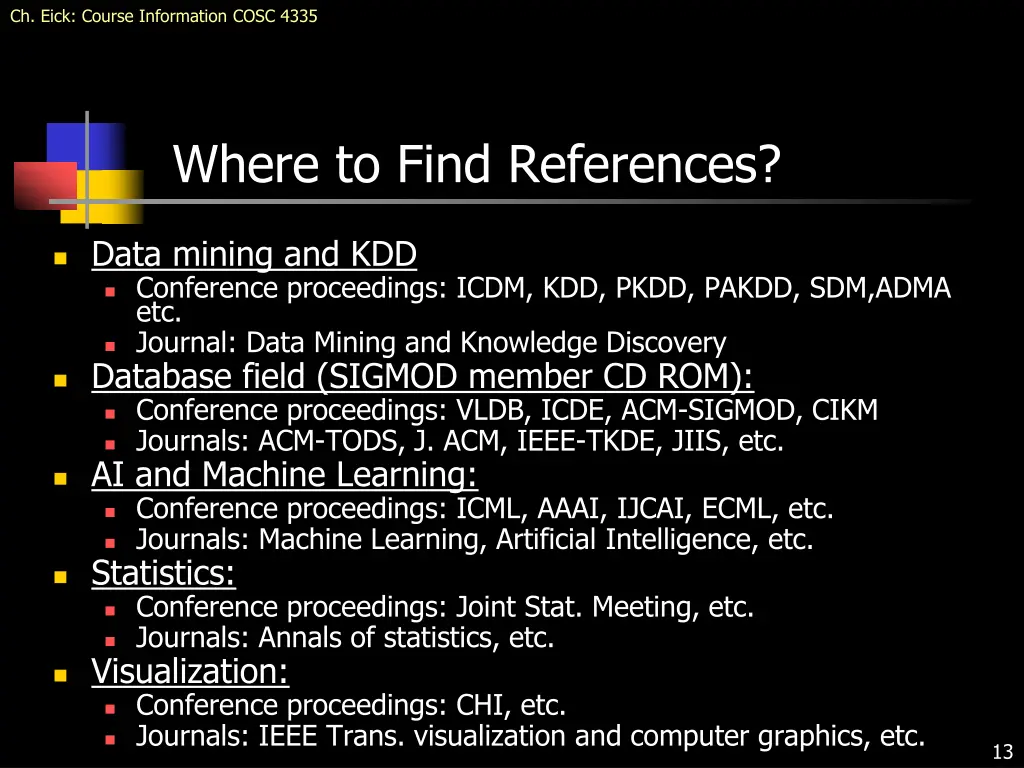
Ch. Eick: Course Information COSC 4335 Where to Find References? Data mining and KDD Conference proceedings: ICDM, KDD, PKDD, PAKDD, SDM,ADMA etc. Journal: Data Mining and Knowledge Discovery Database field (SIGMOD member CD ROM): Conference proceedings: VLDB, ICDE, ACM-SIGMOD, CIKM Journals: ACM-TODS, J. ACM, IEEE-TKDE, JIIS, etc. AI and Machine Learning: Conference proceedings: ICML, AAAI, IJCAI, ECML, etc. Journals: Machine Learning, Artificial Intelligence, etc. Statistics: Conference proceedings: Joint Stat. Meeting, etc. Journals: Annals of statistics, etc. Visualization: Conference proceedings: CHI, etc. Journals: IEEE Trans. visualization and computer graphics, etc. 13
Ch. Eick: Course Information COSC 4335 Textbooks Recommended Text: P.-N. Tang, M. Steinback, and V. Kumar: Introduction to Data Mining, Addison Wesley, Link to Book HomePage Mildly Recommended Text Jiawei Han and Micheline Kamber, Data Mining: Concepts and Techniques, Morgan Kaufman Publishers, second edition. Link to Data Mining Book Home Page 14
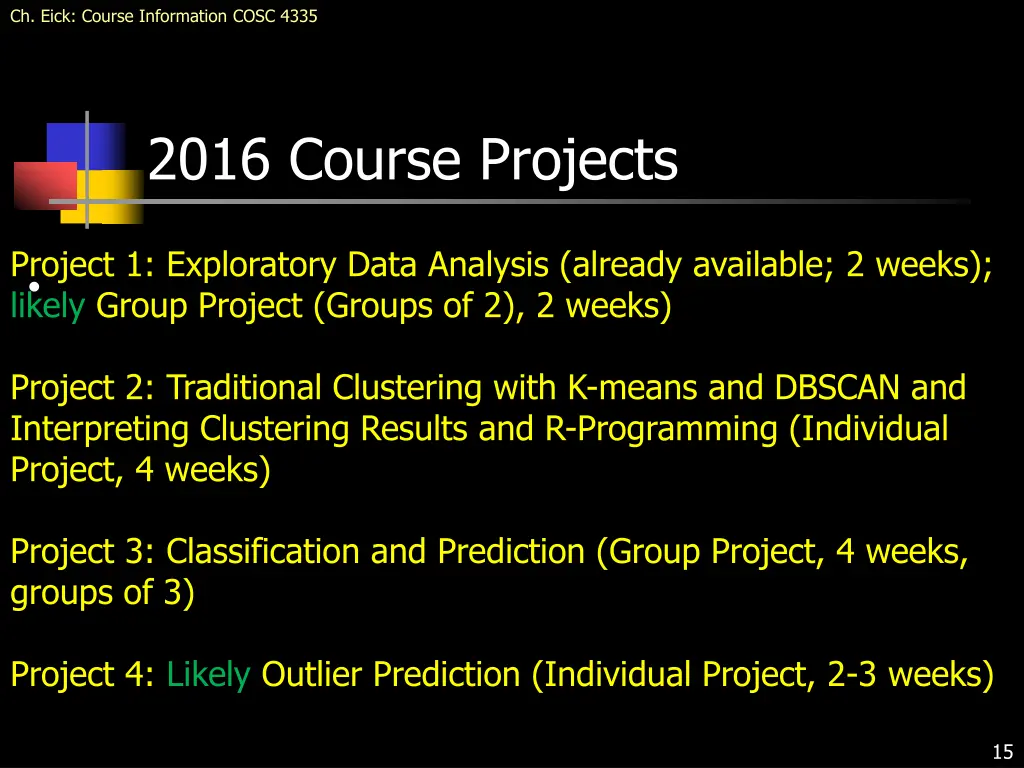
Ch. Eick: Course Information COSC 4335 2016 Course Projects Project 1: Exploratory Data Analysis (already available; 2 weeks); likely Group Project (Groups of 2), 2 weeks) Project 2: Traditional Clustering with K-means and DBSCAN and Interpreting Clustering Results and R-Programming (Individual Project, 4 weeks) Project 3: Classification and Prediction (Group Project, 4 weeks, groups of 3) Project 4: Likely Outlier Prediction (Individual Project, 2-3 weeks) 15
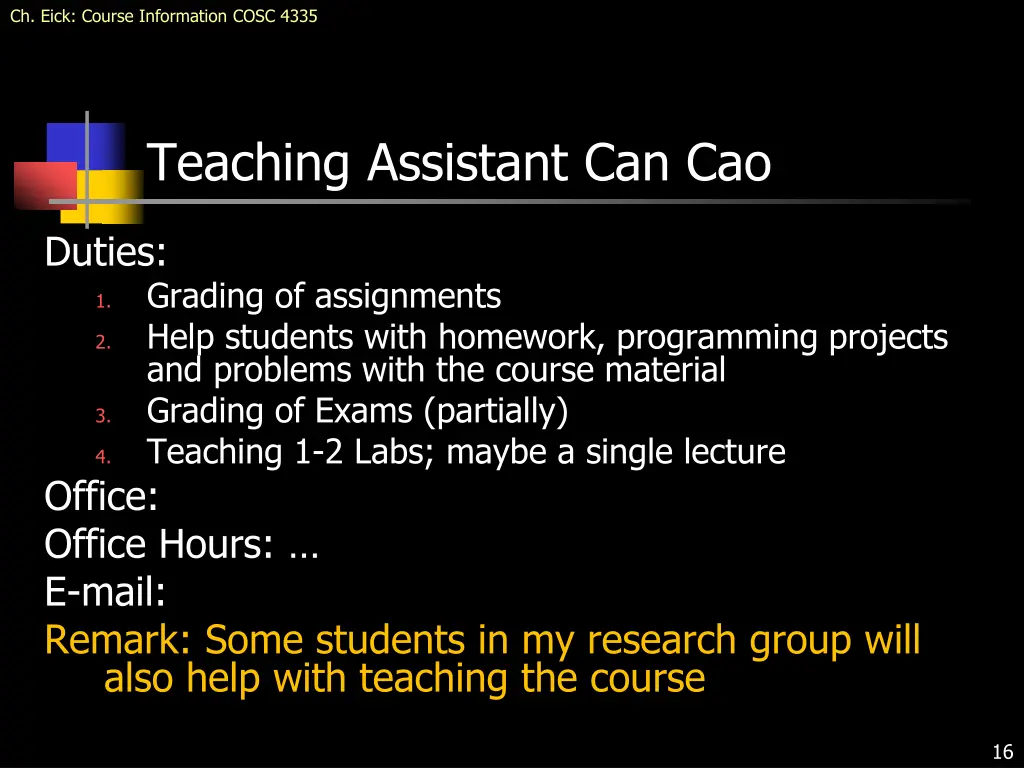
Ch. Eick: Course Information COSC 4335 Teaching Assistant Can Cao Duties: Grading of assignments Help students with homework, programming projects and problems with the course material Grading of Exams (partially) Teaching 1-2 Labs; maybe a single lecture Office: Office Hours: E-mail: Remark: Some students in my research group will also help with teaching the course 1. 2. 3. 4. 16
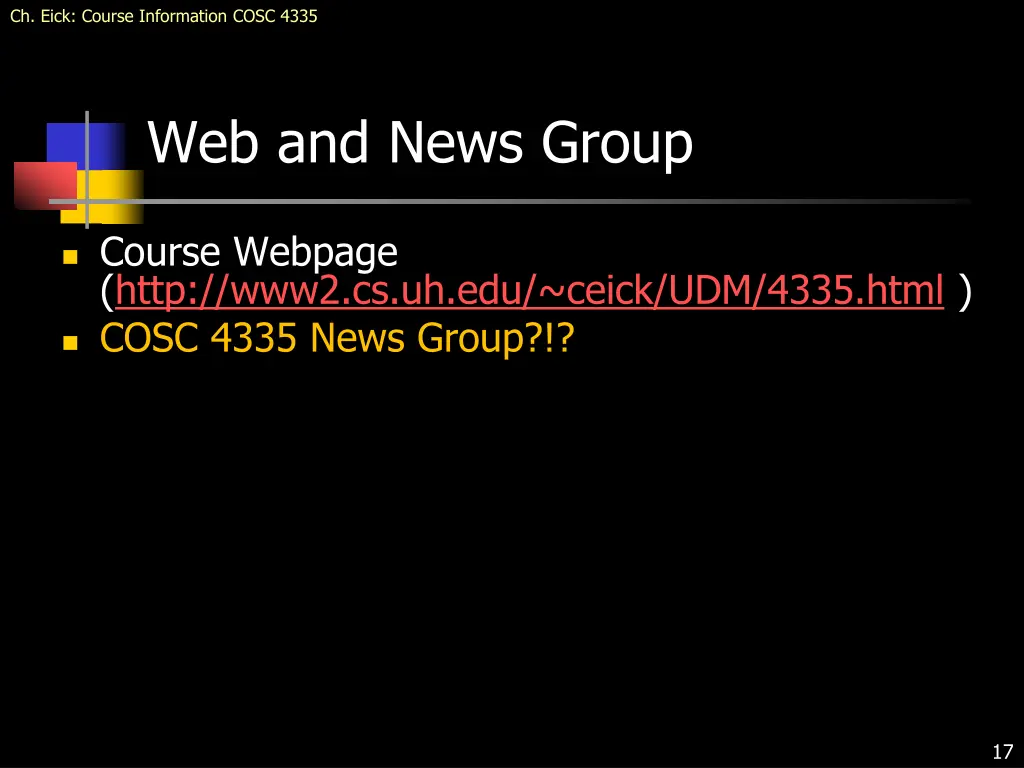
Ch. Eick: Course Information COSC 4335 Web and News Group Course Webpage (http://www2.cs.uh.edu/~ceick/UDM/4335.html ) COSC 4335 News Group?!? 17
Ch. Eick: Course Information COSC 4335 Exams Open Textbook and Note (no computers!) Count about 50% towards the course grade 3 exams Course Schedule will be finalized on Feb. 4 18
Ch. Eick: Course Information COSC 4335 Teaching Philosophy and Advice Read the sections of the textbook and/or slides before you come to the lecture; if you work continuously for the class you will do better and lectures will be more enjoyable. Starting to review the material that is covered in this class 1 week before the next exam is not a good idea. Do not be afraid to ask questions! I really like interactions with students in the lectures If you do not understand something at all send me an e-mail before the next lecture! If you have a serious problem talk to me, before the problem gets out of hand. 19
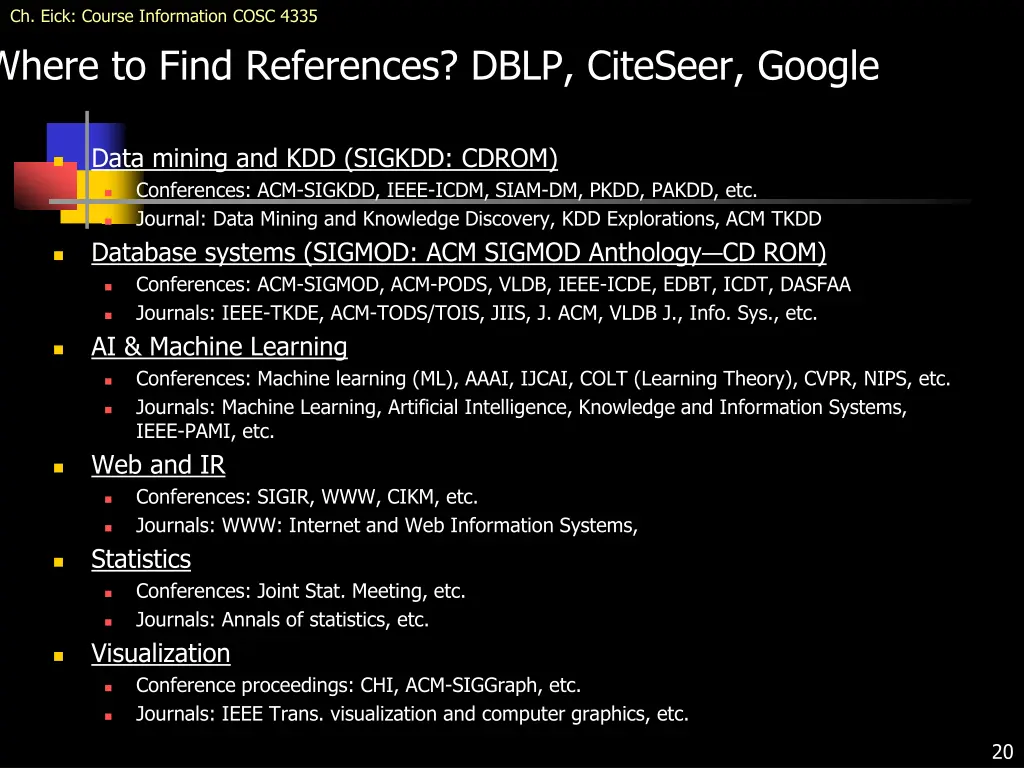
Ch. Eick: Course Information COSC 4335 Where to Find References? DBLP, CiteSeer, Google Data mining and KDD (SIGKDD: CDROM) Conferences: ACM-SIGKDD, IEEE-ICDM, SIAM-DM, PKDD, PAKDD, etc. Journal: Data Mining and Knowledge Discovery, KDD Explorations, ACM TKDD Database systems (SIGMOD: ACM SIGMOD Anthology CD ROM) Conferences: ACM-SIGMOD, ACM-PODS, VLDB, IEEE-ICDE, EDBT, ICDT, DASFAA Journals: IEEE-TKDE, ACM-TODS/TOIS, JIIS, J. ACM, VLDB J., Info. Sys., etc. AI & Machine Learning Conferences: Machine learning (ML), AAAI, IJCAI, COLT (Learning Theory), CVPR, NIPS, etc. Journals: Machine Learning, Artificial Intelligence, Knowledge and Information Systems, IEEE-PAMI, etc. Web and IR Conferences: SIGIR, WWW, CIKM, etc. Journals: WWW: Internet and Web Information Systems, Statistics Conferences: Joint Stat. Meeting, etc. Journals: Annals of statistics, etc. Visualization Conference proceedings: CHI, ACM-SIGGraph, etc. Journals: IEEE Trans. visualization and computer graphics, etc. 20
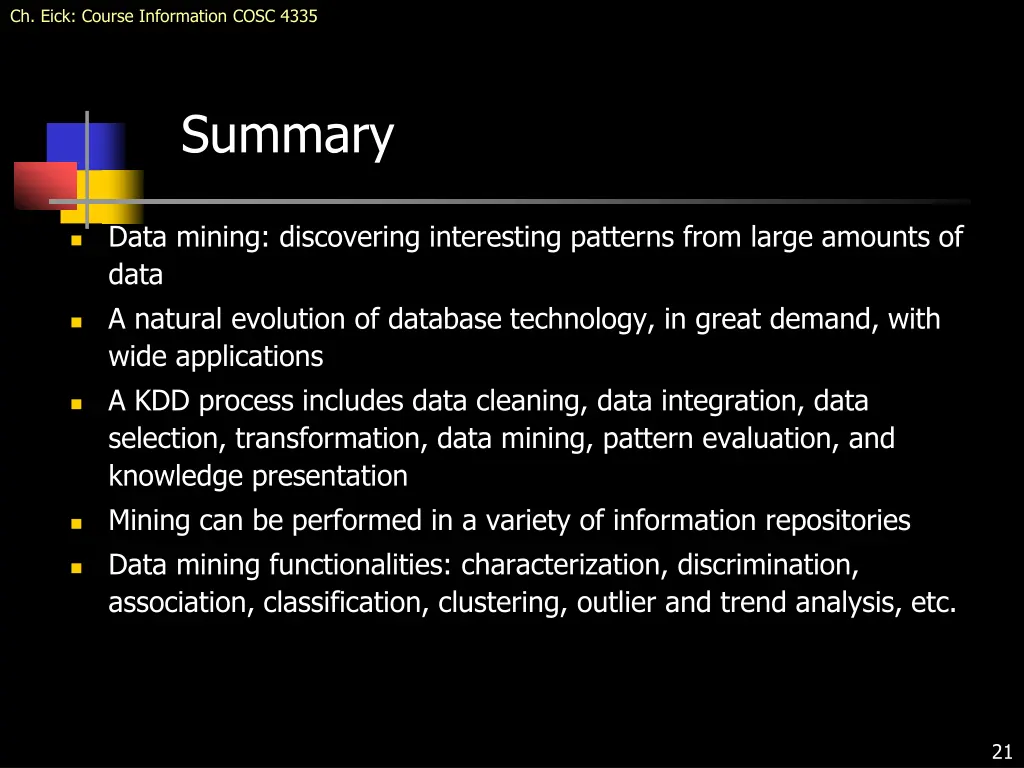
Ch. Eick: Course Information COSC 4335 Summary Data mining: discovering interesting patterns from large amounts of data A natural evolution of database technology, in great demand, with wide applications A KDD process includes data cleaning, data integration, data selection, transformation, data mining, pattern evaluation, and knowledge presentation Mining can be performed in a variety of information repositories Data mining functionalities: characterization, discrimination, association, classification, clustering, outlier and trend analysis, etc. 21