Introduction to Distributed Wind Projects Overview
Distributed wind projects involve wind turbines utilized in various settings to offset energy consumption. Considerations for ordinances include size variations, height restrictions, alternatives to height limits, setback requirements, and more.

Download Presentation

Please find below an Image/Link to download the presentation.
The content on the website is provided AS IS for your information and personal use only. It may not be sold, licensed, or shared on other websites without obtaining consent from the author.If you encounter any issues during the download, it is possible that the publisher has removed the file from their server.
You are allowed to download the files provided on this website for personal or commercial use, subject to the condition that they are used lawfully. All files are the property of their respective owners.
The content on the website is provided AS IS for your information and personal use only. It may not be sold, licensed, or shared on other websites without obtaining consent from the author.
E N D
Presentation Transcript
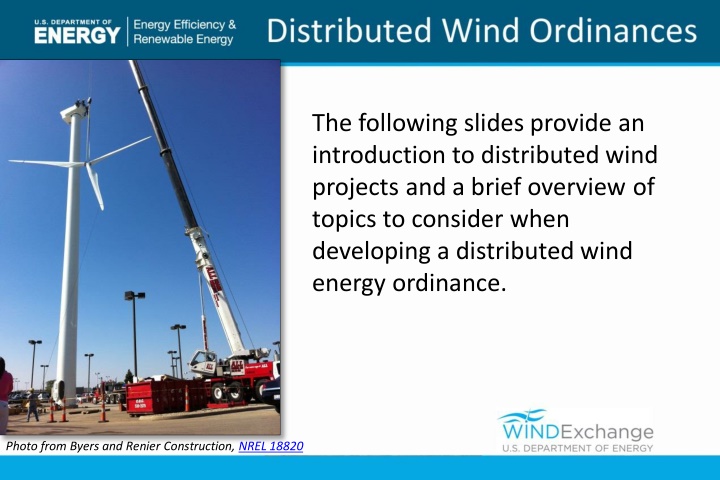
The following slides provide an introduction to distributed wind projects and a brief overview of topics to consider when developing a distributed wind energy ordinance. Photo from Byers and Renier Construction, NREL 18820
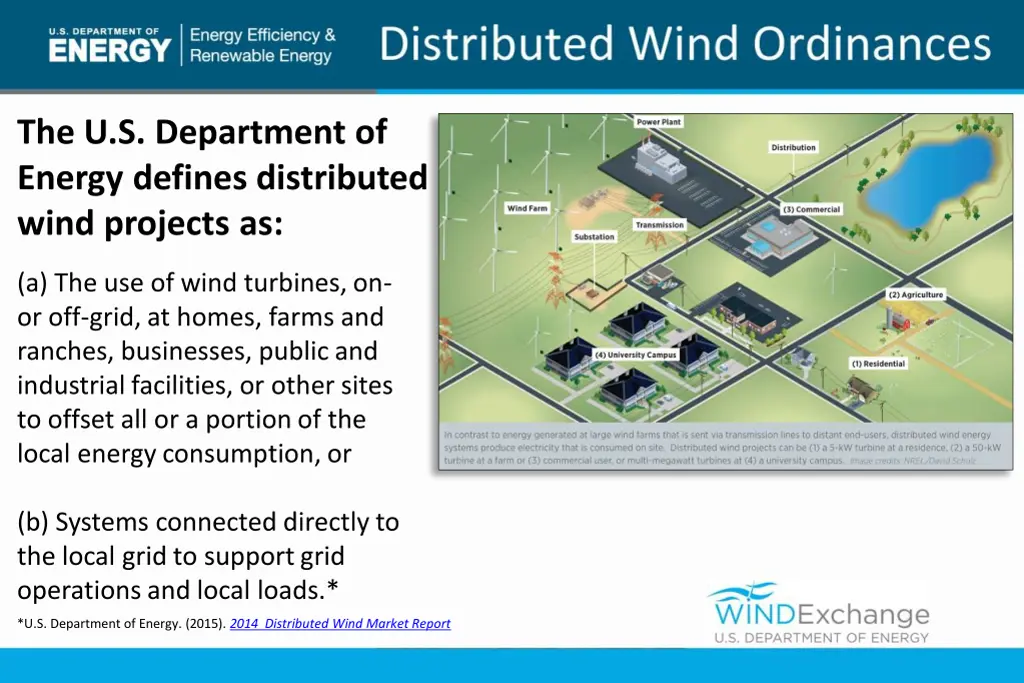
The U.S. Department of Energy defines distributed wind projects as: (a) The use of wind turbines, on- or off-grid, at homes, farms and ranches, businesses, public and industrial facilities, or other sites to offset all or a portion of the local energy consumption, or (b) Systems connected directly to the local grid to support grid operations and local loads.* *U.S. Department of Energy. (2015). 2014 Distributed Wind Market Report
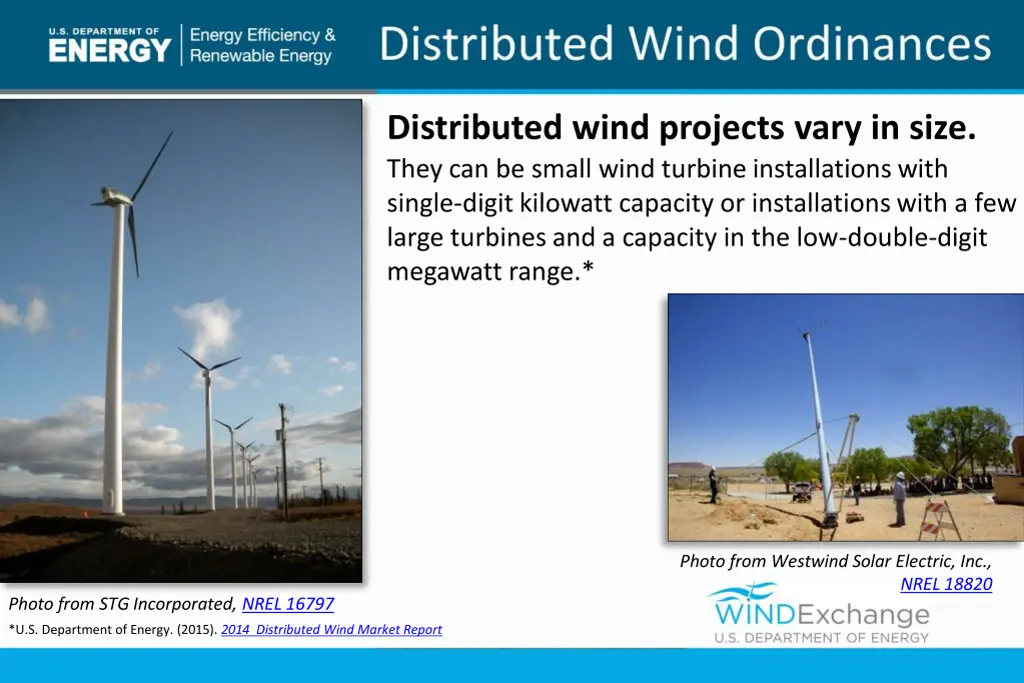
Distributed wind projects vary in size. They can be small wind turbine installations with single-digit kilowatt capacity or installations with a few large turbines and a capacity in the low-double-digit megawatt range.* Photo from Westwind Solar Electric, Inc., NREL 18820 Photo from STG Incorporated, NREL 16797 *U.S. Department of Energy. (2015). 2014 Distributed Wind Market Report
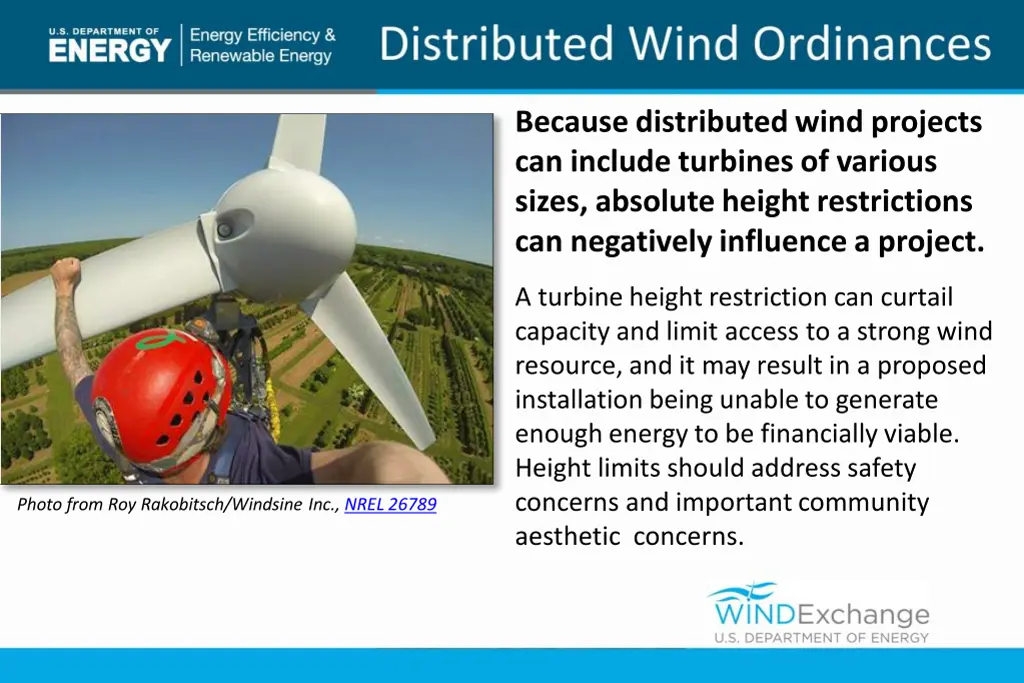
Because distributed wind projects can include turbines of various sizes, absolute height restrictions can negatively influence a project. A turbine height restriction can curtail capacity and limit access to a strong wind resource, and it may result in a proposed installation being unable to generate enough energy to be financially viable. Height limits should address safety concerns and important community aesthetic concerns. Photo from Roy Rakobitsch/Windsine Inc., NREL 26789
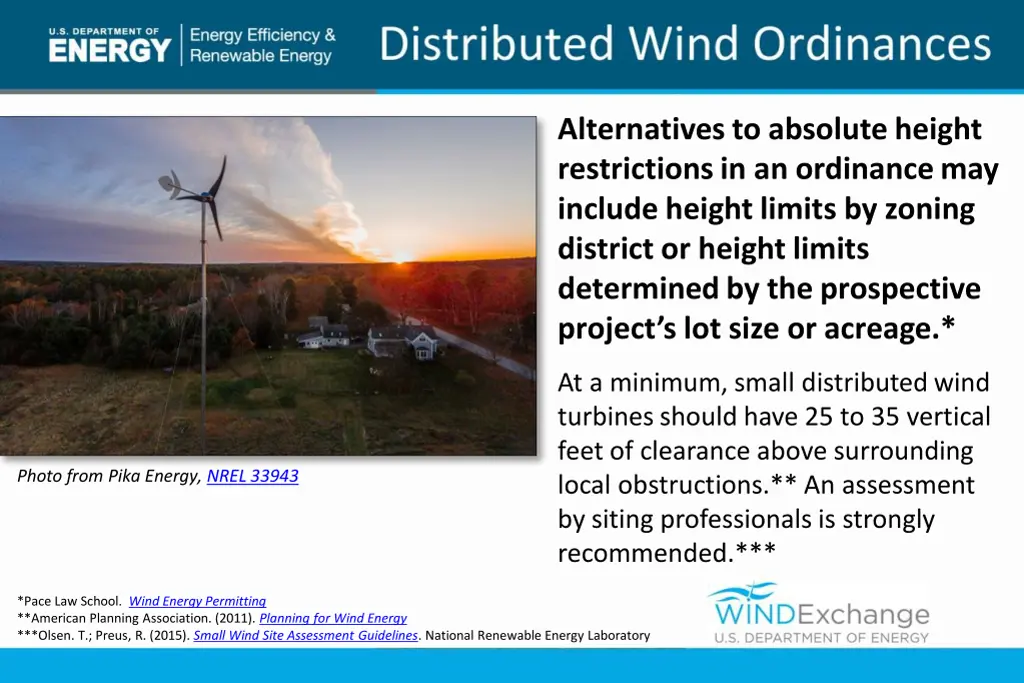
Alternatives to absolute height restrictions in an ordinance may include height limits by zoning district or height limits determined by the prospective project s lot size or acreage.* At a minimum, small distributed wind turbines should have 25 to 35 vertical feet of clearance above surrounding local obstructions.** An assessment by siting professionals is strongly recommended.*** Photo from Pika Energy, NREL 33943 *Pace Law School. Wind Energy Permitting **American Planning Association. (2011). Planning for Wind Energy ***Olsen. T.; Preus, R. (2015). Small Wind Site Assessment Guidelines. National Renewable Energy Laboratory
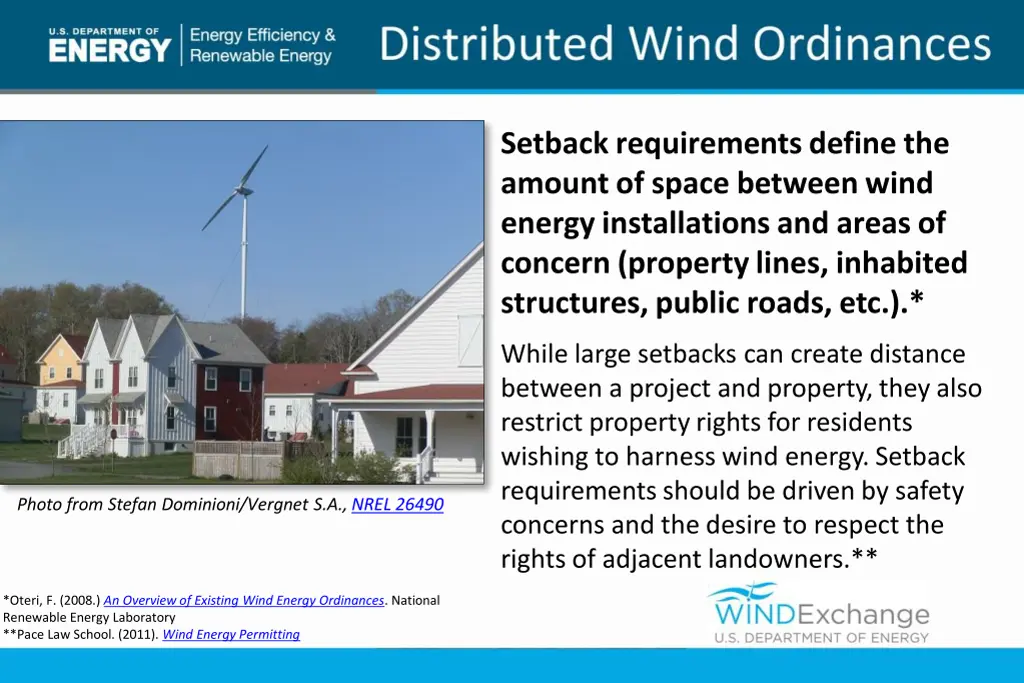
Setback requirements define the amount of space between wind energy installations and areas of concern (property lines, inhabited structures, public roads, etc.).* While large setbacks can create distance between a project and property, they also restrict property rights for residents wishing to harness wind energy. Setback requirements should be driven by safety concerns and the desire to respect the rights of adjacent landowners.** Photo from Stefan Dominioni/Vergnet S.A., NREL 26490 *Oteri, F. (2008.) An Overview of Existing Wind Energy Ordinances. National Renewable Energy Laboratory **Pace Law School. (2011). Wind Energy Permitting
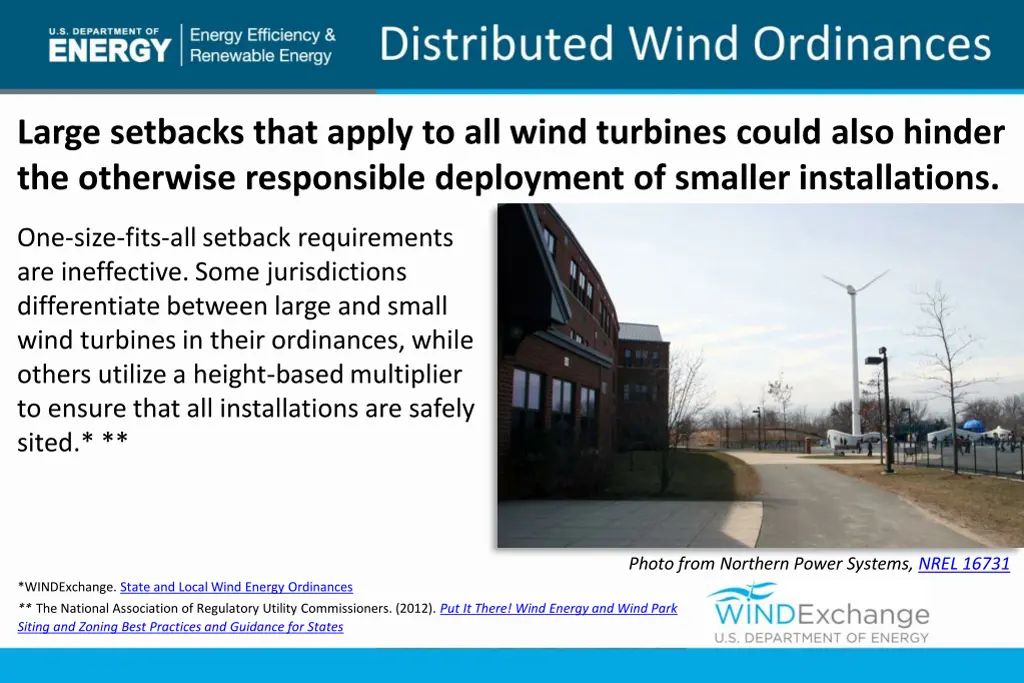
Large setbacks that apply to all wind turbines could also hinder the otherwise responsible deployment of smaller installations. One-size-fits-all setback requirements are ineffective. Some jurisdictions differentiate between large and small wind turbines in their ordinances, while others utilize a height-based multiplier to ensure that all installations are safely sited.* ** Photo from Northern Power Systems, NREL 16731 *WINDExchange. State and Local Wind Energy Ordinances **The National Association of Regulatory Utility Commissioners. (2012). Put It There! Wind Energy and Wind Park Siting and Zoning Best Practices and Guidance for States
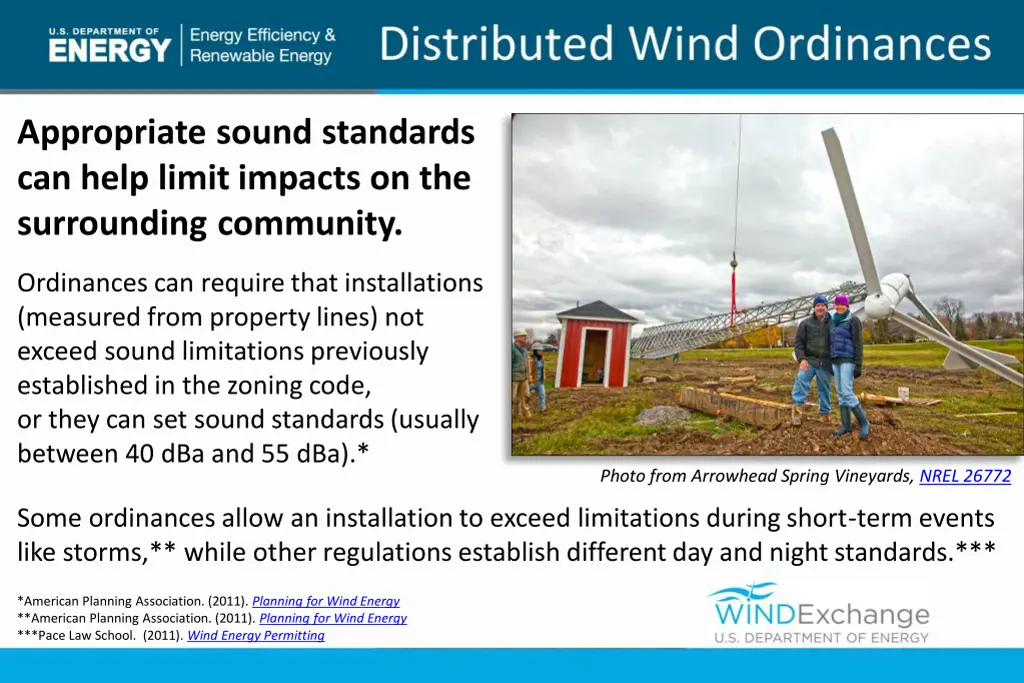
Appropriate sound standards can help limit impacts on the surrounding community. Ordinances can require that installations (measured from property lines) not exceed sound limitations previously established in the zoning code, or they can set sound standards (usually between 40 dBa and 55 dBa).* Photo from Arrowhead Spring Vineyards, NREL 26772 Some ordinances allow an installation to exceed limitations during short-term events like storms,** while other regulations establish different day and night standards.*** *American Planning Association. (2011). Planning for Wind Energy **American Planning Association. (2011). Planning for Wind Energy ***Pace Law School. (2011). Wind Energy Permitting
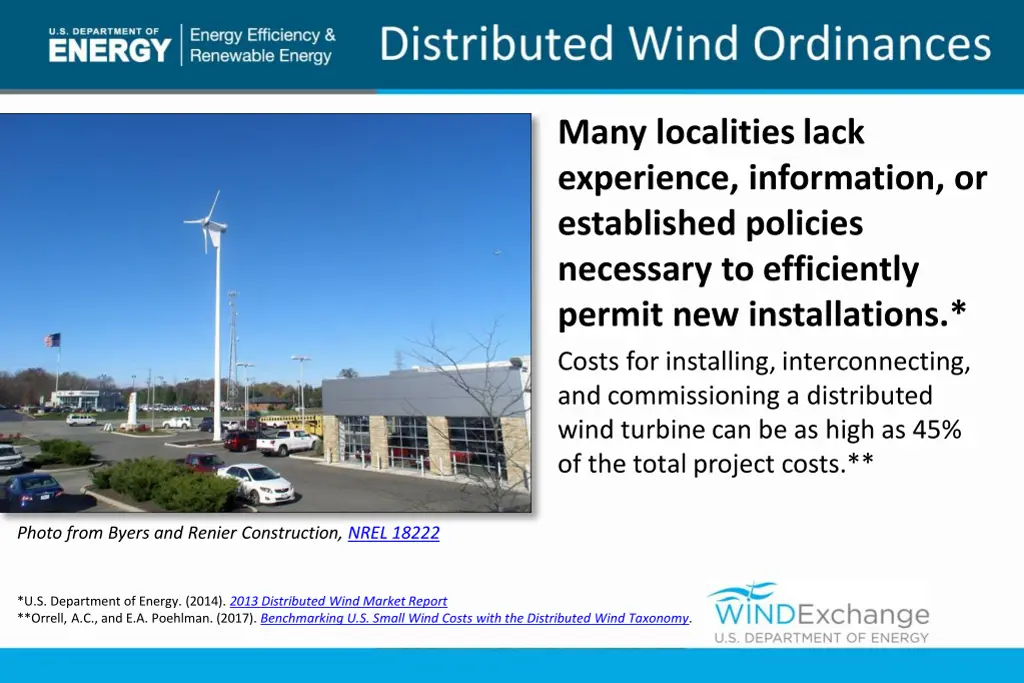
Many localities lack experience, information, or established policies necessary to efficiently permit new installations.* Costs for installing, interconnecting, and commissioning a distributed wind turbine can be as high as 45% of the total project costs.** Photo from Byers and Renier Construction, NREL 18222 *U.S. Department of Energy. (2014). 2013 Distributed Wind Market Report **Orrell, A.C., and E.A. Poehlman. (2017). Benchmarking U.S. Small Wind Costs with the Distributed Wind Taxonomy.
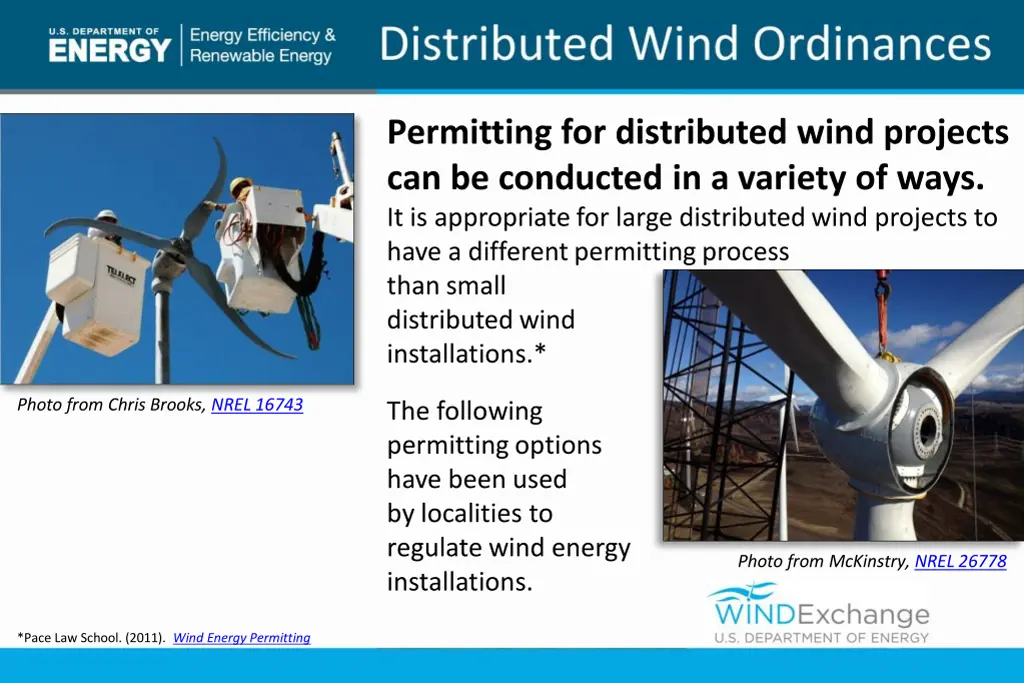
Permitting for distributed wind projects can be conducted in a variety of ways. It is appropriate for large distributed wind projects to have a different permitting process than small distributed wind installations.* Photo from Chris Brooks, NREL 16743 The following permitting options have been used by localities to regulate wind energy installations. Photo from McKinstry, NREL 26778 *Pace Law School. (2011). Wind Energy Permitting
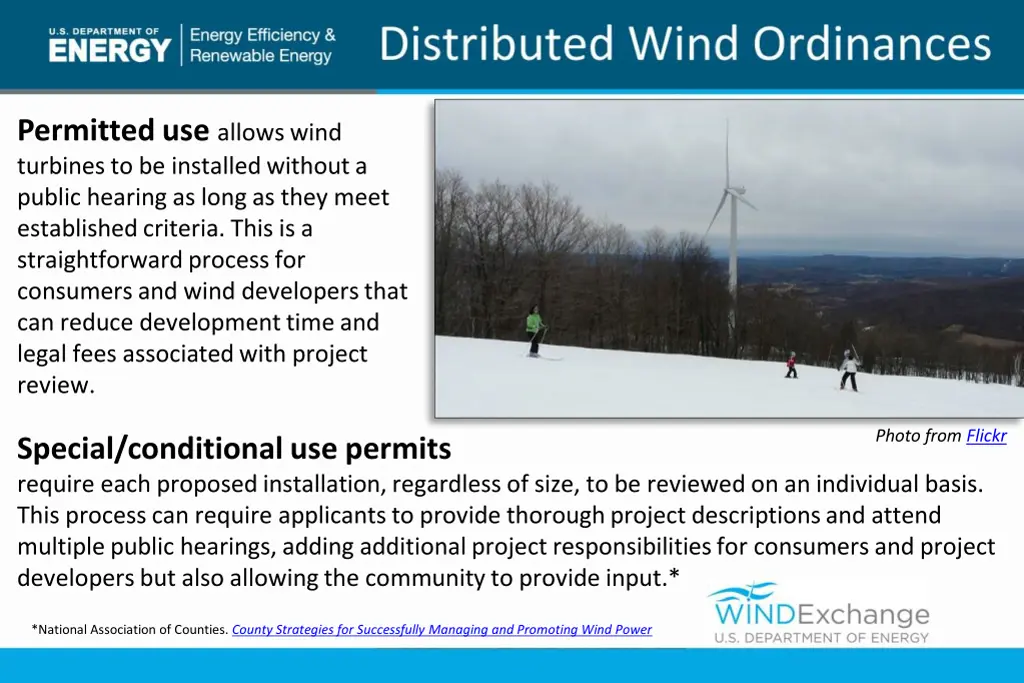
Permitted use allows wind turbines to be installed without a public hearing as long as they meet established criteria. This is a straightforward process for consumers and wind developers that can reduce development time and legal fees associated with project review. Photo from Flickr Special/conditional use permits require each proposed installation, regardless of size, to be reviewed on an individual basis. This process can require applicants to provide thorough project descriptions and attend multiple public hearings, adding additional project responsibilities for consumers and project developers but also allowing the community to provide input.* *National Association of Counties. County Strategies for Successfully Managing and Promoting Wind Power
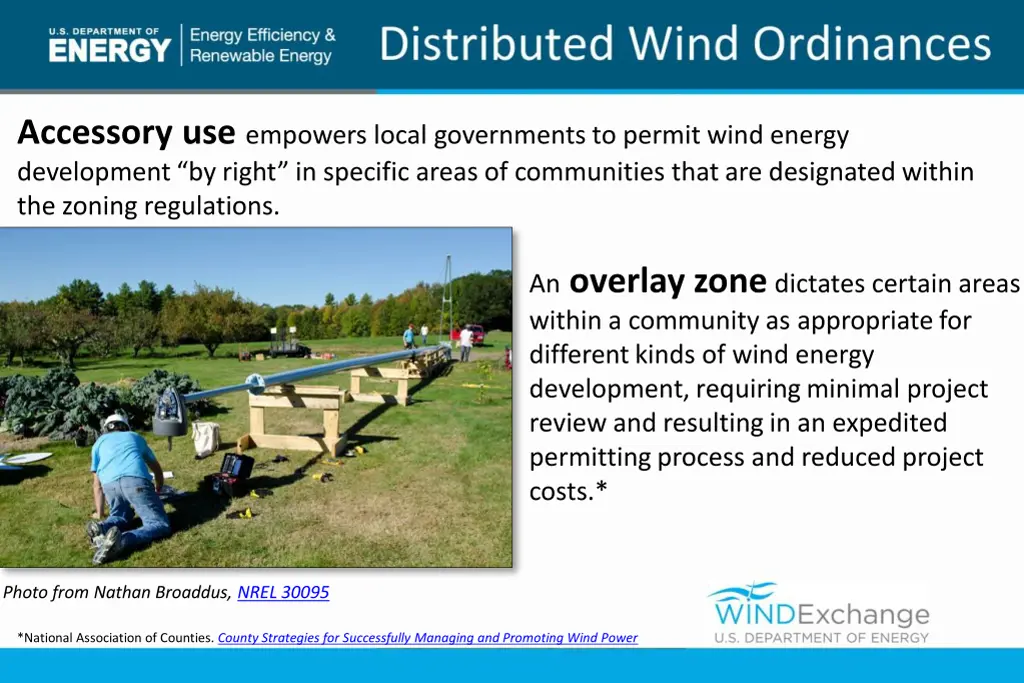
Accessory useempowers local governments to permit wind energy development by right in specific areas of communities that are designated within the zoning regulations. An overlay zone dictates certain areas within a community as appropriate for different kinds of wind energy development, requiring minimal project review and resulting in an expedited permitting process and reduced project costs.* Photo from Nathan Broaddus, NREL 30095 *National Association of Counties. County Strategies for Successfully Managing and Promoting Wind Power
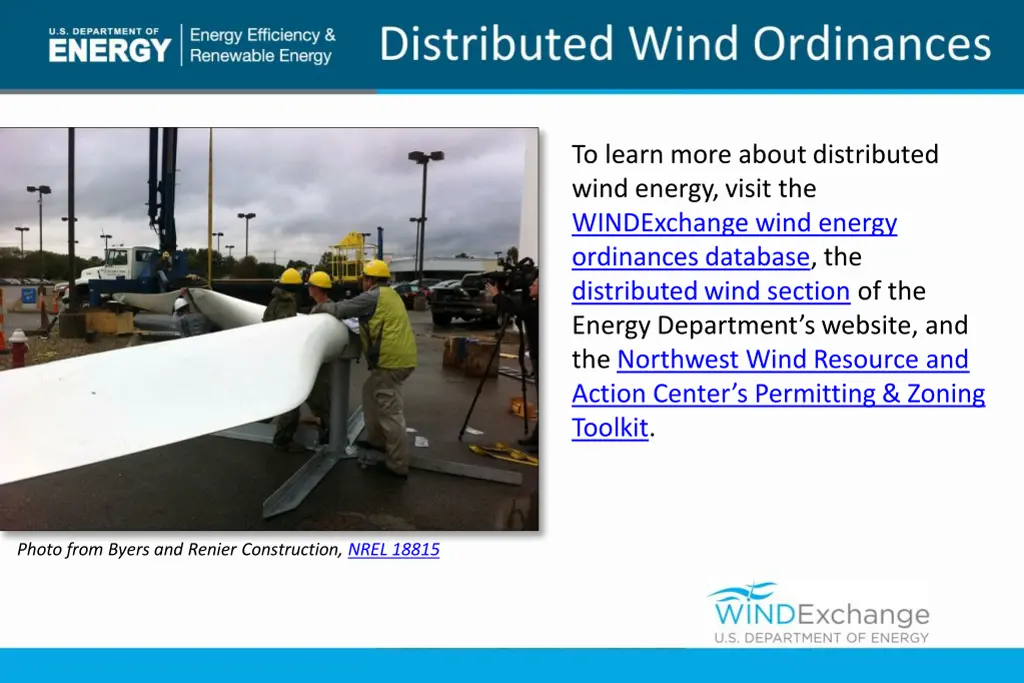
To learn more about distributed wind energy, visit the WINDExchange wind energy ordinances database, the distributed wind section of the Energy Department s website, and the Northwest Wind Resource and Action Center s Permitting & Zoning Toolkit. Photo from Byers and Renier Construction, NREL 18815