Introduction to Economics of Innovation: Theory to Creative Management
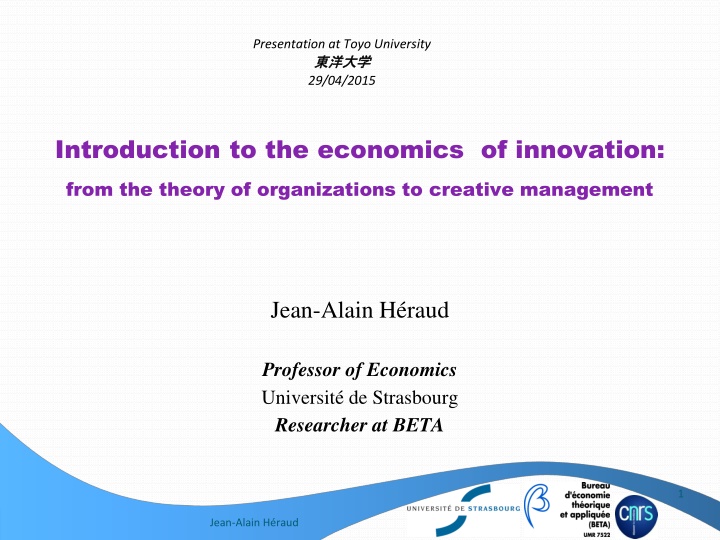
Examples of organizations, decision-making in organizations, functions of organizations, and the variety of modalities in private firms, public institutions, and markets are discussed by Jean-Alain Héraud in a presentation at Toyo University. The presentation covers topics such as coordination of individual actions, hierarchical power, collective decision-making efficiency, and more.

Download Presentation

Please find below an Image/Link to download the presentation.
The content on the website is provided AS IS for your information and personal use only. It may not be sold, licensed, or shared on other websites without obtaining consent from the author.If you encounter any issues during the download, it is possible that the publisher has removed the file from their server.
You are allowed to download the files provided on this website for personal or commercial use, subject to the condition that they are used lawfully. All files are the property of their respective owners.
The content on the website is provided AS IS for your information and personal use only. It may not be sold, licensed, or shared on other websites without obtaining consent from the author.
E N D
Presentation Transcript
Presentation at Toyo University 29/04/2015 Introduction to the economics of innovation: from the theory of organizations to creative management Jean-Alain H raud Professor of Economics Universit de Strasbourg Researcher at BETA 1 Jean-Alain H raud
1. Introduction Examples of organizations Private hierarchies like firms or NGOs Public institutions Sociological institutions, communities . Markets? 2 Jean-Alain H raud
Organizations are an important topic for management, economics, political sciences, etc. Structure of the firm hierachical power, information system, Organizations of organizations Branch organizations Partnerships (strategic alliances) Subcontractors Illegal agreements like cartels, price fixing Other sorts of economic organizations like trade unions 3 Jean-Alain H raud
What is their general functions? Coordination of individual actions Hypothesis: several coordinated actors are more efficient than one actor in isolation Why?: division of labor, economies of scale and scope, Modalities: hierarchical power? psycho-sociological control? Distribution of means of production and revenues Is it more efficient in organizations (hierachies) than in markets (invisible hand)? Learning effects Individual and collective training (formal and unformal) 4 Jean-Alain H raud
Variety of modalities Private firms, public institutions, associations (NGO) and even markets have about the same general functions But the ways of implementing the functions are very different. For example: - Firms and institutions:hierarchical power - NGOs: values, conviction... - Markets: prices Important differences in decision procedures as well 5
2. Decision in organizations How to decide collectively? Is it more efficient collectively than individually? If yes, decision making could be one explanation for the existence of organizations If not, is it more difficult? Is it just different? Is it impossible? (we need the boss for that) 6 Jean-Alain H raud
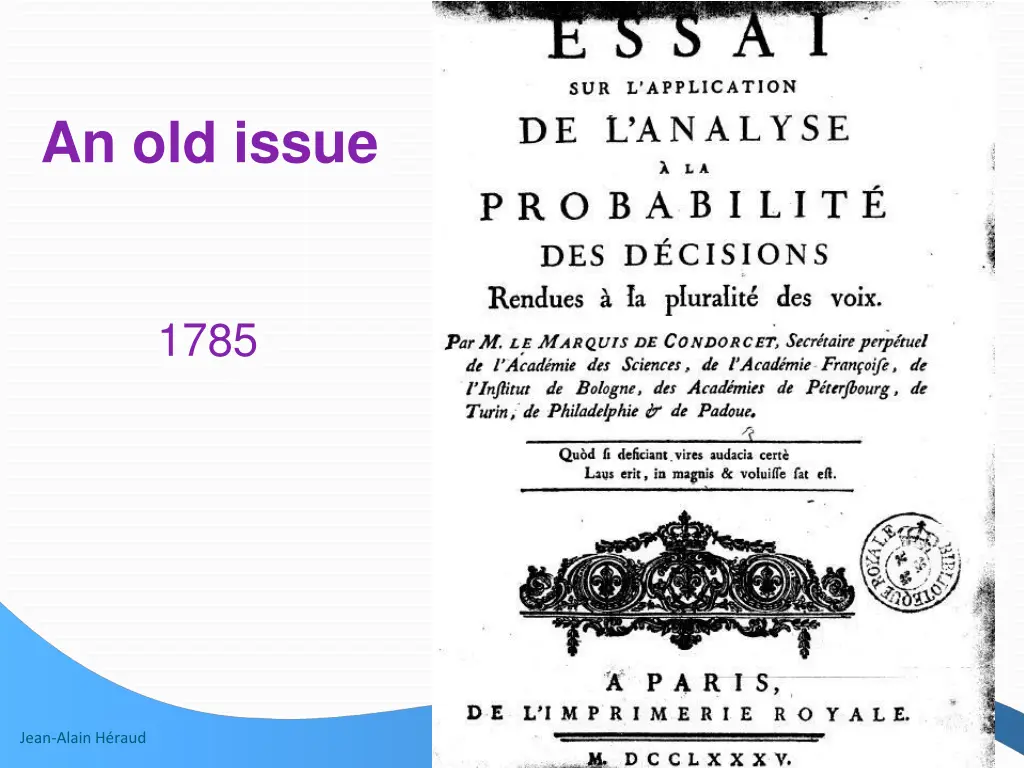
An old issue 1785 7 Jean-Alain H raud
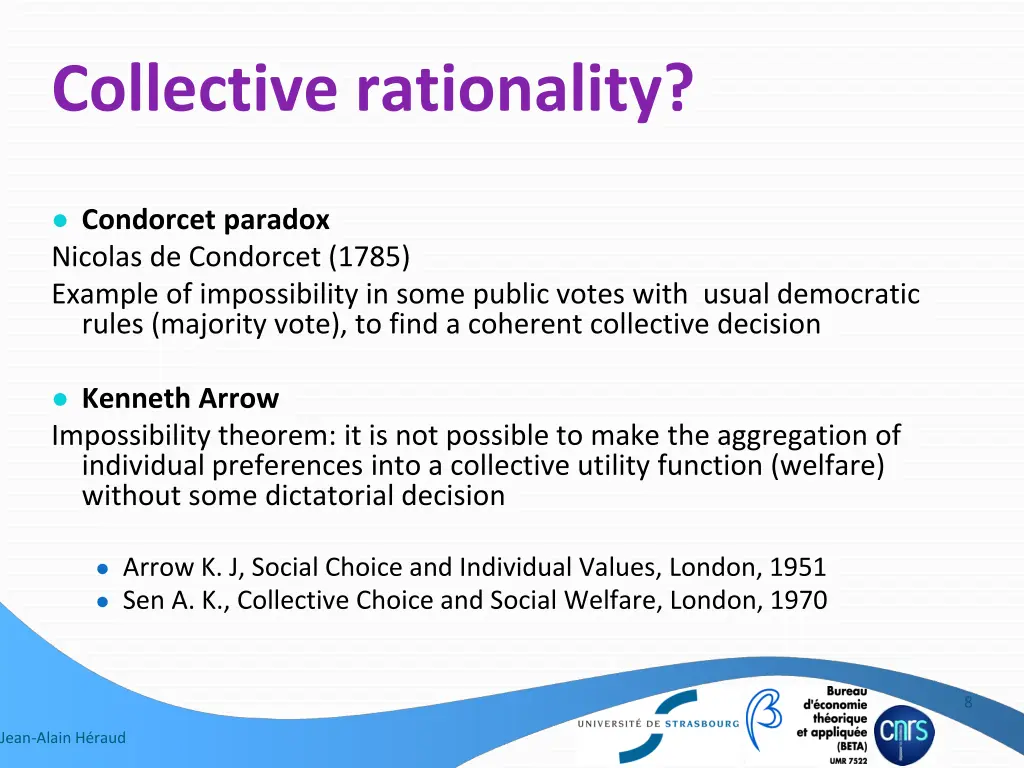
Collective rationality? Condorcet paradox Nicolas de Condorcet (1785) Example of impossibility in some public votes with usual democratic rules (majority vote), to find a coherent collective decision Kenneth Arrow Impossibility theorem: it is not possible to make the aggregation of individual preferences into a collective utility function (welfare) without some dictatorial decision Arrow K. J, Social Choice and Individual Values, London, 1951 Sen A. K., Collective Choice and Social Welfare, London, 1970 8 Jean-Alain H raud
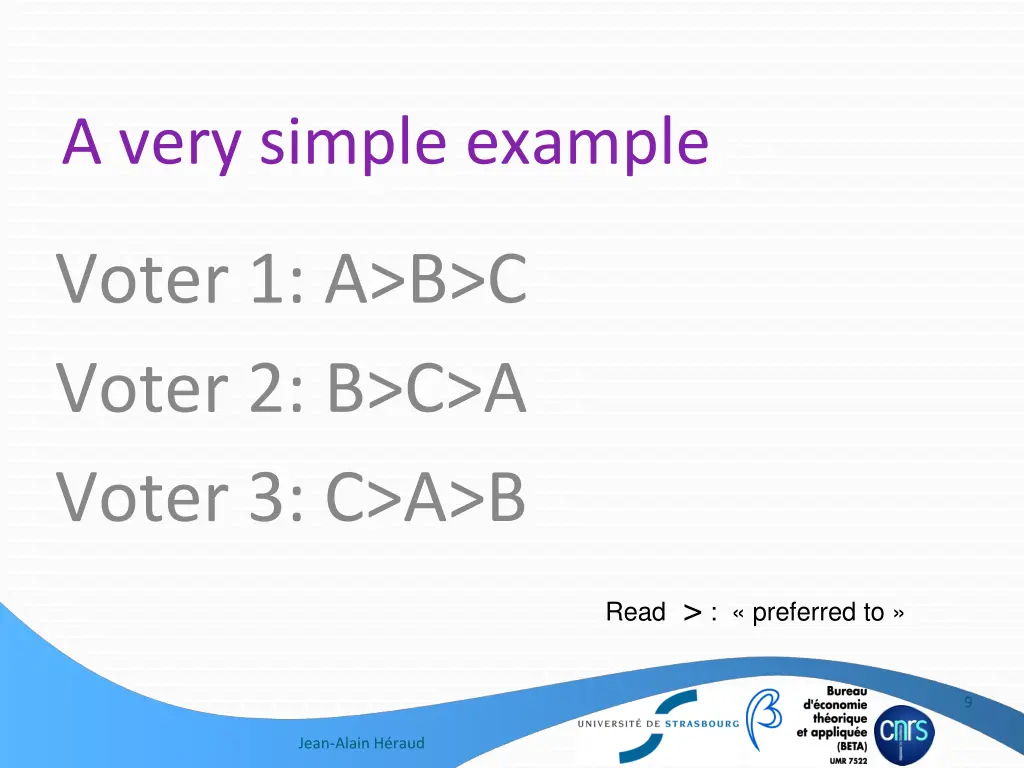
A very simple example Voter 1: A>B>C Voter 2: B>C>A Voter 3: C>A>B Read > : preferred to 9 Jean-Alain H raud
Political implication for modern democracies and management structures A democracy based on systematic referendum processes is either not possible, or would lead to incoherent policy Representative democracy is a possible solution (better than dictatorial) Theoretical conclusion: collective rationality cannot be absolute (in the sense of classical economic rationality which is individual): it is procedural(procedure s bias) Herbert Simon, James March. 10 Jean-Alain H raud
The organization as a set of routines By definition, an organization implements procedures and many sorts of routines Through procedures, the coordination of activities is possible without controlling individually all members Through behavioral standardization, horizontal coordination is possible: people are previsible, communication is easy through codified language, there is a limited set of possible actions and thoughts (concept of code book). 11
The paradox of organizational change Evolution is necessary for most of the organizations. It is sometimes even a condition for survival How is it possible to evolve within a system defined as a set of routines? Is organizational change decided and implemented by the hierarchy or is it a mechanism of self-organization? Incremental changes or radical changes? 12
3. Economics of innovation Models of evolution in other sciences: Darwin vs Lamarck in biology. The founder of evolutionary economics and innovation theory: Josef A Schumpeter 13
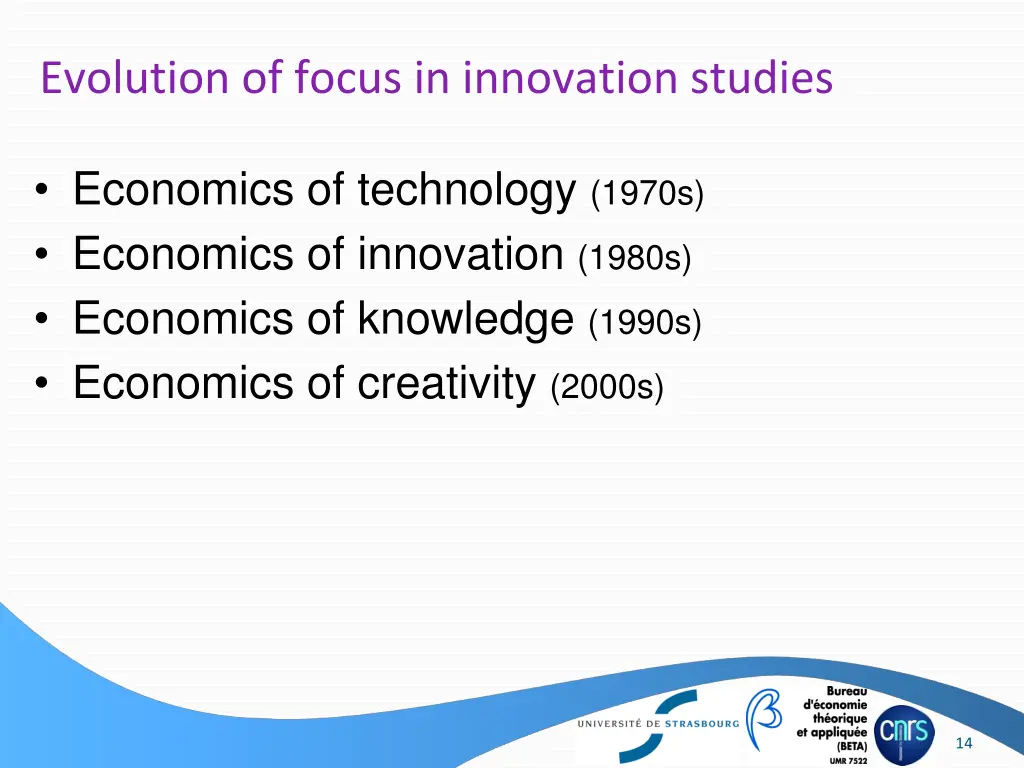
Evolution of focus in innovation studies Economics of technology (1970s) Economics of innovation (1980s) Economics of knowledge (1990s) Economics of creativity (2000s) 14
Innovation as a central strategy for firms and nations Creating and developing new products, processes and/or markets is at least an opportunity for the development of micro and macro entities It is even sometimes a necessity for survival in a globalized, ever- changing world Nevertheless only a minority of entrepreneurs consider creative/innovative activities as day-to-day business: it is a secondary concern because operational business issues claim the entrepreneur s full attention Therefore many ideas stay on the shelf due to lack of time, money, partners or knowledge 15
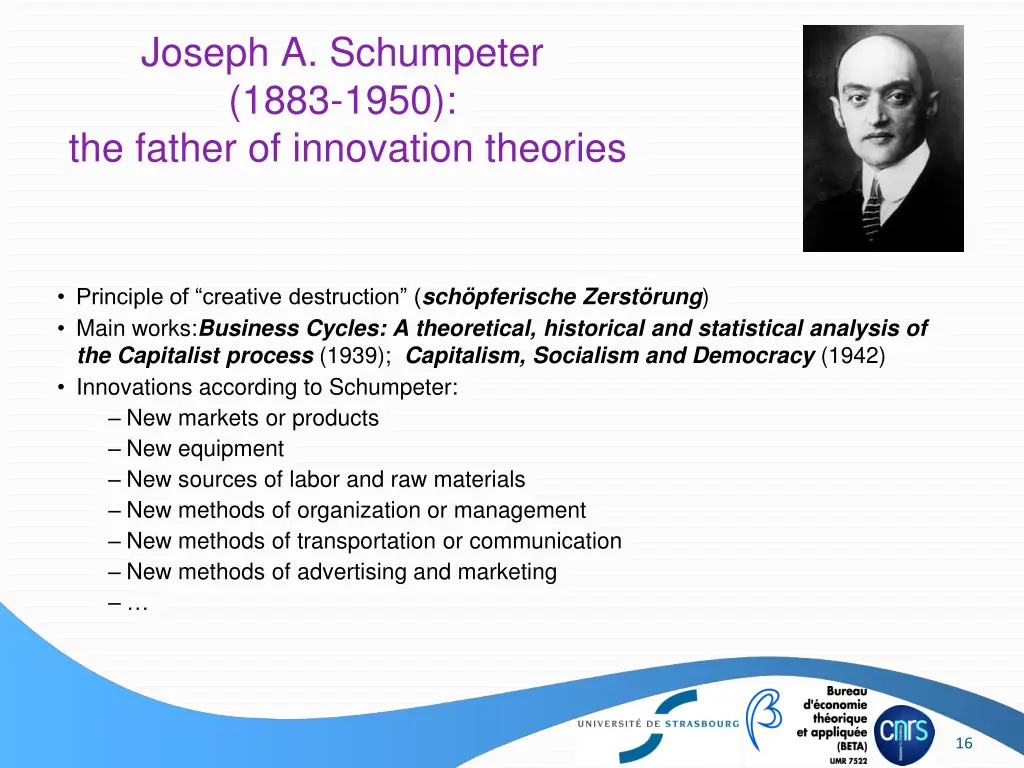
Joseph A. Schumpeter (1883-1950): the father of innovation theories Principle of creative destruction (sch pferische Zerst rung) Main works:Business Cycles: A theoretical, historical and statistical analysis of the Capitalist process (1939); Capitalism, Socialism and Democracy (1942) Innovations according to Schumpeter: New markets or products New equipment New sources of labor and raw materials New methods of organization or management New methods of transportation or communication New methods of advertising and marketing 16
Innovation and networks Nobody innovates alone: Partners Strategic alliances Clients Suppliers Research centers etc. Externalities, material or immaterial infrastructures, . Knowledge communities 17
4. Economics and management of creativity Innovation requires more than knowledge and money Entrepreneurs (in the sense of Schumpeter) are people who have visions A form ofcreativity lays at the bottom of any innovation 18
New idea + entrepreneurship Innovation means : New idea + entrepreneurship The new knowledge (idea) is not necessarily in science and/or technology: can be in the fields of organisation, culture, arts, lifestyle, etc It is not necessarily formal knowledge (in that case, IP does not apply and/or is not necessary) Innovation can be the result of creativity in regular economic sectors, in regular commercial organisations. Another interesting field is the developement of creative industries . 19
Defining creativity Creativity is at the core of every progress in society, in particular at the origin of economic innovation. Creativity corresponds to a positive mental attitude towards anything that is new. "Creativity is the ability to produce work that is both novel (i.e., original, unexpected) and appropriate (i.e., useful, adaptive concerning task constraints)." Sternberg/Labort (2008) 20
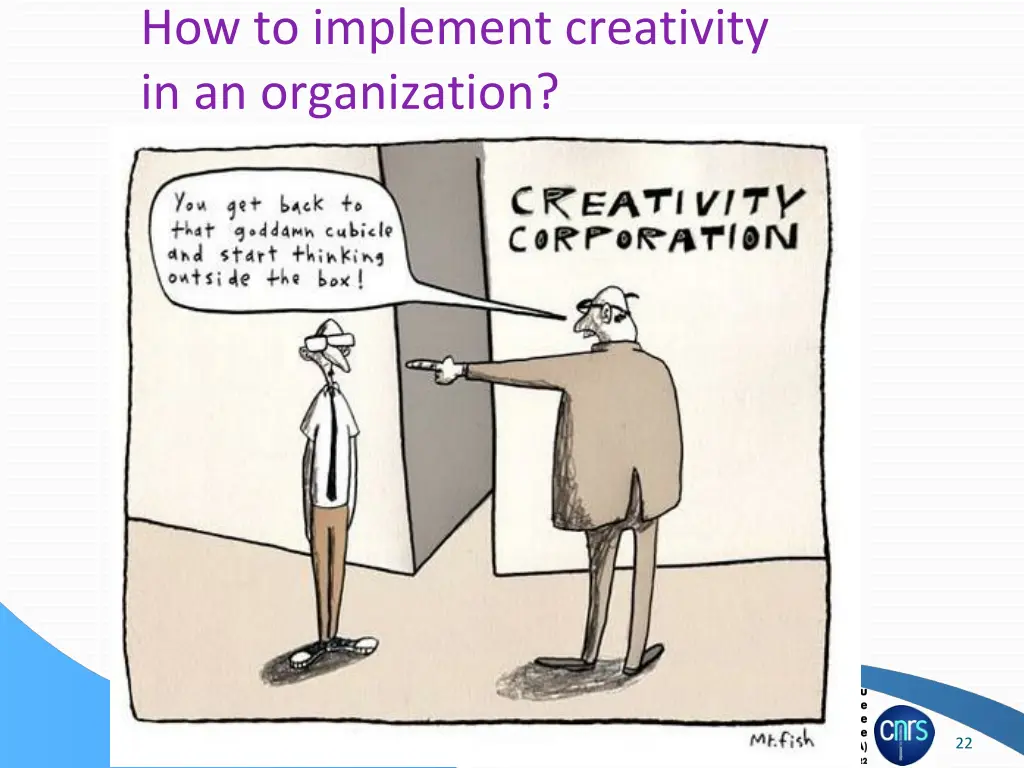
Various types of creativity cr ativit Creativity in art or design (new style) Creativity in science (discovery) Creativity in technology (invention) Creativity in economy / society (innovation) In any case creative people are able to "think out of the box": escape usual way of thinking 21
How to implement creativity in an organization? 22
Thank you for your attention heraud@unistra.fr jaheraud.eu 23 Jean-Alain H raud