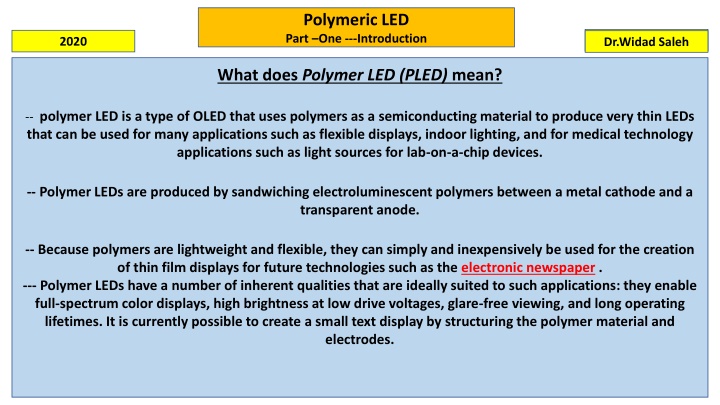
Polymer LEDs (PLED) are a type of OLED utilizing polymers as semiconductors to create ultra-thin, flexible LEDs for diverse applications including flexible displays and medical devices. They are formed by sandwiching electroluminescent polymers between metallic cathodes and transparent anodes. Noteworthy advantages include full-spectrum color displays, high brightness at low voltages, and long lifetimes, making them suitable for innovative technologies like electronic newspapers.
Please find below an Image/Link to download the presentation.
The content on the website is provided AS IS for your information and personal use only. It may not be sold, licensed, or shared on other websites without obtaining consent from the author. If you encounter any issues during the download, it is possible that the publisher has removed the file from their server.
You are allowed to download the files provided on this website for personal or commercial use, subject to the condition that they are used lawfully. All files are the property of their respective owners.
The content on the website is provided AS IS for your information and personal use only. It may not be sold, licensed, or shared on other websites without obtaining consent from the author.
E N D
Presentation Transcript
Polymeric LED Part One ---Introduction Dr.Widad Saleh Dr.Widad Saleh 2020 What does Polymer LED (PLED) mean? -- polymer LED is a type of OLED that uses polymers as a semiconducting material to produce very thin LEDs that can be used for many applications such as flexible displays, indoor lighting, and for medical technology applications such as light sources for lab-on-a-chip devices. -- Polymer LEDs are produced by sandwiching electroluminescent polymers between a metal cathode and a transparent anode. -- Because polymers are lightweight and flexible, they can simply and inexpensively be used for the creation of thin film displays for future technologies such as the electronic newspaper . --- Polymer LEDs have a number of inherent qualities that are ideally suited to such applications: they enable full-spectrum color displays, high brightness at low drive voltages, glare-free viewing, and long operating lifetimes. It is currently possible to create a small text display by structuring the polymer material and electrodes.
Cont. History of PLED In 1953 electroluminescence in organic materials was observed. In 1987---First OLED with driving voltage of 10 V. In 1989--- Discovery of bi- conjugated polymers. --- In 1989 The making first Pled is credited to the cavendish lab.of Cambridge University --- Polyphenylene vinylene (PPV ) is the first LEP discovered. LED Inorganic LED Organic LED Small Molecular LED (oled ) Polymeric LED (PLED )
Inorganic semiconductor light-emitting diodes (LEDs) are environmentally benign and have found widespread use as indicator lights, mobile displays, large-area displays, signage applications, and lighting applications. The entire visible spectrum can be covered by light-emitting semiconductors: AlGaInP and AlGaInN compound semiconductors are capable of emission in the red-to-yellow wavelength range and violet-to-green wavelength range, respectively. Inorganic semiconductors are fascinating candidates for the emitting materials in LEDs. By changing the band gap energy which is energy gap between the valence band and conduction band of a semiconductor, via changing its molecular architecture, a variety of emitting colors can be obtained. However, inorganic LEDs suffer from a range of problems, such as, efficiency, heat management, color rendering, lifetime, and probably the most important one, high cost. They are mainly suitable for point-source illumination rather than surface source illumination. On the other hand, organic LEDs also known as OLEDs were first demonstrated by Pope, Kallmann, and Magnante in 1963. However, this particular field received intense academic and industrial interest after the discovery of the first low-voltage OLED by Tang and VanSlyke at Eastman Kodak in 1987. After that, numbers of novel systems were designed, fabricated, and tested as functional materials for OLED applications and a range of colored OLEDs based on polymeric or molecular thin films were developed. E. Fred Schubert, ... Jong Kyu Kim, in Reference Module in Materials Science and Materials Engineering, 2016
Deference between Inorganic and Organic LED Features Organic LED Inorganic LED Operating voltage 2 to 20 V < 10 V Efficiency ~ 0.5 ~ 0.1 S. Haque, ... M. Mohiuddin, in Biopolymer Composites in Electronics, 2017 Response time ~ 1 s ~ 1 s Display screen size 2 to 20 inch flexible size color contrast Moderate Good View Angle Excellent Good Biopolymer Composite in Electronics, 2017, S.Haque.
Organic light-emitting diodes (OLEDs) and polymer light-emitting diodes (PLEDs) are the cutting edge of lighting and display technology. Today, most commercially available small- screen OLED displays are fabricated by vacuum sublimation. However, this method of fabrication is expensive and time consuming, and controlling uniformity and doping concentration over large areas is very difficult with this technique. Furthermore, due to evaporation, evaporant condensed on cold walls can flake off, contaminating the system and substrate. Thus solution techniques such as spin-coating, ink-jet printing, and screenprinting have gained momentum as they do not require vacuum, consume less time, and allow deposit of thin layer over a large area at low cost. As organic materials are soluble in different solvents, the desired thickness can be deposited on the substrate by spraying these solvated organic complexes using solution techniques. Whatever the technique, during deposition, uniform thickness of each layer is necessary for device fabrication in order to ensure adequate lifetime of the device. The complexity in arraying organic molecules and fabricating OLED and PLED devices is still challenging.
Why Polymeric LED Polymer Light Emitting Diodes (PLED) are best suited for large array of displays due to easy processing and mechanical flexibility. ---Lightweight ,so they can be simply used to make thin film. ----Extraordinary resolution ,which provide high quality imaging. ---Can be seen from any angle without the loss of information. Enable more energy efficiency . ---Consume less power. ---They can be used to make flexible display. ----They offer high brightness at low drive voltage . ---They ensure glare free viewing. Q: What is the disadvantage of polymeric LED?
Advantage of PLED over Incandescent and Compact Fluresence Lamp ( CFL) Light Sources Light Emitting Diodes are almost everywhere. You can find LEDs in Cars, Bikes, Street Lights, Home Lighting, Office Lighting, Mobile Phones, Televisions and many more. The reason for such wide range of implementation of LEDs is its advantages over traditional incandescent bulbs and the recent compact fluorescent lamps (CFL). 1- Low power consumption. 2- Small size. 3- Fast swetching. 4-Physically robust . 5- long lasting. Because of these advantages,P LEDs have become quite popular among a large set of people. Electronics Engineers, Electronic Hobbyists and Electronics Enthusiasts often work with LEDs for various projects.
PLED Device Indium tin oxide Presentation from the lecture by Holger .D and Marco .S , 2010
Fabrication Process 1- Transparent Electrode ( ITO ) 2- Polymer Solution . 3- Spin Coating . 4- Afew Nano meter thin layer. 5- Further layer are coated ( CVD ).
Applications 1- Multi or full color cell phone display, Television and laptop. 2- Lighweight wrist watches . 3- Automobile Light system without bulbs. 4- Roll-up refreshable e-newspapers.
Performance Comparison Wide Viewing Angle Fast Response Time Beter Contrast Ratio PLED LCD LCD PLED PLED LCD