Introduction to Report Writing: Understanding Differences and Presentation
In academia, understanding the nuances between reports and essays is crucial. Reports focus on past events, analysis, and recommendations, while essays allow for more exploration of ideas and concepts. Reports are structured with sub-headings, bullet points, and visuals, while essays may follow a traditional or non-traditional format. Knowing how to differentiate and present each type effectively is key for academic success.

Download Presentation

Please find below an Image/Link to download the presentation.
The content on the website is provided AS IS for your information and personal use only. It may not be sold, licensed, or shared on other websites without obtaining consent from the author.If you encounter any issues during the download, it is possible that the publisher has removed the file from their server.
You are allowed to download the files provided on this website for personal or commercial use, subject to the condition that they are used lawfully. All files are the property of their respective owners.
The content on the website is provided AS IS for your information and personal use only. It may not be sold, licensed, or shared on other websites without obtaining consent from the author.
E N D
Presentation Transcript
Academic Skills Lecturer: Hastyar Asaad hastyar.baper@su.edu.krd 2020-2021 Week2 Introduction to Report Writing
Report: -A report is a form of communication in one or more of the following ways: 1- Written form 2- Verbal form 3- Audio-visual form
A report is a form of communication that will do one or more of the following: describes analyses summarises criticises or praises makes predictions about a subject and is based on an analysis of current or past events or identifiable phenomena.
Whats the difference between a report and an essay? There are two main differences: aim and presentation. Aim - Essays give you more opportunity to expand on possibilities, ideas or concepts. - Reports deal with describing and/or analyzing actual past events. Reports can be written that make predictions or recommendations for the future, but these are usually the result of an analysis of past events or of current or past social, cultural or economic phenomena. An example: The English statesman, Sir Thomas More, wrote an essay titled Utopia, which visualized an ideal state or perfect world . He couldn t have written a report on the same topic!
Presentation - Reports are usually broken up into sections, each section with a relevant sub-heading. Bullet points, illustrations, diagrams, charts, tables can also be used in reports. - Essays at the School of Management can be presented in a traditional form (no sub-headings; very limited use of tables, charts etc ) or non-traditional form (with sub-headings grouping a cluster of related paragraphs and discrete use of bullet points, graphs, tables etc.
Reports can be presented orally, but essays are usually submitted in written form only for marking purposes (although an essay may be read aloud occasionally, e.g. at an academic conference, to share ideas with peers). Essays can explore hypothetical situations but reports are almost always concerned with actual past events (although they may offer recommendations for future action, based on an analysis of past events). Essays are usually written in the third person , i.e. as if detached from the subject. Reports can adopt either the first person or third person (detached) style), depending on the context Reports can selectively include illustrations, charts, diagrams in the main text, but in traditional essays these would be usually be included as appendices (extracts from charts etc can be included, very selectively, in the main e text of traditional essays although you should seek advice from your tutor on this point). Bullet points can be used in reports, but these are not common in traditional essays (unless a tutor gives his or her permission for you to do this). Reports can include a Recommendations for Action section, but this would be very unusual in an essay.
Why reports fail to connect with their intended readership ? Blocks to message: - The overall point or message of the report is unclear. - The report is badly structured: there is no logical and sequential progression of ideas - The report is too long: doesn t get to the main points quickly enough - The words used are inappropriate for the intended readership or audience - The report is boring and does not engage the reader - The report is full of spelling mistakes and grammatical errors
Writing style - When writing: be simple and concise make sure of the meaning of every word don t fill your report with unnecessary detail:
An effective report: - The key to writing an effective report is in designing the skeletal framework or structure for it. - Sub-headings will provide you with signposts for the preparation of the report and help your reader to understand easily and quickly its contents. - The information presented in the report should gradually develop and cascade from one section to the next, so that the report grows in power and force of argument to its conclusion.
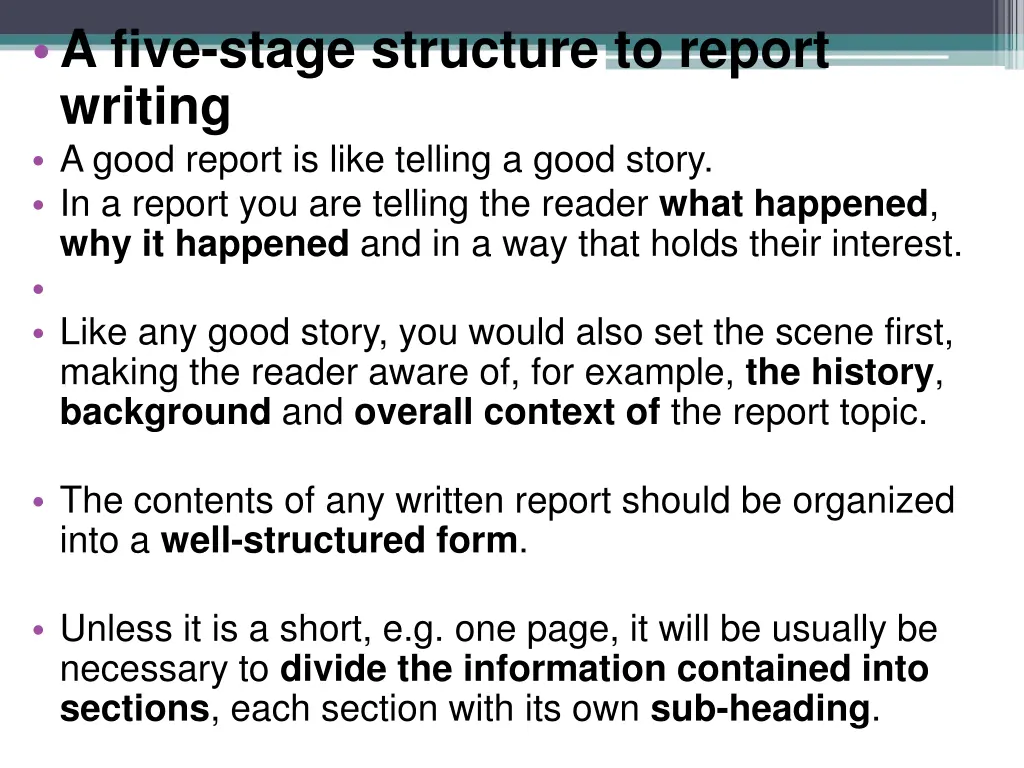
A five-stage structure to report writing A good report is like telling a good story. In a report you are telling the reader what happened, why it happened and in a way that holds their interest. Like any good story, you would also set the scene first, making the reader aware of, for example, the history, background and overall context of the report topic. The contents of any written report should be organized into a well-structured form. Unless it is a short, e.g. one page, it will be usually be necessary to divide the information contained into sections, each section with its own sub-heading.