Introduction to State-Space Modeling
State-space modeling involves representing a system through differential state equations and algebraic output equations. It provides a framework for efficient and geometric understanding of dynamic systems, forming the basis for modern control theory. This modeling approach allows for numerical solutions and handling of complex systems, enabling transformations between different model types. Examples illustrate the process of generating state-space models by mathematical manipulation and matrix representation for linear systems.

Download Presentation

Please find below an Image/Link to download the presentation.
The content on the website is provided AS IS for your information and personal use only. It may not be sold, licensed, or shared on other websites without obtaining consent from the author.If you encounter any issues during the download, it is possible that the publisher has removed the file from their server.
You are allowed to download the files provided on this website for personal or commercial use, subject to the condition that they are used lawfully. All files are the property of their respective owners.
The content on the website is provided AS IS for your information and personal use only. It may not be sold, licensed, or shared on other websites without obtaining consent from the author.
E N D
Presentation Transcript
Lecture 7: State-Space Modeling 1. Introduction to state-space modeling Definitions How it relates to other modeling formalisms ME 431, Lecture 7 2. State-space examples 3. Transforming between model types 1
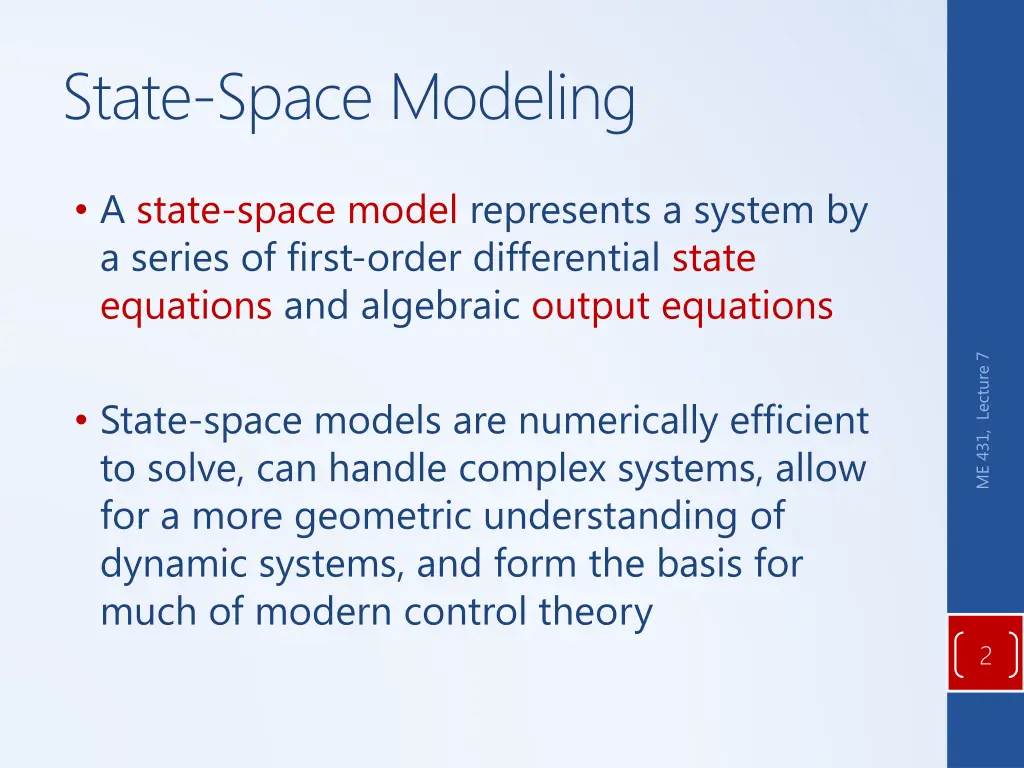
State-Space Modeling A state-space model represents a system by a series of first-order differential state equations and algebraic output equations ME 431, Lecture 7 State-space models are numerically efficient to solve, can handle complex systems, allow for a more geometric understanding of dynamic systems, and form the basis for much of modern control theory 2
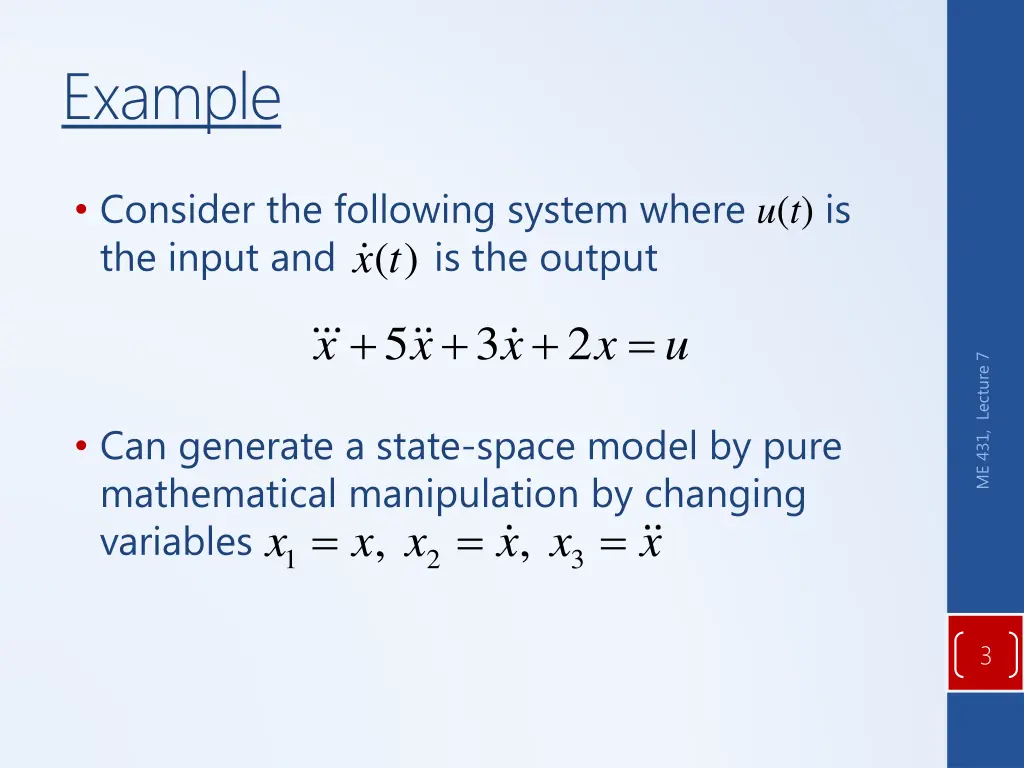
Example Consider the following system where u(t) is the input and is the output ( ) x t + + + = 5 3 2 x x x x u ME 431, Lecture 7 Can generate a state-space model by pure mathematical manipulation by changing variables 1 2 , x x x = = = , x x x 3 3
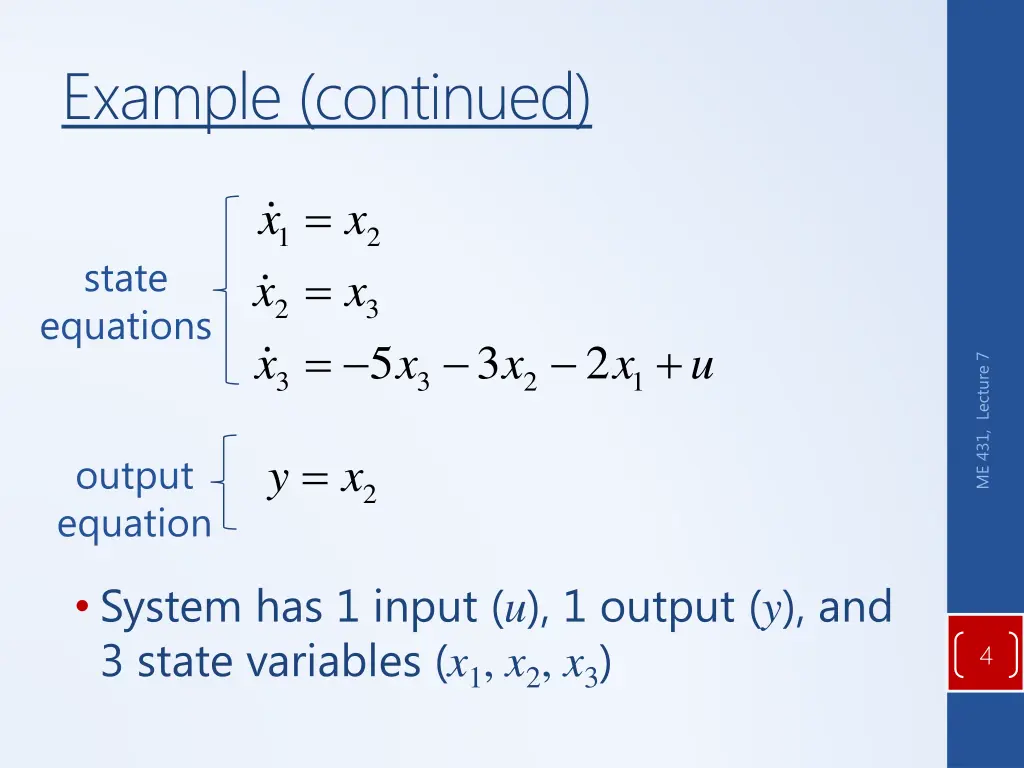
Example (continued) = = = x x x x x 1 2 state 2 3 5 equations + 3 2 x x x u ME 431, Lecture 7 3 3 2 1 = output equation y x 2 System has 1 input (u), 1 output (y), and 3 state variables (x1, x2, x3) 4
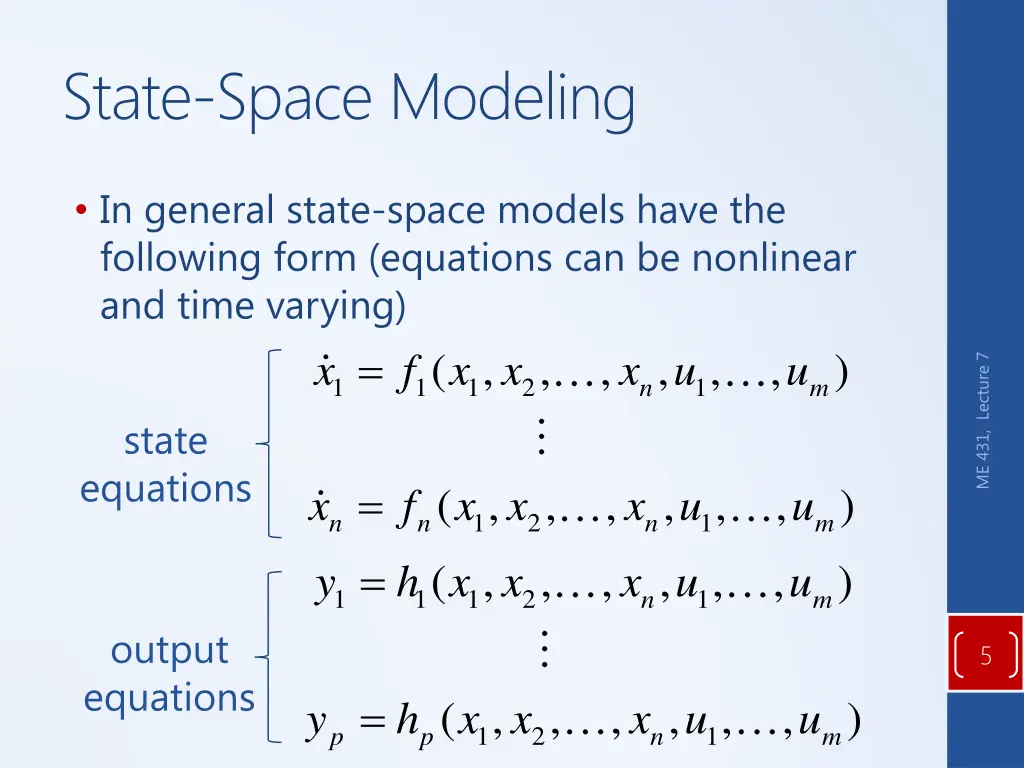
State-Space Modeling In general state-space models have the following form (equations can be nonlinear and time varying) ( , ( , n n x f x x = ( , ( , p p y h x x = = , , , , , ) x f x x x u u ME 431, Lecture 7 1 1 1 2 1 n m state equations , , , , , ) x u u 1 2 1 n m = , , , , , ) y h x x x u u 1 1 1 2 1 n m output equations 5 , , , , , ) x u u 1 2 1 n m
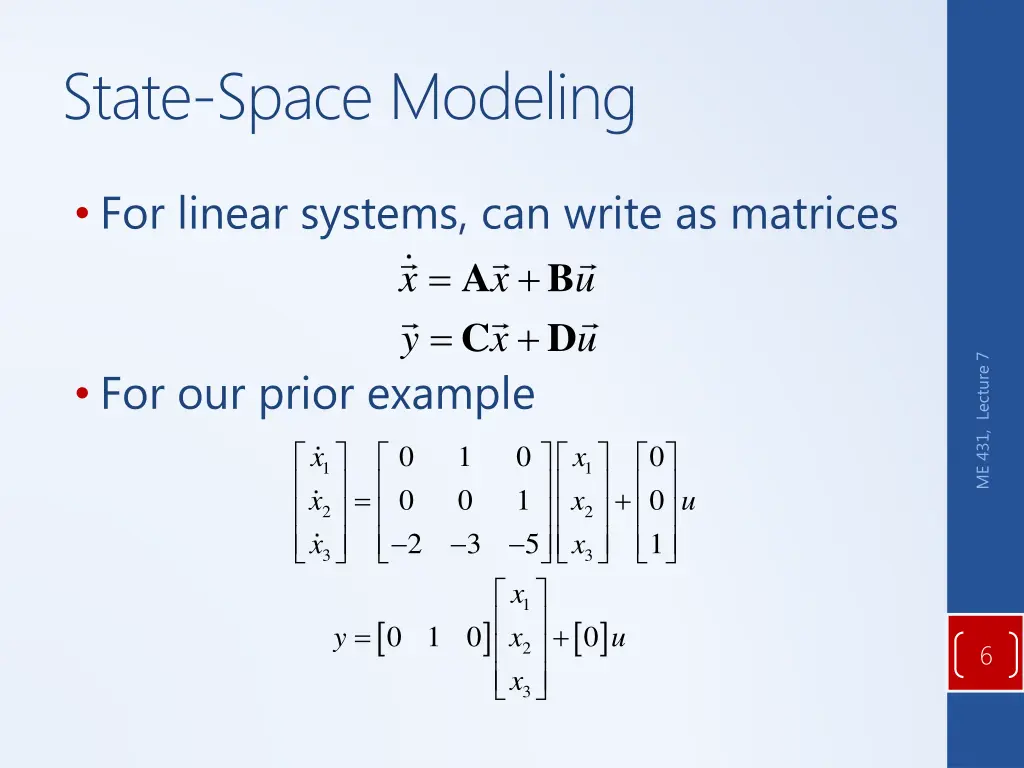
State-Space Modeling For linear systems, can write as matrices x y = C = + + A B D x x u u ME 431, Lecture 7 For our prior example 0 0 1 0 0 1 0 0 1 x x x x x x 1 1 = + u 2 2 2 3 5 3 3 x x x 1 0 = + 0 1 0 y u 6 2 3
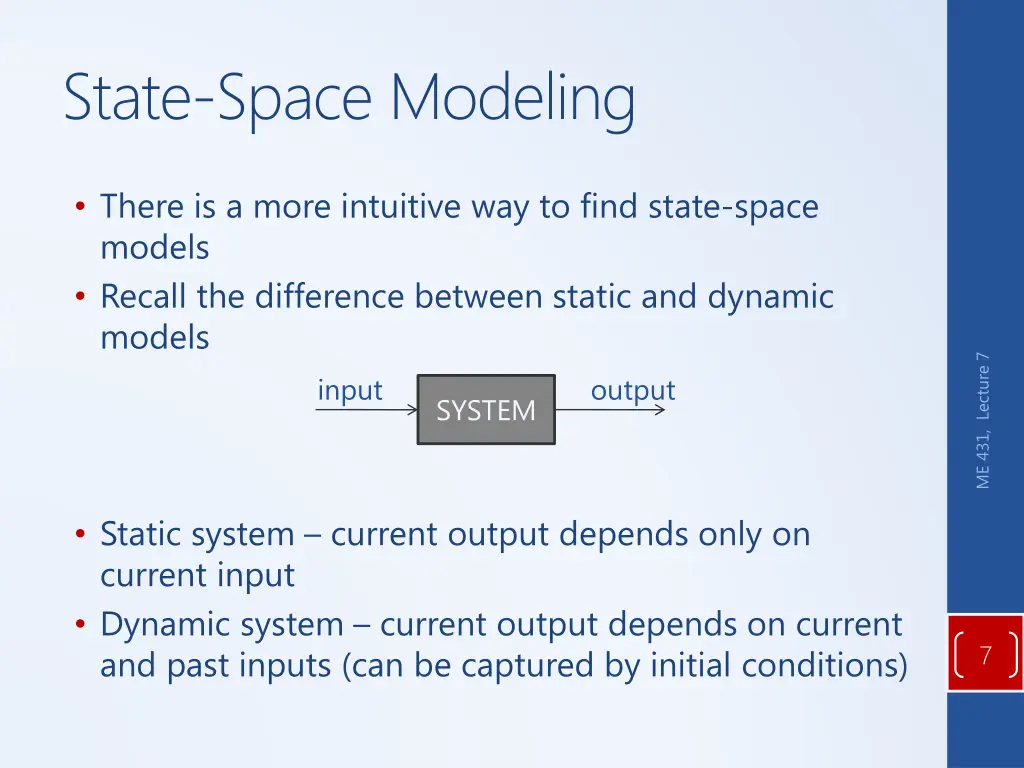
State-Space Modeling There is a more intuitive way to find state-space models Recall the difference between static and dynamic models input ME 431, Lecture 7 output SYSTEM Static system current output depends only on current input Dynamic system current output depends on current and past inputs (can be captured by initial conditions) 7
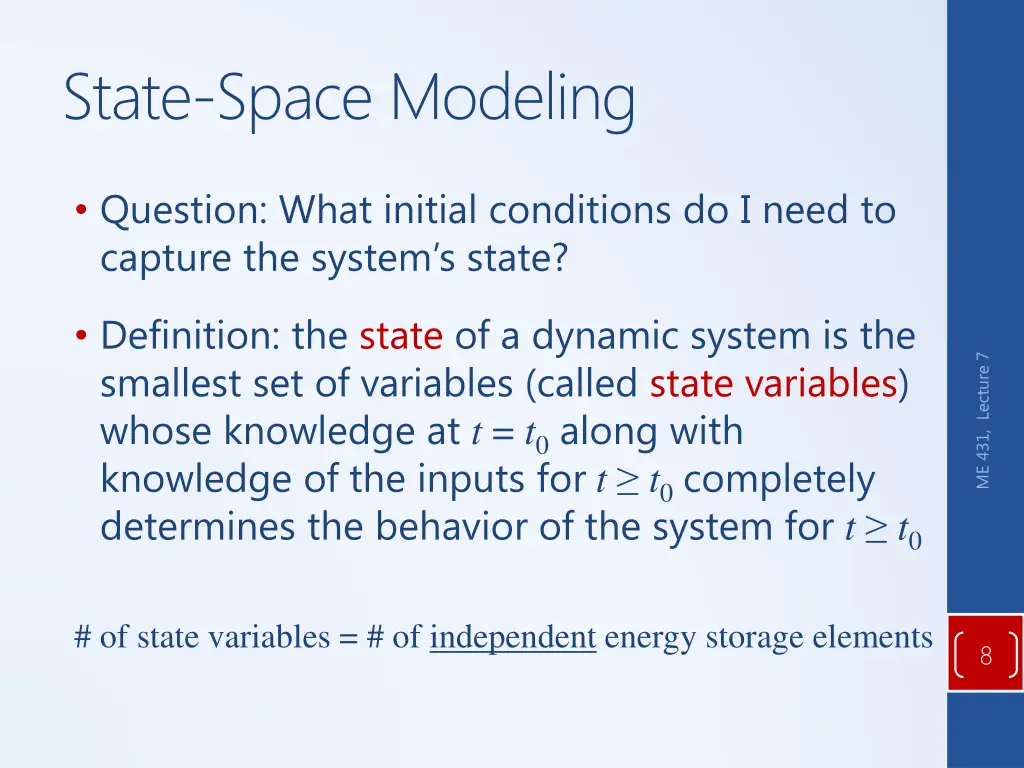
State-Space Modeling Question: What initial conditions do I need to capture the system s state? Definition: the state of a dynamic system is the smallest set of variables (called state variables) whose knowledge at t = t0 along with knowledge of the inputs for t t0completely determines the behavior of the system for t t0 ME 431, Lecture 7 # of state variables = # of independent energy storage elements 8
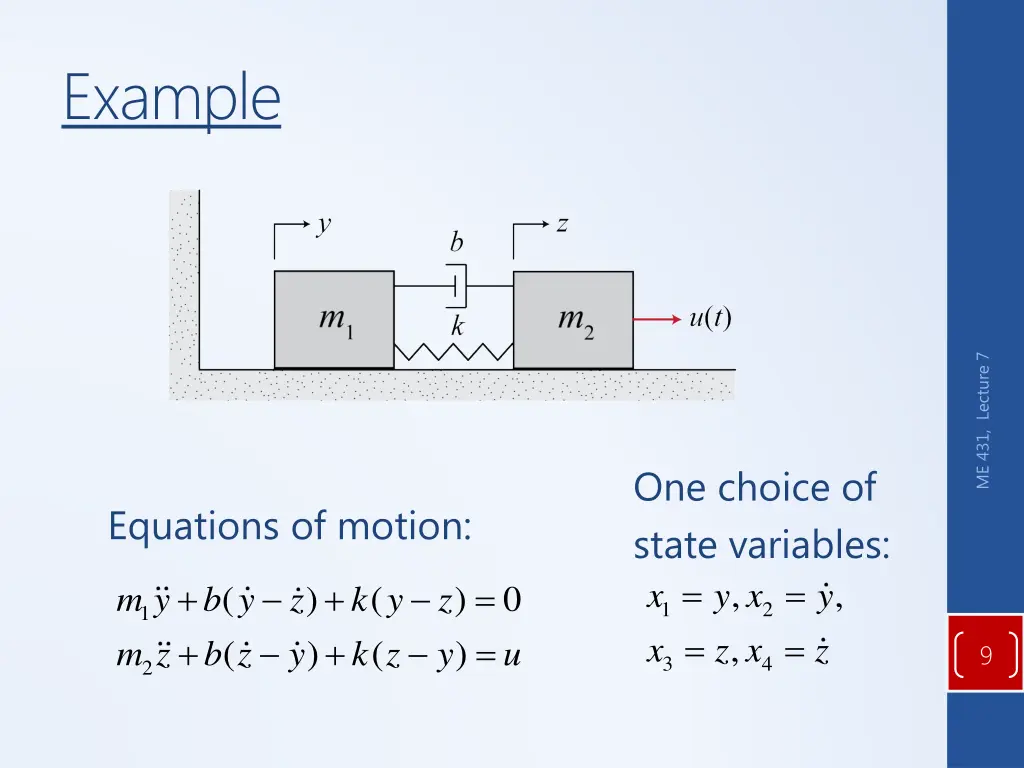
Example ME 431, Lecture 7 One choice of state variables: 1 2 , , x z x = Equations of motion: 1 ( ( m z b z y + = = = , x y x y z + + + = = ) ) ( ( ) ) 0 u m y b y z k y k z z y 9 3 4 2
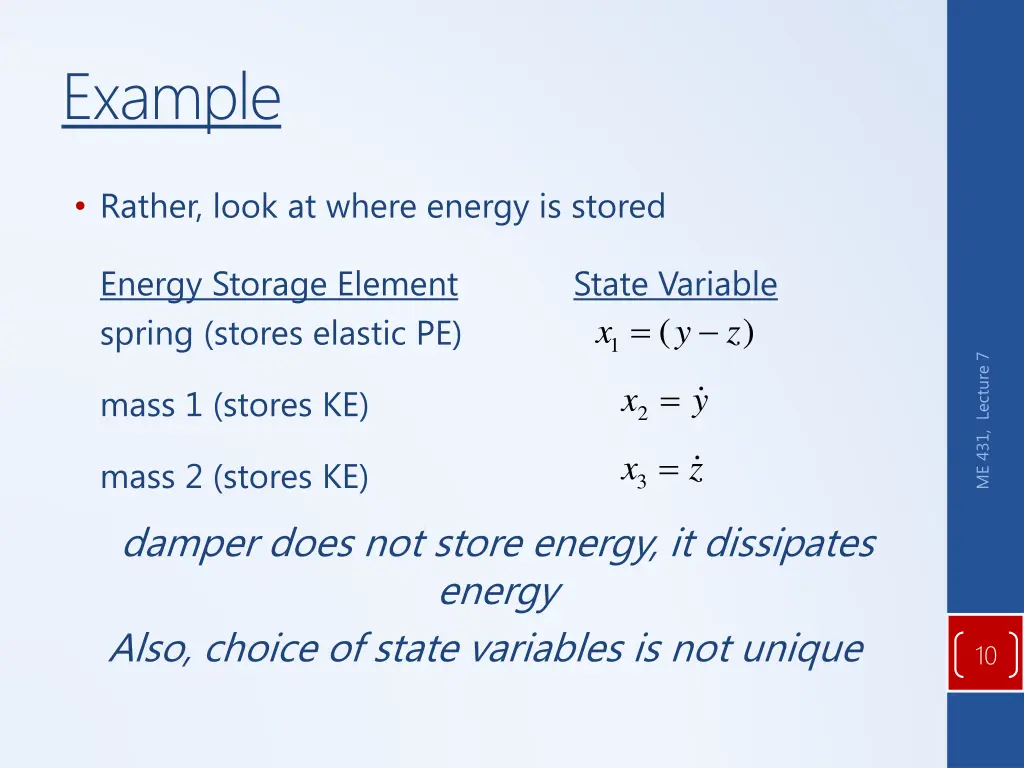
Example Rather, look at where energy is stored Energy Storage Element spring (stores elastic PE) State Variable ( x y = ) z 1 ME 431, Lecture 7 = 2x y mass 1 (stores KE) = 3x z mass 2 (stores KE) damper does not store energy, it dissipates energy Also, choice of state variables is not unique 10
Example ME 431, Lecture 7 11
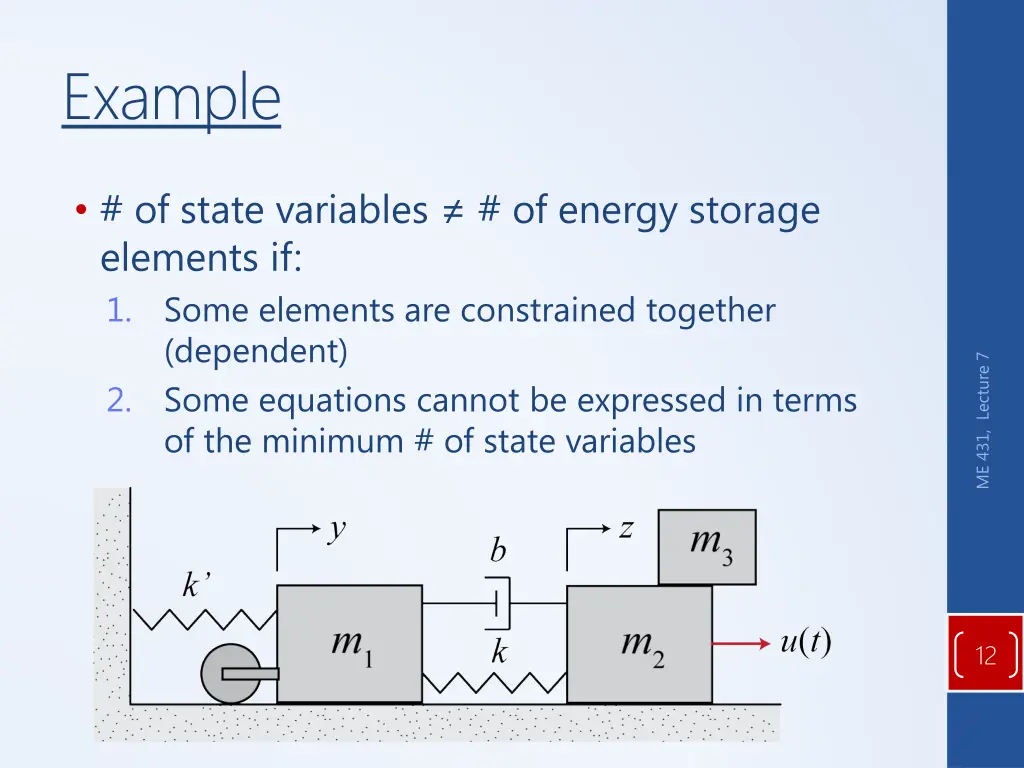
Example # of state variables # of energy storage elements if: 1. Some elements are constrained together (dependent) 2. Some equations cannot be expressed in terms of the minimum # of state variables ME 431, Lecture 7 12
Transforming Between Model Types State space to transfer function ME 431, Lecture 7 13
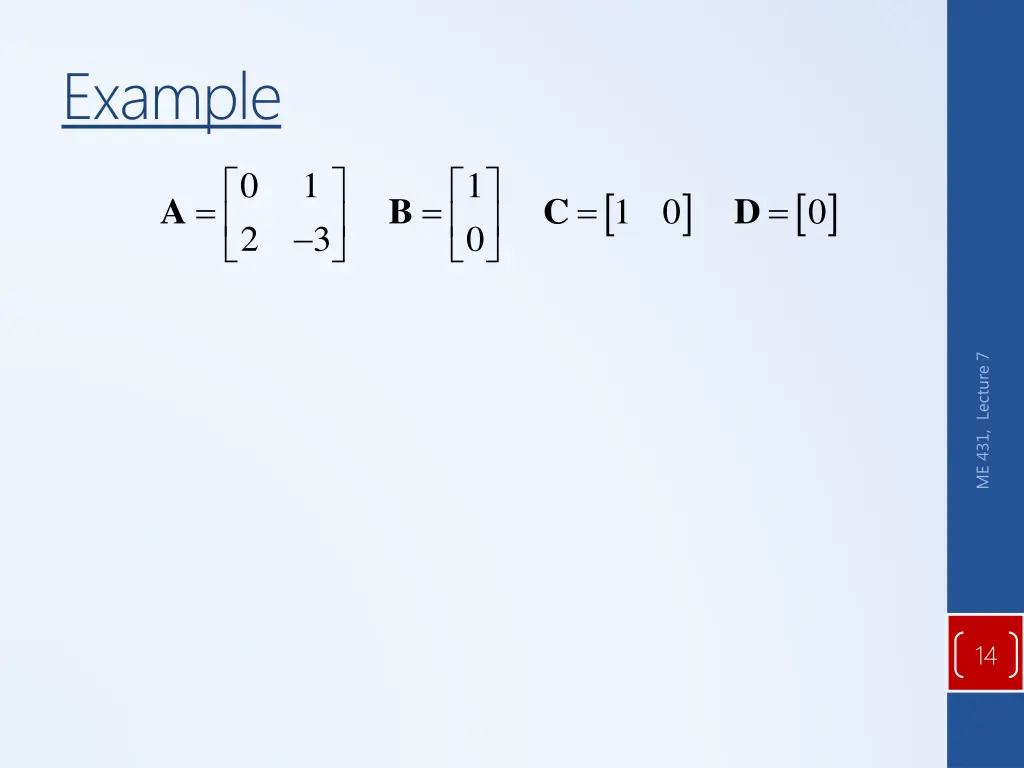
Example 0 2 1 1 0 0 = = = = A B C D 1 0 3 ME 431, Lecture 7 14
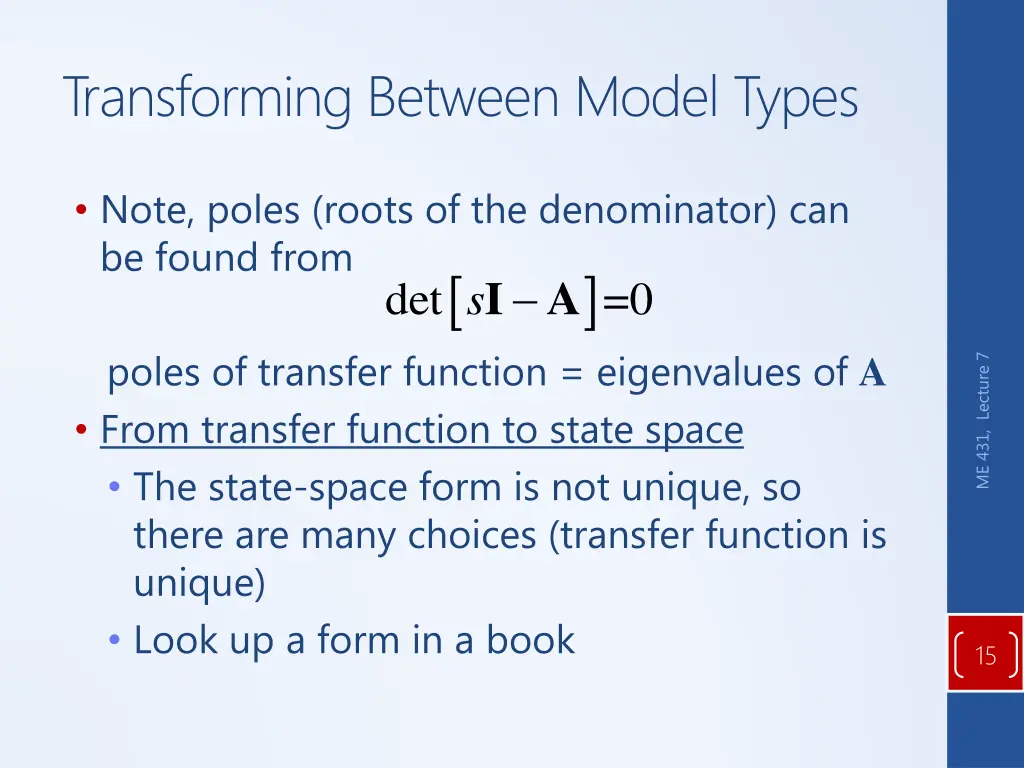
Transforming Between Model Types Note, poles (roots of the denominator) can be found from det s I A =0 poles of transfer function = eigenvalues of A From transfer function to state space The state-space form is not unique, so there are many choices (transfer function is unique) Look up a form in a book ME 431, Lecture 7 15
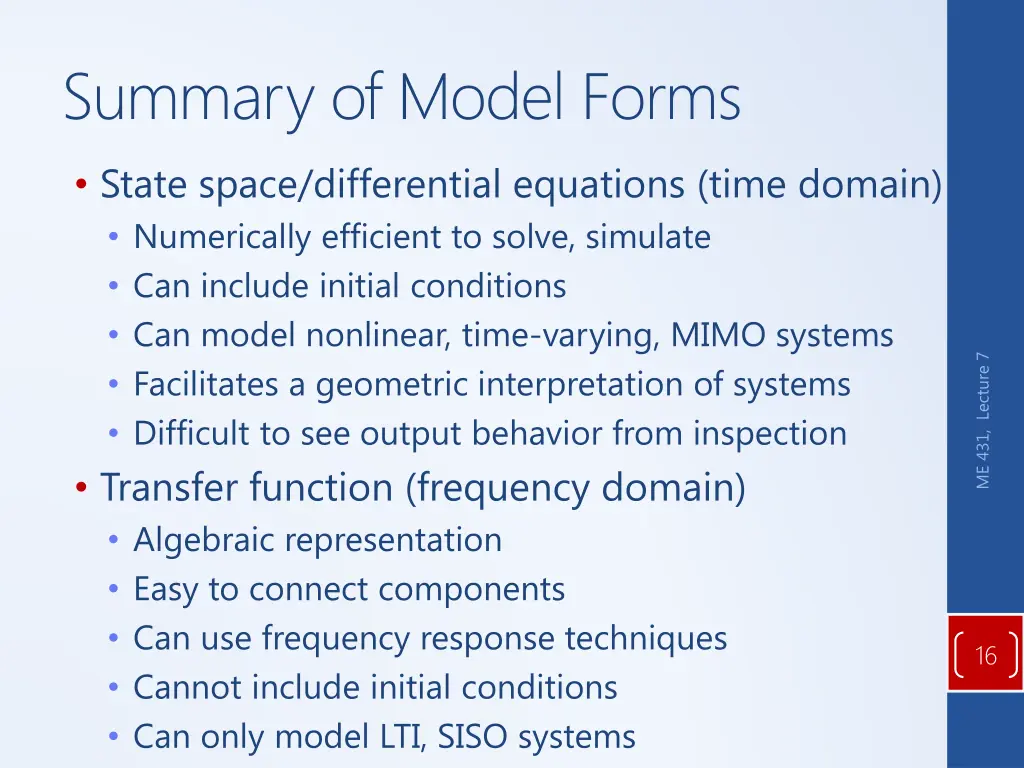
Summary of Model Forms State space/differential equations (time domain) Numerically efficient to solve, simulate Can include initial conditions Can model nonlinear, time-varying, MIMO systems Facilitates a geometric interpretation of systems Difficult to see output behavior from inspection Transfer function (frequency domain) Algebraic representation Easy to connect components Can use frequency response techniques Cannot include initial conditions Can only model LTI, SISO systems ME 431, Lecture 7 16
![Read⚡ebook✔[PDF] Linking the Space Shuttle and Space Stations: Early Docking Te](/thumb/21519/read-ebook-pdf-linking-the-space-shuttle-and-space-stations-early-docking-te.jpg)
![READ⚡[PDF]✔ Emerging Space Powers: The New Space Programs of Asia, the Middle Ea](/thumb/21554/read-pdf-emerging-space-powers-the-new-space-programs-of-asia-the-middle-ea.jpg)