Inversion in Language
Inversion in language is a syntactic phenomenon where the usual order of subjects and verbs is reversed for emphasis or stylistic purposes. This inversion can occur in various sentence structures, often with specific adverbs or adverbial phrases. Through examples and explanations, discover how inversion is utilized in English to convey different meanings and create rhetorical effects in communication.

Download Presentation

Please find below an Image/Link to download the presentation.
The content on the website is provided AS IS for your information and personal use only. It may not be sold, licensed, or shared on other websites without obtaining consent from the author.If you encounter any issues during the download, it is possible that the publisher has removed the file from their server.
You are allowed to download the files provided on this website for personal or commercial use, subject to the condition that they are used lawfully. All files are the property of their respective owners.
The content on the website is provided AS IS for your information and personal use only. It may not be sold, licensed, or shared on other websites without obtaining consent from the author.
E N D
Presentation Transcript
By Dr. Mohamed Saad Daoud
Part IV Leukocytosis, Leukopenia, and Other Reactive Changes of Leucocytes 2
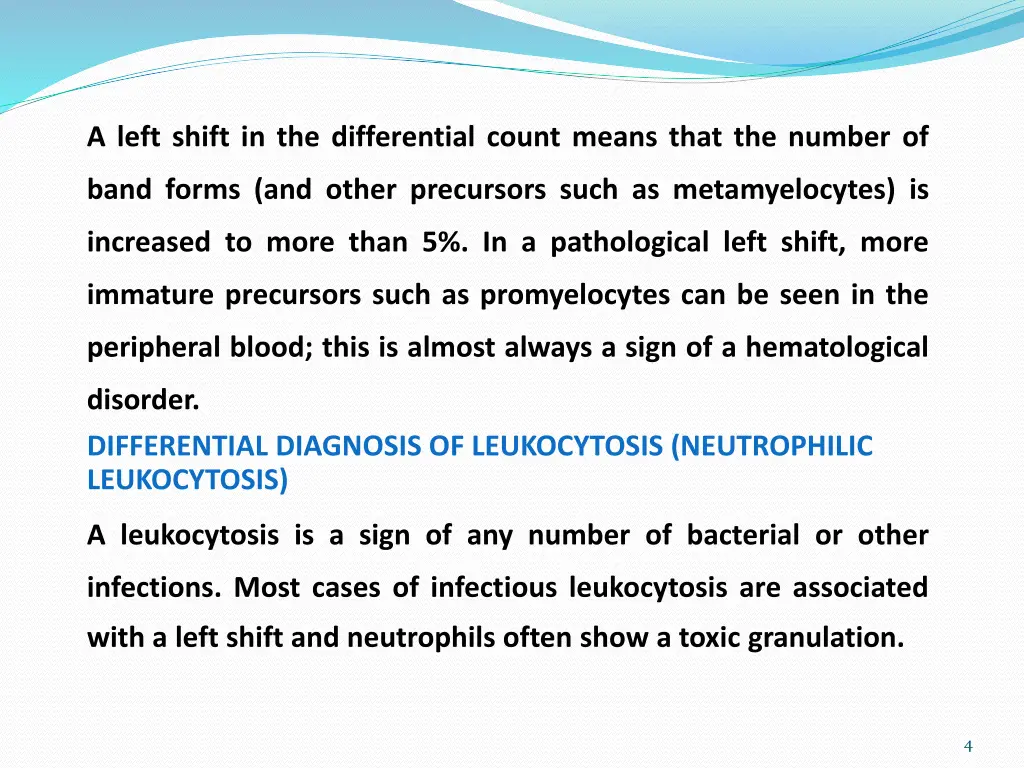
Leukocytosis, Leukopenia, and Other Reactive Changes of Myelopoiesis Leukocytosis is present if leukocytes are increased to more than 10,000/ L. Leukopenia leukocytes are below 4000/ L. Infants and small children have slightly different normal values. A neutropenia is present if granulocytes are below 2000/ L, Agranulocytosis (granulopenia) if granulocytes are below 500/ L. Granulocytes are increased if they are greater than 8000/ L (neutrophilia). In leukemoid reactions, leukocytes are increased to more than 30,000/ L. 3
A left shift in the differential count means that the number of band forms (and other precursors such as metamyelocytes) is increased to more than 5%. In a pathological left shift, more immature precursors such as promyelocytes can be seen in the peripheral blood; this is almost always a sign of a hematological disorder. DIFFERENTIAL DIAGNOSIS OF LEUKOCYTOSIS (NEUTROPHILIC LEUKOCYTOSIS) A leukocytosis is a sign of any number of bacterial or other infections. Most cases of infectious leukocytosis are associated with a left shift and neutrophils often show a toxic granulation. 4
Leukopenia Leukopenia occurs in which the bone marrow produces very few A white blood cells, leaving the body unprotected against many bacteria and other agents that might invade the tissues Normally, the human body lives in symbiosis with many bacteria, Any decrease in the number of white blood cells immediately allows invasion of adjacent tissues by bacteria that are already present. 5
The Leukemias Uncontrolled production of white blood cells can be caused by cancerous of a myelogenous or lymphogenous cell. This causes leukemia, which is usually characterized by greatly increased numbers of abnormal white blood cells in the circulating blood. Types of Leukemia Leukemias are divided into two general types: lymphocytic leukemias and myelogenous leukemias. 6
The lymphocytic leukemias are caused by cancerous production of lymphoid cells, usually beginning in a lymph node or other lymphocytic tissue and spreading to other areas of the body. The myelogenous leukemia, begins by cancerous production of young myelogenous cells in the bone marrow and then spreads throughout the body so that white blood cells are produced in many extramedullary tissues especially in the lymph nodes, spleen, and liver. 7
Myelogenous leukemia (neutrophilic leukemia, eosinophilic leukemia, basophilic leukemia, or monocytic leukemia). The leukemia cells are undifferentiated and not identical to any of the normal white blood cells. The more undifferentiated the cell, the more acute is the leukemia, often leading to death within a few months if untreated. With some of the more differentiated cells, the process can be chronic, sometimes developing slowly over 10 to 20 years. 8
Causes of Leukemia Experts do not know what causes leukemia. They do not know why some people get it and others do not. It is likely that the different types of leukemia have different causes. No one knows the exact causes of leukemia. Studies have found the following risk factors for leukemia: Working with certain chemicals: Exposure to high levels of benzene in the workplace can cause leukemia. Benzene is used widely in the chemical industry. Formaldehyde is also used by the chemical industry. Workers exposed to formaldehyde also may be at greater risk of leukemia. 9
Very high levels of radiation: People exposed to very high levels of radiation are much more likely than others to develop leukemia. Chemotherapy: Cancer patients treated with certain cancer- fighting drugs sometimes later develop leukemia. Smoking: Tobacco products are the single, major avoidable cause of cancer. Smoking is also causally associated with cancers of the pancreas, kidney, bladder, stomach, and cervix and with myeloid leukemia. 10
Some diseases caused by abnormal chromosomes may increase the risk of leukemia. 11
Types There are several types of leukemia. The different types of leukemia are grouped in two ways. One way is by how quickly the disease develops and gets worse. The other way is by the type of blood cell that is affected. by how quickly the disease develops Chronic Acute by the type of blood cell that is affected Lymphoid cells Myeloid cells 12
In chronic leukemia, the leukemia cells come from mature, abnormal cells. The cells grow well for too long and accumulate. The cells grow slowly. Acute leukemia develop from early cells, called "blasts". Blasts are young cells, that divide frequently. They target immature cells, causing symptoms to appear quickly. In acute leukemia cells. 13
Diagnosis The diagnosis of leukemia frequently occurs following a routine blood test that results in an abnormal blood cell count. If you have symptoms that suggest leukemia, doctor will try to find out what's causing the problems. doctor may ask about personal and family medical history. Patient may have one or more of the following tests: Blood tests: The lab does a complete blood count to check the number of white blood cells, red blood cells, and platelets. Leukemia causes a very high level of white blood cells. It may also cause low levels of platelets and hemoglobin, which is found inside red blood cells. 14
Bone marrow aspiration: The doctor uses a thick, hollow needle to remove samples of bone marrow. Bone marrow biopsy: The doctor uses a very thick, hollow needle to remove a small piece of bone and bone marrow. 15
Lymphomas Definition: malignancy of lymphoid tissue Can be T (thymus) or B (bursa) cells T are killers cells ; B make antibodies B- center of lymphoid follicle; T - around the periphery. 2 main types: Hodgkins vs. Non-Hodgkins 16