Explore an extension to the hybrid symbolic-numeric method for detecting parameter redundancy and estimable parameter combinations in complex models. Learn how to apply the hybrid method along with subset profiling to automatically identify relationships between confounded parameters.
Please find below an Image/Link to download the presentation.
The content on the website is provided AS IS for your information and personal use only. It may not be sold, licensed, or shared on other websites without obtaining consent from the author. If you encounter any issues during the download, it is possible that the publisher has removed the file from their server.
You are allowed to download the files provided on this website for personal or commercial use, subject to the condition that they are used lawfully. All files are the property of their respective owners.
The content on the website is provided AS IS for your information and personal use only. It may not be sold, licensed, or shared on other websites without obtaining consent from the author.
E N D
Presentation Transcript
Extension to the Hybrid Symbolic-Numeric Method for Investigating Identifiability Diana Cole, SE@K, University of Kent, UK R mi Choquet, CEFE, CNRS, France
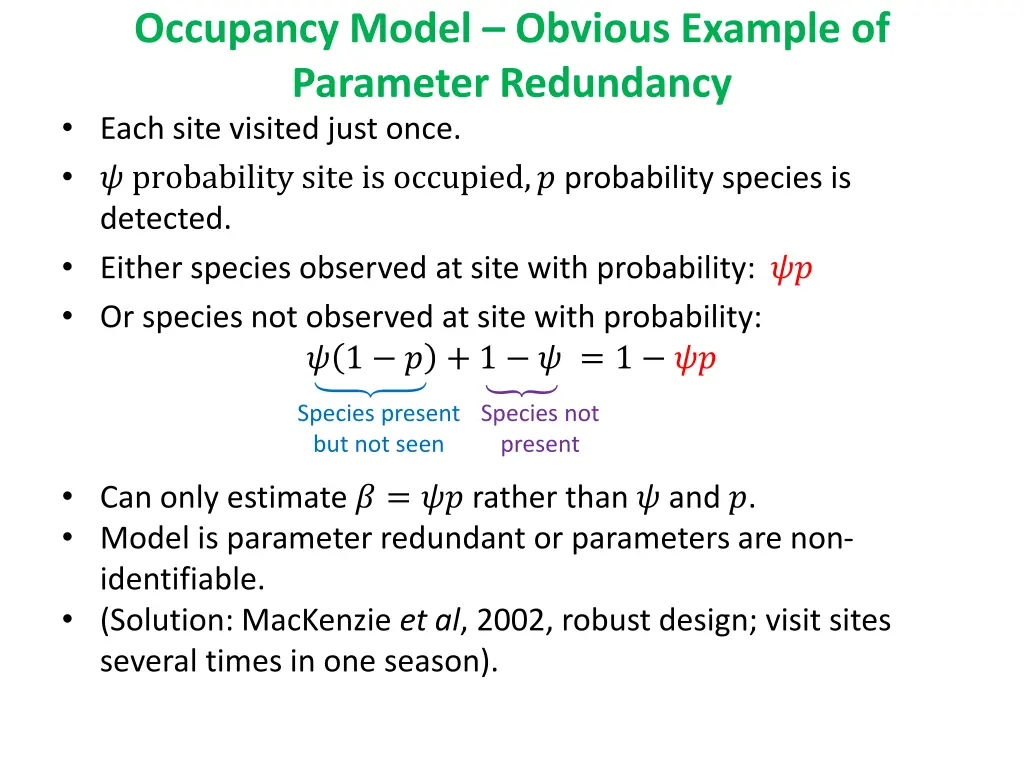
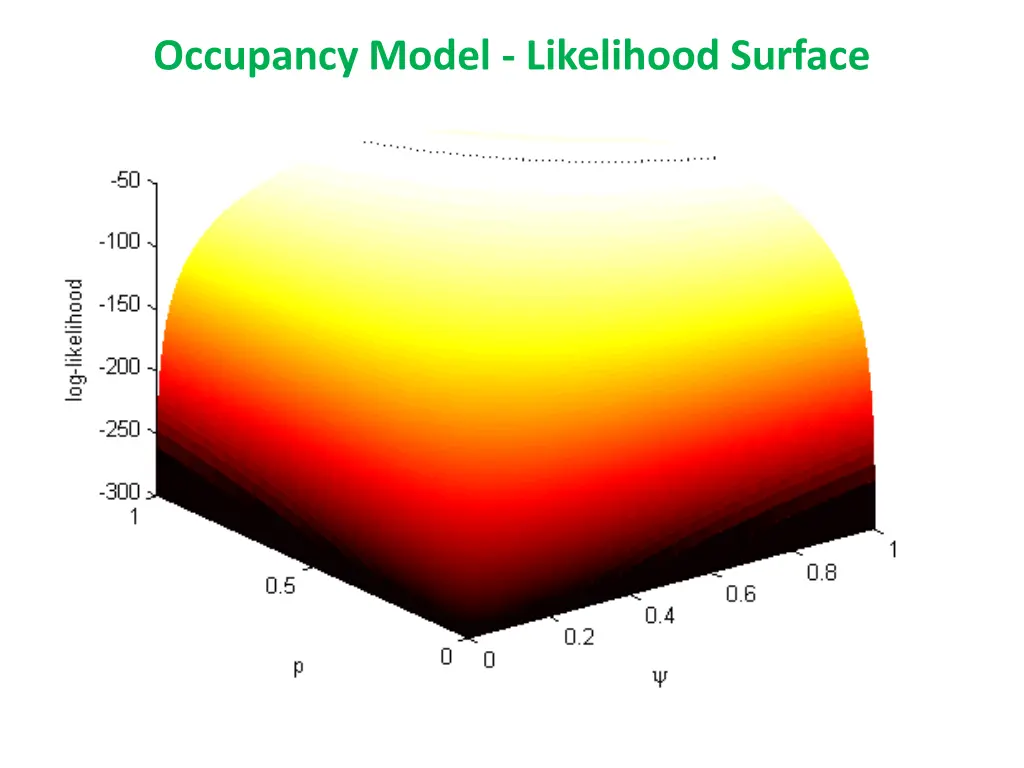
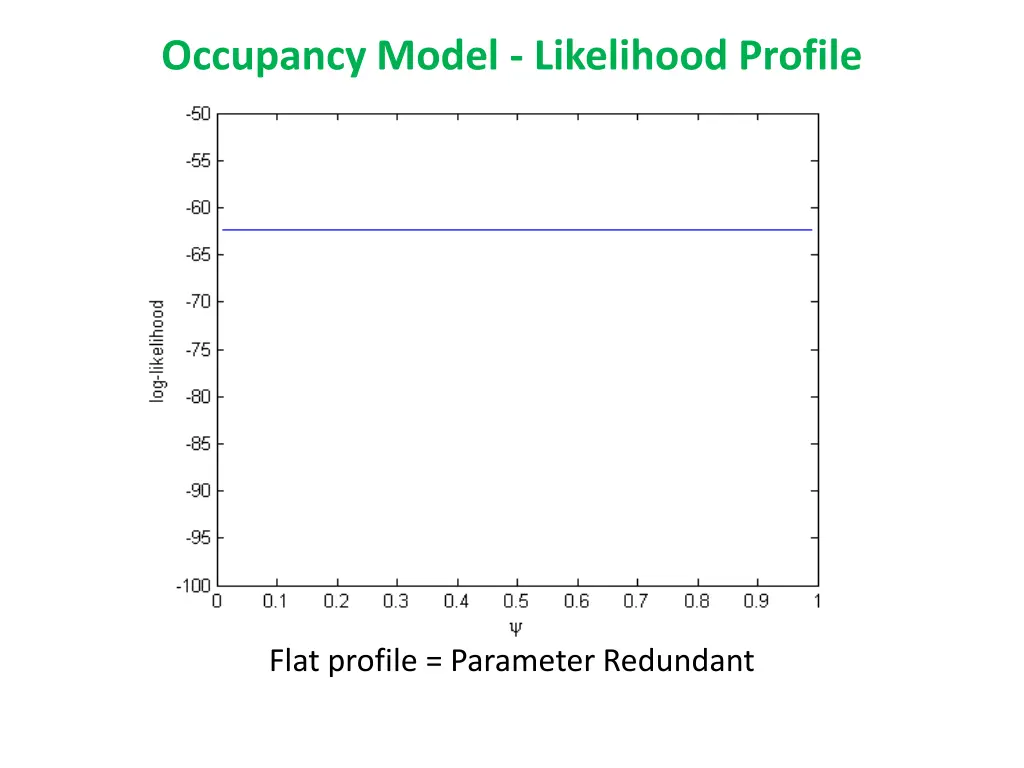
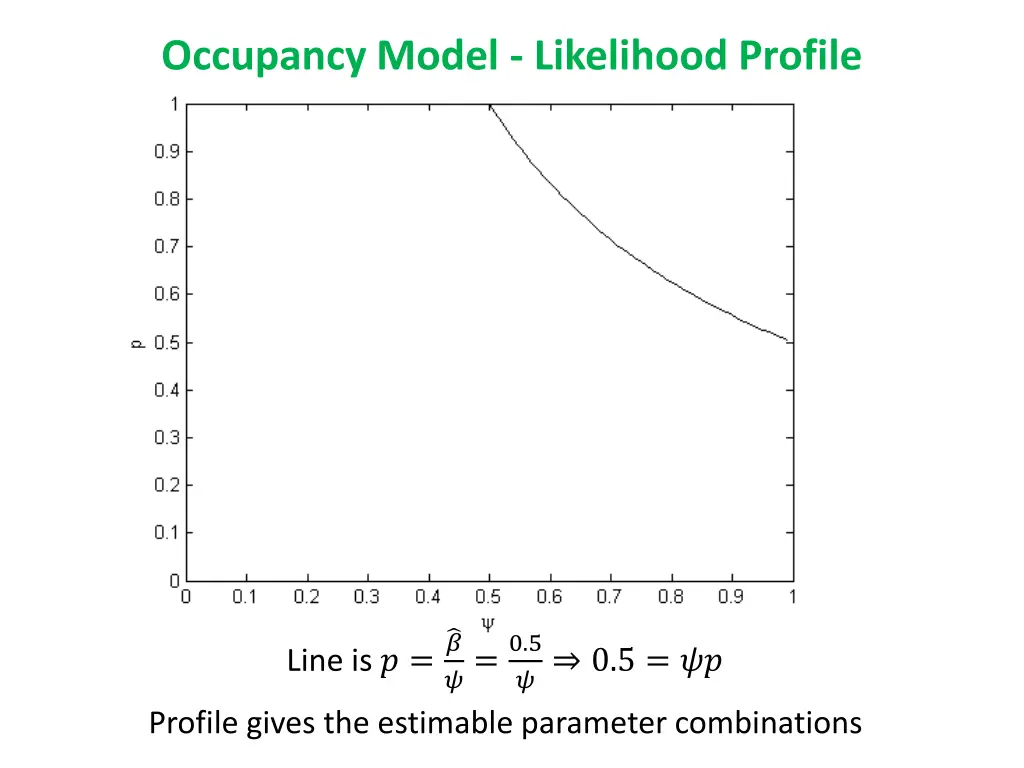
Occupancy Model Obvious Example of Parameter Redundancy Each site visited just once. ? probability site is occupied,? probability species is detected. Either species observed at site with probability: ?? Or species not observed at site with probability: ? 1 ? + 1 ? = 1 ?? Species present but not seen Species not present Can only estimate ? = ?? rather than ? and ?. Model is parameter redundant or parameters are non- identifiable. (Solution: MacKenzie et al, 2002, robust design; visit sites several times in one season).
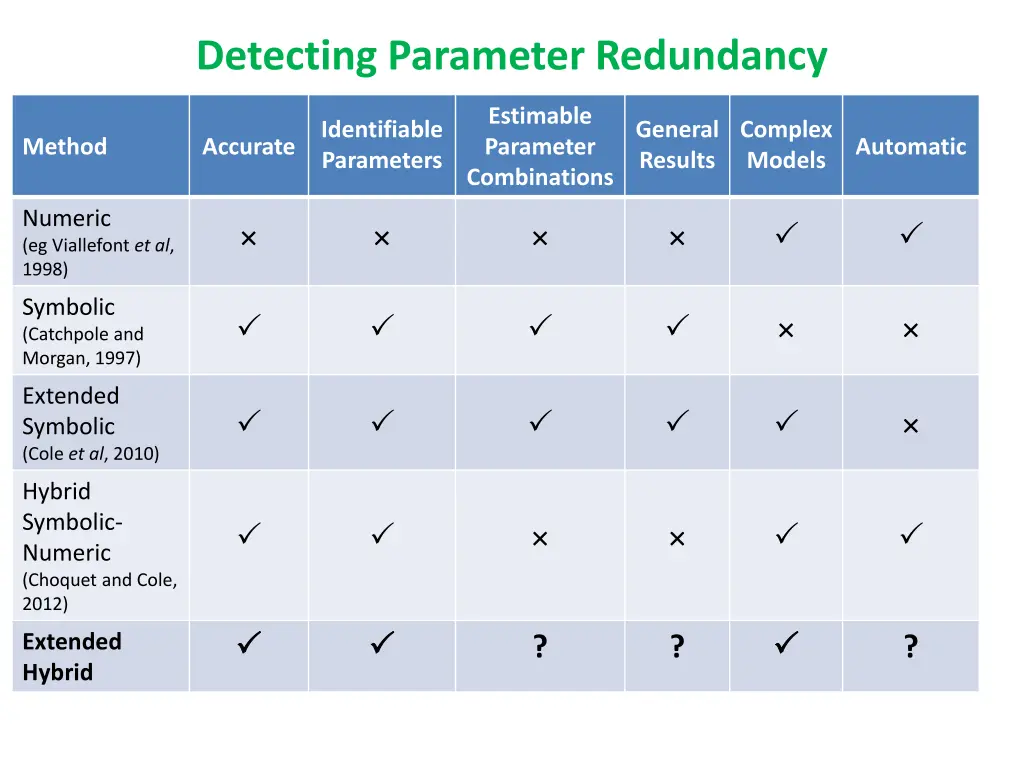
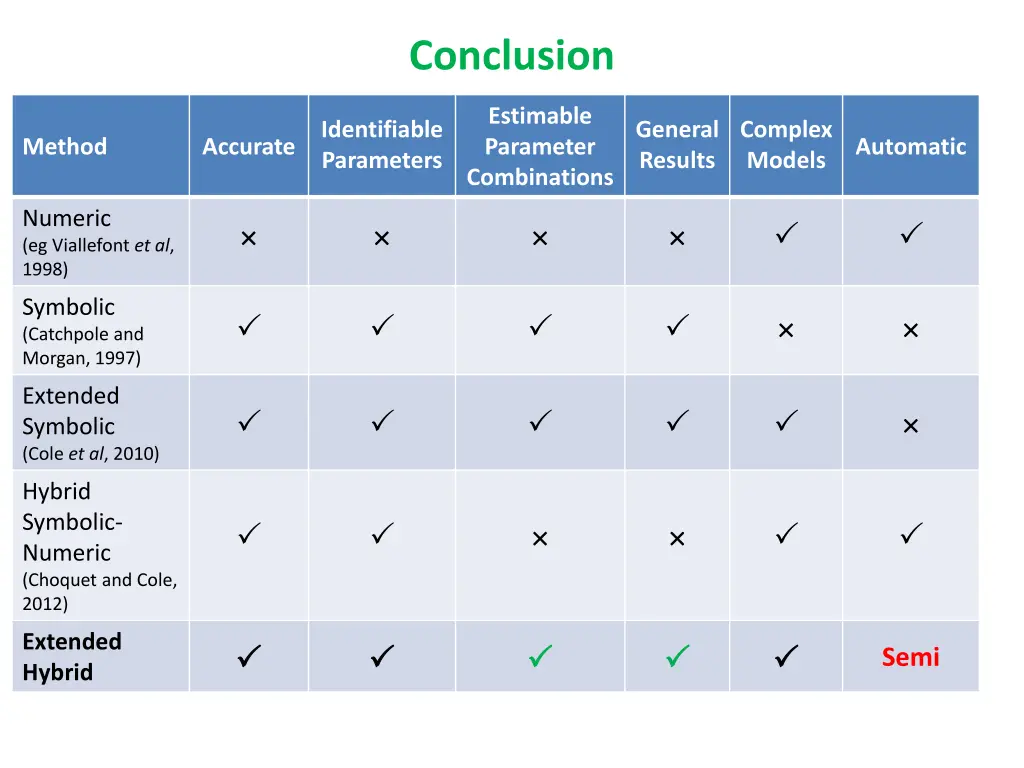
Detecting Parameter Redundancy Estimable Parameter Combinations Identifiable Parameters General Results Complex Models Method Accurate Automatic Numeric (eg Viallefont et al, 1998) Symbolic (Catchpole and Morgan, 1997) Extended Symbolic (Cole et al, 2010) Hybrid Symbolic- Numeric (Choquet and Cole, 2012) Extended Hybrid ? ? ?
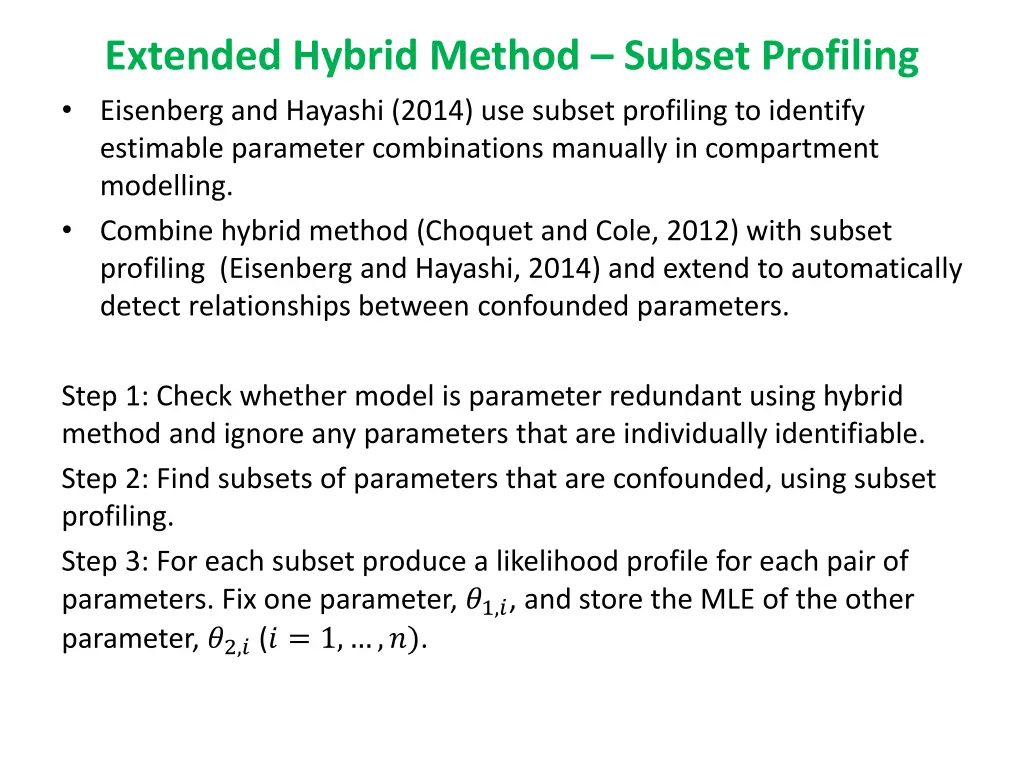
Extended Hybrid Method Subset Profiling Eisenberg and Hayashi (2014) use subset profiling to identify estimable parameter combinations manually in compartment modelling. Combine hybrid method (Choquet and Cole, 2012) with subset profiling (Eisenberg and Hayashi, 2014) and extend to automatically detect relationships between confounded parameters. Step 1: Check whether model is parameter redundant using hybrid method and ignore any parameters that are individually identifiable. Step 2: Find subsets of parameters that are confounded, using subset profiling. Step 3: For each subset produce a likelihood profile for each pair of parameters. Fix one parameter, ?1,?, and store the MLE of the other parameter, ?2,? (? = 1, ,?).
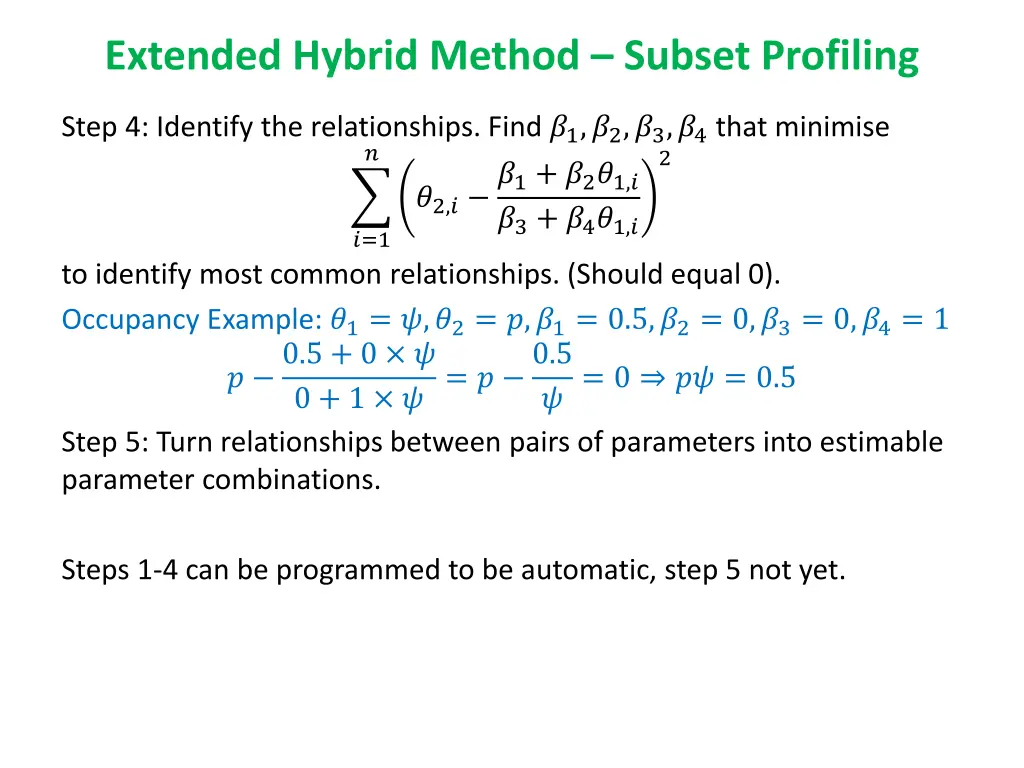
Extended Hybrid Method Subset Profiling Step 4: Identify the relationships. Find ?1,?2,?3,?4 that minimise ? ?2,? ?1+ ?2?1,? 2 ?3+ ?4?1,? ?=1 to identify most common relationships. (Should equal 0). Occupancy Example: ?1= ?,?2= ?,?1= 0.5,?2= 0,?3= 0,?4= 1 ? 0.5 + 0 ? 0 + 1 ? Step 5: Turn relationships between pairs of parameters into estimable parameter combinations. = ? 0.5 ?= 0 ?? = 0.5 Steps 1-4 can be programmed to be automatic, step 5 not yet.
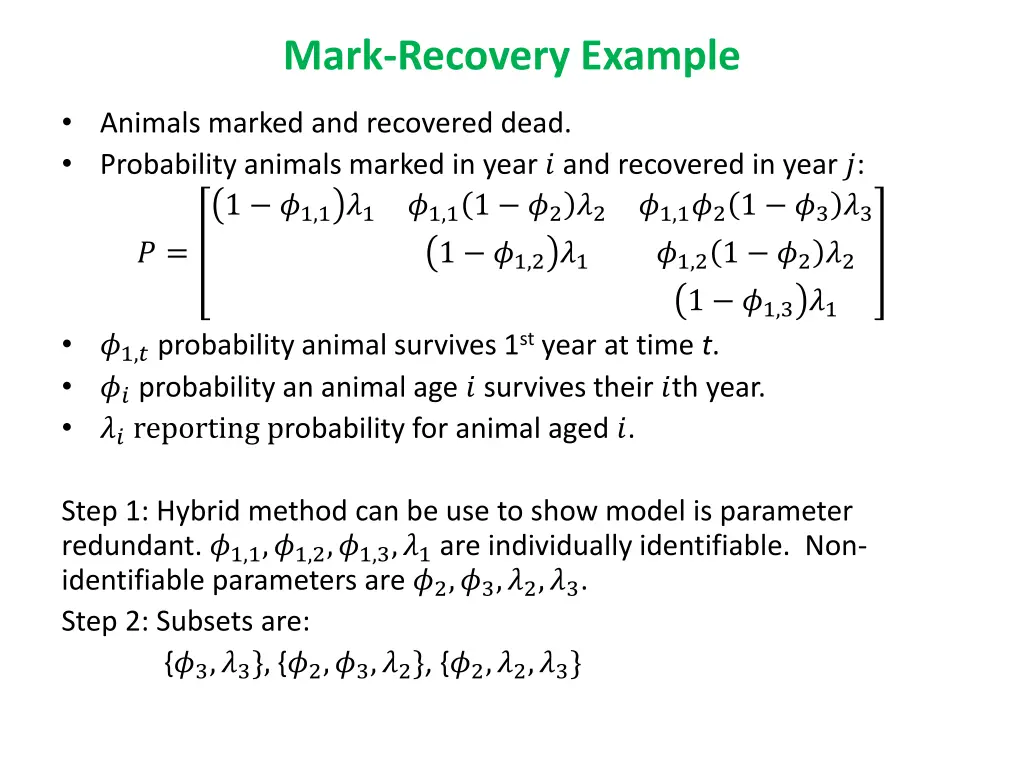
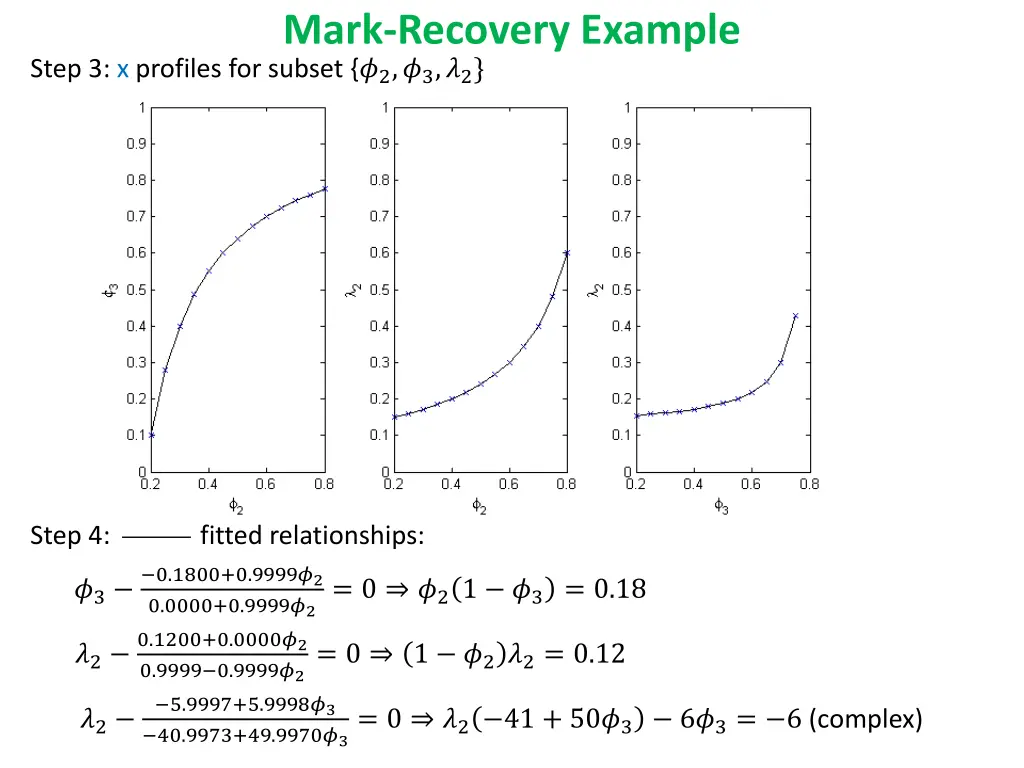
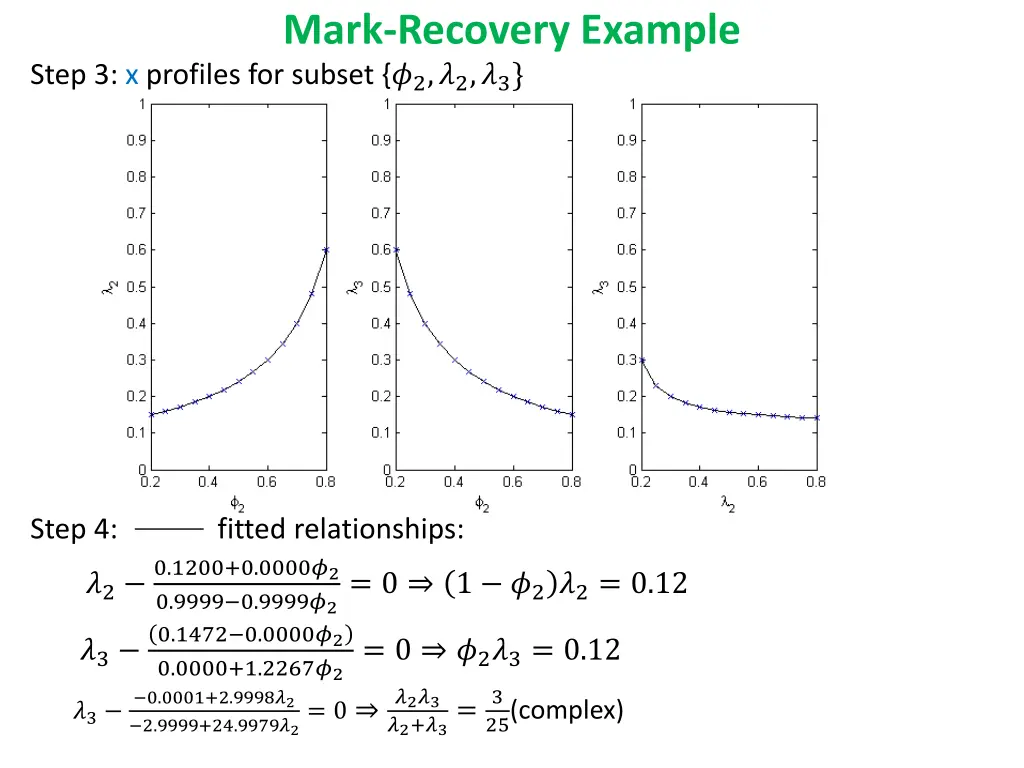
Mark-Recovery Example Animals marked and recovered dead. Probability animals marked in year ? and recovered in year ?: 1 ?1,1?1 ?1,11 ?2?2 1 ?1,2?1 ?1,? probability animal survives 1st year at time t. ?? probability an animal age ? survives their ?th year. ?? reporting probability for animal aged ?. ?1,1?21 ?3?3 ?1,21 ?2?2 1 ?1,3?1 ? = Step 1: Hybrid method can be use to show model is parameter redundant. ?1,1,?1,2,?1,3,?1 are individually identifiable. Non- identifiable parameters are ?2,?3,?2,?3. Step 2: Subsets are: {?3,?3}, {?2,?3,?2}, {?2,?2,?3}
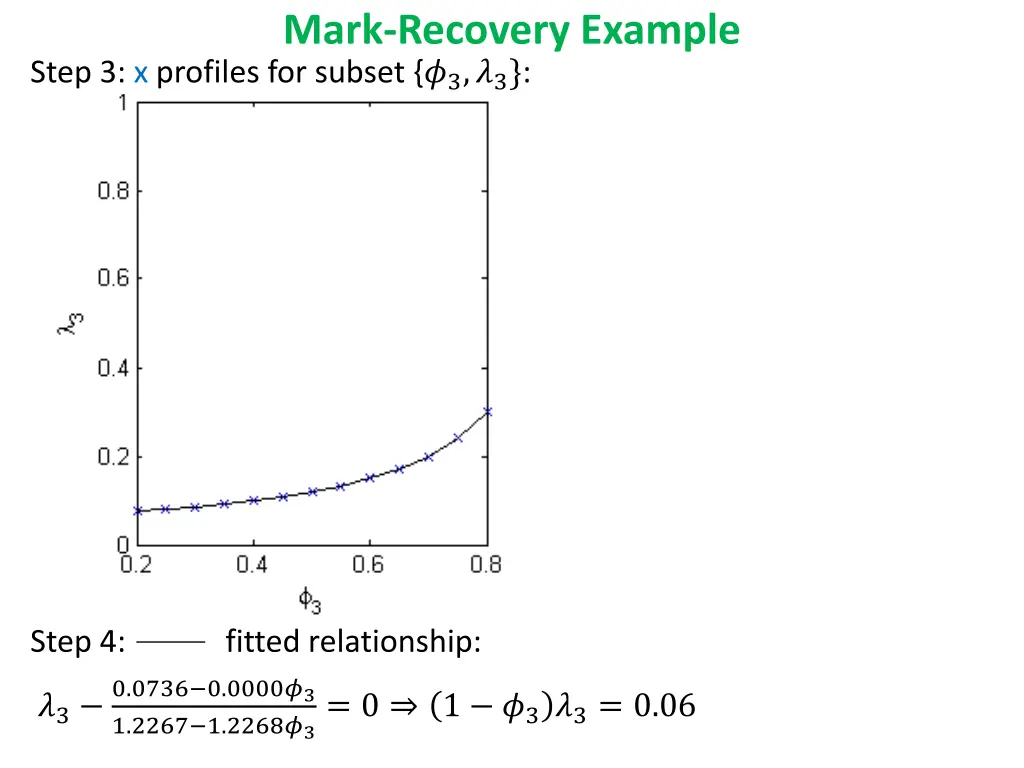
Mark-Recovery Example Step 3: x profiles for subset {?3,?3}: Step 4: fitted relationship: ?3 0.0736 0.0000?3 1.2267 1.2268?3= 0 1 ?3?3= 0.06
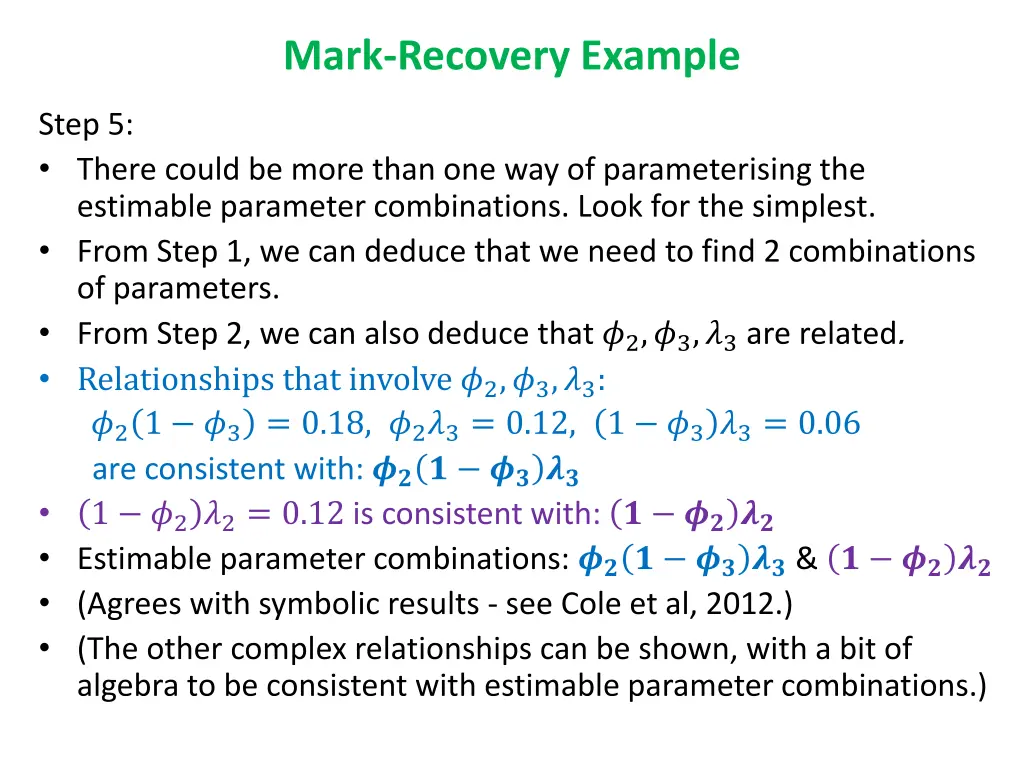
Mark-Recovery Example Step 5: There could be more than one way of parameterising the estimable parameter combinations. Look for the simplest. From Step 1, we can deduce that we need to find 2 combinations of parameters. From Step 2, we can also deduce that ?2,?3,?3are related. Relationships that involve ?2,?3,?3: ?21 ?3 = 0.18, ?2?3= 0.12, are consistent with: ??? ???? 1 ?2?2= 0.12 is consistent with: ? ???? Estimable parameter combinations: ??? ???? & ? ???? (Agrees with symbolic results - see Cole et al, 2012.) (The other complex relationships can be shown, with a bit of algebra to be consistent with estimable parameter combinations.) 1 ?3?3= 0.06
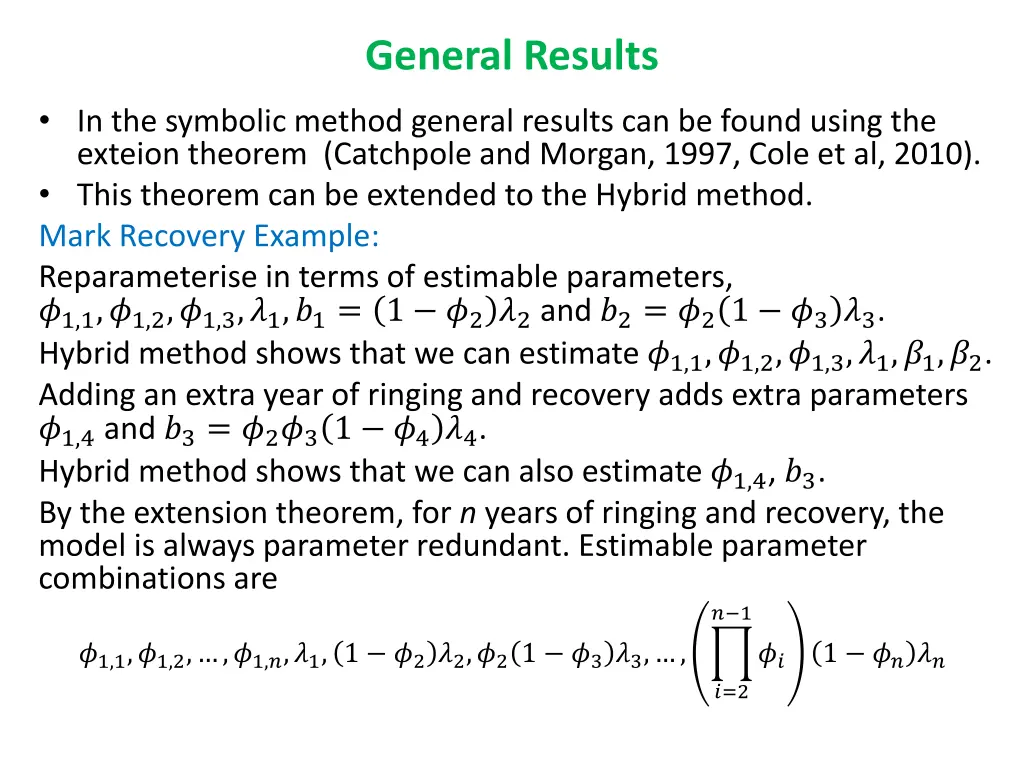
General Results In the symbolic method general results can be found using the exteion theorem (Catchpole and Morgan, 1997, Cole et al, 2010). This theorem can be extended to the Hybrid method. Mark Recovery Example: Reparameterise in terms of estimable parameters, ?1,1,?1,2,?1,3,?1,?1= 1 ?2?2 and ?2= ?21 ?3?3. Hybrid method shows that we can estimate ?1,1,?1,2,?1,3,?1,?1,?2. Adding an extra year of ringing and recovery adds extra parameters ?1,4 and ?3= ?2?31 ?4?4. Hybrid method shows that we can also estimate ?1,4, ?3. By the extension theorem, for n years of ringing and recovery, the model is always parameter redundant. Estimable parameter combinations are ? 1 ?1,1,?1,2, ,?1,?,?1, 1 ?2?2,?21 ?3?3, , ?? 1 ???? ?=2
Conclusion Estimable Parameter Combinations Identifiable Parameters General Results Complex Models Method Accurate Automatic Numeric (eg Viallefont et al, 1998) Symbolic (Catchpole and Morgan, 1997) Extended Symbolic (Cole et al, 2010) Hybrid Symbolic- Numeric (Choquet and Cole, 2012) Extended Hybrid Semi
References Catchpole, E. A. and Morgan, B. J. T. (1997) Detecting parameter redundancy Biometrika, 84, 187-196 Choquet, R. and Cole, D.J. (2012) A Hybrid Symbolic-Numerical Method for Determining Model Structure. Mathematical Biosciences, 236, p117. Cole, D. J. and Morgan, B. J. T. (2010) A note on determining parameter redundancy in age-dependent tag return models for estimating fishing mortality, natural mortality and selectivity, JABES, 15, 431-434. Cole, D. J., Morgan, B. J. T., Catchpole, E. A. and Hubbard, B.A. (2012) Parameter redundancy in mark-recovery models, Biometrical Journal, 54, 507-523. Eisenberg, M. C. and Hayashi, M. A. L (2014) Determining identifiable parameter combinations using subset profiling, Mathematical Biosciences, 256, 116 126. MacKenzie, D. I., et al (2002) Estimating site occupancy rates when detection probabilities are less than one. Ecology, 83, 2248-2255. Viallefont, A., et al (1998) Parameter identifiability and model selection in capture-recapture models: A numerical approach. Biometrical Journal, 40, 313-325.