Investment Strategy for SMSFs Post COVID-19: Importance and Compliance Guidelines
Discover the significance of investment strategies for SMSFs post-COVID-19, including new ATO guidelines, market effects, and legal requirements. Learn how to prepare and maintain a compliant investment strategy to avoid penalties and maximize returns. Stay informed with expert insights and tips in this educational presentation.

Uploaded on | 0 Views
Download Presentation

Please find below an Image/Link to download the presentation.
The content on the website is provided AS IS for your information and personal use only. It may not be sold, licensed, or shared on other websites without obtaining consent from the author. If you encounter any issues during the download, it is possible that the publisher has removed the file from their server.
You are allowed to download the files provided on this website for personal or commercial use, subject to the condition that they are used lawfully. All files are the property of their respective owners.
The content on the website is provided AS IS for your information and personal use only. It may not be sold, licensed, or shared on other websites without obtaining consent from the author.
E N D
Presentation Transcript
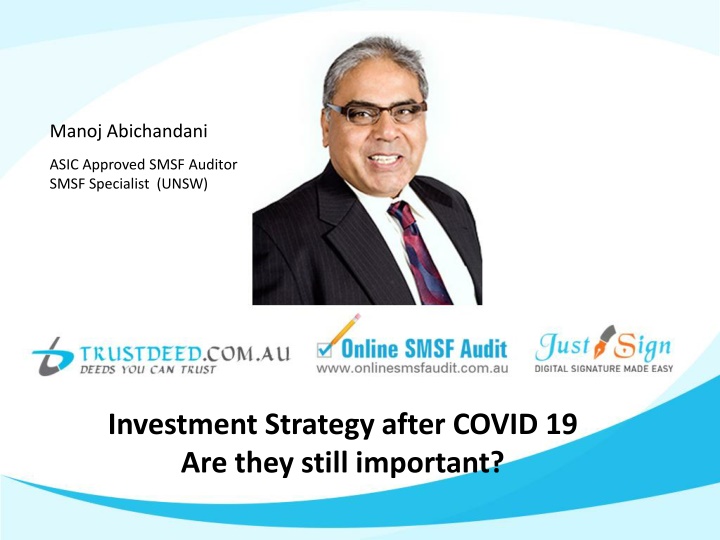
Manoj Abichandani ASIC Approved SMSF Auditor SMSF Specialist (UNSW) Investment Strategy after COVID 19 Are they still important?
Disclaimer of Legal & Financial Advice Educational Purpose Only Statement This paper represents the opinion of the author (s) and not necessarily those of Deed Dot Com Dot Au Pty Ltd. The contents are for general information only. They are not intended as professional advice - for that you should consult a Accountant or other suitably qualified professional. Deed Dot Com dot Au Pty Ltd expressly disclaims all liability for any loss or damage arising from reliance upon any information in this presentation. Disclaimer The information contained in this presentation is based on the understanding of the author has of the relevant Australian laws as at 10th Aug 2021. As these laws are subject to change you should refer to ATO s website or talk to a professional adviser for the most up-to-date information. The information is for adviser use only and is not a substitute for investors seeking advice. While all care has been taken in the preparation of this document (using sources believed to be reliable and accurate), no person, including Deed Dot Com Dot Au Pty Ltd, accepts responsibility for any loss suffered by any person arising from reliance on this information. This update is not financial product advice and does not take into account any individual s objectives, financial situation or needs. Any examples are for illustrative purposes only and actual risks and benefits will vary depending on each investor s individual circumstances. You should form your own opinion and take your own legal, taxation and financial advice on the application of the information to your business and your clients.
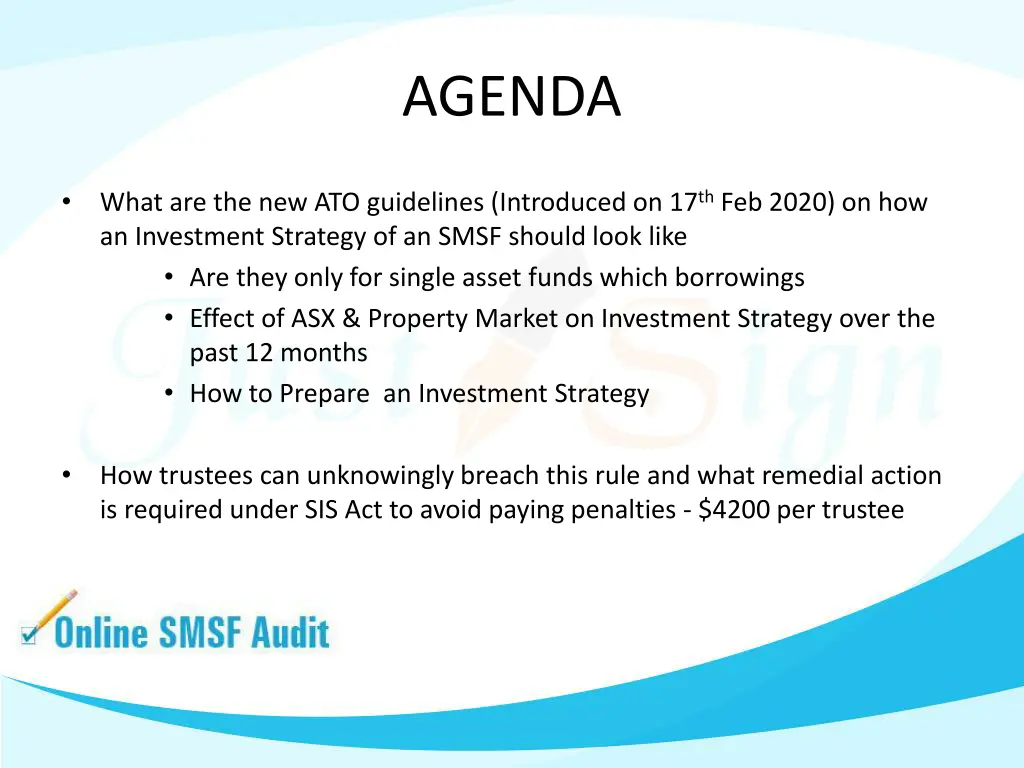
AGENDA What are the new ATO guidelines (Introduced on 17th Feb 2020) on how an Investment Strategy of an SMSF should look like Are they only for single asset funds which borrowings Effect of ASX & Property Market on Investment Strategy over the past 12 months How to Prepare an Investment Strategy How trustees can unknowingly breach this rule and what remedial action is required under SIS Act to avoid paying penalties - $4200 per trustee
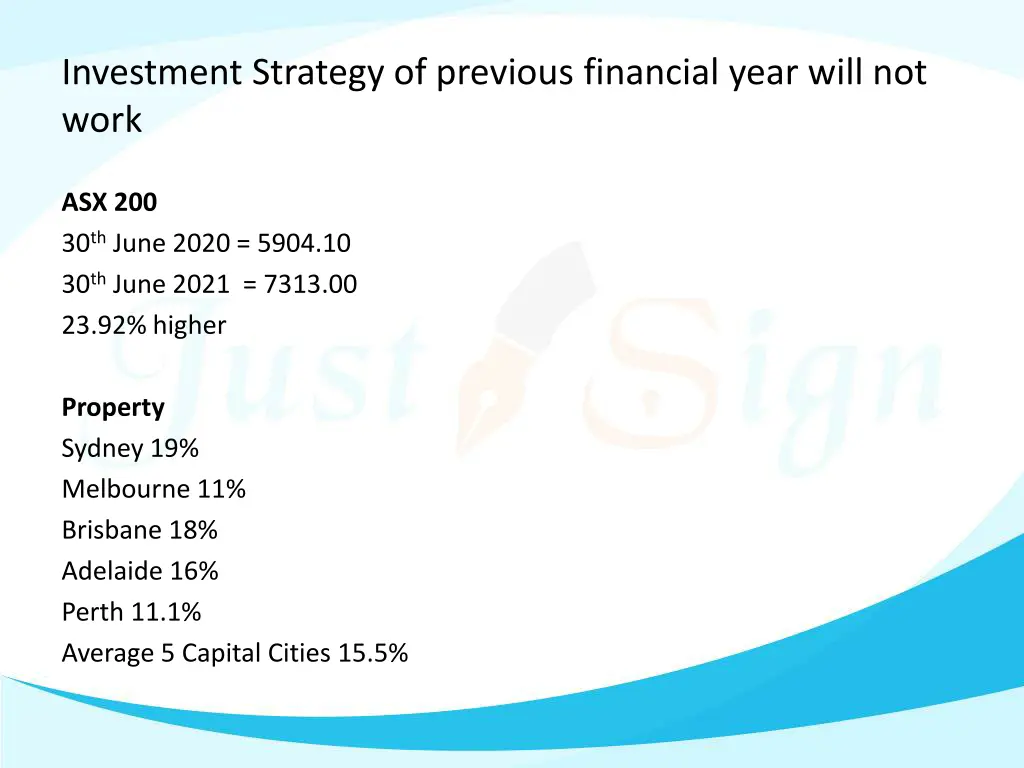
Investment Strategy of previous financial year will not work ASX 200 30th June 2020 = 5904.10 30th June 2021 = 7313.00 23.92% higher Property Sydney 19% Melbourne 11% Brisbane 18% Adelaide 16% Perth 11.1% Average 5 Capital Cities 15.5%
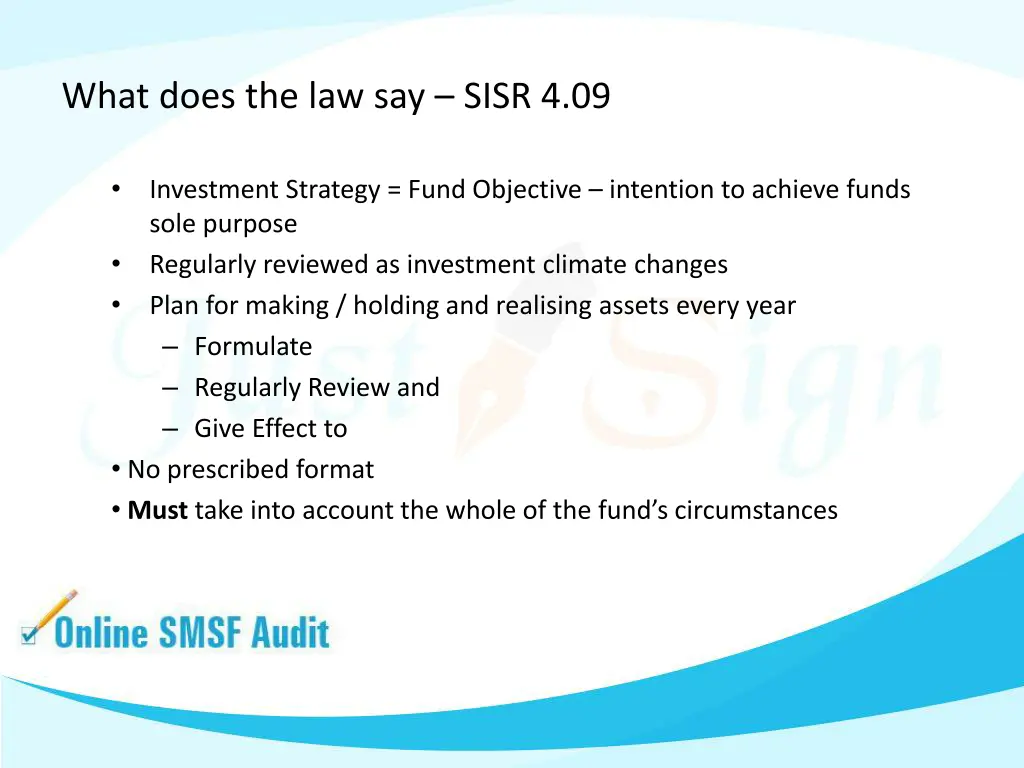
What does the law say SISR 4.09 Investment Strategy = Fund Objective intention to achieve funds sole purpose Regularly reviewed as investment climate changes Plan for making / holding and realising assets every year Formulate Regularly Review and Give Effect to No prescribed format Must take into account the whole of the fund s circumstances
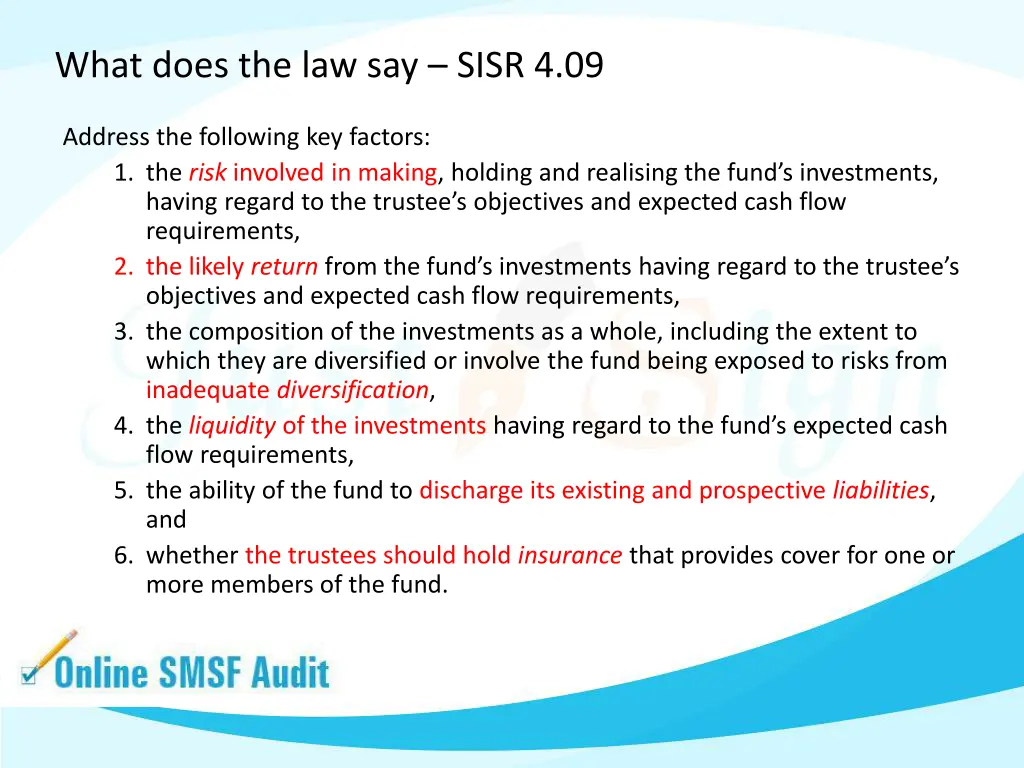
What does the law say SISR 4.09 Address the following key factors: 1. the risk involved in making, holding and realising the fund s investments, having regard to the trustee s objectives and expected cash flow requirements, 2. the likely return from the fund s investments having regard to the trustee s objectives and expected cash flow requirements, 3. the composition of the investments as a whole, including the extent to which they are diversified or involve the fund being exposed to risks from inadequate diversification, 4. the liquidity of the investments having regard to the fund s expected cash flow requirements, 5. the ability of the fund to discharge its existing and prospective liabilities, and 6. whether the trustees should hold insurance that provides cover for one or more members of the fund.
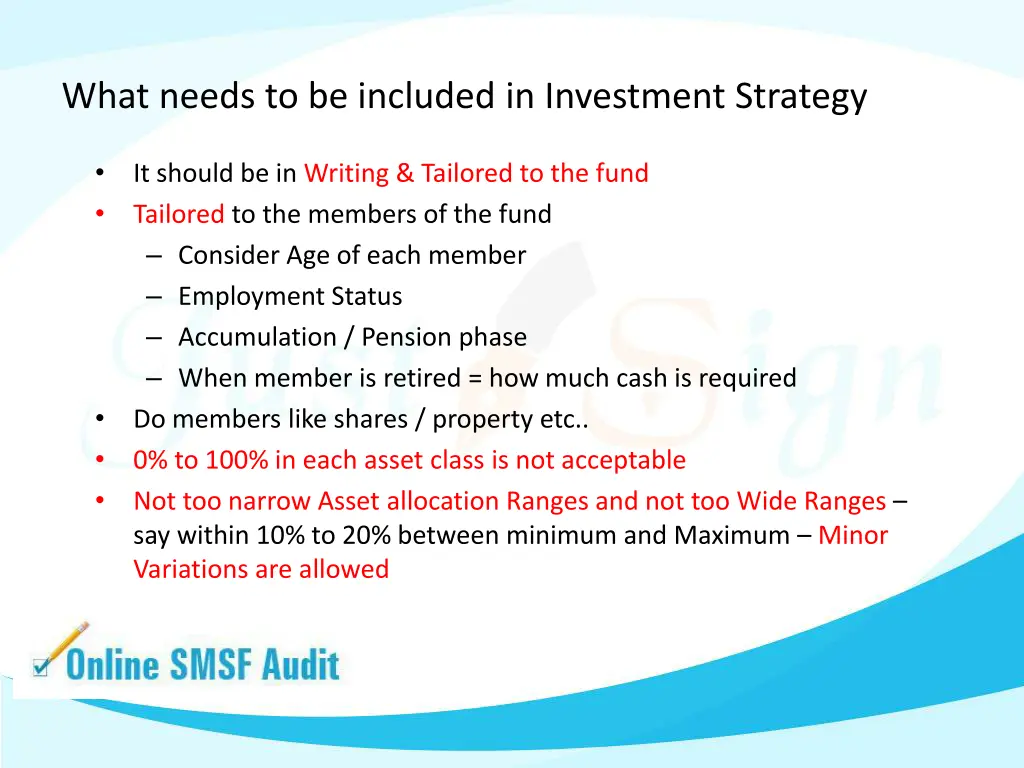
What needs to be included in Investment Strategy It should be in Writing & Tailored to the fund Tailored to the members of the fund Consider Age of each member Employment Status Accumulation / Pension phase When member is retired = how much cash is required Do members like shares / property etc.. 0% to 100% in each asset class is not acceptable Not too narrow Asset allocation Ranges and not too Wide Ranges say within 10% to 20% between minimum and Maximum Minor Variations are allowed
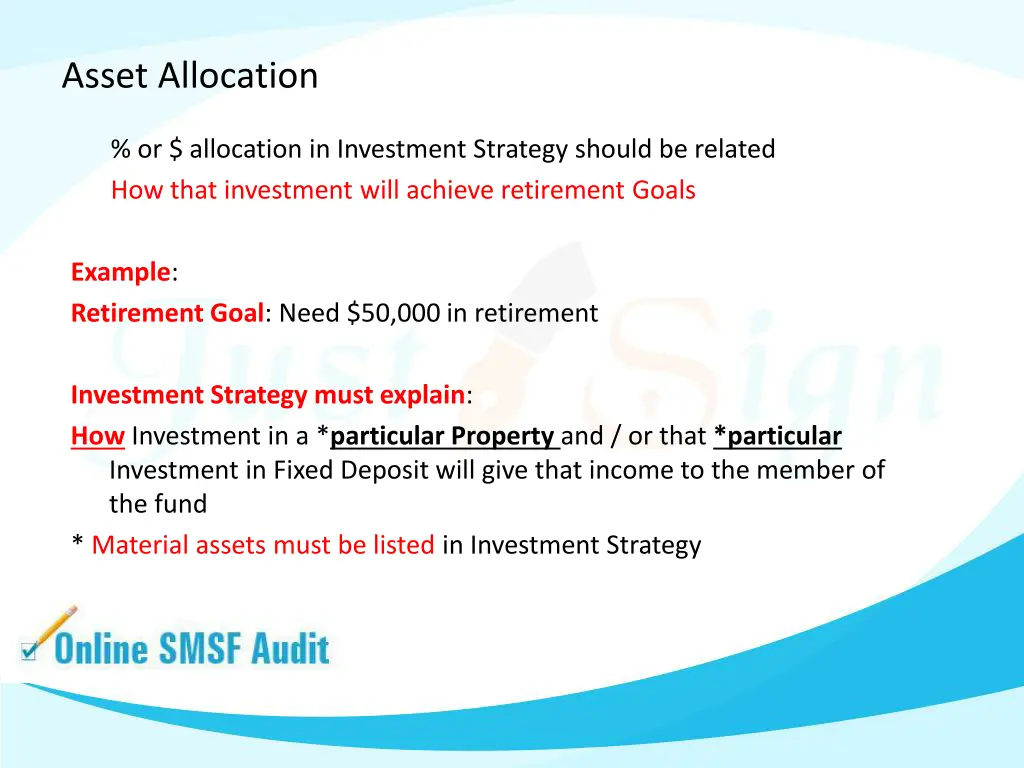
Asset Allocation % or $ allocation in Investment Strategy should be related How that investment will achieve retirement Goals Example: Retirement Goal: Need $50,000 in retirement Investment Strategy must explain: How Investment in a *particular Property and / or that *particular Investment in Fixed Deposit will give that income to the member of the fund * Material assets must be listed in Investment Strategy
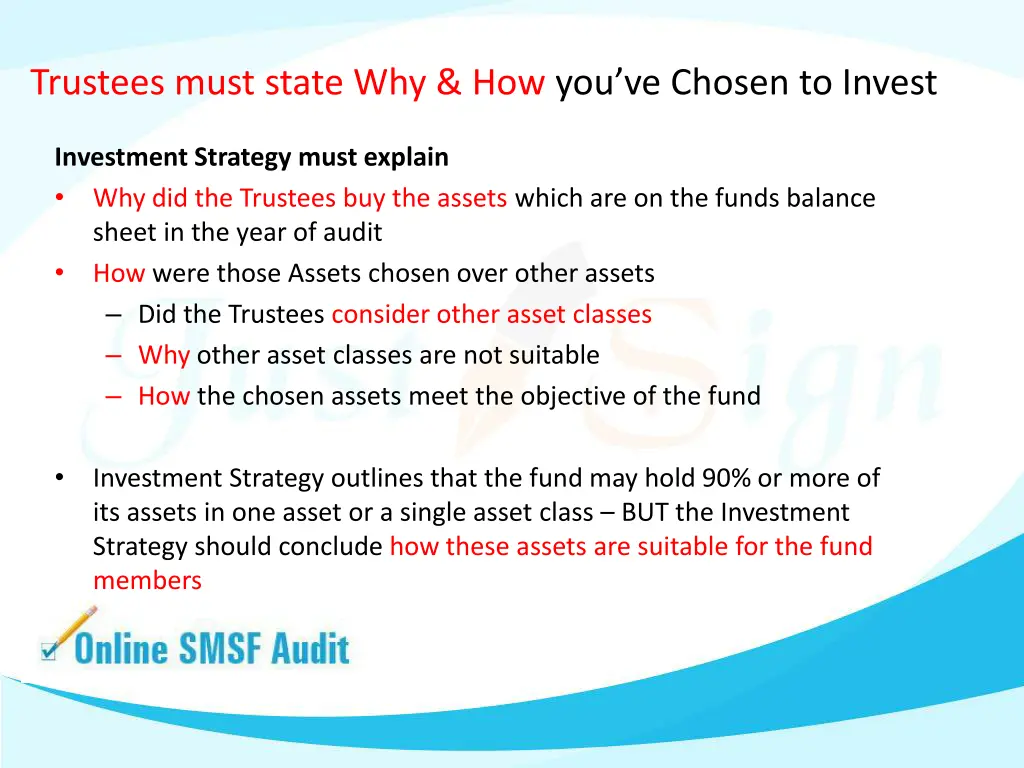
Trustees must state Why & How youve Chosen to Invest Investment Strategy must explain Why did the Trustees buy the assets which are on the funds balance sheet in the year of audit How were those Assets chosen over other assets Did the Trustees consider other asset classes Why other asset classes are not suitable How the chosen assets meet the objective of the fund Investment Strategy outlines that the fund may hold 90% or more of its assets in one asset or a single asset class BUT the Investment Strategy should conclude how these assets are suitable for the fund members
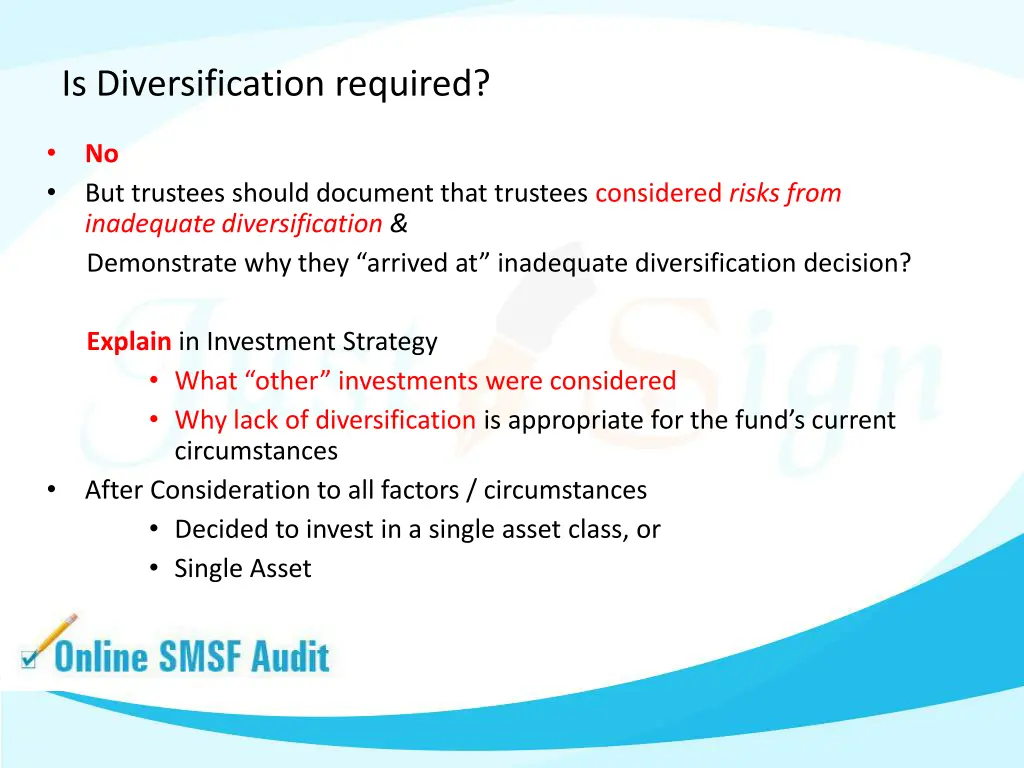
Is Diversification required? No But trustees should document that trustees considered risks from inadequate diversification & Demonstrate why they arrived at inadequate diversification decision? Explain in Investment Strategy What other investments were considered Why lack of diversification is appropriate for the fund s current circumstances After Consideration to all factors / circumstances Decided to invest in a single asset class, or Single Asset
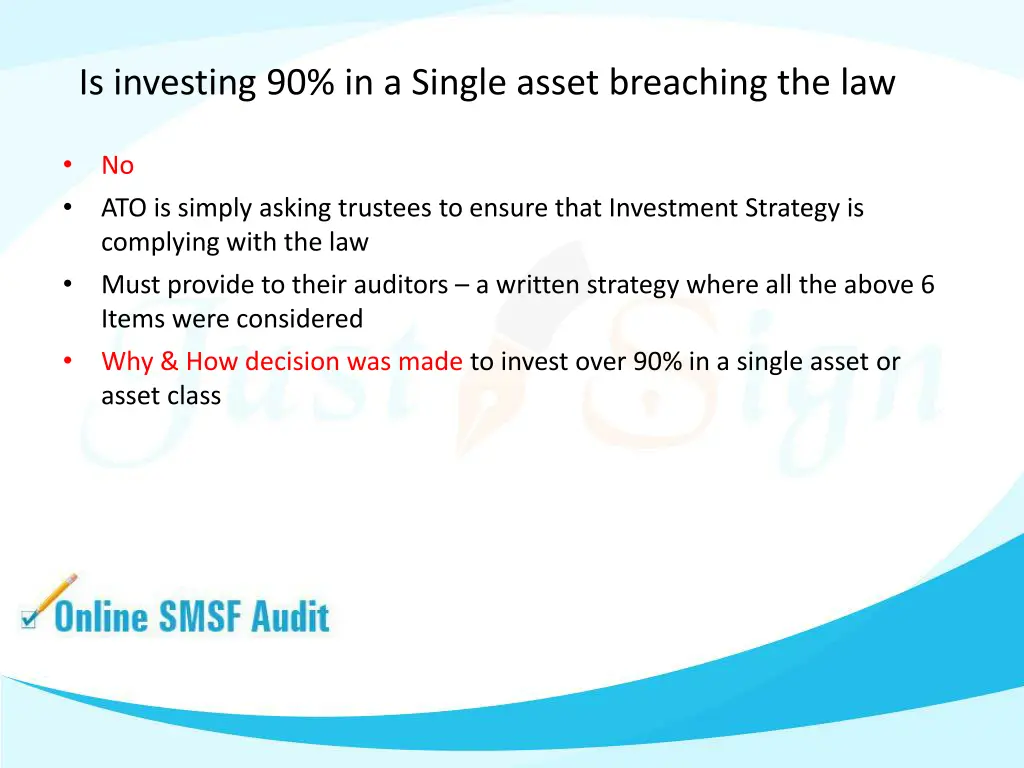
Is investing 90% in a Single asset breaching the law No ATO is simply asking trustees to ensure that Investment Strategy is complying with the law Must provide to their auditors a written strategy where all the above 6 Items were considered Why & How decision was made to invest over 90% in a single asset or asset class
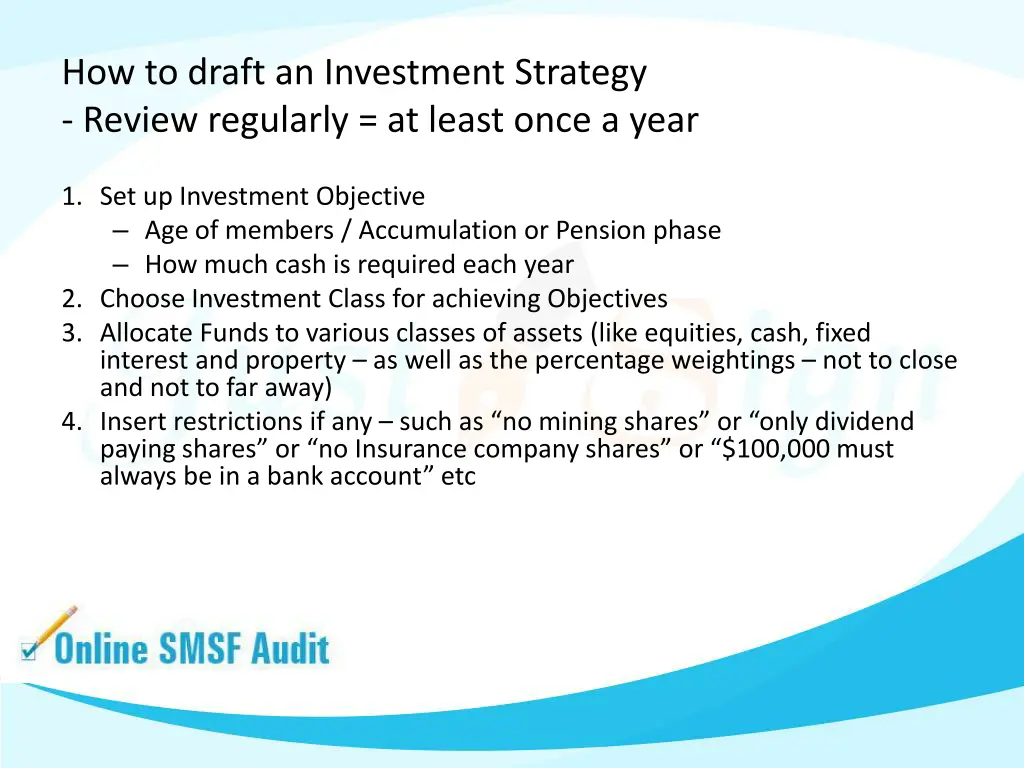
How to draft an Investment Strategy - Review regularly = at least once a year 1. Set up Investment Objective Age of members / Accumulation or Pension phase How much cash is required each year 2. Choose Investment Class for achieving Objectives 3. Allocate Funds to various classes of assets (like equities, cash, fixed interest and property as well as the percentage weightings not to close and not to far away) 4. Insert restrictions if any such as no mining shares or only dividend paying shares or no Insurance company shares or $100,000 must always be in a bank account etc
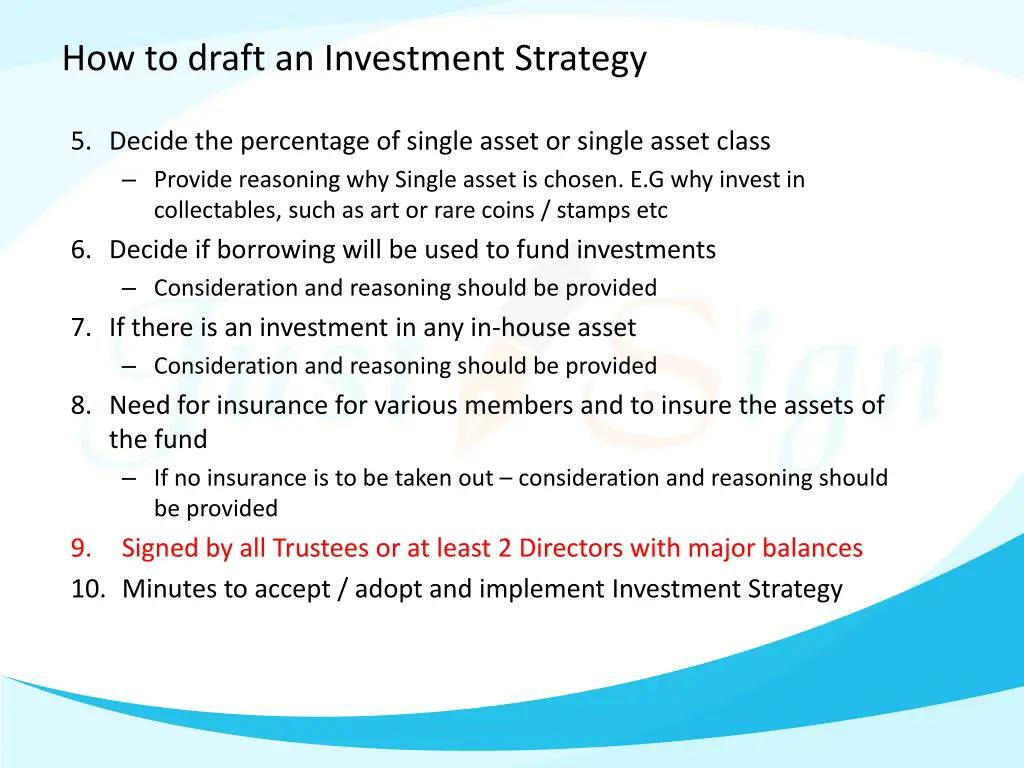
How to draft an Investment Strategy 5. Decide the percentage of single asset or single asset class Provide reasoning why Single asset is chosen. E.G why invest in collectables, such as art or rare coins / stamps etc 6. Decide if borrowing will be used to fund investments Consideration and reasoning should be provided 7. If there is an investment in any in-house asset Consideration and reasoning should be provided 8. Need for insurance for various members and to insure the assets of the fund If no insurance is to be taken out consideration and reasoning should be provided 9. Signed by all Trustees or at least 2 Directors with major balances 10. Minutes to accept / adopt and implement Investment Strategy
Review regularly = at least once a year More often when there is a Significant Event: a market correction (Corona Virus) when a new member joins the fund Member dies or departs a fund when a member commences receiving a pension
How to draft a un-diversified Investment Strategy If Trustees have come to the conclusion that that a single asset or single asset class is appropriate for the fund, then their Investment Strategy should Explain : a) Age of each member & wishes (risk profile) of each member b) What assets and asset classes are held by each member outside the fund c) Risk of holding any particular asset class in the current investment climate d) Return Vs Growth of various asset classes in current investment climate e) Funds current cash requirements (pension liabilities or LRBA etc) f) Why one particular asset class should be preferred in the current investment climate Logically why holding one particular asset is appropriate for the fund
Investment Strategy where the fund has borrowed Leverage brings in additional Risk Investment Strategy should address why borrowing is necessary Some Loans have minimum LVR requirements if asset values drop this can trigger a forced sale e.g. CFD s Investment by Trustee = For = Best financial interest of all members Trustee must consider legal risk
Give Effect to Investment Strategy Where Auditor should have a problem: Look South/Walk North What is essential : Fund s investments are in accordance with your investment strategy Short Term variations are fine Example IS = Purchase an asset which can be sold and converted to cash in 90 Days so that Pensions can be paid on time Actual Investment: Loan to a Property Developer for 3 Years where Interest will be paid at the end of the term
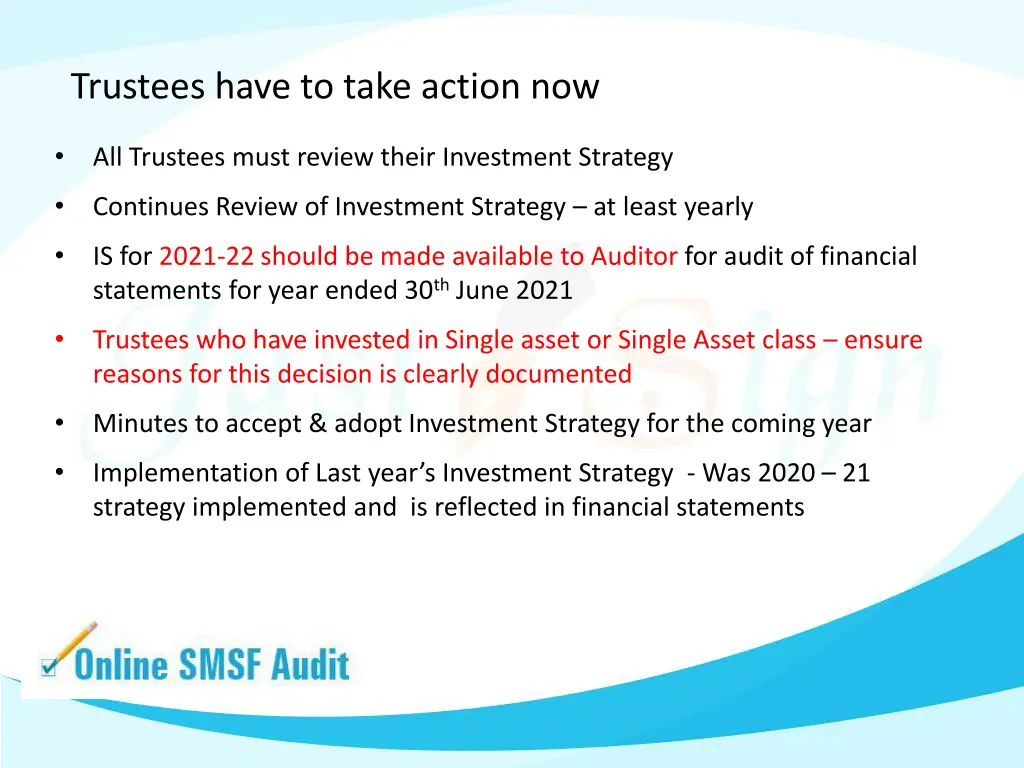
Trustees have to take action now All Trustees must review their Investment Strategy Continues Review of Investment Strategy at least yearly IS for 2021-22 should be made available to Auditor for audit of financial statements for year ended 30th June 2021 Trustees who have invested in Single asset or Single Asset class ensure reasons for this decision is clearly documented Minutes to accept & adopt Investment Strategy for the coming year Implementation of Last year s Investment Strategy - Was 2020 21 strategy implemented and is reflected in financial statements
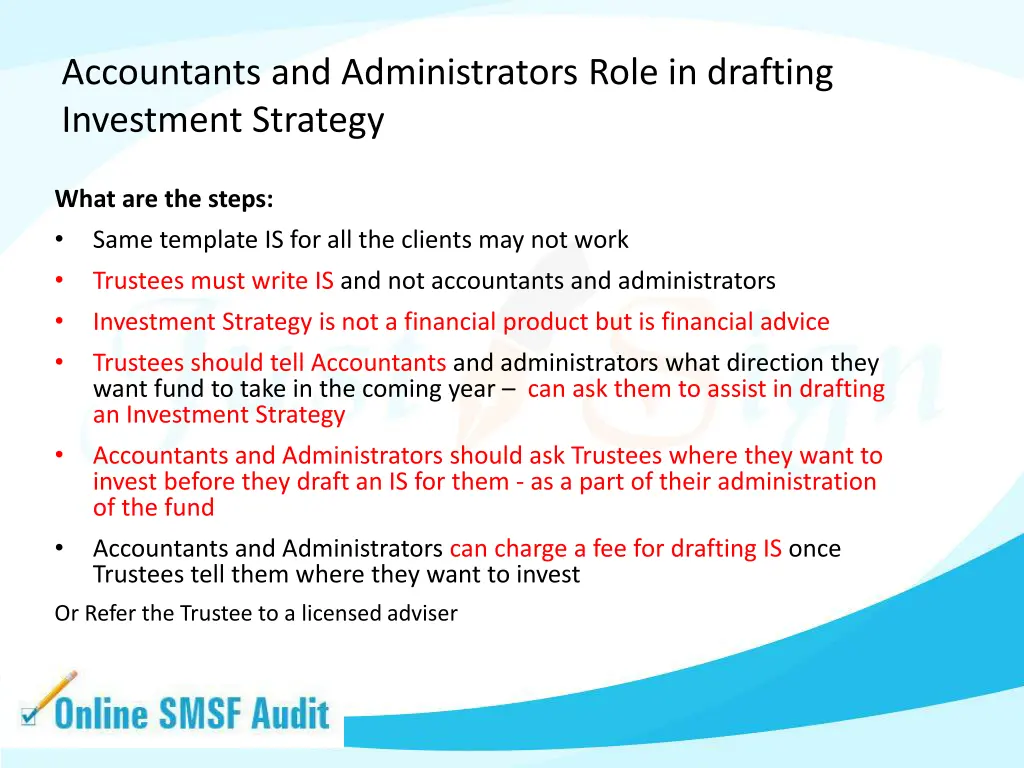
Accountants and Administrators Role in drafting Investment Strategy What are the steps: Same template IS for all the clients may not work Trustees must write IS and not accountants and administrators Investment Strategy is not a financial product but is financial advice Trustees should tell Accountants and administrators what direction they want fund to take in the coming year can ask them to assist in drafting an Investment Strategy Accountants and Administrators should ask Trustees where they want to invest before they draft an IS for them - as a part of their administration of the fund Accountants and Administrators can charge a fee for drafting IS once Trustees tell them where they want to invest Or Refer the Trustee to a licensed adviser
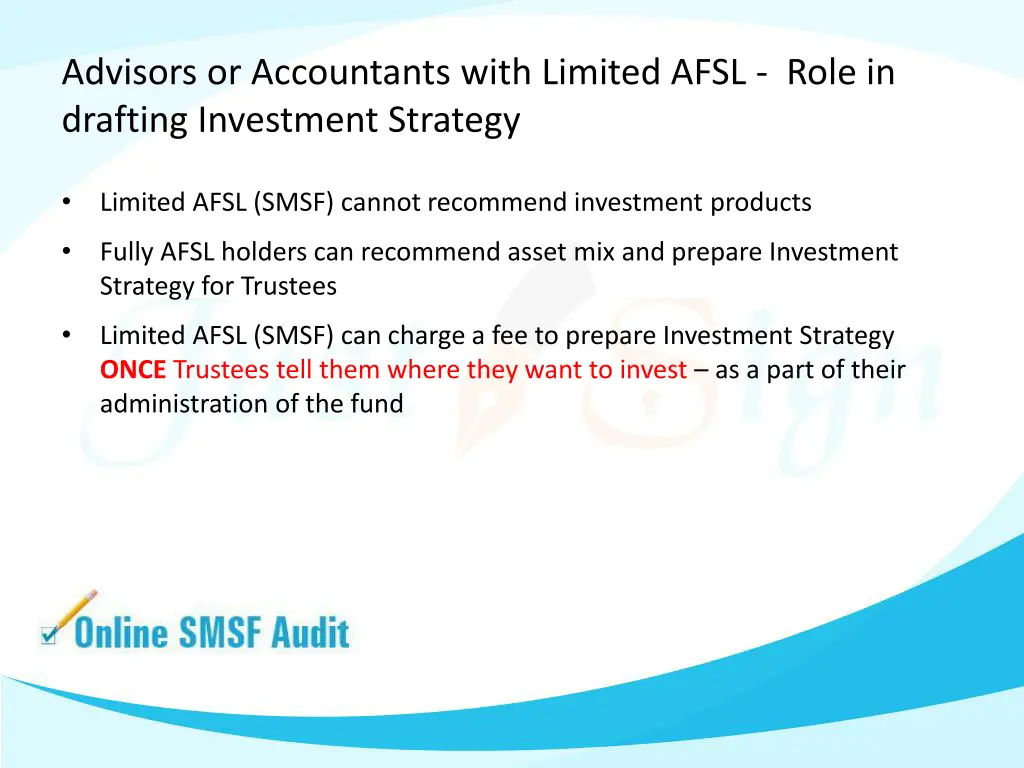
Advisors or Accountants with Limited AFSL - Role in drafting Investment Strategy Limited AFSL (SMSF) cannot recommend investment products Fully AFSL holders can recommend asset mix and prepare Investment Strategy for Trustees Limited AFSL (SMSF) can charge a fee to prepare Investment Strategy ONCE Trustees tell them where they want to invest as a part of their administration of the fund
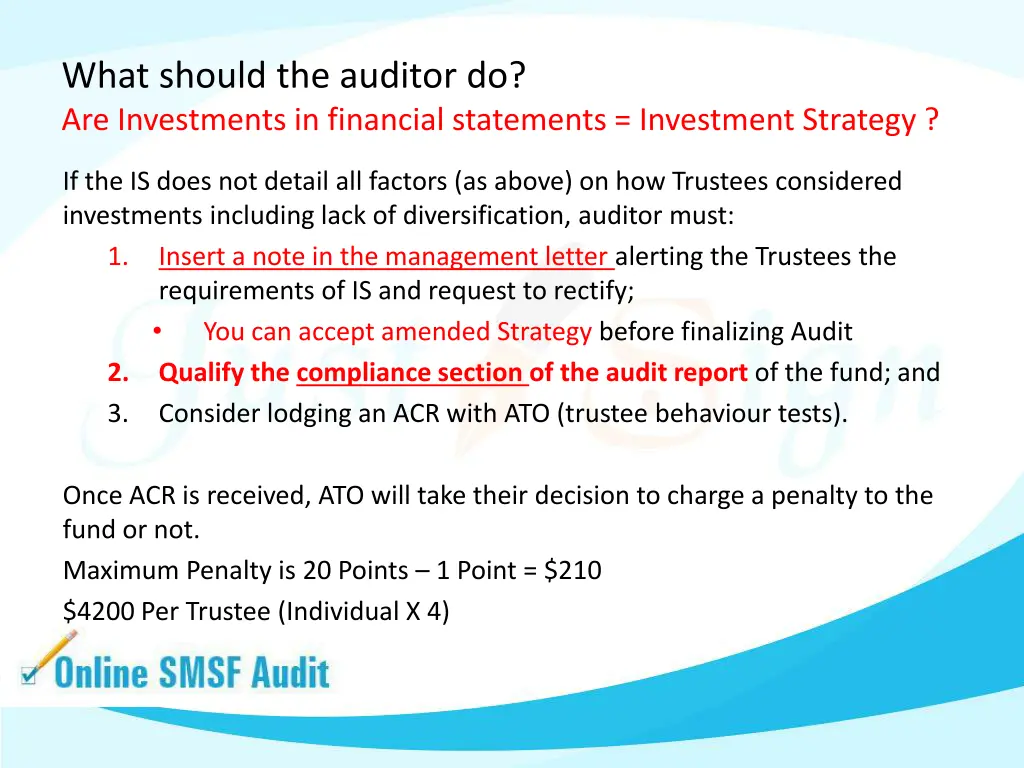
What should the auditor do? Are Investments in financial statements = Investment Strategy ? If the IS does not detail all factors (as above) on how Trustees considered investments including lack of diversification, auditor must: 1. Insert a note in the management letter alerting the Trustees the requirements of IS and request to rectify; You can accept amended Strategy before finalizing Audit 2. Qualify the compliance section of the audit report of the fund; and 3. Consider lodging an ACR with ATO (trustee behaviour tests). Once ACR is received, ATO will take their decision to charge a penalty to the fund or not. Maximum Penalty is 20 Points 1 Point = $210 $4200 Per Trustee (Individual X 4)
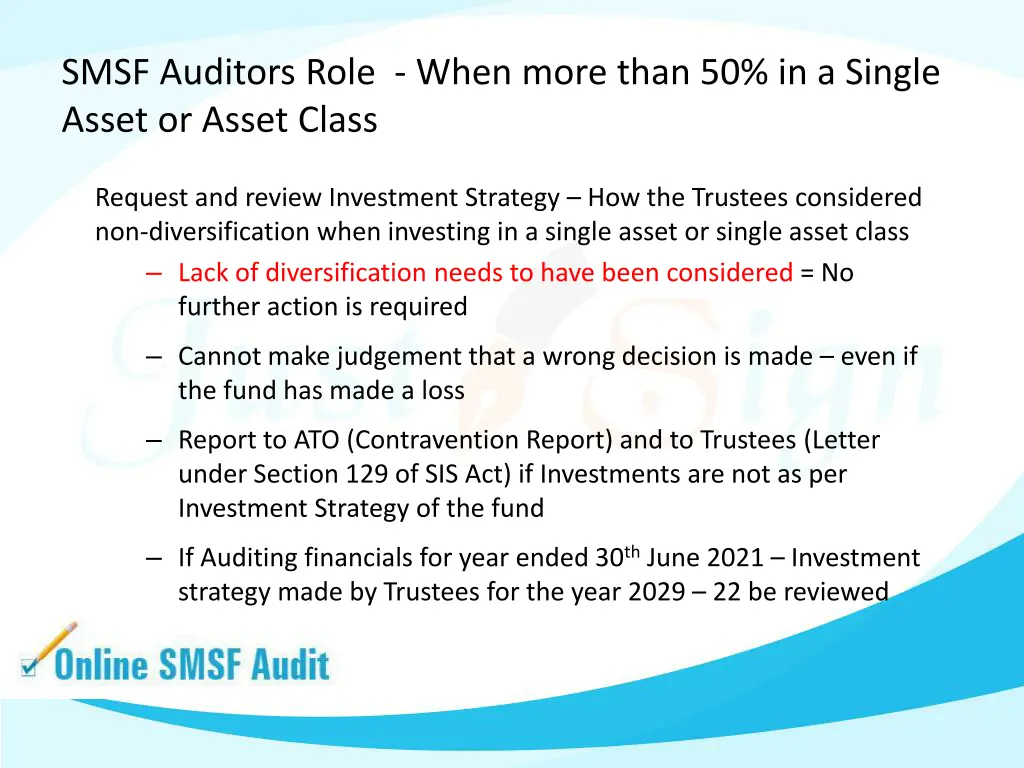
SMSF Auditors Role - When more than 50% in a Single Asset or Asset Class Request and review Investment Strategy How the Trustees considered non-diversification when investing in a single asset or single asset class Lack of diversification needs to have been considered = No further action is required Cannot make judgement that a wrong decision is made even if the fund has made a loss Report to ATO (Contravention Report) and to Trustees (Letter under Section 129 of SIS Act) if Investments are not as per Investment Strategy of the fund If Auditing financials for year ended 30th June 2021 Investment strategy made by Trustees for the year 2029 22 be reviewed
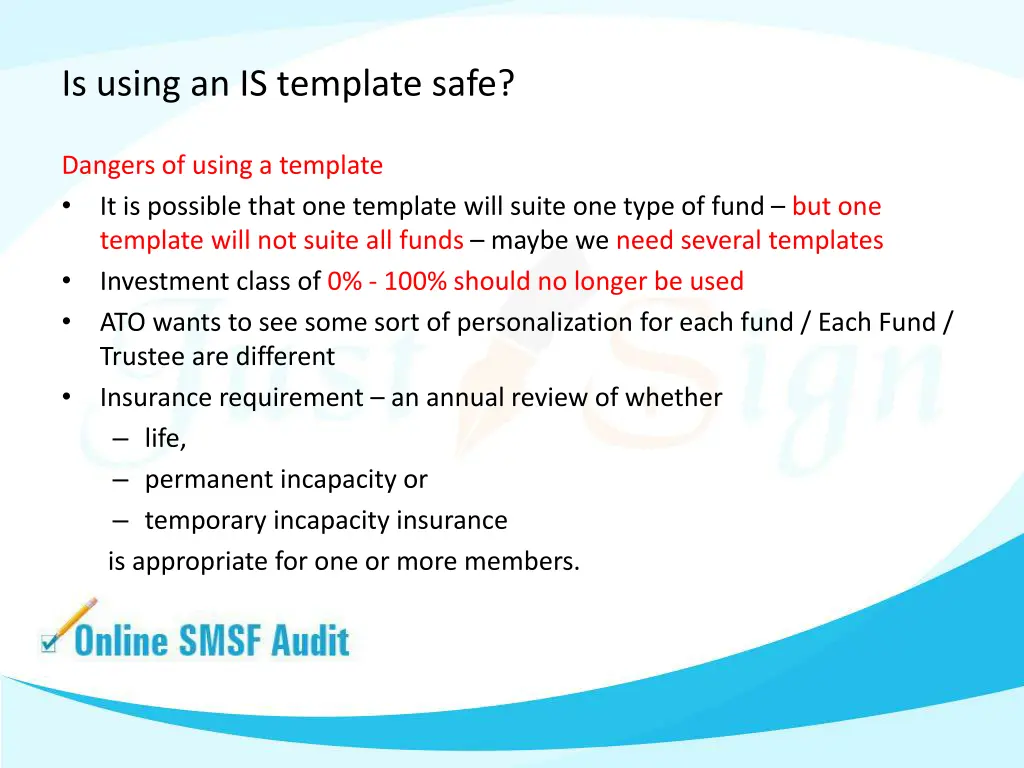
Is using an IS template safe? Dangers of using a template It is possible that one template will suite one type of fund but one template will not suite all funds maybe we need several templates Investment class of 0% - 100% should no longer be used ATO wants to see some sort of personalization for each fund / Each Fund / Trustee are different Insurance requirement an annual review of whether life, permanent incapacity or temporary incapacity insurance is appropriate for one or more members.
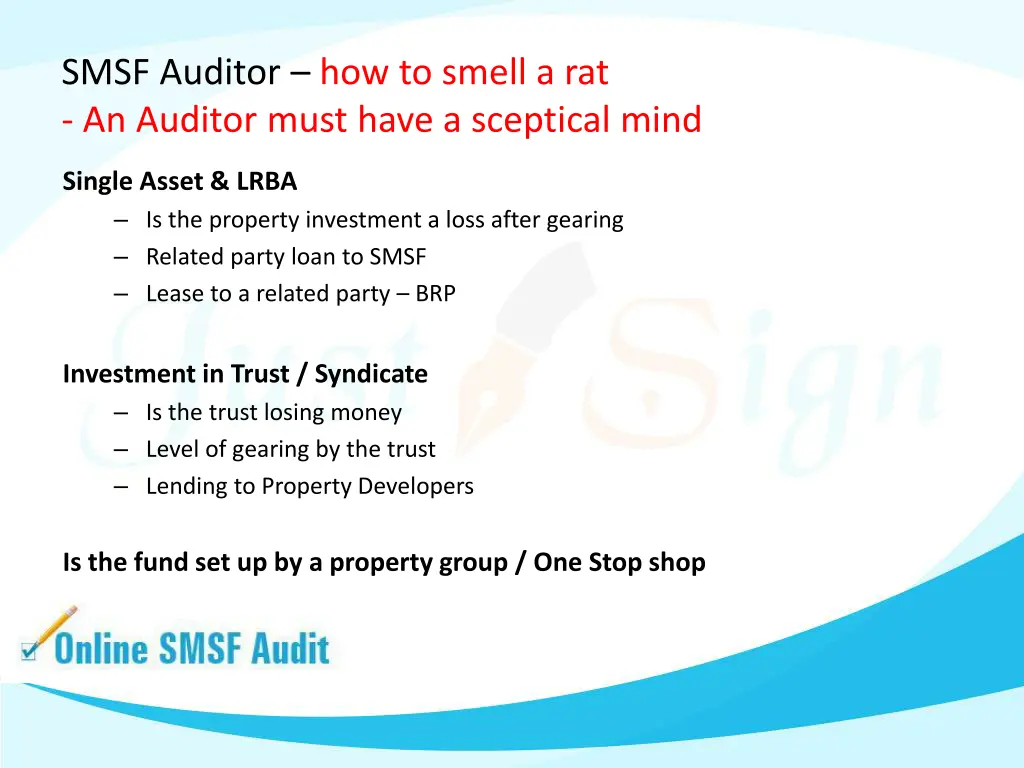
SMSF Auditor how to smell a rat - An Auditor must have a sceptical mind Single Asset & LRBA Is the property investment a loss after gearing Related party loan to SMSF Lease to a related party BRP Investment in Trust / Syndicate Is the trust losing money Level of gearing by the trust Lending to Property Developers Is the fund set up by a property group / One Stop shop
Any Questions ?? please visit our websites: www.trustdeed.com.au www.onlinesmsfaudit.com.au www.justsign.com.au and chat with our agent. Manoj Abichandani ASIC Approved SMSF Auditor SMSF Specialist (UNSW) Alternatively, you - contact us 0296844199 or Email us at sales@trustdeed.com.au sales@onlinesmsfaudit.com.au sales@justsign.com.au