IRB Review Levels and Requirements
Federal regulations outline various levels of IRB review for research projects involving human subjects. Understanding these levels – Not Human Subjects Determination, Exempt, Limited IRB Review, Expedited, and Full Committee – is essential for researchers to navigate the IRB process effectively and ensure compliance with regulations.

Download Presentation

Please find below an Image/Link to download the presentation.
The content on the website is provided AS IS for your information and personal use only. It may not be sold, licensed, or shared on other websites without obtaining consent from the author.If you encounter any issues during the download, it is possible that the publisher has removed the file from their server.
You are allowed to download the files provided on this website for personal or commercial use, subject to the condition that they are used lawfully. All files are the property of their respective owners.
The content on the website is provided AS IS for your information and personal use only. It may not be sold, licensed, or shared on other websites without obtaining consent from the author.
E N D
Presentation Transcript
26-28 Regional Training Workshop to Improve Use of Existing Data for Monitoring Gender Equality and Women s Empowerment in Africa. Africa s Development Agenda: Sustainable Africa s Development Agenda: Sustainable Development Goals and Agenda 2063 Development Goals and Agenda 2063 Fatouma Sissoko African Centre for Statistics Kampala, Uganda, 26-28 September 2017 1
Outline 1 - Background 2 - Regional Consultation on 2030 Agenda and Agenda 2063 in Africa 3 Convergence at Goal and target level 4 - List of indicators
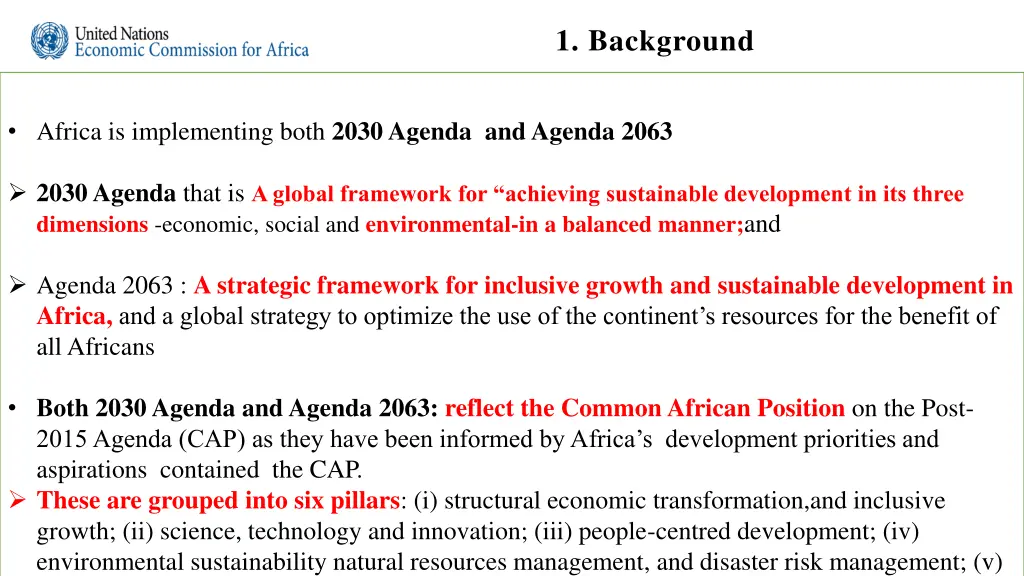
1. Background Africa is implementing both 2030 Agenda and Agenda 2063 2030 Agenda that is A global framework for achieving sustainable development in its three dimensions -economic, social and environmental-in a balanced manner;and Agenda 2063 : A strategic framework for inclusive growth and sustainable development in Africa,and a global strategy to optimize the use of the continent s resources for the benefit of all Africans Both 2030 Agenda and Agenda 2063: reflect the Common African Position on the Post- 2015 Agenda (CAP) as they have been informed by Africa s development priorities and aspirations contained the CAP. These are grouped into six pillars: (i) structural economic transformation,and inclusive growth; (ii) science, technology and innovation; (iii) people-centred development; (iv) environmental sustainability natural resources management, and disaster risk management; (v)
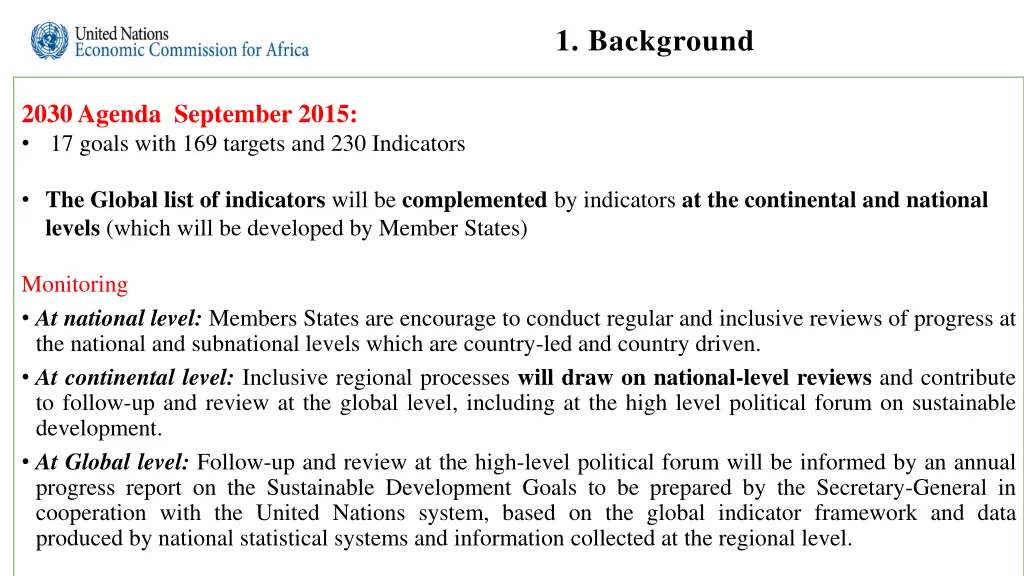
1. Background 2030 Agenda September 2015: 17 goals with 169 targets and 230 Indicators The Global list of indicators will be complemented by indicators at the continental and national levels (which will be developed by Member States) Monitoring At national level: Members States are encourage to conduct regular and inclusive reviews of progress at the national and subnational levels which are country-led and country driven. At continental level: Inclusive regional processes will draw on national-level reviews and contribute to follow-up and review at the global level, including at the high level political forum on sustainable development. At Global level: Follow-up and review at the high-level political forum will be informed by an annual progress report on the Sustainable Development Goals to be prepared by the Secretary-General in cooperation with the United Nations system, based on the global indicator framework and data produced by national statistical systems and information collected at the regional level.
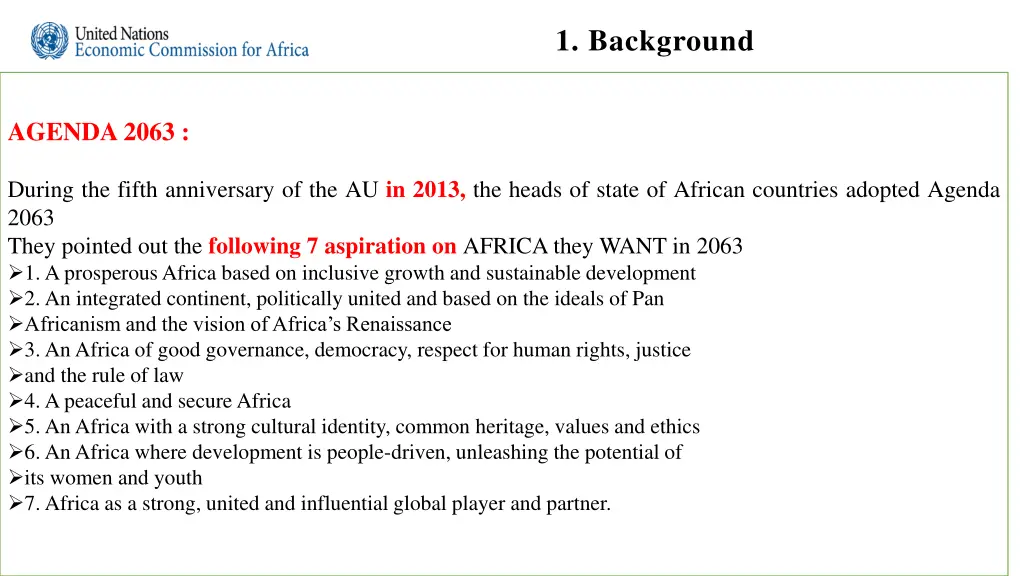
1. Background AGENDA 2063 : During the fifth anniversary of the AU in 2013, the heads of state of African countries adopted Agenda 2063 They pointed out the following 7 aspiration on AFRICA they WANT in 2063 1. A prosperous Africa based on inclusive growth and sustainable development 2. An integrated continent, politically united and based on the ideals of Pan Africanism and the vision of Africa s Renaissance 3. An Africa of good governance, democracy, respect for human rights, justice and the rule of law 4. A peaceful and secure Africa 5. An Africa with a strong cultural identity, common heritage, values and ethics 6. An Africa where development is people-driven, unleashing the potential of its women and youth 7. Africa as a strong, united and influential global player and partner.
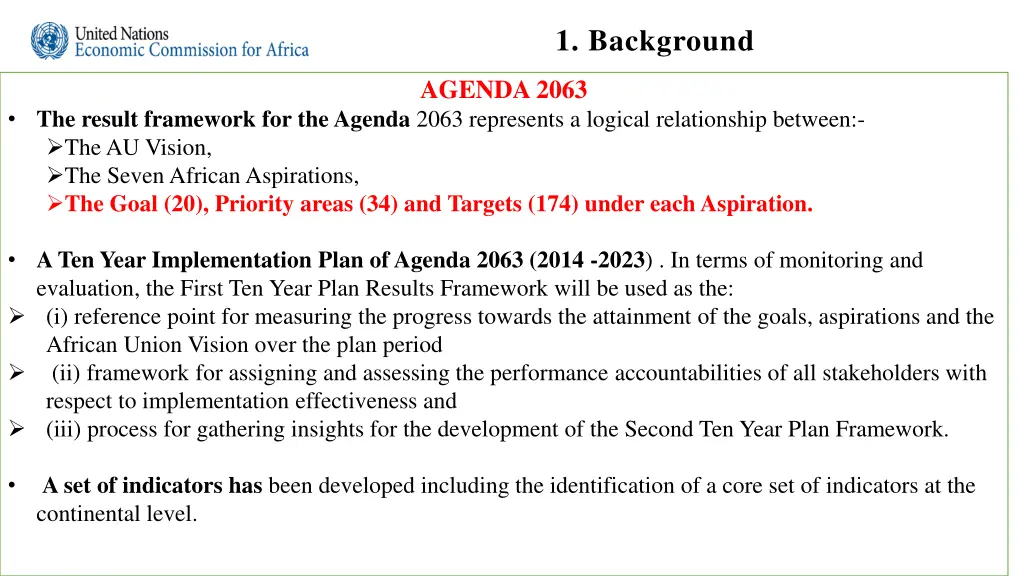
1. Background AGENDA 2063 The result framework for the Agenda 2063 represents a logical relationship between:- The AU Vision, The Seven African Aspirations, The Goal (20), Priority areas (34) and Targets (174) under each Aspiration. A Ten Year Implementation Plan of Agenda 2063 (2014 -2023) . In terms of monitoring and evaluation, the First Ten Year Plan Results Framework will be used as the: (i) reference point for measuring the progress towards the attainment of the goals, aspirations and the African Union Vision over the plan period (ii) framework for assigning and assessing the performance accountabilities of all stakeholders with respect to implementation effectiveness and (iii) process for gathering insights for the development of the Second Ten Year Plan Framework. A set of indicators has been developed including the identification of a core set of indicators at the continental level.
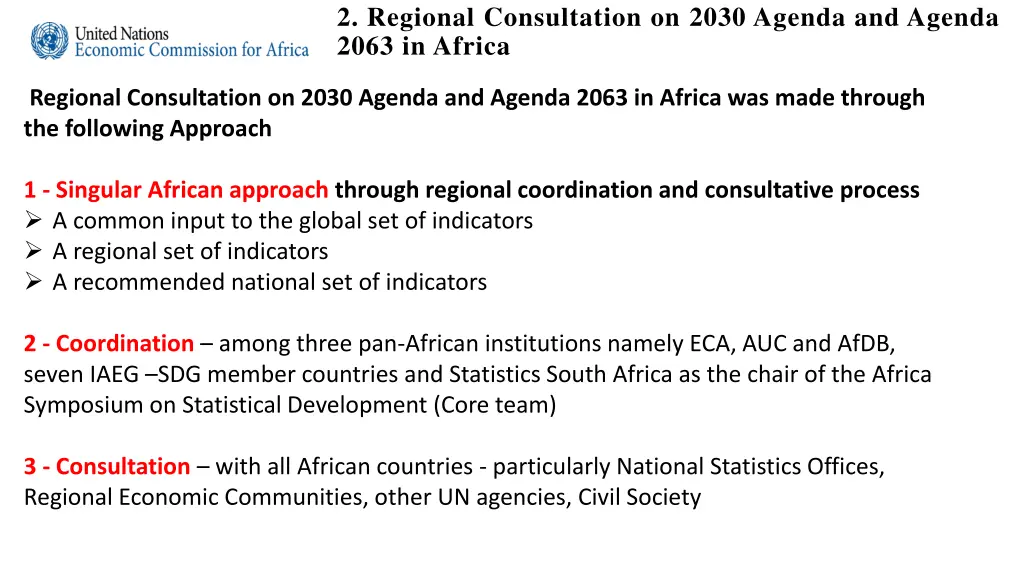
2. Regional Consultation on 2030 Agenda and Agenda 2063 in Africa Regional Consultation on 2030 Agenda and Agenda 2063 in Africa was made through the following Approach 1 - Singular African approach through regional coordination and consultative process A common input to the global set of indicators A regional set of indicators A recommended national set of indicators 2 - Coordination among three pan-African institutions namely ECA, AUC and AfDB, seven IAEG SDG member countries and Statistics South Africa as the chair of the Africa Symposium on Statistical Development (Core team) 3 - Consultation with all African countries - particularly National Statistics Offices, Regional Economic Communities, other UN agencies, Civil Society
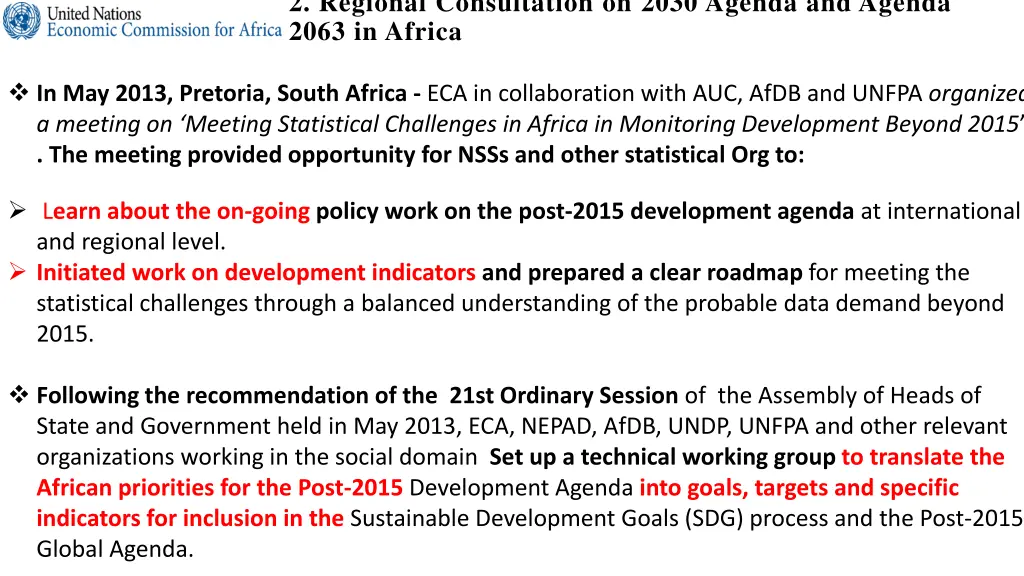
2. Regional Consultation on 2030 Agenda and Agenda 2063 in Africa In May 2013, Pretoria, South Africa - ECA in collaboration with AUC, AfDB and UNFPA organized a meeting on Meeting Statistical Challenges in Africa in Monitoring Development Beyond 2015 . The meeting provided opportunity for NSSs and other statistical Org to: Learn about the on-going policy work on the post-2015 development agenda at international and regional level. Initiated work on development indicators and prepared a clear roadmap for meeting the statistical challenges through a balanced understanding of the probable data demand beyond 2015. Following the recommendation of the 21st Ordinary Session of the Assembly of Heads of State and Government held in May 2013, ECA, NEPAD, AfDB, UNDP, UNFPA and other relevant organizations working in the social domain Set up a technical working group to translate the African priorities for the Post-2015 Development Agenda into goals, targets and specific indicators for inclusion in the Sustainable Development Goals (SDG) process and the Post-2015 Global Agenda.
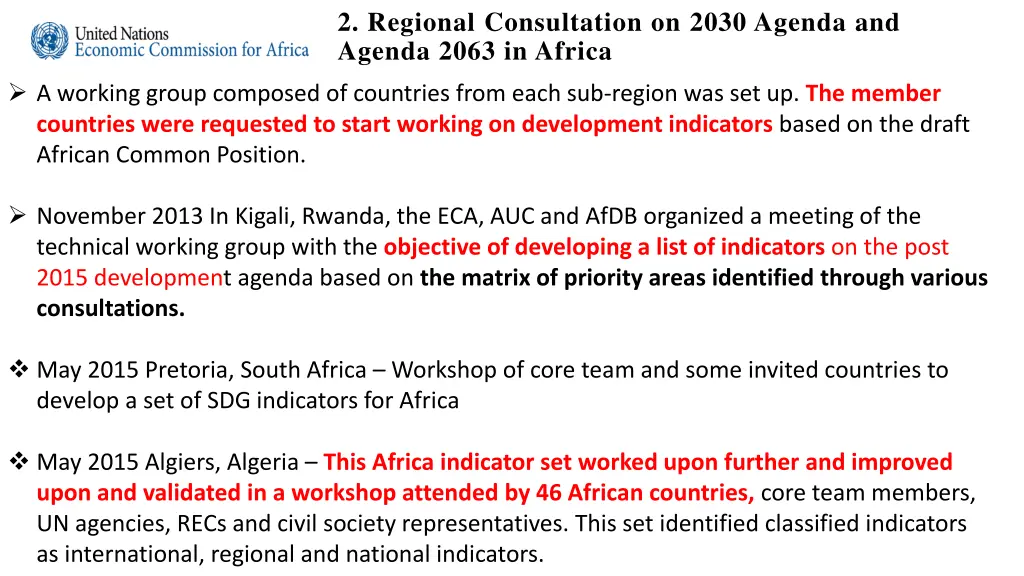
2. Regional Consultation on 2030 Agenda and Agenda 2063 in Africa A working group composed of countries from each sub-region was set up. The member countries were requested to start working on development indicators based on the draft African Common Position. November 2013 In Kigali, Rwanda, the ECA, AUC and AfDB organized a meeting of the technical working group with the objective of developing a list of indicators on the post 2015 development agenda based on the matrix of priority areas identified through various consultations. May 2015 Pretoria, South Africa Workshop of core team and some invited countries to develop a set of SDG indicators for Africa May 2015 Algiers, Algeria This Africa indicator set worked upon further and improved upon and validated in a workshop attended by 46 African countries, core team members, UN agencies, RECs and civil society representatives. This set identified classified indicators as international, regional and national indicators.
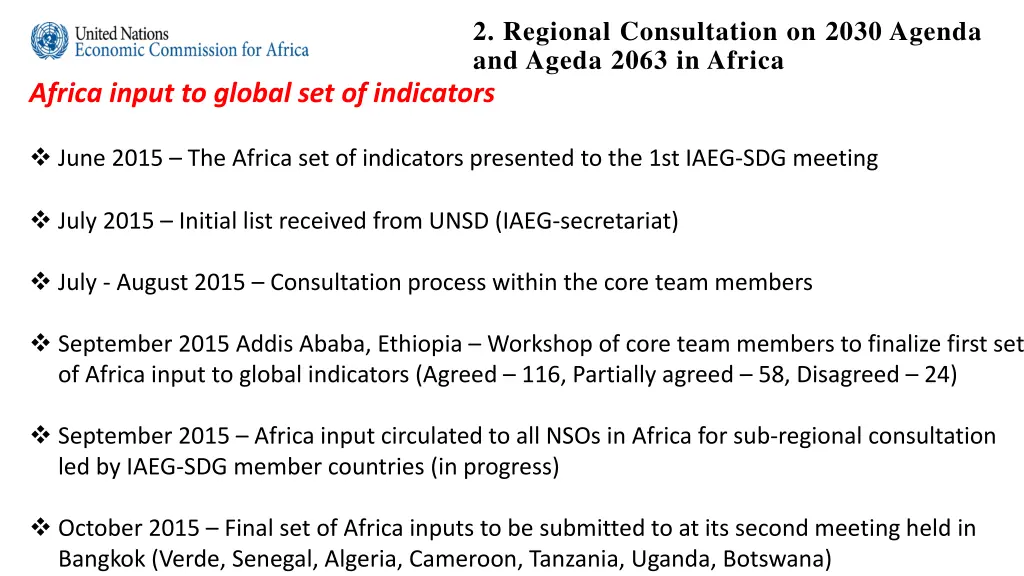
2. Regional Consultation on 2030 Agenda and Ageda 2063 in Africa Africa input to global set of indicators June 2015 The Africa set of indicators presented to the 1st IAEG-SDG meeting July 2015 Initial list received from UNSD (IAEG-secretariat) July - August 2015 Consultation process within the core team members September 2015 Addis Ababa, Ethiopia Workshop of core team members to finalize first set of Africa input to global indicators (Agreed 116, Partially agreed 58, Disagreed 24) September 2015 Africa input circulated to all NSOs in Africa for sub-regional consultation led by IAEG-SDG member countries (in progress) October 2015 Final set of Africa inputs to be submitted to at its second meeting held in Bangkok (Verde, Senegal, Algeria, Cameroon, Tanzania, Uganda, Botswana)
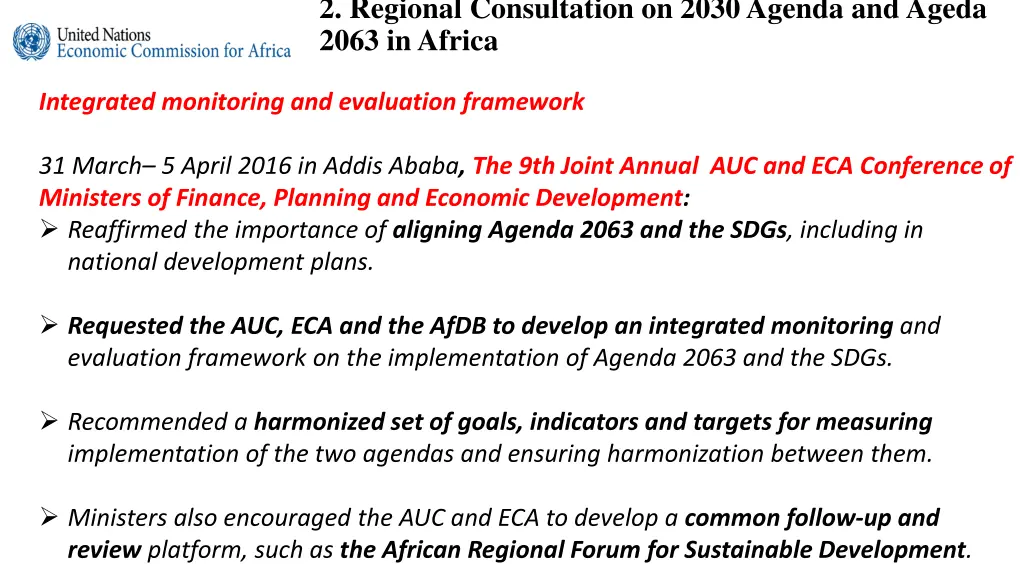
2. Regional Consultation on 2030 Agenda and Ageda 2063 in Africa Integrated monitoring and evaluation framework 31 March 5 April 2016 in Addis Ababa, The 9th Joint Annual AUC and ECA Conference of Ministers of Finance, Planning and Economic Development: Reaffirmed the importance of aligning Agenda 2063 and the SDGs, including in national development plans. Requested the AUC, ECA and the AfDB to develop an integrated monitoring and evaluation framework on the implementation of Agenda 2063 and the SDGs. Recommended a harmonized set of goals, indicators and targets for measuring implementation of the two agendas and ensuring harmonization between them. Ministers also encouraged the AUC and ECA to develop a common follow-up and review platform, such as the African Regional Forum for Sustainable Development.
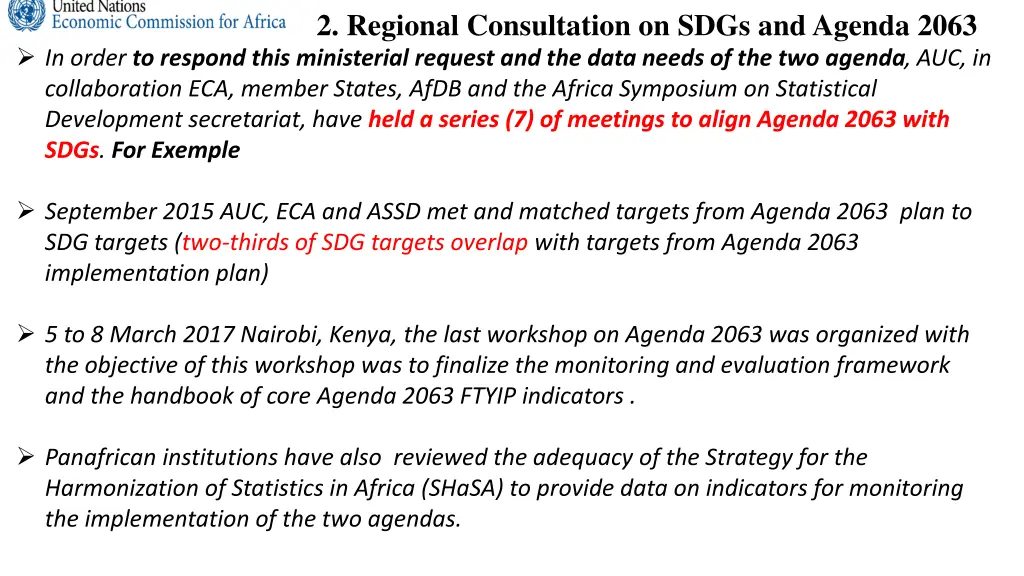
2. Regional Consultation on SDGs and Agenda 2063 In order to respond this ministerial request and the data needs of the two agenda, AUC, in collaboration ECA, member States, AfDB and the Africa Symposium on Statistical Development secretariat, have held a series (7) of meetings to align Agenda 2063 with SDGs. For Exemple September 2015 AUC, ECA and ASSD met and matched targets from Agenda 2063 plan to SDG targets (two-thirds of SDG targets overlap with targets from Agenda 2063 implementation plan) 5 to 8 March 2017 Nairobi, Kenya, the last workshop on Agenda 2063 was organized with the objective of this workshop was to finalize the monitoring and evaluation framework and the handbook of core Agenda 2063 FTYIP indicators . Panafrican institutions have also reviewed the adequacy of the Strategy for the Harmonization of Statistics in Africa (SHaSA) to provide data on indicators for monitoring the implementation of the two agendas.
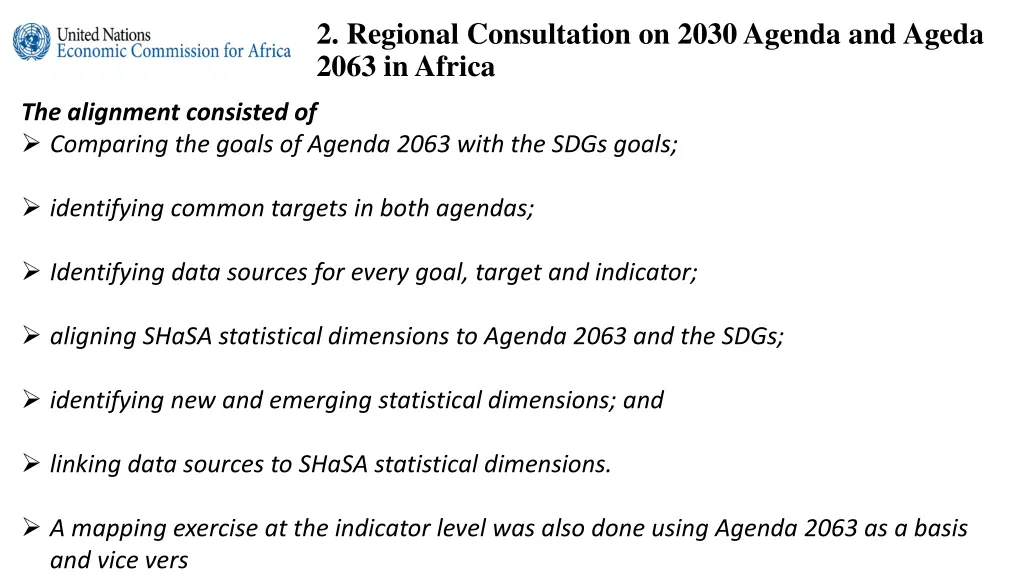
2. Regional Consultation on 2030 Agenda and Ageda 2063 in Africa The alignment consisted of Comparing the goals of Agenda 2063 with the SDGs goals; identifying common targets in both agendas; Identifying data sources for every goal, target and indicator; aligning SHaSA statistical dimensions to Agenda 2063 and the SDGs; identifying new and emerging statistical dimensions; and linking data sources to SHaSA statistical dimensions. A mapping exercise at the indicator level was also done using Agenda 2063 as a basis and vice vers
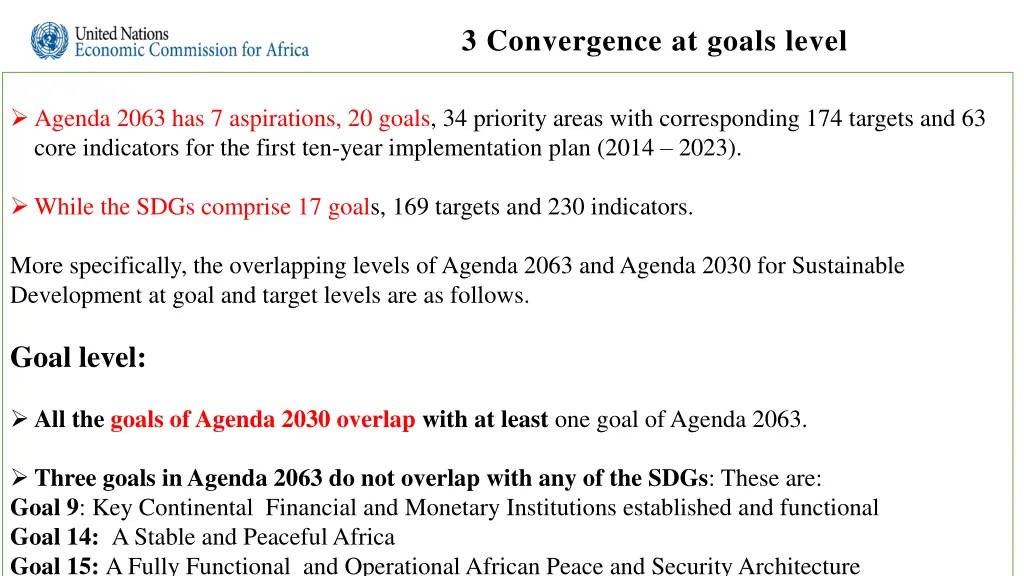
3 Convergence at goals level Agenda 2063 has 7 aspirations, 20 goals, 34 priority areas with corresponding 174 targets and 63 core indicators for the first ten-year implementation plan (2014 2023). While the SDGs comprise 17 goals, 169 targets and 230 indicators. More specifically, the overlapping levels of Agenda 2063 and Agenda 2030 for Sustainable Development at goal and target levels are as follows. Goal level: All the goals of Agenda 2030 overlap with at least one goal of Agenda 2063. Three goals in Agenda 2063 do not overlap with any of the SDGs: These are: Goal 9: Key Continental Financial and Monetary Institutions established and functional Goal 14: A Stable and Peaceful Africa Goal 15: A Fully Functional and Operational African Peace and Security Architecture
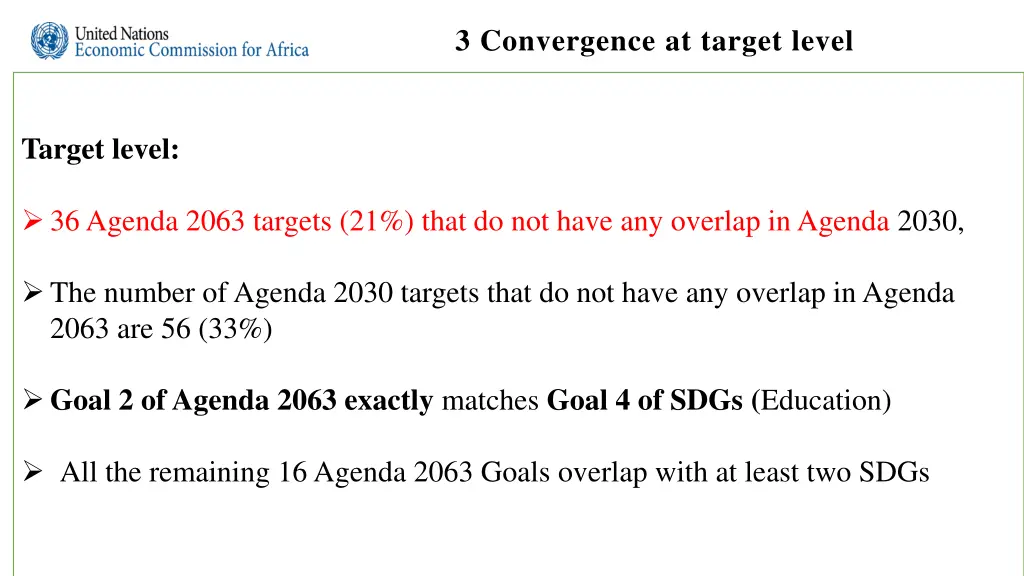
3 Convergence at target level Target level: 36 Agenda 2063 targets (21%) that do not have any overlap in Agenda 2030, The number of Agenda 2030 targets that do not have any overlap in Agenda 2063 are 56 (33%) Goal 2 of Agenda 2063 exactly matches Goal 4 of SDGs (Education) All the remaining 16 Agenda 2063 Goals overlap with at least two SDGs
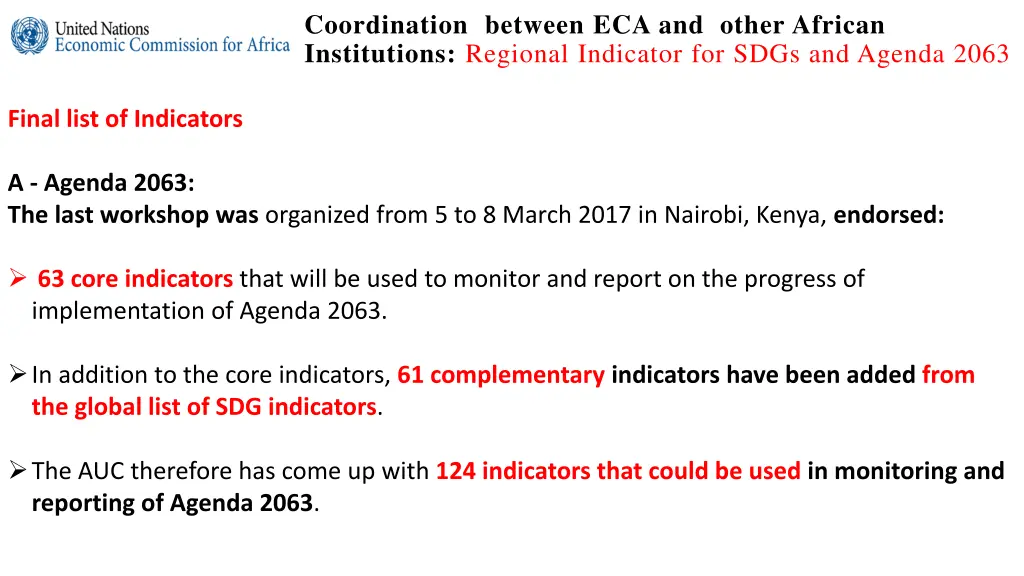
Coordination between ECA and other African Institutions: Regional Indicator for SDGs and Agenda 2063 Final list of Indicators A - Agenda 2063: The last workshop was organized from 5 to 8 March 2017 in Nairobi, Kenya, endorsed: 63 core indicators that will be used to monitor and report on the progress of implementation of Agenda 2063. In addition to the core indicators, 61 complementary indicators have been added from the global list of SDG indicators. The AUC therefore has come up with 124 indicators that could be used in monitoring and reporting of Agenda 2063.
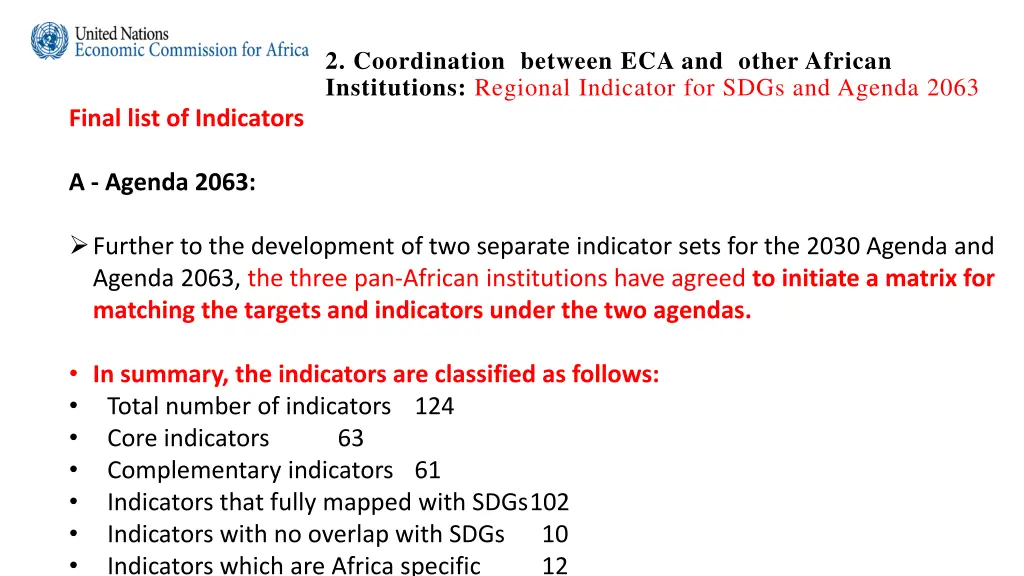
2. Coordination between ECA and other African Institutions: Regional Indicator for SDGs and Agenda 2063 Final list of Indicators A - Agenda 2063: Further to the development of two separate indicator sets for the 2030 Agenda and Agenda 2063, the three pan-African institutions have agreed to initiate a matrix for matching the targets and indicators under the two agendas. In summary, the indicators are classified as follows: Total number of indicators 124 Core indicators 63 Complementary indicators 61 Indicators that fully mapped with SDGs 102 Indicators with no overlap with SDGs 10 Indicators which are Africa specific 12
2 - Regional Consultation on 2030 Agenda and Agenda 2063 in Africa Final List B. 2030 Agenda for Sustainable Development At ECA level, the African Centre for Statistics (ACS) has been leading the process of developing the regional indicator framework for 2030 Agenda for Sustainable Development. During the second half of 2016, ACShas proposed an initial list of 84 regional indicators and invited substantive divisions to supplement the list based on their data requirements. Accordingly, the ECA substantive divisions have provided their inputs during the consultation process. In November 2016, the ACS has finalized the compilation process and came up with 199 regional indicators that could be used to monitor and report on Agenda 2030 for Sustainable Development.
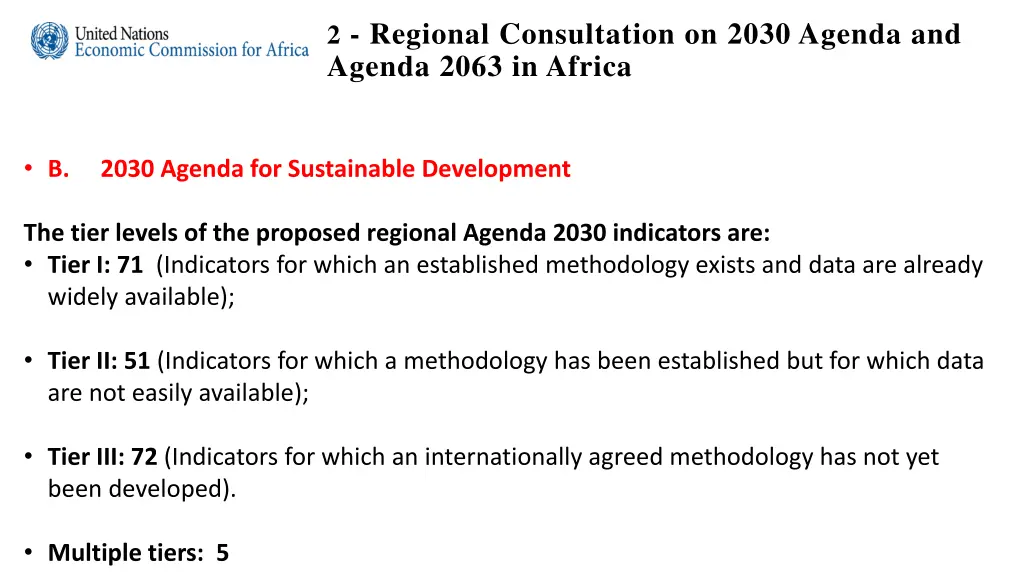
2 - Regional Consultation on 2030 Agenda and Agenda 2063 in Africa B. 2030 Agenda for Sustainable Development The tier levels of the proposed regional Agenda 2030 indicators are: Tier I: 71 (Indicators for which an established methodology exists and data are already widely available); Tier II: 51 (Indicators for which a methodology has been established but for which data are not easily available); Tier III: 72 (Indicators for which an internationally agreed methodology has not yet been developed). Multiple tiers: 5
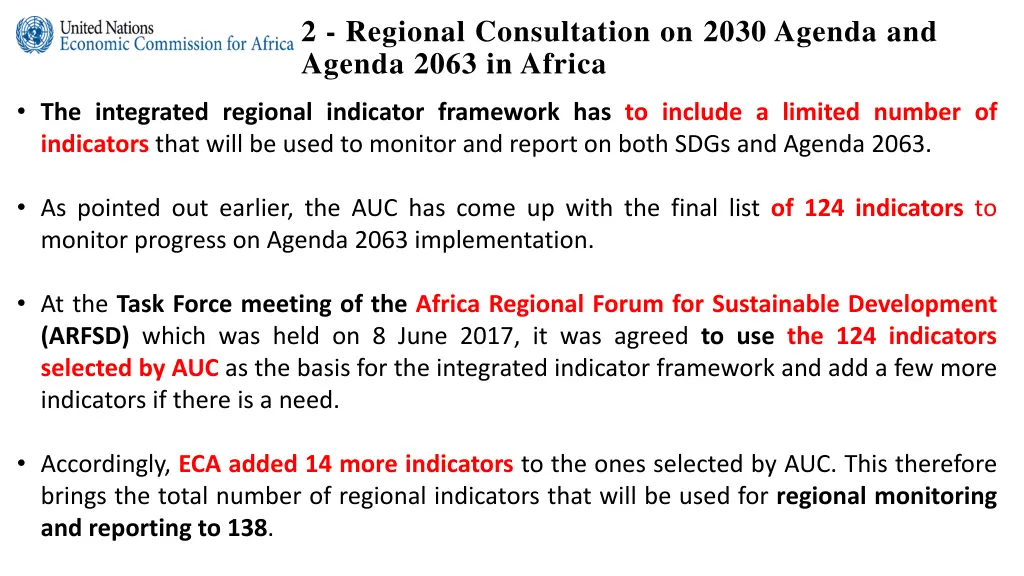
2 - Regional Consultation on 2030 Agenda and Agenda 2063 in Africa The integrated regional indicator framework has to include a limited number of indicators that will be used to monitor and report on both SDGs and Agenda 2063. As pointed out earlier, the AUC has come up with the final list of 124 indicators to monitor progress on Agenda 2063 implementation. At the Task Force meeting of the Africa Regional Forum for Sustainable Development (ARFSD) which was held on 8 June 2017, it was agreed to use the 124 indicators selected by AUC as the basis for the integrated indicator framework and add a few more indicators if there is a need. Accordingly, ECA added 14 more indicators to the ones selected by AUC. This therefore brings the total number of regional indicators that will be used for regional monitoring and reporting to 138.
2 - Regional Consultation on 2030 Agenda and Agenda 2063 in Africa C. Other coordination between ECA and other African institutions in the M&I of the two agenda The establishment of the (RFSD) and its institutionalization, in 2015, by the Joint Conference of Ministers of the ECA and AUC: The RFSD is an intergovernmental mechanism convened by ECA, in collaboration with the AUC, the AfDB and other partners, on an annual basis to: follow up and review the Addis Ababa Action Agenda, Agenda 2063 and the 2030 Agenda for Sustainable; to review progress towards SDGs in the continent and exchange experience in their implementation.
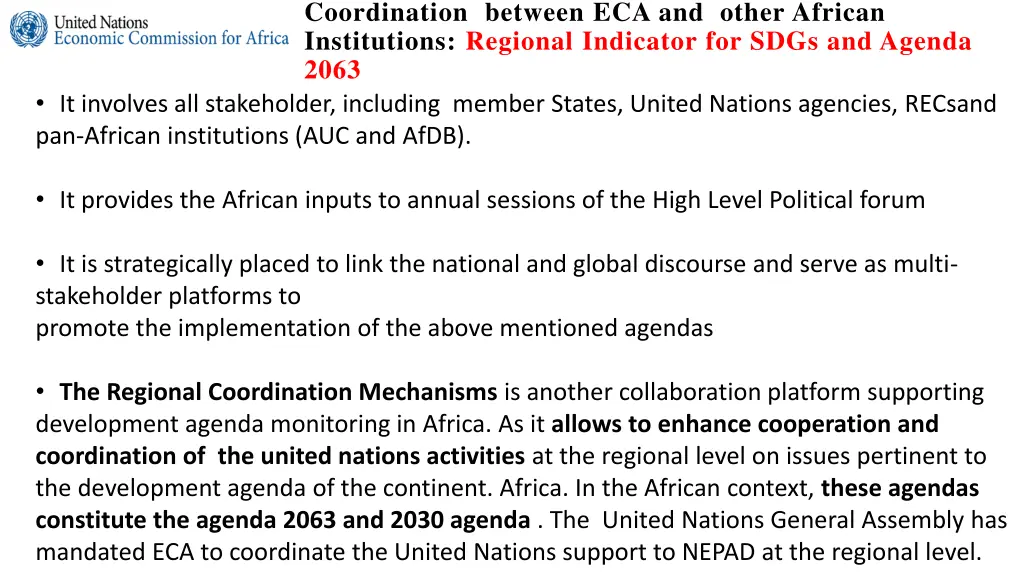
Coordination between ECA and other African Institutions: Regional Indicator for SDGs and Agenda 2063 It involves all stakeholder, including member States, United Nations agencies, RECsand pan-African institutions (AUC and AfDB). It provides the African inputs to annual sessions of the High Level Political forum It is strategically placed to link the national and global discourse and serve as multi- stakeholder platforms to promote the implementation of the above mentioned agendas The Regional Coordination Mechanisms is another collaboration platform supporting development agenda monitoring in Africa. As it allows to enhance cooperation and coordination of the united nations activities at the regional level on issues pertinent to the development agenda of the continent. Africa. In the African context, these agendas constitute the agenda 2063 and 2030 agenda . The United Nations General Assembly has mandated ECA to coordinate the United Nations support to NEPAD at the regional level.
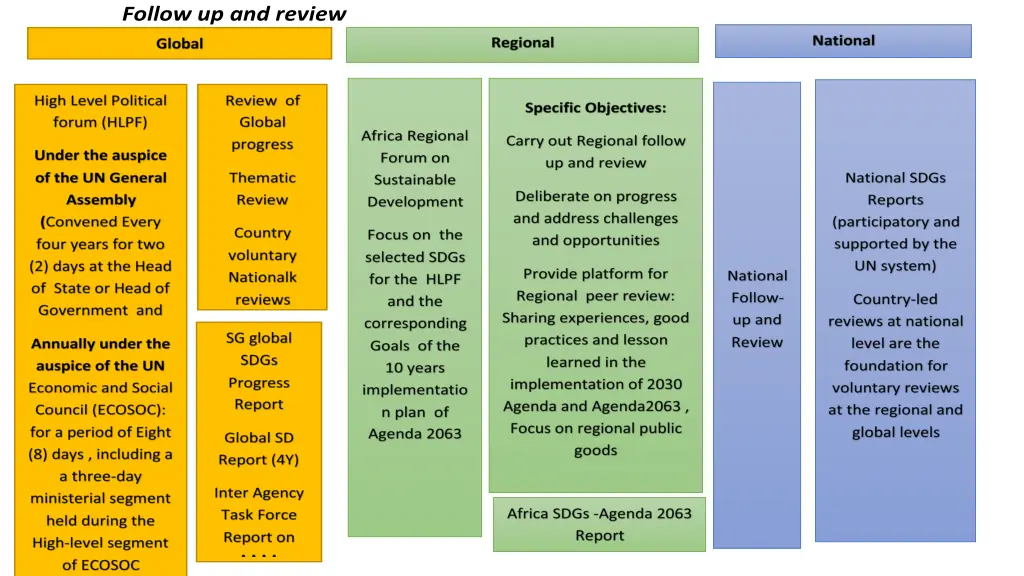
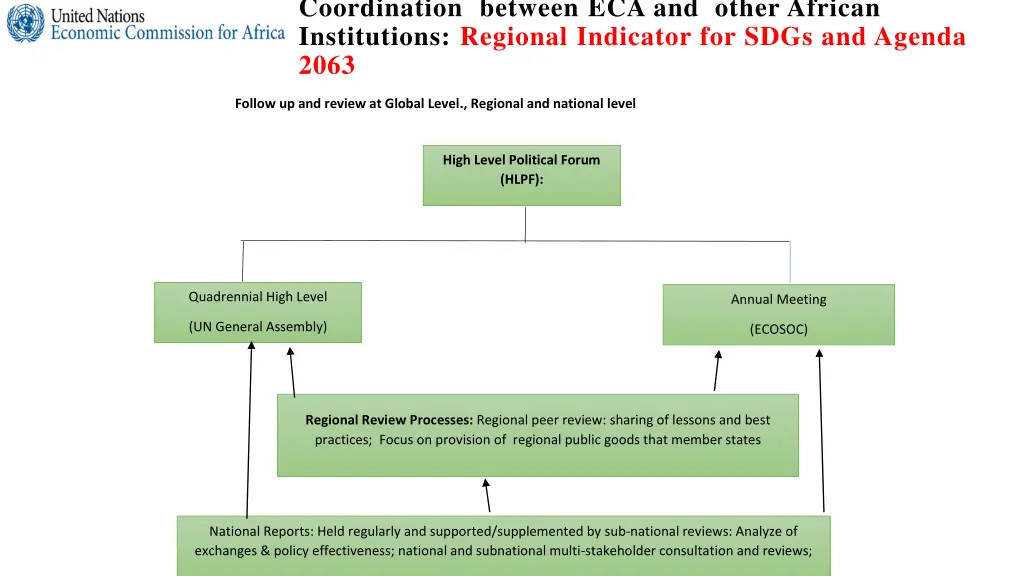
Coordination between ECA and other African Institutions: Regional Indicator for SDGs and Agenda 2063 Follow up and review at Global Level., Regional and national level High Level Political Forum (HLPF): Quadrennial High Level Annual Meeting (UN General Assembly) (ECOSOC) Regional Review Processes: Regional peer review: sharing of lessons and best practices; Focus on provision of regional public goods that member states National Reports: Held regularly and supported/supplemented by sub-national reviews: Analyze of exchanges & policy effectiveness; national and subnational multi-stakeholder consultation and reviews;
Thank You Please visit us at: http://www.uneca.org/acs