Issues Faced by Older People with Substance Misuse Problems
Older people face unique challenges related to substance misuse, such as complex physical and psychiatric issues, social factors like bereavement and retirement, and potential misuse of legal and illegal drugs. Despite these challenges, older individuals respond positively to treatment and care plans tailored to their specific needs. Understanding these distinctive issues is crucial for healthcare professionals providing effective support to older adults dealing with substance misuse.

Download Presentation

Please find below an Image/Link to download the presentation.
The content on the website is provided AS IS for your information and personal use only. It may not be sold, licensed, or shared on other websites without obtaining consent from the author. If you encounter any issues during the download, it is possible that the publisher has removed the file from their server.
You are allowed to download the files provided on this website for personal or commercial use, subject to the condition that they are used lawfully. All files are the property of their respective owners.
The content on the website is provided AS IS for your information and personal use only. It may not be sold, licensed, or shared on other websites without obtaining consent from the author.
E N D
Presentation Transcript
Substance Misuse Factsheet Slides- Category IV Distinctive Groups: Older People September 2015
Recognition of core distinctive issues for older people with substance misuse Appreciation of key components of a detailed history relevant to older people Provide effective advice about the impact of substances on daily living Initiation of a care plan appropriate to older people Acknowledgement that older people do respond positively to effective treatment September 2015
Older people present with complex problems which may be atypical and subtle Physical health problems can precipitate substance misuse in older people Psychiatric comorbidities are common in older people with substance problems Social issues e.g. bereavement, retirement, may be associated September 2015
Older people, 60+, will constitute 42% of the UK population by 2027 Older generally means over the age of 60, though it can refer to clients over 40 years, or over 50 years Older people are using more legal & illegal drugs including over the counter & prescription drugs 22% men,17% women over 60 still smoke 60% NHS prescriptions for over 60s, Alcohol consumption above adult safe limits : 20% in men, 10% in women over 65 Highest alcohol death rate is in ages 55-74 September 2015
Older people can present in any health and social care setting with the effects of substance use but older people fail to get same attention as younger people Alcohol & prescription drugs are the most commonly used substances in the older age group Number of people aged 60+ receiving drug treatment has increased rapidly during the period 2006-2013 Older people may take more than prescribed due to poor memory, concentration, and judgment, anxiety, malaise Effects may be misattributed to ageing, or stereotyping substance use are a young person s activity 62% of older people aged 60+ who receive treatment complete treatment free of dependency compared to 47% of 18-59 yr olds September 2015
The relationship may be missed due to atypical and subtle presentation Substances can interact with physical and mental health conditions which are part of ageing, and for which medications are prescribed Older people drink less but more frequently than younger counterparts The impact from a similar amount at a younger age may be greater in old age September 2015
Older people may: Feel stigmatised Fear being judged Feel no one cares about them, there is no one to care for them Feel they are a burden, and no one is there to help September 2015
Practitioners: are not trained are not confident do not easily recognise atypical or subtle presentations Do not have a high index of suspicion September 2015
Sleep complaints Cognitive impairment, memory or concentration disturbance Depression and anxiety Pain Liver function abnormalities Incontinence Poor hygiene and self neglect Unusual restlessness/agitation or persistent tiredness Unexplained nausea and vomiting Changes in eating habits Alteration in and erratic behaviour Slurred speech, tremor, poor coordination Frequent falls and unexplained bruising Requests for more prescription drugs Evidence of illegal activities September 2015
Demographics Age/Sex/ethnicity/living arrangements/living environment Presenting problem may be masked Past and Family Psychiatric history Occupational and Psychosexual history Medical history (especially known complications from substance and effects on existing age-related impairment) Forensic history (especially public order and acquisitive offences) September 2015
Discuss substances separately (Alcohol/nicotine/OTC/prescribed/Illicit) - Age at first use, weekend, weekly, daily use - Age of dependence syndrome - Maximum use and when/how long - Pattern (Quantity/Frequency) over day/week - Route - Cost/ funding - Abstinence/relapse, link stability/life events - Preferred substance(s) Treatment (dates, service, intervention, outcome) September 2015
Consent and Capacity Social vulnerability Risk of falls, social/cultural isolation, financial abuse Social function Activities of daily living, statutory/voluntary/private care Social support Informal carers and friends Social pressures Debt, substance using carers , open drug dealing Investigations (including cognitive testing and neuroimaging) September 2015
Collateral information Relatives GP consultations and medications Hospital discharge summaries Home carers Day centres Housing officers/Wardens of Sheltered accommodation Criminal justice agencies September 2015
Evidence exists which demonstrates that older people want to stop substance use and do well with treatment The treatment that is offered will depends on the nature and extent of the problems and availability and accessibility of services Assess to what extent patient wishes to change pattern of substance use Support with reducing/abstaining from substance use should be given May include home visits, supervision by medical and care staff or family, admission to hospital e.g. detoxification for acute presentation with alcohol withdrawal Withdrawal of unnecessary prescribed medication gradually September 2015
Pharmacological treatment should be undertaken cautiously and be safe, effective and tolerated Diagnosis of dependence is necessary Medication for substitution therapy should be initiated after discussion with an addiction specialist Medications are usually prescribed at about half that for adults Short acting benzodiazepines are first choice for alcohol withdrawal Some medications e.g. acamprosate, naltrexone and disulfiram should be administered with extreme caution Pharmacological treatment should always be implemented within the context of psychosocial interventions September 2015
No single empirically supported approach which is superior Responsive to needs and supports adaptive strategies Education and advice Brief interventions Motivational interviewing Cognitive behavioural therapy Mutual self help September 2015
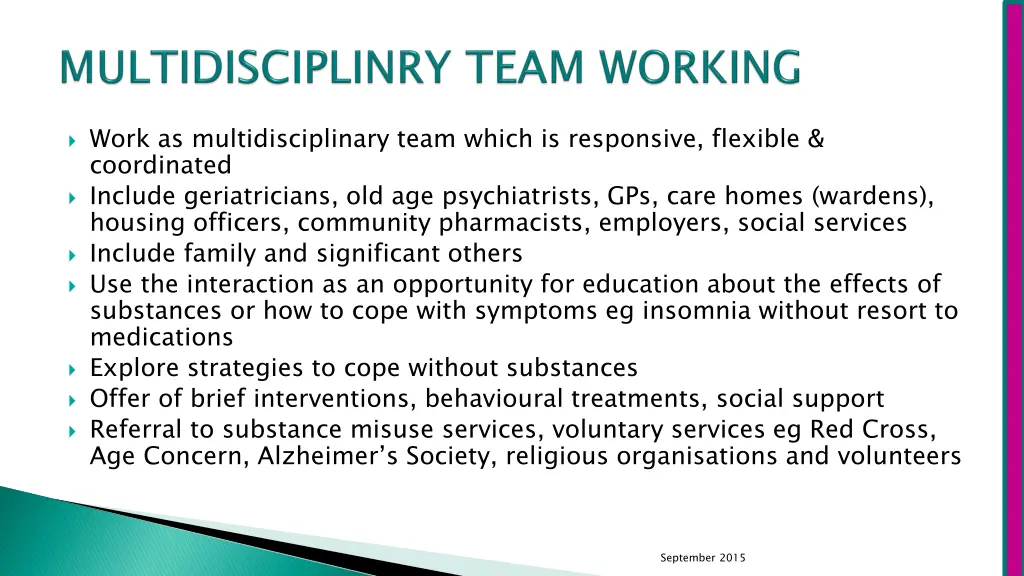
Work as multidisciplinary team which is responsive, flexible & coordinated Include geriatricians, old age psychiatrists, GPs, care homes (wardens), housing officers, community pharmacists, employers, social services Include family and significant others Use the interaction as an opportunity for education about the effects of substances or how to cope with symptoms eg insomnia without resort to medications Explore strategies to cope without substances Offer of brief interventions, behavioural treatments, social support Referral to substance misuse services, voluntary services eg Red Cross, Age Concern, Alzheimer s Society, religious organisations and volunteers September 2015
Threshold for admission for older people is lower than adults Criteria: Chaotic lifestyle, heavy substance use and dependence, emergency presentations, comorbid conditions, social circumstances Exclude head injury (detected or suspected), infections, malnutrition, depression, Wernicke Korsakoff Exclude other causes of thiamine deficiency eg AIDS, thyrotoxicosis, metastases, congestive heart failure, thyrotoxicosis Assess the need to institute treatment immediately eg if Wernicke Korsakoff s is a possibility Undertake investigations on serum and urine September 2015
The number of older people with substance use problems is rising as is the proportion of older people in our population Older people are entitled to the same treatment as young people Older people can and do respond to effective treatment Older people have distinctive differences which impact on the manner in which assessment and treatment are delivered September 2015
http kingdom/2013/stb http 2012 ASH PHE (2014) Alcohol statistics The Forgotten People: Drug in Later Life: A Report for the Big Lottery Fund https://www.basw.co.uk/resource/? http://www.ons.gov.uk/ons/rel/subnational kingdom/2013/stb--- http:// 2012- -based ASH Smoking Statistics Illness and death 2014, PHE (2014) Alcohol treatment statistics- -2013 The Forgotten People: Drug in Later Life: A Report for the Big Lottery Fund July 2014 https://www.basw.co.uk/resource/?id=3384 ://www.ons.gov.uk/ons/rel/subnational- -health4/alcohol ---alcohol ://www.ons.gov.uk/ons/rel/npp/national based- -npp Smoking Statistics Illness and death 2014, http:// treatment in 2013- -14 health4/alcohol- -related deaths- -in population- -projections/2012 key- -variants.html#tab http://www.ash.org.uk/files/documents/ASH_107.pdf in England 2013 14- -commentary.pdf related- -deaths kingdom-- projections/2012- -based Changing- -Age www.ash.org.uk/files/documents/ASH_107.pdf 14 http:// the- -united in- -2013.html based- -projections/stb Age- -Structure deaths- -in --registered in- -the united- - 2013.html projections/stb- - alcohol- -related related- -deaths in- -the the- -united united- -kingdom registered- -in www.ons.gov.uk/ons/rel/npp/national- -population npp- -principal principal- -and and- -key variants.html#tab- -Changing Structure England 2013- -14 http://www.nta.nhs.uk/uploads/adult www.nta.nhs.uk/uploads/adult- -alcohol alcohol- - commentary.pdf July 2014 id=3384 September 2015