"Learn about the fundamental distinctions between dissertations and essays, including requirements, structure, research depth, and independent research components. Explore how to choose a research topic and create a winning dissertation proposal."
Please find below an Image/Link to download the presentation.
The content on the website is provided AS IS for your information and personal use only. It may not be sold, licensed, or shared on other websites without obtaining consent from the author. If you encounter any issues during the download, it is possible that the publisher has removed the file from their server.
You are allowed to download the files provided on this website for personal or commercial use, subject to the condition that they are used lawfully. All files are the property of their respective owners.
The content on the website is provided AS IS for your information and personal use only. It may not be sold, licensed, or shared on other websites without obtaining consent from the author.
What is a dissertation? What is a dissertation? A dissertation is a long, formalised form of essay, in which you generate a topic or enquiry, plan and execute a project that investigates it, and write-up what you did and what you found. This is a general introduction, other skills development sessions offer specific guidance on Literature Reviews , Researching your dissertation , and Writing up your dissertation .
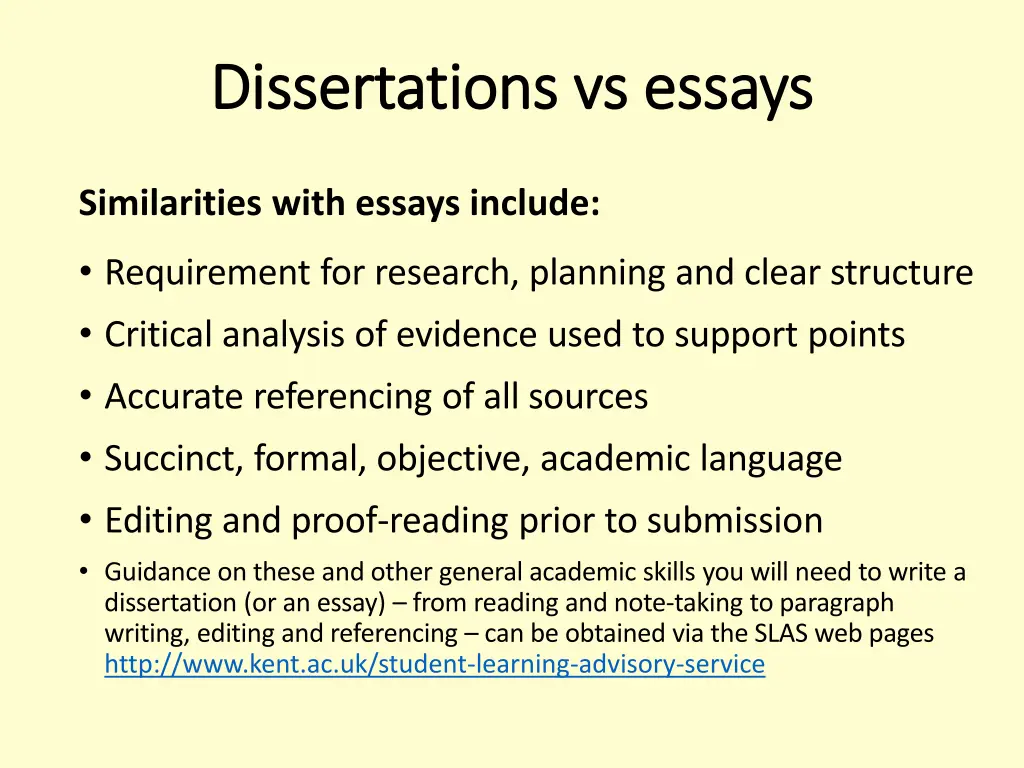
Dissertations vs essays Dissertations vs essays Similarities with essays include: Requirement for research, planning and clear structure Critical analysis of evidence used to support points Accurate referencing of all sources Succinct, formal, objective, academic language Editing and proof-reading prior to submission Guidance on these and other general academic skills you will need to write a dissertation (or an essay) from reading and note-taking to paragraph writing, editing and referencing can be obtained via the SLAS web pages http://www.kent.ac.uk/student-learning-advisory-service
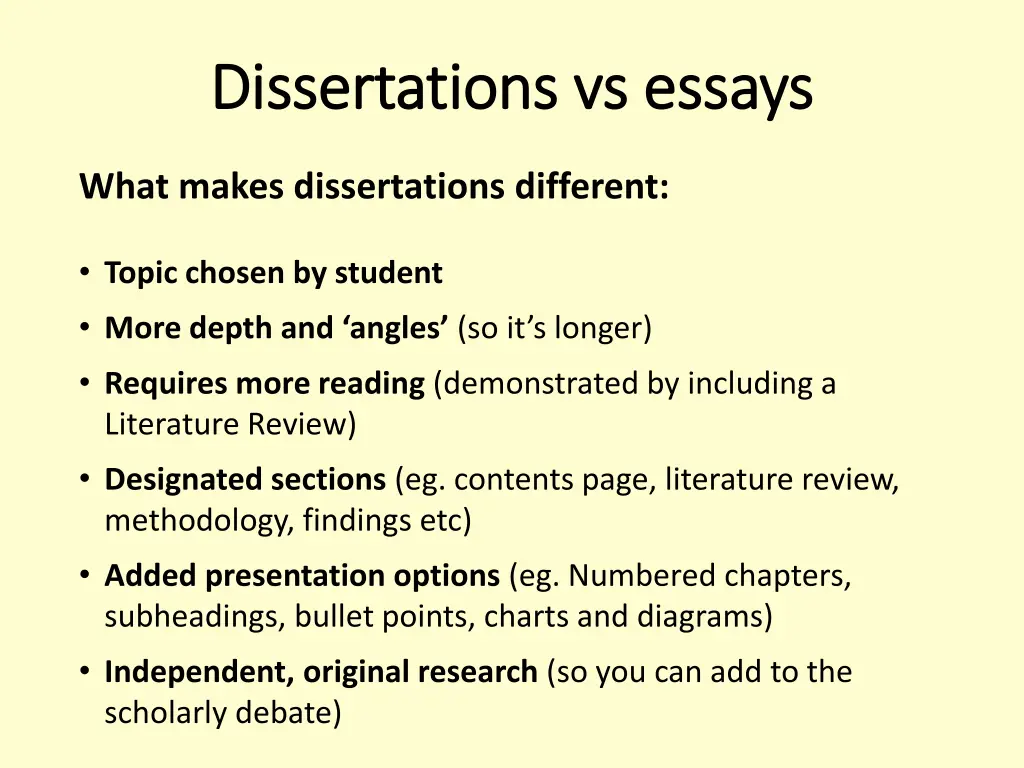
Dissertations vs essays Dissertations vs essays What makes dissertations different: Topic chosen by student More depth and angles (so it s longer) Requires more reading (demonstrated by including a Literature Review) Designated sections (eg. contents page, literature review, methodology, findings etc) Added presentation options (eg. Numbered chapters, subheadings, bullet points, charts and diagrams) Independent, original research (so you can add to the scholarly debate)
Dissertation: getting started Dissertation: getting started Choose a topic of research that: - Will maintain your long-term interest - Is practical in terms of time, budget, and other constraints - Falls within the general expertise of your academic supervisor - Is narrow enough in focus to explore in depth - Will add in some way to the scholarly debate Dissertation Proposal Before proceeding with your chosen research topic you will need to write, and gain approval of, your dissertation proposal.
Dissertation proposal Dissertation proposal This should include: Outline of topic (focus, aims and objectives) Preliminary literature search (setting your topic in context, potentially highlighting gaps in knowledge that you may fill) Research methodology to be used Dissertation outline Project schedule The proposal should demonstrate that your dissertation will be interesting, relevant and practical, with an element of originality
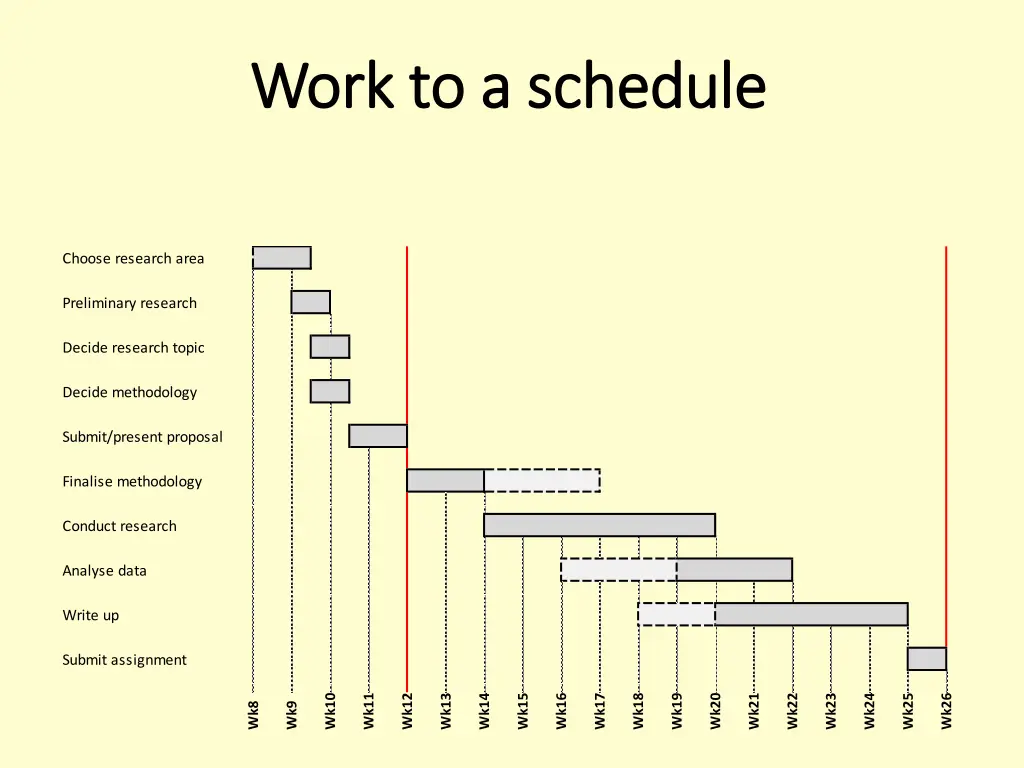
Work to a schedule Work to a schedule Choose research area Preliminary research Decide research topic Decide methodology Submit/present proposal Finalise methodology Conduct research Analyse data Write up Submit assignment Wk10 Wk11 Wk12 Wk13 Wk14 Wk15 Wk16 Wk17 Wk18 Wk19 Wk20 Wk21 Wk22 Wk23 Wk24 Wk25 Wk26 Wk8 Wk9
Dissertation structure Dissertation structure A dissertation may contain most or all of the following: Title Acknowledgements Abstract Contents page Main body Bibliography Appendices Introduction Background information Literature review Methodology Findings Analysis Discussion/analysis Conclusions Recommendations
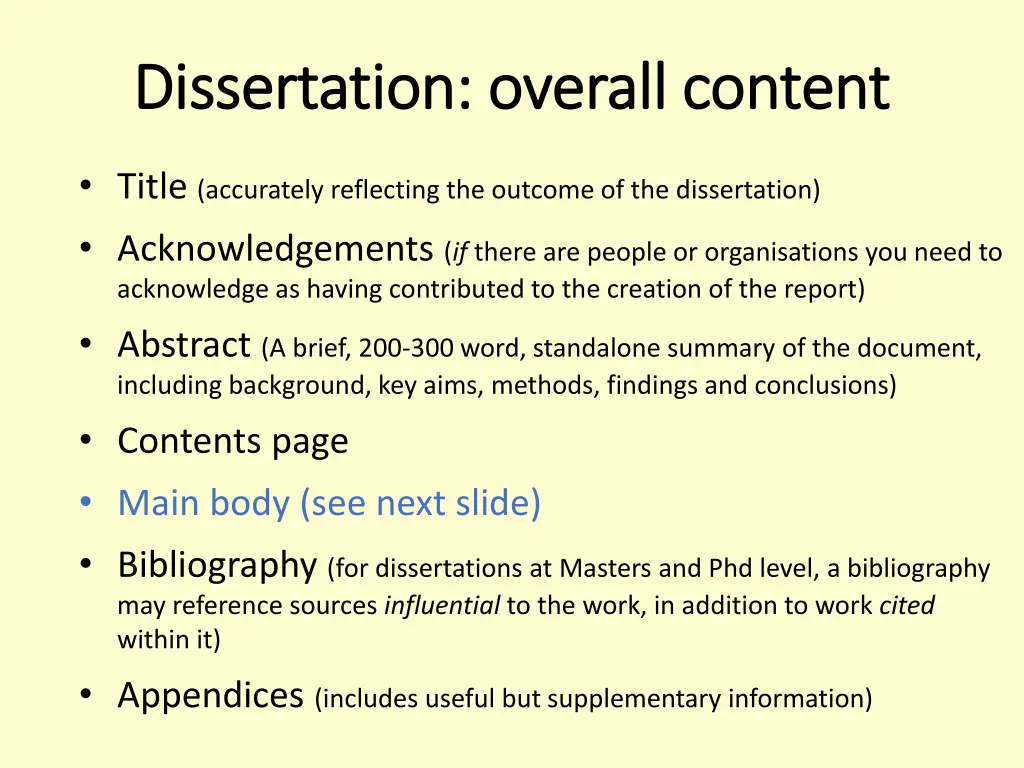
Dissertation: overall content Dissertation: overall content Title (accurately reflecting the outcome of the dissertation) Acknowledgements (if there are people or organisations you need to acknowledge as having contributed to the creation of the report) Abstract (A brief, 200-300 word, standalone summary of the document, including background, key aims, methods, findings and conclusions) Contents page Main body (see next slide) Bibliography (for dissertations at Masters and Phd level, a bibliography may reference sources influential to the work, in addition to work cited within it) Appendices (includes useful but supplementary information)
Dissertation: main body content Dissertation: main body content Introduction (context, focus, aims, objectives of the dissertation) Background information (anything the reader may need to know at the start in order to understand the content of the dissertation) Literature review (summarises existing knowledge around the topic) Methodology (how you found things out) Findings (what you found out) Analysis (understanding the findings, discussing what they mean) Conclusions (key things those findings indicate, clarify or confirm) Recommendations (any further actions suggested by those findings)
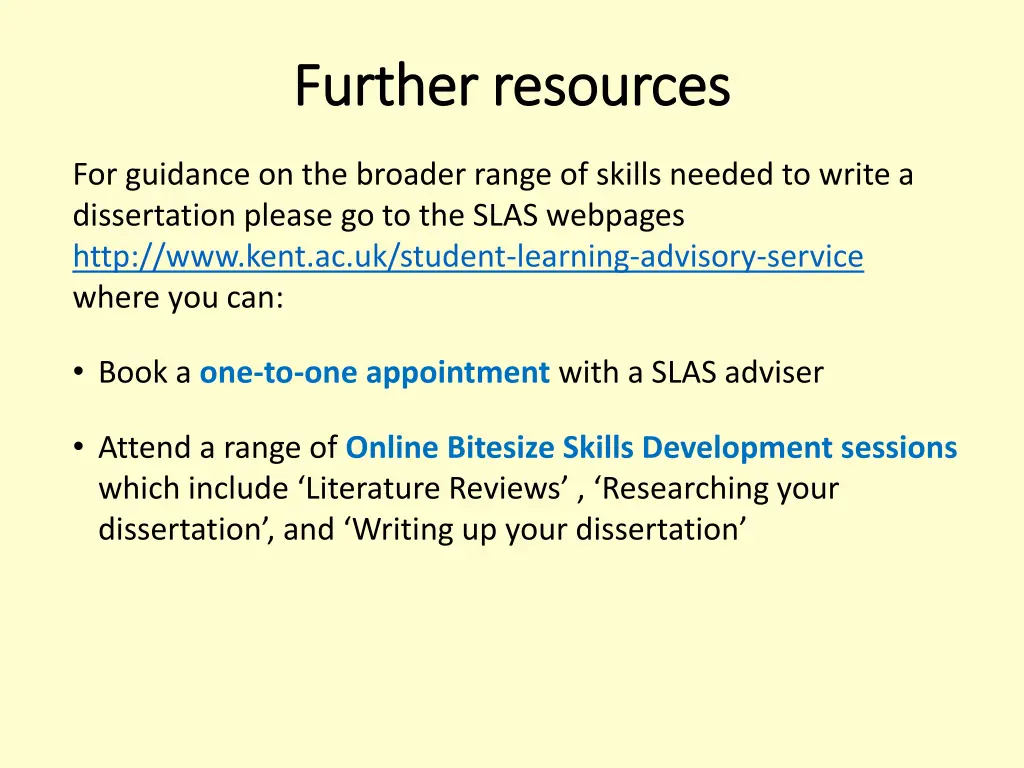
Further resources Further resources For guidance on the broader range of skills needed to write a dissertation please go to the SLAS webpages http://www.kent.ac.uk/student-learning-advisory-service where you can: Book a one-to-one appointment with a SLAS adviser Attend a range of Online Bitesize Skills Development sessions which include Literature Reviews , Researching your dissertation , and Writing up your dissertation
Get in touch Get in touch SLAS CONNECT To book an appointment: www.kent.ac.uk/student-learning-advisory-service learning@kent.ac.uk SLASkent KentUniSLAS SLASkent