Key Features of Experimental Ecosystem Classification Services in London
Explore the latest updates on the experimental ecosystem accounts classification presented at the London Group conference in October 2017. Learn about the evolution of the Classification of Ecosystem Services (CICES) Version 5.1, including its key features and potential limitations highlighted during the event.

Download Presentation

Please find below an Image/Link to download the presentation.
The content on the website is provided AS IS for your information and personal use only. It may not be sold, licensed, or shared on other websites without obtaining consent from the author. If you encounter any issues during the download, it is possible that the publisher has removed the file from their server.
You are allowed to download the files provided on this website for personal or commercial use, subject to the condition that they are used lawfully. All files are the property of their respective owners.
The content on the website is provided AS IS for your information and personal use only. It may not be sold, licensed, or shared on other websites without obtaining consent from the author.
E N D
Presentation Transcript
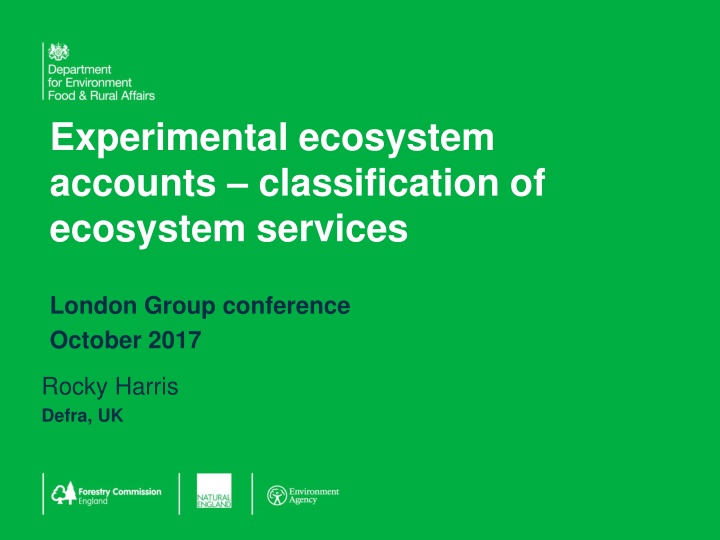
Experimental ecosystem accounts classification of ecosystem services London Group conference October 2017 Rocky Harris Defra, UK
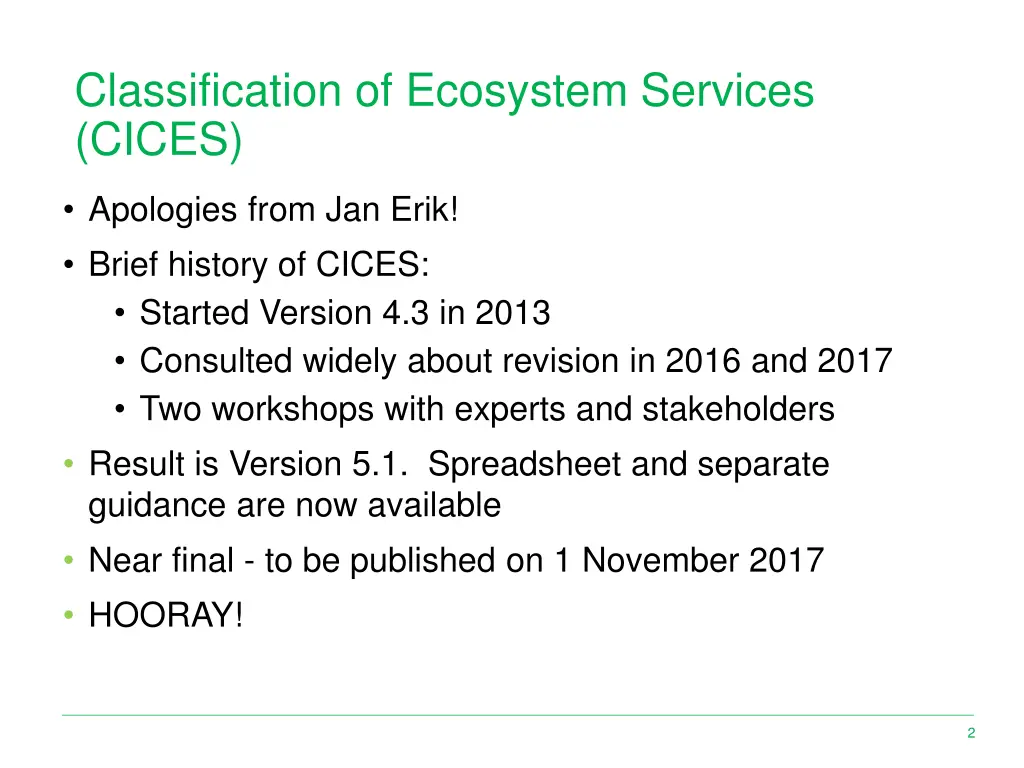
Classification of Ecosystem Services (CICES) Apologies from Jan Erik! Brief history of CICES: Started Version 4.3 in 2013 Consulted widely about revision in 2016 and 2017 Two workshops with experts and stakeholders Result is Version 5.1. Spreadsheet and separate guidance are now available Near final - to be published on 1 November 2017 HOORAY! 2
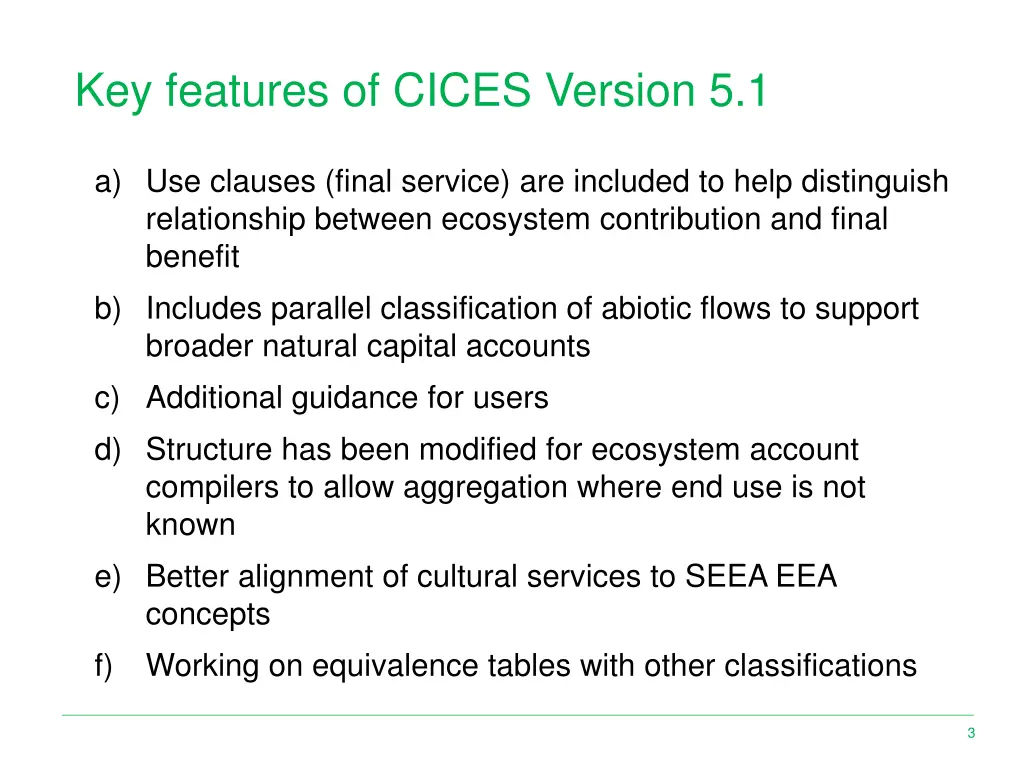
Key features of CICES Version 5.1 a) Use clauses (final service) are included to help distinguish relationship between ecosystem contribution and final benefit b) Includes parallel classification of abiotic flows to support broader natural capital accounts c) Additional guidance for users d) Structure has been modified for ecosystem account compilers to allow aggregation where end use is not known e) Better alignment of cultural services to SEEA EEA concepts f) Working on equivalence tables with other classifications 3
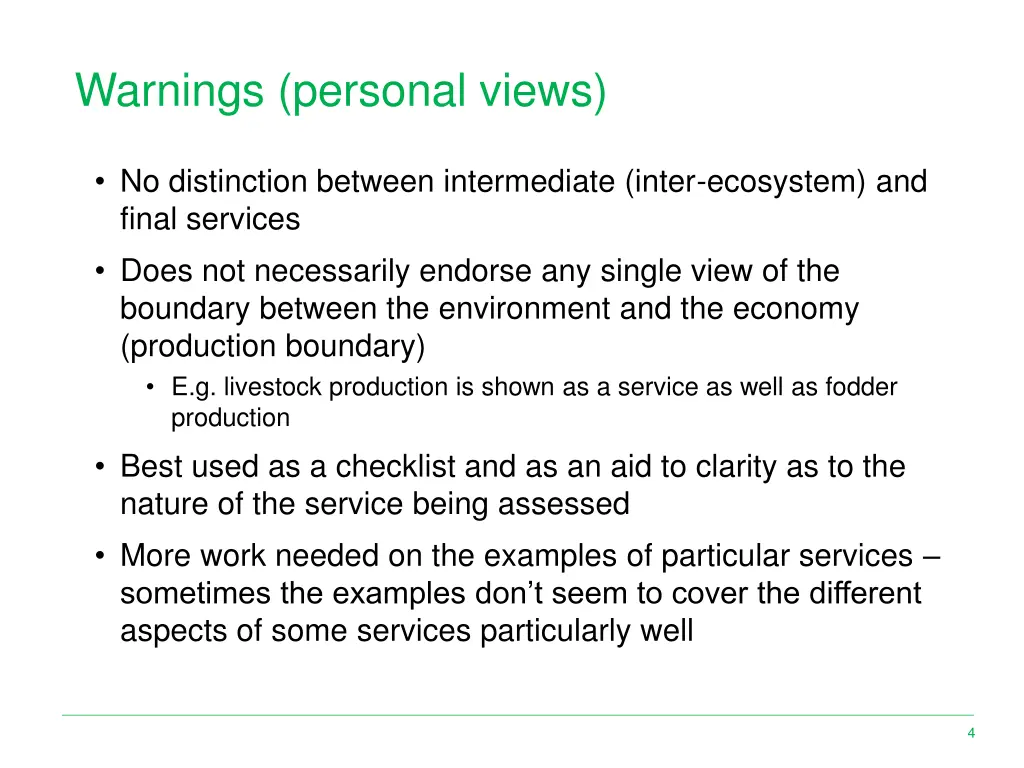
Warnings (personal views) No distinction between intermediate (inter-ecosystem) and final services Does not necessarily endorse any single view of the boundary between the environment and the economy (production boundary) E.g. livestock production is shown as a service as well as fodder production Best used as a checklist and as an aid to clarity as to the nature of the service being assessed More work needed on the examples of particular services sometimes the examples don t seem to cover the different aspects of some services particularly well 4