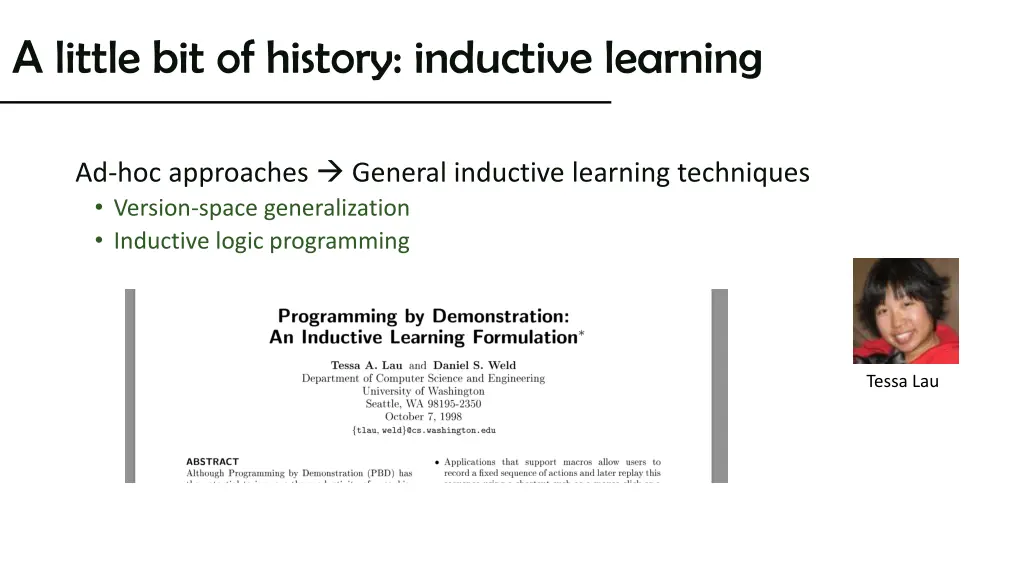
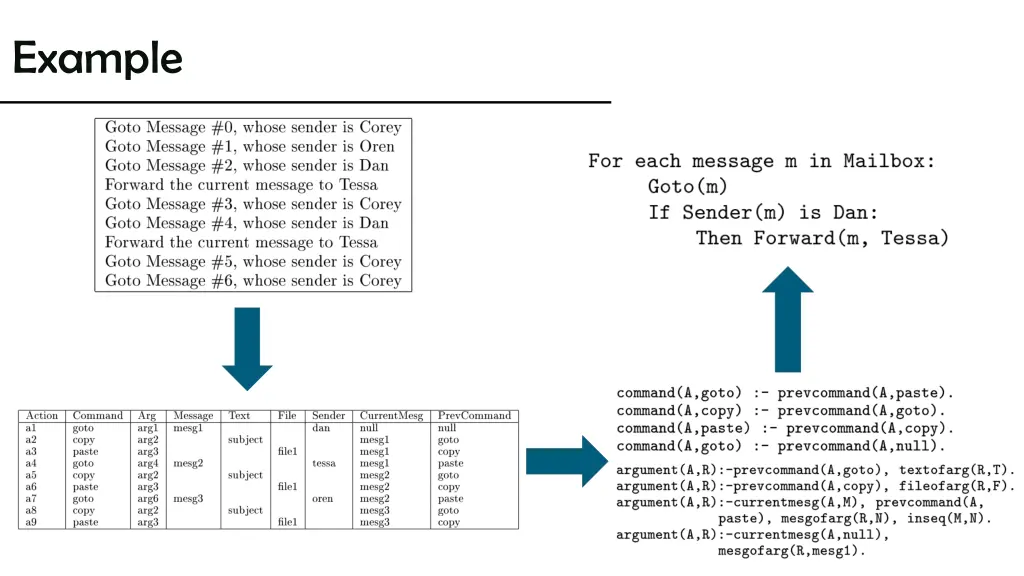
Explore the key issues in inductive learning and programming by example, touching on topics such as the criticisms of synthesis, PBE vs PBD, historical perspectives, and important considerations in finding and verifying programs that match observations.
Please find below an Image/Link to download the presentation.
The content on the website is provided AS IS for your information and personal use only. It may not be sold, licensed, or shared on other websites without obtaining consent from the author. If you encounter any issues during the download, it is possible that the publisher has removed the file from their server.
You are allowed to download the files provided on this website for personal or commercial use, subject to the condition that they are used lawfully. All files are the property of their respective owners.
The content on the website is provided AS IS for your information and personal use only. It may not be sold, licensed, or shared on other websites without obtaining consent from the author.
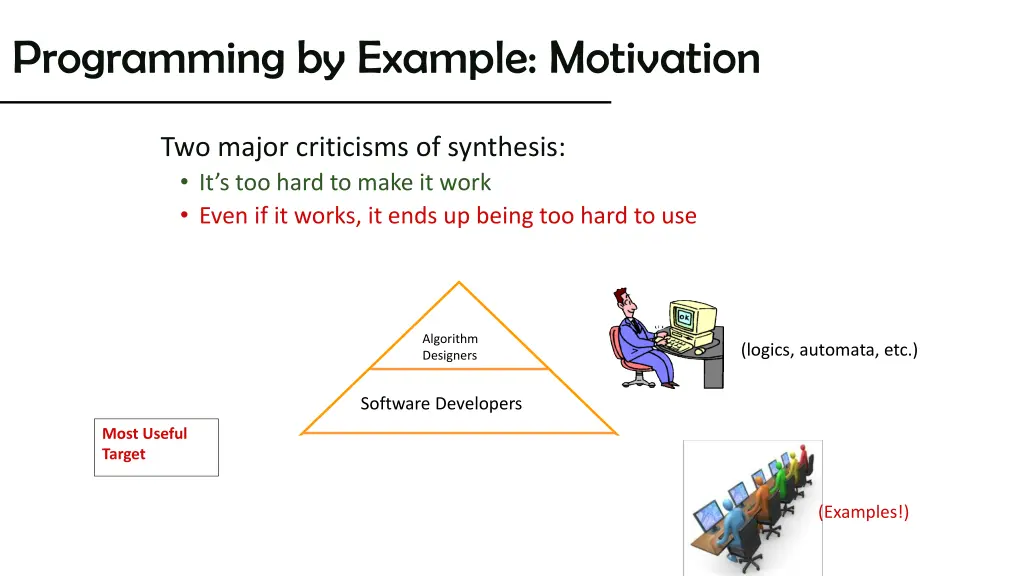
Programming by Example: Motivation Two major criticisms of synthesis: It s too hard to make it work Even if it works, it ends up being too hard to use Algorithm Designers (logics, automata, etc.) Software Developers Most Useful Target End-Users (Examples!) Students and Teachers
PBE vs. PBD Programming by Example (PBE) Generally input/output E.g., factorial(6) = 720 Programming by Demonstration (PBD) In addition to input/output, show a trace of the computation E.g., factorial(6) = 6 * (5 * (4 * (3 * (2 * 1)))) = 720
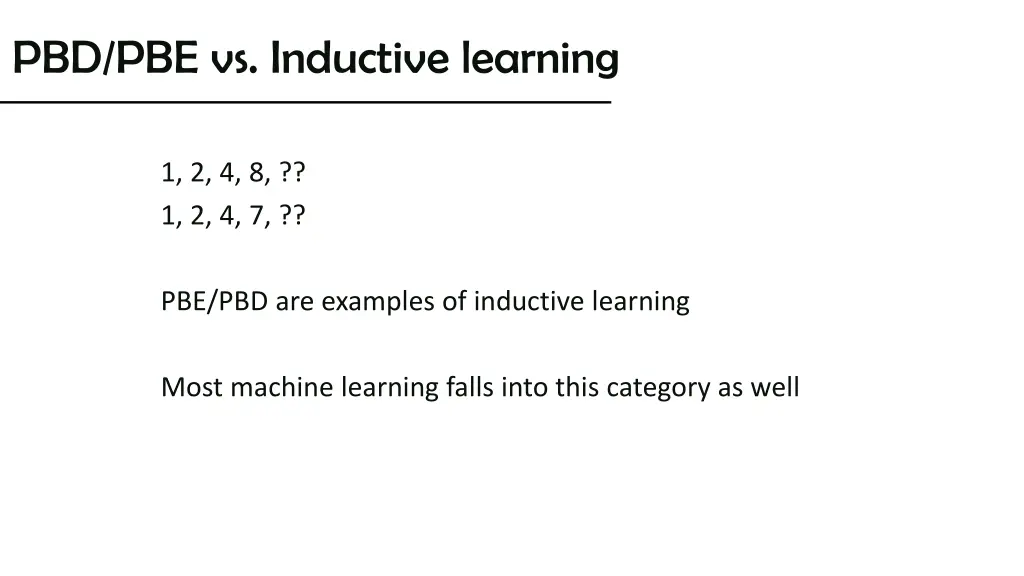
PBD/PBE vs. Inductive learning 1, 2, 4, 8, ?? 1, 2, 4, 7, ?? PBE/PBD are examples of inductive learning Most machine learning falls into this category as well
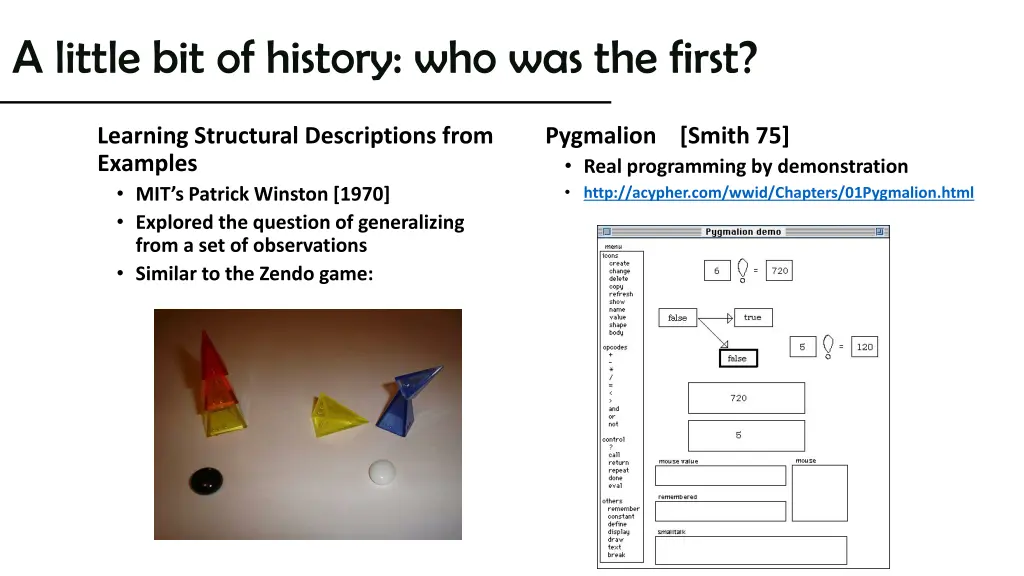
A little bit of history: who was the first? Learning Structural Descriptions from Examples MIT s Patrick Winston [1970] Explored the question of generalizing from a set of observations Similar to the Zendo game: Pygmalion [Smith 75] Real programming by demonstration http://acypher.com/wwid/Chapters/01Pygmalion.html
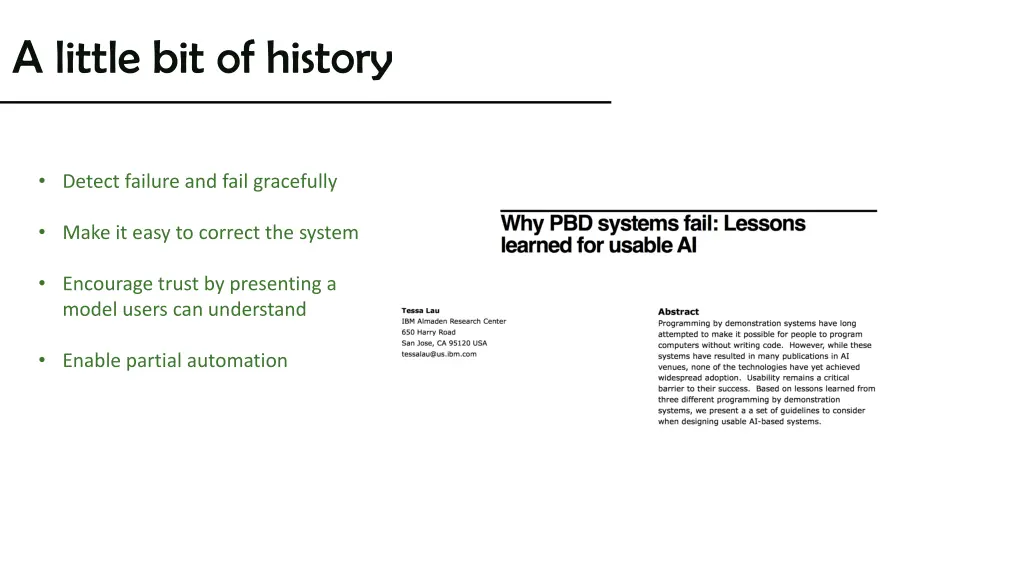
A little bit of history Detect failure and fail gracefully Make it easy to correct the system Encourage trust by presenting a model users can understand Enable partial automation
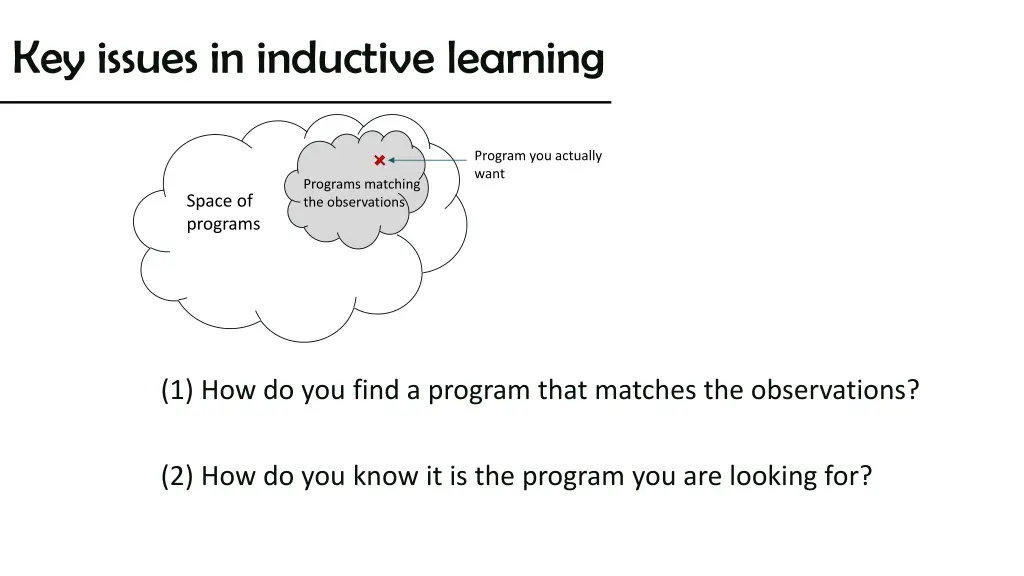
Key issues in inductive learning Program you actually want Programs matching the observations Space of programs (1) How do you find a program that matches the observations? (2) How do you know it is the program you are looking for?
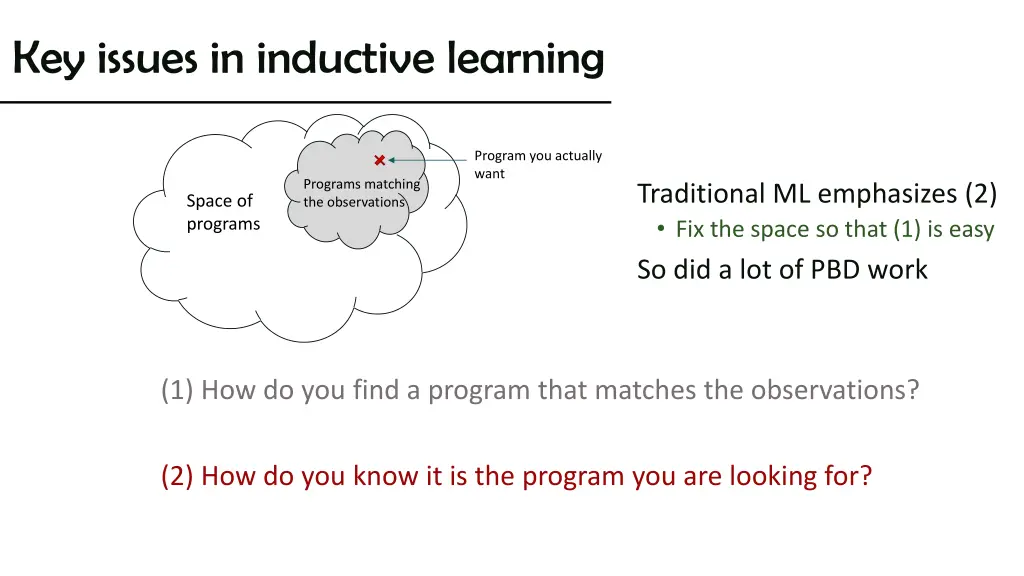
Key issues in inductive learning Program you actually want Programs matching the observations Traditional ML emphasizes (2) Fix the space so that (1) is easy Space of programs So did a lot of PBD work (1) How do you find a program that matches the observations? (2) How do you know it is the program you are looking for?
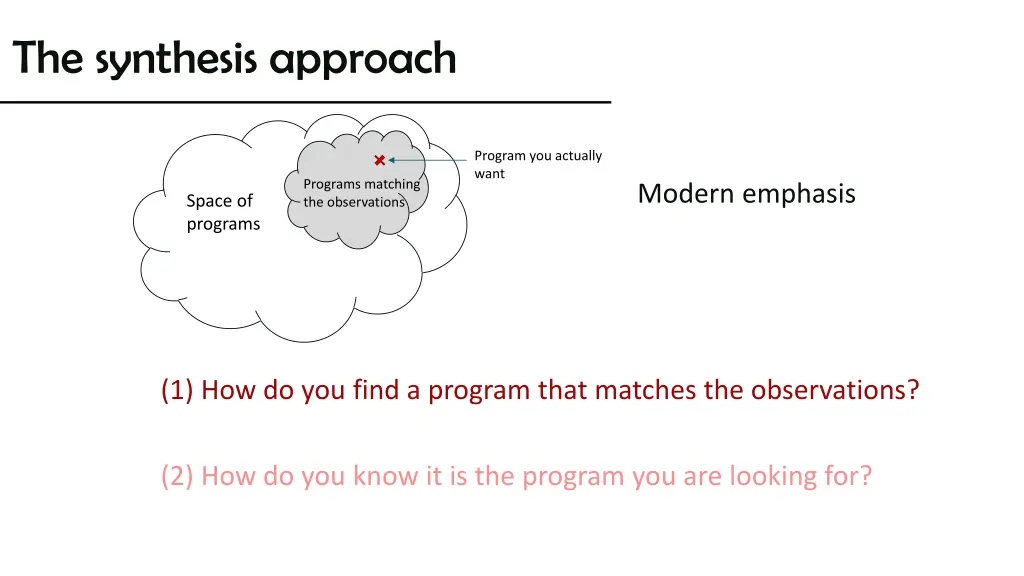
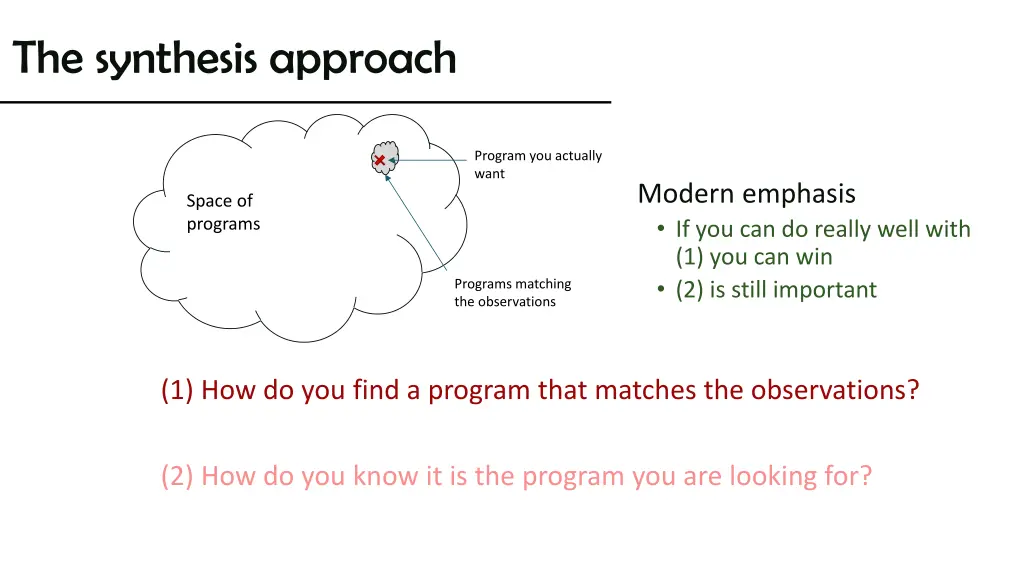
The synthesis approach Program you actually want Programs matching the observations Modern emphasis Space of programs (1) How do you find a program that matches the observations? (2) How do you know it is the program you are looking for?
The synthesis approach Program you actually want Modern emphasis If you can do really well with (1) you can win (2) is still important Space of programs Programs matching the observations (1) How do you find a program that matches the observations? (2) How do you know it is the program you are looking for?
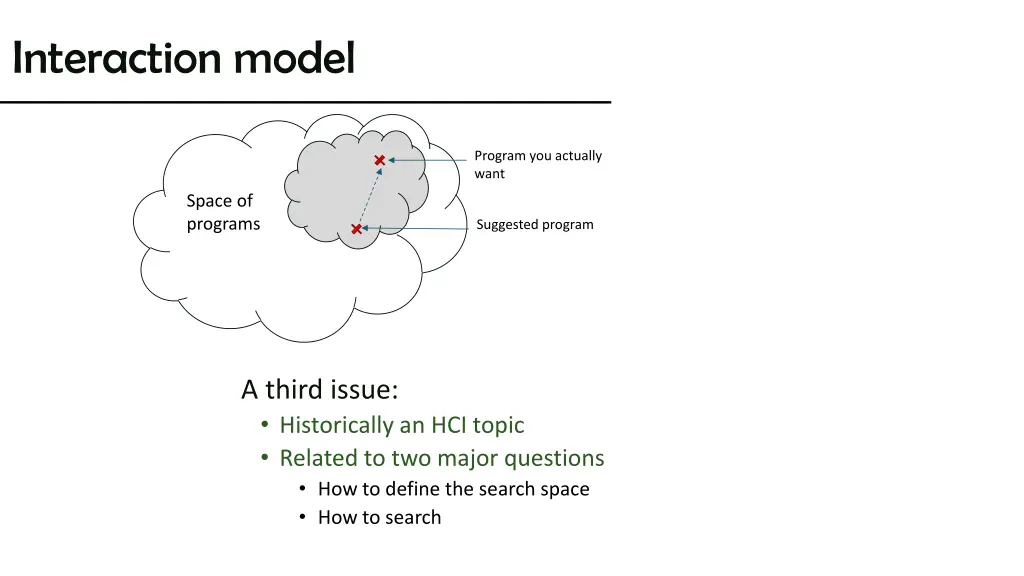
Interaction model Program you actually want Space of programs Suggested program A third issue: Historically an HCI topic Related to two major questions How to define the search space How to search
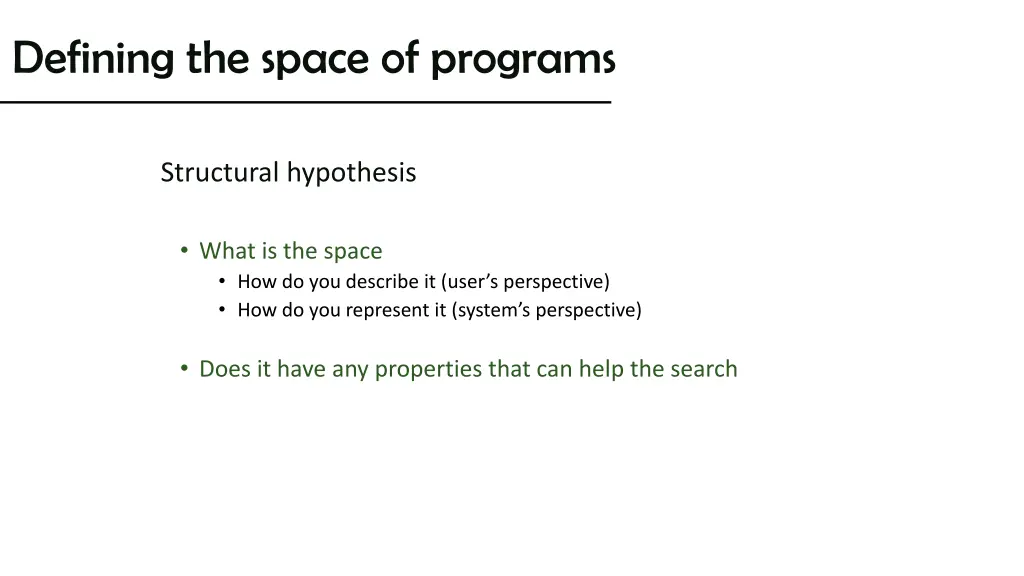
Defining the space of programs Structural hypothesis What is the space How do you describe it (user s perspective) How do you represent it (system s perspective) Does it have any properties that can help the search
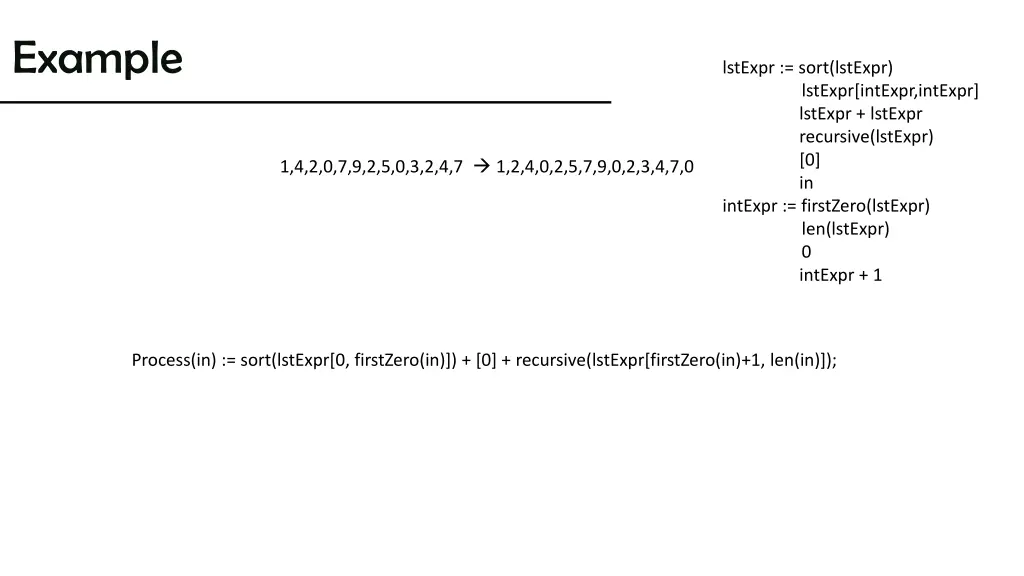
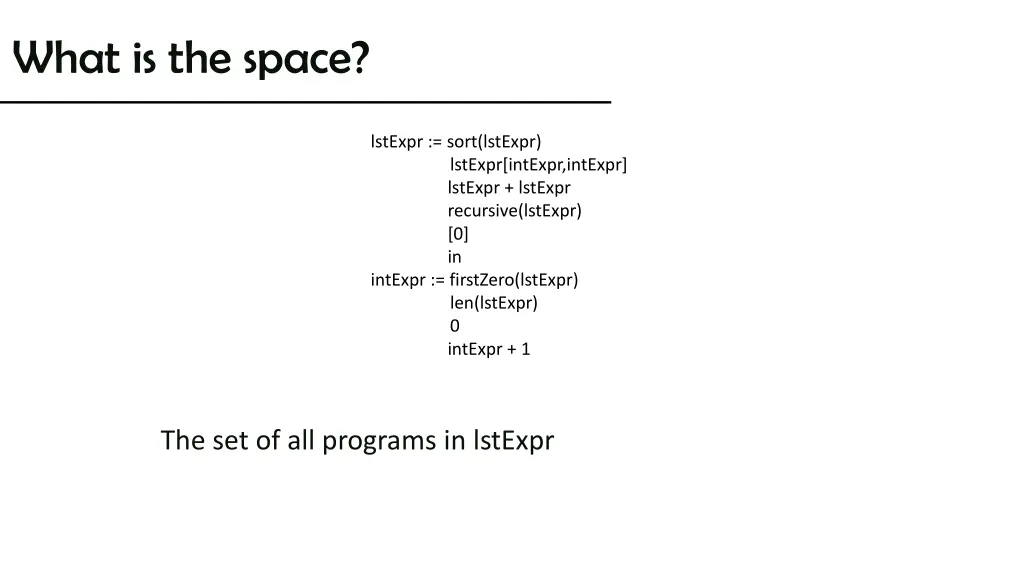
What is the space? lstExpr := sort(lstExpr) lstExpr[intExpr,intExpr] lstExpr + lstExpr recursive(lstExpr) [0] in intExpr := firstZero(lstExpr) len(lstExpr) 0 intExpr + 1 The set of all programs in lstExpr
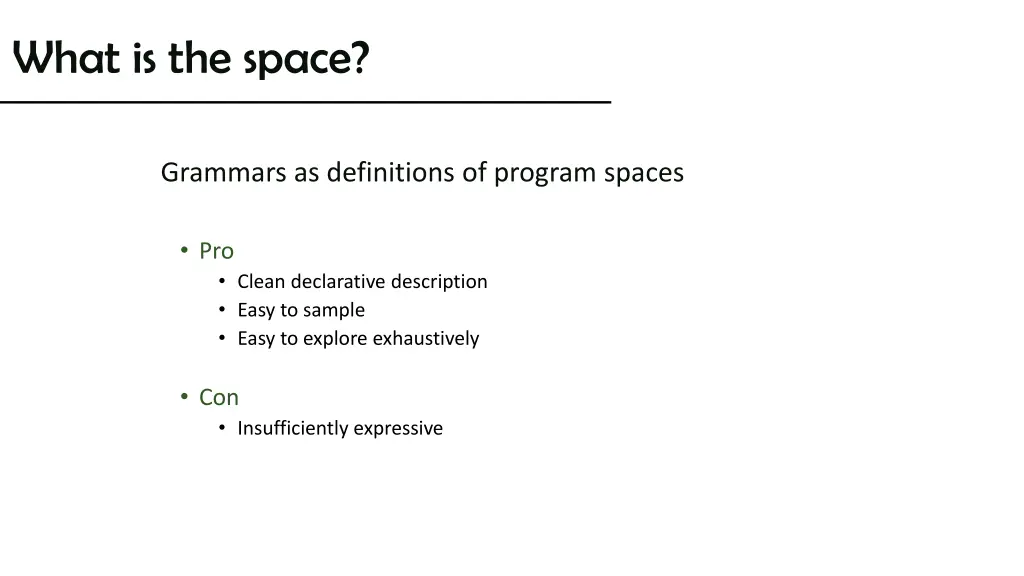
What is the space? Grammars as definitions of program spaces Pro Clean declarative description Easy to sample Easy to explore exhaustively Con Insufficiently expressive
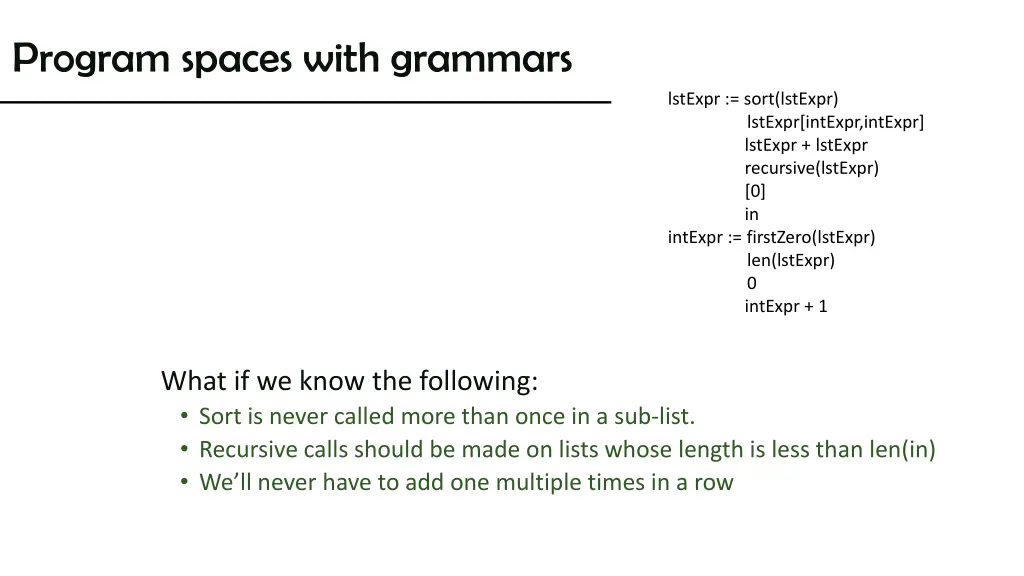
Program spaces with grammars lstExpr := sort(lstExpr) lstExpr[intExpr,intExpr] lstExpr + lstExpr recursive(lstExpr) [0] in intExpr := firstZero(lstExpr) len(lstExpr) 0 intExpr + 1 What if we know the following: Sort is never called more than once in a sub-list. Recursive calls should be made on lists whose length is less than len(in) We ll never have to add one multiple times in a row
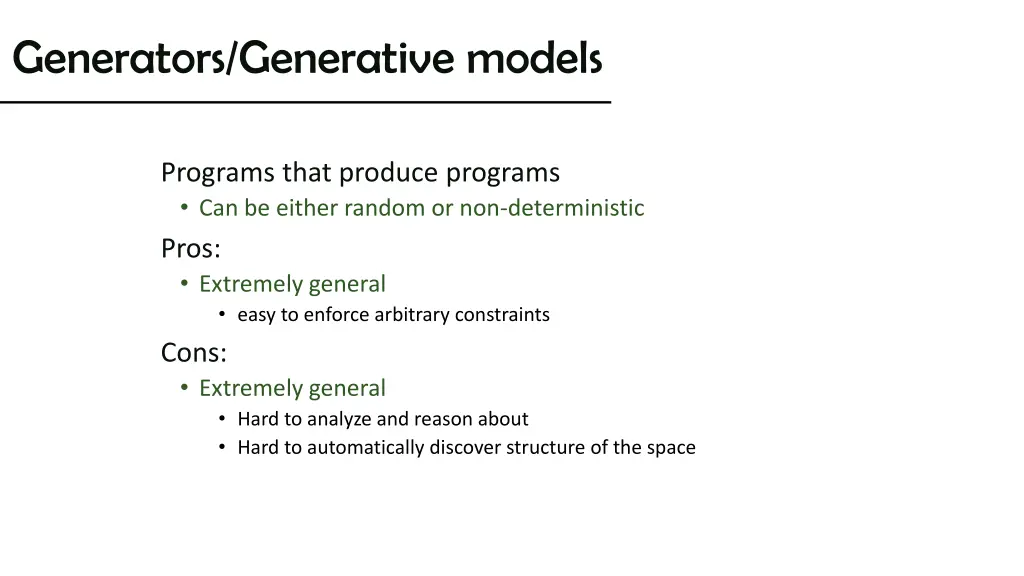
Generators/Generative models Programs that produce programs Can be either random or non-deterministic Pros: Extremely general easy to enforce arbitrary constraints Cons: Extremely general Hard to analyze and reason about Hard to automatically discover structure of the space
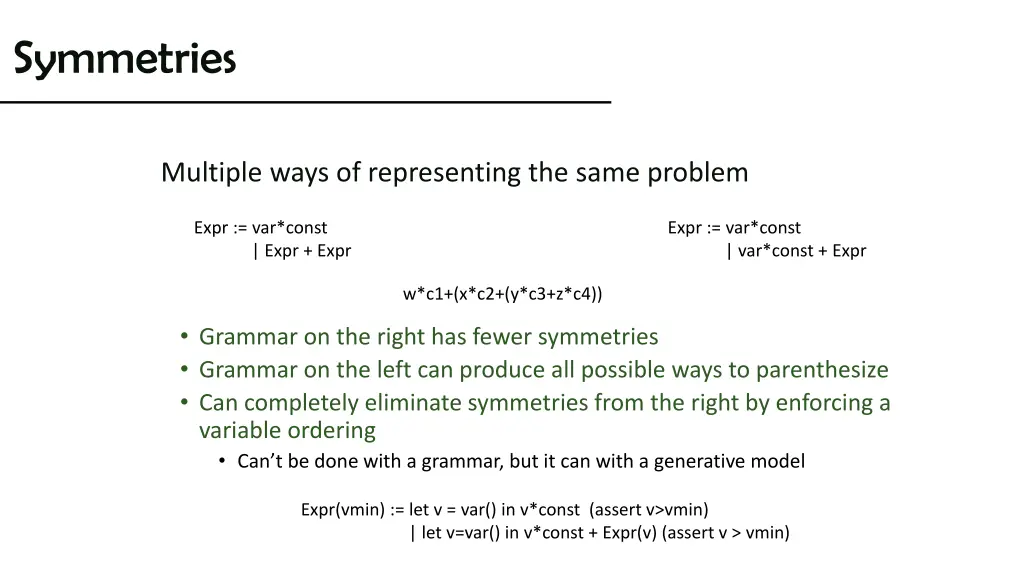
Symmetries Multiple ways of representing the same problem Expr := var*const | Expr + Expr Expr := var*const | var*const + Expr w*c1+(x*c2+(y*c3+z*c4)) Grammar on the right has fewer symmetries Grammar on the left can produce all possible ways to parenthesize Can completely eliminate symmetries from the right by enforcing a variable ordering Can t be done with a grammar, but it can with a generative model Expr(vmin) := let v = var() in v*const (assert v>vmin) | let v=var() in v*const + Expr(v) (assert v > vmin)
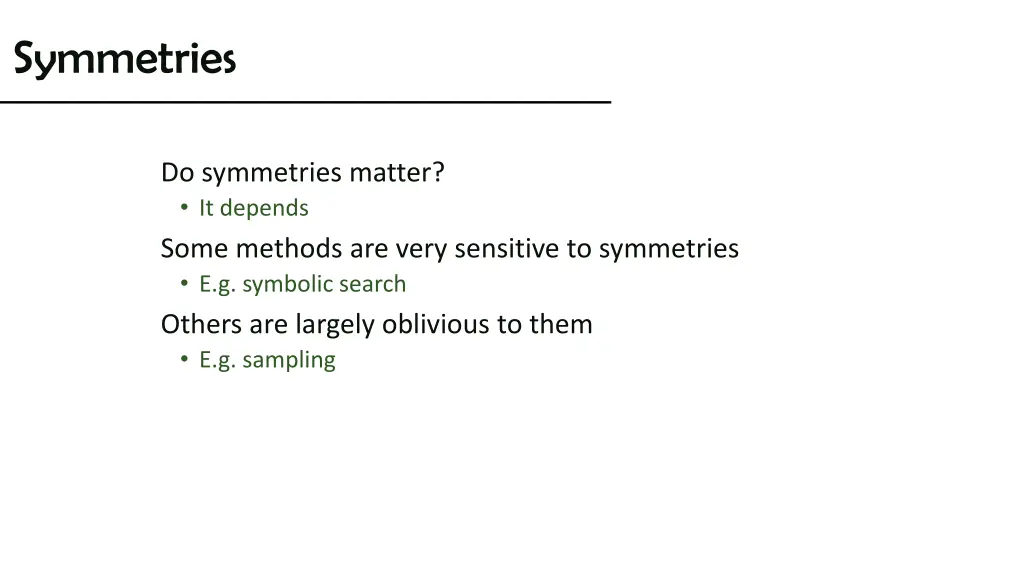
Symmetries Do symmetries matter? It depends Some methods are very sensitive to symmetries E.g. symbolic search Others are largely oblivious to them E.g. sampling
Representing the space As the system searches, it needs to keep track of what has already been generated and what needs to be generated next Representation and search strategy are intimately tied together
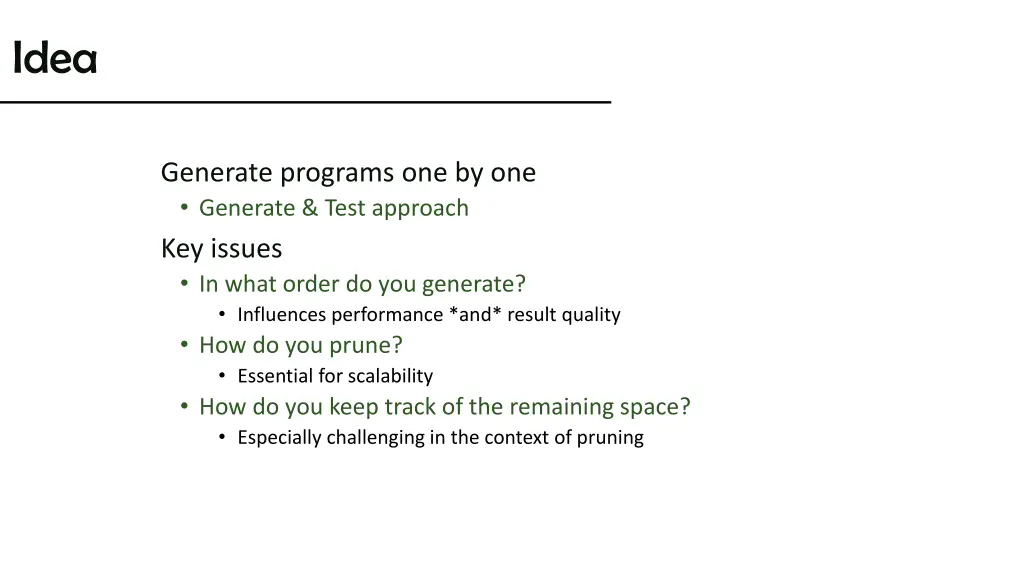
Idea Generate programs one by one Generate & Test approach Key issues In what order do you generate? Influences performance *and* result quality How do you prune? Essential for scalability How do you keep track of the remaining space? Especially challenging in the context of pruning
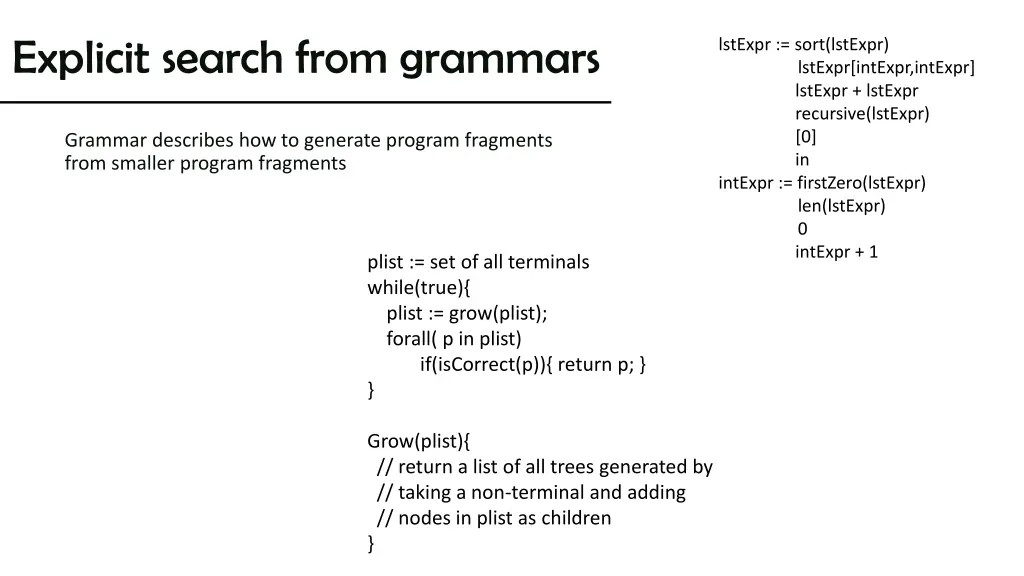
Explicit search from grammars lstExpr := sort(lstExpr) lstExpr[intExpr,intExpr] lstExpr + lstExpr recursive(lstExpr) [0] in intExpr := firstZero(lstExpr) len(lstExpr) 0 intExpr + 1 Grammar describes how to generate program fragments from smaller program fragments plist := set of all terminals while(true){ plist := grow(plist); forall( p in plist) if(isCorrect(p)){ return p; } } Grow(plist){ // return a list of all trees generated by // taking a non-terminal and adding // nodes in plist as children }
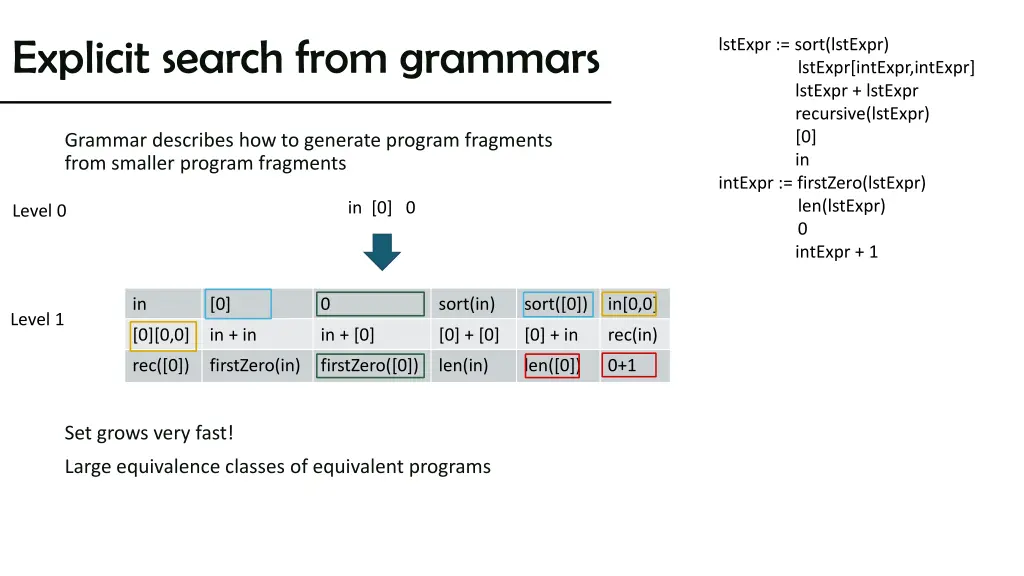
Explicit search from grammars lstExpr := sort(lstExpr) lstExpr[intExpr,intExpr] lstExpr + lstExpr recursive(lstExpr) [0] in intExpr := firstZero(lstExpr) len(lstExpr) 0 intExpr + 1 Grammar describes how to generate program fragments from smaller program fragments in [0] 0 Level 0 in [0] 0 sort(in) sort([0]) in[0,0] Level 1 [0][0,0] in + in in + [0] [0] + [0] [0] + in rec(in) rec([0]) firstZero(in) firstZero([0]) len(in) len([0]) 0+1 Set grows very fast! Large equivalence classes of equivalent programs
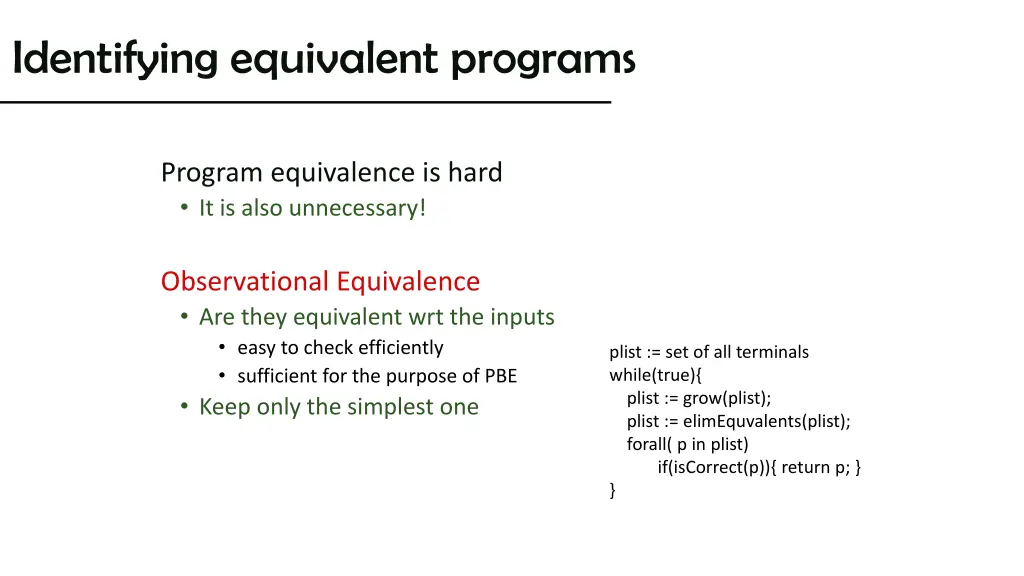
Identifying equivalent programs Program equivalence is hard It is also unnecessary! Observational Equivalence Are they equivalent wrt the inputs easy to check efficiently sufficient for the purpose of PBE Keep only the simplest one plist := set of all terminals while(true){ plist := grow(plist); plist := elimEquvalents(plist); forall( p in plist) if(isCorrect(p)){ return p; } }
Explicit search from grammars Features: Search small programs before large programs Simple Works even with black-box language building blocks no need to have source for sort or firstZero just need to be able to execute them no need to know of any properties about them e.g. automatically ignores sort(sort(in)) without having to know that sort is idempotent Complexity depends on the size of the set of distinct programs Copes well with symmetries
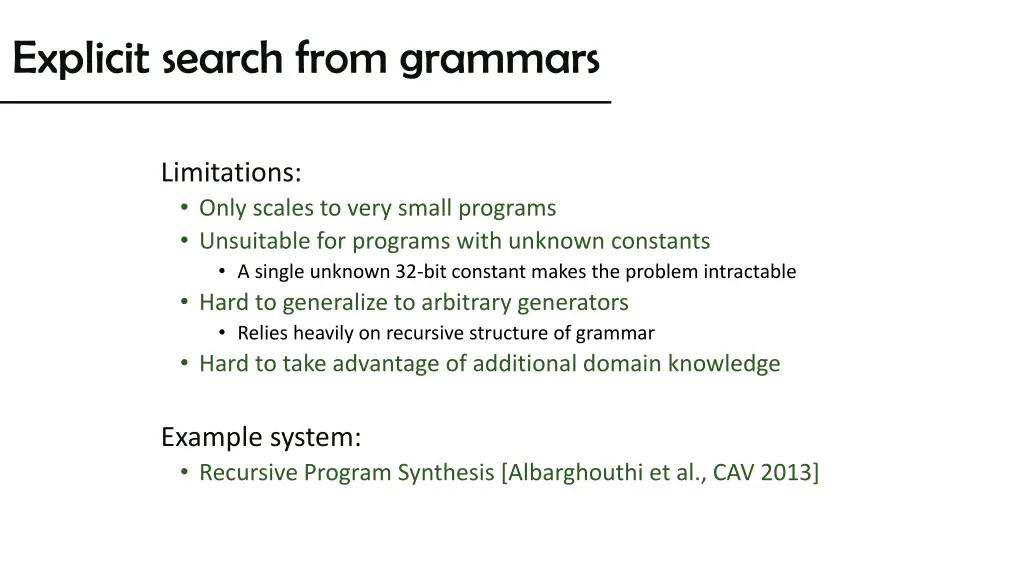
Explicit search from grammars Limitations: Only scales to very small programs Unsuitable for programs with unknown constants A single unknown 32-bit constant makes the problem intractable Hard to generalize to arbitrary generators Relies heavily on recursive structure of grammar Hard to take advantage of additional domain knowledge Example system: Recursive Program Synthesis [Albarghouthi et al., CAV 2013]