Korean Community Health Resources and Needs Assessment
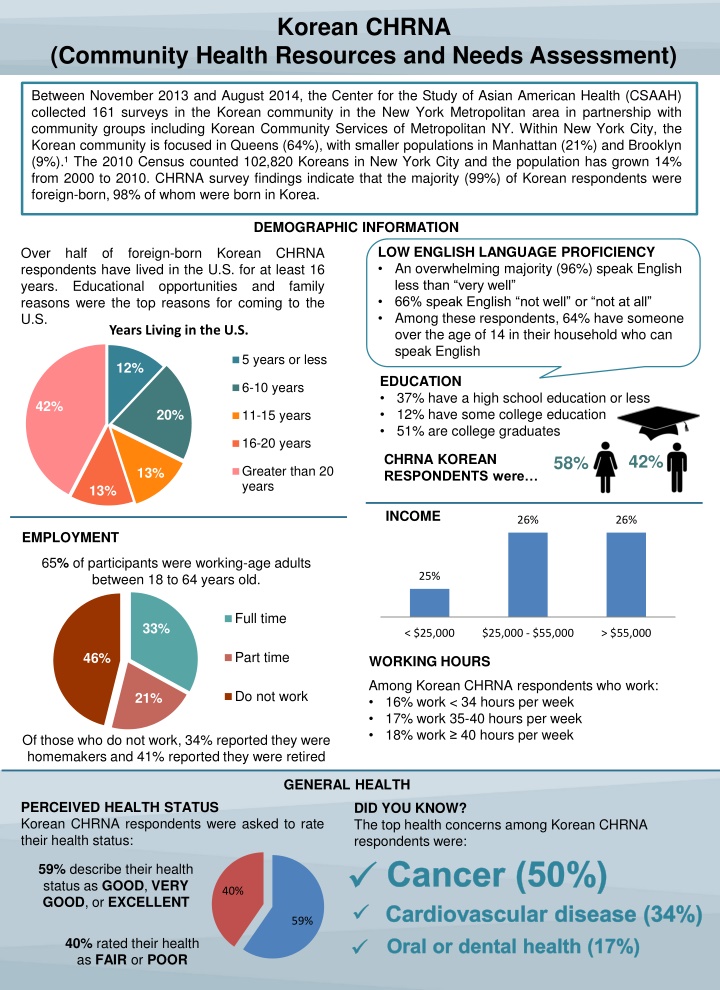
Between November 2013 and August 2014, the Center for the Study of Asian American Health conducted a survey with 161 Korean respondents in the New York Metropolitan area. The study reveals that the majority of participants are foreign-born, with low English proficiency and varying educational backgrounds. Health concerns such as cancer and cardiovascular disease are prevalent, and many face barriers to accessing healthcare. Despite having healthcare providers, a significant number report difficulties in obtaining necessary medical care due to cost or insurance issues.

Download Presentation

Please find below an Image/Link to download the presentation.
The content on the website is provided AS IS for your information and personal use only. It may not be sold, licensed, or shared on other websites without obtaining consent from the author.If you encounter any issues during the download, it is possible that the publisher has removed the file from their server.
You are allowed to download the files provided on this website for personal or commercial use, subject to the condition that they are used lawfully. All files are the property of their respective owners.
The content on the website is provided AS IS for your information and personal use only. It may not be sold, licensed, or shared on other websites without obtaining consent from the author.
E N D
Presentation Transcript
Korean CHRNA (Community Health Resources and Needs Assessment) Between November 2013 and August 2014, the Center for the Study of Asian American Health (CSAAH) collected 161 surveys in the Korean community in the New York Metropolitan area in partnership with community groups including Korean Community Services of Metropolitan NY. Within New York City, the Korean community is focused in Queens (64%), with smaller populations in Manhattan (21%) and Brooklyn (9%). The 2010 Census counted 102,820 Koreans in New York City and the population has grown 14% from 2000 to 2010. CHRNA survey findings indicate that the majority (99%) of Korean respondents were foreign-born, 98% of whom were born in Korea. DEMOGRAPHICINFORMATION LOW ENGLISH LANGUAGE PROFICIENCY An overwhelming majority (96%) speak English less than very well 66% speak English not well or not at all Among these respondents, 64% have someone over the age of 14 in their household who can speak English Over half of foreign-born Korean CHRNA respondents have lived in the U.S. for at least 16 years. Educational opportunities and family reasons were the top reasons for coming to the U.S. Years Living in the U.S. 5 years or less 12% EDUCATION 37% have a high school education or less 12% have some college education 51% are college graduates 6-10 years 42% 20% 11-15 years 16-20 years CHRNA KOREAN RESPONDENTS were 42% 58% Greater than 20 years 13% 13% INCOME 26% 26% EMPLOYMENT 65% of participants were working-age adults between 18 to 64 years old. 25% Full time 33% < $25,000 $25,000 - $55,000 > $55,000 Part time 46% WORKING HOURS Among Korean CHRNA respondents who work: 16% work < 34 hours per week 17% work 35-40 hours per week 18% work 40 hours per week Do not work 21% Of those who do not work, 34% reported they were homemakers and 41% reported they were retired GENERAL HEALTH PERCEIVED HEALTH STATUS Korean CHRNA respondents were asked to rate their health status: DID YOU KNOW? The top health concerns among Korean CHRNA respondents were: Cancer (50%) 59% describe their health status as GOOD, VERY GOOD, or EXCELLENT 40% Cardiovascular disease (34%) Oral or dental health (17%) 59% 40% rated their health as FAIR or POOR
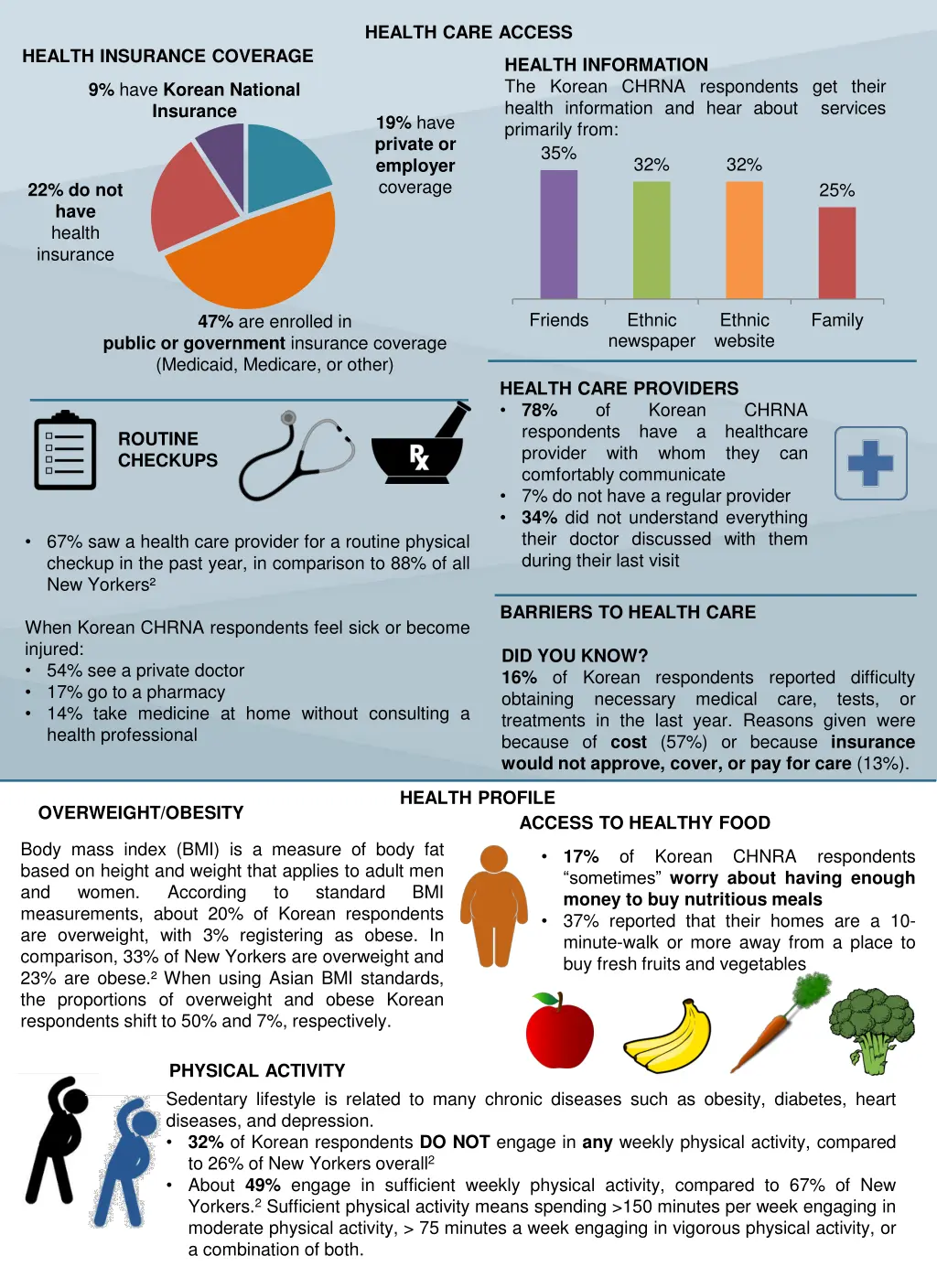
HEALTH CARE ACCESS HEALTH INSURANCE COVERAGE HEALTH INFORMATION The Korean CHRNA respondents get their health information and hear about services primarily from: 35% 32% 9% have Korean National Insurance 19% have private or employer coverage 32% 22%do not have health insurance 25% Friends Ethnic newspaper Ethnic website Family 47% areenrolled in public or government insurance coverage (Medicaid, Medicare, or other) HEALTH CARE PROVIDERS 78% of respondents have a healthcare provider with whom they can comfortably communicate 7% do not have a regular provider 34% did not understand everything their doctor discussed with them during their last visit Korean CHRNA ROUTINE CHECKUPS 67% saw a health care provider for a routine physical checkup in the past year, in comparison to 88% of all New Yorkers BARRIERS TO HEALTH CARE When Korean CHRNA respondents feel sick or become injured: 54% see a private doctor 17% go to a pharmacy 14% take medicine at home without consulting a health professional DID YOU KNOW? 16% of Korean respondents reported difficulty obtaining necessary medical care, tests, or treatments in the last year. Reasons given were because of cost (57%) or because insurance would not approve, cover, or pay for care (13%). HEALTHPROFILE OVERWEIGHT/OBESITY ACCESS TO HEALTHY FOOD Body mass index (BMI) is a measure of body fat based on height and weight that applies to adult men and women. According measurements, about 20% of Korean respondents are overweight, with 3% registering as obese. In comparison, 33% of New Yorkers are overweight and 23% are obese. When using Asian BMI standards, the proportions of overweight and obese Korean respondents shift to 50% and 7%, respectively. 17% of Korean CHNRA respondents sometimes worry about having enough money to buy nutritious meals 37% reported that their homes are a 10- minute-walk or more away from a place to buy fresh fruits and vegetables to standard BMI PHYSICAL ACTIVITY Sedentary lifestyle is related to many chronic diseases such as obesity, diabetes, heart diseases, and depression. 32% of Korean respondents DO NOT engage in any weekly physical activity, compared to 26% of New Yorkers overall2 About 49% engage in sufficient weekly physical activity, compared to 67% of New Yorkers.2 Sufficient physical activity means spending >150 minutes per week engaging in moderate physical activity, > 75 minutes a week engaging in vigorous physical activity, or a combination of both.
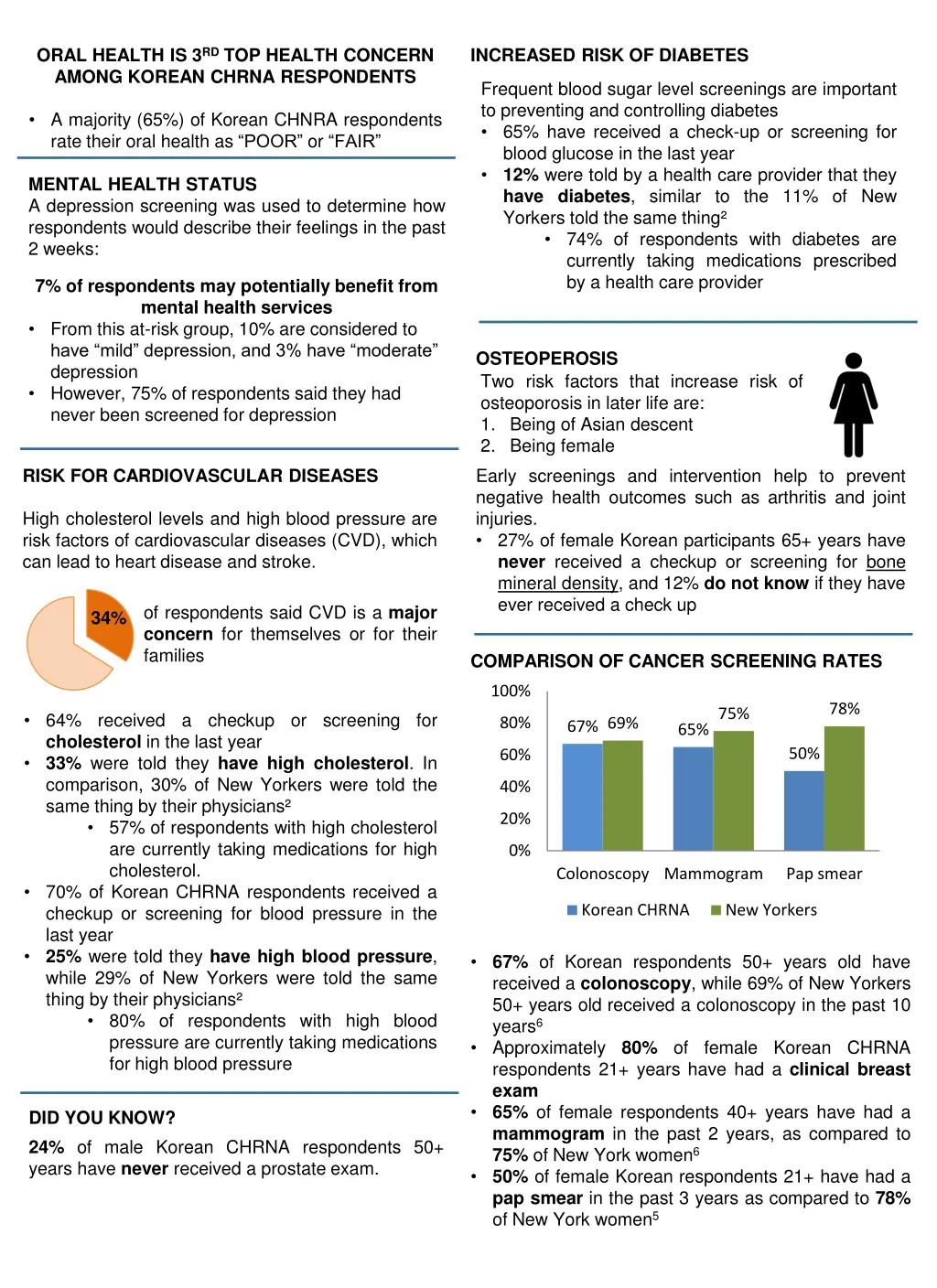
ORAL HEALTH IS 3RD TOP HEALTH CONCERN AMONG KOREAN CHRNA RESPONDENTS INCREASED RISK OF DIABETES Frequent blood sugar level screenings are important to preventing and controlling diabetes 65% have received a check-up or screening for blood glucose in the last year 12% were told by a health care provider that they have diabetes, similar to the 11% of New Yorkers told the same thing 74% of respondents with diabetes are currently taking medications prescribed by a health care provider A majority (65%) of Korean CHNRA respondents rate their oral health as POOR or FAIR MENTAL HEALTH STATUS A depression screening was used to determine how respondents would describe their feelings in the past 2 weeks: 7% of respondents may potentially benefit from mental health services From this at-risk group, 10% are considered to have mild depression, and 3% have moderate depression However, 75% of respondents said they had never been screened for depression OSTEOPEROSIS Two risk factors that increase risk of osteoporosis in later life are: 1. Being of Asian descent 2. Being female Early screenings and intervention help to prevent negative health outcomes such as arthritis and joint injuries. 27% of female Korean participants 65+ years have never received a checkup or screening for bone mineral density, and 12% do not know if they have ever received a check up RISK FOR CARDIOVASCULAR DISEASES High cholesterol levels and high blood pressure are risk factors of cardiovascular diseases (CVD), which can lead to heart disease and stroke. of respondents said CVD is a major concern for themselves or for their families 34% COMPARISON OF CANCER SCREENING RATES 100% 78% 75% 64% received a checkup or screening for cholesterol in the last year 33% were told they have high cholesterol. In comparison, 30% of New Yorkers were told the same thing by their physicians 57% of respondents with high cholesterol are currently taking medications for high cholesterol. 70% of Korean CHRNA respondents received a checkup or screening for blood pressure in the last year 25% were told they have high blood pressure, while 29% of New Yorkers were told the same thing by their physicians 80% of respondents with high blood pressure are currently taking medications for high blood pressure 80% 69% 67% 65% 50% 60% 40% 20% 0% Colonoscopy Mammogram Pap smear Korean CHRNA New Yorkers 67% of Korean respondents 50+ years old have received a colonoscopy, while 69% of New Yorkers 50+ years old received a colonoscopy in the past 10 years6 Approximately 80% of female Korean CHRNA respondents 21+ years have had a clinical breast exam 65% of female respondents 40+ years have had a mammogram in the past 2 years, as compared to 75% of New York women6 50% of female Korean respondents 21+ have had a pap smear in the past 3 years as compared to 78% of New York women5 DID YOU KNOW? 24% of male Korean CHRNA respondents 50+ years have never received a prostate exam.
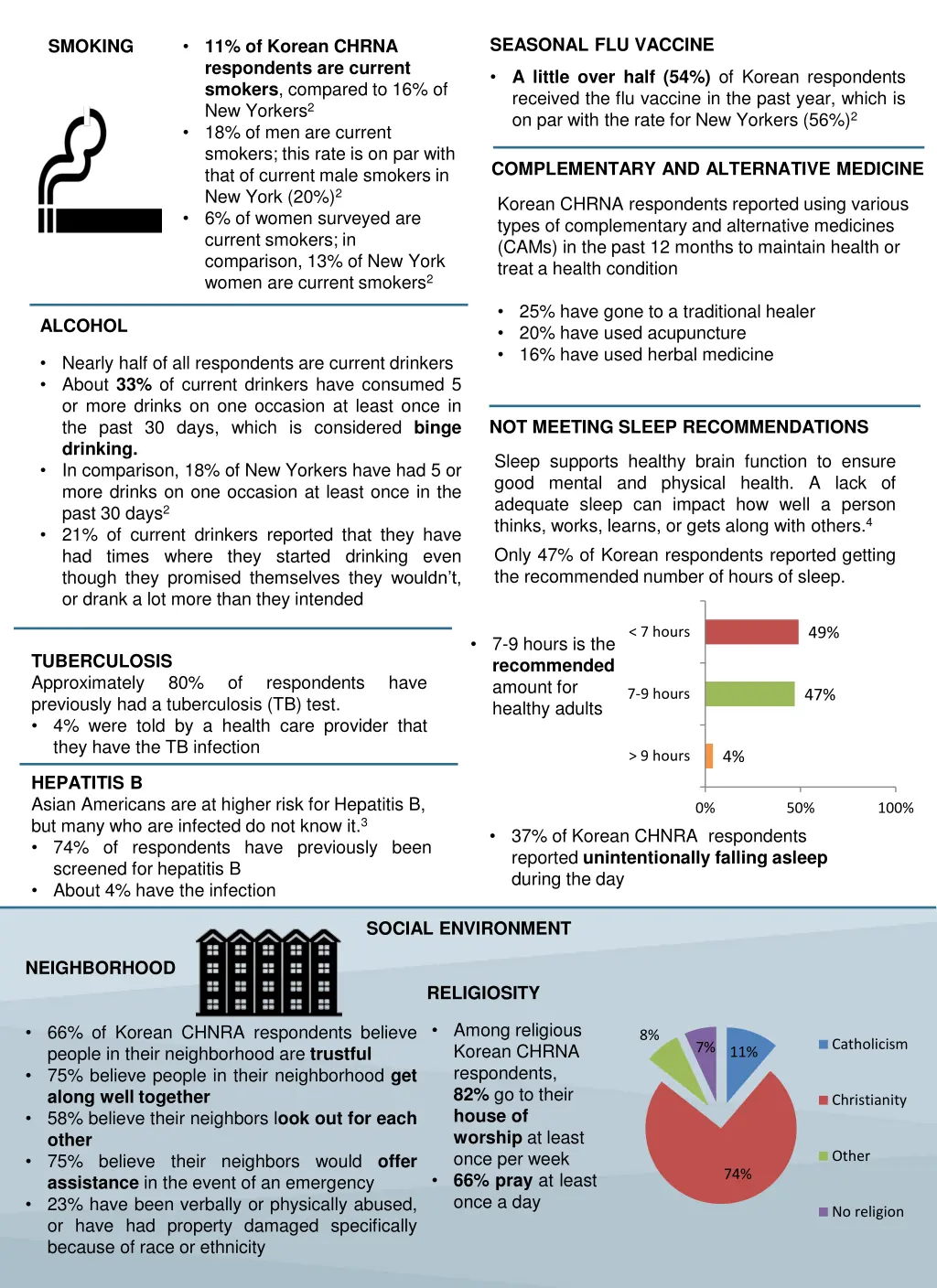
SEASONAL FLU VACCINE SMOKING 11% of Korean CHRNA respondents are current smokers, compared to 16% of New Yorkers2 18% of men are current smokers; this rate is on par with that of current male smokers in New York (20%)2 6% of women surveyed are current smokers; in comparison, 13% of New York women are current smokers2 A little over half (54%) of Korean respondents received the flu vaccine in the past year, which is on par with the rate for New Yorkers (56%)2 COMPLEMENTARY AND ALTERNATIVE MEDICINE Korean CHRNA respondents reported using various types of complementary and alternative medicines (CAMs) in the past 12 months to maintain health or treat a health condition 25% have gone to a traditional healer 20% have used acupuncture 16% have used herbal medicine ALCOHOL Nearly half of all respondents are current drinkers About 33% of current drinkers have consumed 5 or more drinks on one occasion at least once in the past 30 days, which is considered binge drinking. In comparison, 18% of New Yorkers have had 5 or more drinks on one occasion at least once in the past 30 days2 21% of current drinkers reported that they have had times where they started drinking even though they promised themselves they wouldn t, or drank a lot more than they intended NOT MEETING SLEEP RECOMMENDATIONS Sleep supports healthy brain function to ensure good mental and physical health. A lack of adequate sleep can impact how well a person thinks, works, learns, or gets along with others.4 Only 47% of Korean respondents reported getting the recommended number of hours of sleep. < 7 hours 49% 7-9 hours is the recommended amount for healthy adults TUBERCULOSIS Approximately previously had a tuberculosis (TB) test. 4% were told by a health care provider that they have the TB infection 80% of respondents have 7-9 hours 47% > 9 hours 4% HEPATITIS B Asian Americans are at higher risk for Hepatitis B, but many who are infected do not know it.3 74% of respondents have previously been screened for hepatitis B About 4% have the infection 0% 50% 100% 37% of Korean CHNRA respondents reported unintentionallyfallingasleep during the day SOCIAL ENVIRONMENT NEIGHBORHOOD RELIGIOSITY Among religious Korean CHRNA respondents, 82% go to their house of worship at least once per week 66% pray at least once a day 66% of Korean CHNRA respondents believe people in their neighborhood are trustful 75% believe people in their neighborhood get along well together 58% believe their neighbors look out for each other 75% believe their neighbors would offer assistance in the event of an emergency 23% have been verbally or physically abused, or have had property damaged specifically because of race or ethnicity 8% Catholicism 7% 11% Christianity Other 74% No religion
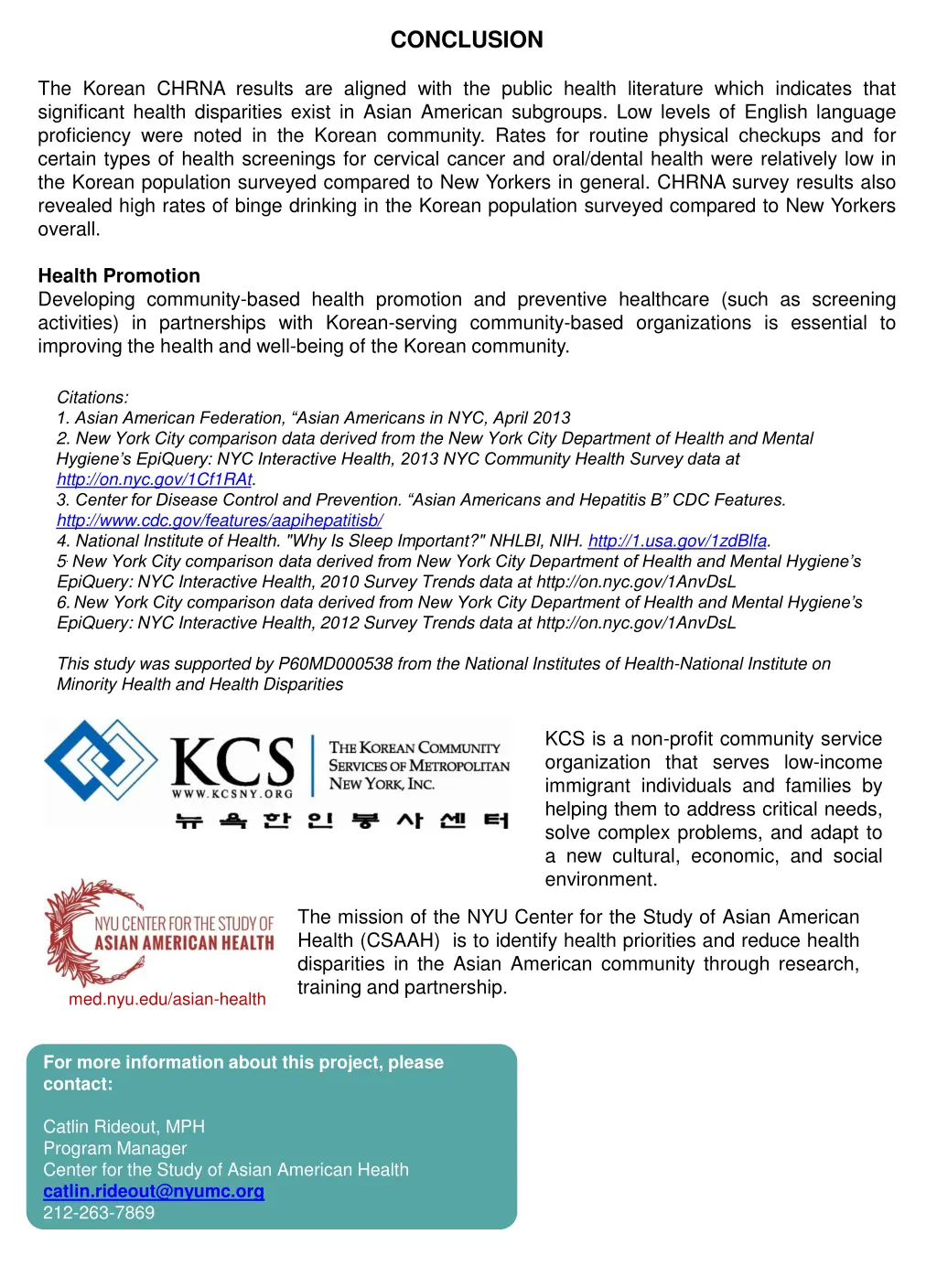
CONCLUSION The Korean CHRNA results are aligned with the public health literature which indicates that significant health disparities exist in Asian American subgroups. Low levels of English language proficiency were noted in the Korean community. Rates for routine physical checkups and for certain types of health screenings for cervical cancer and oral/dental health were relatively low in the Korean population surveyed compared to New Yorkers in general. CHRNA survey results also revealed high rates of binge drinking in the Korean population surveyed compared to New Yorkers overall. Health Promotion Developing community-based health promotion and preventive healthcare (such as screening activities) in partnerships with Korean-serving community-based organizations is essential to improving the health and well-being of the Korean community. Citations: 1. Asian American Federation, Asian Americans in NYC, April 2013 2. New York City comparison data derived from the New York City Department of Health and Mental Hygiene s EpiQuery: NYC Interactive Health, 2013 NYC Community Health Survey data at http://on.nyc.gov/1Cf1RAt. 3. Center for Disease Control and Prevention. Asian Americans and Hepatitis B CDC Features. http://www.cdc.gov/features/aapihepatitisb/ 4. National Institute of Health. "Why Is Sleep Important?" NHLBI, NIH. http://1.usa.gov/1zdBlfa. 5. New York City comparison data derived from New York City Department of Health and Mental Hygiene s EpiQuery: NYC Interactive Health, 2010 Survey Trends data at http://on.nyc.gov/1AnvDsL 6.New York City comparison data derived from New York City Department of Health and Mental Hygiene s EpiQuery: NYC Interactive Health, 2012 Survey Trends data at http://on.nyc.gov/1AnvDsL This study was supported by P60MD000538 from the National Institutes of Health-National Institute on Minority Health and Health Disparities KCS is a non-profit community service organization that serves low-income immigrant individuals and families by helping them to address critical needs, solve complex problems, and adapt to a new cultural, economic, and social environment. The mission of the NYU Center for the Study of Asian American Health (CSAAH) is to identify health priorities and reduce health disparities in the Asian American community through research, training and partnership. med.nyu.edu/asian-health For more information about this project, please contact: Catlin Rideout, MPH Program Manager Center for the Study of Asian American Health catlin.rideout@nyumc.org 212-263-7869