Explore the practical implementation of Laminar for decentralized information flow control, ensuring end-to-end security guarantees without extensive code changes. Learn about security models, data control, DIFC implementation challenges, and comparisons with existing systems.
Please find below an Image/Link to download the presentation.
The content on the website is provided AS IS for your information and personal use only. It may not be sold, licensed, or shared on other websites without obtaining consent from the author. If you encounter any issues during the download, it is possible that the publisher has removed the file from their server.
You are allowed to download the files provided on this website for personal or commercial use, subject to the condition that they are used lawfully. All files are the property of their respective owners.
The content on the website is provided AS IS for your information and personal use only. It may not be sold, licensed, or shared on other websites without obtaining consent from the author.
E N D
Presentation Transcript
LAMINAR: PRACTICAL FINE-GRAINED DECENTRALIZED INFORMATION FLOW CONTROL (DIFC) Indrajit Roy, Donald E. Porter, Michael D. Bond, Kathryn S. McKinley, Emmett Witchel The University of Texas at Austin
Untrusted code on trusted data Your computer holds trusted and sensitive data Credit card number, SSN, personal calendar But not every program you run is trusted Bugs in code, malicious plugins Security breach !
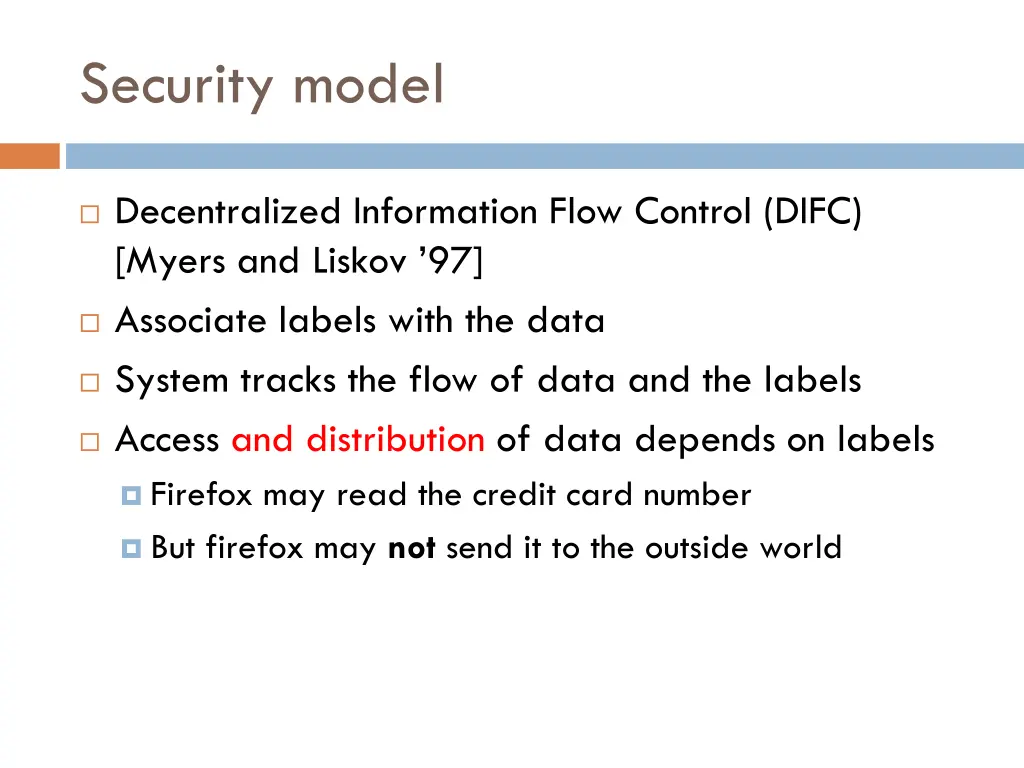
Security model Decentralized Information Flow Control (DIFC) [Myers and Liskov 97] Associate labels with the data System tracks the flow of data and the labels Access and distribution of data depends on labels Firefox may read the credit card number But firefox may not send it to the outside world
DIFC Implementation How do we rethink and rewrite code for security? Hopefully not many changes Users create a lattice of labels Associate labels with the data-structure User Mon. Tue. Wed. {Alice, Bob} Alice Watch game Office work Free {Alice} {Bob} Bob Free Meet doctor Free {} Information flow in a lattice Calendar data-structure
Challenge: Programmability vs. security An ideal DIFC system No code refactoring or changes to the data structures Naturally interact with the file system and the network Enforce fine-grained policies User Mon. Tue. Wed. {Alice, Bob} Alice Watch game Office work Free {Alice} {Bob} Bob Free Meet doctor Free {} Information flow in a lattice Calendar data-structure
Outline Comparison with current DIFC systems Laminar: programming model Design: PL + OS techniques Security regions Case studies and evaluation Summary
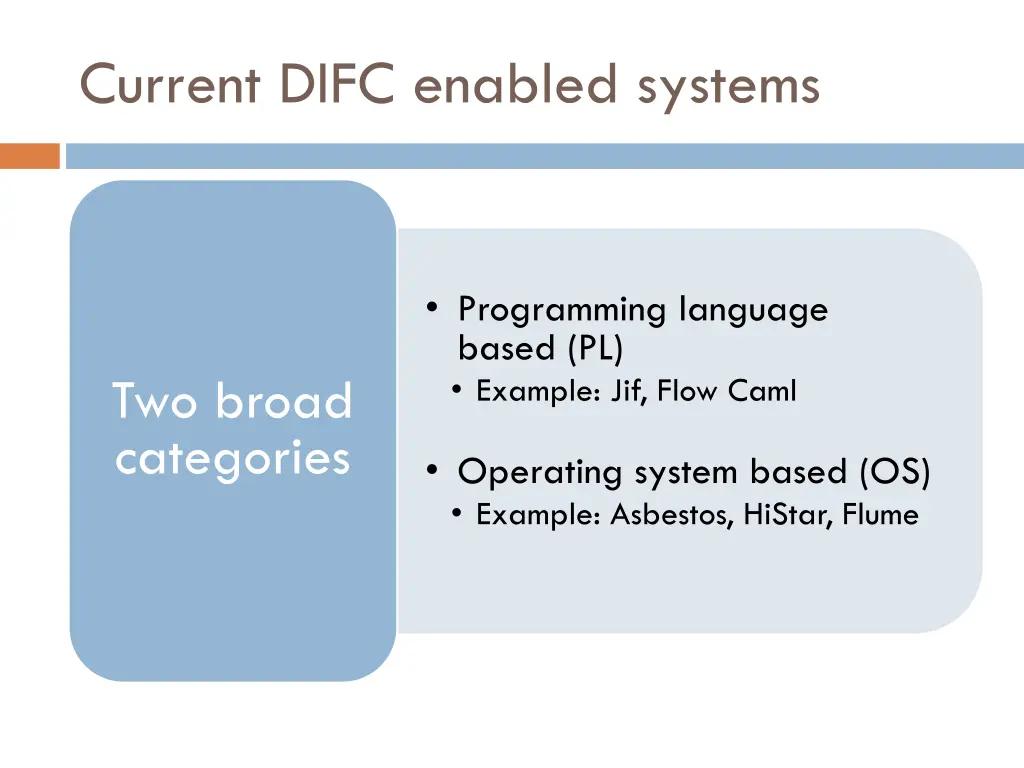
Current DIFC enabled systems Programming language based (PL) Example: Jif, Flow Caml Two broad categories Operating system based (OS) Example: Asbestos, HiStar, Flume
Advantages of Laminar PL Based OS based Laminar Fine grained Address space or page level Object level
Advantages of Laminar PL Based OS based Laminar Fine grained End-to-end guarantee Information leaks possible through files and sockets
Advantages of Laminar PL Based OS based Laminar Fine grained End-to-end guarantee Incrementally deployable New language or type system Code refactoring
Advantages of Laminar PL Based OS based Laminar Fine grained End-to-end guarantee Incrementally deployable Advanced language features * *Dynamic class loading, reflection, multi-threading
Advantages of Laminar PL Based OS based Laminar Fine grained End-to-end guarantee Incrementally deployable Advanced language features JVM tracks labels of objects Dynamic analysis JVM+OS integration Security regions (new PL construct)
Outline Comparison with current DIFC systems Laminar: programming model Design: PL + OS techniques Security regions Case studies and evaluation Summary
Programming model No modifications to code that does not access the calendar No need to trust such code! User Monday Tuesday Alice Watch game Office work Bob Free Meet doctor Security regions Wraps the code that accesses the calendar Again, no need to trust the code! Unless it modifies the labels of the data structure Less work by the programmer. Laminar enforces user security policy.
Trust assumptions Laminar JVM and Laminar OS should perform the correct DIFC checks Programmers should correctly specify the security policies using labels Limitation covert channels Timing channels Termination channels Probabilistic channels
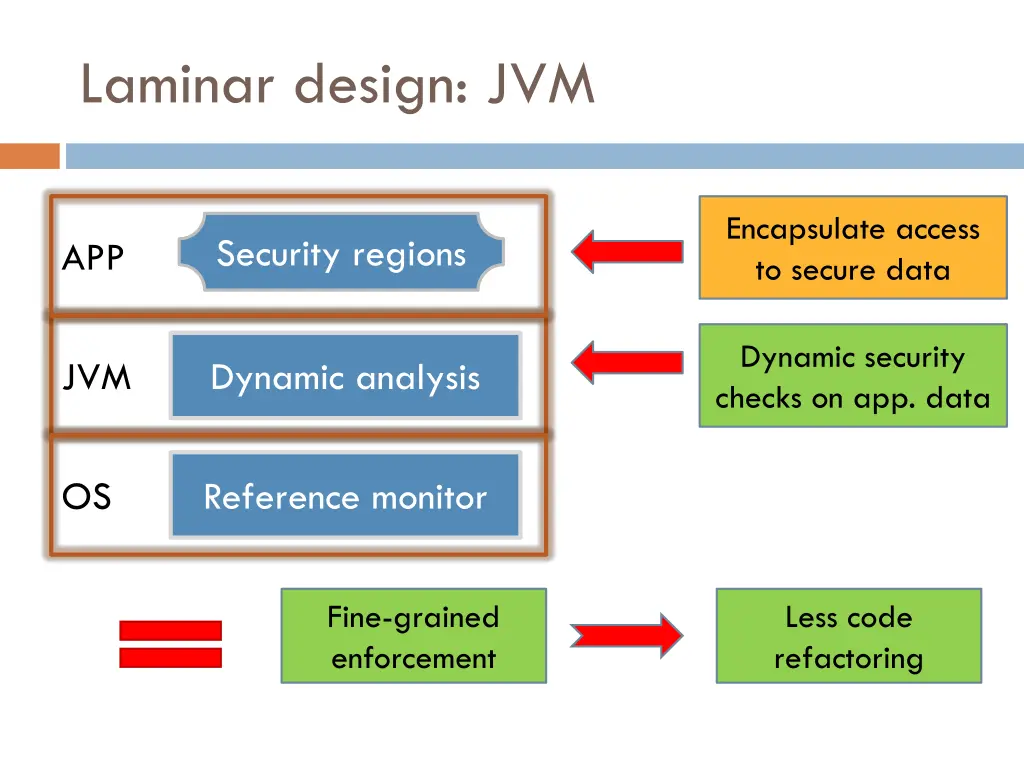
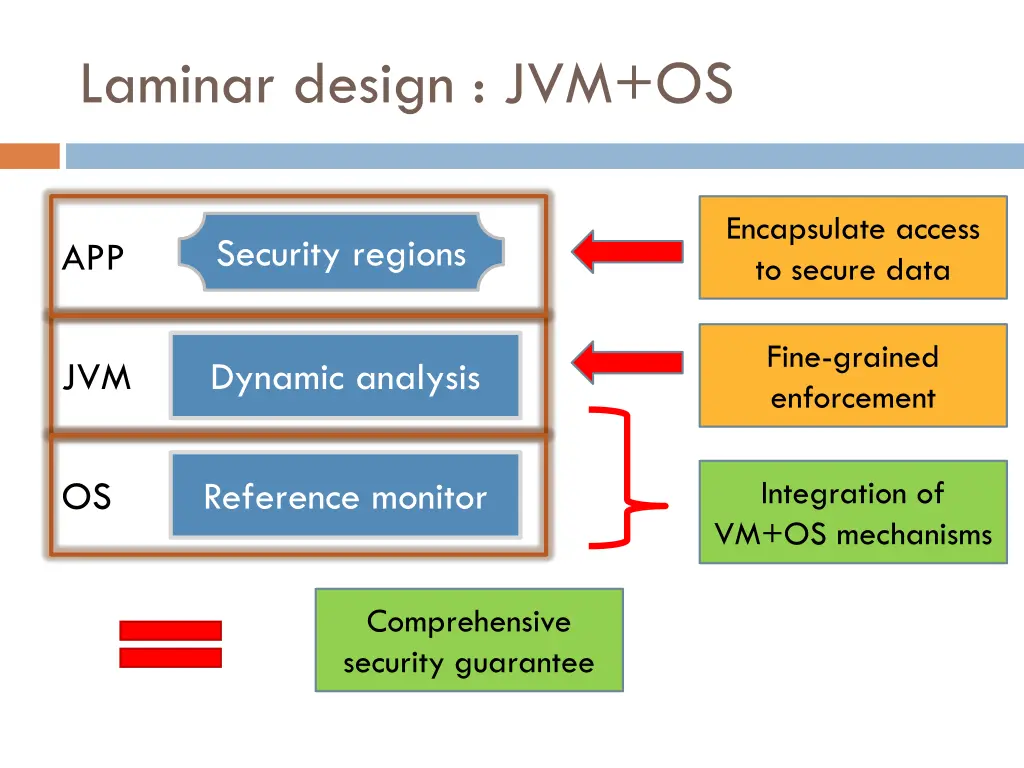
Laminar design Security regions APP JVM Dynamic analysis OS Reference monitor
Laminar design: security regions Programming language construct Security regions APP JVM Dynamic analysis Security sensitive data accessed only inside a security region OS Reference monitor Lowers overhead of DIFC checks Helps incremental deployment
Laminar design: JVM Encapsulate access to secure data Security regions APP Dynamic security checks on app. data JVM Dynamic analysis OS Reference monitor Fine-grained enforcement Less code refactoring
Laminar design : OS Encapsulate access to secure data Security regions APP Fine-grained enforcement JVM Dynamic analysis Security checks on files/sockets OS Reference monitor Prevents security violation on system resources
Laminar design : JVM+OS Encapsulate access to secure data Security regions APP Fine-grained enforcement JVM Dynamic analysis Integration of VM+OS mechanisms OS Reference monitor Comprehensive security guarantee
Outline Comparison with current DIFC systems Laminar: programming model Design: PL + OS techniques Security regions Case studies and evaluation Summary
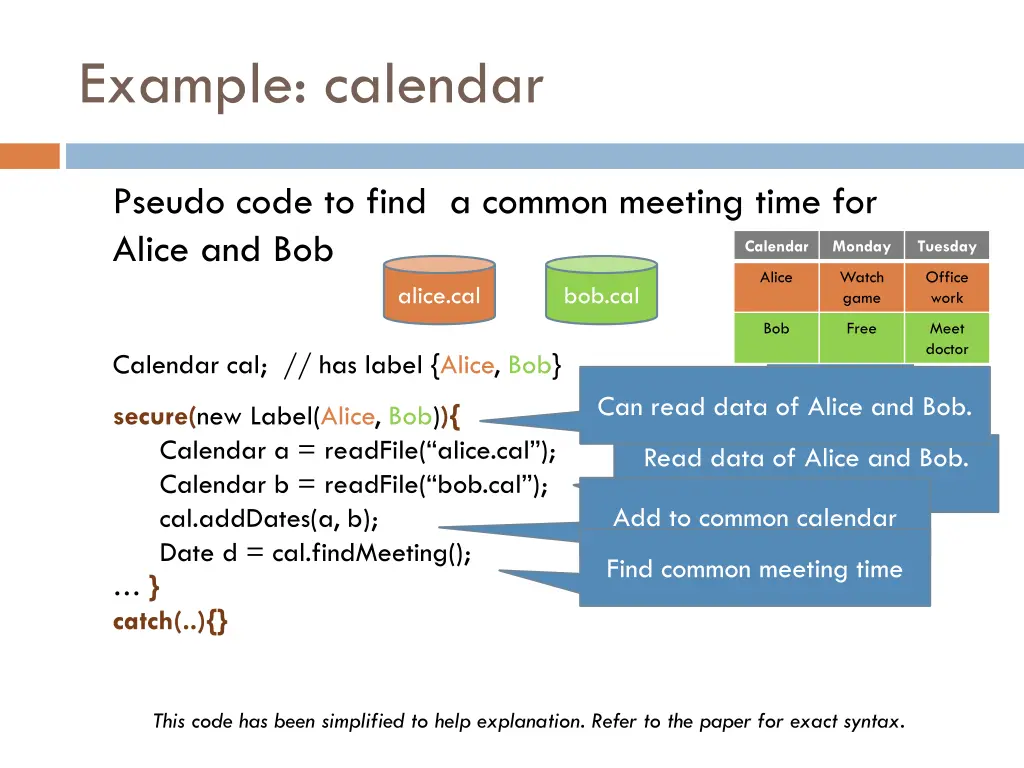
Example: calendar Pseudo code to find a common meeting time for Alice and Bob alice.cal Calendar Monday Tuesday Alice Watch game Office work bob.cal Bob Free Meet doctor Calendar cal; // has label {Alice, Bob} Labeled Data Can read data of Alice and Bob. secure(new Label(Alice, Bob)){ Calendar a = readFile( alice.cal ); Calendar b = readFile( bob.cal ); cal.addDates(a, b); Date d = cal.findMeeting(); } catch(..){} Read data of Alice and Bob. Access checks by OS Add to common calendar Find common meeting time This code has been simplified to help explanation. Refer to the paper for exact syntax.
Security regions for programming ease Easier to add security policies Wrap code that touches sensitive data inside security region Untrusted Code Hypothesis: only small portions of code and data are security sensitive Security region APP Untrusted Code Simplifies auditing
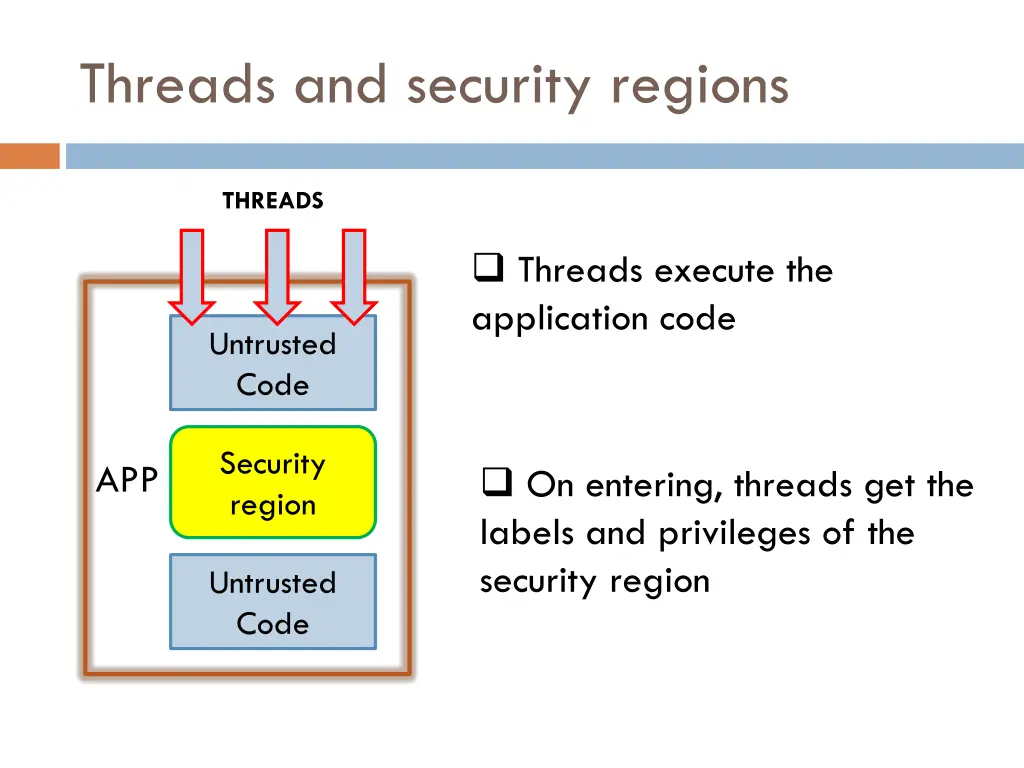
Threads and security regions THREADS Threads execute the application code Untrusted Code Security region APP On entering, threads get the labels and privileges of the security region Untrusted Code
Supporting security regions: JVM+OS Calendar cal; // has label {Alice, Bob} secure(new Label(Alice, Bob)){ Calendar a = readFile( alice.cal ); Calendar b = readFile( bob.cal ); cal.addDates(a, b); Date d = cal.findMeeting(); } catch(..){} Security region APP JVM Dynamic analysis Reference monitor OS {Alice, Bob} {Alice} {Bob} {}
Labeling application data JVM allocates labeled objects from a separate heap space Efficient checks on whether an object is labeled Object header points to secrecy and integrity labels Locals and statics are not labeled Restricted use inside and outside security regions Prevents illegal information flow We are extending our implementation to support labeled statics
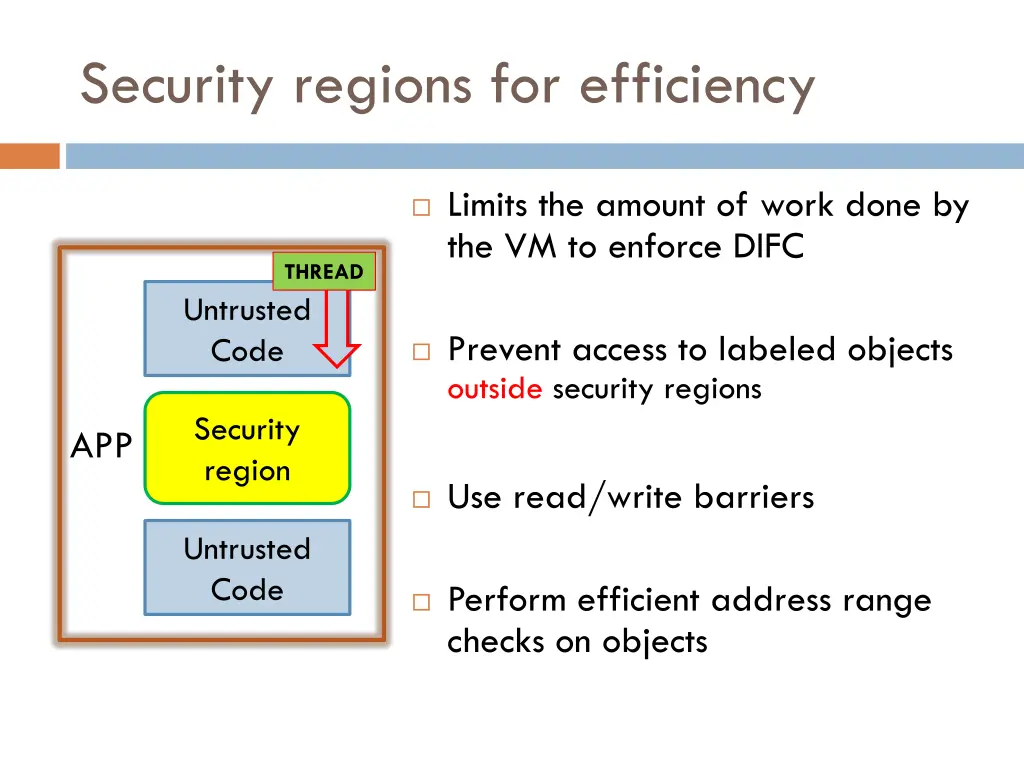
Security regions for efficiency Limits the amount of work done by the VM to enforce DIFC THREAD Untrusted Code Prevent access to labeled objects outside security regions Security region APP Use read/write barriers Untrusted Code Perform efficient address range checks on objects
Checks outside a security region Label credentials = new Label (Alice, Bob); Calendar cal; // has label {Alice, Bob} THREAD Untrusted Code secure(credentials){ cal.addDates(a, b); Date d = cal.findMeeting(); } catch(..){} Security region APP Untrusted Code Date d= cal.getMeetTime(); Labeled object read outside the security region
Checks inside a security region Mandatory DIFC checks inside security regions Untrusted Code Secrecy rule Cannot read more secret Cannot write to less secret THREAD Security region APP Untrusted Code Integrity rule Cannot read less trusted Cannot write to more trusted
Checks inside a security region Label credentials = new Label (Alice, Bob); Calendar mainCal; // has label {Alice, Bob} Calendar aliceCal; //has label {Alice} Thread in security region WRITE secure(credentials){ mainCal.event = aliceCal.date; READ mainCal.event Information flow aliceCal.date } catch(..){} {Alice, Bob} {Alice} {Bob} {} Information flow in a lattice
Checks inside a security region Label credentials = new Label (Alice, Bob); Calendar mainCal; // has label {Alice, Bob} Calendar aliceCal; //has label {Alice} Thread in security region WRITE secure(credentials){ aliceCal.date = mainCal.event ; READ aliceCal.date Information flow mainCal.event } catch(..){} {Alice, Bob} {Alice} {Bob} {} Information flow in a lattice
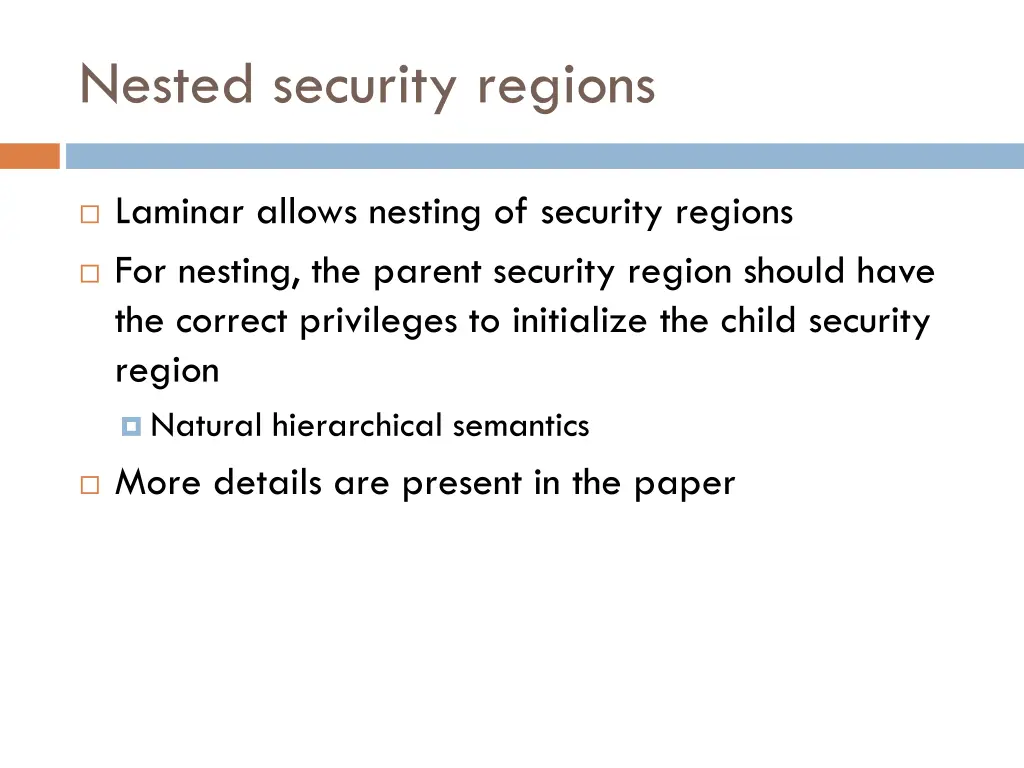
Nested security regions Laminar allows nesting of security regions For nesting, the parent security region should have the correct privileges to initialize the child security region Natural hierarchical semantics More details are present in the paper
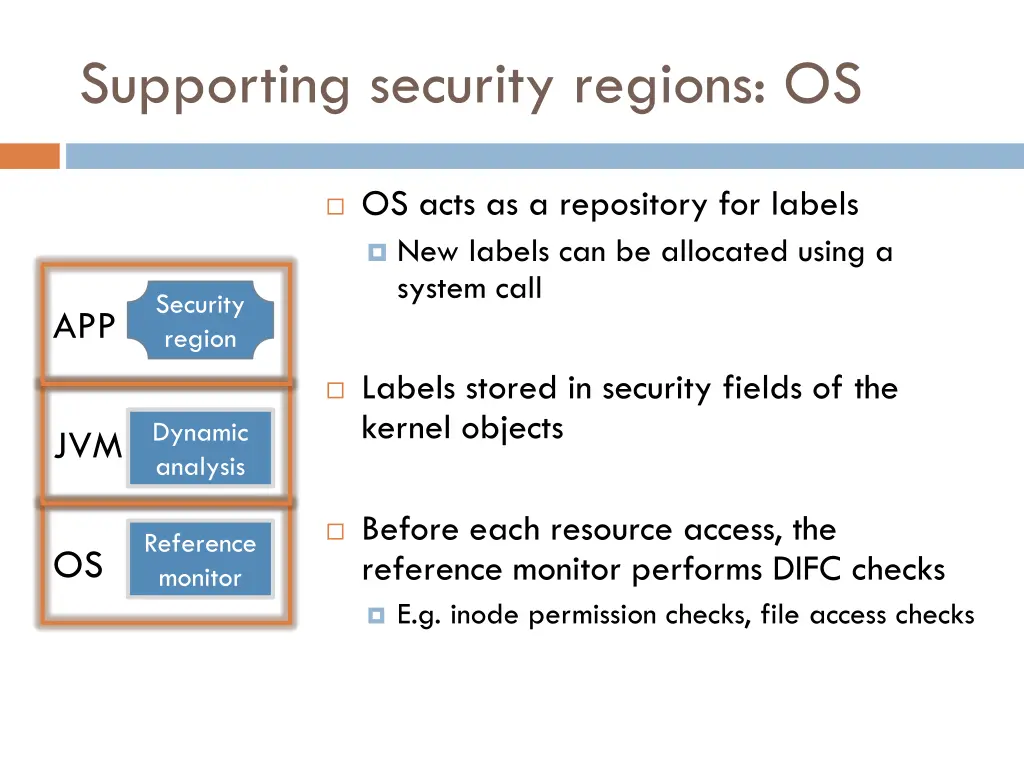
Supporting security regions: OS OS acts as a repository for labels New labels can be allocated using a system call Security region APP Labels stored in security fields of the kernel objects JVM Dynamic analysis Before each resource access, the reference monitor performs DIFC checks E.g. inode permission checks, file access checks Reference monitor OS
Outline Comparison with current DIFC systems Laminar: programming model Design: PL + OS techniques Security regions Case studies and evaluation Summary
Evaluation hypothesis Laminar requires modest code changes to retrofit security to applications Less burden on the programmer Laminar incurs modest overheads Practical and efficient
Laminar has modest overheads Compared against unmodified applications running on unmodified JVM and OS Overheads range from 1% to 54% IO disabled to prevent masking effect Lower overheads expected in real deployment All experiments on Quad-code Intel Xeon 2.83 GHz 60 50 40 30 20 10 0 GradeSheet Battleship Calendar FreeCS
Related Work IFC and lattice model Lattice Model[Denning 76], Biba 77, Bell-LaPadula 73 Language level DIFC Jif[Myers 97], FlowCaml[Simonet 03], Swift[Chong 07] OS based DIFC Asbestos[Efstathopoulos 05], HiStar[Zeldovich 06], Flume[Krohn 07], DStar[Zeldovich 08]
Summary Current DIFC systems fall short of enforcing comprehensive DIFC policies Laminar solves this by introducing security regions and integrating PL + OS mechanisms Laminar provides fine-grained DIFC, and yet has low overheads
Thank you! Current DIFC systems fall short of enforcing comprehensive DIFC policies Laminar solves this by introducing security regions and integrating PL + OS mechanisms Laminar provides fine-grained DIFC, and yet has low overheads
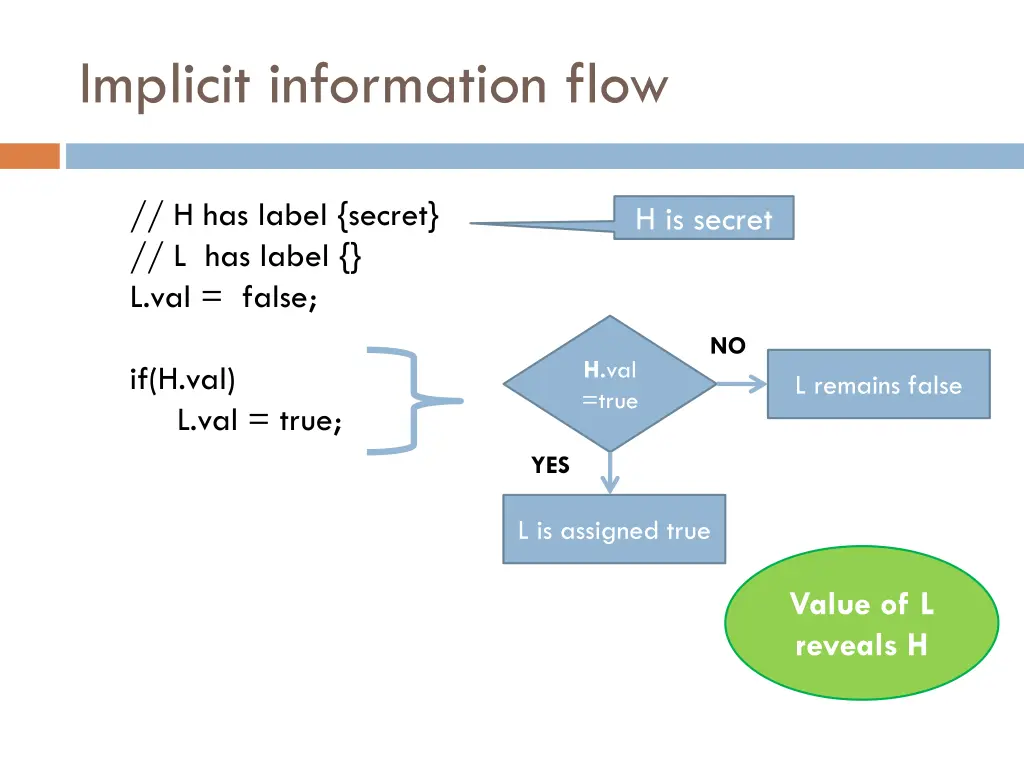
Implicit information flow // H has label {secret} // L has label {} L.val = false; H is secret NO H.val =true if(H.val) L.val = true; L remains false YES L is assigned true Value of L reveals H
Handling implicit information flows // H has label {secret} // L has label {} L.val = false; secure(credentials){ if(H.val) L.val = true; } catch( ) { } NO L.valnot assigned H.val =true YES VM raises exception L.val not assigned L.val always false ! No implicit flow Mandatory catch block. Executes with same labels as the security region Exception not revealed