Let's Talk About Social Inequality
This discussion on social inequality in November 2017 addresses vital issues affecting our society. Explore the complexities, impacts, and solutions surrounding this critical topic.

Download Presentation

Please find below an Image/Link to download the presentation.
The content on the website is provided AS IS for your information and personal use only. It may not be sold, licensed, or shared on other websites without obtaining consent from the author.If you encounter any issues during the download, it is possible that the publisher has removed the file from their server.
You are allowed to download the files provided on this website for personal or commercial use, subject to the condition that they are used lawfully. All files are the property of their respective owners.
The content on the website is provided AS IS for your information and personal use only. It may not be sold, licensed, or shared on other websites without obtaining consent from the author.
E N D
Presentation Transcript
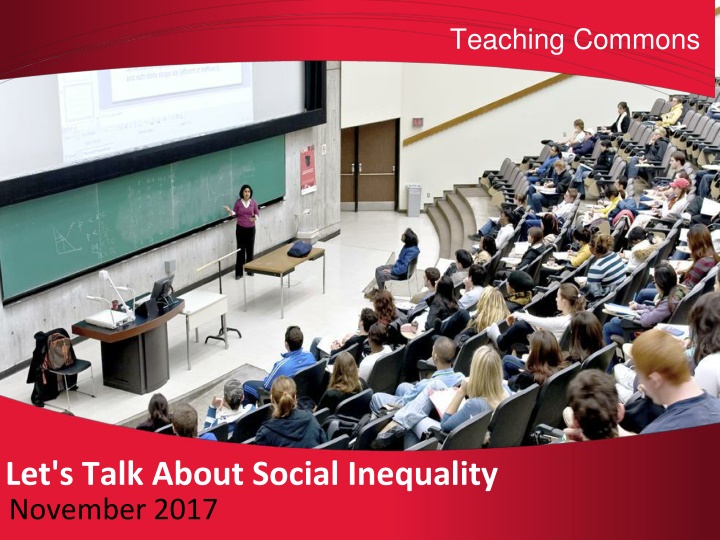
Teaching Commons Let's Talk About Social Inequality November 2017
Meet your Facilitator! Jessica Whitehead, TCT Communication & Culture PhD whitejl3@yorku.ca
Intended Learning Outcomes At the end of this workshop: Describe some theories behind equity in higher education. Identify on-campus resources that provide support. Learn some strategies on how to create an equitable and inclusive tutorial. Learn how to better address difficult situations that might occur in your tutorials.
Studies to Keep in Mind Redmond, M. (2010). Safe space oddity: Revisiting critical pedagogy. Journal of Teaching in Social Work, 30(1), 1-14. Turpin, C. A. (2007). Feminist praxis, online teaching, and the urban campus. Feminist Teacher, 18(1), 9-27. Wagner, A. (2005). Unsettling the academy: Working through the challenges of anti racist pedagogy. Race Ethnicity and Education, 8(3), 261-275.
Tips and strategies for facilitating critical discourses (adapted from Wagner, 2005). Acknowledge that the class can be expected to be an unsettling experience for some, as some deeply entrenched beliefs will be challenged. Initiate a collaborative approach Encourage teacher-student and student- student relationships in the classroom through active learning. Disrupt traditional dichotomous thinking through standpoint theory.
Creating an Equitable and Inclusive Tutorial Set clear expectations on the importance of equity in the first tutorial Give an overview to students of the importance of language when discussing race, gender, sexuality, and disabilities Be inclusive and address different types of learning styles Understand conflict resolution and do not escalate difficult situations Be careful of using stereotypes in your own teaching
Fears Exercise On a piece of paper, write your worst fear about dealing with social inequality in the classroom . Fold it and place in the middle of the table (do not write your name on the Post-it). Randomly redistribute the Post-its. Each TA will read the fear out loud and you will discuss it as a group. E.g. do you share this fear also? What strategies might help you to deal with it?
What are Your Strategies?
York Code of Student Rights & Responsibilities: Community Standards and behavioral expectations at York are defined in the Code of Students Rights and Responsibilities (CSRR) It was developed collaboratively by students, faculty and, and staff The code is intended to maintain York s core values of Diversity, Equity, Respect, Civility, and Honesty
Students Have the Following Rights and Responsibilities: The right to participate in activities for students at the University, without harassment, intimidation, discrimination, disruption or acts of violence. The right to engage and participate in dialogue and to examine diverse views and ideas. The responsibility not to disrupt or interfere with University activities(e.g. academic activities such as classes, University programs, student co-curricular activities and tabling). The responsibility to behave in a way that does not harm or threaten to harm another person s physical or mental well being. Find out more: http://www.yorku.ca/oscr/pdfs/CodeofRightsandResponsibilities.pdf
Resources Available @ York 1. The Office of Student Community Relations (OSCR) Supports students impacted by critical incidents, facing personal crises or multiple complex issues OSCR works with students and faculty to resolve complaints regarding inappropriate behaviour either informally or through formal disciplinary processes. 2. The Centre for Human Rights, Equity and Inclusion The Centre for Human Rights, Equity and Inclusion (REI) responds to concerns, and complaints under provincial human rights legislation and related York policies and procedures, including but not limited to questions of discrimination on the grounds of age, race, citizenship, creed, disability (incl. mental health and addictions), family status, marital status, gender identity/expression, sex, and sexual orientation. 3. Sexual Violence Response and Support Has a mission to foster a culture where attitudes and behaviors that perpetuate sexual violence are rejected, survivors are supported, community members are educated and those who commit incidents of sexual violence are held accountable.
Support for TAs: The Teaching Commons. http://teachingcommons.yorku.ca/graduate- students/ CUPE 3903: Equity http://3903.cupe.ca/resources/equity/
Some Additional Support Services for Students: Disability Services offers three disability service units : Learning Disability Services: provides educational support to university students with documented learning disabilities, attention disorders, and autism spectrum disorders. Mental Health Disability Services: provides educational support to university students with mental health disabilities. Physical, Sensory & Medical Disability Services: provides educational support to university students with physical, sensory & medical disabilities http://ds.info.yorku.ca/
What does this mean for TAs? Be clear about expectations from your course director and department Have an accessible tutorial Keep your course director in the loop with any concerns that come up If a critical incident does occur reach out to OSCR, Centre for Human Rights, or the office of Sexual Violence Response and Support You can also contact the Teaching Commons and the CUPE 3903 Equity officer for help
This could happen to you Your group has received a series of scenarios. In the time allotted, read and discuss the scenarios assigned. This activity is designed to provide you with opportunities to problem-solve and share your individual responses based on how you think you should handle each situation.
Concluding Remarks Today we Described the importance of equity in your tutorials. Identified strategies of how to address social inequality in your classroom. Formed a discussion group with fellow TAs and looked at how to deal with specific issues. Identified the numerous supports available to you at York.
Upcoming Workshops for TAs http://teachingcommons.yorku.ca/calendar/action~agenda/request_format~html/cat_ids~9/ Title of Workshop and Location Date and Time Dealing with Classroom and Student Conflict (DB 1014) Marking and Grading Practices (DB 1014) Academic Integrity in the Classroom (DB 1014) Learn How to Use Prezi for your Tutorials (DB 1014) Classroom Strategies for When They Haven t Done the Readings (DB 1014) Teaching, Research and a Life? Finding the Right Balance (DB 1014) Reading Week is Over: Strategies to Maintain and Inspire Student Motivation (DB 1014) We also offer TA Drop-in Hours in the Teaching Commons Lounge (in DB 1050) by appointment: http://teachingcommons.yorku.ca/graduate- students/ta-drop-in/ Thurs. Nov. 23, 12-1pm Mon. Jan. 8, 1- 4pm Wed. Jan. 17, 12- 1pm Thurs. Jan. 25, 11:30am-1pm Tues. Jan. 30, 12- 1pm Wed. Feb. 7, 12- 1pm Tues. Feb 27, 12- 1pm