Leveraging Software-Defined Networks to Support Mobile Application Offloading
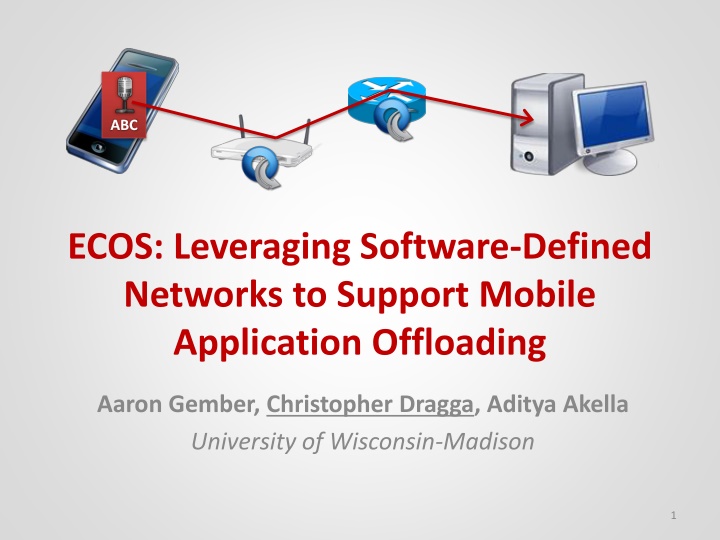
Mobile devices face increasing demands from complex applications that require significant CPU, memory, and energy resources. To address the limitations of these devices, mobile apps must utilize remote computation services effectively. This presentation discusses application-independent offloading techniques that can dynamically divide execution between mobile devices and compute resources while ensuring privacy and resource management within enterprises, leveraging Software-Defined Networking for enhanced flexibility and control.

Download Presentation

Please find below an Image/Link to download the presentation.
The content on the website is provided AS IS for your information and personal use only. It may not be sold, licensed, or shared on other websites without obtaining consent from the author.If you encounter any issues during the download, it is possible that the publisher has removed the file from their server.
You are allowed to download the files provided on this website for personal or commercial use, subject to the condition that they are used lawfully. All files are the property of their respective owners.
The content on the website is provided AS IS for your information and personal use only. It may not be sold, licensed, or shared on other websites without obtaining consent from the author.
E N D
Presentation Transcript
ECOS: Leveraging Software-Defined Networks to Support Mobile Application Offloading Aaron Gember, Christopher Dragga, Aditya Akella University of Wisconsin-Madison 1
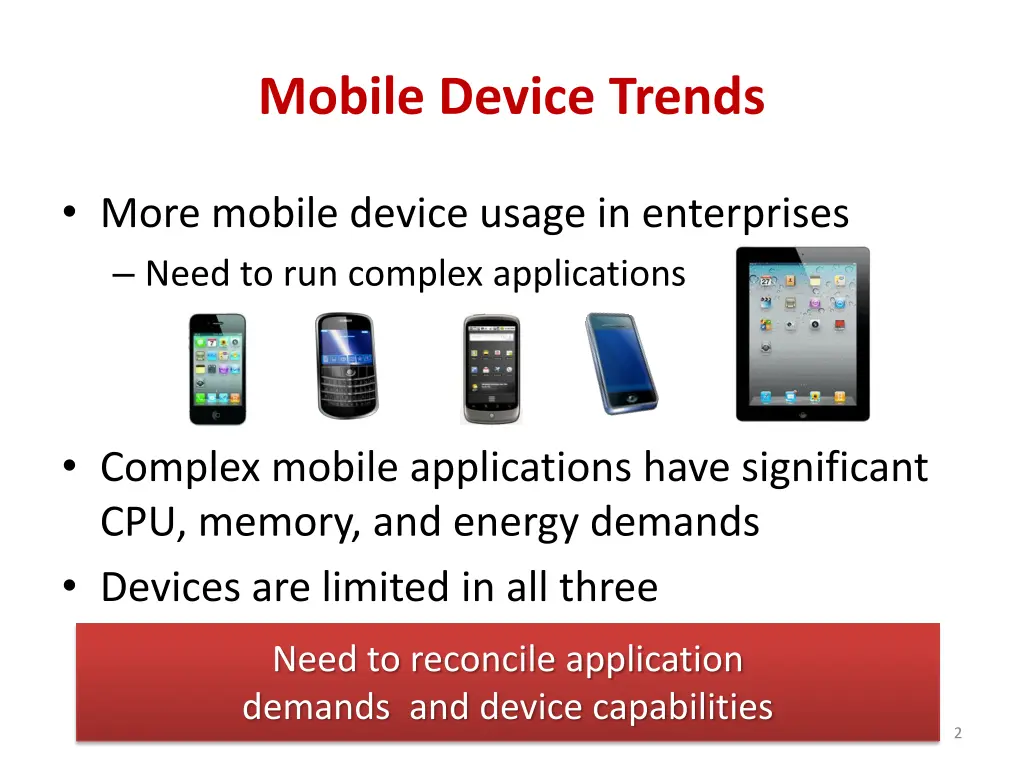
Mobile Device Trends More mobile device usage in enterprises Need to run complex applications Complex mobile applications have significant CPU, memory, and energy demands Devices are limited in all three Need to reconcile application demands and device capabilities 2
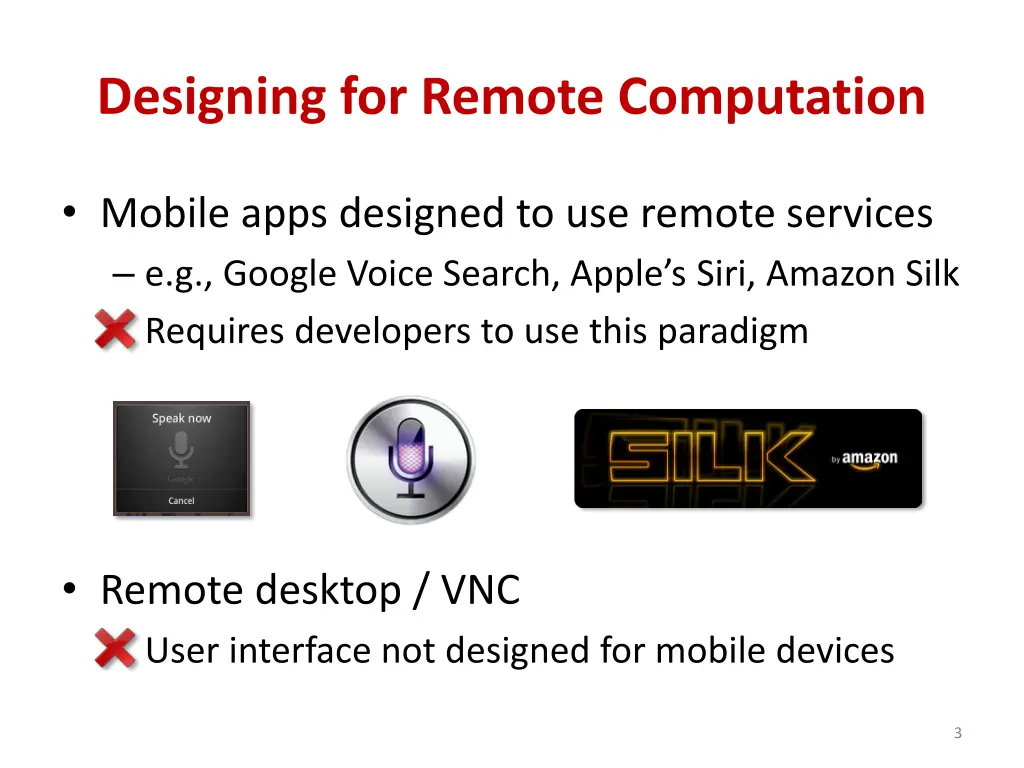
Designing for Remote Computation Mobile apps designed to use remote services e.g., Google Voice Search, Apple s Siri, Amazon Silk Requires developers to use this paradigm Remote desktop / VNC User interface not designed for mobile devices 3
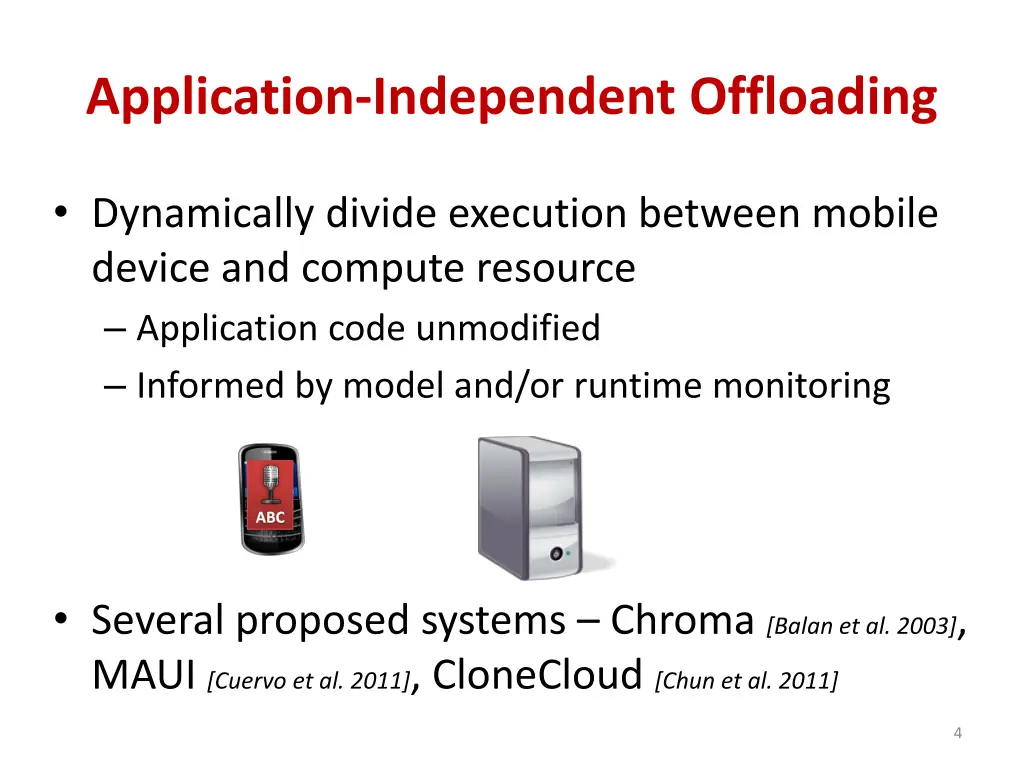
Application-Independent Offloading Dynamically divide execution between mobile device and compute resource Application code unmodified Informed by model and/or runtime monitoring Several proposed systems Chroma [Balan et al. 2003], MAUI [Cuervo et al. 2011], CloneCloud [Chun et al. 2011] 4
Roadblocks to Offloading Adoption Privacy and trust Proposed systems largely ignore privacy Privacy is paramount in enterprises Resource sharing and churn Proposed systems consider one device, plus a dedicated resource Enterprises have many devices and a changing pool of resources 5
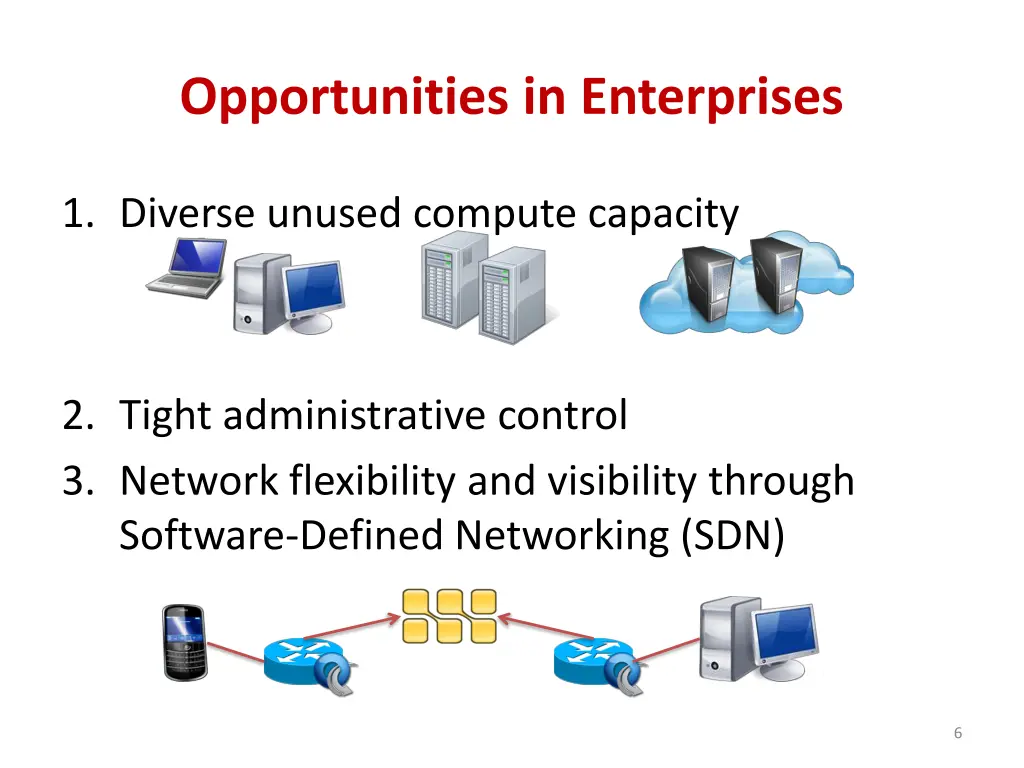
Opportunities in Enterprises 1. Diverse unused compute capacity 2. Tight administrative control 3. Network flexibility and visibility through Software-Defined Networking (SDN) 6
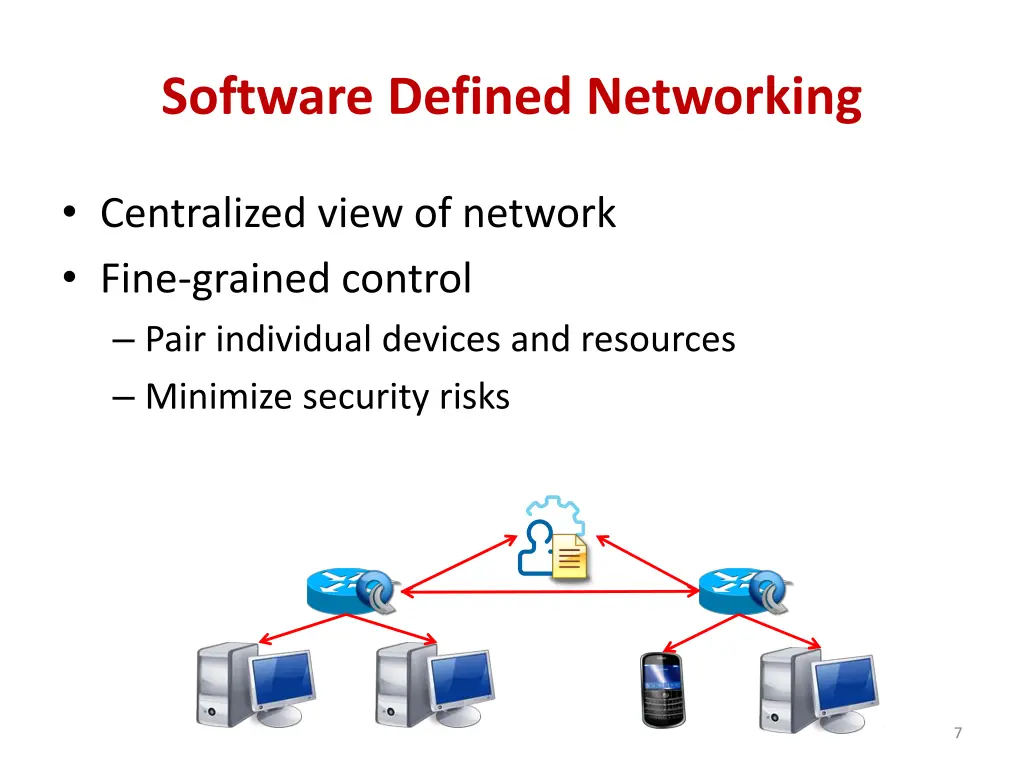
Software Defined Networking Centralized view of network Fine-grained control Pair individual devices and resources Minimize security risks 7
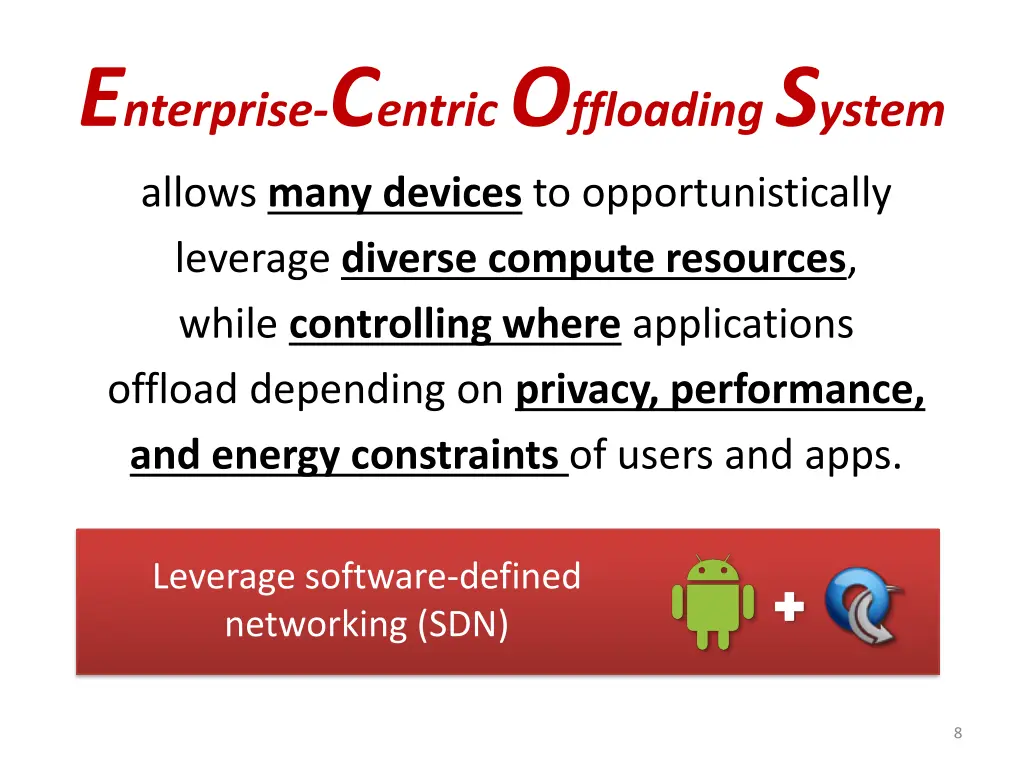
Enterprise-Centric Offloading System allows many devices to opportunistically leverage diverse compute resources, while controlling where applications offload depending on privacy, performance, and energy constraints of users and apps. Leverage software-defined networking (SDN) + + 8
Outline Offloading benefits and roadblocks Addressing privacy and trust Resource sharing and churn ECOS prototype Evaluation for a small enterprise setting 9
Privacy and Trust Security is paramount in enterprises Offloading may cause data to leave device Challenges When should security be applied? How to secure offloading? Offloading benefits and opportunities should not be significantly diminished 10
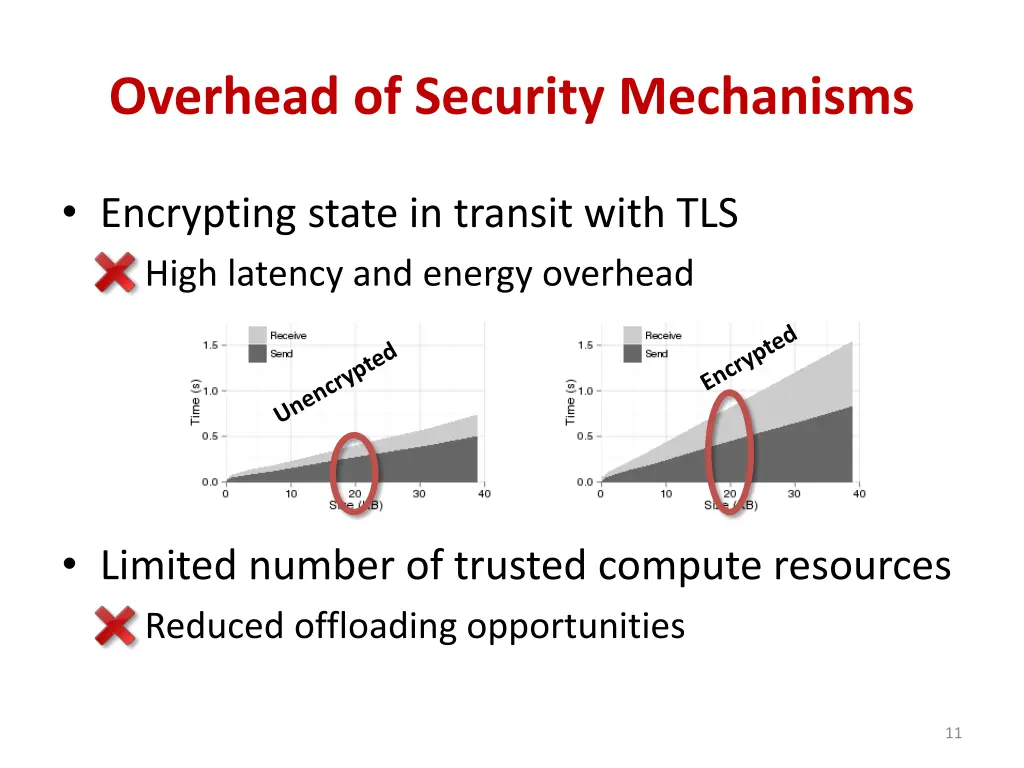
Overhead of Security Mechanisms Encrypting state in transit with TLS High latency and energy overhead Limited number of trusted compute resources Reduced offloading opportunities 11
Security Policy Security policy provided to SDN controller Privacy levels for devices & applications Trust levels for compute resources Choose between three privacy levels Differ in trusted resources and use of encryption 12
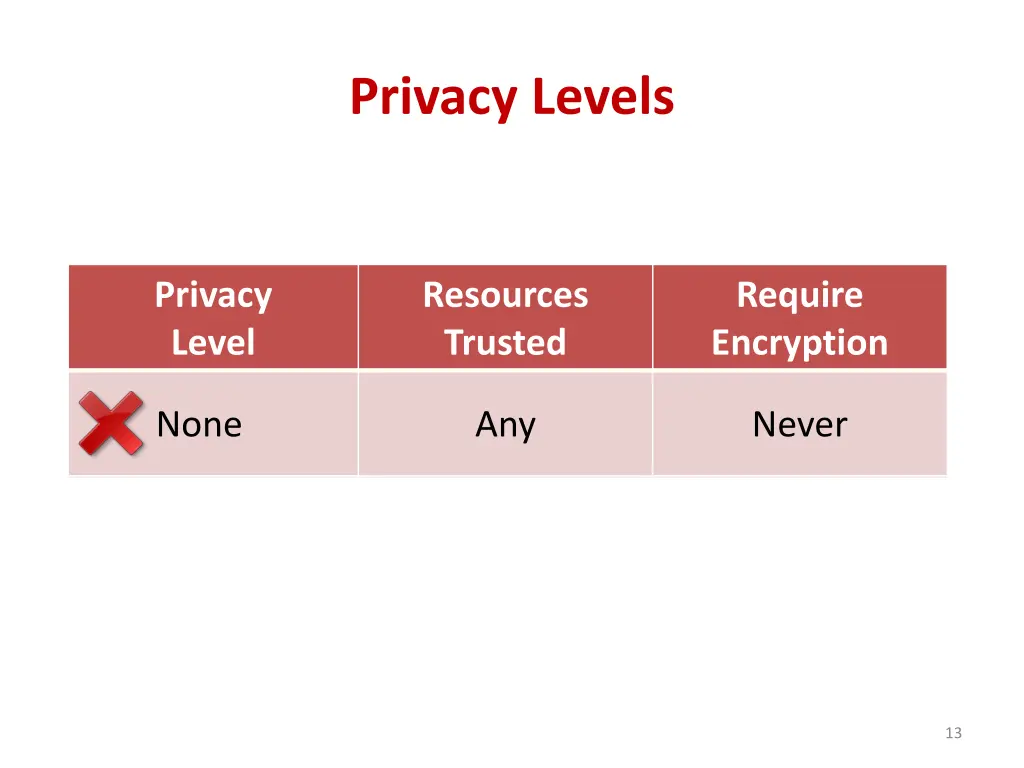
Privacy Levels Privacy Level Resources Trusted Require Encryption None Any Never All internal resources Select servers and desktops Enterprise Never User Always 13
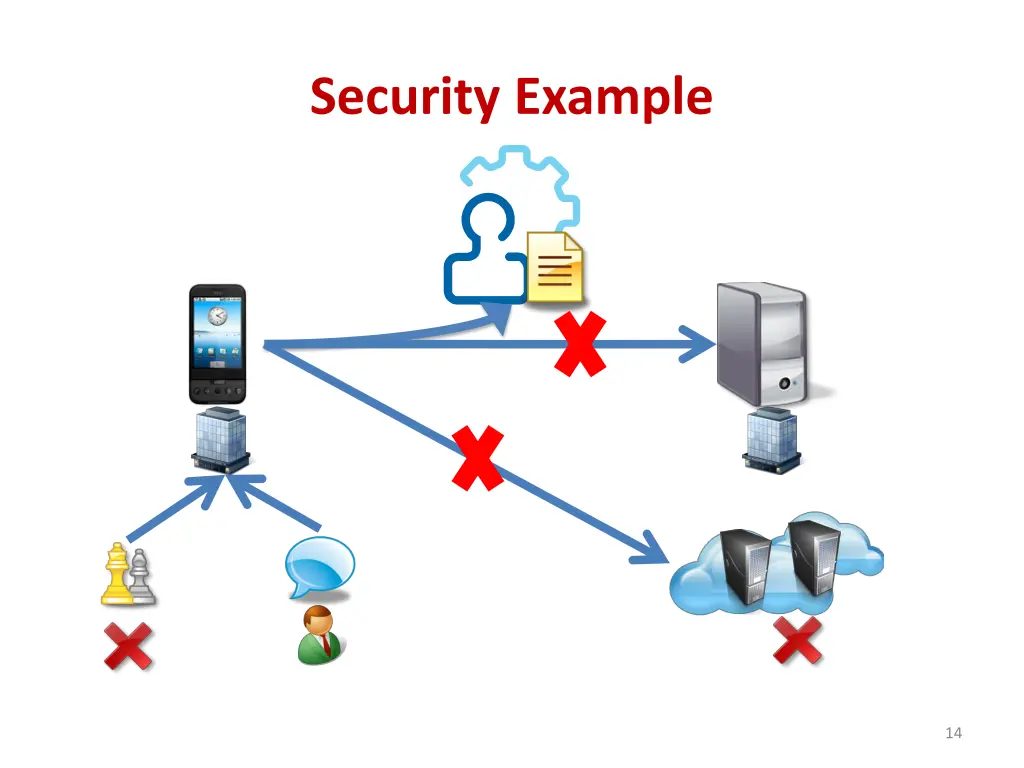
Security Mechanisms Always enforce encryption and resource selection decisions using SDN Default off-network Only allow flows on specific ports and between specific mobile devices and compute resources Remove forwarding rules to stop rogue offloads 15
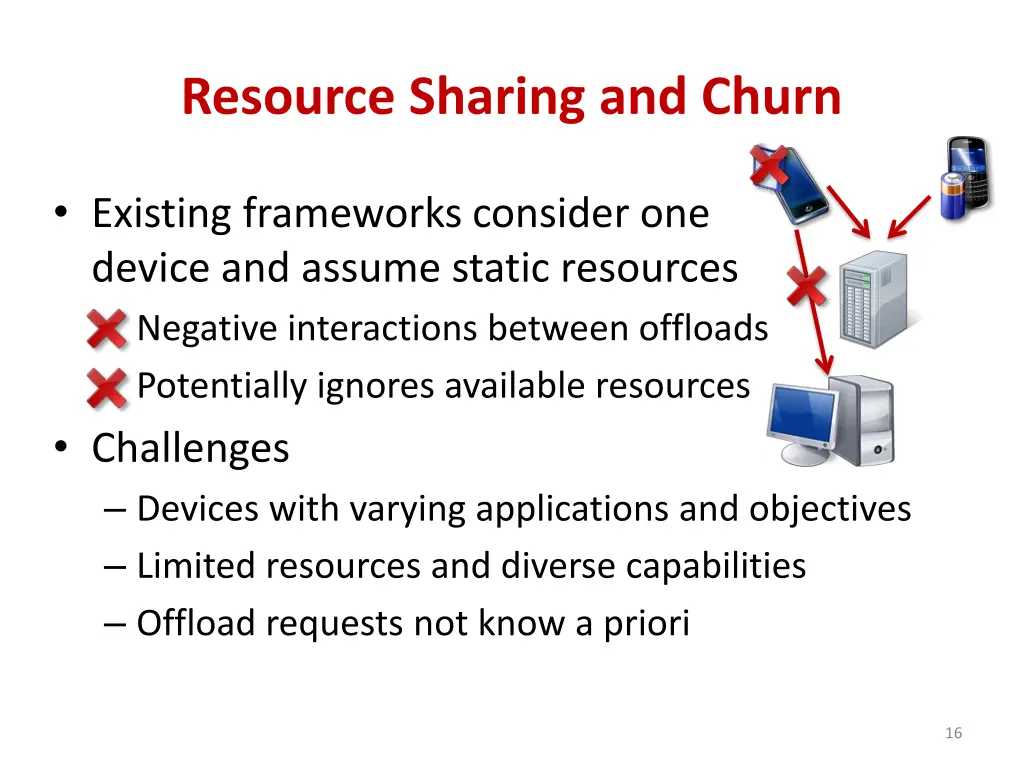
Resource Sharing and Churn Existing frameworks consider one device and assume static resources Negative interactions between offloads Potentially ignores available resources Challenges Devices with varying applications and objectives Limited resources and diverse capabilities Offload requests not know a priori 16
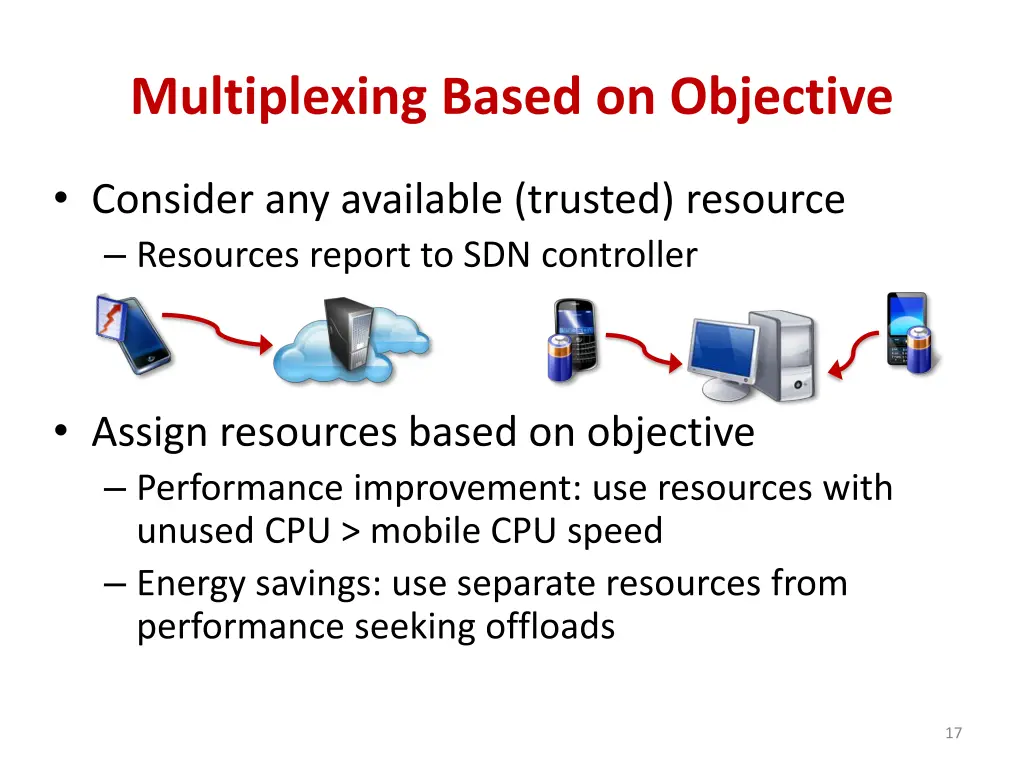
Multiplexing Based on Objective Consider any available (trusted) resource Resources report to SDN controller Assign resources based on objective Performance improvement: use resources with unused CPU > mobile CPU speed Energy savings: use separate resources from performance seeking offloads 17
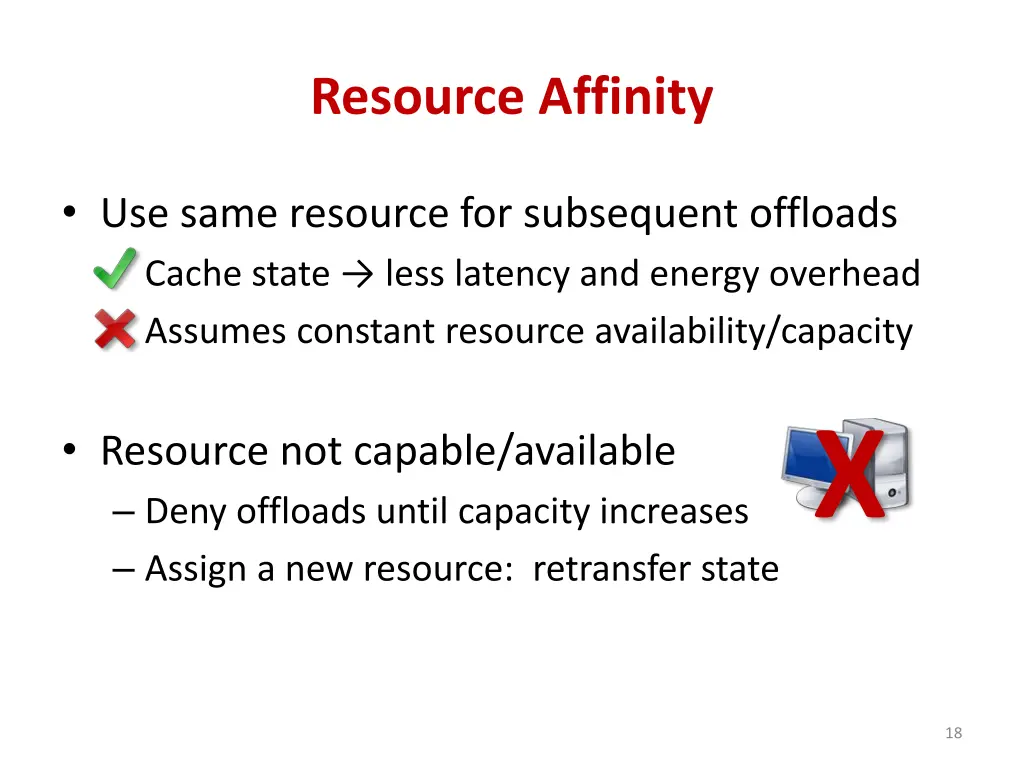
Resource Affinity Use same resource for subsequent offloads Cache state less latency and energy overhead Assumes constant resource availability/capacity X Resource not capable/available Deny offloads until capacity increases Assign a new resource: retransfer state 18
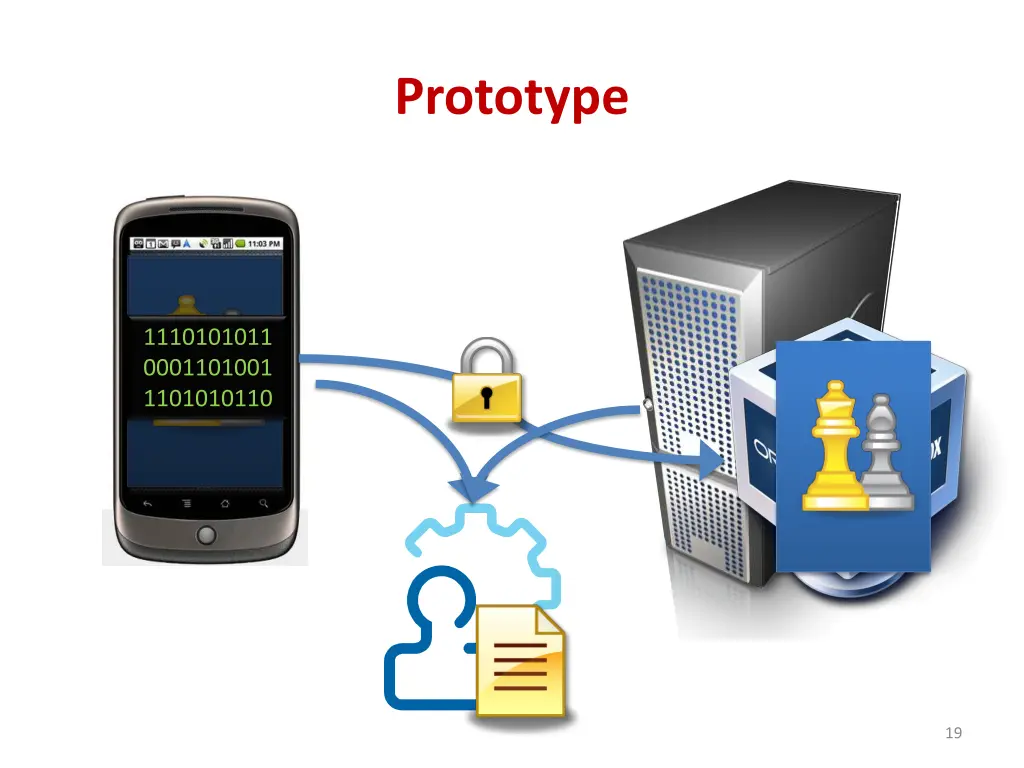
Prototype 1110101011 0001101001 1101010110 19
Evaluation Small enterprise setting 12 phones (Android emulator) 4 to 6 desktops (2.4Ghz quad-core, 4GB RAM) Two applications : AI-decision making (Chess) 50 moves No privacy Speech-to-text (emulated) 20 recognitions User privacy Significant computation, small state Actual enterprise applications expensive 20
Performance Improvement 400 350 300 250 Time (sec) 200 150 100 50 0 1 2 3 4 5 6 7 8 9 10 11 12 Phones No Offloading 4 Desktops 6 Desktops 21
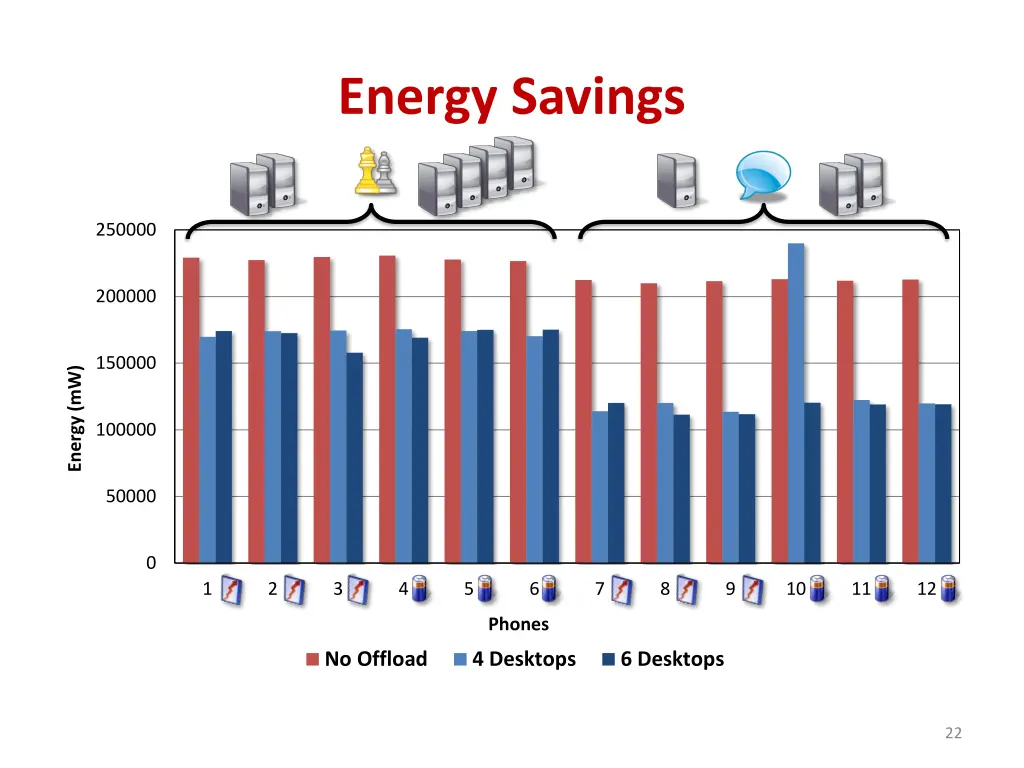
Energy Savings 250000 200000 150000 Energy (mW) 100000 50000 0 1 2 3 4 5 6 7 8 9 10 11 12 Phones No Offload 4 Desktops 6 Desktops 22
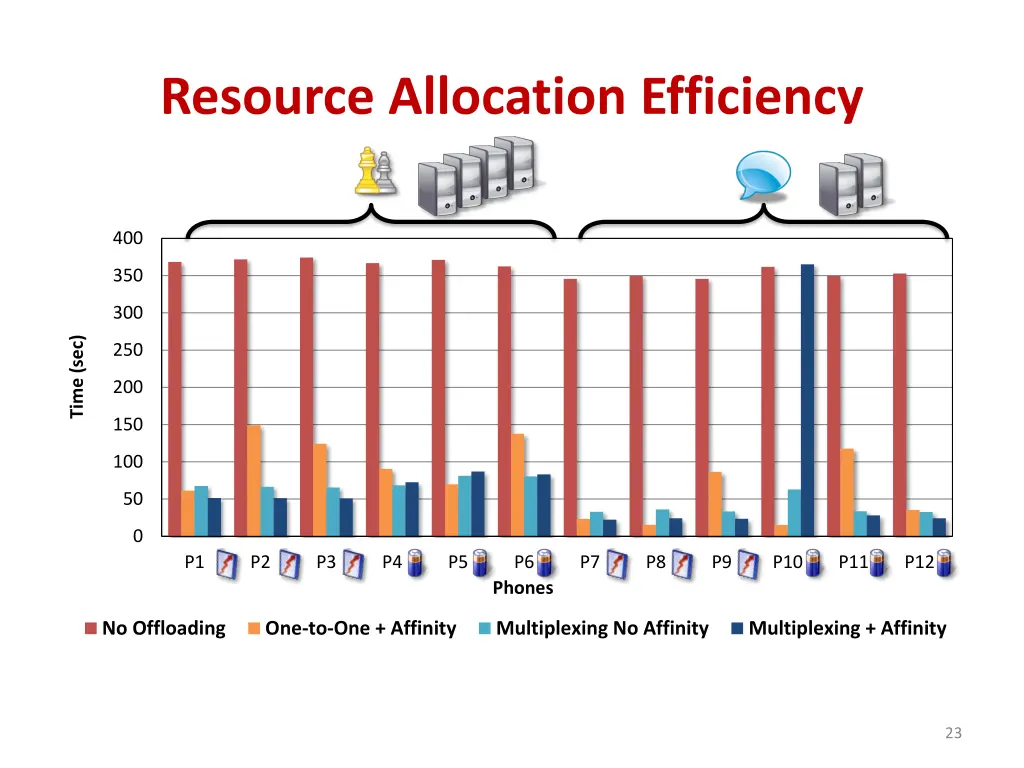
Resource Allocation Efficiency 400 350 300 Time (sec) 250 200 150 100 50 0 P1 P2 P3 P4 P5 P6 P7 P8 P9 P10 P11 P12 Phones No Offloading One-to-One + Affinity Multiplexing No Affinity Multiplexing + Affinity 23
Summary Enterprise-Centric Offloading System Leverages software-defined networking Accommodates trust and privacy concerns with minimal complexity and overhead Scales offloading to many mobile devices, and opportunistically leverages diverse resources 24