Light-Duty Vehicle GHG Technical Amendments Rulemaking
The rulemaking seeks to correct errors in regulations related to advanced technology incentive multipliers and off-cycle credits for light-duty vehicle GHG programs. These amendments are crucial for manufacturers to meet compliance requirements efficiently.

Download Presentation

Please find below an Image/Link to download the presentation.
The content on the website is provided AS IS for your information and personal use only. It may not be sold, licensed, or shared on other websites without obtaining consent from the author.If you encounter any issues during the download, it is possible that the publisher has removed the file from their server.
You are allowed to download the files provided on this website for personal or commercial use, subject to the condition that they are used lawfully. All files are the property of their respective owners.
The content on the website is provided AS IS for your information and personal use only. It may not be sold, licensed, or shared on other websites without obtaining consent from the author.
E N D
Presentation Transcript
Light-duty Vehicle GHG Technical Amendments Rulemaking EPA/OTAQ Briefing for E.O. 12866 Interagency Review June 19, 2018 E.O. 12866 Review Material 1
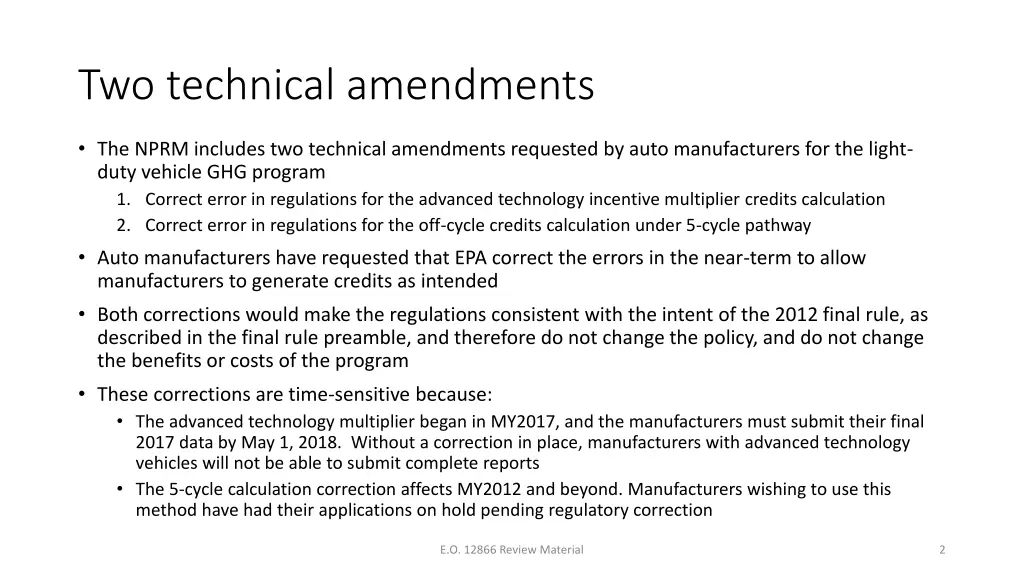
Two technical amendments The NPRM includes two technical amendments requested by auto manufacturers for the light- duty vehicle GHG program 1. Correct error in regulations for the advanced technology incentive multiplier credits calculation 2. Correct error in regulations for the off-cycle credits calculation under 5-cycle pathway Auto manufacturers have requested that EPA correct the errors in the near-term to allow manufacturers to generate credits as intended Both corrections would make the regulations consistent with the intent of the 2012 final rule, as described in the final rule preamble, and therefore do not change the policy, and do not change the benefits or costs of the program These corrections are time-sensitive because: The advanced technology multiplier began in MY2017, and the manufacturers must submit their final 2017 data by May 1, 2018. Without a correction in place, manufacturers with advanced technology vehicles will not be able to submit complete reports The 5-cycle calculation correction affects MY2012 and beyond. Manufacturers wishing to use this method have had their applications on hold pending regulatory correction E.O. 12866 Review Material 2
1. Advanced Technology Incentive Multipliers 1. Advanced Technology Incentive Multipliers E.O. 12866 Review Material 3
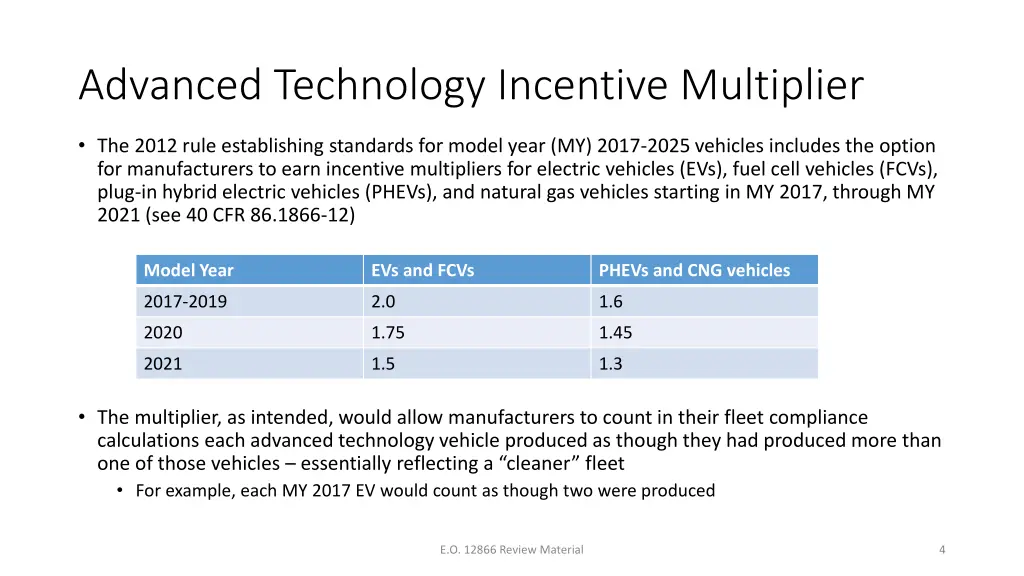
Advanced Technology Incentive Multiplier The 2012 rule establishing standards for model year (MY) 2017-2025 vehicles includes the option for manufacturers to earn incentive multipliers for electric vehicles (EVs), fuel cell vehicles (FCVs), plug-in hybrid electric vehicles (PHEVs), and natural gas vehicles starting in MY 2017, through MY 2021 (see 40 CFR 86.1866-12) Model Year EVs and FCVs PHEVs and CNG vehicles 2017-2019 2.0 1.6 2020 1.75 1.45 2021 1.5 1.3 The multiplier, as intended, would allow manufacturers to count in their fleet compliance calculations each advanced technology vehicle produced as though they had produced more than one of those vehicles essentially reflecting a cleaner fleet For example, each MY 2017 EV would count as though two were produced E.O. 12866 Review Material 4
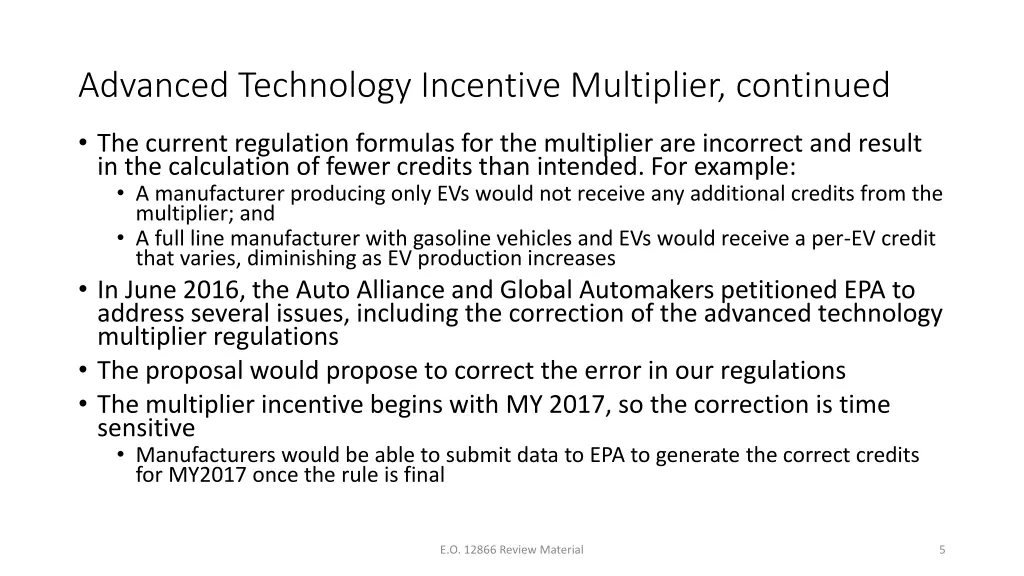
Advanced Technology Incentive Multiplier, continued The current regulation formulas for the multiplier are incorrect and result in the calculation of fewer credits than intended. For example: A manufacturer producing only EVs would not receive any additional credits from the multiplier; and A full line manufacturer with gasoline vehicles and EVs would receive a per-EV credit that varies, diminishing as EV production increases In June 2016, the Auto Alliance and Global Automakers petitioned EPA to address several issues, including the correction of the advanced technology multiplier regulations The proposal would propose to correct the error in our regulations The multiplier incentive begins with MY 2017, so the correction is time sensitive Manufacturers would be able to submit data to EPA to generate the correct credits for MY2017 once the rule is final E.O. 12866 Review Material 5
2. Off 2. Off- -cycle Technology Credits cycle Technology Credits E.O. 12866 Review Material 6
Off-cycle Technology Credits Using 5-cycle Methodology Manufacturers may optionally generate credits for off-cycle technologies, which are technologies that provide CO2 reductions in the real-world but are not captured over the 2-cycle tests that are the basis of the standards One pathway for generating off-cycle technology credits is to test vehicles with and without the technology over the 5-cycle test procedures used to determine vehicle fuel economy label values (the 5-cycle pathway ) The 5-cycle test method weights the 2-cycle tests used for compliance with 3 additional test cycles that better represent real-world factors impacting GHG emissions/fuel economy, including higher speeds and more aggressive driving, colder temperature operation, and the use of air conditioning In the 2012 rulemaking, EPA provided an opportunity for credits in cases where the off-cycle technology results in some benefit over the 2-cycle tests but more significant benefits off-cycle (an example is stop-start technology) E.O. 12866 Review Material 7
Off-cycle Technology Credits Using 5-cycle Methodology, continued EPA s intention in the 2012 rule was that, since the 5-cycle test procedures include the 2-cycle tests used for compliance, the 2-cycle benefit must be subtracted from the 5-cycle benefit to avoid double counting of benefits However, the current regulations erroneously do not require that the 2-cycle benefit be subtracted from the 5-cycle benefit, resulting in a credit calculation that is artificially too high and not reflecting actual real-world emission reductions, as was the intent of the credits Manufacturers interested in generating credits under the 5-cycle pathway recognize this error, and have asked EPA to clarify the regulations The proposal would propose to correct the error in our regulations E.O. 12866 Review Material 8