Dive into the world of geophysical models and parameter estimation through linear and non-linear least-squares inversion techniques. Explore how forward and inverse modeling play a crucial role in analyzing crustal deformation and seismic activities.
Please find below an Image/Link to download the presentation.
The content on the website is provided AS IS for your information and personal use only. It may not be sold, licensed, or shared on other websites without obtaining consent from the author. If you encounter any issues during the download, it is possible that the publisher has removed the file from their server.
You are allowed to download the files provided on this website for personal or commercial use, subject to the condition that they are used lawfully. All files are the property of their respective owners.
The content on the website is provided AS IS for your information and personal use only. It may not be sold, licensed, or shared on other websites without obtaining consent from the author.
E N D
Presentation Transcript
Introduction to linear and non- linear least-squares inversion M. A. Floyd Massachusetts Institute of Technology Modeling Active Crustal Deformation Abastumani, Georgia 28 August 1 September 2015
Geophysical models We have observations Velocity, strain rate, fault displacement, etc. We want to know geophysical parameters Fault slip rates, plate rotation rates, locking depth, coupling coefficient ( in tdefnode), etc. To estimate geophysical parameters from observations, we must assume a physical relationship between them Introduction to linear and non-linear least- squares inversion - M. A. Floyd 2015/08/29 2
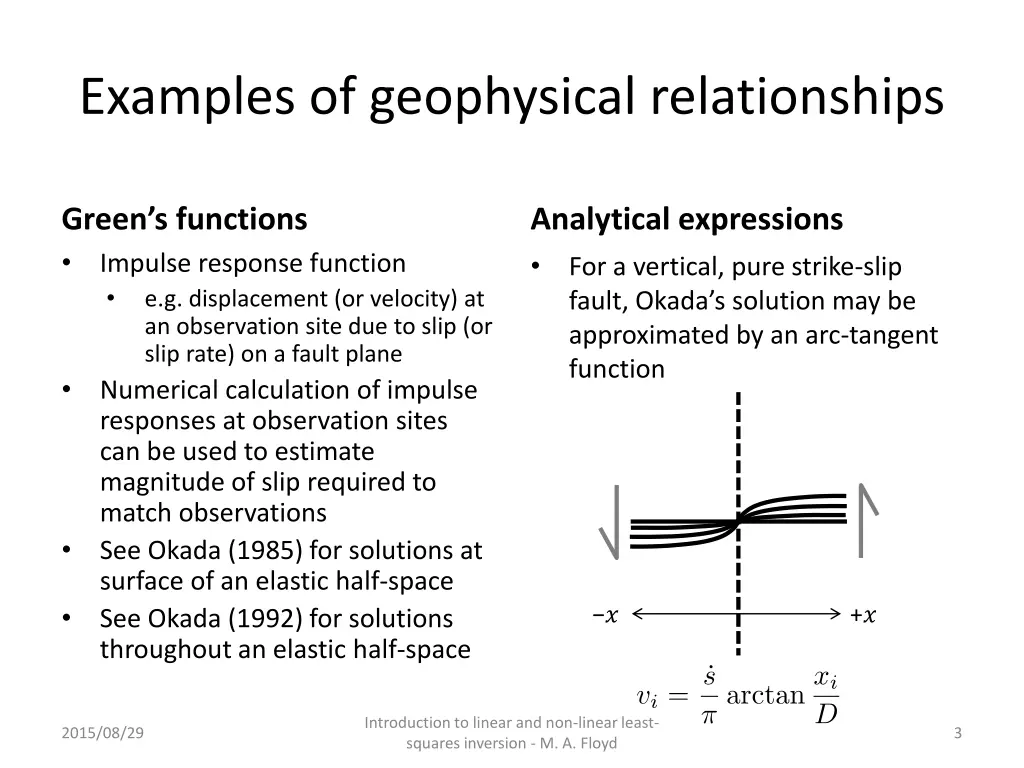
Examples of geophysical relationships Green s functions Impulse response function e.g. displacement (or velocity) at an observation site due to slip (or slip rate) on a fault plane Numerical calculation of impulse responses at observation sites can be used to estimate magnitude of slip required to match observations See Okada (1985) for solutions at surface of an elastic half-space See Okada (1992) for solutions throughout an elastic half-space Analytical expressions For a vertical, pure strike-slip fault, Okada s solution may be approximated by an arc-tangent function ? +? Introduction to linear and non-linear least- squares inversion - M. A. Floyd 2015/08/29 3
Forward models We could use a computer to run lots of models with various parameter values and see which ones are closest to the observations i.e. we estimate the observations from the model This can be slow because it requires a large number of runs to find a solution The parameter uncertainties must also be estimated using a similar approach Introduction to linear and non-linear least- squares inversion - M. A. Floyd 2015/08/29 4
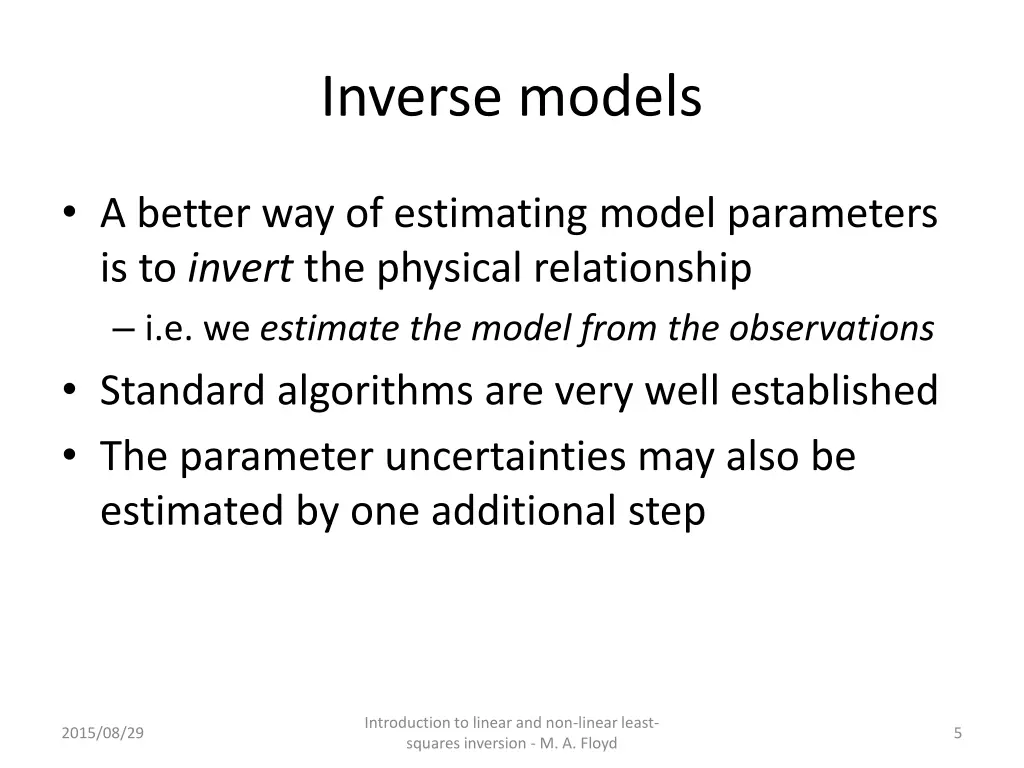
Inverse models A better way of estimating model parameters is to invert the physical relationship i.e. we estimate the model from the observations Standard algorithms are very well established The parameter uncertainties may also be estimated by one additional step Introduction to linear and non-linear least- squares inversion - M. A. Floyd 2015/08/29 5
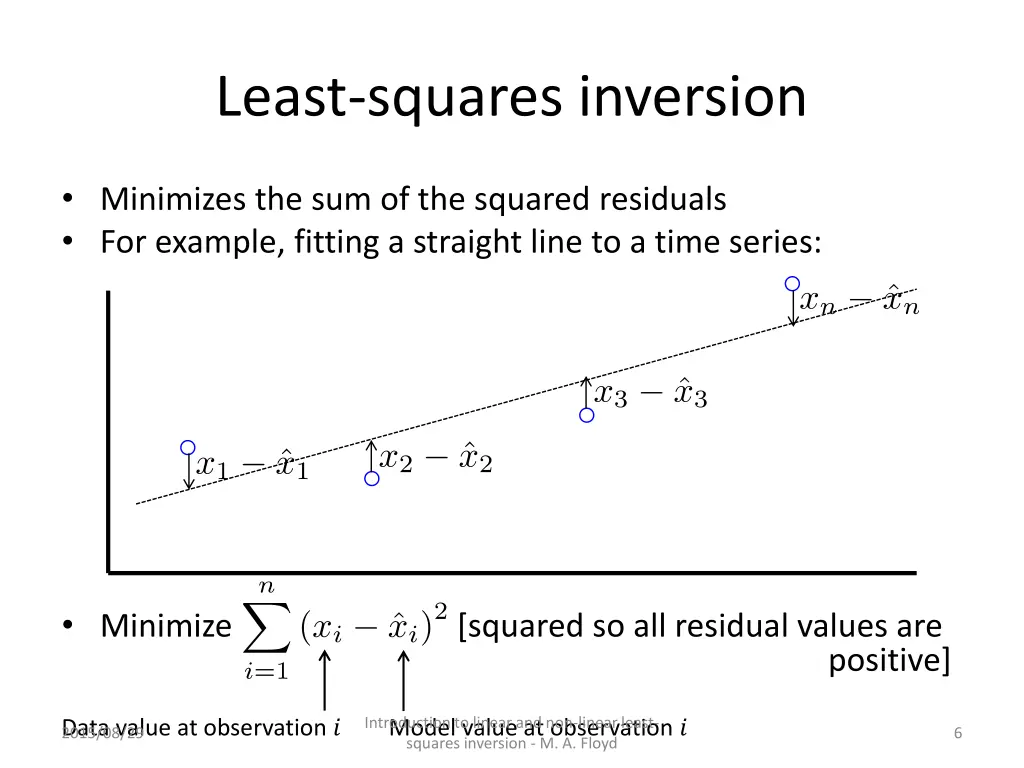
Least-squares inversion Minimizes the sum of the squared residuals For example, fitting a straight line to a time series: Minimize [squared so all residual values are positive] Introduction to linear and non-linear least- Data value at observation ? 2015/08/29 Model value at observation ? squares inversion - M. A. Floyd 6
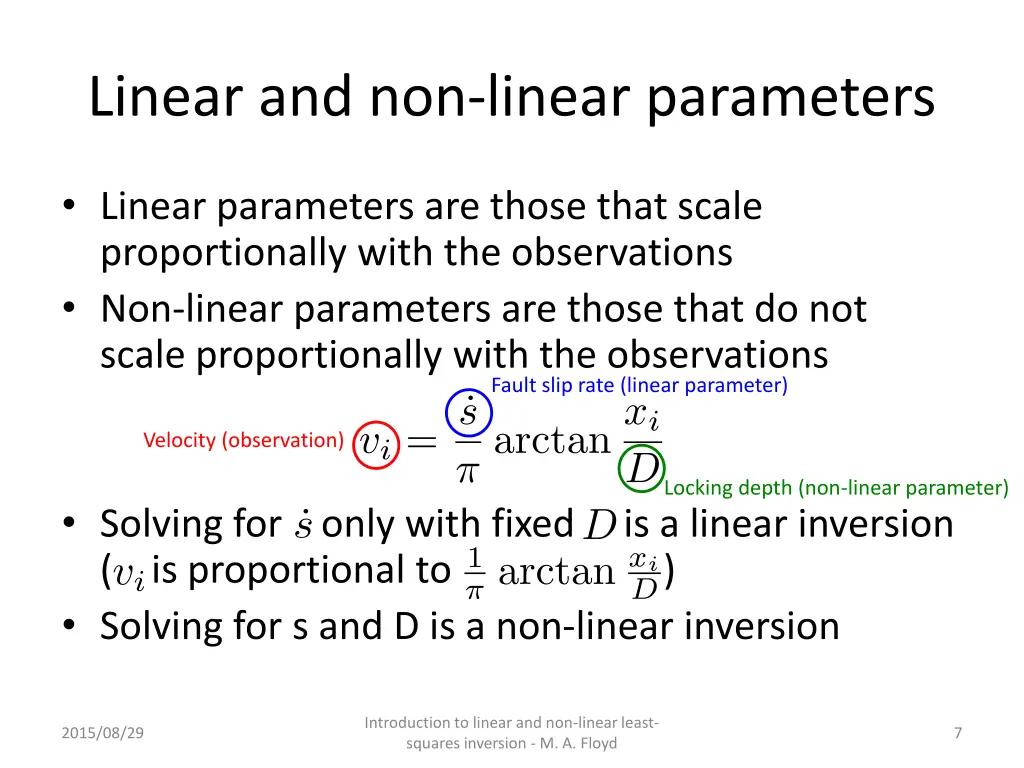
Linear and non-linear parameters Linear parameters are those that scale proportionally with the observations Non-linear parameters are those that do not scale proportionally with the observations Fault slip rate (linear parameter) Velocity (observation) Locking depth (non-linear parameter) Solving for only with fixed is a linear inversion ( is proportional to ) Solving for s and D is a non-linear inversion Introduction to linear and non-linear least- squares inversion - M. A. Floyd 2015/08/29 7
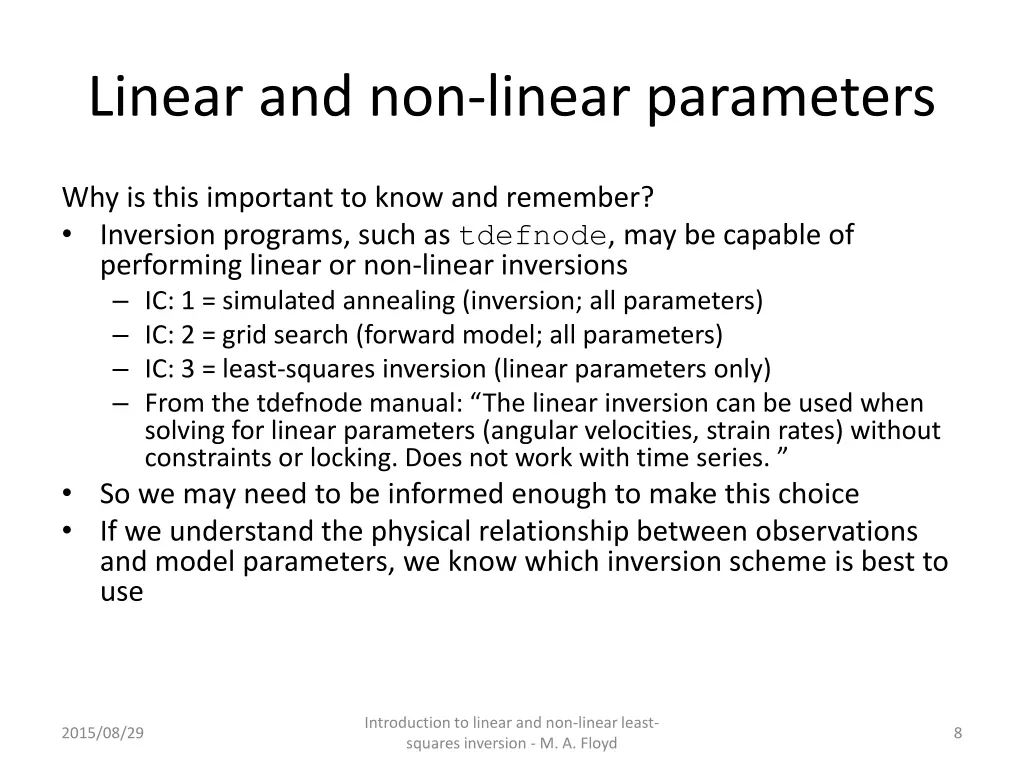
Linear and non-linear parameters Why is this important to know and remember? Inversion programs, such as tdefnode, may be capable of performing linear or non-linear inversions IC: 1 = simulated annealing (inversion; all parameters) IC: 2 = grid search (forward model; all parameters) IC: 3 = least-squares inversion (linear parameters only) From the tdefnode manual: The linear inversion can be used when solving for linear parameters (angular velocities, strain rates) without constraints or locking. Does not work with time series. So we may need to be informed enough to make this choice If we understand the physical relationship between observations and model parameters, we know which inversion scheme is best to use Introduction to linear and non-linear least- squares inversion - M. A. Floyd 2015/08/29 8
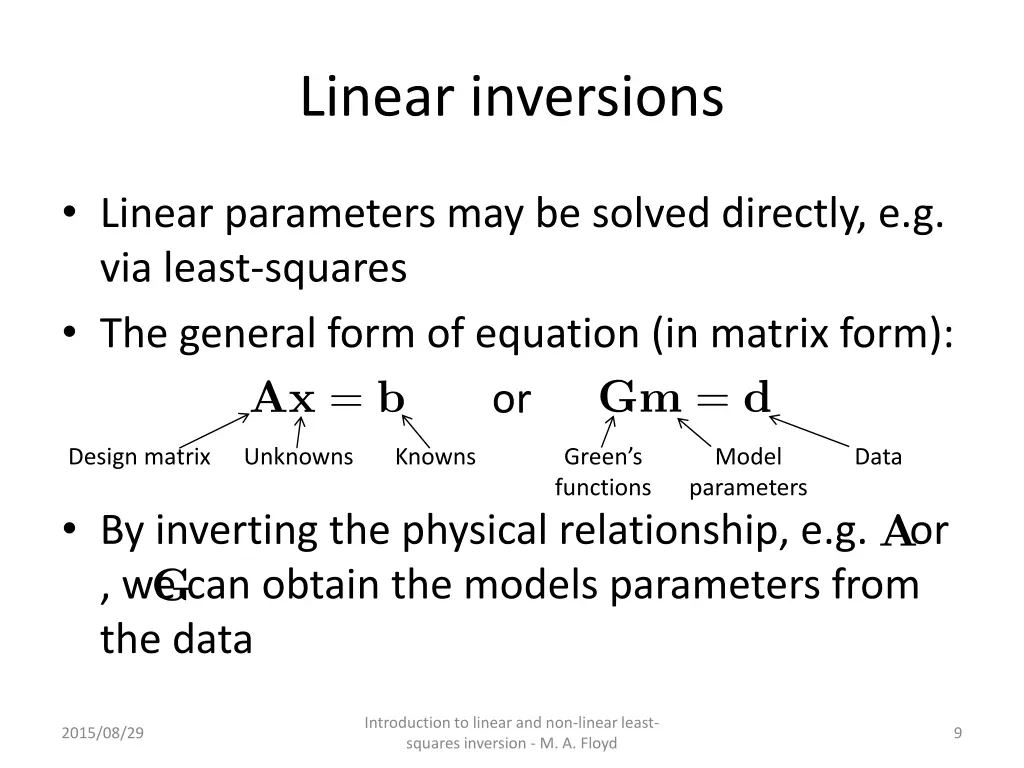
Linear inversions Linear parameters may be solved directly, e.g. via least-squares The general form of equation (in matrix form): or Design matrix Unknowns Knowns Green s functions Model parameters Data By inverting the physical relationship, e.g. or , we can obtain the models parameters from the data Introduction to linear and non-linear least- squares inversion - M. A. Floyd 2015/08/29 9
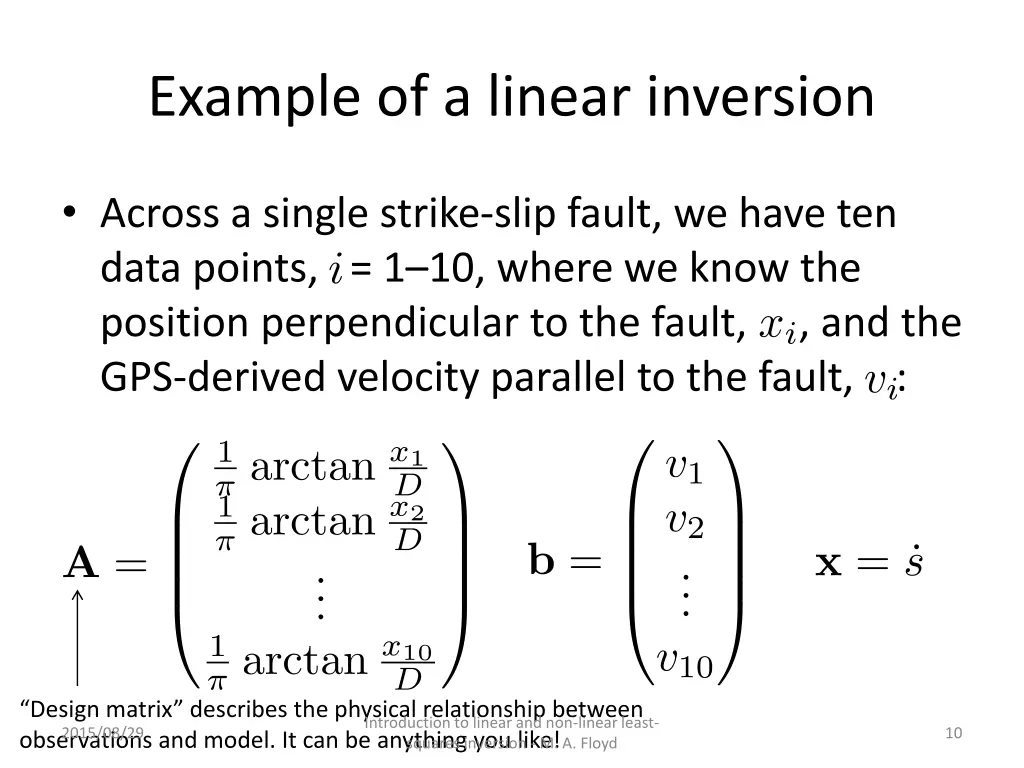
Example of a linear inversion Across a single strike-slip fault, we have ten data points, = 1 10, where we know the position perpendicular to the fault, , and the GPS-derived velocity parallel to the fault, : Design matrix describes the physical relationship between observations and model. It can be anything you like! Introduction to linear and non-linear least- squares inversion - M. A. Floyd 2015/08/29 10
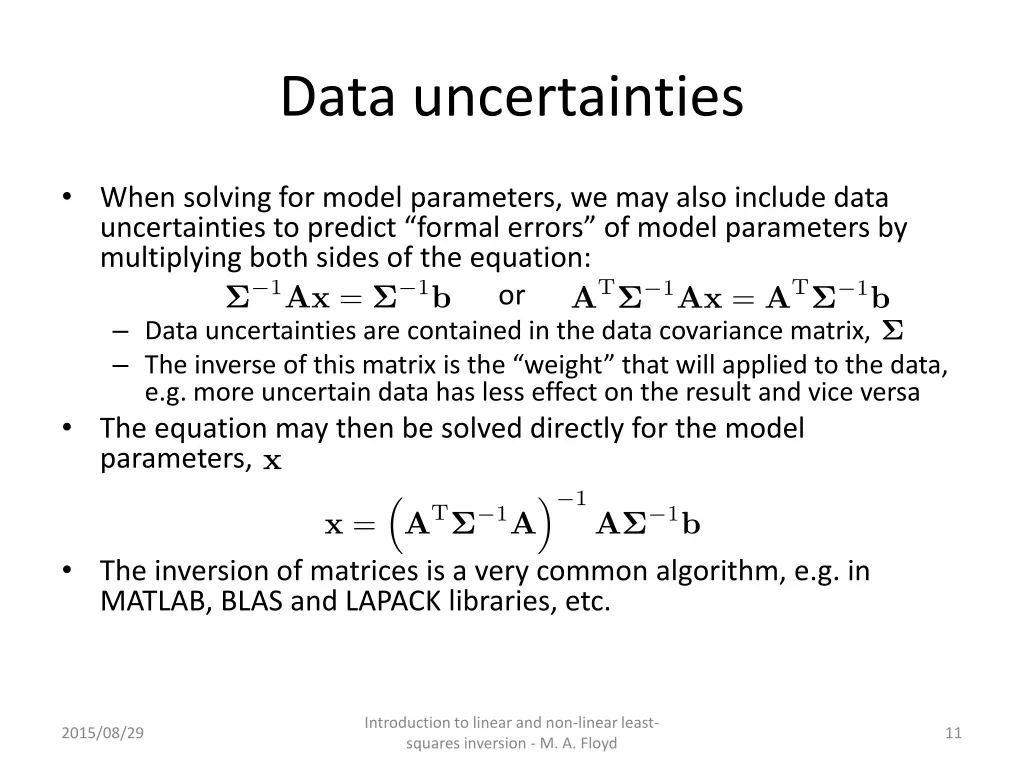
Data uncertainties When solving for model parameters, we may also include data uncertainties to predict formal errors of model parameters by multiplying both sides of the equation: or Data uncertainties are contained in the data covariance matrix, The inverse of this matrix is the weight that will applied to the data, e.g. more uncertain data has less effect on the result and vice versa The equation may then be solved directly for the model parameters, The inversion of matrices is a very common algorithm, e.g. in MATLAB, BLAS and LAPACK libraries, etc. Introduction to linear and non-linear least- squares inversion - M. A. Floyd 2015/08/29 11
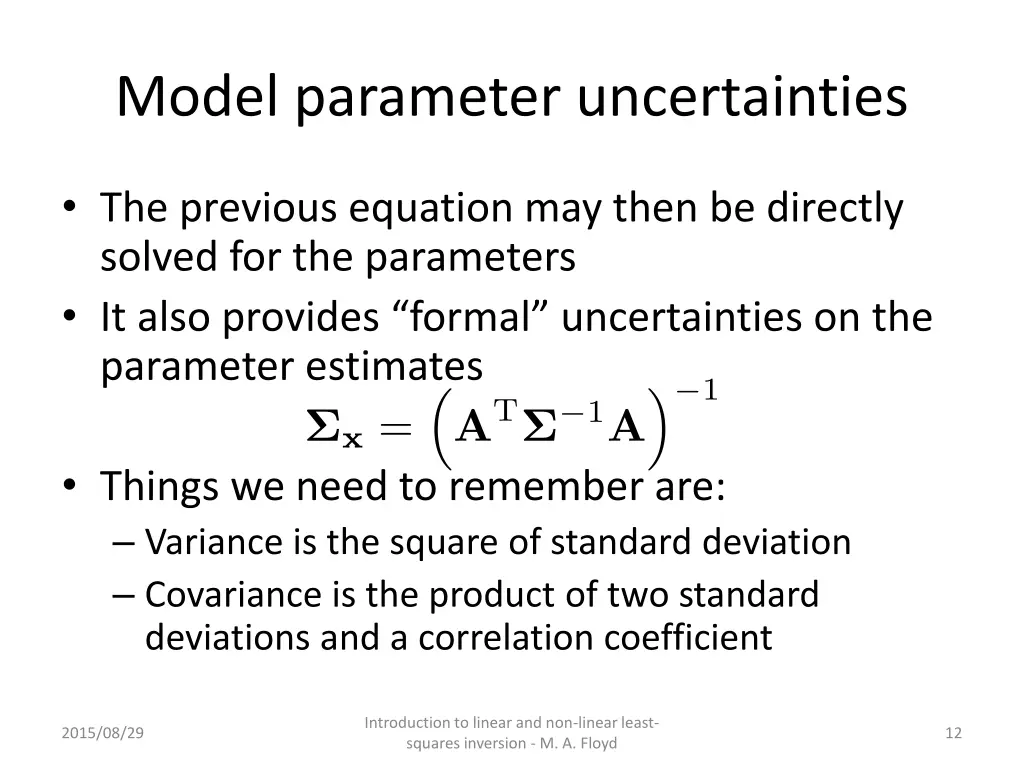
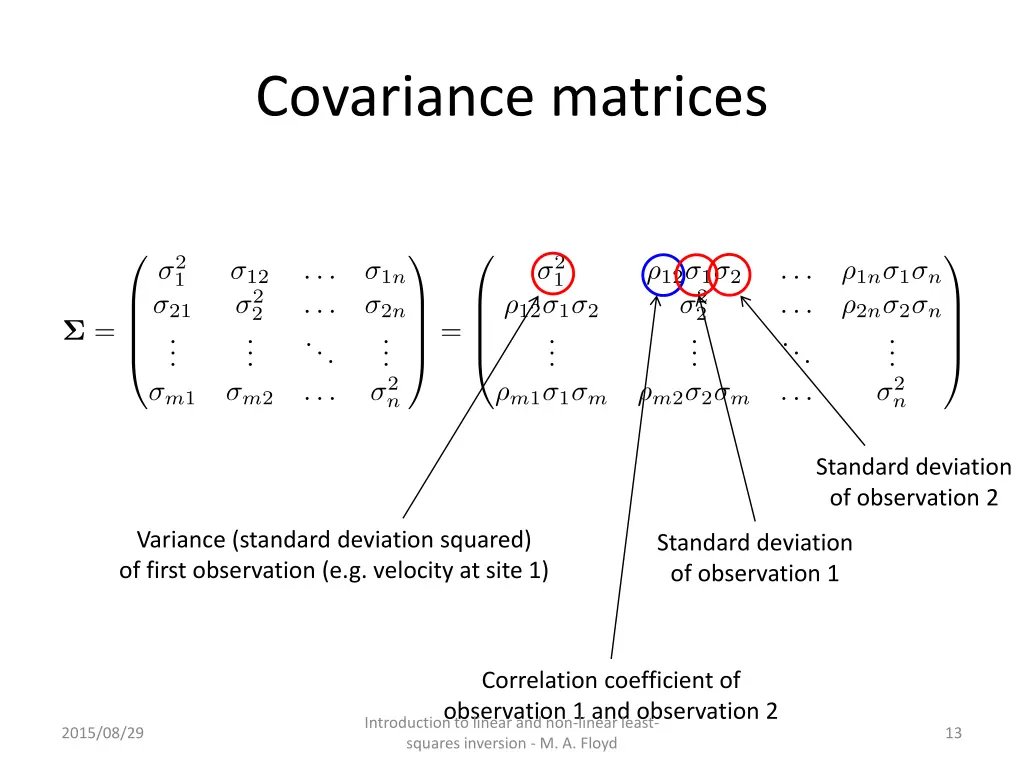
Model parameter uncertainties The previous equation may then be directly solved for the parameters It also provides formal uncertainties on the parameter estimates Things we need to remember are: Variance is the square of standard deviation Covariance is the product of two standard deviations and a correlation coefficient Introduction to linear and non-linear least- squares inversion - M. A. Floyd 2015/08/29 12
Covariance matrices Standard deviation of observation 2 Variance (standard deviation squared) of first observation (e.g. velocity at site 1) Standard deviation of observation 1 Correlation coefficient of observation 1 and observation 2 Introduction to linear and non-linear least- squares inversion - M. A. Floyd 2015/08/29 13
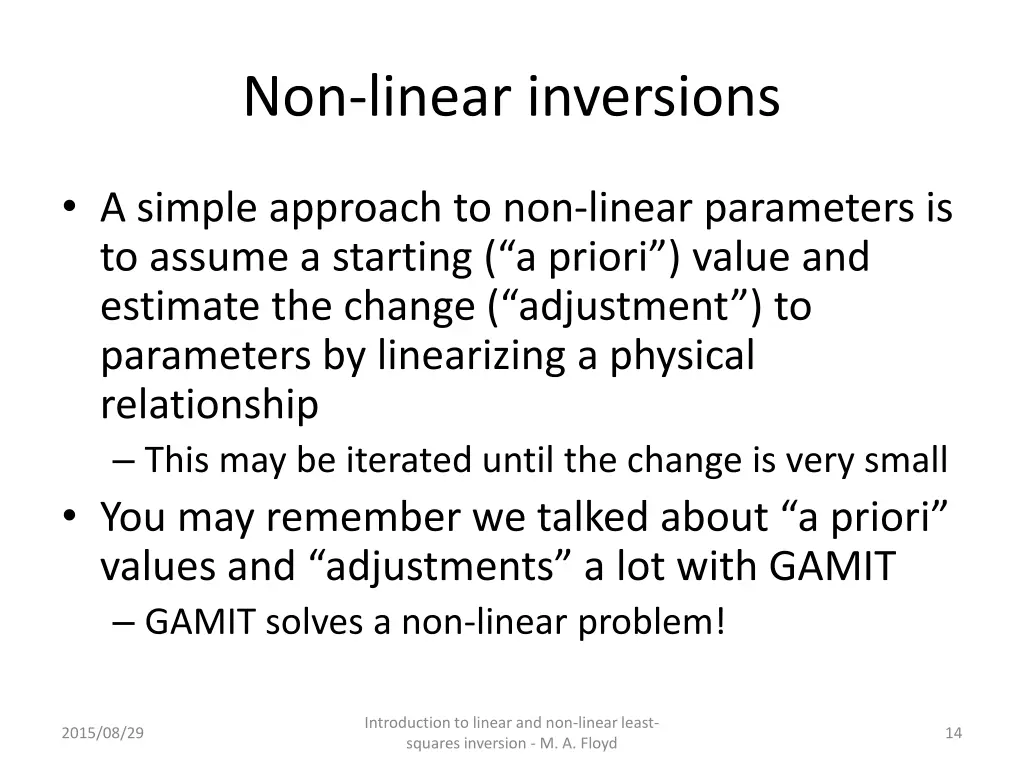
Non-linear inversions A simple approach to non-linear parameters is to assume a starting ( a priori ) value and estimate the change ( adjustment ) to parameters by linearizing a physical relationship This may be iterated until the change is very small You may remember we talked about a priori values and adjustments a lot with GAMIT GAMIT solves a non-linear problem! Introduction to linear and non-linear least- squares inversion - M. A. Floyd 2015/08/29 14
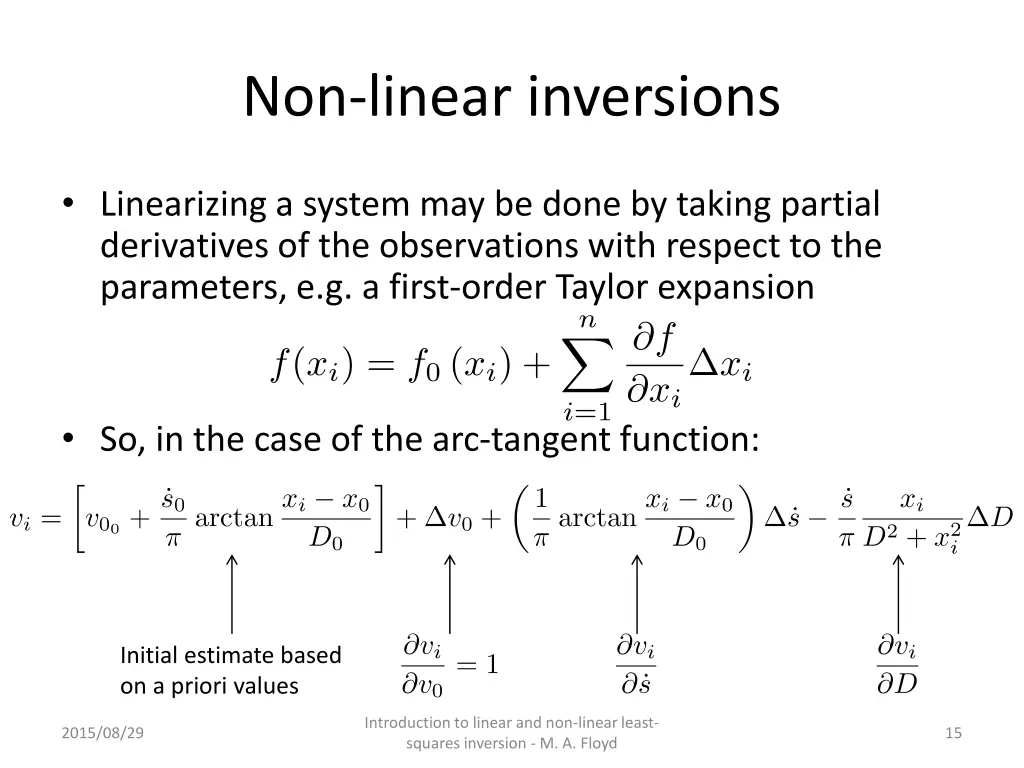
Non-linear inversions Linearizing a system may be done by taking partial derivatives of the observations with respect to the parameters, e.g. a first-order Taylor expansion So, in the case of the arc-tangent function: Initial estimate based on a priori values Introduction to linear and non-linear least- squares inversion - M. A. Floyd 2015/08/29 15
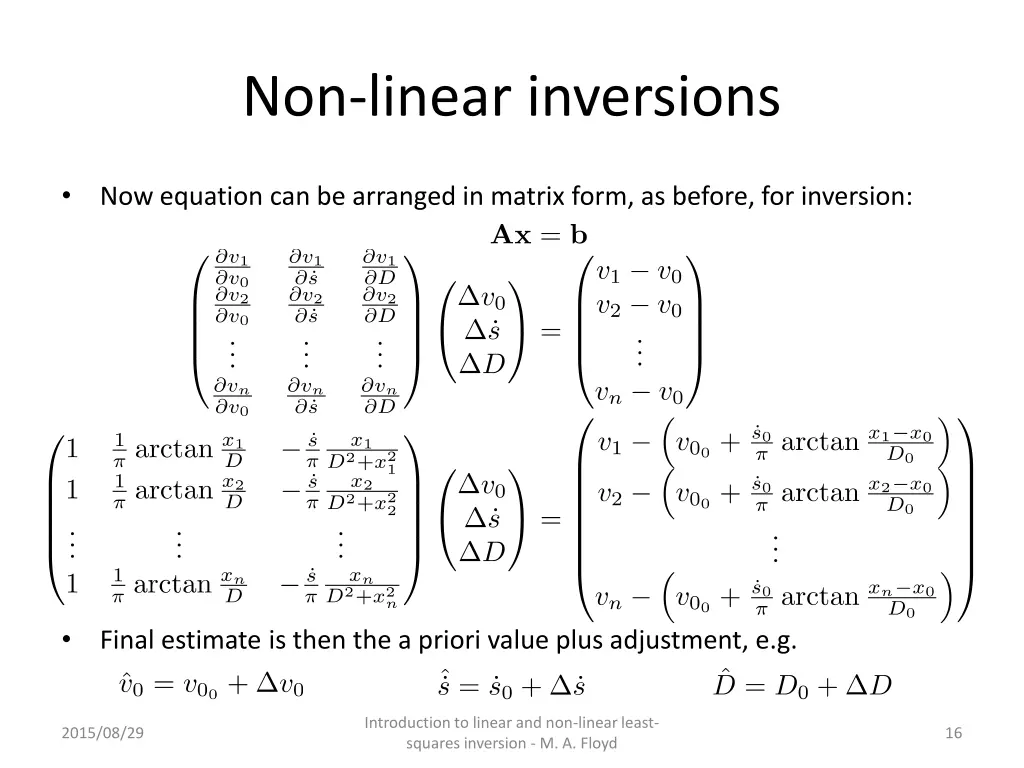
Non-linear inversions Now equation can be arranged in matrix form, as before, for inversion: Final estimate is then the a priori value plus adjustment, e.g. Introduction to linear and non-linear least- squares inversion - M. A. Floyd 2015/08/29 16
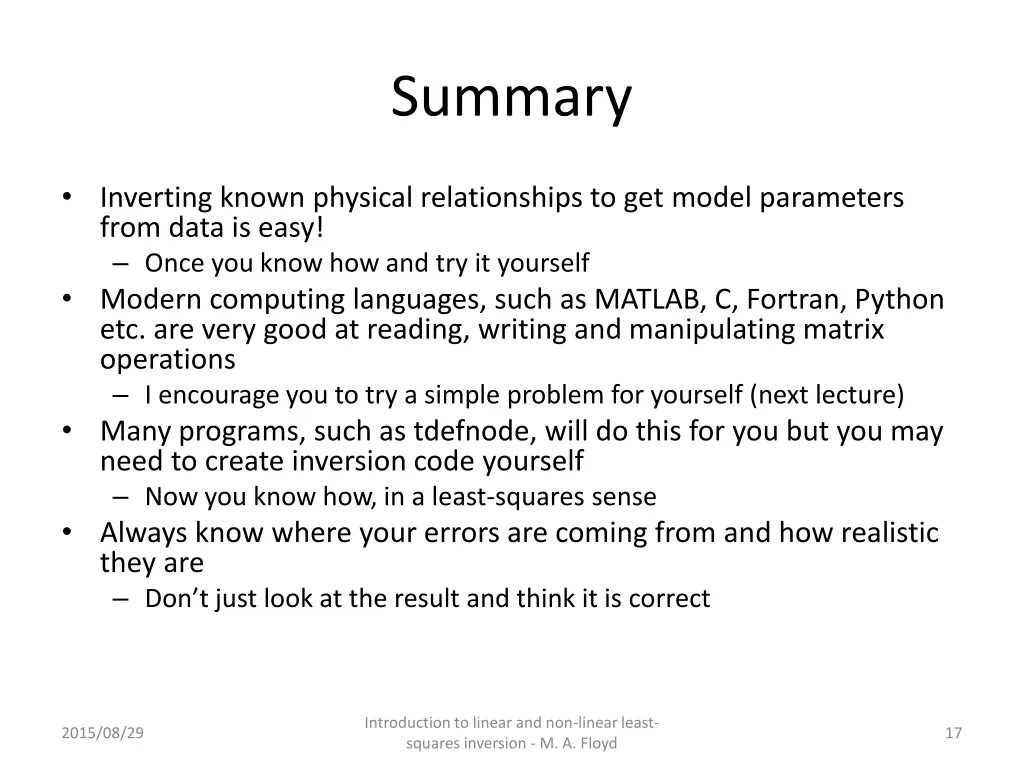
Summary Inverting known physical relationships to get model parameters from data is easy! Once you know how and try it yourself Modern computing languages, such as MATLAB, C, Fortran, Python etc. are very good at reading, writing and manipulating matrix operations I encourage you to try a simple problem for yourself (next lecture) Many programs, such as tdefnode, will do this for you but you may need to create inversion code yourself Now you know how, in a least-squares sense Always know where your errors are coming from and how realistic they are Don t just look at the result and think it is correct Introduction to linear and non-linear least- squares inversion - M. A. Floyd 2015/08/29 17