Listening Session on Indigenous Sacred Sites MOU & Tribal Engagement
A session aiming to gather feedback on the implementation of the Sacred Sites MOU from Tribal leaders and Native Hawaiian Organizations to improve protection and access to Indian sacred sites. The session focuses on expertise in Traditional Ecological Knowledge (TEK) and perspectives on the MOU's implementation. Signatories include key government departments, and responsibilities involve training, guidance development, and confidentiality mechanisms. Accomplishments include policy statements and progress reports related to Indian Sacred Sites.

Download Presentation

Please find below an Image/Link to download the presentation.
The content on the website is provided AS IS for your information and personal use only. It may not be sold, licensed, or shared on other websites without obtaining consent from the author.If you encounter any issues during the download, it is possible that the publisher has removed the file from their server.
You are allowed to download the files provided on this website for personal or commercial use, subject to the condition that they are used lawfully. All files are the property of their respective owners.
The content on the website is provided AS IS for your information and personal use only. It may not be sold, licensed, or shared on other websites without obtaining consent from the author.
E N D
Presentation Transcript
Listening Session on Indigenous Sacred Sites MOU March 9, 2022 March 9, 2022
Opening & Blessing Opening & Blessing Purpose of Listening Session Purpose of Listening Session 2016 Sacred Sites MOU 2016 Sacred Sites MOU Outline of Listening Session 2021 Sacred Sites MOU 2021 Sacred Sites MOU Dialogue Dialogue
Session Goal: Session Goal: To get feedback on the implementation of the Sacred Sites MOU from Tribal leaders and Native Hawaiian Organizations who are on today s call. Purpose of Today s Engagement Session Specific Feedback Needed: Specific Feedback Needed: Expertise on Traditional Ecological Knowledge (TEK) and perspectives on the MOU and its implementation, as it relates to TEK.
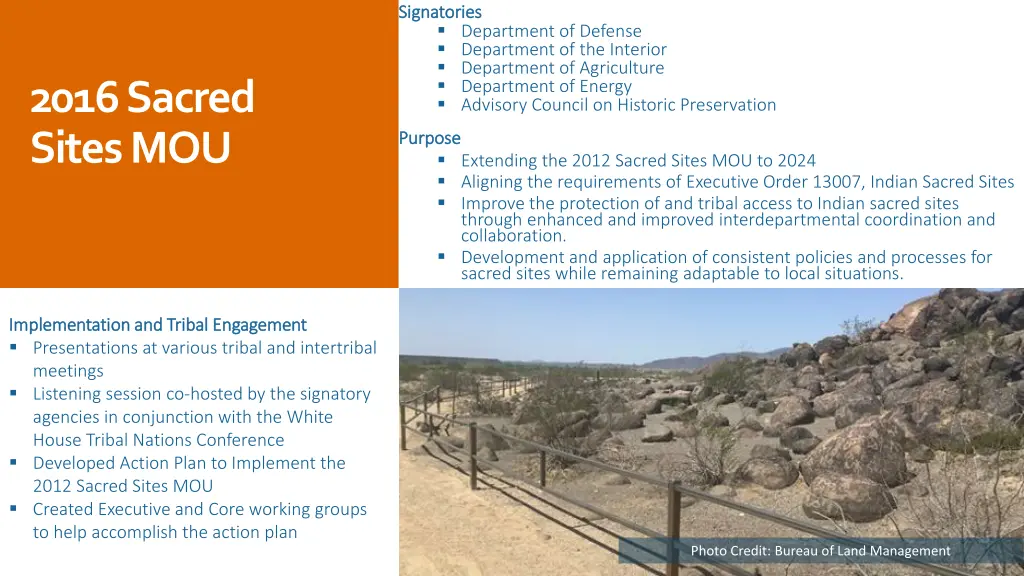
Signatories Signatories Department of Defense Department of the Interior Department of Agriculture Department of Energy Advisory Council on Historic Preservation 2016 Sacred Sites MOU Purpose Purpose Extending the 2012 Sacred Sites MOU to 2024 Aligning the requirements of Executive Order 13007, Indian Sacred Sites Improve the protection of and tribal access to Indian sacred sites through enhanced and improved interdepartmental coordination and collaboration. Development and application of consistent policies and processes for sacred sites while remaining adaptable to local situations. Implementation and Tribal Engagement Implementation and Tribal Engagement Presentations at various tribal and intertribal meetings Listening session co-hosted by the signatory agencies in conjunction with the White House Tribal Nations Conference Developed Action Plan to Implement the 2012 Sacred Sites MOU Created Executive and Core working groups to help accomplish the action plan Photo Credit: Bureau of Land Management
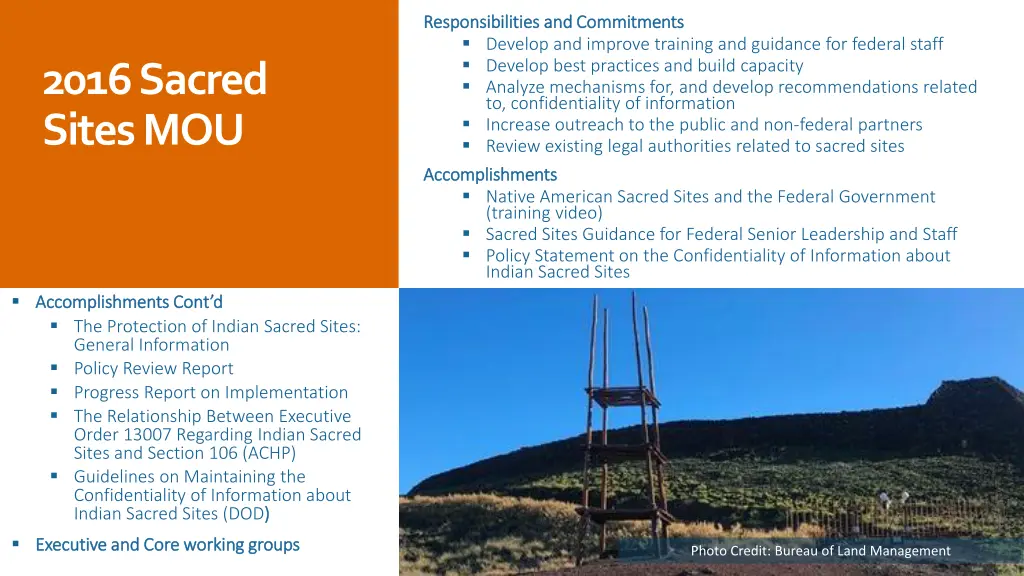
R Responsibilities esponsibilities and C Develop and improve training and guidance for federal staff Develop best practices and build capacity Analyze mechanisms for, and develop recommendations related to, confidentiality of information Increase outreach to the public and non-federal partners Review existing legal authorities related to sacred sites Accomplishments Accomplishments Native American Sacred Sites and the Federal Government (training video) Sacred Sites Guidance for Federal Senior Leadership and Staff Policy Statement on the Confidentiality of Information about Indian Sacred Sites and Commitments ommitments 2016 Sacred Sites MOU Accomplishments Cont d Accomplishments Cont d The Protection of Indian Sacred Sites: General Information Policy Review Report Progress Report on Implementation The Relationship Between Executive Order 13007 Regarding Indian Sacred Sites and Section 106 (ACHP) Guidelines on Maintaining the Confidentiality of Information about Indian Sacred Sites (DOD) ) Executive Executive and Core working groups and Core working groups Photo Credit: Bureau of Land Management
2021 Sacred Sites MOU Signatories Signatories: USDA, DOE, DOI, DOT, EPA, ACHP, CEQ, TVA Renews Renews and and Strengthens Strengthens 2016 MOU Tribal Tribal and and NHO NHO guidance guidance are central to MOU
2021 Sacred Sites MOU MOU MOUCommitments Commitments Working Group Develop best practices, procedures, and guidance for management, treatment, and protection of sacred sites Identify impediments to Federal-level protection of sacred sites Address and remedy impediments
2021 Sacred Sites MOU MOU MOUCommitments Commitments Incorporate consideration of Sacred Sites into Federal decision-making; consultation; regulatory processes; Incorporate Traditional Ecological Knowledge; Increase accountability Sacred Sites Legal Subgroup Consultations
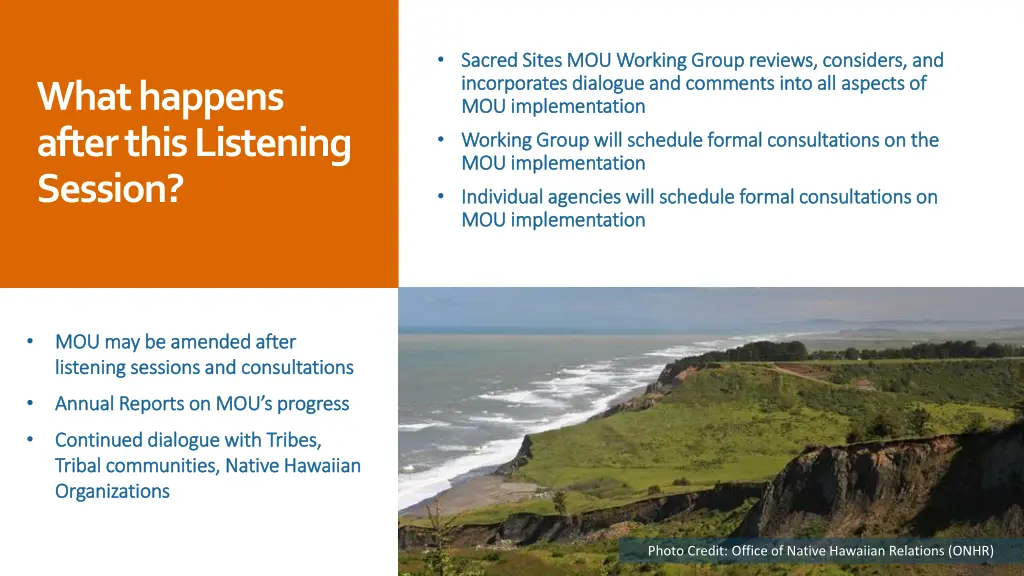
Sacred Sites MOU Working Group reviews, considers, and Sacred Sites MOU Working Group reviews, considers, and incorporates dialogue and comments into all aspects of incorporates dialogue and comments into all aspects of MOU implementation MOU implementation Working Group will schedule formal consultations on the Working Group will schedule formal consultations on the MOU implementation MOU implementation Individual agencies will schedule formal consultations on Individual agencies will schedule formal consultations on MOU implementation MOU implementation What happens after this Listening Session? MOU may be amended after MOU may be amended after listening sessions and consultations listening sessions and consultations Annual Reports on MOU s progress Annual Reports on MOU s progress Continued dialogue with Tribes, Continued dialogue with Tribes, Tribal communities, Native Hawaiian Tribal communities, Native Hawaiian Organizations Organizations Photo Credit: Office of Native Hawaiian Relations (ONHR)
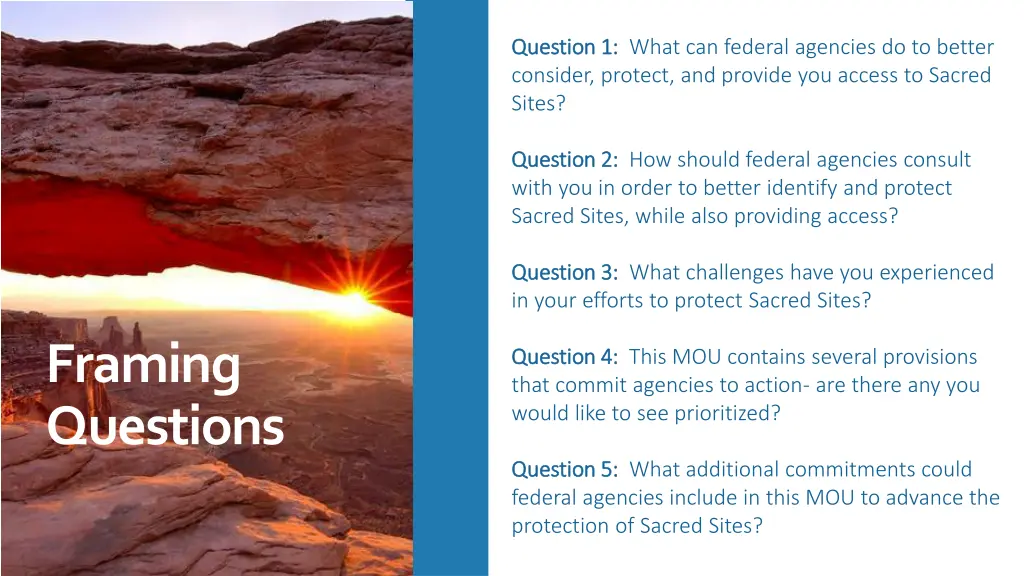
Question 1: Question 1: What can federal agencies do to better consider, protect, and provide you access to Sacred Sites? Question 2: Question 2: How should federal agencies consult with you in order to better identify and protect Sacred Sites, while also providing access? Question 3: Question 3: What challenges have you experienced in your efforts to protect Sacred Sites? Framing Questions Question 4: Question 4: This MOU contains several provisions that commit agencies to action- are there any you would like to see prioritized? Question 5: Question 5: What additional commitments could federal agencies include in this MOU to advance the protection of Sacred Sites?
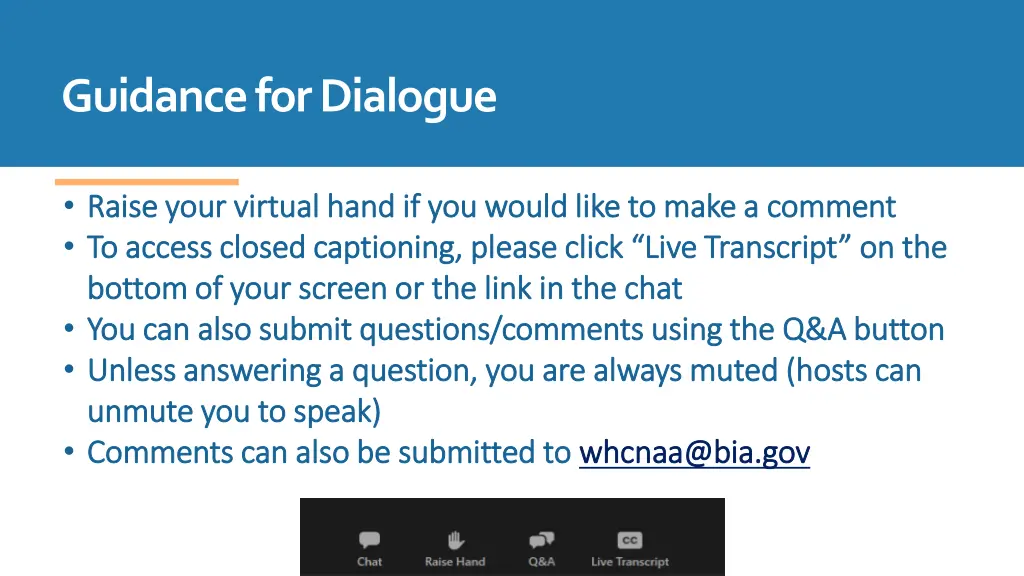
Guidance for Dialogue Raise your virtual hand if you would like to make a comment Raise your virtual hand if you would like to make a comment To access closed captioning, please click Live Transcript on the To access closed captioning, please click Live Transcript on the bottom of your screen or the link in the chat bottom of your screen or the link in the chat You can also submit questions/comments using the Q&A button You can also submit questions/comments using the Q&A button Unless answering a question, you are always muted (hosts can Unless answering a question, you are always muted (hosts can unmute you to speak) unmute you to speak) Comments can also be submitted to Comments can also be submitted to whcnaa@bia.gov whcnaa@bia.gov
Thank You Contact information: www.bia.gov/whcnaa whcnaa@bia.gov Photo Credit: National Park Service