Literacy Challenges and Advantages in Education
Explore the complexities of literacy highlighted by Geoff Barton and Daniel Rigney, focusing on the disparities between good and poor readers, the impact on students' learning paths, and the societal implications. Gain insights into the struggles faced by individuals in navigating the world of reading and language, and the critical role of educators, parents, and society in addressing these challenges effectively.

Download Presentation

Please find below an Image/Link to download the presentation.
The content on the website is provided AS IS for your information and personal use only. It may not be sold, licensed, or shared on other websites without obtaining consent from the author. If you encounter any issues during the download, it is possible that the publisher has removed the file from their server.
You are allowed to download the files provided on this website for personal or commercial use, subject to the condition that they are used lawfully. All files are the property of their respective owners.
The content on the website is provided AS IS for your information and personal use only. It may not be sold, licensed, or shared on other websites without obtaining consent from the author.
E N D
Presentation Transcript
Dont Call it Literacy! Geoff Barton, Head, King Edward VI School, Suffolk 18 March 2025 Twitter: @RealGeoffBarton Download this presentation free at: www.geoffbarton.co.uk (Teacher Resources: 124)
Dont Call it Literacy! Geoff Barton, Head, King Edward VI School, Suffolk 18 March 2025 Twitter: @RealGeoffBarton Download this presentation free at: www.geoffbarton.co.uk (Teacher Resources: 124)
Shouldnt we be angrier?
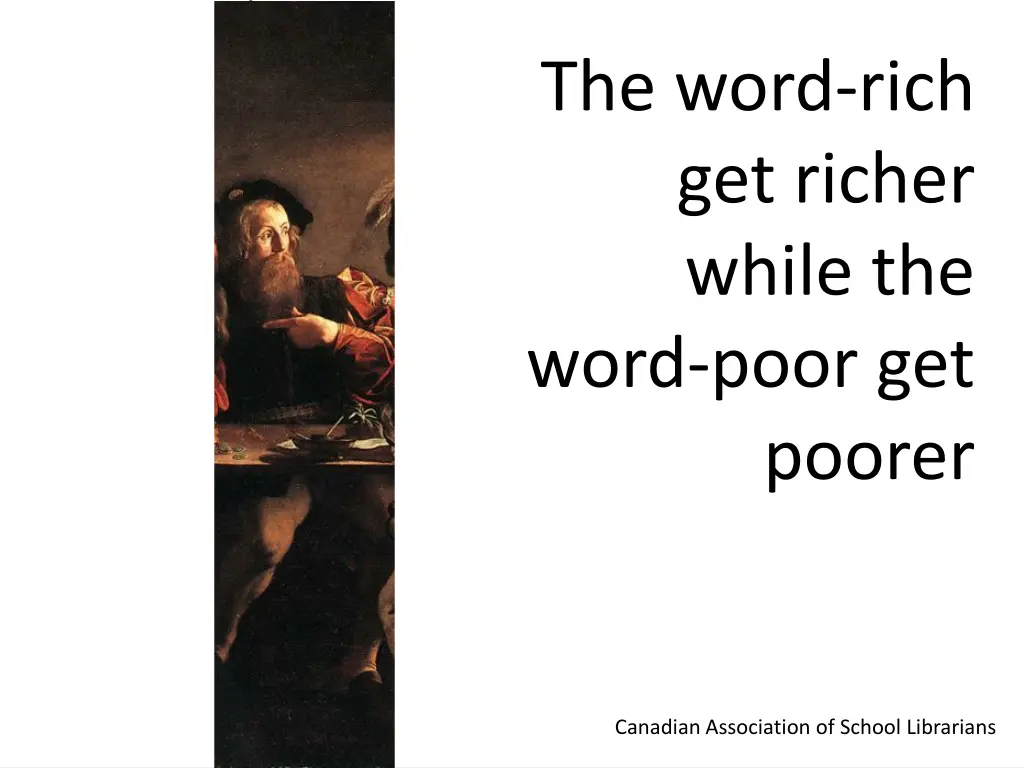
The word-rich get richer while the word-poor get poorer Canadian Association of School Librarians
Too often the argument for reading is made by those who have spent their lives as insiders; the pleasures of solitary reading are so obvious, the value of reading so self- evident, that we fail to appreciate how utterly strange reading is to the outsider Thomas Newkirk, Misreading Masculinity: Boys, Literacy and Popular Culture
Students who begin with high verbal aptitudes find themselves in verbally enriched social environments and have a double advantage The Matthew Effect Daniel Rigney
While good readers gain new skills very rapidly, and quickly move from learning to read to reading to learn, poor readers become increasingly frustrated with the act of reading, and try to avoid reading where possible The Matthew Effect Daniel Rigney
Spoken language forms a constraint, a ceiling not only on the ability to comprehend, but also on the ability to write, beyond which literacy cannot progress Myhill and Fisher Informing practice in English
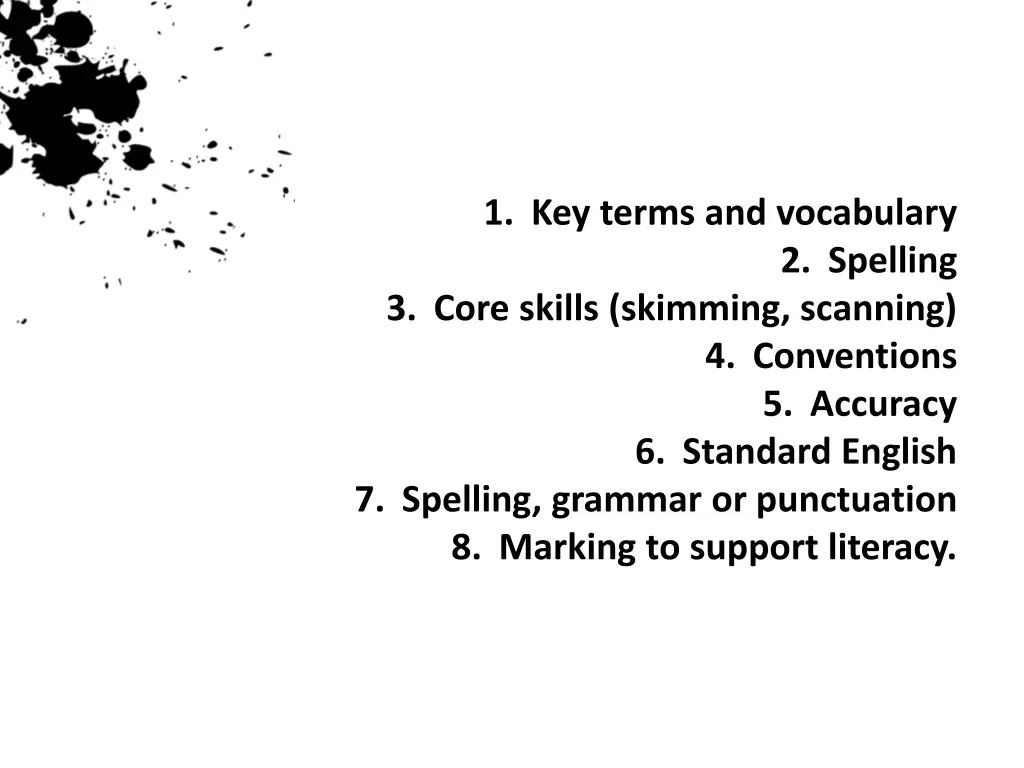
1. Key terms and vocabulary 2. Spelling 3. Core skills (skimming, scanning) 4. Conventions 5. Accuracy 6. Standard English 7. Spelling, grammar or punctuation 8. Marking to support literacy.
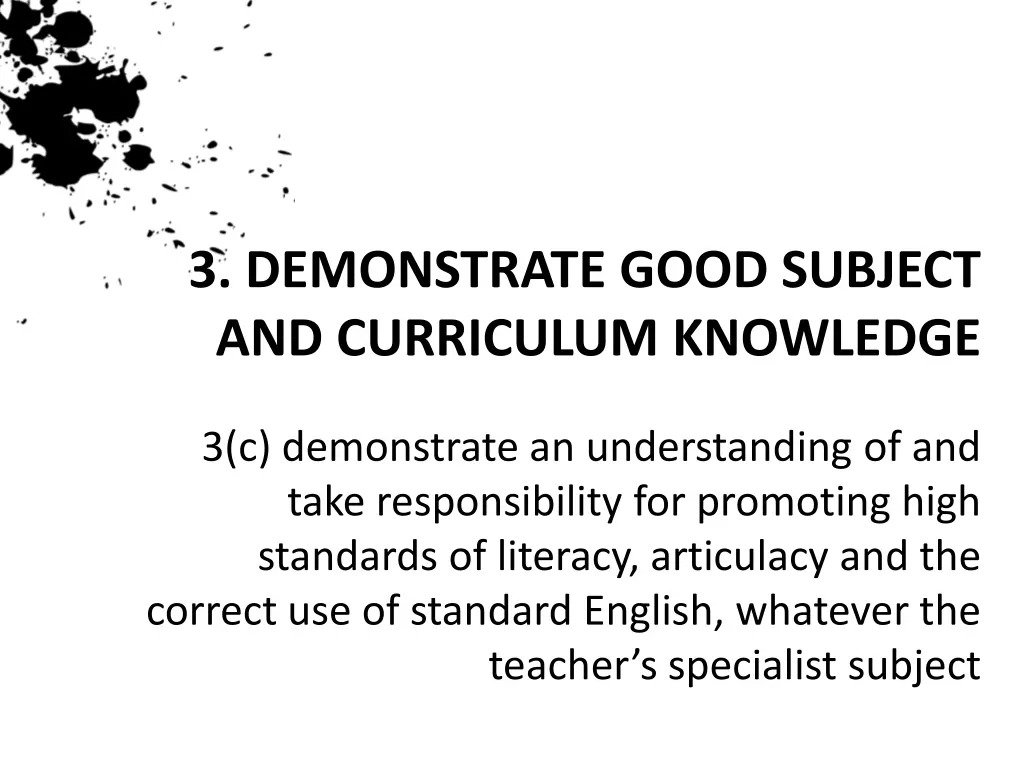
3. DEMONSTRATE GOOD SUBJECT AND CURRICULUM KNOWLEDGE 3(c) demonstrate an understanding of and take responsibility for promoting high standards of literacy, articulacy and the correct use of standard English, whatever the teacher s specialist subject
We are the word-rich and there are things we do
We are the word-rich and there are things we do
1: We self-regulate: we know that accuracy counts (in many contexts)
2: We understand interestingness : sentence & lexical variety
3: We know that reading matters: we have reading strategies
4: We know that some words in our culture carry extraordinary power
5: We keep these things secret
What if we made the implicit explicit by teaching it
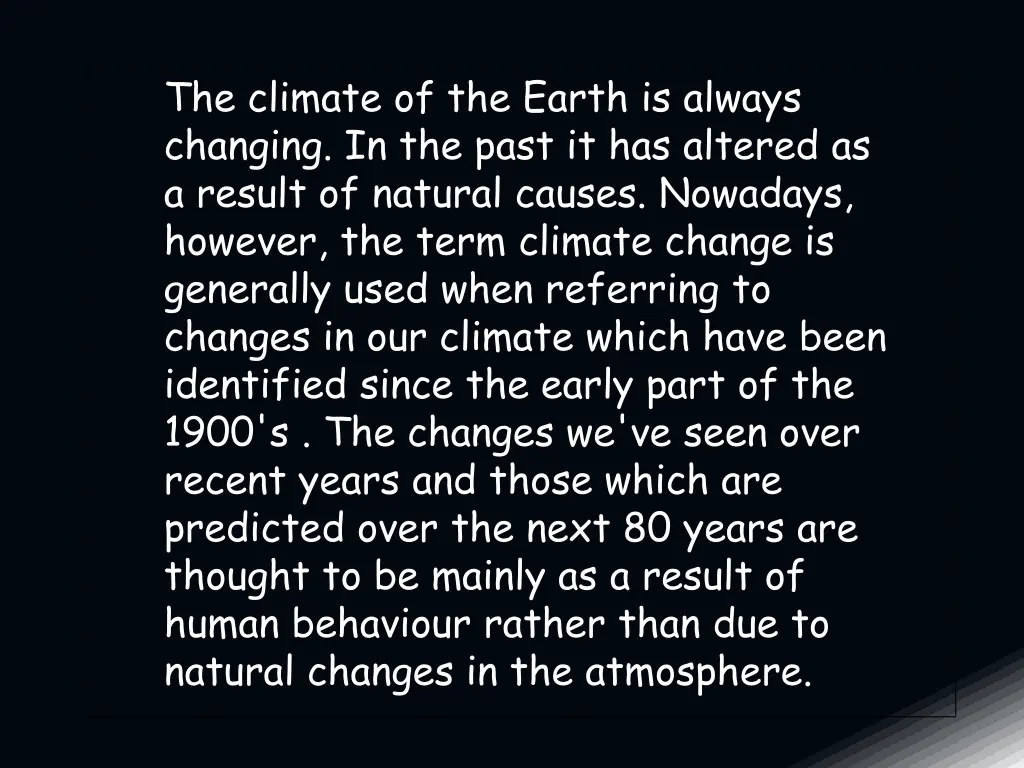
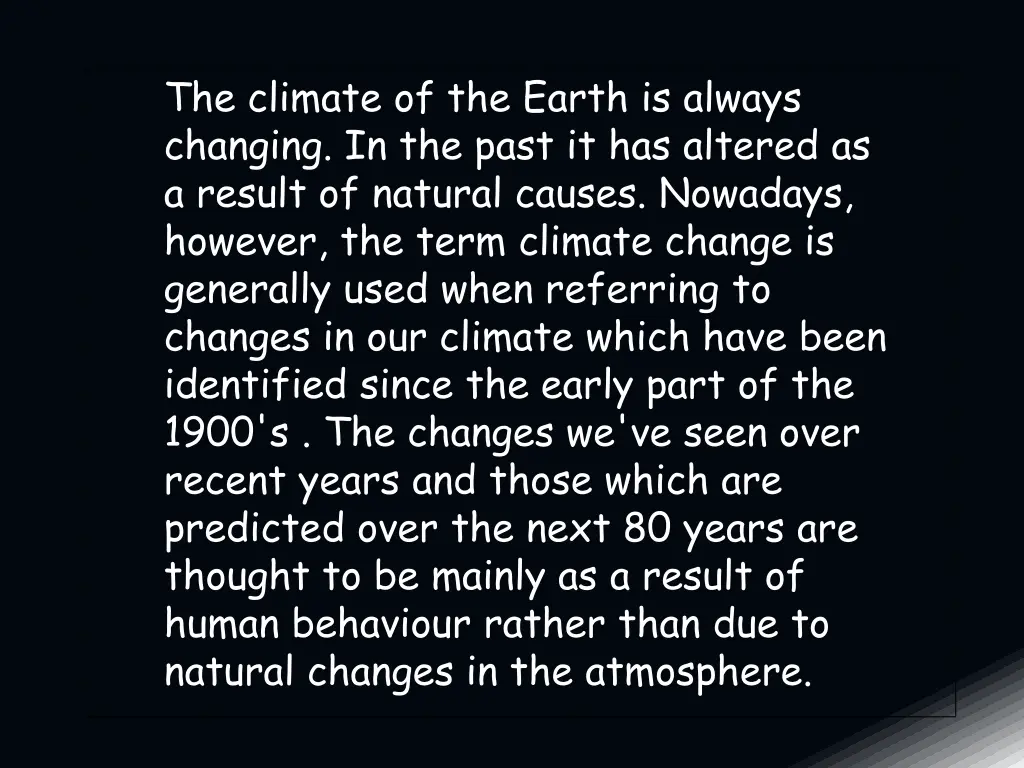
The climate of the Earth is always changing. In the past it has altered as a result of natural causes. Nowadays, however, the term climate change is generally used when referring to changes in our climate which have been identified since the early part of the 1900's . The changes we've seen over recent years and those which are predicted over the next 80 years are thought to be mainly as a result of human behaviour rather than due to natural changes in the atmosphere.
The climate of the Earth is always changing. In the past it has altered as a result of natural causes. Nowadays, however, the term climate change is generally used when referring to changes in our climate which have been identified since the early part of the 1900's . The changes we've seen over recent years and those which are predicted over the next 80 years are thought to be mainly as a result of human behaviour rather than due to natural changes in the atmosphere.
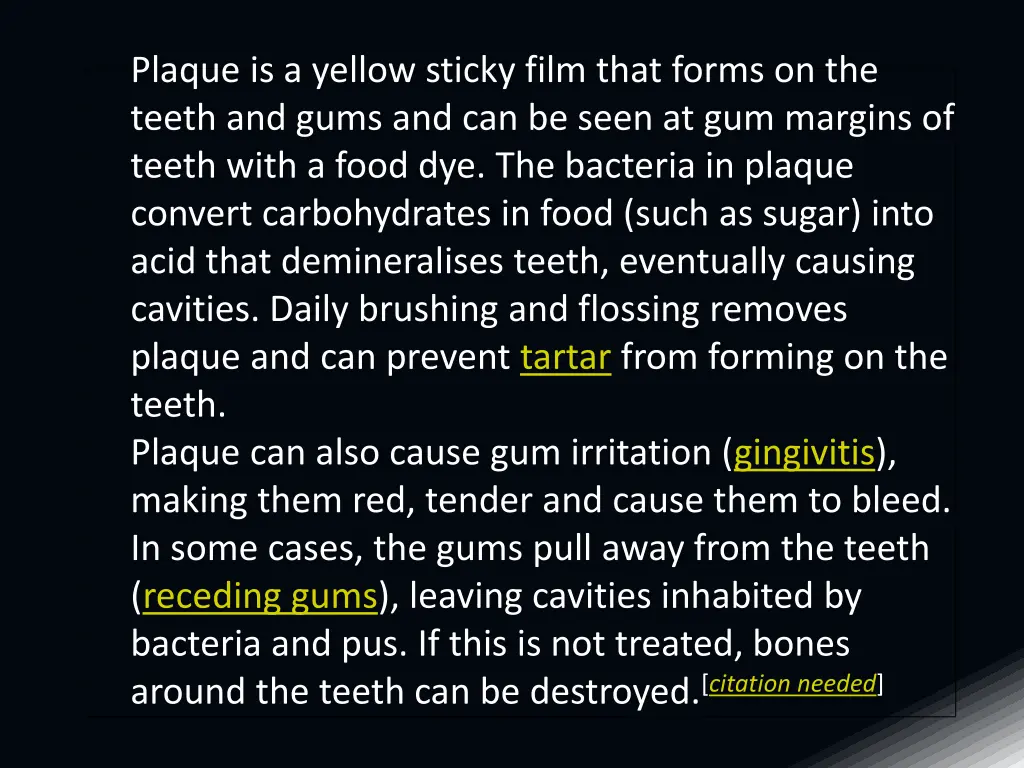
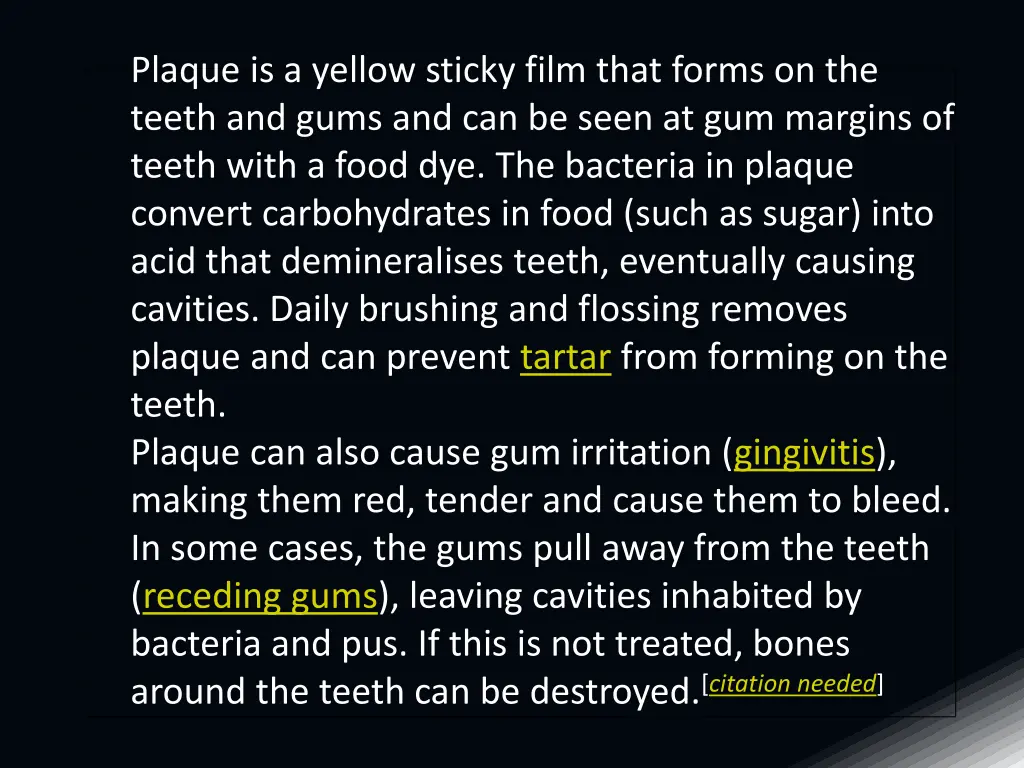
Plaque is a yellow sticky film that forms on the teeth and gums and can be seen at gum margins of teeth with a food dye. The bacteria in plaque convert carbohydrates in food (such as sugar) into acid that demineralises teeth, eventually causing cavities. Daily brushing and flossing removes plaque and can prevent tartar from forming on the teeth. Plaque can also cause gum irritation (gingivitis), making them red, tender and cause them to bleed. In some cases, the gums pull away from the teeth (receding gums), leaving cavities inhabited by bacteria and pus. If this is not treated, bones around the teeth can be destroyed.[citation needed]
Plaque is a yellow sticky film that forms on the teeth and gums and can be seen at gum margins of teeth with a food dye. The bacteria in plaque convert carbohydrates in food (such as sugar) into acid that demineralises teeth, eventually causing cavities. Daily brushing and flossing removes plaque and can prevent tartar from forming on the teeth. Plaque can also cause gum irritation (gingivitis), making them red, tender and cause them to bleed. In some cases, the gums pull away from the teeth (receding gums), leaving cavities inhabited by bacteria and pus. If this is not treated, bones around the teeth can be destroyed.[citation needed]
Urquhart castle is probably one of the most picturesquely situated castles in the Scottish Highlands. Located 16 miles south-west of Inverness, the castle, one of the largest in Scotland, overlooks much of Loch Ness. Visitors come to stroll through the ruins of the 13th- century castle because Urquhart has earned the reputation of being one of the best spots for sighting Loch Ness s most famous inhabitant.
Urquhart castle is probably one of the most picturesquely situated castles in the Scottish Highlands. Located 16 miles south-west of Inverness, the castle, one of the largest in Scotland, overlooks much of Loch Ness. Visitors come to stroll through the ruins of the 13th- century castle because Urquhart has earned the reputation of being one of the best spots for sighting Loch Ness s most famous inhabitant.
Urquhart castle is probably one of the most picturesquely situated castles in the Scottish Highlands. Located 16 miles south-west of Inverness, the castle, one of the largest in Scotland, overlooks much of Loch Ness. Visitors come to stroll through the ruins of the 13th- century castle because Urquhart has earned the reputation of being one of the best spots for sighting Loch Ness s most famous inhabitant.
Urquhart castle is probably one of the most picturesquely situated castles in the Scottish Highlands. Located 16 miles south-west of Inverness, the castle, one of the largest in Scotland, overlooks much of Loch Ness. Visitors come to stroll through the ruins of the 13th- century castle because Urquhart has earned the reputation of being one of the best spots for sighting Loch Ness s most famous inhabitant.
Urquhart castle is probably one of the most picturesquely situated castles in the Scottish Highlands. Located 16 miles south-west of Inverness, the castle, one of the largest in Scotland, overlooks much of Loch Ness. Visitors come to stroll through the ruins of the 13th- century castle because Urquhart has earned the reputation of being one of the best spots for sighting Loch Ness s most famous inhabitant.
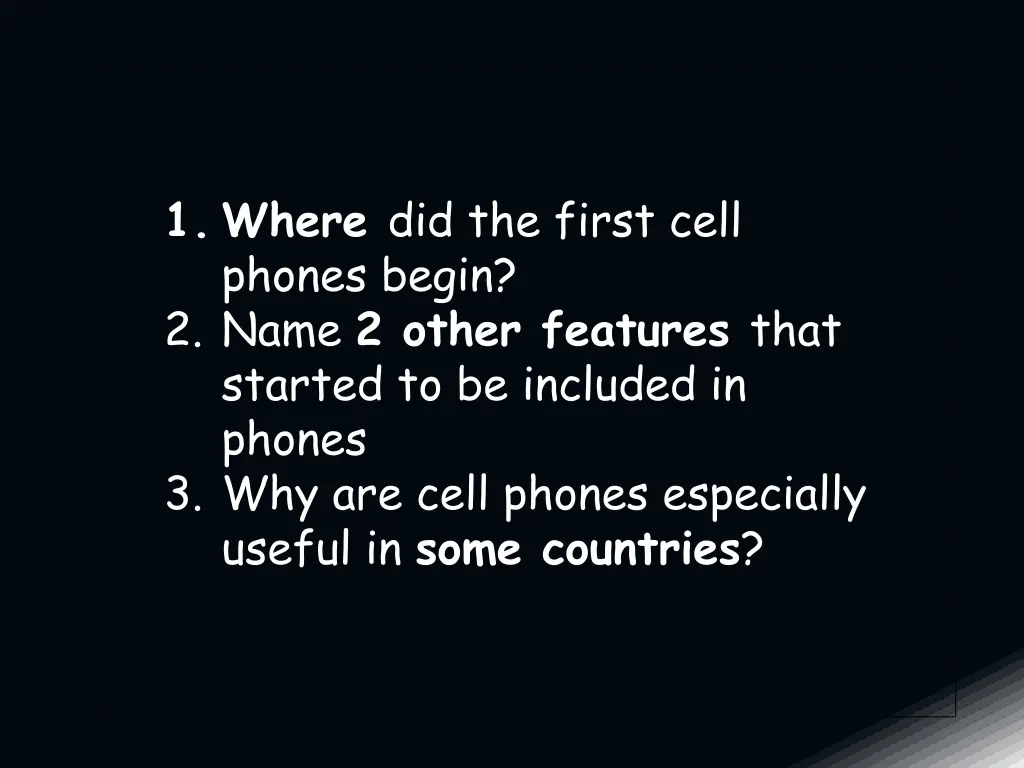
1. Where did the first cell phones begin? 2. Name 2 other features that started to be included in phones 3. Why are cell phones especially useful in some countries?
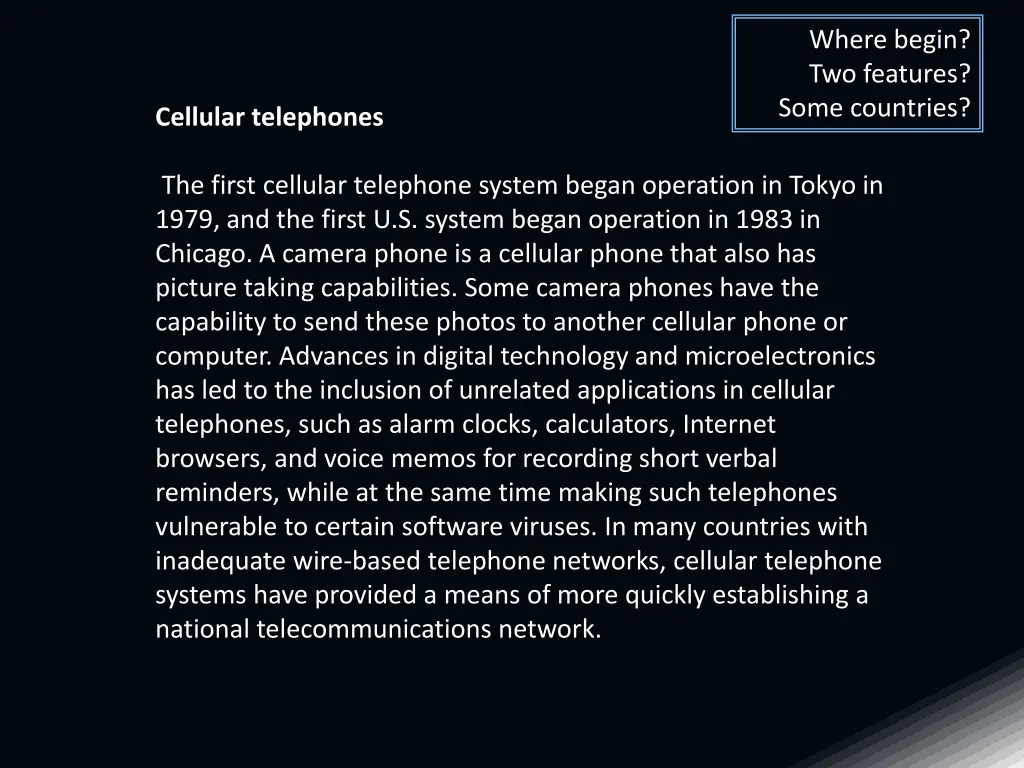
Where begin? Two features? Some countries? Cellular telephones The first cellular telephone system began operation in Tokyo in 1979, and the first U.S. system began operation in 1983 in Chicago. A camera phone is a cellular phone that also has picture taking capabilities. Some camera phones have the capability to send these photos to another cellular phone or computer. Advances in digital technology and microelectronics has led to the inclusion of unrelated applications in cellular telephones, such as alarm clocks, calculators, Internet browsers, and voice memos for recording short verbal reminders, while at the same time making such telephones vulnerable to certain software viruses. In many countries with inadequate wire-based telephone networks, cellular telephone systems have provided a means of more quickly establishing a national telecommunications network.
RESEARCH SKILLS
Research the life of Martin Luther King