Living By Chemistry
This lesson delves into the concept of mirror-image isomers, also known as enantiomers, and their significance in chemistry. Students will learn to identify molecular structures that exhibit handedness and understand the implications of these isomers on physical properties, including their distinct smells. The curriculum emphasizes recognizing superimposable and non-superimposable structures, utilizing tetrahedral configurations with different groups attached to carbon atoms. Real-world examples like D-carvone and L-carvone illustrate the practical importance of these concepts.

Download Presentation

Please find below an Image/Link to download the presentation.
The content on the website is provided AS IS for your information and personal use only. It may not be sold, licensed, or shared on other websites without obtaining consent from the author.If you encounter any issues during the download, it is possible that the publisher has removed the file from their server.
You are allowed to download the files provided on this website for personal or commercial use, subject to the condition that they are used lawfully. All files are the property of their respective owners.
The content on the website is provided AS IS for your information and personal use only. It may not be sold, licensed, or shared on other websites without obtaining consent from the author.
E N D
Presentation Transcript
Living By Chemistry SECOND EDITION Unit 2: SMELLS Molecular Structure and Properties
Lesson 47: Mirror, Mirror Mirror-Image Isomers
ChemCatalyst Which of these objects looks identical in a mirror? Explain any differences. 1. glove 3. spring 2. barbell 4. tetrahedron
Key Question What are mirror-image isomers?
You will be able to: recognize mirror-image molecular structures explain what it means for molecules to be superimposable understand why mirror-image isomers have different properties
Prepare for the Activity Work in groups of four.
Discussion Notes Mirror-image molecules that cannot be superimposed on each other are called mirror- image isomers. Tetrahedral molecules in which four different atoms or groups are attached to a carbon atom always have mirror-image isomers.
Discussion Notes (cont.) The mirror-image isomers D-carvone and L- carvone have different smells. The mirror-image isomers have a handedness.
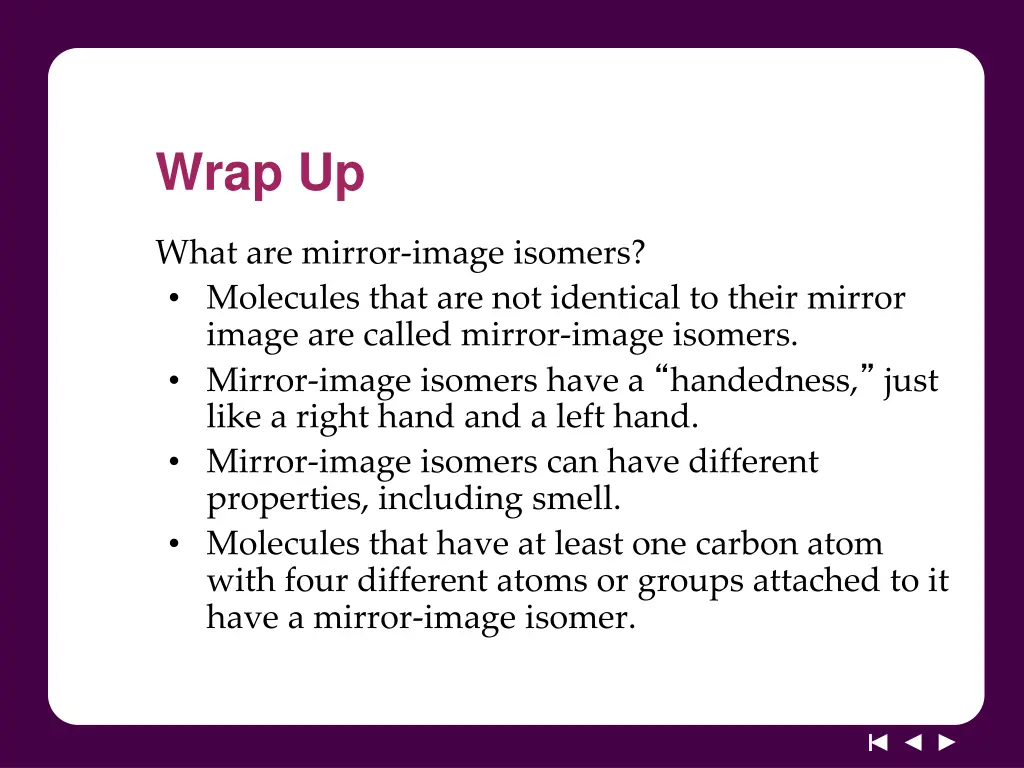
Wrap Up What are mirror-image isomers? Molecules that are not identical to their mirror image are called mirror-image isomers. Mirror-image isomers have a handedness, just like a right hand and a left hand. Mirror-image isomers can have different properties, including smell. Molecules that have at least one carbon atom with four different atoms or groups attached to it have a mirror-image isomer.
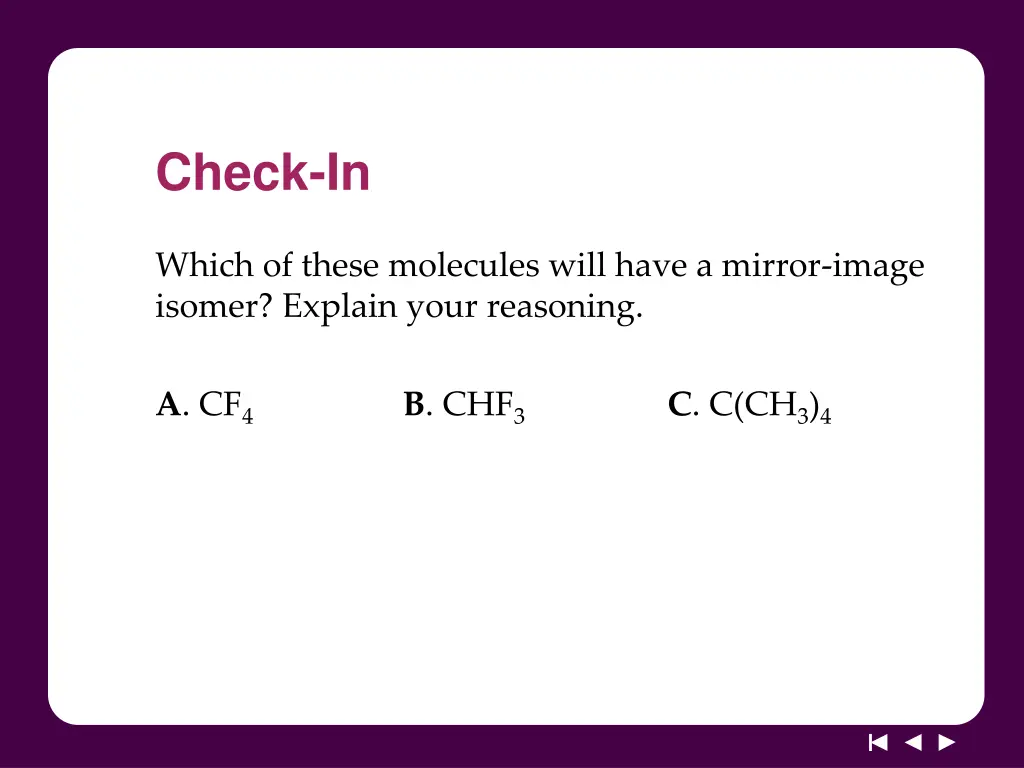
Check-In Which of these molecules will have a mirror-image isomer? Explain your reasoning. A. CF4 B. CHF3 C. C(CH3)4