Logic
A categorical syllogism is a deductive argument comprised of three categorical propositions containing three unique terms, each appearing twice. The conclusion utilizes a major term (predicate) and a minor term (subject), whereas the middle term links the two premises but does not appear in the conclusion. Understanding the figures and moods of syllogisms is essential for clear logical reasoning. Syllogistic arguments must adhere to specific rules to avoid fallacies, ensuring valid conclusions through proper term distribution.

Download Presentation

Please find below an Image/Link to download the presentation.
The content on the website is provided AS IS for your information and personal use only. It may not be sold, licensed, or shared on other websites without obtaining consent from the author.If you encounter any issues during the download, it is possible that the publisher has removed the file from their server.
You are allowed to download the files provided on this website for personal or commercial use, subject to the condition that they are used lawfully. All files are the property of their respective owners.
The content on the website is provided AS IS for your information and personal use only. It may not be sold, licensed, or shared on other websites without obtaining consent from the author.
E N D
Presentation Transcript
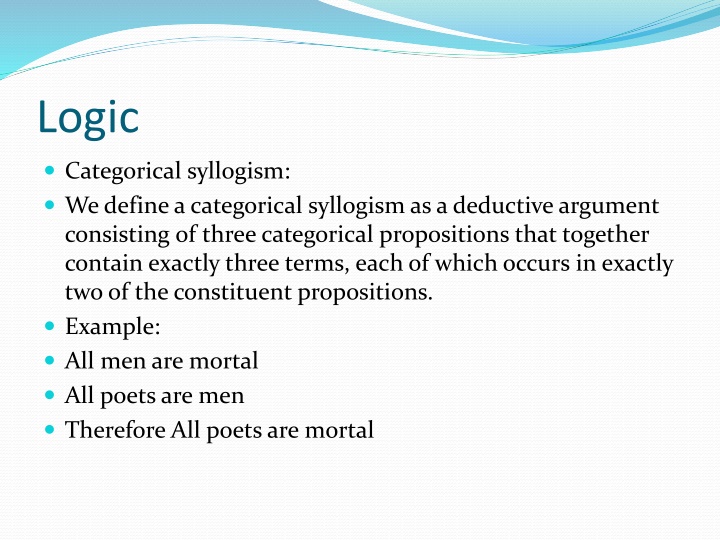
Logic Categorical syllogism: We define a categorical syllogism as a deductive argument consisting of three categorical propositions that together contain exactly three terms, each of which occurs in exactly two of the constituent propositions. Example: All men are mortal All poets are men Therefore All poets are mortal
Construction of syllogism : The three categorical propositions in our example argument above contain exactly three terms- mortal, poets and men. The term that occurs as the predicate of the conclusion( mortal in this case), is called the major term of the syllogism. The term that occurs as the subject of the conclusion( poets in this case), is called the minor term of the syllogism. The third term of the syllogism( men in this case), which never occurs in the conclusion but always appears in both premises, is called the middle term.
Logic Figure of syllogism: Syllogisms can have four and only four possible different figures: 1. First figure: The middle term may be the subject term of the major premise and the predicate term of the minor premise. 2. Second figure: The middle term may be the predicate term of both premises. 3. Third figure: The middle term may be subject term of both premises. 4. Fourth Figure: The middle term may be the predicate term of the major premise and the subject term of the minor premise.
Logic The Mood of Syllogism: Every syllogism has a mood. The mood of the syllogism is determined by the types(A,E,I,or O)of standard form categorical propositions it contains.The mood of the syllogism is therefore is represented by three letters, and those three letters are always given in standard-form order.
Logic Syllogistic Rules and Syllogistic Fallacies: In syllogistic argument there are Six Rules. 1. A valid standard-form categorical syllogism must contain exactly three terms, each of which is used in the same sense throughout the argument. If more than three terms are involved the syllogism is invalid . The fallacy thus committed is called the fallacy of four terms. If major term, minor term and middle term are used in different sense in different places then fallacy of ambiguous major minor and middle will be committed respectively.
Logic 2. In a valid standard form categorical syllogism, the middle term must be distributed in at least one premise. All Russians were revolutionists All anarchists were revolutionists Therefore, all anarchists are Russians. This argument is invalid, because here the middle term revolutionists is an undistributed term in both of the premises. The fallacy this syllogism commits is called the fallacy of the undistributed middle.
Logic 3. In a valid standard-form categorical syllogism, if any term is disrtibuted in the conclusion then it must be distributed in the premises. A term that is distributed in the conclusion but is not distributed in the premises is therefore a sure mark that the conclusion has gone beyond its premises and has reached too far. The fallacy is that of illicit process. This fallacy may be of two types- illicit major and illicit minor. Example; All dogs are mammals No cats are dogs Therefore no cats are mammals.
This syllogism is invalid ,the fallacy here is that of an illicit major. Since the major term mammals is distributed in the conclusion . It is E proposition but the major term mammals is not distributed in the major premise, since here the major term mammals is the predicate of A proposition
Example: All traditionally religious people are fundamentalists. All traditionally religious people are opponents of same sex marriages. Therefore all opponents of same sex marriages are fundamentalists. Here the minor term opponents of same sex marriages is ditributed in the conclusion but it is undisributed in the minor premise.
Logic 4.No standard- form categorical syllogism having two negative premises is valid any negative proposition denies class inclusion; it asserts that some or all of one class is excluded from the whole of the other class.If both premises are negative the argument must be invalid. The mistake is named the fallacy of exclusive premises.
Logic 5. If either premise of a valid standard form syllogism is negative, the conclusion must be negative. The mistake here is called the fallacy of drawing an affirmative conclusion from a negative premise.
Logic 6. From two universal premises no particular conclusion may be drawn. This final rule is not needed in the traditional account of the categorical syllogism. When existential import is carefully considered, it will be clear that if the premises of an argument do not assert the existence of anything at all, the conclusion will be unwarranted when, from it, the existence may be inferred. The mistake is called the existential fallacy. Example: All household pets are domestic animals. No unicorns are domestic animals. Therefore some unicorns are not household pets.
Logic The precise Meaning of Invlid and valid If the specific form of a given argument has substitution instance whose premises are true but conclusion is false, then the given argument is invalid. Any argument that is not invalid must be valid. An argument is valid if and only if it has no substitution instances with true premises and a false conclusion Therefore validity is a formal notion,an argument is valid if and only if the specific form of that argument is a valid argument form. Example: i) PvQ It is not the case that P ii) P Q Therefore Q Therefore Q iii) P.Q Therefore P p