Luminosity Monitoring at the Electron-Ion Collider
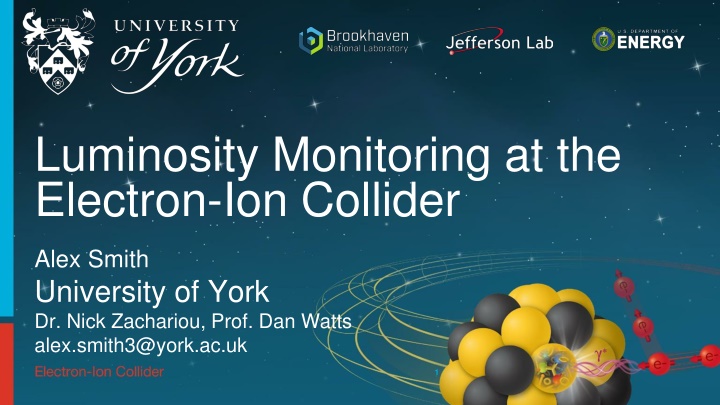
The Electron-Ion Collider is a high-energy physics facility aiming to achieve precision 3D imaging of protons and nuclei, solve the proton spin puzzle, and explore quark and gluon confinement. This article discusses the scientific goals, system layout, and monitoring techniques involved in measuring the luminosity of the collider, essential for understanding particle interactions. It details the use of bremsstrahlung radiation and photon detectors for luminosity determination, emphasizing the collider's capabilities in studying fundamental physics phenomena. The system requirements for achieving accurate luminosity measurements are also highlighted, including energy and timing resolutions, complementarity, and redundancy.

Download Presentation

Please find below an Image/Link to download the presentation.
The content on the website is provided AS IS for your information and personal use only. It may not be sold, licensed, or shared on other websites without obtaining consent from the author.If you encounter any issues during the download, it is possible that the publisher has removed the file from their server.
You are allowed to download the files provided on this website for personal or commercial use, subject to the condition that they are used lawfully. All files are the property of their respective owners.
The content on the website is provided AS IS for your information and personal use only. It may not be sold, licensed, or shared on other websites without obtaining consent from the author.
E N D
Presentation Transcript
Luminosity Monitoring at the Electron-Ion Collider Alex Smith University of York Dr. Nick Zachariou, Prof. Dan Watts alex.smith3@york.ac.uk 1
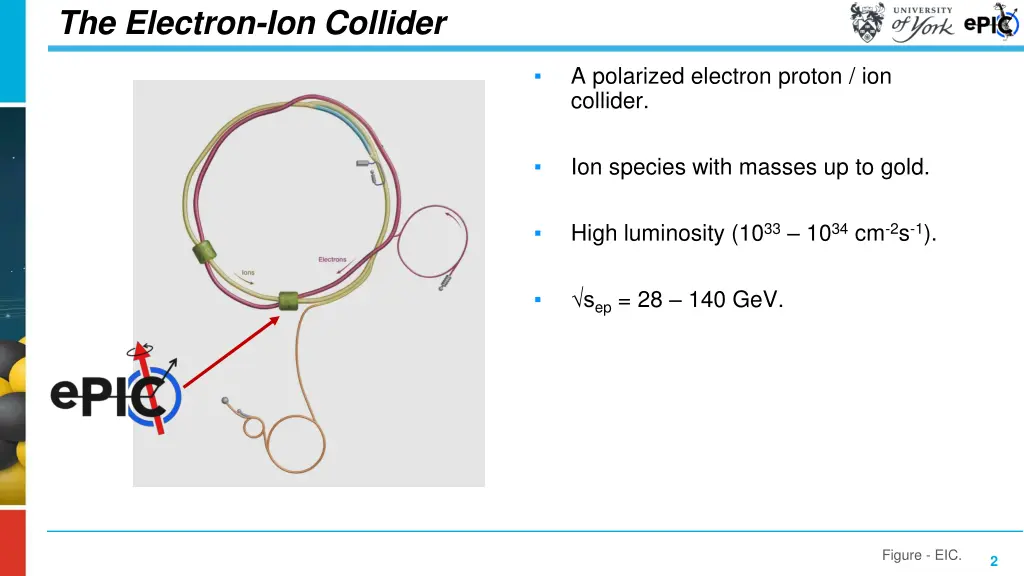
The Electron-Ion Collider A polarized electron proton / ion collider. Ion species with masses up to gold. High luminosity (1033 1034cm-2s-1). sep= 28 140 GeV. Electron-Ion Collider Figure - EIC. 2 EIC Preliminary Design & Safety Review of the EIC Auxiliary Far-Forward/Far-Backward Detectors
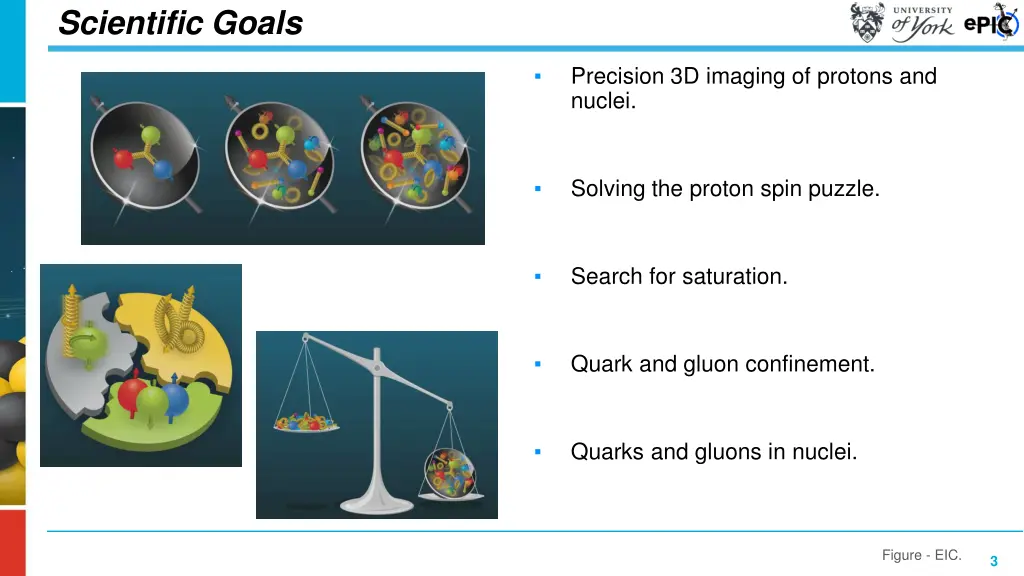
Scientific Goals Precision 3D imaging of protons and nuclei. Solving the proton spin puzzle. Search for saturation. Quark and gluon confinement. Quarks and gluons in nuclei. Electron-Ion Collider Figure - EIC. 3 EIC Preliminary Design & Safety Review of the EIC Auxiliary Far-Forward/Far-Backward Detectors
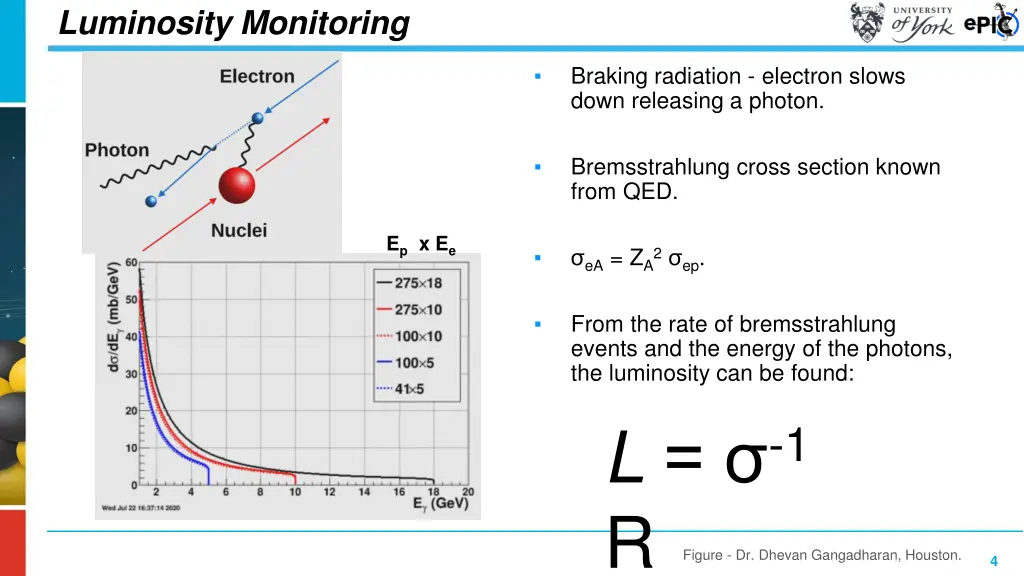
Luminosity Monitoring Braking radiation - electron slows down releasing a photon. Bremsstrahlung cross section known from QED. Epx Ee eA= ZA2 ep. From the rate of bremsstrahlung events and the energy of the photons, the luminosity can be found: L = -1 R Electron-Ion Collider Figure - Dr. Dhevan Gangadharan, Houston. 4 EIC Preliminary Design & Safety Review of the EIC Auxiliary Far-Forward/Far-Backward Detectors
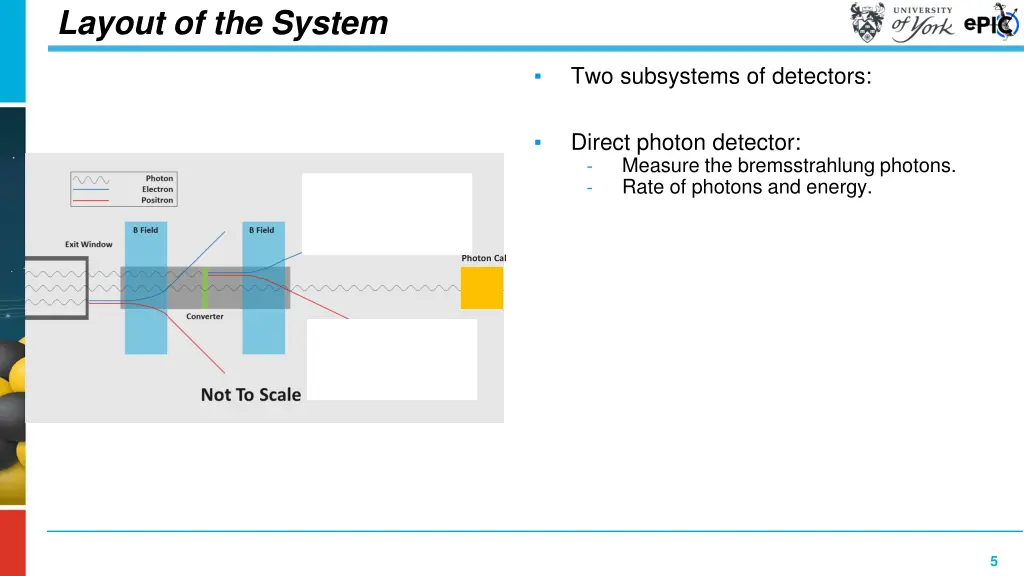
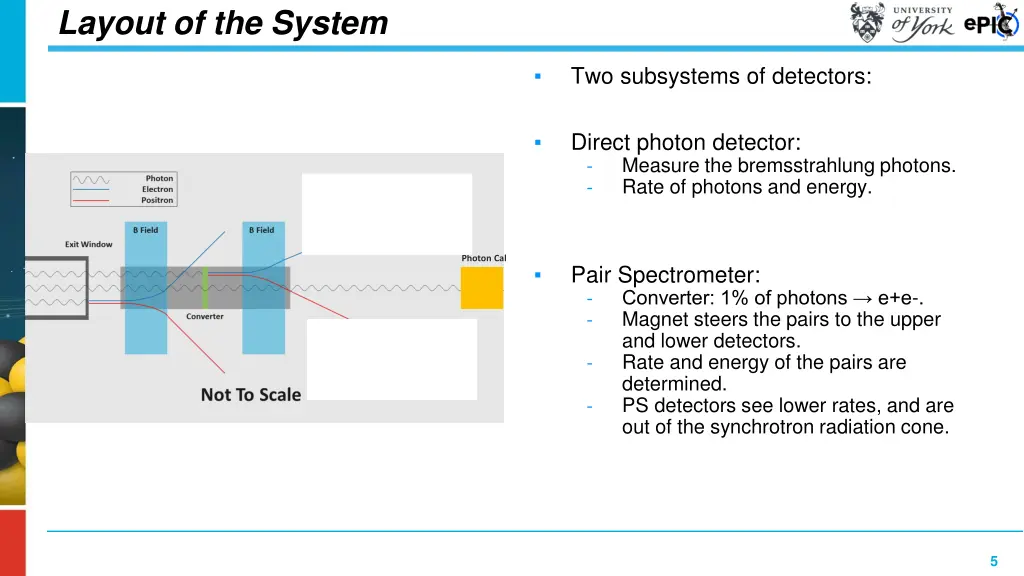
Layout of the System Two subsystems of detectors: Direct photon detector: - Measure the bremsstrahlung photons. - Rate of photons and energy. Photon Cal Electron-Ion Collider 5 EIC Preliminary Design & Safety Review of the EIC Auxiliary Far-Forward/Far-Backward Detectors
Layout of the System Two subsystems of detectors: Direct photon detector: - Measure the bremsstrahlung photons. - Rate of photons and energy. Photon Cal Pair Spectrometer: - Converter: 1% of photons e+e-. - Magnet steers the pairs to the upper and lower detectors. - Rate and energy of the pairs are determined. - PS detectors see lower rates, and are out of the synchrotron radiation cone. Electron-Ion Collider 5 EIC Preliminary Design & Safety Review of the EIC Auxiliary Far-Forward/Far-Backward Detectors
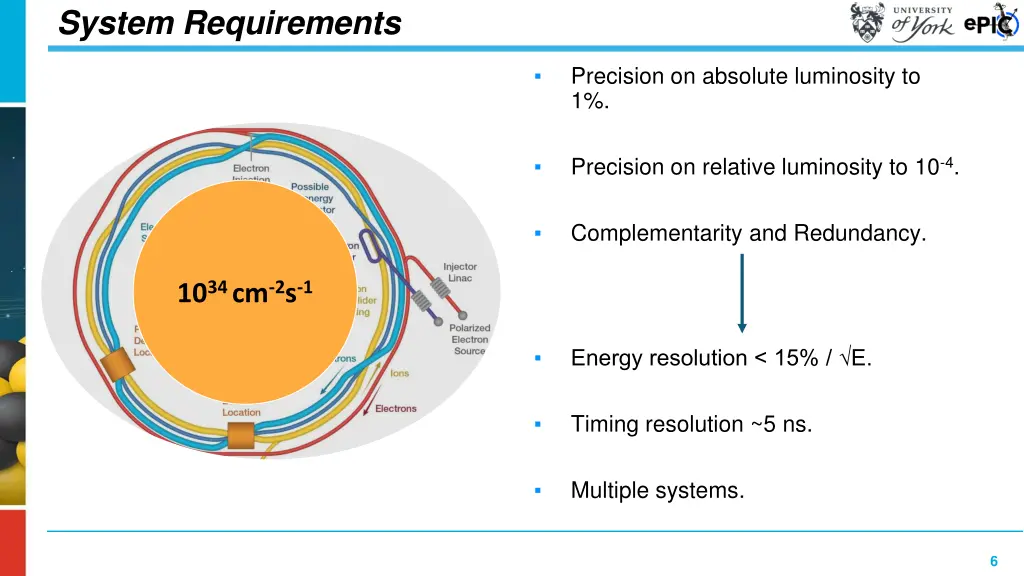
System Requirements Precision on absolute luminosity to 1%. Precision on relative luminosity to 10-4. Complementarity and Redundancy. 1034 cm-2s-1 Energy resolution < 15% / E. Timing resolution ~5 ns. Multiple systems. Electron-Ion Collider 6 EIC Preliminary Design & Safety Review of the EIC Auxiliary Far-Forward/Far-Backward Detectors
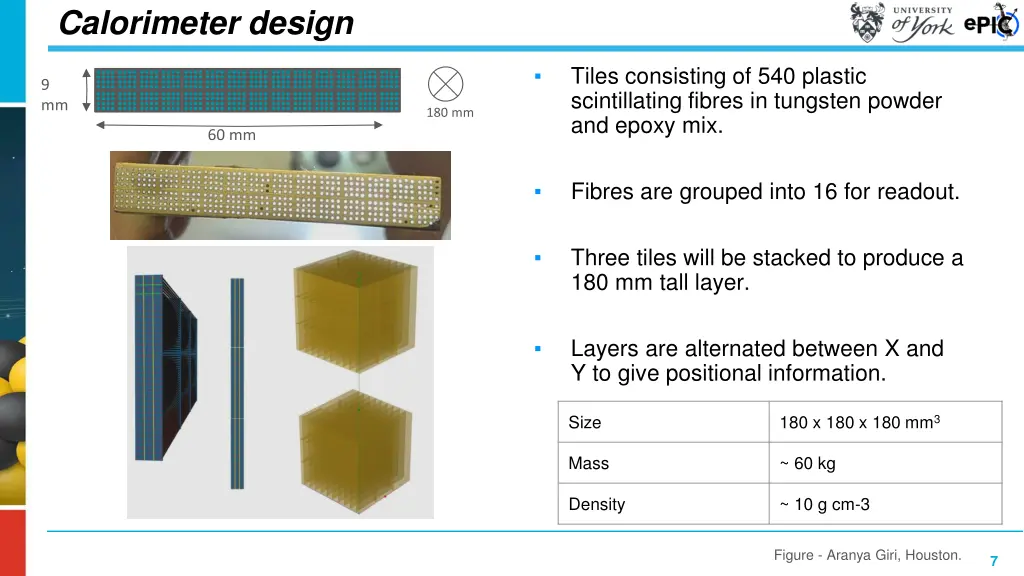
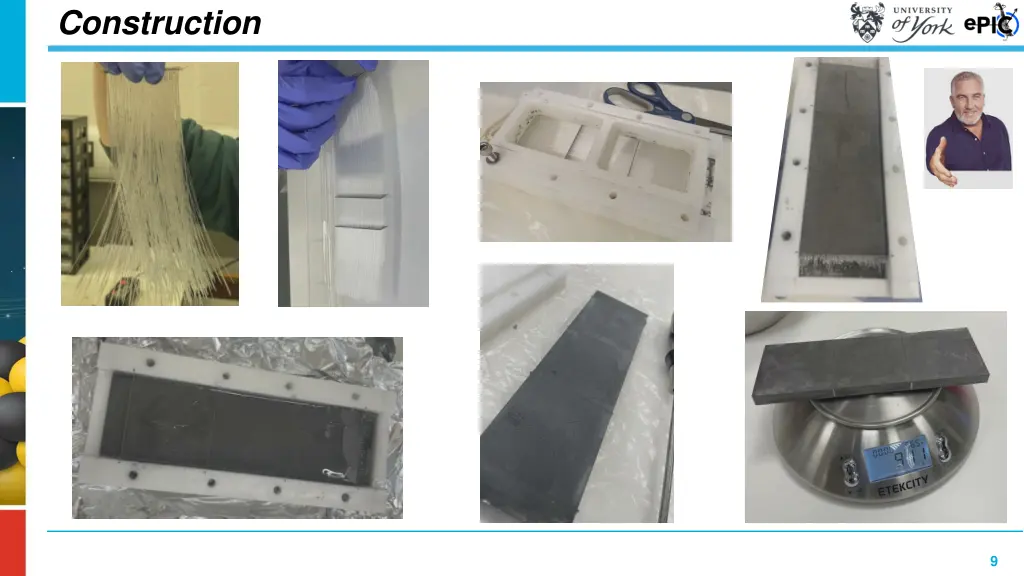
Calorimeter design Tiles consisting of 540 plastic scintillating fibres in tungsten powder and epoxy mix. 9 mm 180 mm Fibres are grouped into 16 for readout. Three tiles will be stacked to produce a 180 mm tall layer. Layers are alternated between X and Y to give positional information. Size 180 x 180 x 180 mm3 Mass ~ 60 kg Density ~ 10 g cm-3 Electron-Ion Collider Figure - Aranya Giri, Houston. 7 EIC Preliminary Design & Safety Review of the EIC Auxiliary Far-Forward/Far-Backward Detectors
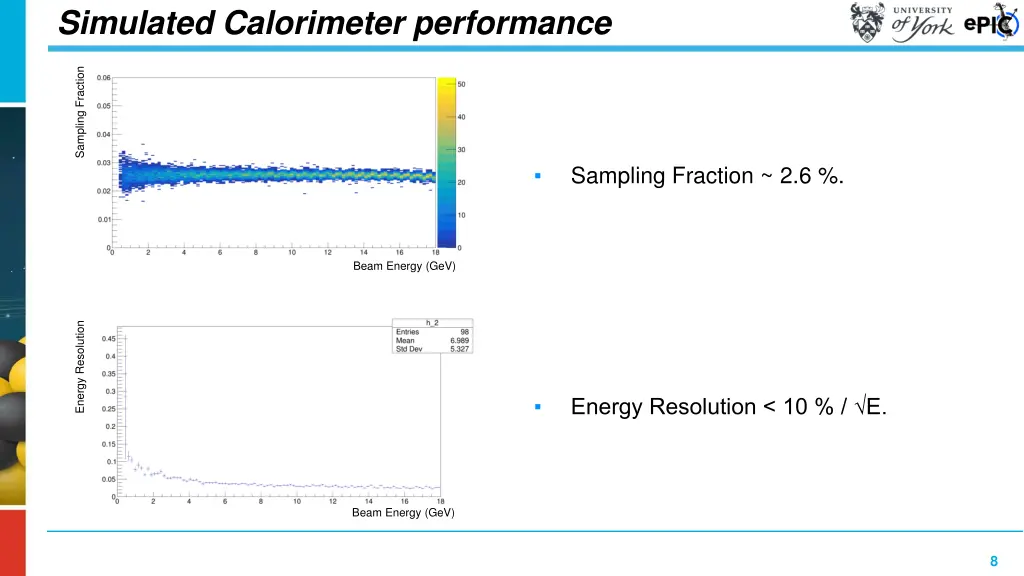
Simulated Calorimeter performance Sampling Fraction Sampling Fraction ~ 2.6 %. Beam Energy (GeV) Energy Resolution Energy Resolution < 10 % / E. Beam Energy (GeV) Electron-Ion Collider 8 EIC Preliminary Design & Safety Review of the EIC Auxiliary Far-Forward/Far-Backward Detectors
Construction Electron-Ion Collider 9 EIC Preliminary Design & Safety Review of the EIC Auxiliary Far-Forward/Far-Backward Detectors
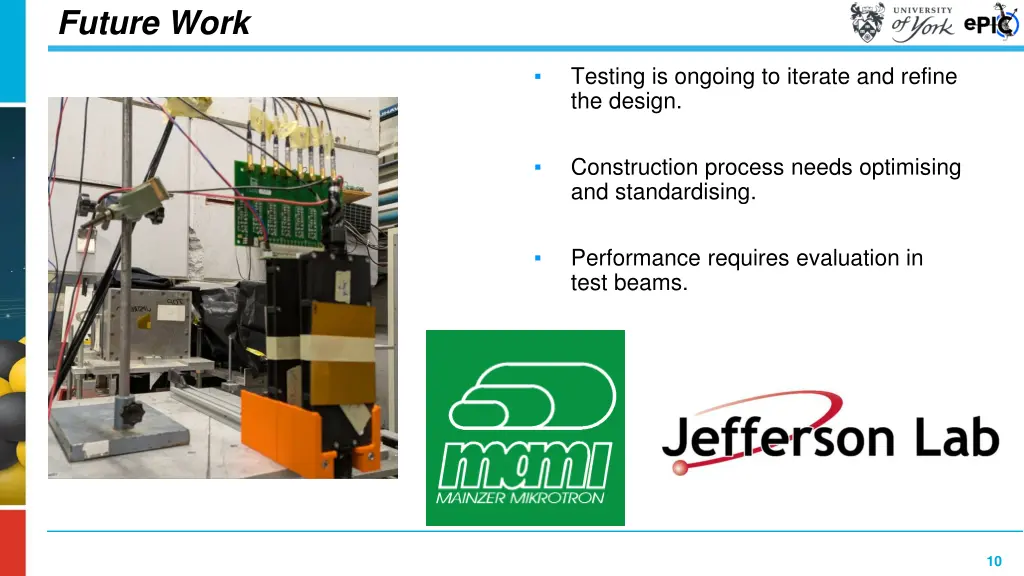
Future Work Testing is ongoing to iterate and refine the design. Construction process needs optimising and standardising. Performance requires evaluation in test beams. Electron-Ion Collider 10 EIC Preliminary Design & Safety Review of the EIC Auxiliary Far-Forward/Far-Backward Detectors
Thank you for listening Alex Smith University of York Dr. Nick Zachariou, Prof. Dan Watts alex.smith3@york.ac.uk 12
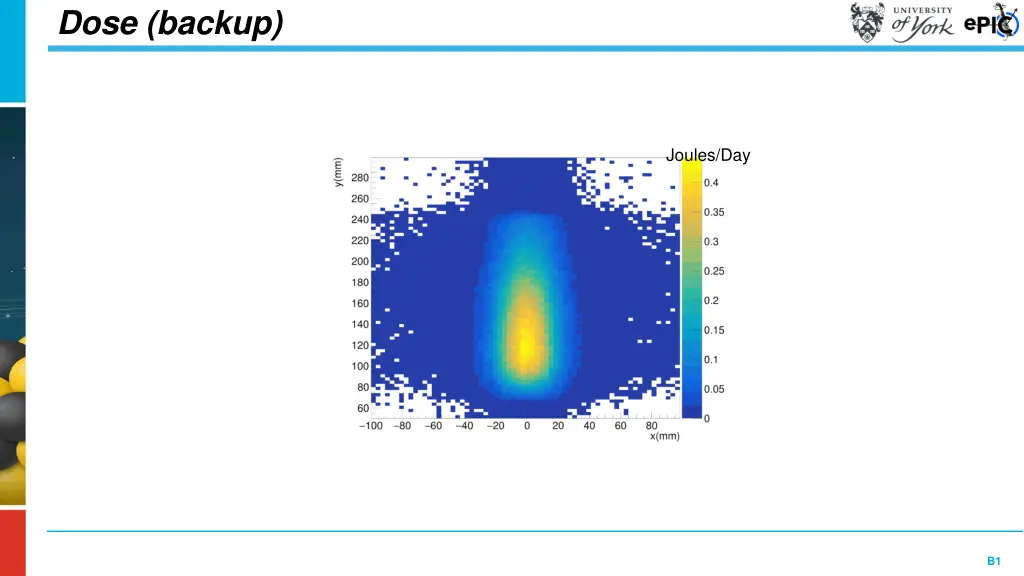
Dose (backup) Joules/Day Electron-Ion Collider B1 EIC Preliminary Design & Safety Review of the EIC Auxiliary Far-Forward/Far-Backward Detectors