Lung Cancer Survivability Prediction Using Machine Learning and Deep Neural Network
Lung cancer is a significant concern, impacting patient care and treatment decisions. This project focuses on predicting the survival time of lung cancer patients using machine learning techniques. Leveraging data from the SEER program, the goal is to estimate the number of months each patient has to survive. Building on previous research, this work aims to enhance survivability predictions for better patient outcomes.

Download Presentation

Please find below an Image/Link to download the presentation.
The content on the website is provided AS IS for your information and personal use only. It may not be sold, licensed, or shared on other websites without obtaining consent from the author.If you encounter any issues during the download, it is possible that the publisher has removed the file from their server.
You are allowed to download the files provided on this website for personal or commercial use, subject to the condition that they are used lawfully. All files are the property of their respective owners.
The content on the website is provided AS IS for your information and personal use only. It may not be sold, licensed, or shared on other websites without obtaining consent from the author.
E N D
Presentation Transcript
Lung Cancer Survivability Prediction using Machine Learning and Deep Neural Network CS 732: Advanced Machine Learning Final Project By: Firas Gerges (fg92) 1
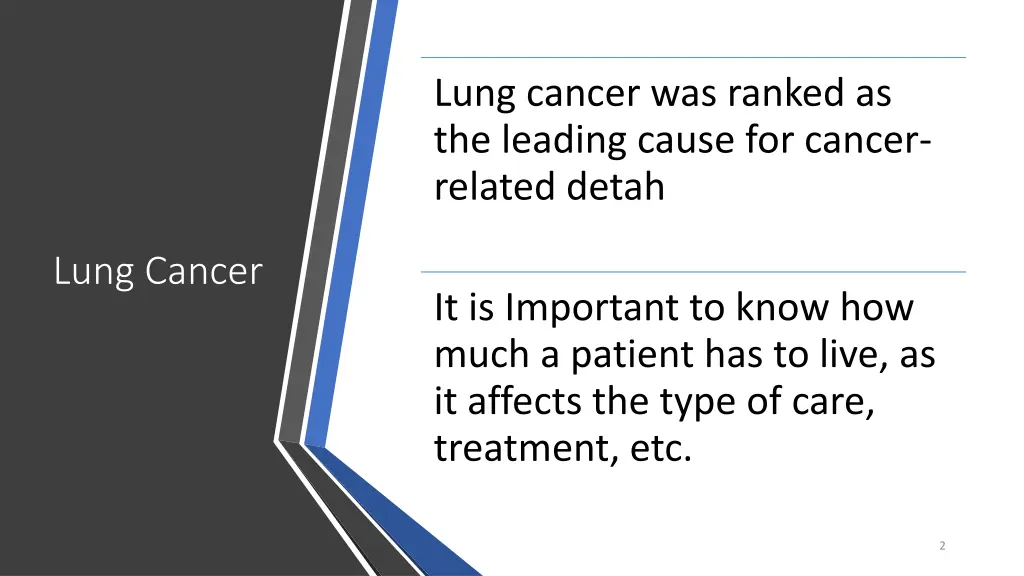
Lung cancer was ranked as the leading cause for cancer- related detah Lung Cancer It is Important to know how much a patient has to live, as it affects the type of care, treatment, etc. 2
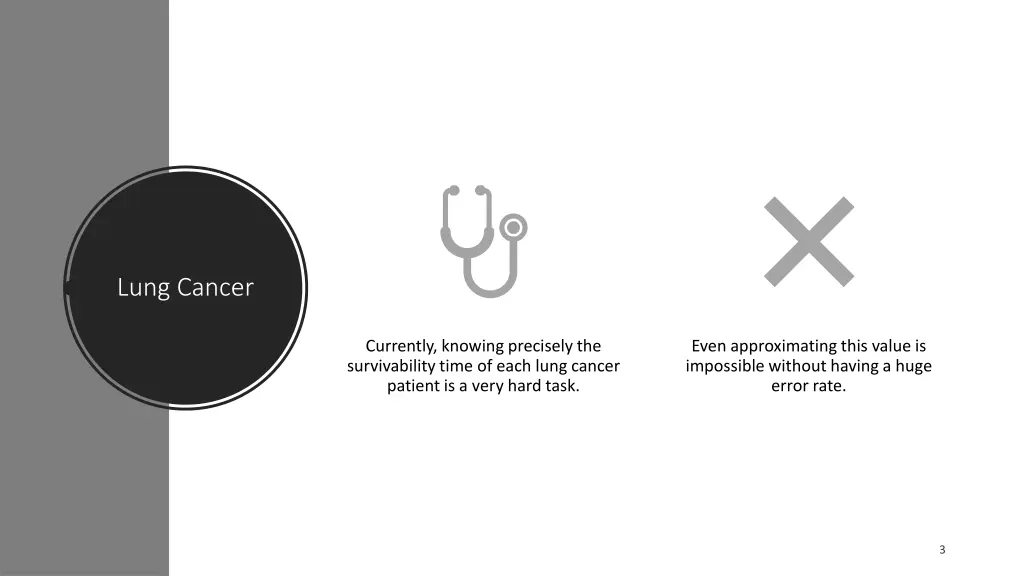
Lung Cancer Currently, knowing precisely the survivability time of each lung cancer patient is a very hard task. Even approximating this value is impossible without having a huge error rate.
The aim of this project is to use a wide variety of supervised machine learning techniques on Lung Cancer patient data in order to predict the number of month each patient has to survive Goal
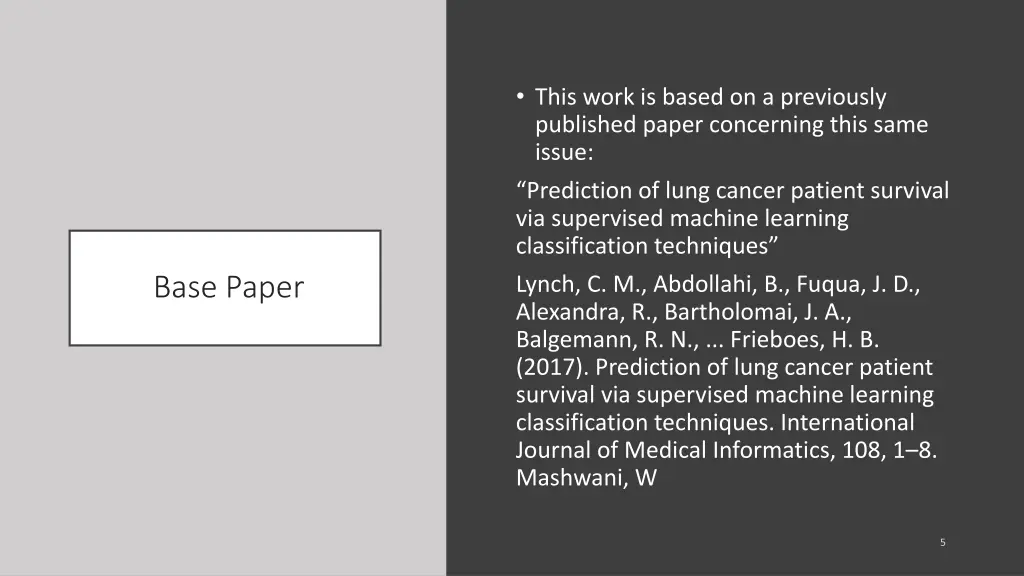
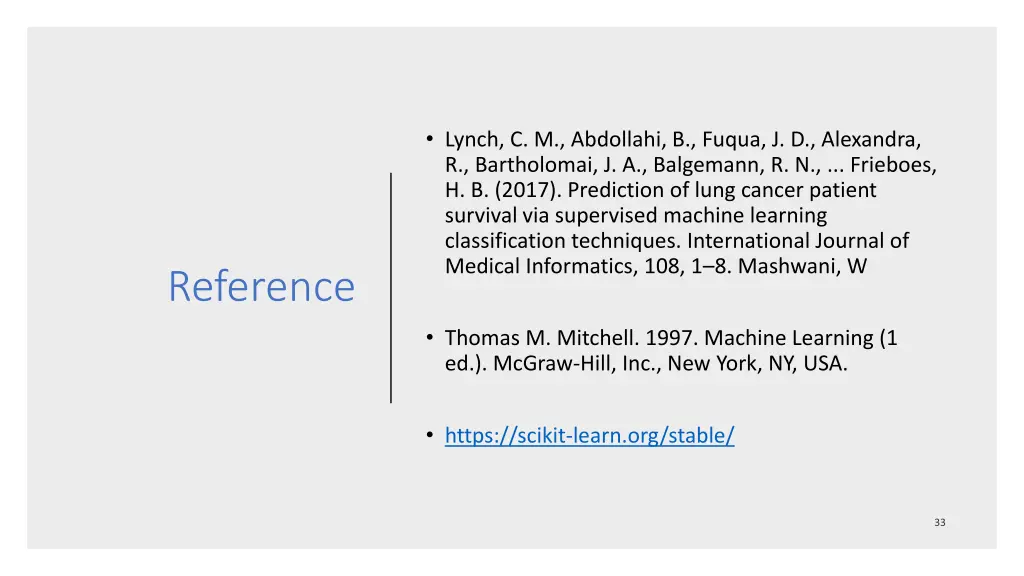
This work is based on a previously published paper concerning this same issue: Prediction of lung cancer patient survival via supervised machine learning classification techniques Lynch, C. M., Abdollahi, B., Fuqua, J. D., Alexandra, R., Bartholomai, J. A., Balgemann, R. N., ... Frieboes, H. B. (2017). Prediction of lung cancer patient survival via supervised machine learning classification techniques. International Journal of Medical Informatics, 108, 1 8. Mashwani, W Base Paper
6 Data is requested from the authors of the base paper. Originally, the data is extracted for The Surveillance, Epidemiology, and End Results program (SEER) database, which is provided by provided by: National Cancer Institute (NCI) at the National Institute of Health (NIH) Data
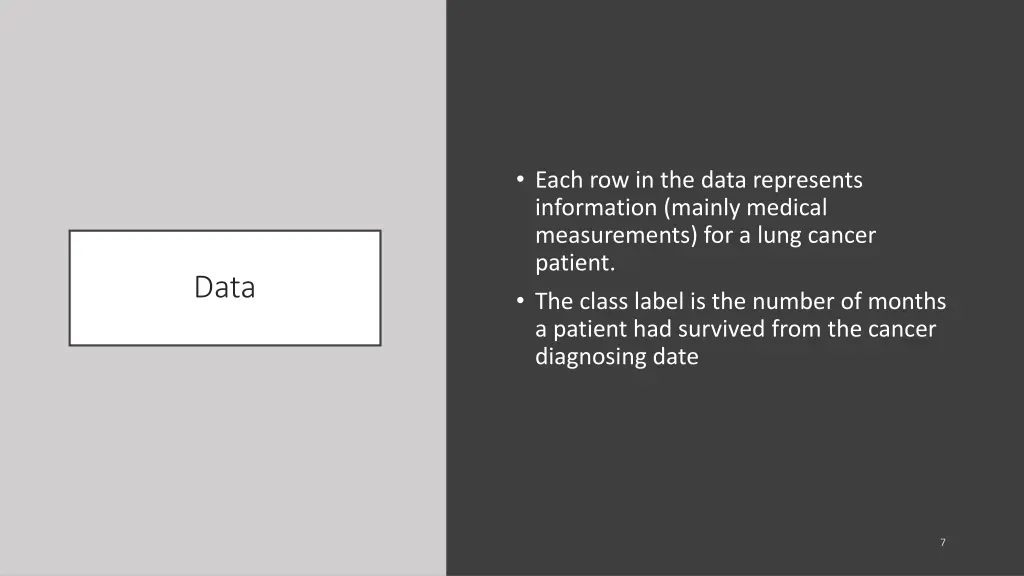
Each row in the data represents information (mainly medical measurements) for a lung cancer patient. The class label is the number of months a patient had survived from the cancer diagnosing date Data
Data 10442 patient record Each record include:
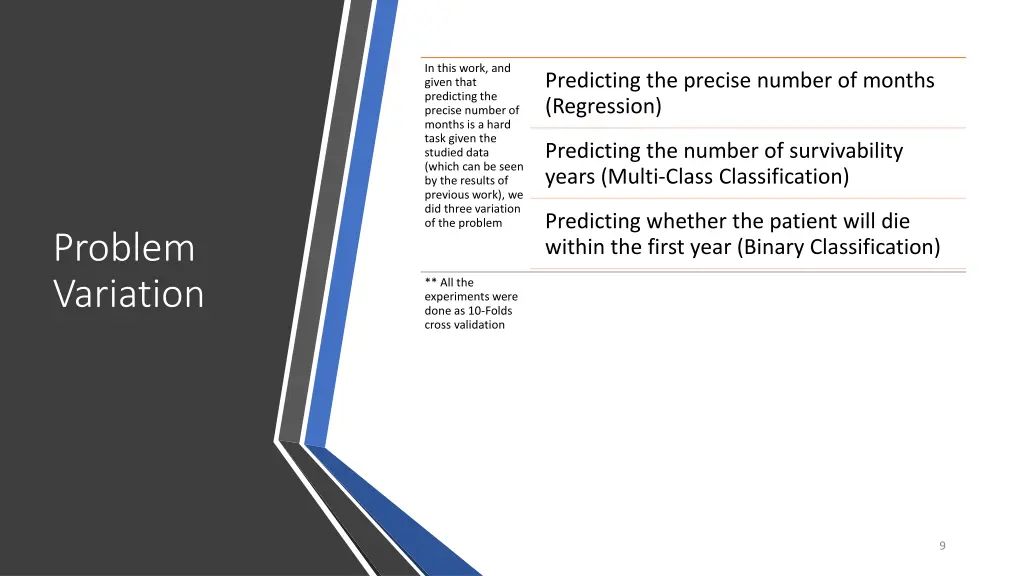
In this work, and given that predicting the precise number of months is a hard task given the studied data (which can be seen by the results of previous work), we did three variation of the problem Predicting the precise number of months (Regression) Predicting the number of survivability years (Multi-Class Classification) Predicting whether the patient will die within the first year (Binary Classification) Problem Variation ** All the experiments were done as 10-Folds cross validation 9
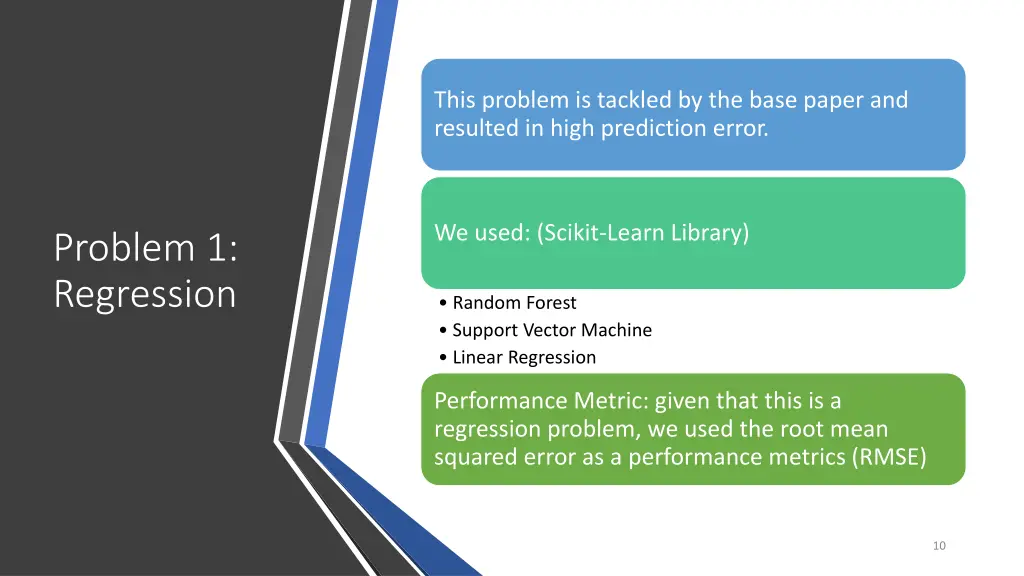
This problem is tackled by the base paper and resulted in high prediction error. We used: (Scikit-Learn Library) Problem 1: Regression Random Forest Support Vector Machine Linear Regression Performance Metric: given that this is a regression problem, we used the root mean squared error as a performance metrics (RMSE) 10
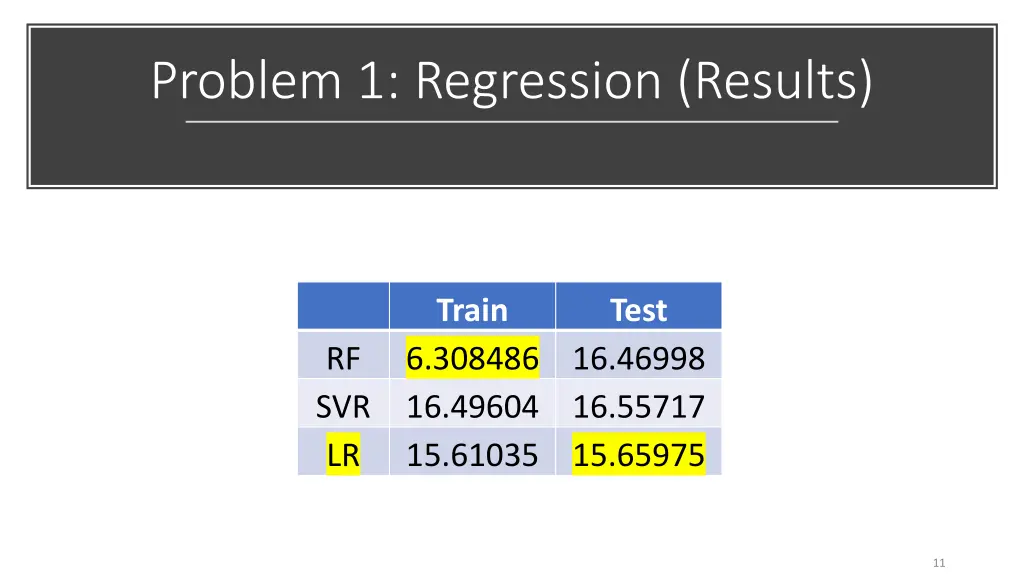
Problem 1: Regression (Results) Train 6.308486 16.49604 15.61035 Test RF SVR LR 16.46998 16.55717 15.65975 11
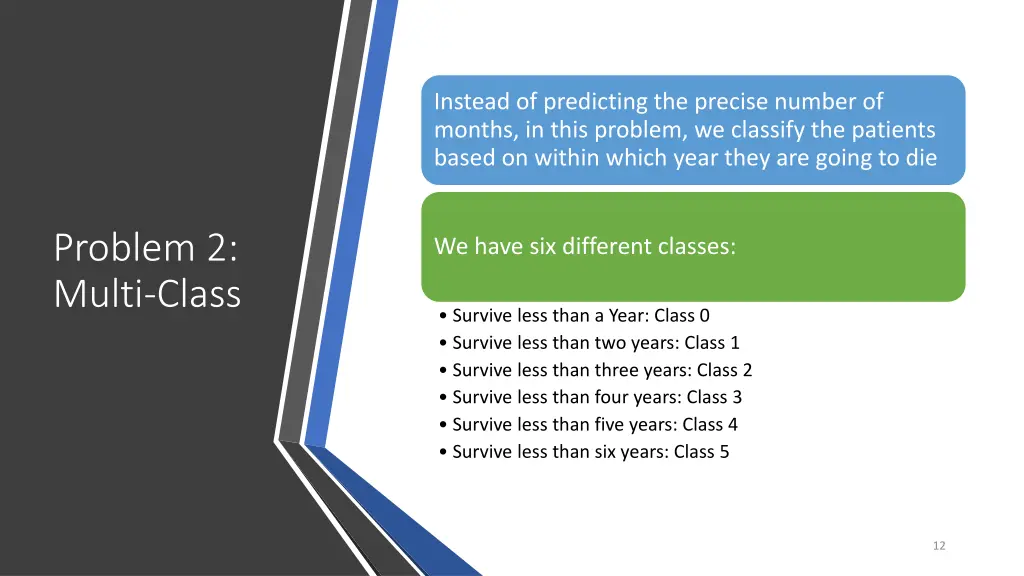
Instead of predicting the precise number of months, in this problem, we classify the patients based on within which year they are going to die Problem 2: Multi-Class We have six different classes: Survive less than a Year: Class 0 Survive less than two years: Class 1 Survive less than three years: Class 2 Survive less than four years: Class 3 Survive less than five years: Class 4 Survive less than six years: Class 5 12
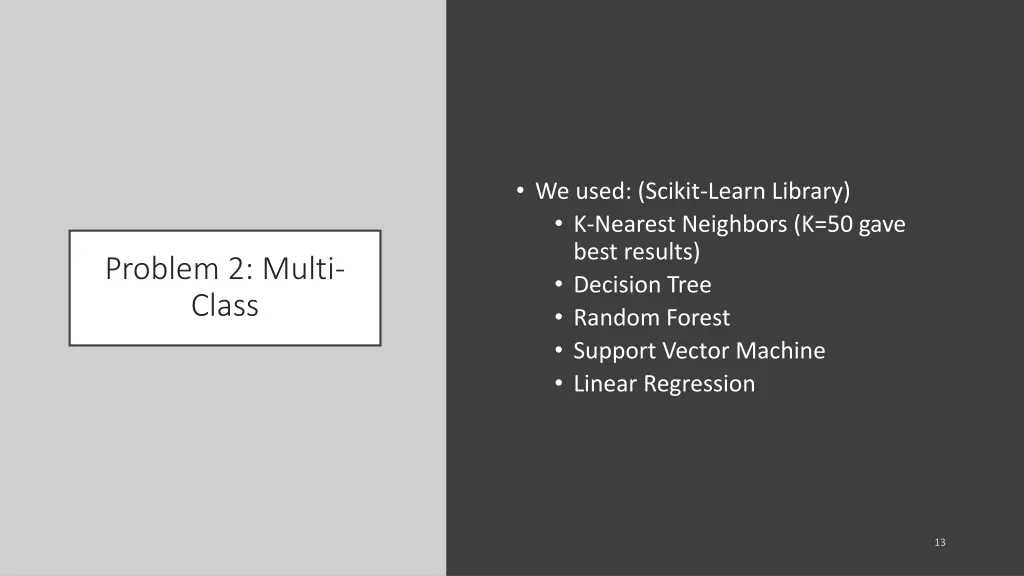
We used: (Scikit-Learn Library) K-Nearest Neighbors (K=50 gave best results) Decision Tree Random Forest Support Vector Machine Linear Regression Problem 2: Multi- Class
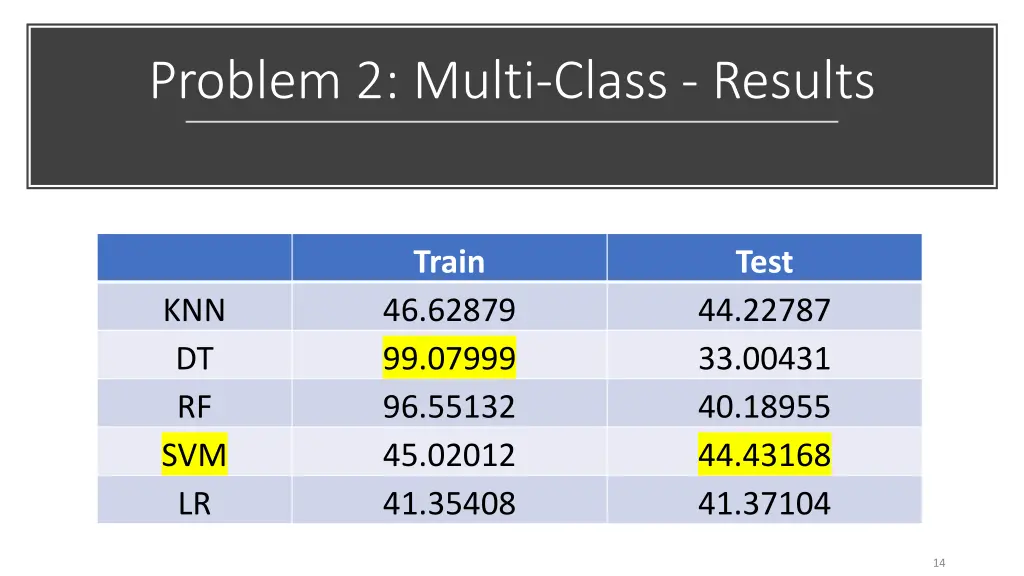
Problem 2: Multi-Class - Results Train 46.62879 99.07999 96.55132 45.02012 41.35408 Test KNN DT RF SVM LR 44.22787 33.00431 40.18955 44.43168 41.37104 14
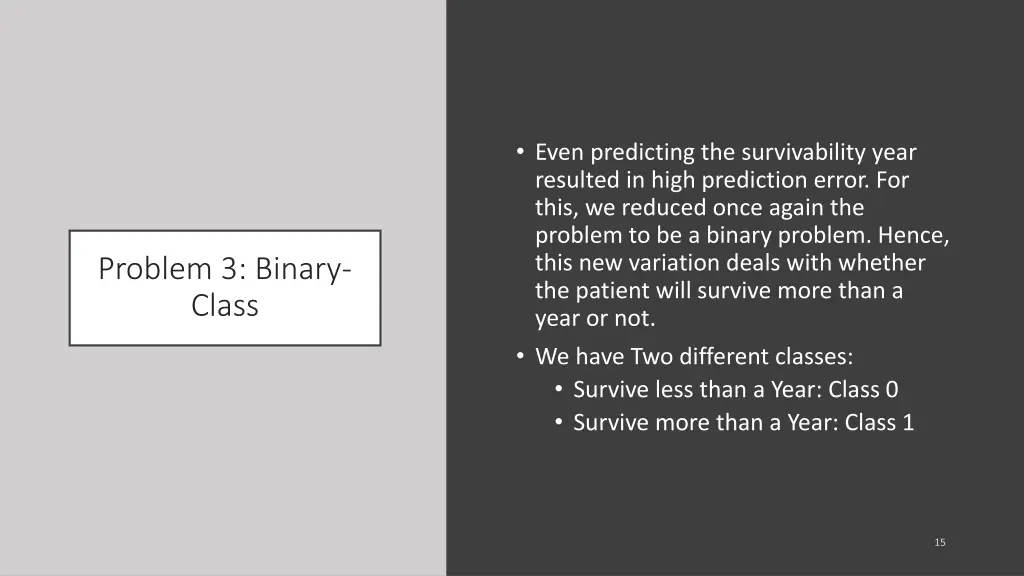
Even predicting the survivability year resulted in high prediction error. For this, we reduced once again the problem to be a binary problem. Hence, this new variation deals with whether the patient will survive more than a year or not. We have Two different classes: Survive less than a Year: Class 0 Survive more than a Year: Class 1 Problem 3: Binary- Class
16 We used: (Scikit-Learn Library) K-Nearest Neighbors (K=50 gave best results) Decision Tree Random Forest Support Vector Machine Linear Regression Problem 3: Binary-Class
Train 64.54689 99.46736 97.71667 Test KNN DT RF SVM 64.40055 LR 44.7382 62.88037 55.21957 60.70107 63.21919 44.74136 Problem 3: Binary-Class- Results
AS CAN BE SEEN FROM THE BINARY CLASSIFICATION RESULTS, SVM OUTPERFORMS THE OTHER TECHNIQUES WITH AN ACCURACY OF ~63% SO IN ORDER TO STUDY MORE THE DATA, AND IT SEE IF WE CAN EXPLORE DEEP AND HIDDEN RELATIONSHIP, WE IMPLEMENTED DEEP BACKPROPAGATION NEURAL NETWORK (DBNN) 18
19 A backpropagation neural network is multi linear perceptron that consists of two main steps: Feed Forward: compute output of each node, then the final output Backpropagation: Compute error of the network and update the weights accordingly based on the gradient descent. Back Propagation
BNN Architecture 20
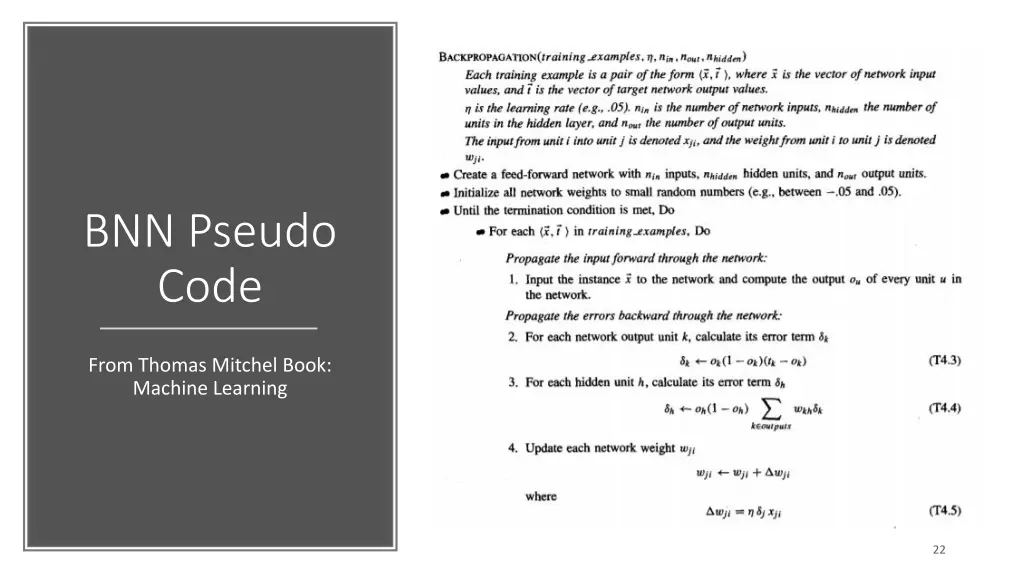
BNN Pseudo Code From Thomas Mitchel Book: Machine Learning 22
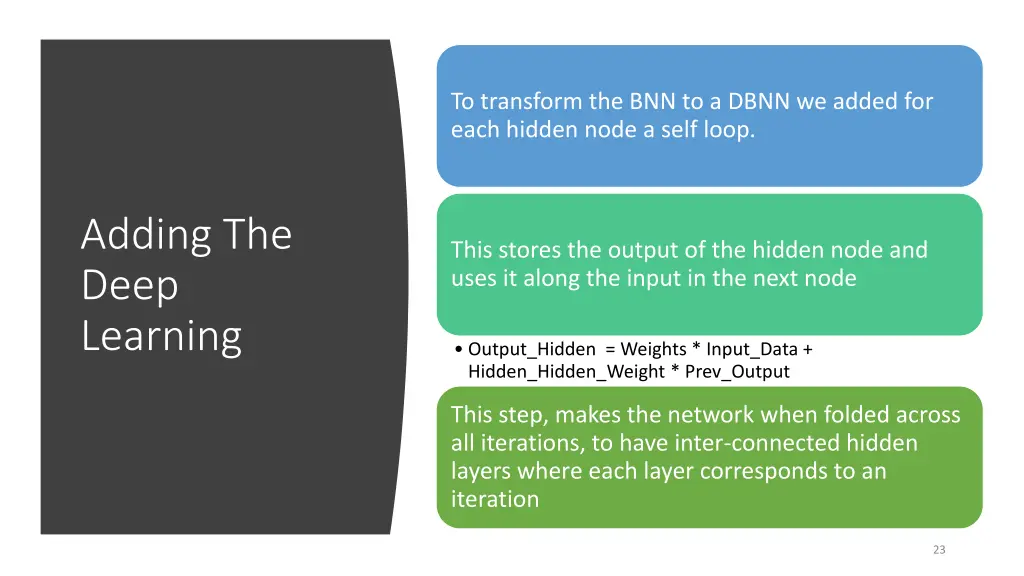
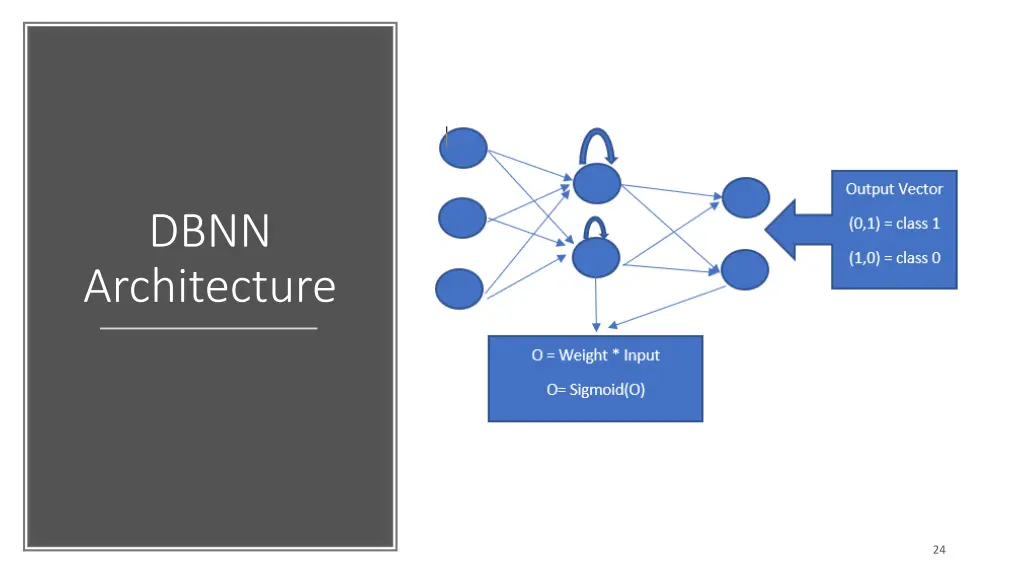
To transform the BNN to a DBNN we added for each hidden node a self loop. Adding The Deep Learning This stores the output of the hidden node and uses it along the input in the next node Output_Hidden = Weights * Input_Data + Hidden_Hidden_Weight * Prev_Output This step, makes the network when folded across all iterations, to have inter-connected hidden layers where each layer corresponds to an iteration 23
DBNN Architecture 24
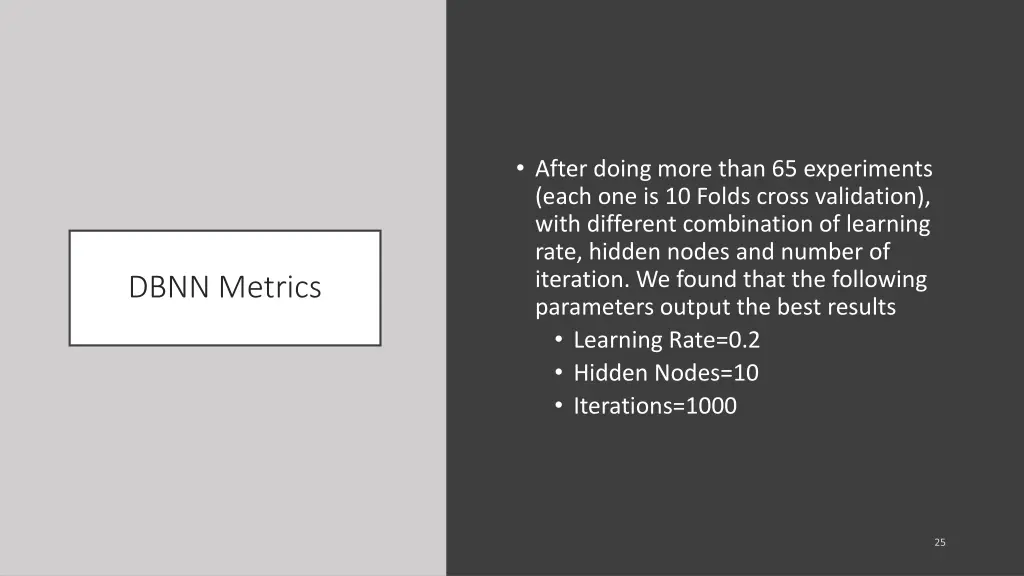
After doing more than 65 experiments (each one is 10 Folds cross validation), with different combination of learning rate, hidden nodes and number of iteration. We found that the following parameters output the best results Learning Rate=0.2 Hidden Nodes=10 Iterations=1000 DBNN Metrics
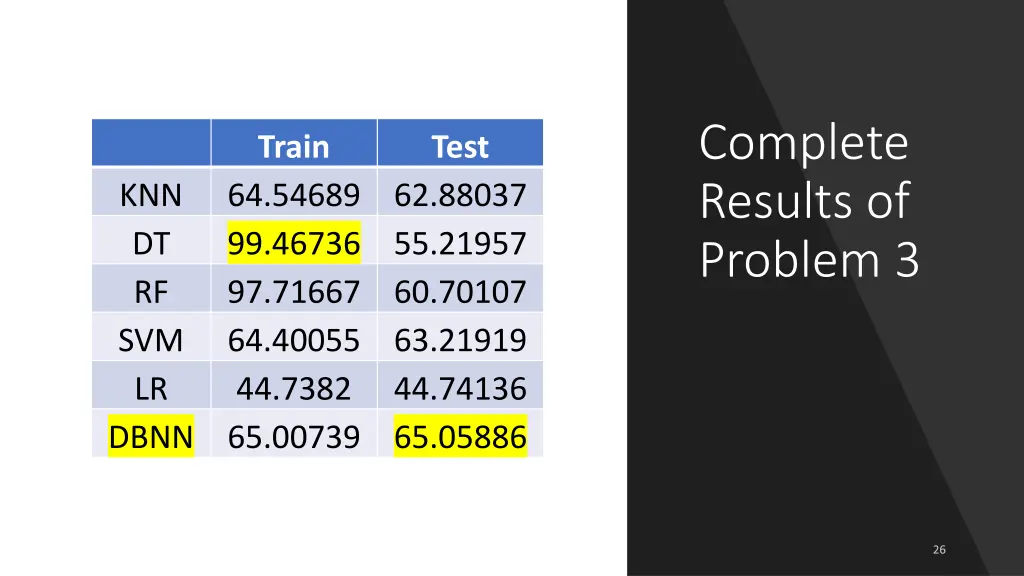
Complete Results of Problem 3 Train 64.54689 99.46736 97.71667 64.40055 44.7382 65.00739 Test KNN DT RF SVM LR DBNN 62.88037 55.21957 60.70107 63.21919 44.74136 65.05886
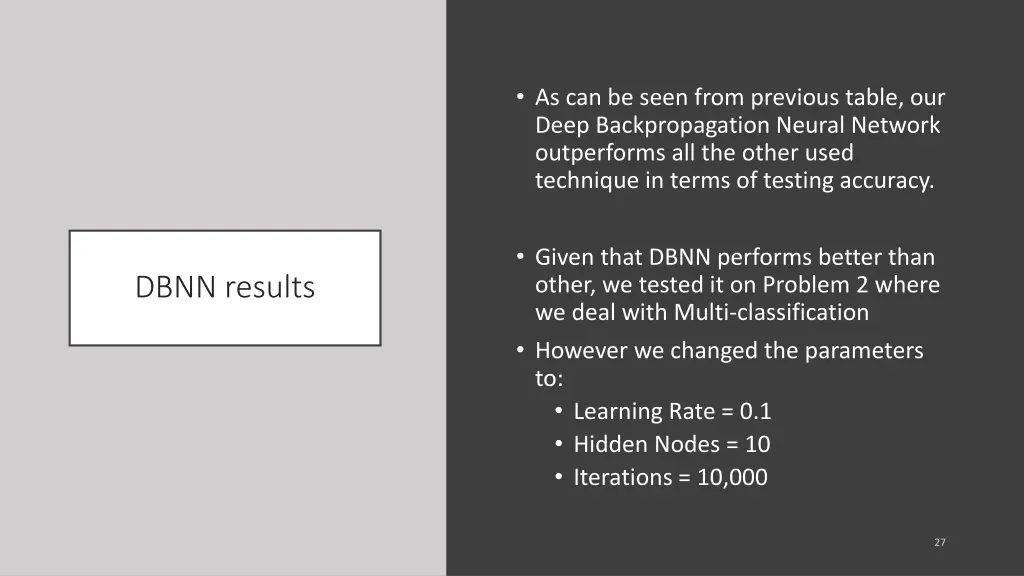
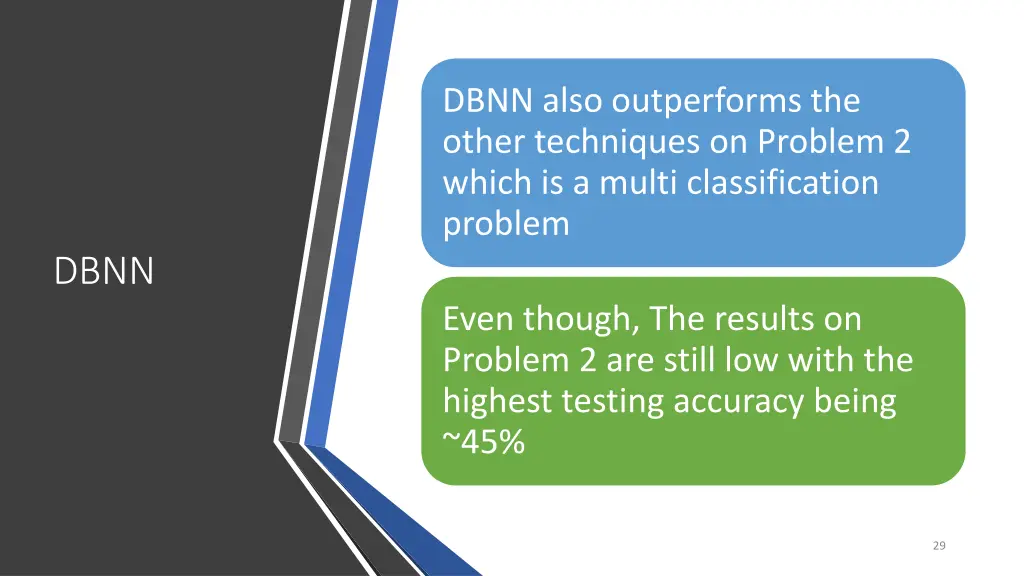
As can be seen from previous table, our Deep Backpropagation Neural Network outperforms all the other used technique in terms of testing accuracy. Given that DBNN performs better than other, we tested it on Problem 2 where we deal with Multi-classification However we changed the parameters to: Learning Rate = 0.1 Hidden Nodes = 10 Iterations = 10,000 DBNN results
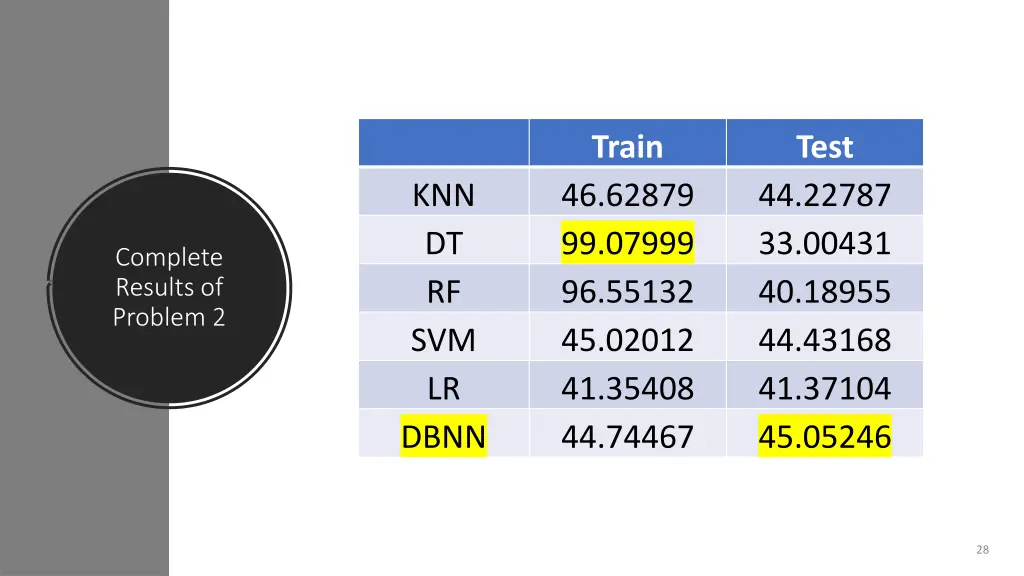
Train 46.62879 99.07999 96.55132 45.02012 41.35408 44.74467 Test KNN DT RF SVM LR DBNN 44.22787 33.00431 40.18955 44.43168 41.37104 45.05246 Complete Results of Problem 2 28
DBNN also outperforms the other techniques on Problem 2 which is a multi classification problem DBNN Even though, The results on Problem 2 are still low with the highest testing accuracy being ~45% 29
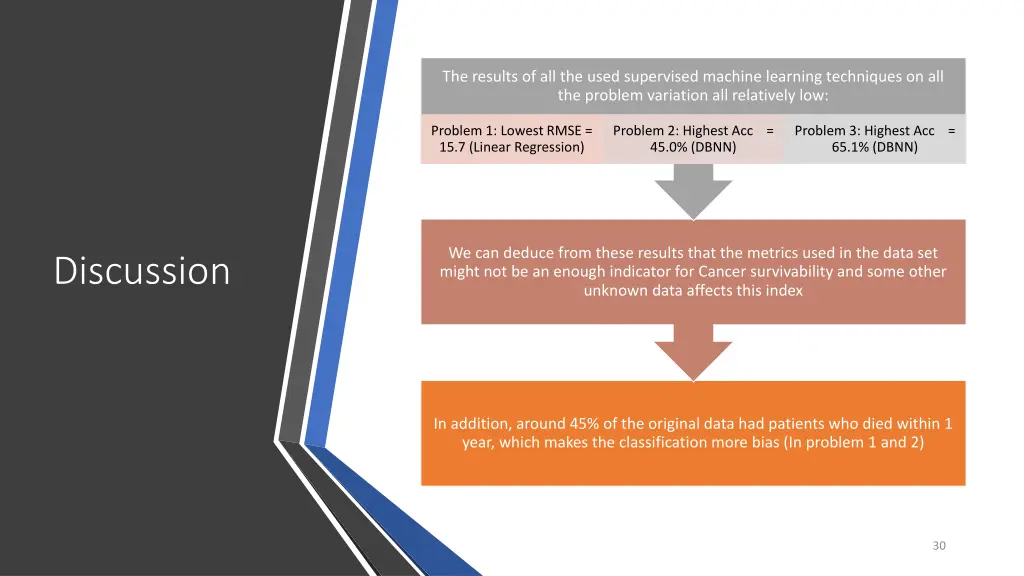
The results of all the used supervised machine learning techniques on all the problem variation all relatively low: Problem 1: Lowest RMSE = 15.7 (Linear Regression) Problem 2: Highest Acc = 45.0% (DBNN) Problem 3: Highest Acc = 65.1% (DBNN) We can deduce from these results that the metrics used in the data set might not be an enough indicator for Cancer survivability and some other unknown data affects this index Discussion In addition, around 45% of the original data had patients who died within 1 year, which makes the classification more bias (In problem 1 and 2) 30
Lung Cancer leads to death more than other type of cancers Knowing the patient survivability is an important task We used different machine learning techniques on different variation of the problem : Regression, Multi- Classification and Binary Classification Conclusion Results show that the data used might no be an enough indicator for the patient survivability time Nevertheless, Deep Backpropagation Neural Network outperformed all the other techniques on the classification version of the problem 31
Thank You 32
Lynch, C. M., Abdollahi, B., Fuqua, J. D., Alexandra, R., Bartholomai, J. A., Balgemann, R. N., ... Frieboes, H. B. (2017). Prediction of lung cancer patient survival via supervised machine learning classification techniques. International Journal of Medical Informatics, 108, 1 8. Mashwani, W Reference Thomas M. Mitchell. 1997. Machine Learning (1 ed.). McGraw-Hill, Inc., New York, NY, USA. https://scikit-learn.org/stable/