Explore the constraints on macroeconomic policy, focusing on the role of monetary policy by the Federal Reserve and challenges in financing government budgets. Dive into international fiscal comparisons and the dynamics of government consumption, tax revenues, and fiscal institutions in the U.S.
Please find below an Image/Link to download the presentation.
The content on the website is provided AS IS for your information and personal use only. It may not be sold, licensed, or shared on other websites without obtaining consent from the author. If you encounter any issues during the download, it is possible that the publisher has removed the file from their server.
You are allowed to download the files provided on this website for personal or commercial use, subject to the condition that they are used lawfully. All files are the property of their respective owners.
The content on the website is provided AS IS for your information and personal use only. It may not be sold, licensed, or shared on other websites without obtaining consent from the author.
E N D
Presentation Transcript
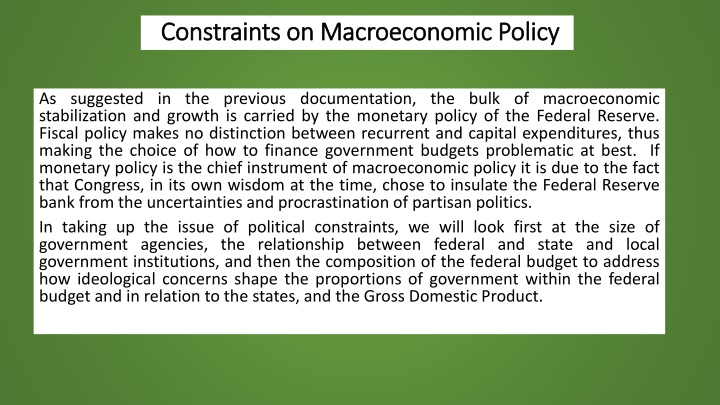
Constraints on Macroeconomic Policy Constraints on Macroeconomic Policy As suggested in the previous documentation, the bulk of macroeconomic stabilization and growth is carried by the monetary policy of the Federal Reserve. Fiscal policy makes no distinction between recurrent and capital expenditures, thus making the choice of how to finance government budgets problematic at best. If monetary policy is the chief instrument of macroeconomic policy it is due to the fact that Congress, in its own wisdom at the time, chose to insulate the Federal Reserve bank from the uncertainties and procrastination of partisan politics. In taking up the issue of political constraints, we will look first at the size of government agencies, the relationship between federal and state and local government institutions, and then the composition of the federal budget to address how ideological concerns shape the proportions of government within the federal budget and in relation to the states, and the Gross Domestic Product.
Making Sense of Fiscal Policy Making Sense of Fiscal Policy Tracking the size of government is done through taking stock of overall government taxation, spending, and debt creation. It is clear that government, the federal government in particular, is playing a much larger role in the U.S. economy than during the early decades of the 20thcentury. Much of the expansion has taken place in response to the Great Depression of the 1930 s, and the Second World War. The United States government now supports a panoply of services that make up a mixed-government welfare state. In comparison to peer nation-states, the United States operates with a less comprehensive welfare state. It still does not have universal health care, yet provides a range of services in old age and survivors insurance, veterans benefits, disability insurance, and a range of other services. The federal budget calendar extends from October 1 to September 30 of the following year. This deadline has not always been met, nor has there been a principled classification of recurrent from capital expenditures, thus creating uncertainty as to what would constitute capital expenditures that could be justified through a budget deficit.
Constraints on Fiscal Policy Except for a refusal by Congress to approve an increase in the debt ceiling, federal spending is largely subject to political decisions. And the legislative process of establishing a decision regarding a budget authorization and a budget appropriation can be time consuming. What brings about a degree of consensus is the perception by enough legislators that some action is required, namely, in regarding major economic indicators such as the basic and augmented misery index. Legislators also tend to rely on decision discount rates that are as valid only until the next election, while some of the spending priorities involve multi- year consequences and obligations. The decision to fund NASA is a classic example. Congress had to commit to annual appropriations consistent with the decade-long goal of putting someone on the moon. Moreover, funding decisions that affected NASA were folded into larger appropriation legislation, thus creating a considerable degree of uncertainty. A perception that the U.S. was in a space race with the Soviet Union may have had as much of an incentive to make annual appropriations as any other consideration. All of this is compounded by partisan political divisions. To bring fiscal policy more in tandem weight with monetary policy requires reform measures that have yet to be voted upon.