Malawi Seismic Network Report
Located on the East African Rift System, Malawi's seismic network aims to determine earthquake locations, conduct seismic hazards research, map faults, study the Earth's interior, disseminate earthquake information, and raise public awareness. Operational since 1962, the network utilizes advanced equipment and real-time monitoring to provide crucial data for seismic activity in the region.

Download Presentation

Please find below an Image/Link to download the presentation.
The content on the website is provided AS IS for your information and personal use only. It may not be sold, licensed, or shared on other websites without obtaining consent from the author.If you encounter any issues during the download, it is possible that the publisher has removed the file from their server.
You are allowed to download the files provided on this website for personal or commercial use, subject to the condition that they are used lawfully. All files are the property of their respective owners.
The content on the website is provided AS IS for your information and personal use only. It may not be sold, licensed, or shared on other websites without obtaining consent from the author.
E N D
Presentation Transcript
REPORT ON MALAWI SEISMIC NETWORK Chindandali P., Lunda J., Mphepo F. Geological Survey Department of Malawi Managing Data from Seismic Networks August 20-26, 2017, Pretoria, South Africa
CONTENTS Introduction Objectives Seismic Network Real-Time Monitoring Data Availability Seismicity Collaborations Summary/Conclusion
INTRODUCTION Malawi is located on the western branch East African Rift System EARS (Figure 1). It is a seismically active belt mostly characterized by shallow earthquakes of the Malawi Figure 1: The East African Rift System
OBJECTIVES Determination of earthquake locations Seismic hazards research & monitoring Mapping of suspected faults Research on the interior of the earth Dissemination of earthquake information to general public Advising Government and civil society on matters relating to earthquakes Public awareness
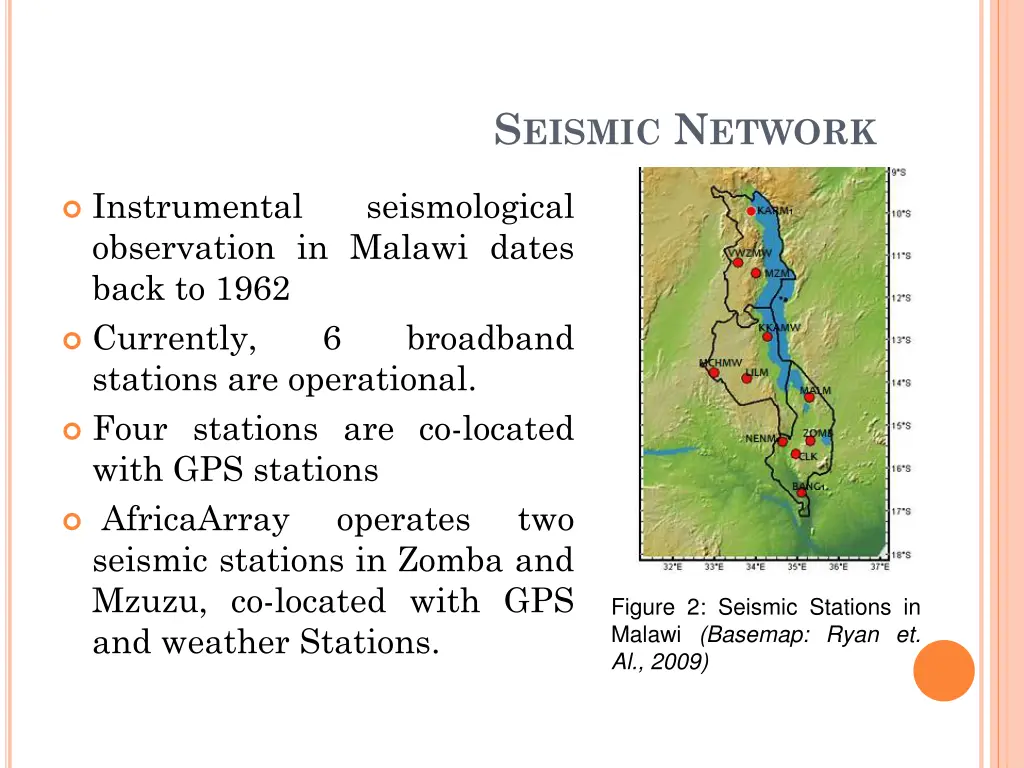
SEISMIC NETWORK Instrumental observation in Malawi dates back to 1962 Currently, 6 stations are operational. Four stations are co-located with GPS stations AfricaArray seismic stations in Zomba and Mzuzu, co-located with GPS and weather Stations. seismological broadband operates two Figure 2: Seismic Stations in Malawi (Basemap: Ryan et. Al., 2009)
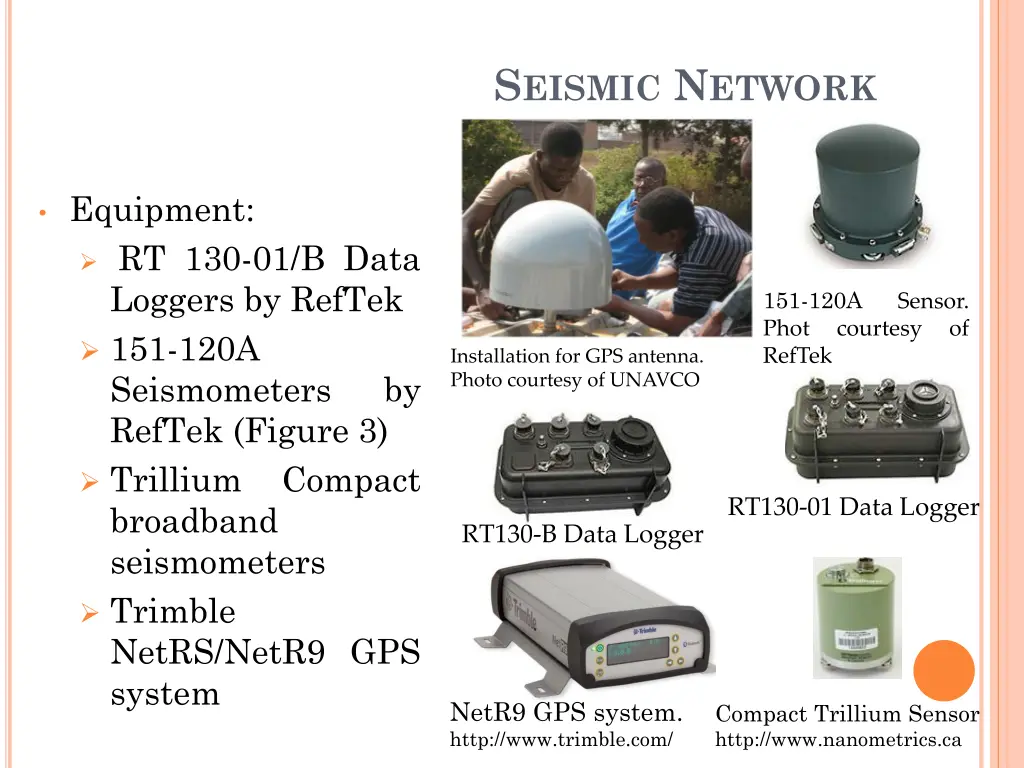
SEISMIC NETWORK Equipment: RT 130-01/B Data Loggers by RefTek 151-120A Seismometers RefTek (Figure 3) Trillium Compact broadband seismometers Trimble NetRS/NetR9 GPS system 151-120A Phot RefTek Sensor. courtesy of Installation for GPS antenna. Photo courtesy of UNAVCO by RT130-01 Data Logger RT130-B Data Logger NetR9 GPS system. http://www.trimble.com/ Compact Trillium Sensor http://www.nanometrics.ca
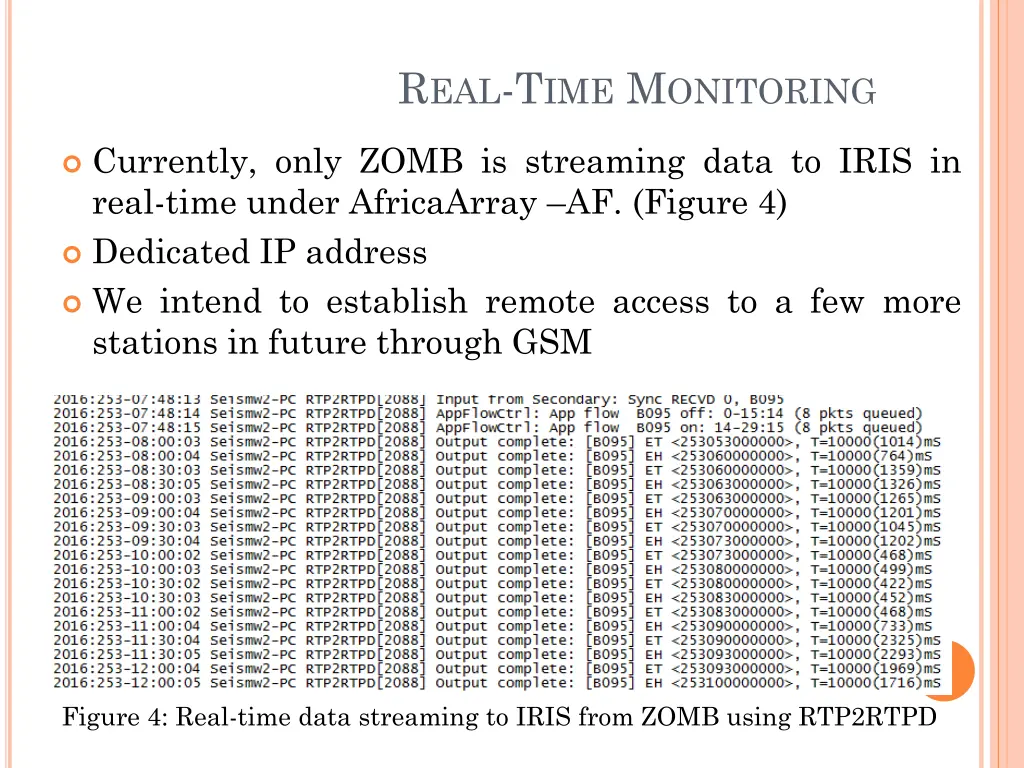
REAL-TIME MONITORING Currently, only ZOMB is streaming data to IRIS in real-time under AfricaArray AF. (Figure 4) Dedicated IP address We intend to establish remote access to a few more stations in future through GSM Figure 4: Real-time data streaming to IRIS from ZOMB using RTP2RTPD
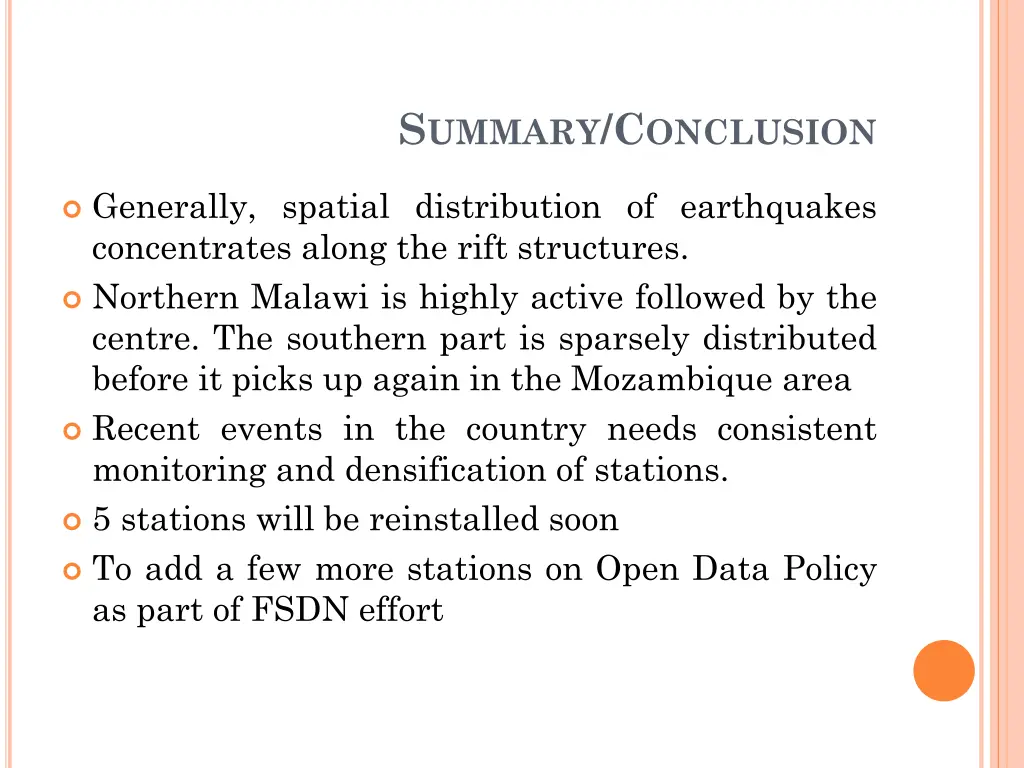
SEISMICITY Small-to-moderate earthquakes occur both from within the country and from neighbouring countries Spatial distribution northern Malawi active followed by the centre whereas the south is sparsely distributed Seismicity picks further south of the country into Mozambique (Figure 5). shows highly as up again Figure 5: Seismicity of Malawi
COLLABORATIONS Geological Survey Department of Malawi Malawi Polytechnic- University of Malawi Mzuzu University Chancellor College- University of Malawi Malawi University of Science and Technology Malawi Institute of Engineers Catholic University CTBTO IRIS Goetz Observatory, Bulawayo ESARSWG Lamont-Doherty Institute,Columbia University, USA etc.
SUMMARY/CONCLUSION Generally, spatial distribution of earthquakes concentrates along the rift structures. Northern Malawi is highly active followed by the centre. The southern part is sparsely distributed before it picks up again in the Mozambique area Recent events in the country needs consistent monitoring and densification of stations. 5 stations will be reinstalled soon To add a few more stations on Open Data Policy as part of FSDN effort