Explore how malware like Mebroot uses complex obfuscation techniques to evade detection, and learn about strategies to defeat them. Discover the state machine-like obfuscation used by Mebroot and the classic Spaghetti code obfuscation employed by threats like Conficker/Downadup and Hydraq.
Please find below an Image/Link to download the presentation.
The content on the website is provided AS IS for your information and personal use only. It may not be sold, licensed, or shared on other websites without obtaining consent from the author. If you encounter any issues during the download, it is possible that the publisher has removed the file from their server.
You are allowed to download the files provided on this website for personal or commercial use, subject to the condition that they are used lawfully. All files are the property of their respective owners.
The content on the website is provided AS IS for your information and personal use only. It may not be sold, licensed, or shared on other websites without obtaining consent from the author.
Mebroot Details Trojan horse, appeared in the mid-2008 Other name: Sinowal Installs a kernel-mode driver in the last sectors of the hard drive Infects the MBR, hooks the Windows boot chain: interrupt hook, ntldr hook, sector fetching, payload driver load Super stealthy: no visible file on disk, no infected file, no registry modification Low level hooks in kernel mode to bypass traffic sniffing on an infected host Goal: download DLLs from the Internet, inject them into specific processes
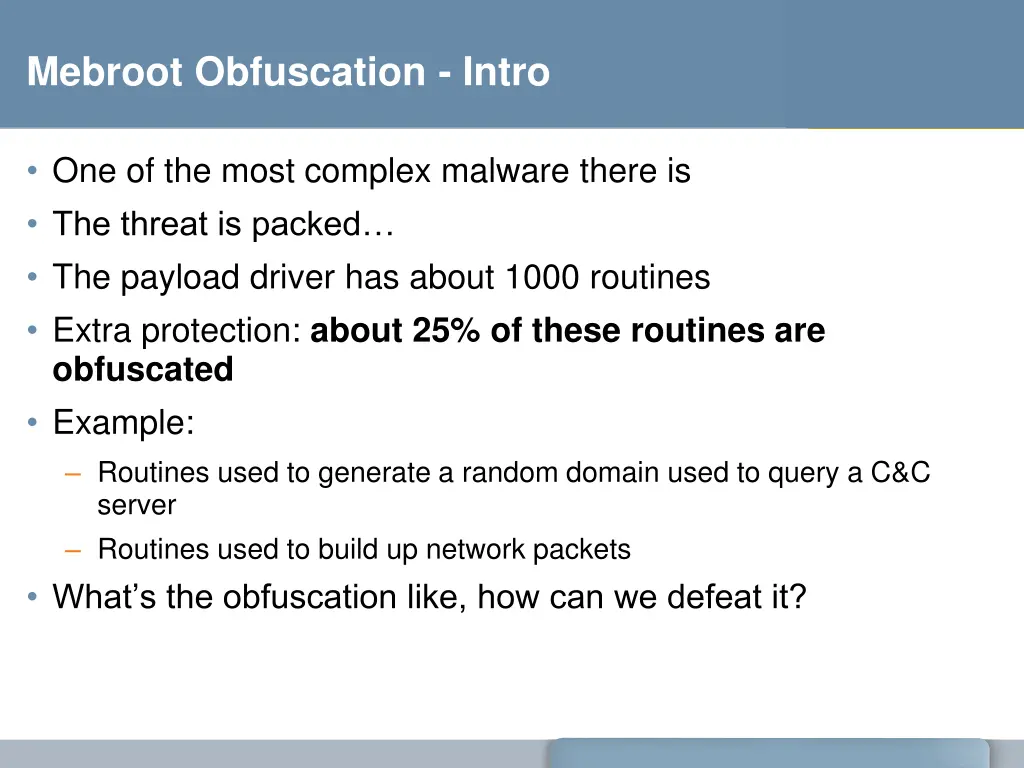
Mebroot Obfuscation - Intro One of the most complex malware there is The threat is packed The payload driver has about 1000 routines Extra protection: about 25% of these routines are obfuscated Example: Routines used to generate a random domain used to query a C&C server Routines used to build up network packets What s the obfuscation like, how can we defeat it?
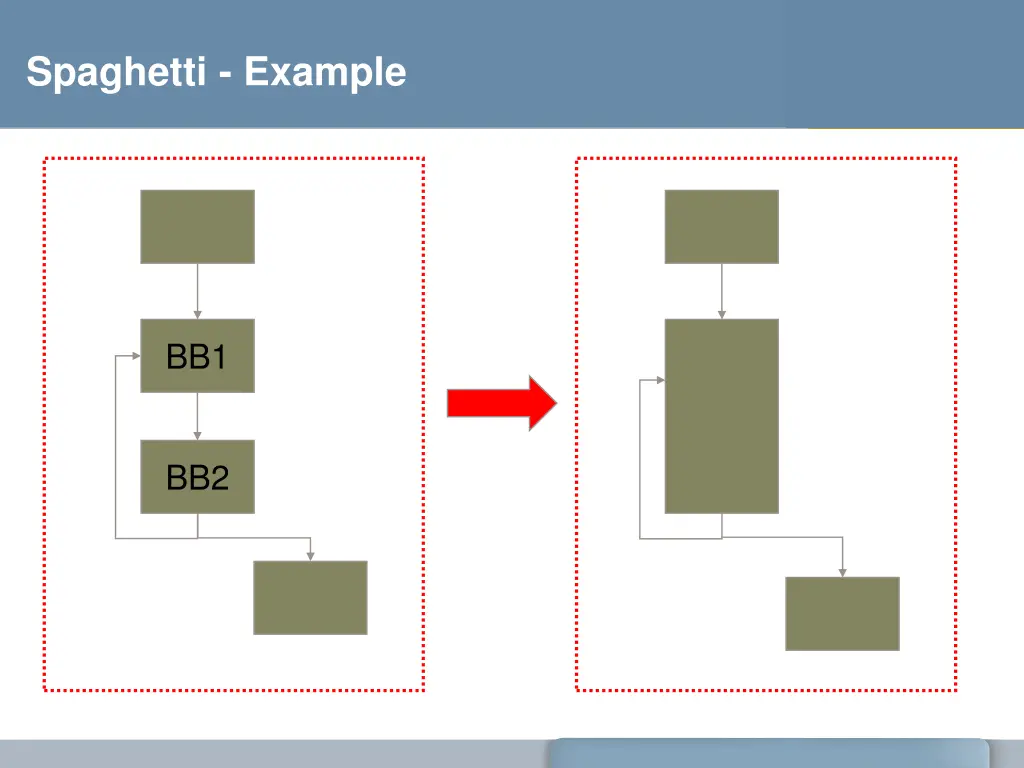
Obfuscation 101 - Spaghetti Classic obfuscation used by threats make use of Spaghetti code Conficker/Downadup, Hydraq, Characteristics: JMP insertion inside function Basic Blocks (BB) Blocks may be scattered in the file Assembly reading is tricky Decompiler can handle this easily (e.g., Hexrays) This type of obfuscation does not require extra code (ie, extra logic) Because it s unconditional branches insertion Easy to reverse: Let BB1 and BB2 be two basic blocks IF BB1 unconditionally branches to BB2 AND references_to(BB2) == {B1}, THEN merge(BB1, BB2)
Mebroot Obfuscation - What Mebroot uses a state machine-like obfuscation technique: Sets up a state variable to hold a state value After execution of a BB, the state is modified A dispatcher is called, that will determine what BB execute next based on the updated state value Consequences: The flow of the original function is modified State machine instructions overhead (+ junk) Assembly unreadable, decompiled code even more unreadable
Alloc() obfuscated, Hexrays NTSTATUS __stdcall alloc(PVOID *pdata, SIZE_T size, POOL_TYPE pooltype, ULONG tag) { int x1; // ebx@1 signed int x2; // ebp@1 int eax0; // eax@1 signed int Status; // ecx@2 int x5; // edx@8 signed int x4; // ebp@13 int x3; // edx@16 PVOID p; // eax@19 signed int state; // [sp+18h] [bp-14h]@1 state = 68; x1 = eax0; x2 = eax0; label0: x4 = 85; if ( pdata == 0 | size == 0 ) x4 = 40; state = x4; Status = STATUS_INVALID_PARAMETER; x2 = 65; } if ( state == 32 ) { memset(p, 0, size); return 0; } if ( state != 40 ) { if ( state == 51 ) { p = ExAllocatePoolWithTag(pooltype, size, tag); *pdata = p; x5 = 101 - x1; if ( !p ) x5 = 109 - x1; state = x5; continue; } goto label0; } return Status; } } while ( 2 ) { Status = STATUS_INSUFFICIENT_RESOURCES; while ( 1 ) { while ( state > 84 ) { if ( state != 85 ) goto label0; x1 = x2 + 4; x3 = ((x2 + 4) ^ 0x76) - 11; if ( !*pdata ) x3 = (x2 + 4) ^ 0x76; state = x3; Status = STATUS_ADDRESS_ALREADY_ASSOCIATED; } if ( state <= 67 ) break;
Solution 1 Code Injection Function prototype analysis How do we call the function, what parameters? Kernel code injection We call the obfuscated routine, get the result Works well if we know what the routine does (blackbox point of view) Ex: generate_domain (complex, highly obfuscated) But the prologue can be derived easily signed int __stdcall generate_domain_random_method0( PCHAR buffer, unsigned int buffersize, unsigned __int16 seed2, PTIME_FIELDS t) { if(!( buffer > *minaddress && buffersize && t > *minaddress )) return 0; return generate_domain(t->Year, t->Month, t->Day, buffer, buffersize, 91u, seed2); }
Solution 2 Reverse the obfuscation How is the state machine/dispatcher implemented .text:00011BB0 push ebp .text:00011BB1 push ebx .text:00011BB2 push edi .text:00011BB3 push esi .text:00011BB4 sub esp, 1Ch .text:00011BB7 mov [esp+2Ch+state], 44h .text:00011BBF mov esi, [esp+2Ch+arg_4] .text:00011BC3 mov edi, [esp+2Ch+arg_0] .text:00011BC7 mov ebx, eax .text:00011BC9 mov ebp, eax .text:00011BD0 mov edx, [esp+2Ch+var_14] ... ... .text:00011BD0 mov edx, [esp+2Ch+state] .text:00011BD4 cmp edx, 54h .text:00011BD7 jg loc_A .text:00011BD9 cmp edx, 43h .text:00011BDC jg loc_B .text:00011BDE cmp edx, 20h .text:00011BE1 jz loc_C .text:00011BE7 cmp edx, 28h .text:00011BEA jz loc_D .text:00011BF0 cmp edx, 33h .text:00011BF3 jnz loc_E ... ... Initial State Junk Read State Dispatcher
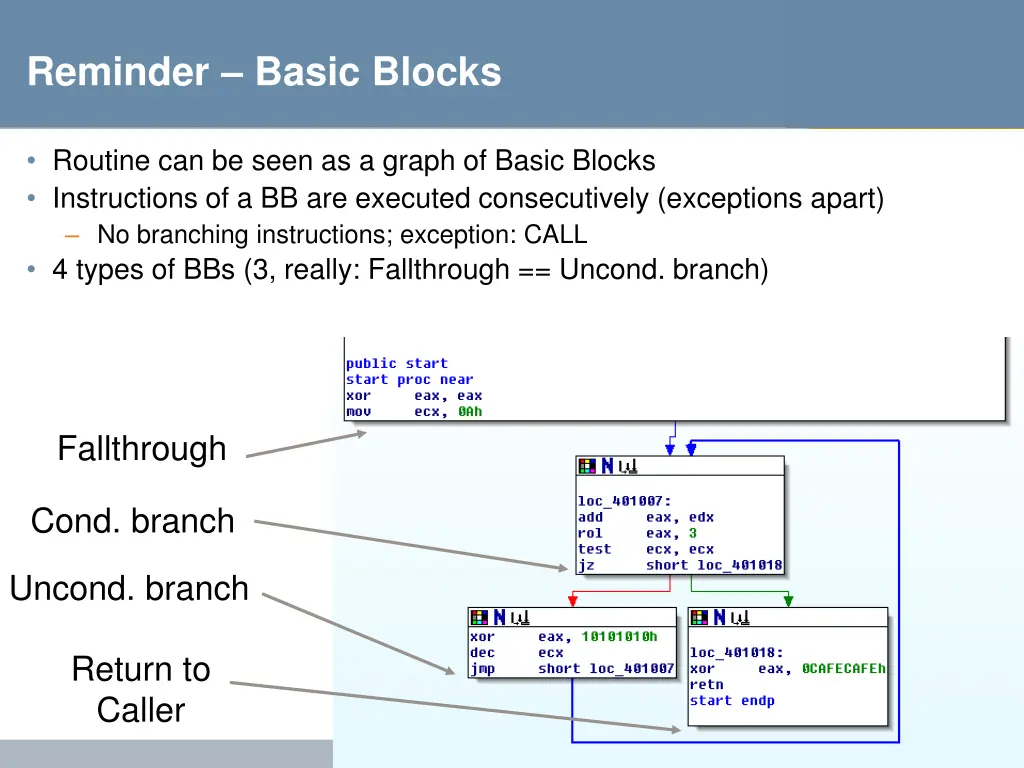
Reminder Basic Blocks Routine can be seen as a graph of Basic Blocks Instructions of a BB are executed consecutively (exceptions apart) No branching instructions; exception: CALL 4 types of BBs (3, really: Fallthrough == Uncond. branch) Fallthrough Cond. branch Uncond. branch Return to Caller
Obfuscated BB type #1 Simple basic block of type RET: ... State_XXX: .text:00011CA2 add esp, 1Ch .text:00011CA5 pop esi .text:00011CA6 pop edi .text:00011CA7 pop ebx .text:00011CA8 pop ebp .text:00011CA9 retn 10h Difficulty: None returns to Caller No state update The simplest kind of transformed block
Obfuscated BB type #2 Simple basic block of type JMP or Fallthrough: ... State_YYY: .dump:81728CC0 mov esi, ecx .dump:81728CC2 and esi, 41h .dump:81728CC5 mov edx, 42h .dump:81728CCA sub edx, esi .dump:81728CCC mov edi, MT_table[eax*4] .dump:81728CD3 mov [esp+14h+state], edx .dump:81728CD6 mov esi, edi .dump:81728CD8 shr esi, 1Eh .dump:81728CDB mov ebx, eax .dump:81728CDD inc ebx .dump:81728CDE jmp dispatch Next state calculated using arith. ops. Updates state Difficulty: Medium Need to figure out what the next value of state is The intermediate instructions (between state update and jmp dispatch) can be of any kind
Obfuscated BB type #3 Simple basic block of type JCC (cond. jump): ... State_ZZZ: .text:00011C65 mov ebx, ebp .text:00011C67 add ebx, 4 .text:00011C6A mov ecx, ebx .text:00011C6C xor ecx, 76h .text:00011C6F mov edx, ecx .text:00011C71 add edx, 0FFFFFFF5h .text:00011C74 cmp dword ptr [edi], 0 .text:00011C77 cmovz edx, ecx .text:00011C7A mov [esp+2Ch+state], edx .text:00011C7E mov ecx, 0C0000238h .text:00011C83 jmp dispatch Next states calculation Mebroot characteristic: Uses cmovcc to set the next state value Updates state Difficulty: High Two potential state values They should be calculable independently of program-state values (globals, input parameters, etc.) The intermediary instructions (between state update and jmp dispatch) CANNOT modify the flags!
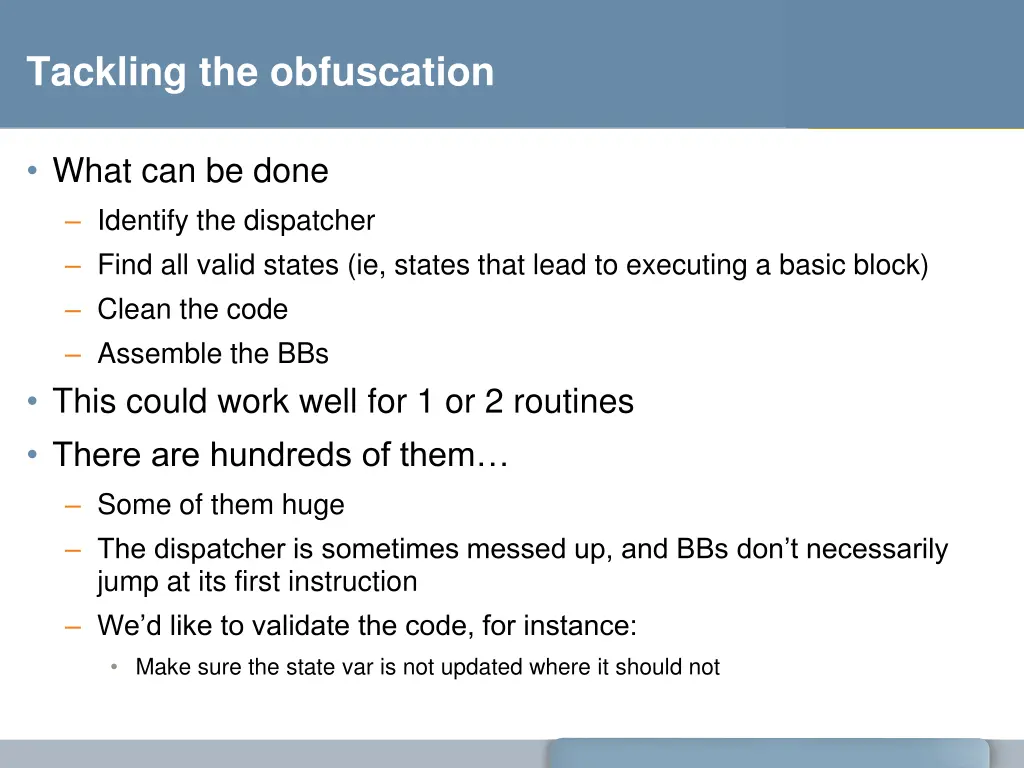
Tackling the obfuscation What can be done Identify the dispatcher Find all valid states (ie, states that lead to executing a basic block) Clean the code Assemble the BBs This could work well for 1 or 2 routines There are hundreds of them Some of them huge The dispatcher is sometimes messed up, and BBs don t necessarily jump at its first instruction We d like to validate the code, for instance: Make sure the state var is not updated where it should not
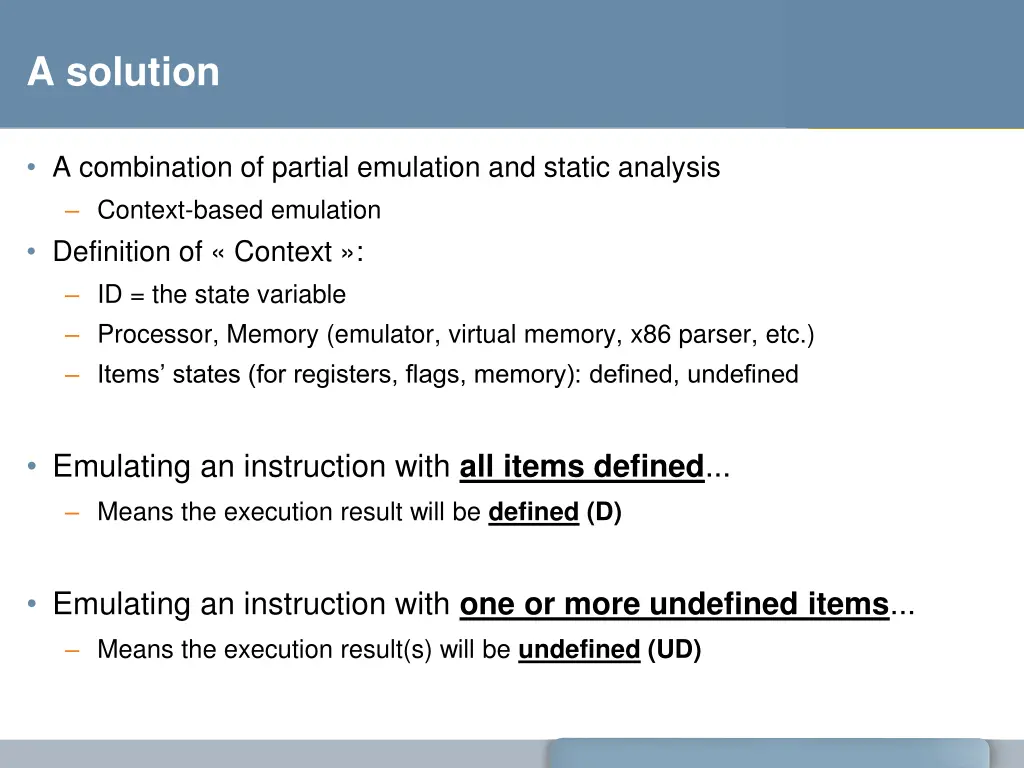
A solution A combination of partial emulation and static analysis Context-based emulation Definition of Context : ID = the state variable Processor, Memory (emulator, virtual memory, x86 parser, etc.) Items states (for registers, flags, memory): defined, undefined Emulating an instruction with all items defined... Means the execution result will be defined (D) Emulating an instruction with one or more undefined items... Means the execution result(s) will be undefined (UD)
Context-based emulation mov X, Y Y must be defined X need not be defined add X, Y X must be defined Y must be defined push X X must be defined ESP must be defined
Context-based emulation (continued) The operands (X, Y, etc) can be (simplified): Immediate Registers Memory Conditions of operand is defined : Immediate: ALWAYS Registers: MAYBE defined, can be partially defined (ex: AL of EAX) Memory (size ptr [base + scale*index + disp]) BASE and INDEX registers defined Memory item pointed to defined
Context-based emulation example Context (ID=123): Registers: all undefined, except esp(20000h), ecx(30000h) Flags: all undefined Memory: all undefined, except dword@30000h mov eax, 12 : eax UD -> eax D add eax, ebx : eax D, ebx UD -> eax UD push ecx : esp D, ecx D -> esp D, dw@20000 D pop edx : esp D, edx UD -> esp D, edx D xor dword [edx], eax : edx D, dw@edx D, eax UD! -> dw@edx UD jz $+1234 : target D, zeroflag UD -> ip UD emulation stops
Mebroot specificities When we reach state variable manipulation instructions, the instruction input items must be defined Except for the flags in the case of cmovcc When we reach a state variable update instruction (mov [esp+state], xxxx), the end of the original BB is getting closer: It could be a block of type #2 (JMP, Fallthrough) It could be a block of type #3 (JCC) -> ONLY if cmovcc stateX, state Y was encountered before If reach a RET, we should not have encountered a state variable update instruction before It is a block of type #1 (RET)
Contexts creation Start with an initial context New contexts are created: BB type #1: none BB type #2: one context BB type #3: two contexts The contexts are stacked up for analysis Emulation of context ends when the branch to dispatcher instruction is found
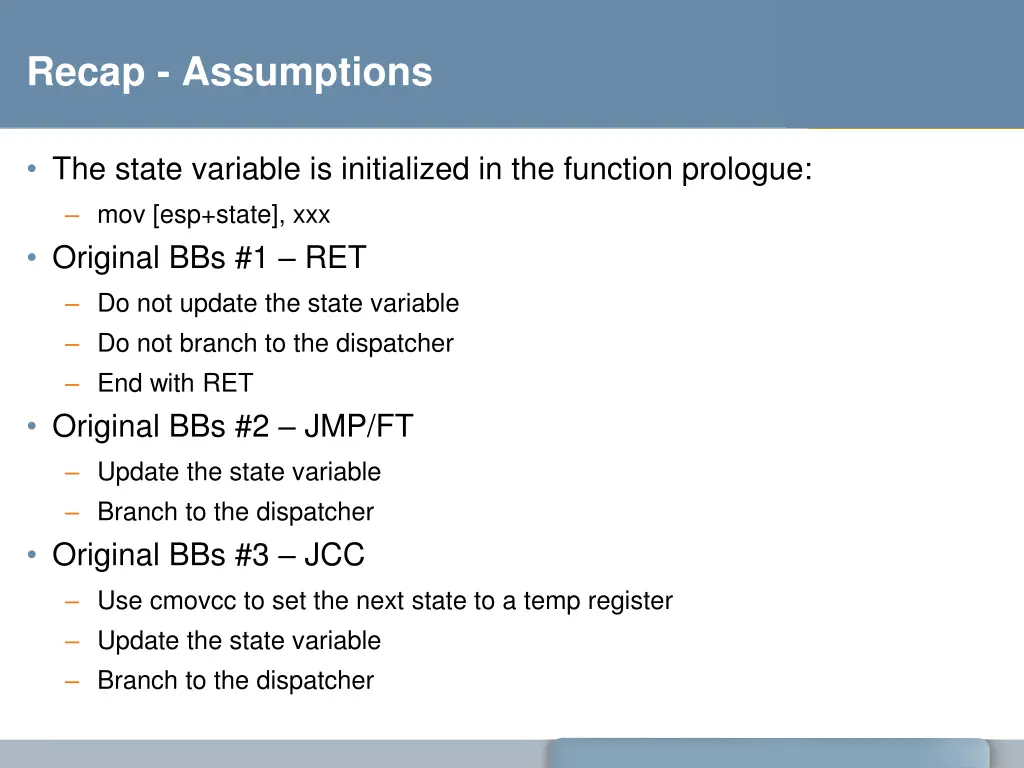
Recap - Assumptions The state variable is initialized in the function prologue: mov [esp+state], xxx Original BBs #1 RET Do not update the state variable Do not branch to the dispatcher End with RET Original BBs #2 JMP/FT Update the state variable Branch to the dispatcher Original BBs #3 JCC Use cmovcc to set the next state to a temp register Update the state variable Branch to the dispatcher
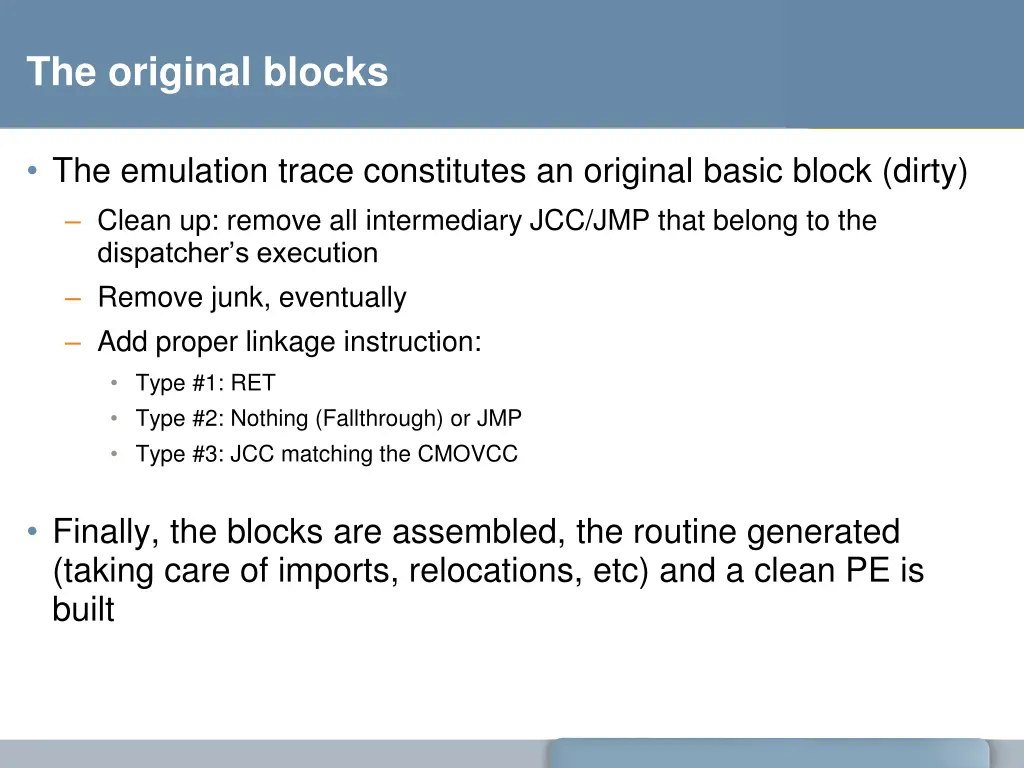
The original blocks The emulation trace constitutes an original basic block (dirty) Clean up: remove all intermediary JCC/JMP that belong to the dispatcher s execution Remove junk, eventually Add proper linkage instruction: Type #1: RET Type #2: Nothing (Fallthrough) or JMP Type #3: JCC matching the CMOVCC Finally, the blocks are assembled, the routine generated (taking care of imports, relocations, etc) and a clean PE is built
Processing a file Finding the obfuscated routines is easy: Pattern of routine prologue: push reg0 push reg1 ... sub esp, xxxxxxxx mov [esp],state0 The state variable location is derived The initial context can be set up: All memory items are undefined All GP registers are defined Flags are undefined
Example alloc() mov [edi], eax alloc proc near push ebp push ebx push edi push esi sub esp, 1Ch mov [esp+2Ch+state], 44h mov esi, [esp+2Ch+arg_4] mov edi, [esp+2Ch+arg_0] mov ebx, eax mov ebp, eax loc_11BCB: mov ecx, 0C000009Ah loc_11BD0: mov edx, [esp+2Ch+state] cmp edx, 54h jg short loc_11C32 cmp edx, 43h jg short loc_11C2D cmp edx, 20h jz loc_11C88 cmp edx, 28h jz loc_11CA0 cmp edx, 33h jnz short loc_11C37 mov eax, [esp+2Ch+arg_8] mov [esp+2Ch+var_2C], eax mov eax, [esp+2Ch+arg_C] mov [esp+2Ch+var_24], eax mov [esp+2Ch+var_28], esi mov eax, ds:ExAllocatePoolWithTag call eax sub esp, 0Ch mov ecx, 6Dh sub ecx, ebx mov edx, 65h sub edx, ebx test eax, eax cmovz edx, ecx mov [esp+2Ch+state], edx jmp short loc_11BCB loc_11C2D: cmp edx, 44h jmp short loc_11C37 loc_11C32: cmp edx, 55h jz short loc_11C65 loc_11C37: test edi, edi setz cl test esi, esi setz dl or dl, cl mov ecx, 28h mov ebp, 55h test dl, dl cmovnz ebp, ecx mov [esp+2Ch+state], ebp mov ecx, 0C000000Dh mov ebp, 41h jmp loc_11BD0 ....... retn 10h alloc endp
Example context #0 Emulation of the initial context: ... cmp edx, 44h jmp short loc_11C37 ... test edi, edi setz cl test esi, esi setz dl or dl, cl mov ecx, 28h mov ebp, 55h test dl, dl cmovnz ebp, ecx mov [esp+2Ch+state], ebp mov ecx, 0C000000Dh mov ebp, 41h jmp loc_11BD0 ... mov edx, [esp+2Ch+state] cmp edx, 54h jg short loc_11C32 push ebp push ebx push edi push esi sub esp, 1Ch mov [esp+2Ch+state], 44h mov esi, [esp+2Ch+arg_4] mov edi, [esp+2Ch+arg_0] mov ebx, eax mov ebp, eax ... mov ecx, 0C000009Ah ... mov edx, [esp+2Ch+state] cmp edx, 54h jg short loc_11C32 ... cmp edx, 43h jg short loc_11C2D ... (continued) Initial state Next states: NZ->28 Z->55 State update Dispatcher detected End of emu.
Example context #0 (continued) Clean up the emulation trace of context #0: Linkage Final block push ebp push ebx push edi push esi sub esp, 1Ch mov esi, [esp+2Ch+arg_4] mov edi, [esp+2Ch+arg_0] mov ecx, 0C000009Ah test edi, edi setz cl test esi, esi setz dl or dl, cl mov ecx, 28h mov ebp, 55h test dl, dl cmovnz ebp, ecx mov ecx, 0C000000Dh (link?) push ebp push ebx push edi push esi sub esp, 1Ch mov esi, [esp+2Ch+arg_4] mov edi, [esp+2Ch+arg_0] mov ecx, 0C000009Ah test edi, edi setz cl test esi, esi setz dl or dl, cl mov ecx, 28h mov ebp, 55h test dl, dl mov ecx, 0C000000Dh jnz block_55_else_28
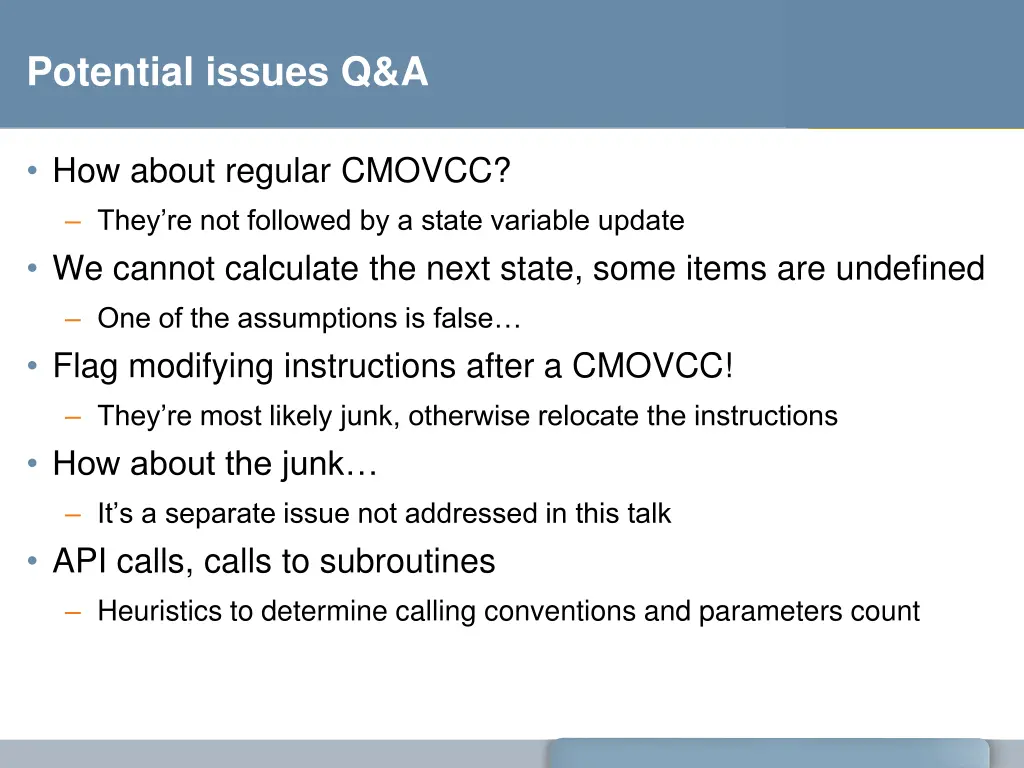
Potential issues Q&A How about regular CMOVCC? They re not followed by a state variable update We cannot calculate the next state, some items are undefined One of the assumptions is false Flag modifying instructions after a CMOVCC! They re most likely junk, otherwise relocate the instructions How about the junk It s a separate issue not addressed in this talk API calls, calls to subroutines Heuristics to determine calling conventions and parameters count
Conclusion Mebroot binary s obfuscation is unique It yields code that: Is spaghetized Contains extra instructions: the state machine overhead Is not decompilable Reversing it can be done with emulation and context validation The methodology has 2 key elements that are Mebroot- specific: The cmovcc stopper The state variable watcher
Questions? Thank you for attending! Contact: nicolas underscore falliere at symantec dot com Two interesting papers on Mebroot: Your computer is now stoned (...again!). The rise of MBR rootkits (Kimmo Kasslin, Elia Florio) Torpig/Mebroot RCE (Andreas Greulich)