Guidelines for diagnosing and managing acute HIV infection, emphasizing early detection, rapid ART initiation, and comprehensive care to reduce transmission, improve health outcomes, and adhere to New York State reporting requirements.
Please find below an Image/Link to download the presentation.
The content on the website is provided AS IS for your information and personal use only. It may not be sold, licensed, or shared on other websites without obtaining consent from the author. If you encounter any issues during the download, it is possible that the publisher has removed the file from their server.
You are allowed to download the files provided on this website for personal or commercial use, subject to the condition that they are used lawfully. All files are the property of their respective owners.
The content on the website is provided AS IS for your information and personal use only. It may not be sold, licensed, or shared on other websites without obtaining consent from the author.
E N D
Presentation Transcript
Diagnosis and Management of Acute HIV Infection www.hivguidelines.org DECEMBER 2024 NYSDOH AIDS Institute Clinical Guidelines Program
Purpose of This Guideline Purpose of This Guideline To ensure that NYS clinicians are able to: Recognize the risks of and signs and symptoms of acute HIV, include HIV infection in the differential diagnosis, and consider HIV testing in any person who presents with signs and symptoms suggestive of influenza ( flu ), mononucleosis ( mono ), or other viral syndromes, including suspected COVID-19. Perform appropriate diagnostic and confirmatory testing when HIV infection is suspected and manage the treatment of acute HIV. Meet the New York State requirements for reporting and partner notification. Recommend or offer immediate initiation of antiretroviral therapy (ART) to improve the patient s health and reduce the risk of HIV transmission; refer and confirm that patients can access optimal HIV care. Initiate or refer the patient for prevention services. DECEMBER 2024 NYSDOH AIDS Institute Clinical Guidelines Program www.hivguidelines.org
Terminology Terminology Acute HIV infection: Describes the period immediately after infection with HIV when an individual is viremic and has detectable p24 antigen or has HIV RNA without diagnostic HIV antibodies. In the medical literature, primary HIV infection may describe this same period. Recent infection: Generally used to describe the 6-month period after infection occurs. Early infection: May refer to acute or recent infection, after which infection is defined as chronic. DECEMBER 2024 NYSDOH AIDS Institute Clinical Guidelines Program www.hivguidelines.org
Key Points Key Points HIV is highly transmissible during acute infection; rapid initiation of ART reduces transmission, with significant public health benefits; and early viral suppression preserves immune function, with significant clinical benefits for the individual with HIV. Acute HIV often has nonspecific signs and symptoms and often goes unsuspected and undetected. This committee urges a high index of suspicion for acute infection and HIV testing for any individual who reports recent high-risk behavior or presents with signs or symptoms of influenza, mononucleosis, or other viral syndromes. When HIV infection is diagnosed, immediate linkage to care is essential; ART dramatically reduces HIV-related morbidity and mortality, and viral suppression prevents HIV transmission. The urgency of ART initiation is even greater if the newly diagnosed patient is pregnant, has acute HIV infection, is aged 50 years, or has advanced disease. For these patients, every effort should be made to initiate ART immediately, ideally on the same day as diagnosis. All clinical care settings should be prepared, either on-site or with a confirmed referral, to support patients in initiating ART as rapidly as possible after diagnosis. When a diagnosis of acute HIV infection is made, clinicians should discuss the importance of notifying all recent contacts and refer patients to partner notification services, as mandated by New York State law. The NYSDOH can provide assistance if necessary. DECEMBER 2024 NYSDOH AIDS Institute Clinical Guidelines Program www.hivguidelines.org
New York State Law New York State Law Clinicians must perform diagnostic HIV laboratory tests in full compliance with New York State HIV/AIDS laws and regulations. Clinicians must report confirmed cases of HIV according to New York State law. Additional information regarding testing procedures and regulations is available from the NYSDOH Wadsworth Center (518-474-2163). Consent: HIV testing is voluntary. Although written or oral informed consent to HIV testing is not required in New York State, patients must be given the opportunity to decline. Healthcare providers must advise patients that an HIV test will be performed by giving notice orally, in writing, with prominently displayed signage, or using electronic means or other appropriate forms of communication. If the patient declines, it must be noted in the medical record. See New York State Senate Bill S7809. DECEMBER 2024 NYSDOH AIDS Institute Clinical Guidelines Program www.hivguidelines.org
Recommendations: Recommendations: Presentation of Acute HIV Infection Presentation of Acute HIV Infection Clinicians should include acute HIV infection in the differential diagnosis for any patientwho presents with signs or symptoms of influenza ( flu ), mononucleosis ( mono ), or other viral syndromes and reports sexual or parenteral exposure to a person with or at risk of HIV infection within the past month. (A2) Clinicians should also include acute HIV infection in the differential diagnosis for any patient (regardless of reported risk) who presents with signs or symptoms of influenza ( flu ), mononucleosis ( mono ), or other viral syndromes (A3) and when the patient: Presents with a rash. (A2) Requests HIV testing. (A3) Presents with a newly diagnosed STI. (A2) Presents with aseptic meningitis. (A2) Is pregnant or breastfeeding. (A3) Is currently taking antiretroviral medications for PrEP or PEP. (A3) DECEMBER 2024 NYSDOH AIDS Institute Clinical Guidelines Program www.hivguidelines.org
HIV Test Window of Detection HIV Test Window of Detection [ [a,b,c a,b,c] ] Notes: a. Figure reproduced from CDC: Clinical Testing Guidance for HIV. b. Without PrEP or PEP exposure; PrEP or PEP exposure may delay seroconversion. Very early treatment of acute HIV infection may also alter the serologic response. c. The eclipse period is the time from the onset of HIV infection until the virus is detectable by virologic tests. DECEMBER 2024 NYSDOH AIDS Institute Clinical Guidelines Program www.hivguidelines.org
Acute Retroviral Syndrome Acute Retroviral Syndrome Signs and symptoms of ARS with the expected frequency among symptomatic patients are listed below. The most specific symptoms in this study were oral ulcers and weight loss; the best predictors were fever and rash. The index of suspicion should be high when these symptoms are present. Fever (80%) Tired or fatigued (78%) Malaise (68%) Arthralgias (joint pain) (54%) Headache (54%) Loss of appetite (54%) Rash (51%) Night sweats (51%) Myalgias (pain in muscles) (49%) Nausea (49%) Diarrhea (46%) Fever and rash (46%) Pharyngitis (sore throat) (44%) Lymphadenopathy (39%) Oral ulcers (mouth sores) (37%) Stiff neck (34%) Weight loss (>5 lb; 2.5 kg) (32%) Confusion (25%) Photophobia (24%) Vomiting (12%) Infected gums (10%) Sores on anus (5%) Sores on genitals (2%) DECEMBER 2024 NYSDOH AIDS Institute Clinical Guidelines Program www.hivguidelines.org
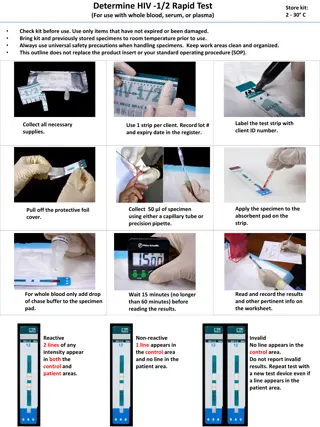
Recommendations: Recommendations: Testing for and Diagnosis of Acute HIV Infection Testing for and Diagnosis of Acute HIV Infection Clinicians should always perform a plasma HIV RNA assay in conjunction with an Ag/Ab combination immunoassay when acute HIV is suspected. (A2) Note: When point-of-care screening is performed, even with a rapid Ag/Ab combination immunoassay, a laboratory- based Ag/Ab combination immunoassay is recommended for follow-up diagnostic HIV testing. Clinicians can presume the diagnosis of acute HIV when HIV RNA levels 200 copies/mL are detected in plasma with sensitive NAT, and the result of the HIV screening or type- differentiation test is negative or indeterminate. (A2) When a low-level quantitative HIV RNA viral load result (<200 copies/mL) is obtained in the absence of serologic evidence of HIV infection, the clinician should repeat HIV RNA testing and perform an Ag/Ab combination immunoassay to exclude a false-positive result. (A2) Note: A serologic test result that does not meet the criteria for HIV infection is a nonreactive screening result (Ab or Ag/Ab combination) or a reactive screening result with a nonreactive or indeterminate Ab differentiation confirmatory result. Clinicians should seek expert consultation when an ambiguous HIV result is obtained for an individual taking PrEP or PEP because the diagnosis of acute HIV can be particularly challenging. (A3) DECEMBER 2024 NYSDOH AIDS Institute Clinical Guidelines Program www.hivguidelines.org
Key Points: Testing and Diagnosis Key Points: Testing and Diagnosis The diagnosis of acute HIV infection requires a high degree of clinical awareness. The nonspecific signs and symptoms of acute HIV infection are often not recognized or attributed to another viral illness. Individual laboratories have internal protocols for reporting HIV tests with preliminary results. The terms used when preliminary results cannot be classified include indeterminate, inconclusive, nondiagnostic, and pending validation. Clinicians can contact the appropriate laboratory authority to determine the significance of nondefinitive results and the recommended supplemental testing, particularly when acute HIV infection is suspected. Clinicians are advised to become familiar with the internal test-reporting policies of their institutions. DECEMBER 2024 NYSDOH AIDS Institute Clinical Guidelines Program www.hivguidelines.org
Diagnostic Testing for Acute HIV Infection Diagnostic Testing for Acute HIV Infection Notes: a. Viremia will be present several days prior to p24 antigen detection and several weeks before antibody detection. b.HIV RNA quantitative testing is preferred. c. The absence of serologic evidence of HIV infection is defined as nonreactive screening result (antibody or antibody/antigen combination) or a reactive screening result with a nonreactive or indeterminate antibody- differentiation confirmatory result. d.Serologic confirmation as defined by the CDC HIV testing algorithm. Western blot is no longer recommended as the confirmatory test because it may yield an indeterminate result during the early stages of seroconversion and may delay confirmation of diagnosis. e. No further testing is indicated. DECEMBER 2024 NYSDOH AIDS Institute Clinical Guidelines Program www.hivguidelines.org
Recommendations: Recommendations: ART Initiation and Partner Notification ART Initiation and Partner Notification If a diagnosis of acute infection is made based on HIV RNA testing, clinicians should recommend ART initiation without waiting for serologic confirmation. (A2) Clinicians should offer assistance with partner notification and refer patients to other sources for partner notification assistance. (A2) DECEMBER 2024 NYSDOH AIDS Institute Clinical Guidelines Program www.hivguidelines.org
Recommendations: Recommendations: Managing Acute HIV Infection Managing Acute HIV Infection Clinicians should recommend immediate ART initiation to all patients diagnosed with acute HIV infection. (A1) Clinicians should inform patients that the risk of transmitting HIV is increased during acute infection and the 6 months following infection and continues beyond 6 months (A2). As part of the initial management of patients diagnosed with acute HIV infection, clinicians should: Consult with a care provider experienced in the treatment of acute HIV infection. (A3) Obtain HIV genotypic resistance testing for the protease (A2), reverse transcriptase (A2), and integrase (B2) genes at the time of diagnosis. Patients taking PEP: When acute HIV infection is diagnosed in an individual receiving PEP, ART should be continued pending consultation with an experienced HIV care provider. (A3) Patients taking PrEP: Because the risk of drug-resistant mutations is higher in patients who acquire HIV while taking PrEP, clinicians should consult with an experienced HIV care provider and recommend a fully active ART regimen. (A3) Clinicians who do not have access to experienced HIV care providers should call the Clinical Education Initiative (CEI) Line at 866-637-2342. DECEMBER 2024 NYSDOH AIDS Institute Clinical Guidelines Program www.hivguidelines.org
Recommendations: Recommendations: Initiating ART Initiating ART When a patient agrees with the clinician s recommendation to initiate ART during acute HIV infection: The clinicians should implement treatment to suppress the patient s plasma HIV RNA to below detectable levels. (A1) Clinicians should perform baseline laboratory testing for all patients initiating ART immediately; ART can be started while awaiting laboratory test results. (A3) DECEMBER 2024 NYSDOH AIDS Institute Clinical Guidelines Program www.hivguidelines.org
Need Help? Need Help? NYSDOH AIDS Institute Clinical Guidelines Program www.hivguidelines.org
Access the Guideline Access the Guideline www.hivguidelines.org > Diagnosis and Management of Acute HIV Infection Also available: Printable pocket guide and PDF NYSDOH AIDS Institute Clinical Guidelines Program www.hivguidelines.org