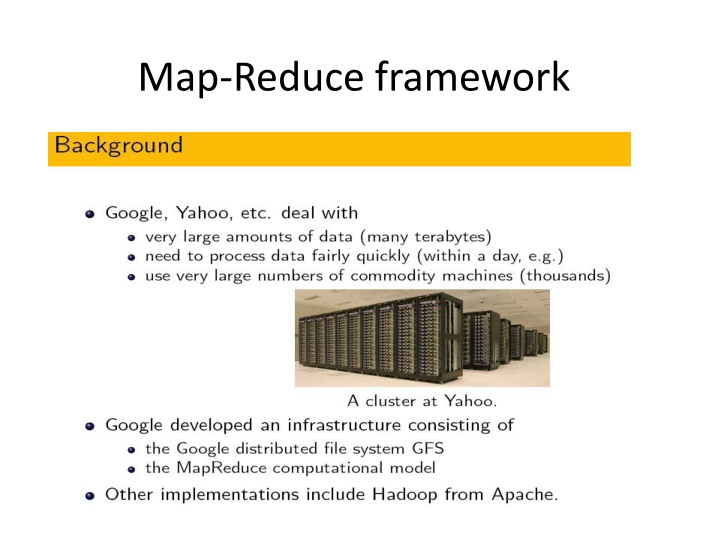
Learn how Map-Reduce framework processes large volumes of data in parallel by dividing tasks into independent units. Explore the concepts of mapping, reducing, and how Hadoop utilizes these principles for efficient information processing.
Please find below an Image/Link to download the presentation.
The content on the website is provided AS IS for your information and personal use only. It may not be sold, licensed, or shared on other websites without obtaining consent from the author. If you encounter any issues during the download, it is possible that the publisher has removed the file from their server.
You are allowed to download the files provided on this website for personal or commercial use, subject to the condition that they are used lawfully. All files are the property of their respective owners.
The content on the website is provided AS IS for your information and personal use only. It may not be sold, licensed, or shared on other websites without obtaining consent from the author.
Introduction Map-Reduce is a programming model designed for processing large volumes of data in parallel by dividing the work into a set of independent tasks. Map-Reduce programs are written in a particular style influenced by functional programmingconstructs, specifically idioms for processing lists of data. This module explains the nature of this programming model and how it can be used to write programs which run in the Hadoop environment.
Map-reduce Basics 1. List Processing Conceptually, Map-Reduce programs transform lists of input data elements into lists of output data elements. A Map-Reduce program will do this twice, using two different list processing idioms: map, and reduce. These terms are taken from several list processing languages such as LISP, Scheme, or ML
Map-reduce Basics 2.Mapping Lists The first phase of a Map-Reduce program is called mapping. A list of data elements are provided, one at a time, to a function called the Mapper, which transforms each element individually to an output data element.
Map-reduce Basics 3.Reducing List Reducing lets you aggregate values together. A reducer function receives an iterator of input values from an input list. It then combines these values together, returning a single output value.
Map-reduce Basics 4.Putting Them Together in Map-Reduce: The Hadoop Map-Reduce framework takes these concepts and uses them to process large volumes of information. A Map-Reduce program has two components: Mapper And reducer. The Mapper and Reducer idioms described above are extended slightly to work in this environment, but the basic principles are the same.
Example (word count) mapper (filename, file-contents): for each word in file-contents: emit (word, 1) reducer (word, values): sum = 0 for each value in values: sum = sum + value emit (word, sum)
Map-Reduce Data Flow Now that we have seen the components that make up a basic MapReduce job, we can see how everything works together at a higher level:
Data flow Map-Reduce inputs typically come from input files loaded onto our processing cluster in HDFS. These files are distributed across all our nodes. Running a Map-Reduce program involves running mapping tasks on many or all of the nodes in our cluster. Each of these mapping tasks is equivalent: no mappers have particular "identities" associated with them. Therefore, any mappercan process any input file. Each mapper loads the set of files local to that machine and processes them.
Data flow When the mapping phase has completed, the intermediate (key, value) pairs must be exchanged between machines to send all values with the same key to a single reducer. The reduce tasks are spread across the same nodes in the cluster as the mappers. This is the only communication step in MapReduce. Individual map tasks do not exchange information with one another, nor are they aware of one another's existence. Similarly, different reduce tasks do not communicate with one another.
Data flow The user never explicitly marshals information from one machine to another; all data transfer is handled by the HadoopMap-Reduce platform itself, guided implicitly by the different keys associated with values. This is a fundamental element of HadoopMap-Reduce'sreliability. If nodes in the cluster fail, tasks must be able to be restarted. If they have been performing side-effects, e.g., communicating with the outside world, then the shared state must be restored in a restarted task. By eliminating communication and side-effects, restarts can be handled more gracefully.
Input files This is where the data for a Map-Reduce task is initially stored. While this does not need to be the case, the input files typically reside in HDFS. The format of these files is arbitrary; while line-based log files can be used, we could also use a binary format, multi-line input records, or something else entirely. It is typical for these input files to be very large -- tens of gigabytes or more.
InputFormat These input files are split up and read is defined by the InputFormat. An InputFormatis a class that provides the following functionality: Selects the files or other objects that should be used for input Defines the InputSplitsthat break a file into tasks Provides a factory for RecordReaderobjects that read the file Several InputFormatsare provided with Hadoop. An abstract type is called FileInputFormat; all InputFormatsthat operate on files inherit functionality and properties from this class. When starting a Hadoop job, FileInputFormat is provided with a path containing files to read. The FileInputFormatwill read all files in this directory. It then divides these files into one or more InputSplitseach. You can choose which InputFormatto apply to your input files for a job by calling the setInputFormat() method of the JobConf object that defines the job.
The default InputFormat is the TextInputFormat. This is useful for unformatted data or line-based records like log files. A more interesting input format is the KeyValueInputFormat. This format also treats each line of input as a separate record. While the TextInputFormat treats the entire line as the value, the KeyValueInputFormat breaks the line itself into the key and value by searching for a tab character. This is particularly useful for reading the output of one MapReducejob as the input to another Finally, the SequenceFileInputFormat reads special binary files that are specific to Hadoop. These files include many features designed to allow data to be rapidly read into Hadoop mappers. Sequence files are block-compressed and provide direct serialization and deserializationof several arbitrary data types (not just text). Sequence files can be generated as the output of other MapReducetasks and are an efficient intermediate representation for data that is passing from one MapReducejob to anther.
InputSplits An InputSplit describes a unit of work that comprises a single map task in a MapReduce program. A MapReduce program applied to a data set, collectively referred to as a Job, is made up of several (possibly several hundred) tasks. Map tasks may involve reading a whole file; they often involve reading only part of a file. By default, the FileInputFormat and its descendants break a file up into 64 MB chunks (the same size as blocks in HDFS).
RecordReader The InputSplit has defined a slice of work, but does not describe how to access it. The RecordReaderclass actually loads the data from its source and converts it into (key, value) pairs suitable for reading by the Mapper. The RecordReader instance is defined by the InputFormat. The default InputFormat, TextInputFormat, provides a LineRecordReader, which treats each line of the input file as a new value. The key associated with each line is its byte offset in the file. The RecordReader is invoke repeatedly on the input until the entire InputSplithas been consumed. Each invocation of the RecordReader leads to another call to the map() method of the Mapper.
Mapper The Mapperperforms the interesting user-defined work of the first phase of the MapReduceprogram. Given a key and a value, the map() method emits (key, value) pair(s) which are forwarded to the Reducers. A new instance of Mapperis instantiated in a separate Java process for each map task (InputSplit) that makes up part of the total job input. The individual mappersare intentionally not provided with a mechanism to communicate with one another in any way. This allows the reliability of each map task to be governed solely by the reliability of the local machine. The map() method receives two parameters in addition to the key and the value:
Mapper The OutputCollectorobject has a method named collect() which will forward a (key, value) pair to the reduce phase of the job. The Reporterobject provides information about the current task; its getInputSplit() method will return an object describing the current InputSplit. It also allows the map task to provide additional information about its progress to the rest of the system. The setStatus() method allows you to emit a status message back to the user. The incrCounter() method allows you to increment shared performance counters. Each mappercan increment the counters, and the JobTrackerwill collect the increments made by the different processes and aggregate them for later retrieval when the job ends.
1.Partition & Shuffle (Mapper) After the first maptasks have completed, the nodes may still be performing several more map tasks each. But they also begin exchangingthe intermediate outputs from the maptasks to where they are required by the reducers. This process of moving mapoutputs to the reducers is known as shuffling. A different subset of the intermediate key space is assigned to each reduce node; these subsets (known as "partitions") are the inputs to the reduce tasks. Each map task may emit (key, value) pairs to any partition; all values for the same key are always reduced together regardless of which mapperis its origin. Therefore, the map nodes must all agree on where to send the different pieces of the intermediate data. The Partitioner class determines which partition a given (key, value) pair will go to. The default partitionercomputes a hash value for the key and assigns the partition based on this result.
2. Sort (Mapper) Each reduce task is responsible for reducing the values associated with several intermediate keys. The set of intermediate keys on a single node is automatically sorted by Hadoop before they are presented to the Reducer.
Reduce A Reducer instance is created for each reduce task. This is an instance of user-provided code that performs the second important phase of job-specific work. For each keyin the partition assigned to a Reducer, the Reducer's reduce() method is called once. This receives a key as well as an iterator over all the values associated with the key. The values associated with a key are returned by the iterator in an undefined order. The Reducer also receives as parameters OutputCollector and Reporterobjects; they are used in the same manner as in the map() method.
1. OutputFormat (Reducer) The (key, value) pairs provided to this OutputCollector are then written to output files. The way they are written is governed by the OutputFormat. The OutputFormat functions much like the InputFormat class. The instances of OutputFormat provided by Hadoop write to files on the local disk or in HDFS; they all inherit from a common FileOutputFormat.
2. RecordWriter (Reducer) Much like how the InputFormatactually reads individual records through the RecordReader implementation, the OutputFormatclass is a factory for RecordWriterobjects; these are used to write the individual records to the files as directed by the OutputFormat.
3. Combiner (Reducer) The pipeline showed earlier omits a processing step which can be used for optimizing bandwidth usage by MapReducejob. Called the Combiner,this pass runs after the Mapperand before the Reducer. Usage of the Combiner is optional. If this pass is suitable for your job, instances of the Combinerclass are run on every node that has run map tasks. The Combinerwill receive as input all data emitted by the Mapper instances on a given node. The output from the Combineris then sent to the Reducers, instead of the output from the Mappers. The Combiner is a "mini-reduce" process which operates only on data generated by one machine.
More Tips about map-reduce Chaining Jobs Not every problem can be solved with a MapReduce program, but fewer still are those which can be solved with a single MapReduce job. Many problems can be solved with MapReduce, by writing several MapReduce steps which run in series to accomplish a goal: E.g Map1 -> Reduce1 -> Map2 -> Reduce2 -> Map3
Listing and Killing Jobs: It is possible to submit jobs to a Hadoopcluster which malfunction and send themselves into infinite loops or other problematic states. In this case, you will want to manually kill the job you have started. The following command, run in the Hadoopinstallation directory on a Hadoopcluster, will list all the current jobs: $ bin/hadoopjob -list currently running JobId 1 1218506470390 StartTime aaron UserNamejob_200808111901_0001 $ bin/hadoopjob -kill jobid
Conclusions This module described the MapReduce heart of the Hadoop system. By using MapReduce of parallelism can be achieved by applications. The MapReduce MapReduceframework provides a high degree of fault tolerance for applications running on it by limiting the communication which can occur between nodes, and requiring applications to be written in a "dataflow MapReduceexecution platform at the MapReduce, a high degree dataflow- -centric centric" manner.