Marriage Equality for People with Disabilities: A Virtual Briefing on Personal Stories and Pending Legislation
Supplemental Security Income (SSI) and Disabled Adult Child (DAC) benefits play crucial roles for individuals with disabilities. Issues such as the DAC Marriage Penalty and reduced benefits for married SSI beneficiaries are highlighted in this virtual briefing.

Download Presentation

Please find below an Image/Link to download the presentation.
The content on the website is provided AS IS for your information and personal use only. It may not be sold, licensed, or shared on other websites without obtaining consent from the author.If you encounter any issues during the download, it is possible that the publisher has removed the file from their server.
You are allowed to download the files provided on this website for personal or commercial use, subject to the condition that they are used lawfully. All files are the property of their respective owners.
The content on the website is provided AS IS for your information and personal use only. It may not be sold, licensed, or shared on other websites without obtaining consent from the author.
E N D
Presentation Transcript
Marriage Equality for People with Disabilities: A Virtual Briefing on Personal Stories and Pending Legislation
Who are we talking about and what is at stake? Who are we talking about and what is at stake? Supplemental Security Income Supplemental Security Income (SSI) is a Social Security Administration (SSA) program for disabled people, blind people, and older adults who have little to no income and assets. Recipients younger than 65 must have a qualifying disability. SSI provides a modest monthly stipend and in most states SSI recipients receive Medicaid. As of December 2023, there are approximately 7.4 million SSI recipients, most of whom have a qualifying disability. Disabled Adult Child The Disabled Adult Child (DAC) benefit is a Title II SSA disability benefit that provides a monthly stipend, access to Medicare, and a pathway to Medicaid. DAC is a secondary benefit based on the work record of a parent who is deceased, disabled, or retired. A person receiving DAC must be a dependent adult child aged 18 or older with a qualifying disability that began before age 22. Although DAC is technically a kind of Child s Insurance Benefit, everyone who receives DAC is an adult. As of December 2023, there are 1.1 million people receiving DAC benefits. Qualifying Disability A qualifying disability is a disability that the federal government determines prevents someone from maintaining substantial gainful employment. A person may be able to do some work, but the disability seriously limits their ability to maintain paid employment. SSA applies strict rules and standards for determining whether a person has a qualifying disability.
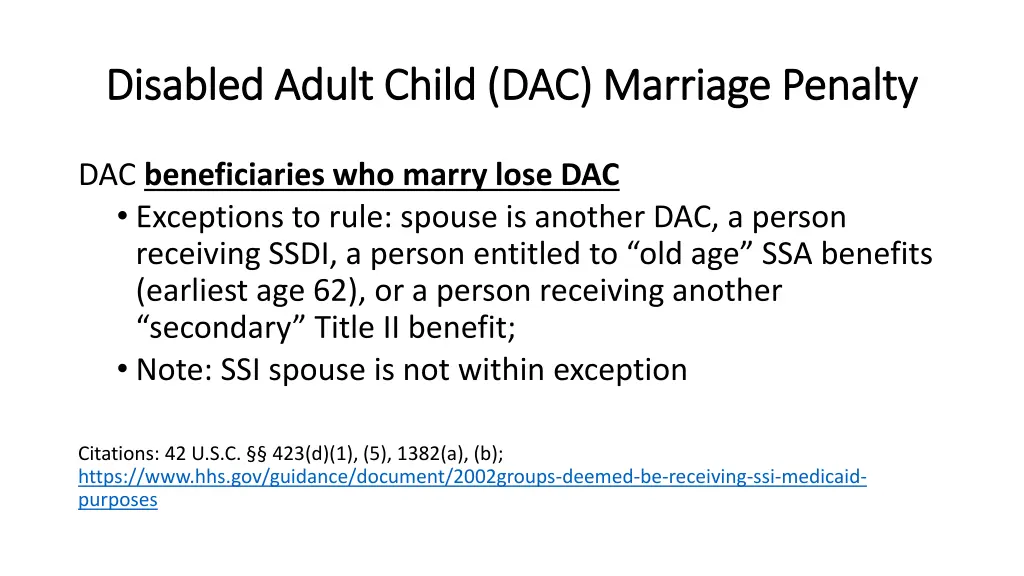
Disabled Adult Child (DAC) Marriage Penalty Disabled Adult Child (DAC) Marriage Penalty DAC beneficiaries who marry lose DAC Exceptions to rule: spouse is another DAC, a person receiving SSDI, a person entitled to old age SSA benefits (earliest age 62), or a person receiving another secondary Title II benefit; Note: SSI spouse is not within exception Citations: 42 U.S.C. 423(d)(1), (5), 1382(a), (b); https://www.hhs.gov/guidance/document/2002groups-deemed-be-receiving-ssi-medicaid- purposes
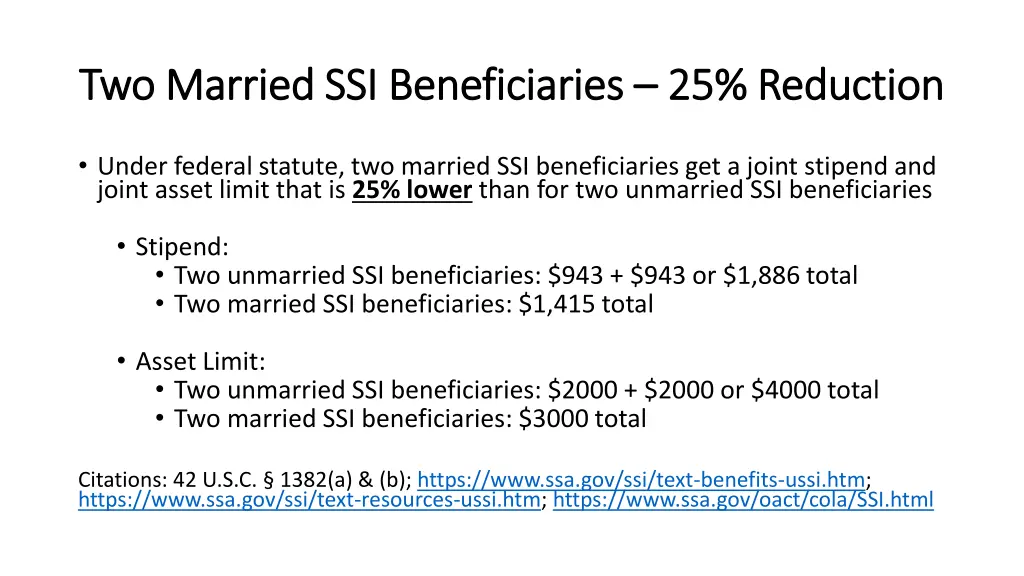
Two Married SSI Beneficiaries Two Married SSI Beneficiaries 25% Reduction 25% Reduction Under federal statute, two married SSI beneficiaries get a joint stipend and joint asset limit that is 25% lower than for two unmarried SSI beneficiaries Stipend: Two unmarried SSI beneficiaries: $943 + $943 or $1,886 total Two married SSI beneficiaries: $1,415 total Asset Limit: Two unmarried SSI beneficiaries: $2000 + $2000 or $4000 total Two married SSI beneficiaries: $3000 total Citations: 42 U.S.C. 1382(a) & (b); https://www.ssa.gov/ssi/text-benefits-ussi.htm; https://www.ssa.gov/ssi/text-resources-ussi.htm; https://www.ssa.gov/oact/cola/SSI.html
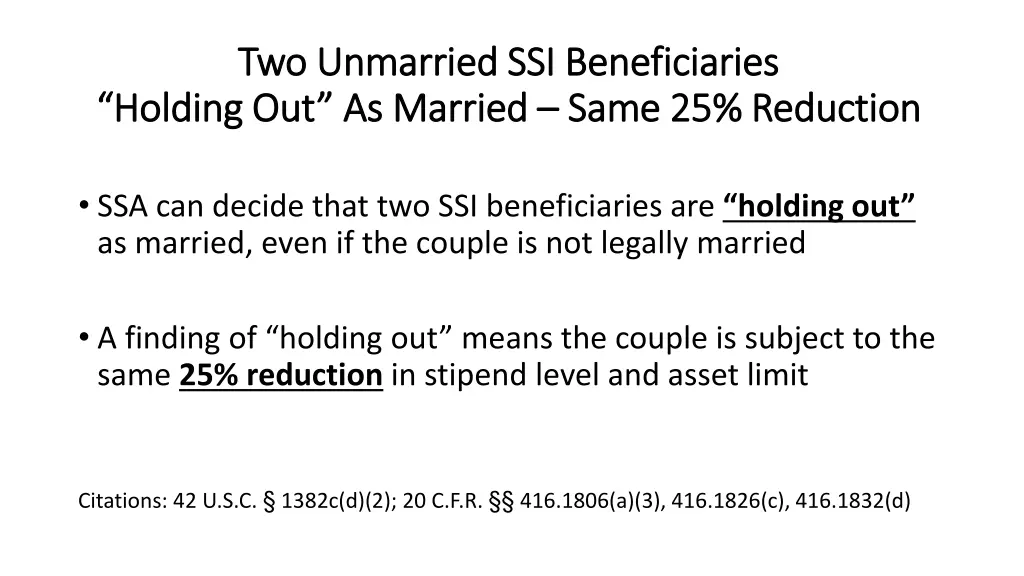
Two Unmarried SSI Beneficiaries Two Unmarried SSI Beneficiaries Holding Out As Married Holding Out As Married Same 25% Reduction Same 25% Reduction SSA can decide that two SSI beneficiaries are holding out as married, even if the couple is not legally married A finding of holding out means the couple is subject to the same 25% reduction in stipend level and asset limit Citations: 42 U.S.C. 1382c(d)(2); 20 C.F.R. 416.1806(a)(3), 416.1826(c), 416.1832(d)
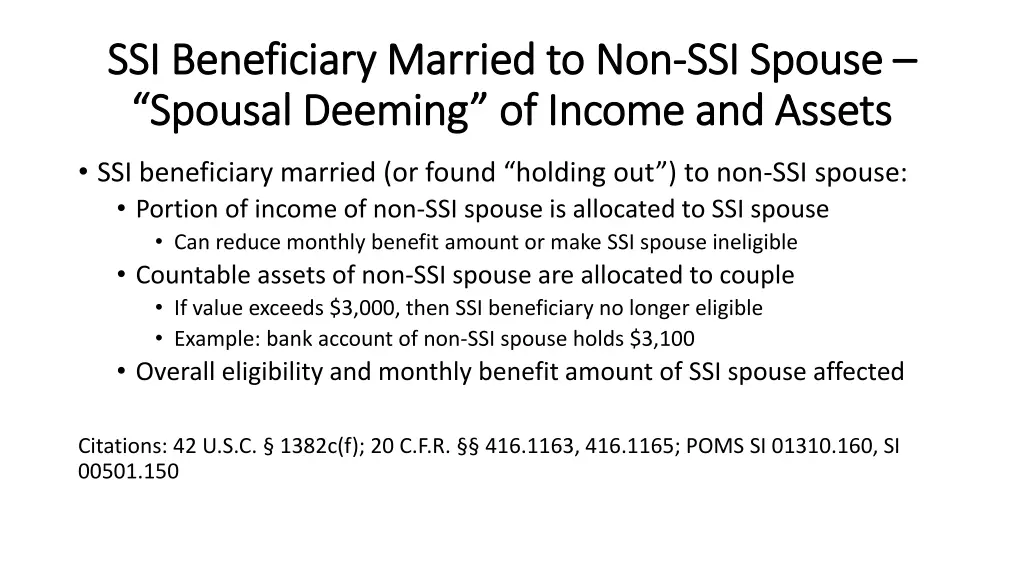
SSI Beneficiary Married to Non SSI Beneficiary Married to Non- -SSI Spouse Spousal Deeming of Income and Assets Spousal Deeming of Income and Assets SSI Spouse SSI beneficiary married (or found holding out ) to non-SSI spouse: Portion of income of non-SSI spouse is allocated to SSI spouse Can reduce monthly benefit amount or make SSI spouse ineligible Countable assets of non-SSI spouse are allocated to couple If value exceeds $3,000, then SSI beneficiary no longer eligible Example: bank account of non-SSI spouse holds $3,100 Overall eligibility and monthly benefit amount of SSI spouse affected Citations: 42 U.S.C. 1382c(f); 20 C.F.R. 416.1163, 416.1165; POMS SI 01310.160, SI 00501.150
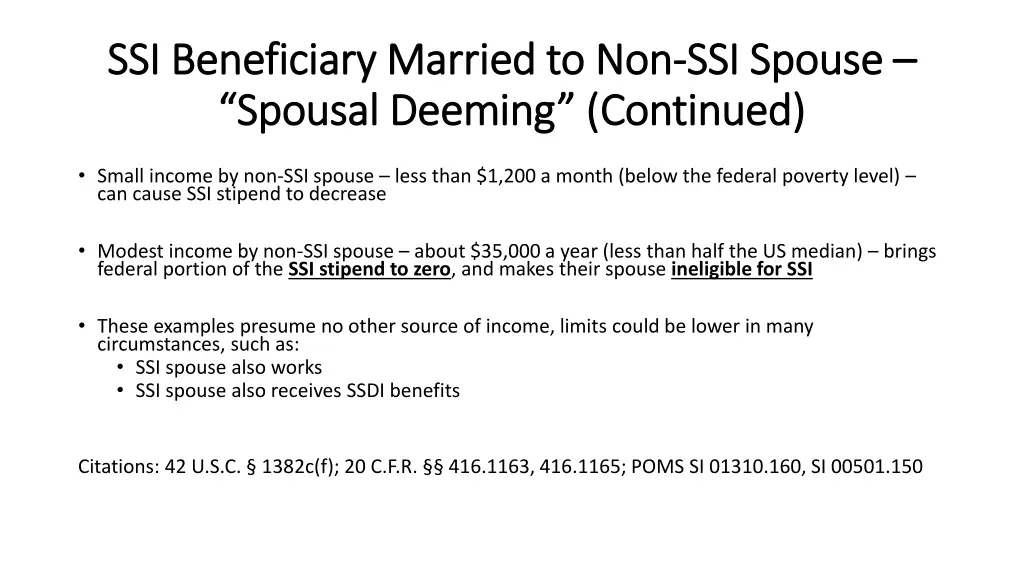
SSI Beneficiary Married to Non SSI Beneficiary Married to Non- -SSI Spouse Spousal Deeming (Continued) Spousal Deeming (Continued) SSI Spouse Small income by non-SSI spouse less than $1,200 a month (below the federal poverty level) can cause SSI stipend to decrease Modest income by non-SSI spouse about $35,000 a year (less than half the US median) brings federal portion of the SSI stipend to zero, and makes their spouse ineligible for SSI These examples presume no other source of income, limits could be lower in many circumstances, such as: SSI spouse also works SSI spouse also receives SSDI benefits Citations: 42 U.S.C. 1382c(f); 20 C.F.R. 416.1163, 416.1165; POMS SI 01310.160, SI 00501.150
In In- -Kind Support and Maintenance Kind Support and Maintenance If unmarried SSI beneficiary lives with non-SSI partner, contributions by non-SSI partner to household living can decrease SSI benefits under In-Kind Support and Maintenance (ISM) rules. For example: Household expenses paid by non-SSI partner can reduce stipend by up to one-third of FBR + $20 ($331.19 for 2024) under Presumed Maximum Value (PMV) rule If SSI beneficiary lives with their partner and is not on the lease, SSA could find that SSI beneficiary does not pay their fair share of housing expenses and reduce stipend by one third under the Value of the One-Third Reduction (VTR) rule Citations: 42 U.S.C. 1382a(a)(2); 20 C.F.R. 416.1130 416.1148; POMS SI 00835.000 et seq.; see also SI 00835.300; SI 00835.200
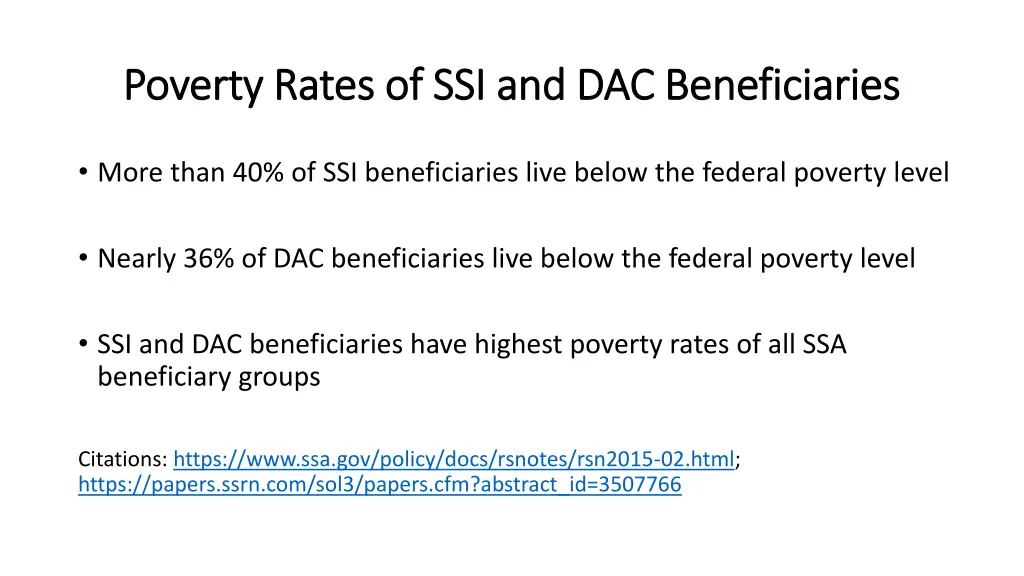
Poverty Rates of SSI and DAC Beneficiaries Poverty Rates of SSI and DAC Beneficiaries More than 40% of SSI beneficiaries live below the federal poverty level Nearly 36% of DAC beneficiaries live below the federal poverty level SSI and DAC beneficiaries have highest poverty rates of all SSA beneficiary groups Citations: https://www.ssa.gov/policy/docs/rsnotes/rsn2015-02.html; https://papers.ssrn.com/sol3/papers.cfm?abstract_id=3507766
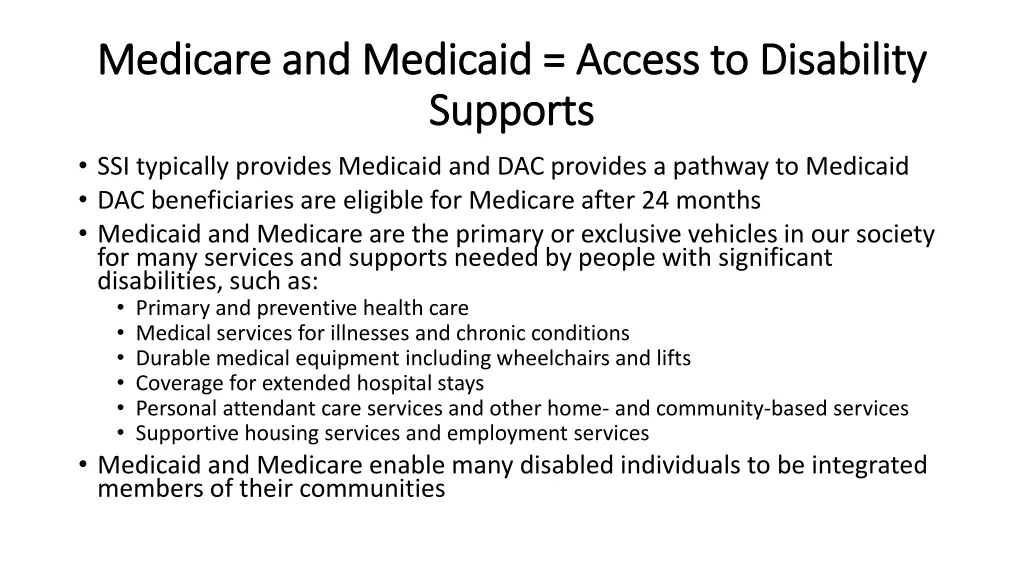
Medicare and Medicaid = Access to Disability Medicare and Medicaid = Access to Disability Supports Supports SSI typically provides Medicaid and DAC provides a pathway to Medicaid DAC beneficiaries are eligible for Medicare after 24 months Medicaid and Medicare are the primary or exclusive vehicles in our society for many services and supports needed by people with significant disabilities, such as: Primary and preventive health care Medical services for illnesses and chronic conditions Durable medical equipment including wheelchairs and lifts Coverage for extended hospital stays Personal attendant care services and other home- and community-based services Supportive housing services and employment services Medicaid and Medicare enable many disabled individuals to be integrated members of their communities
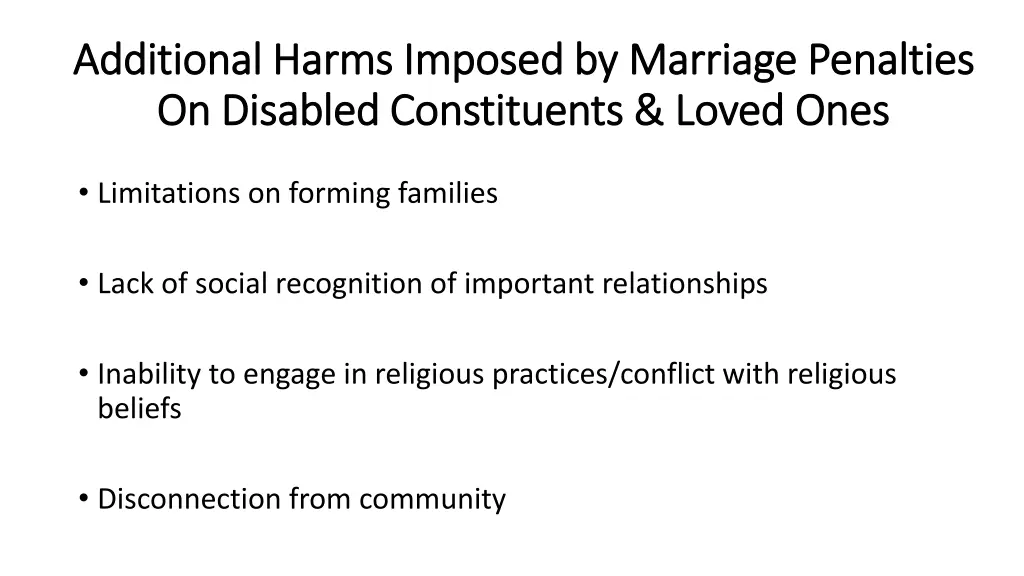
Additional Harms Imposed by Marriage Penalties Additional Harms Imposed by Marriage Penalties On Disabled Constituents & Loved Ones On Disabled Constituents & Loved Ones Limitations on forming families Lack of social recognition of important relationships Inability to engage in religious practices/conflict with religious beliefs Disconnection from community
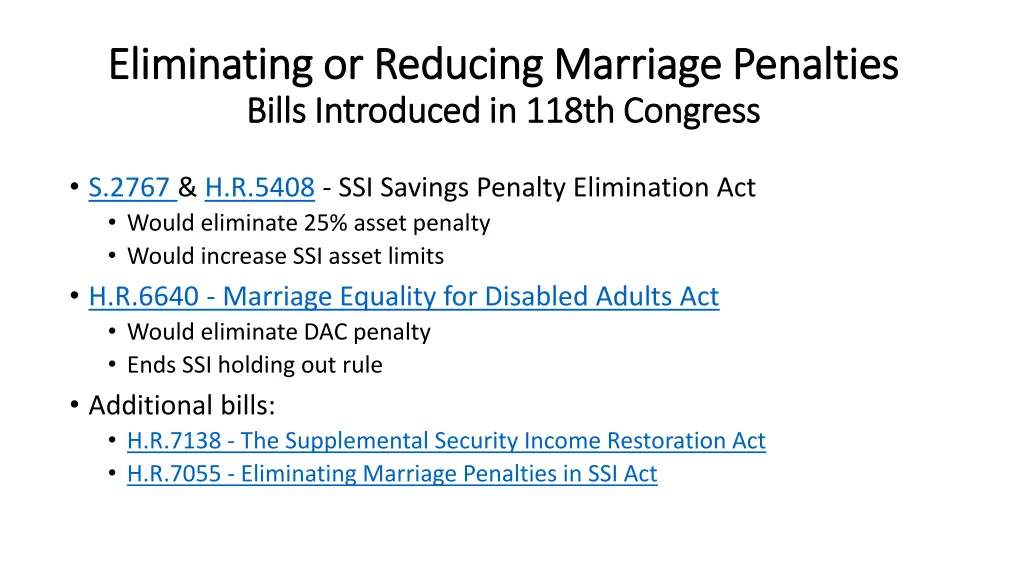
Eliminating or Reducing Marriage Penalties Eliminating or Reducing Marriage Penalties Bills Introduced in 118th Congress Bills Introduced in 118th Congress S.2767 & H.R.5408 - SSI Savings Penalty Elimination Act Would eliminate 25% asset penalty Would increase SSI asset limits H.R.6640 - Marriage Equality for Disabled Adults Act Would eliminate DAC penalty Ends SSI holding out rule Additional bills: H.R.7138 - The Supplemental Security Income Restoration Act H.R.7055 - Eliminating Marriage Penalties in SSI Act