Master Factoring Trinomials Step-by-Step
Learn how to factor trinomials easily with detailed explanations and examples. Understand concepts like FOIL, pairing numbers, and factoring binomials. Practice factoring trinomials with coefficients and constant terms effectively.

Download Presentation

Please find below an Image/Link to download the presentation.
The content on the website is provided AS IS for your information and personal use only. It may not be sold, licensed, or shared on other websites without obtaining consent from the author. If you encounter any issues during the download, it is possible that the publisher has removed the file from their server.
You are allowed to download the files provided on this website for personal or commercial use, subject to the condition that they are used lawfully. All files are the property of their respective owners.
The content on the website is provided AS IS for your information and personal use only. It may not be sold, licensed, or shared on other websites without obtaining consent from the author.
E N D
Presentation Transcript
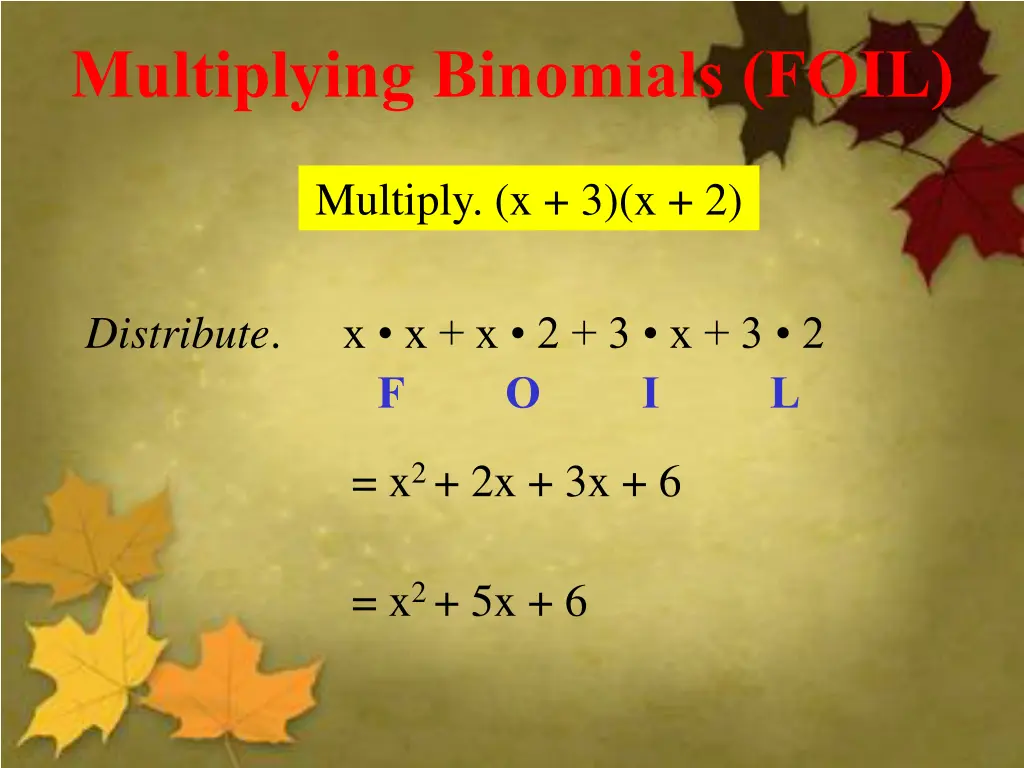
Multiplying Binomials (FOIL) Multiply. (x + 3)(x + 2) Distribute. x x + x 2 + 3 x + 3 2 F O I L = x2 + 2x + 3x + 6 = x2 + 5x + 6
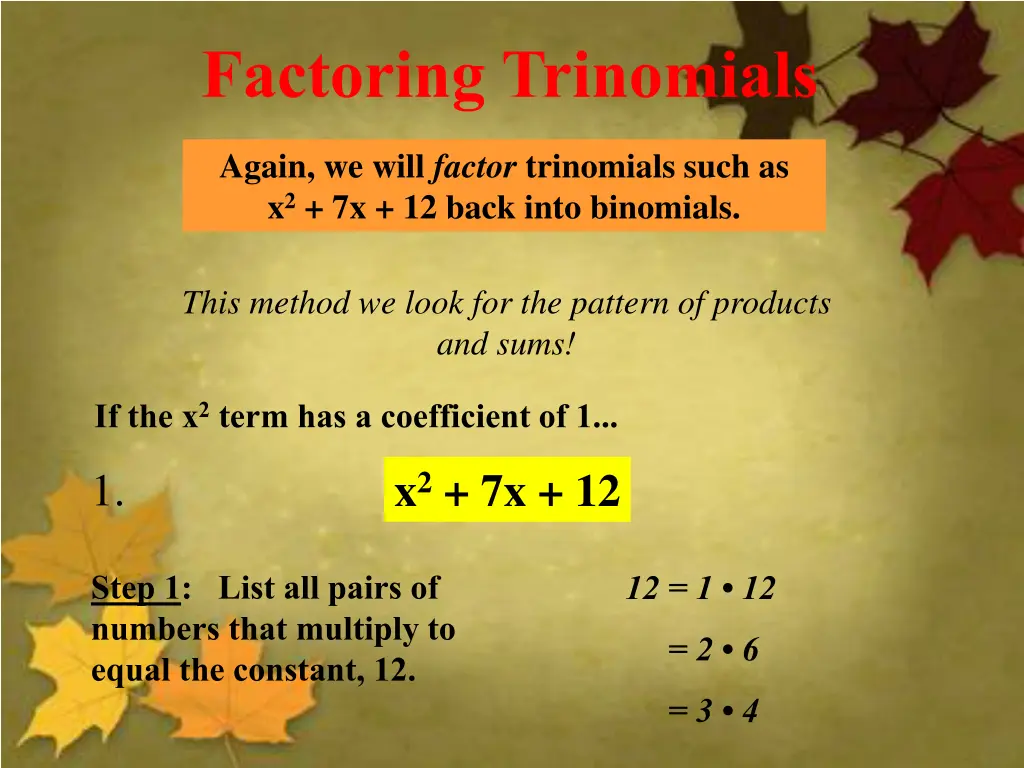
Factoring Trinomials Again, we will factor trinomials such as x2 + 7x + 12 back into binomials. This method we look for the pattern of products and sums! If the x2 term has a coefficient of 1... x2 + 7x + 12 1. Step 1: List all pairs of numbers that multiply to equal the constant, 12. 12 = 1 12 = 2 6 = 3 4
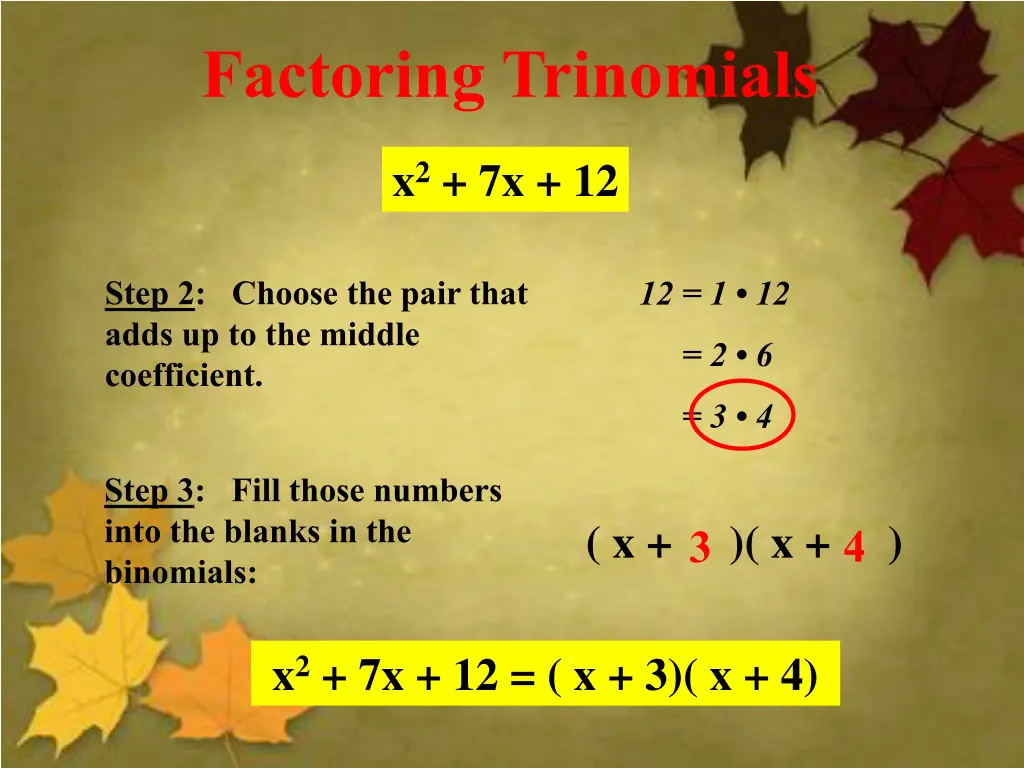
Factoring Trinomials x2 + 7x + 12 Step 2: Choose the pair that adds up to the middle coefficient. 12 = 1 12 = 2 6 = 3 4 Step 3: Fill those numbers into the blanks in the binomials: ( x + )( x + ) 3 4 x2 + 7x + 12 = ( x + 3)( x + 4)
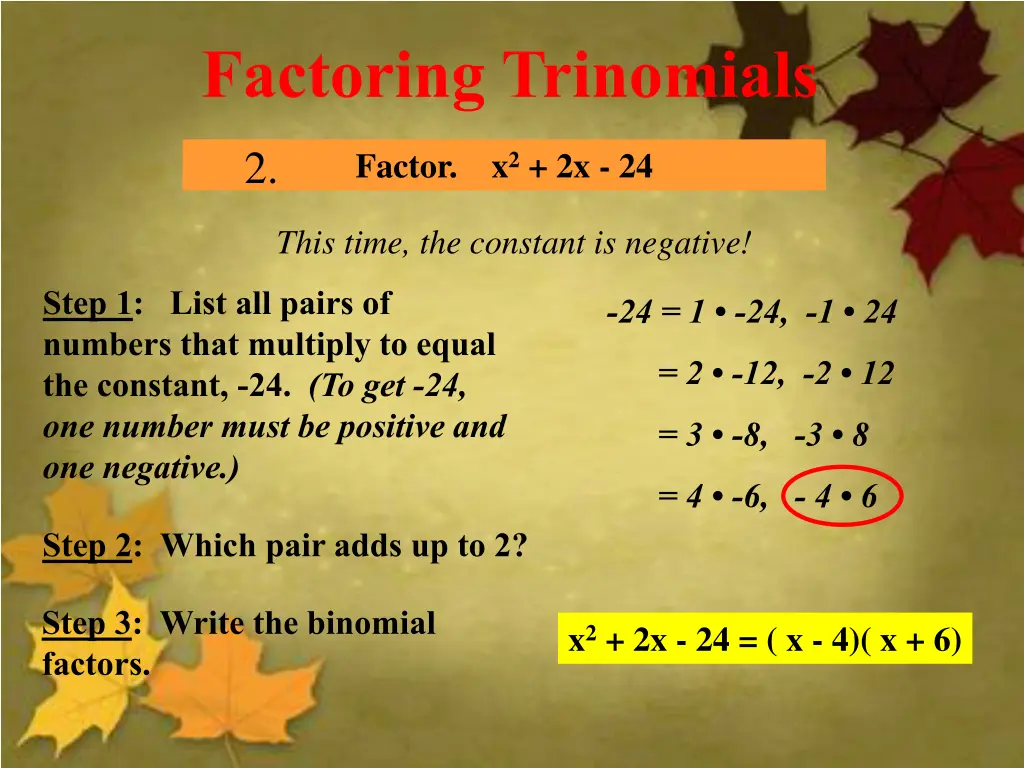
Factoring Trinomials 2. Factor. x2 + 2x - 24 This time, the constant is negative! Step 1: List all pairs of numbers that multiply to equal the constant, -24. (To get -24, one number must be positive and one negative.) -24 = 1 -24, -1 24 = 2 -12, -2 12 = 3 -8, -3 8 = 4 -6, - 4 6 Step 2: Which pair adds up to 2? Step 3: Write the binomial factors. x2 + 2x - 24 = ( x - 4)( x + 6)
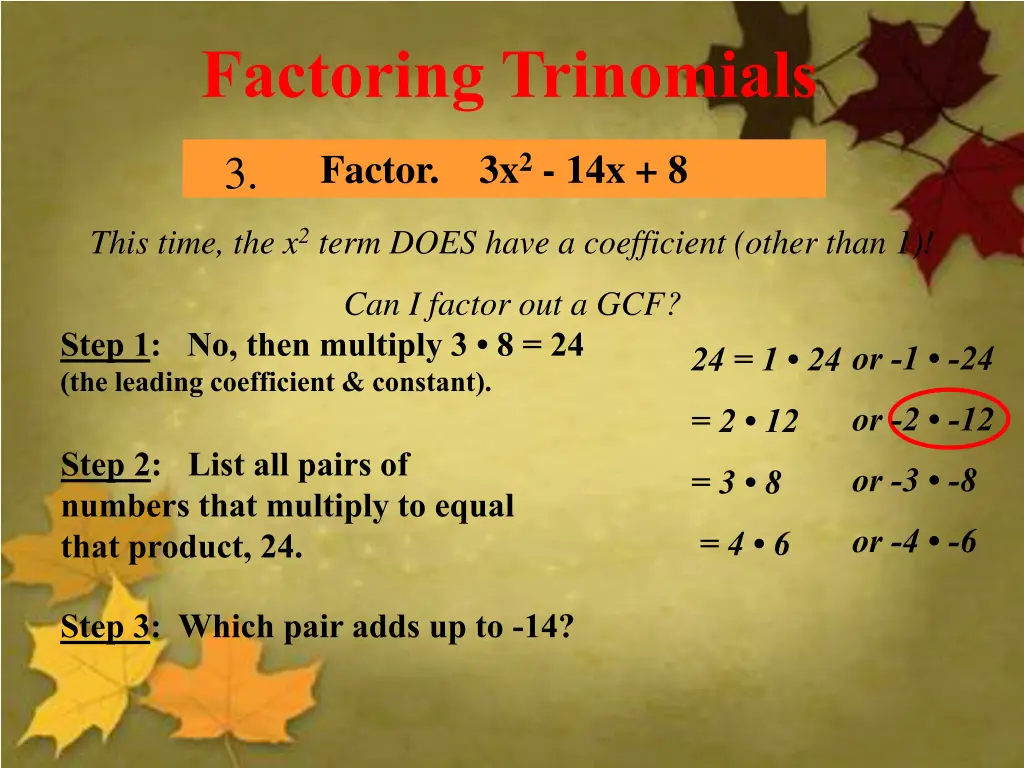
Factoring Trinomials Factor. 3x2 - 14x + 8 3. This time, the x2 term DOES have a coefficient (other than 1)! Can I factor out a GCF? Step 1: No, then multiply 3 8 = 24 (the leading coefficient & constant). or -1 -24 24 = 1 24 or -2 -12 = 2 12 Step 2: List all pairs of numbers that multiply to equal that product, 24. or -3 -8 = 3 8 or -4 -6 = 4 6 Step 3: Which pair adds up to -14?
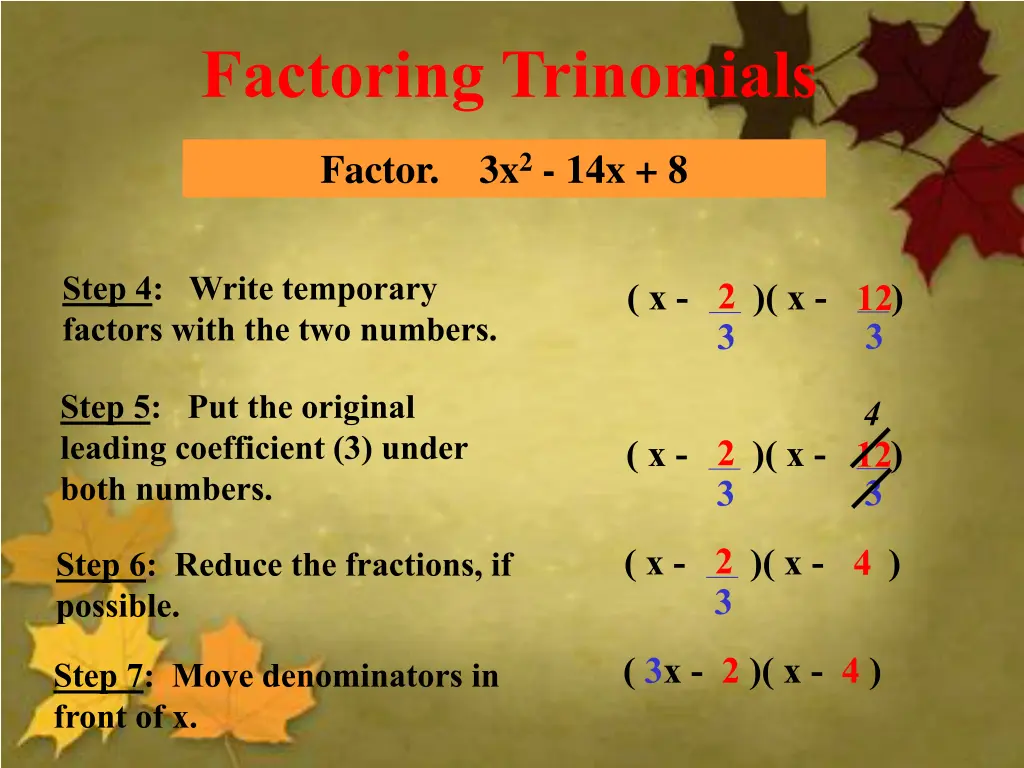
Factoring Trinomials Factor. 3x2 - 14x + 8 Step 4: Write temporary factors with the two numbers. 2 3 ( x - )( x - ) 12 3 Step 5: Put the original leading coefficient (3) under both numbers. 4 2 3 ( x - )( x - ) 12 3 2 3 ( x - )( x - ) 4 Step 6: Reduce the fractions, if possible. ( 3x - 2 )( x - 4 ) Step 7: Move denominators in front of x.
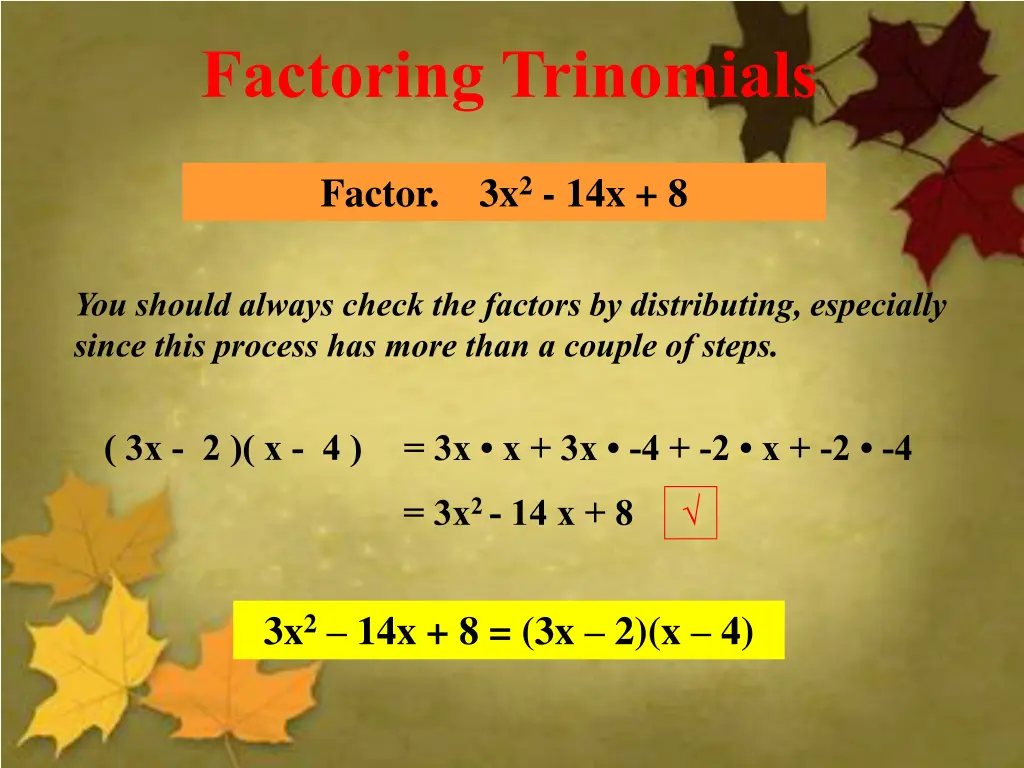
Factoring Trinomials Factor. 3x2 - 14x + 8 You should always check the factors by distributing, especially since this process has more than a couple of steps. ( 3x - 2 )( x - 4 ) = 3x x + 3x -4 + -2 x + -2 -4 = 3x2 - 14 x + 8 3x2 14x + 8 = (3x 2)(x 4)
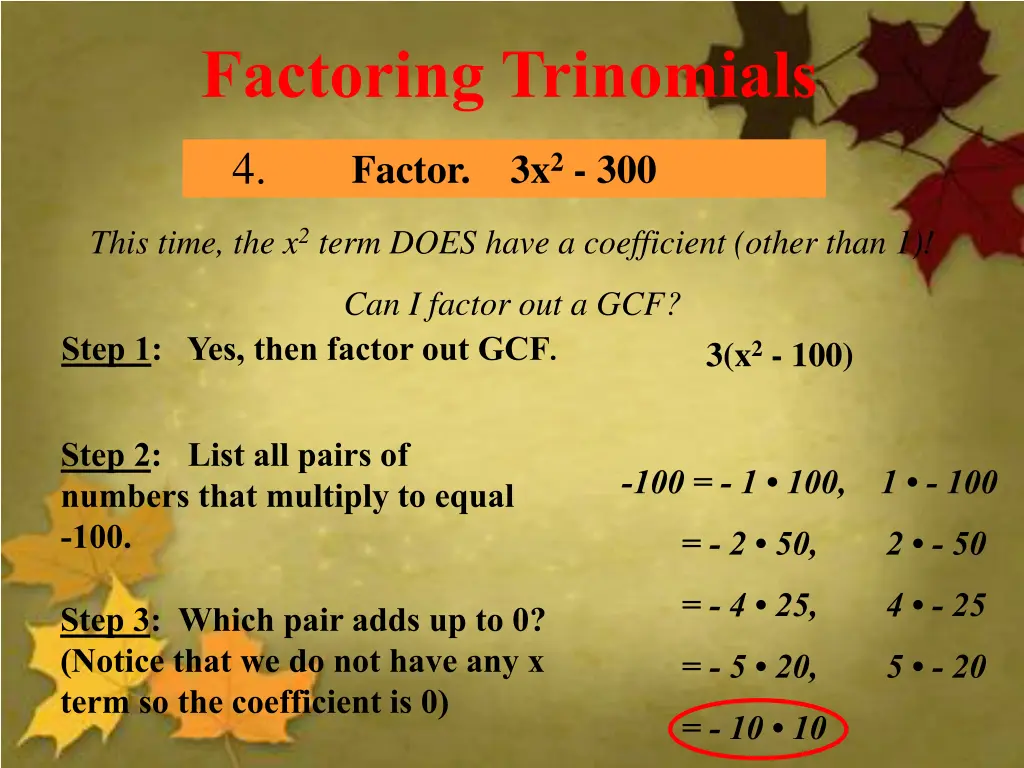
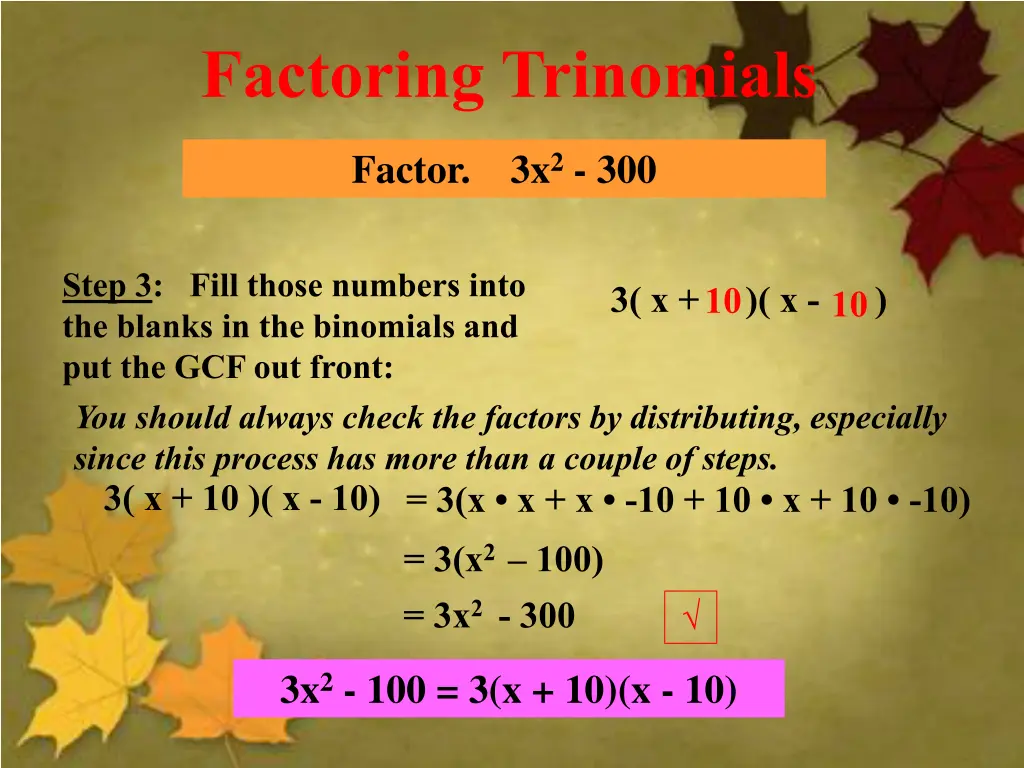
Factoring Trinomials 4. Factor. 3x2 - 300 This time, the x2 term DOES have a coefficient (other than 1)! Can I factor out a GCF? Step 1: Yes, then factor out GCF. 3(x2 - 100) Step 2: List all pairs of numbers that multiply to equal -100. -100 = - 1 100, 1 - 100 = - 2 50, 2 - 50 = - 4 25, 4 - 25 Step 3: Which pair adds up to 0? (Notice that we do not have any x term so the coefficient is 0) = - 5 20, 5 - 20 = - 10 10
Factoring Trinomials Factor. 3x2 - 300 Step 3: Fill those numbers into the blanks in the binomials and put the GCF out front: You should always check the factors by distributing, especially since this process has more than a couple of steps. 3( x + 10 )( x - 10) = 3(x x + x -10 + 10 x + 10 -10) 3( x + )( x - ) 10 10 = 3(x2 100) = 3x2 - 300 3x2 - 100 = 3(x + 10)(x - 10)
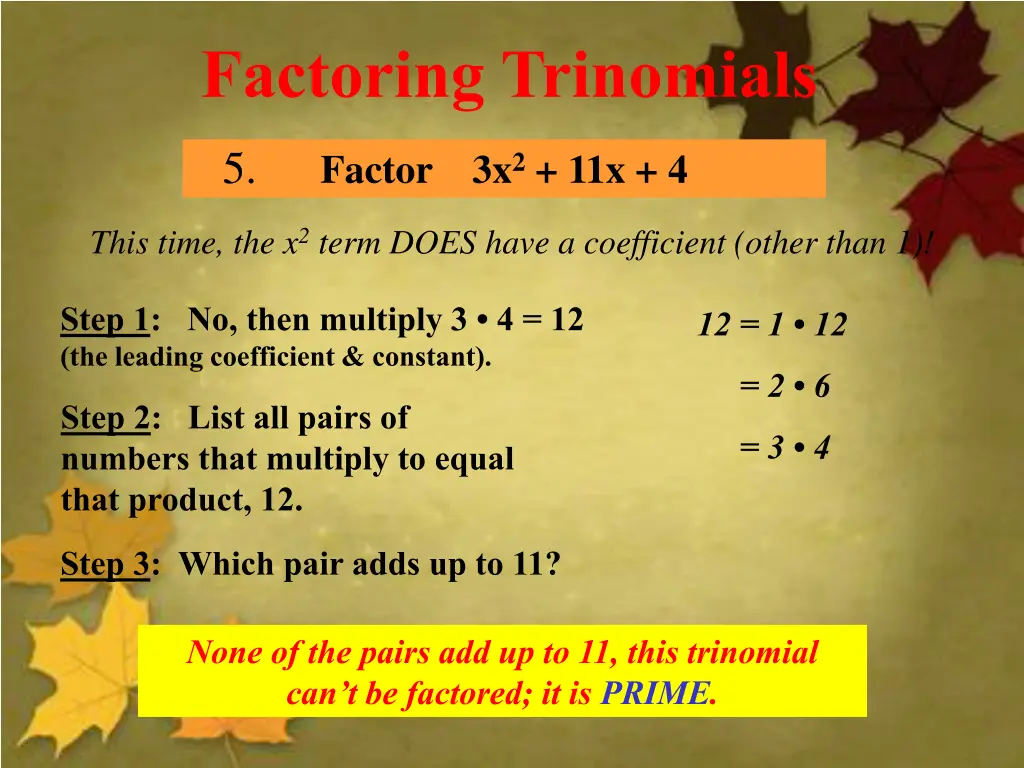
Factoring Trinomials 5. Factor 3x2 + 11x + 4 This time, the x2 term DOES have a coefficient (other than 1)! Step 1: No, then multiply 3 4 = 12 (the leading coefficient & constant). 12 = 1 12 = 2 6 Step 2: List all pairs of numbers that multiply to equal that product, 12. = 3 4 Step 3: Which pair adds up to 11? None of the pairs add up to 11, this trinomial can t be factored; it is PRIME.
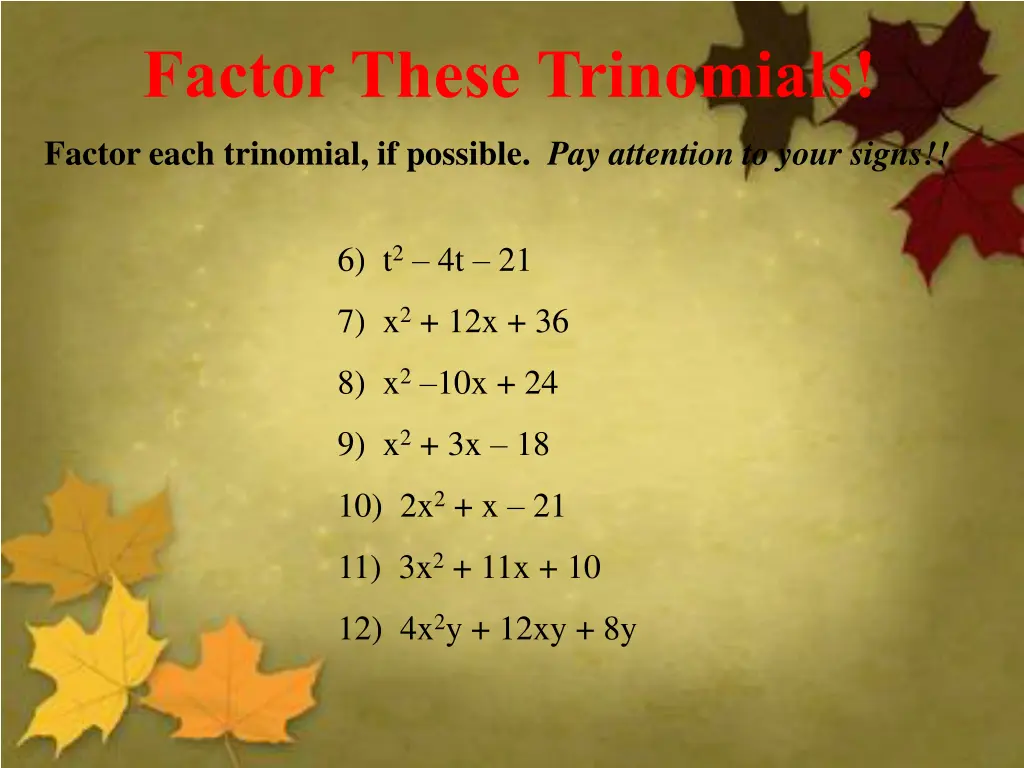
Factor These Trinomials! Factor each trinomial, if possible. Pay attention to your signs!! 6) t2 4t 21 7) x2 + 12x + 36 8) x2 10x + 24 9) x2 + 3x 18 10) 2x2 + x 21 11) 3x2 + 11x + 10 12) 4x2y + 12xy + 8y
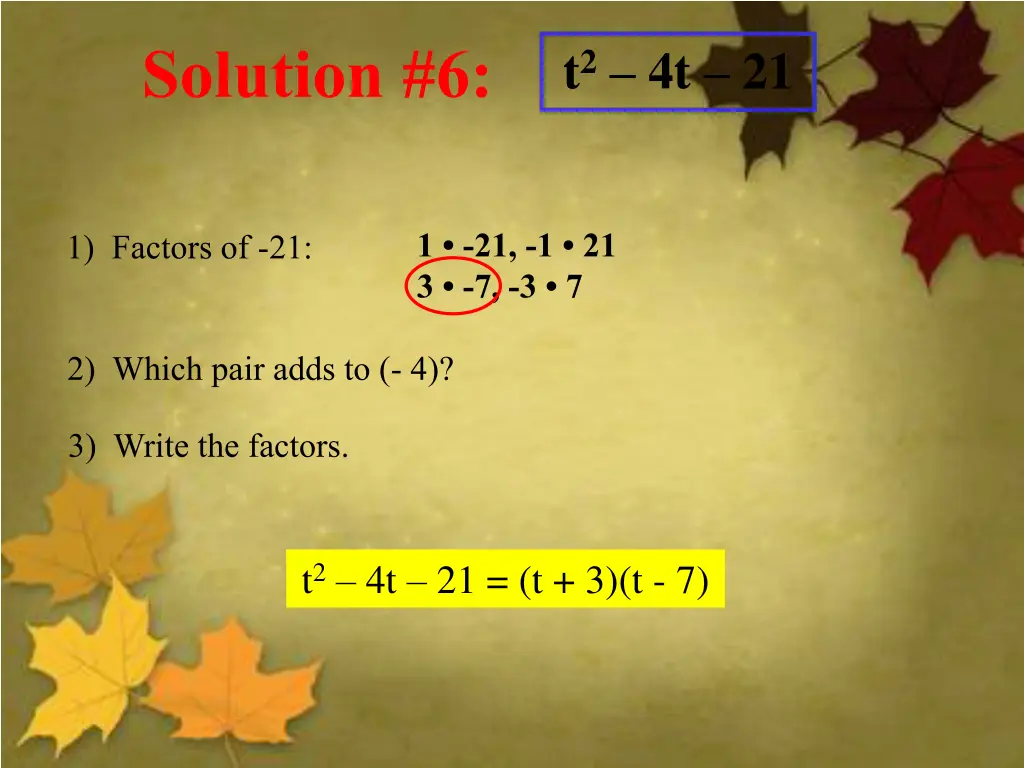
Solution #6: t2 4t 21 1 -21, -1 21 3 -7, -3 7 1) Factors of -21: 2) Which pair adds to (- 4)? 3) Write the factors. t2 4t 21 = (t + 3)(t - 7)
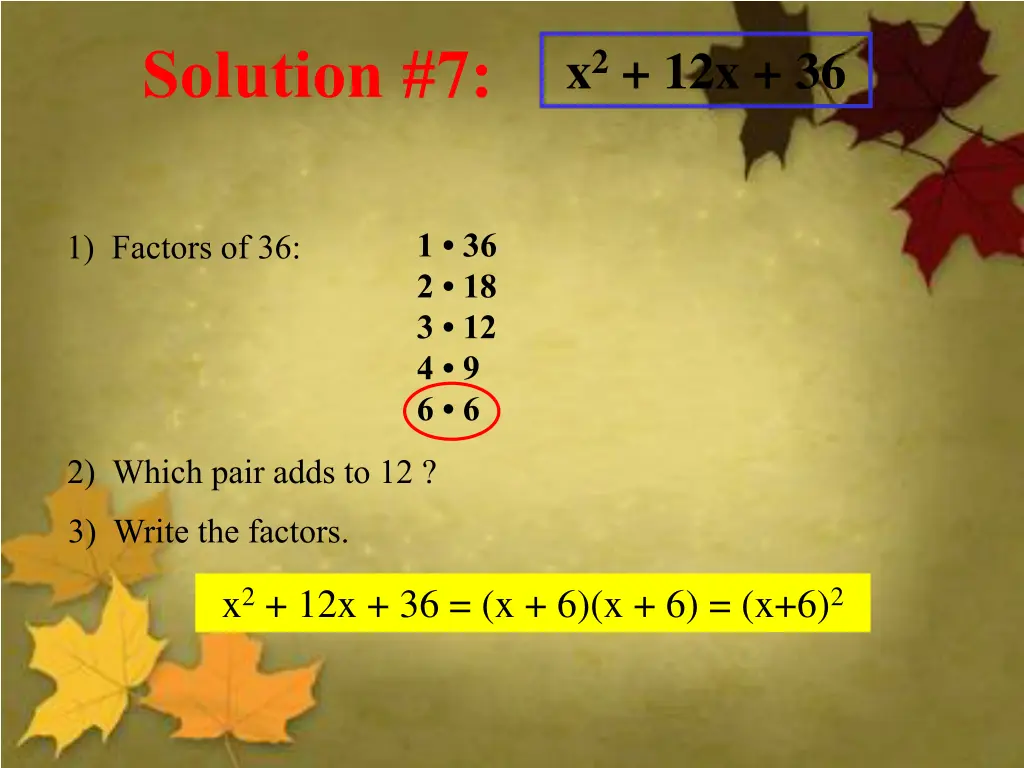
Solution #7: x2 + 12x + 36 1 36 2 18 3 12 4 9 6 6 1) Factors of 36: 2) Which pair adds to 12 ? 3) Write the factors. x2 + 12x + 36 = (x + 6)(x + 6) = (x+6)2
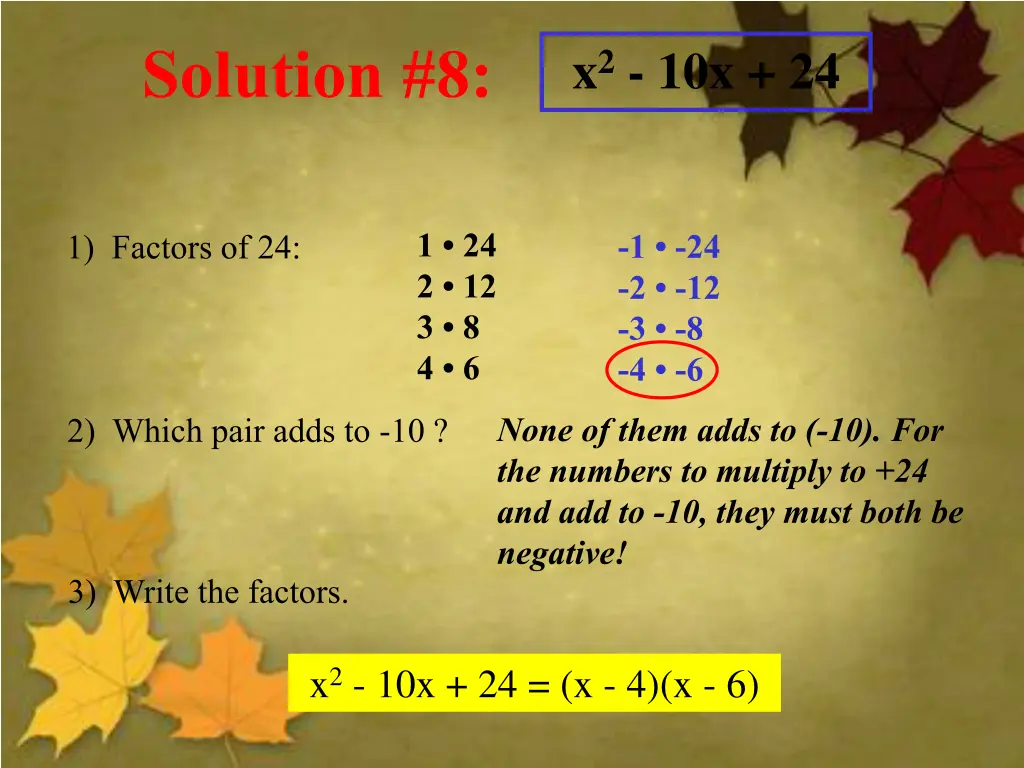
Solution #8: x2 - 10x + 24 1 24 2 12 3 8 4 6 -1 -24 -2 -12 -3 -8 -4 -6 1) Factors of 24: None of them adds to (-10). For the numbers to multiply to +24 and add to -10, they must both be negative! 2) Which pair adds to -10 ? 3) Write the factors. x2 - 10x + 24 = (x - 4)(x - 6)
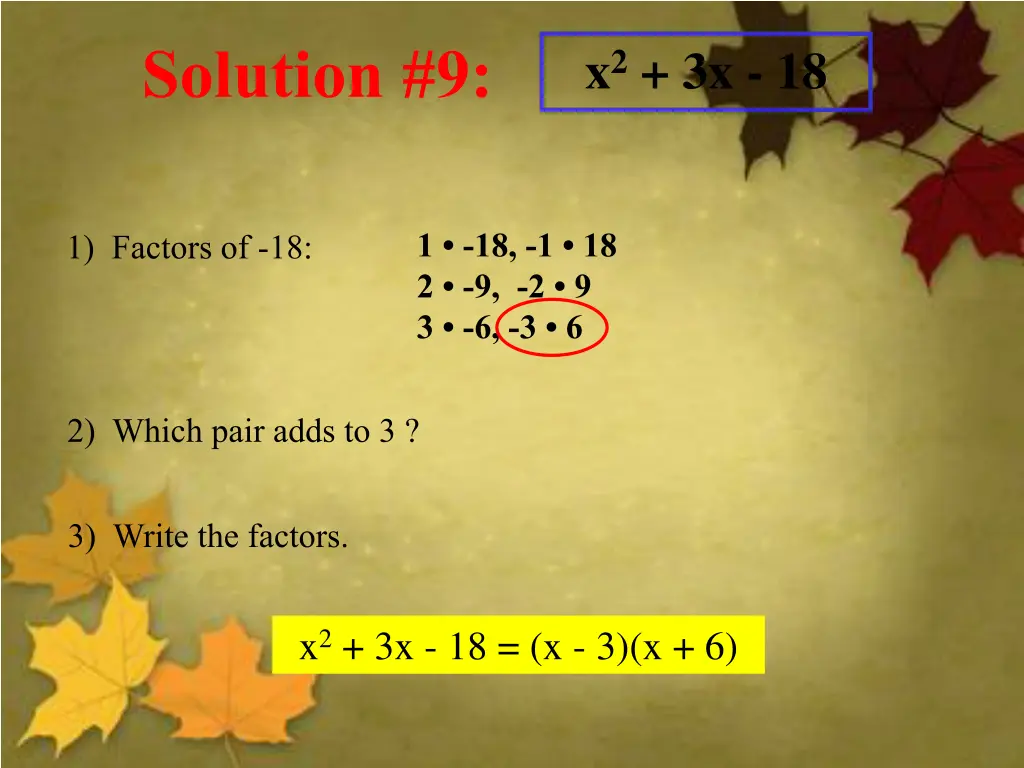
Solution #9: x2 + 3x - 18 1 -18, -1 18 2 -9, -2 9 3 -6, -3 6 1) Factors of -18: 2) Which pair adds to 3 ? 3) Write the factors. x2 + 3x - 18 = (x - 3)(x + 6)
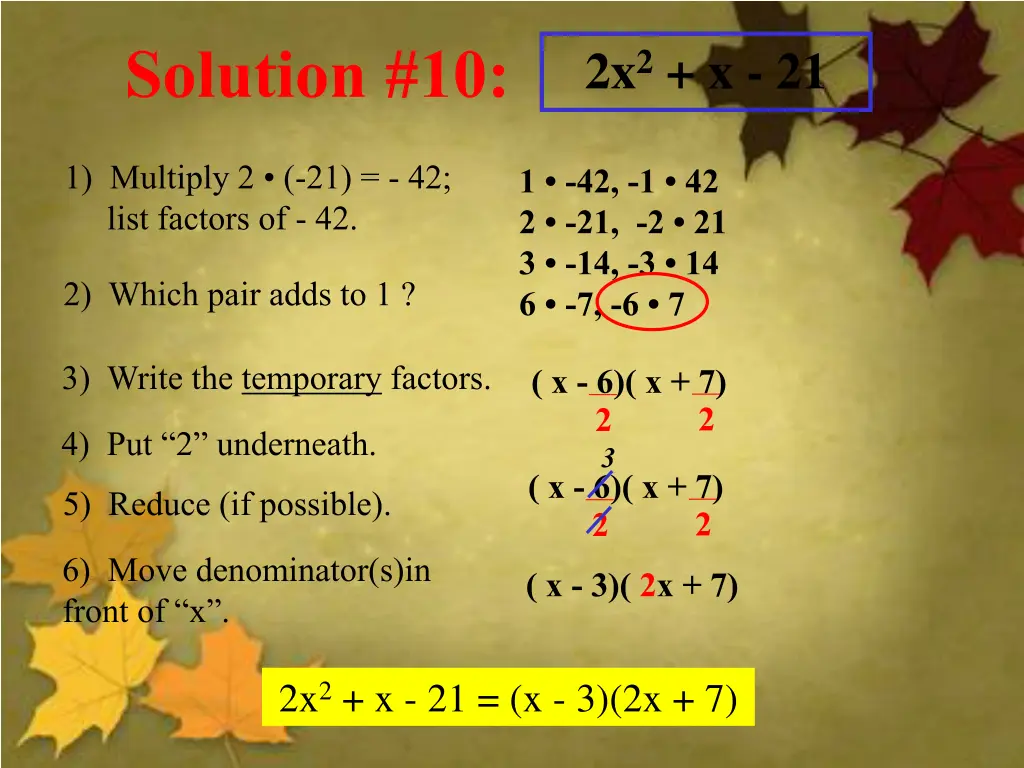
Solution #10: 2x2 + x - 21 1) Multiply 2 (-21) = - 42; list factors of - 42. 1 -42, -1 42 2 -21, -2 21 3 -14, -3 14 6 -7, -6 7 2) Which pair adds to 1 ? 3) Write the temporary factors. ( x - 6)( x + 7) 2 3 2 4) Put 2 underneath. ( x - 6)( x + 7) 2 5) Reduce (if possible). 2 6) Move denominator(s)in front of x . ( x - 3)( 2x + 7) 2x2 + x - 21 = (x - 3)(2x + 7)
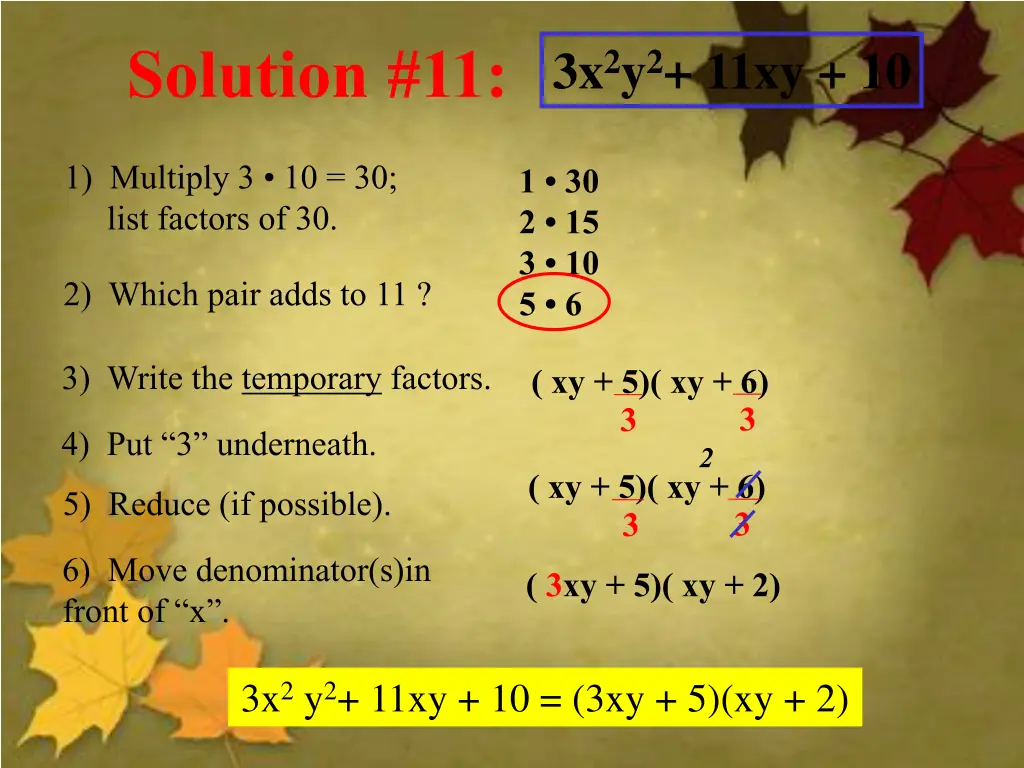
Solution #11: 3x2y2+ 11xy + 10 1) Multiply 3 10 = 30; list factors of 30. 1 30 2 15 3 10 5 6 2) Which pair adds to 11 ? 3) Write the temporary factors. ( xy + 5)( xy + 6) 3 3 4) Put 3 underneath. 2 ( xy + 5)( xy + 6) 3 5) Reduce (if possible). 3 6) Move denominator(s)in front of x . ( 3xy + 5)( xy + 2) 3x2 y2+ 11xy + 10 = (3xy + 5)(xy + 2)
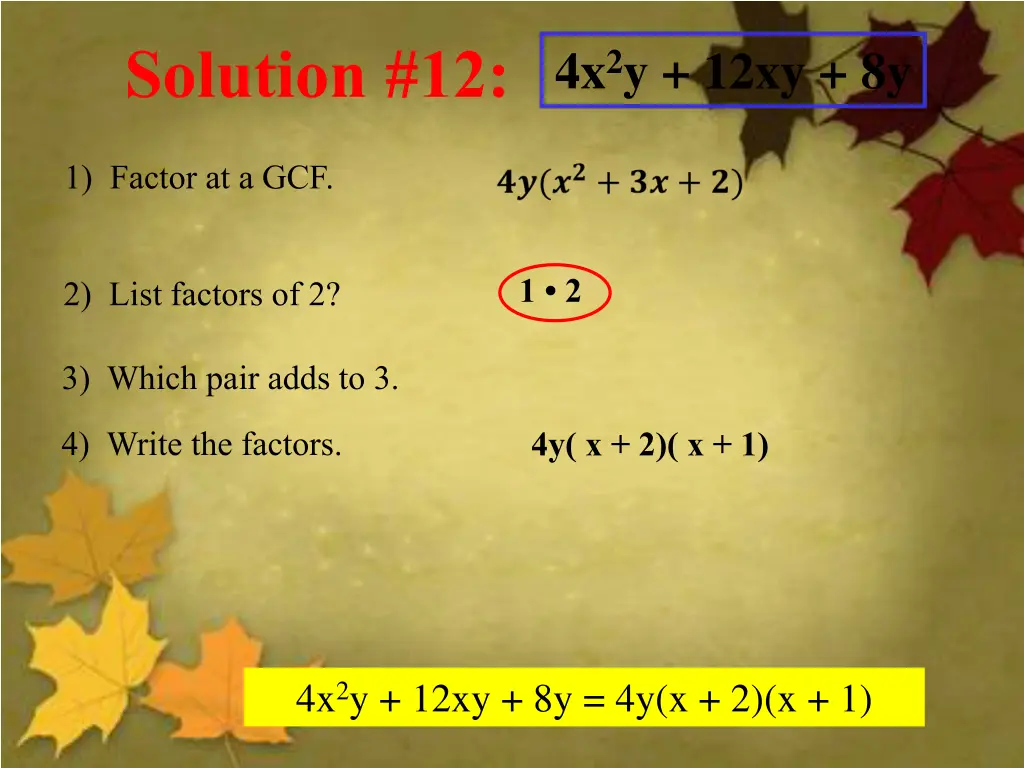
Solution #12: 4x2y + 12xy + 8y 1) Factor at a GCF. 1 2 2) List factors of 2? 3) Which pair adds to 3. 4) Write the factors. 4y( x + 2)( x + 1) 4x2y + 12xy + 8y = 4y(x + 2)(x + 1)