Explore the skills required to solve molarity and titration problems efficiently, including the use of chemical formulas, mole ratios, percent compositions, and titration methods. Practice examples and tools for problem-solving are provided to help enhance understanding.
Please find below an Image/Link to download the presentation.
The content on the website is provided AS IS for your information and personal use only. It may not be sold, licensed, or shared on other websites without obtaining consent from the author. If you encounter any issues during the download, it is possible that the publisher has removed the file from their server.
You are allowed to download the files provided on this website for personal or commercial use, subject to the condition that they are used lawfully. All files are the property of their respective owners.
The content on the website is provided AS IS for your information and personal use only. It may not be sold, licensed, or shared on other websites without obtaining consent from the author.
E N D
Presentation Transcript
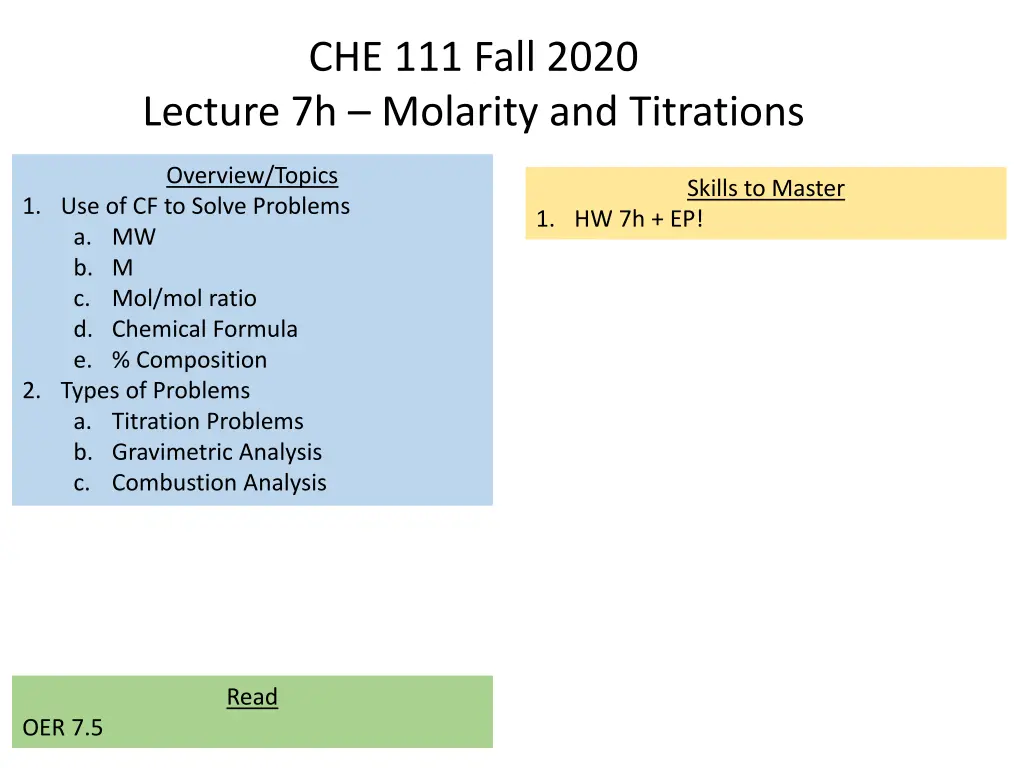
CHE 111 Fall 2020 Lecture 7h Molarity and Titrations Overview/Topics Skills to Master 1. Use of CF to Solve Problems a. MW b. M c. Mol/mol ratio d. Chemical Formula e. % Composition 2. Types of Problems a. Titration Problems b. Gravimetric Analysis c. Combustion Analysis 1. HW 7h + EP! Read OER 7.5
Review 7e Molarity (M or mol/L) o Equivalent of MW for aqueous solutions o CF between mL and mols o Write M but in problems use mol/L MW MW mol/mol Grams A Mol A Mol B Grams B Mol to Mol Ratio from Balanced Eqn Molecular Weight g/mol Molecular Weight g/mol M M mL A mL B
Titration Neutralization Method to determine the concentration or amount of an unknown substance by reacting it with a known substance A + B C + D Conc. (M) Vol. (V) Vol. (V) Conc. (M) Given any 3 value s can solve for the missing value. Known Concentration Known Volume Indicator Changes color when: [A] = [B] Unknown Concentration Known Volume or Mass
Example: _2_ H3PO4 (aq) + _3_ Mg(OH)2 (aq) _1_ Mg3(PO4)2 (aq) + _6_ H2O + Heat How many mL of 4.75 M H3PO4 are required to titrate 107.5 mL of 3.50 M Mg(OH)2?
Example: _1_ H2SO4 (aq) + _2_ NaOH (aq) _1_ Na2SO4 (aq) + _2_ H2O + Heat It required 250.0 mL of 5.0 M NaOH to neutralize 175.0 mL of an unknown concentration of H2SO4 . What is the Molarity of the H2SO4 solution?
Tools for Solving Problems II 2 Types of Titration Problems A B A B x mL ? x mL x x x M ? x M mol B L B mL A mL B mL B mL A Start: Start: MW MW mol/mol Grams A Mol A Mol B Grams B Mol to Mol Ratio from Balanced Eqn Molecular Weight g/mol Molecular Weight g/mol M M mL A mL B
You Try It: _1_ H2SO4 (aq) + _2_ KOH (aq) _1_ K2SO4 (aq) + _2_ H2O + Heat It required 117.0 mL of 2.50 M H2SO4 to neutralize 15.0 mL of an unknown concentration of KOH. What is the Molarity of the KOH solution?
You Try It: _3_ HCl (aq) + _3_ Al(OH)3 (aq) _1_ AlCl3 (aq) + _3_ H2O + Heat How many mL of 1.25 M Al(OH)3 are required to titrate 95.0 mL of 0.75 M HCl?
Percent Composition Problems Percent Pure/Impurity Percent Composition Mass Pure Substance Total Mass Substance Mass Element Total Mass Substance 100 100 Mass Impure Substance Percents = 100 % 100 Total Mass Substance
Example: C2H4 C =2 12.01 28.05 100 = 85.63% H =4 1.008 28.05 100 = 14.37% 100.00% Double Check
Empirical vs Molecular Formula Empirical Formula Molecular Formula Absolute number of each type of atom in a compound Smallest whole number ratio atoms MW Ex: C1H2 Ex: C2H4 or C6H12 Doesn t Exist Actual MW = n (# of units/molecule) Empirical MW (CxHy ) n = CnxBny n = Molecular Formula Empirical Formula
Example: The molecular weight of an unknown compound of CxHy is 85.15 g/mol. You determine the Empirical formula to be C1H2. What is the correct Molecular formula? Actual MW = n (# of units/molecule) Step 1 Empirical MW (CxHy ) n = CnxBny n = Molecular Formula Empirical Formula Step 2 85.15 g/mol = 6.07 C1H2 x 6 = C6H12 14.03 g/mol
Example: The molecular weight of an unknown compound of CxHy is 142.27 g/mol. You determine the Empirical formula to be C5H11. What is the correct Molecular formula?
Method to determine the percent composition of a component of a compound by reacting it create a state change (generally to solid). Multiple applications allow the chemical formula to be determined. Gravimetric Analysis A + B C + D Original Sample Mass (g) Reagent Examples: o Lab 8 Water in Hydrates o Formation of PPT o Combustion PPT PPT Mass (g) Mass of Unknown Compound (A) React with excess B to Form a PPT Mass of Known C PPT
Example: A 0.750 g mixture of K2SO4 + an unknown compound is reacted with excess Ba(NO3)2 resulting in the precipitation of 0.900 g of BaSO4 (s). (a) What is the concentration (% K2SO4) in the mixture? (b) What is the % of the impurity in the sample? _1_ Ba(NO3)2 (aq) + _1_ K2SO4 (aq) _1_ BaSO4 (s) + _2_ KNO3 (aq) 174.27 g/mol 233.43 g/mol
You Try It! An impure sample of AlCl3 that weighs 5.00 grams is reacted with excess Ba(NO3)2 resulting in the precipitation of 4.50 g of BaCl2 (s). (a) What is the concentration of pure (% AlCl3) in the mixture? (b) What is the % of the impurity in the sample? __ Ba(NO3)2 (aq) + __ AlCl3 (aq) __ BaCl2 (s) + __ Al(NO3)3 (aq) 133.3 g/mol 208.23 g/mol
Example: A 2.50 g sample of VxCly is reacted with excess Ba(NO3)2 to produce 5.40 g of BaCl2 (s) precipitate. (a) What is the % of V and % Cl in the sample? (b) What is the empirical formula of VxCly compound? (c) What is the charge of the Vanadium cation? (Name the compound) V = 50.94 g/mol Cl = 35.45 g/mol BaCl2 = 208.23 g/mol
You Try It! A 1.66 g sample of Chromium (???) Carbonate is reacted with excess Barium Nitrate to produce 4.25 g of Barium Carbonate (s) precipitate. (a) What is the % of Chromium and % of Carbonate in the sample? (b) What is the empirical formula of the chromium carbonatecompound? (c) What is the charge of the chromium cation? Cr = 52.00 g/mol (CO3) = 60.00 g/mol BaCO3 = 197.34 g/mol Ba(NO3)2 = 261.35 g/mol
Combustion Analysis An unknown (generally hydrocarbon) is combusted and the resulting products massed. The %-composition or chemical formula of the original sample is determined Mass of CO2 Mass of C Mass of H2O Mass of H CxHy (l) + excess O2 x CO2 (g) + y/2 H2O (g)
Example: 2.50 grams of an unknown hydrocarbon CxHy was burned to produce 7.49 g of CO2 (g) and 4.09 g of H2O (g). CO2 = 44.01 g/mol H2O = 18.02 g/mol (a) What is the % composition of the unknown hydrocarbon? (b) What is the empirical formula of the unknown hydrocarbon?
You Try It! 5.00 grams of an unknown hydrocarbon CxHy was burned to produce 16.15 g of CO2 (g) and 5.29 g of H2O (g). CO2 = 44.01 g/mol H2O = 18.02 g/mol (a) What is the % composition of the unknown hydrocarbon? (b) What is the empirical formula of the unknown hydrocarbon?
Review of Chemical Calculations Solution Problem 1. Learn to use the Road Map 2. Learn to use different conversion factors a. MW b. M c. mol/mol ratio d. Chemical formula e. % composition 3. List the different problem types Lots of problem types, how are you going to remember it all?
Road Map to Success R1 + R2 P1 + P2 A + B C + D Use Reactants or Make Products MW MW mol/mol Grams A Mol A Mol B Grams B Mol to Mol Ratio from Balanced Eqn Molecular Weight g/mol Molecular Weight g/mol M M mL A mL B
Lots of Conversion Factors + General Rules Q A o To go from A to B must use mol/mol ratio o Never start with a CF (MW, M, mol/mol ratio) o When in doubt convert to mols 1 unit 1 unit 2 unit 2 unit Percent s Conversion Factors g mol mol/mol ratio = mol A Mass Element Total Mass Substance M = mol 100 MW = L Percents = 100 % mol B A # =atoms molec. mol Mass Pure Substance Total Mass Substance 100 or mol
Tools for Solving Problems III Information about 1 compound (7f) I know grams R1 how much of R2 do I need or P1 do I make? g R1 g R2 or P2 Molarity Problems (7 f) Same as MW problems or Chart I know mL or grams of R1 Information about 2 compounds (7 g) ____ g A ____ g B ____ g C ____ g D Limiting Reactant Excess Reactant Theoretical Yield Percent Yield I know grams R1 and R2 or Titration/Neutralization (7 h) I know mL and/or M of R1 and R2 Titrate or Neutralize 2 Types Problems Memorize?
Percent Composition/Chemical Formula (7h) Key Words g Product g A and g B % composition Chemical formula Gravimetric Analysis Combustion Analysis and g A 100 = % A g Total Mass s of parts of a compound Total mass of a compound g B g Total 100 = % B
Limiting Reactant Problems Excess Reactant: Limiting Reactant: The reactant that you run out of first Zero left at end of the reaction g R1 mol R1 mol P1 g P1 g R2 mol R2 mol P1 g P1 Fewest grams of P1 determines LR The reactant that is left over g LR mol LR mol ER g ER used - Starting g ER Used g ER Left Over ER Grams of a Product or Theoretical Yield: Percent Yield: Actual Yield (Lab or Given) Theoretical Yield g LR mol LR mol P g Pmade Percent Yield = 100 Energy Released: Double Check: Energy is just like a normal product g LR mol LR kJ Energy Mass at Start = Mass at the End g R1 + g R2 = g ER + g P1 + g P2
2 Types of Titration Problems Titration Problems A B A B x mL ? x mL x x x M ? x M mol B L B mL A mL B mL B mL A Start: Start: MW MW mol/mol Grams A Mol A Mol B Grams B Mol to Mol Ratio from Balanced Eqn Molecular Weight g/mol Molecular Weight g/mol M M mL A mL B