Explore the step-by-step process of the scientific method, from identifying questions to reporting results. Engage in background research, construct hypotheses, conduct experiments, and analyze data. Prepare for the science fair with tips on presenting your project effectively and meeting deadlines.
Please find below an Image/Link to download the presentation.
The content on the website is provided AS IS for your information and personal use only. It may not be sold, licensed, or shared on other websites without obtaining consent from the author. If you encounter any issues during the download, it is possible that the publisher has removed the file from their server.
You are allowed to download the files provided on this website for personal or commercial use, subject to the condition that they are used lawfully. All files are the property of their respective owners.
The content on the website is provided AS IS for your information and personal use only. It may not be sold, licensed, or shared on other websites without obtaining consent from the author.
E N D
Presentation Transcript
The Scientific Method Identify Question Do Background Research Construct Hypothesis Test with an Experiment Accept or Reject Hypothesis Report Results
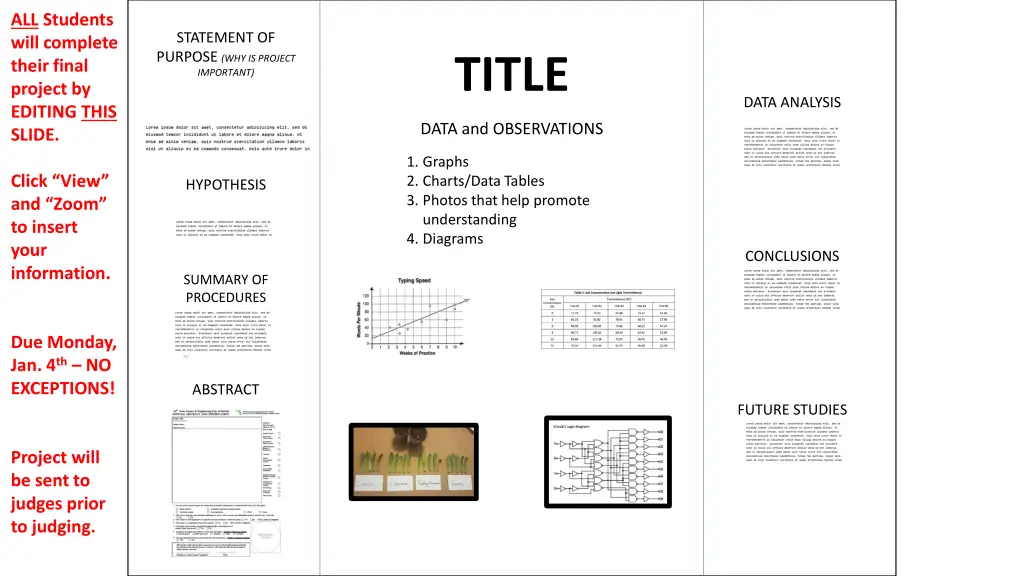
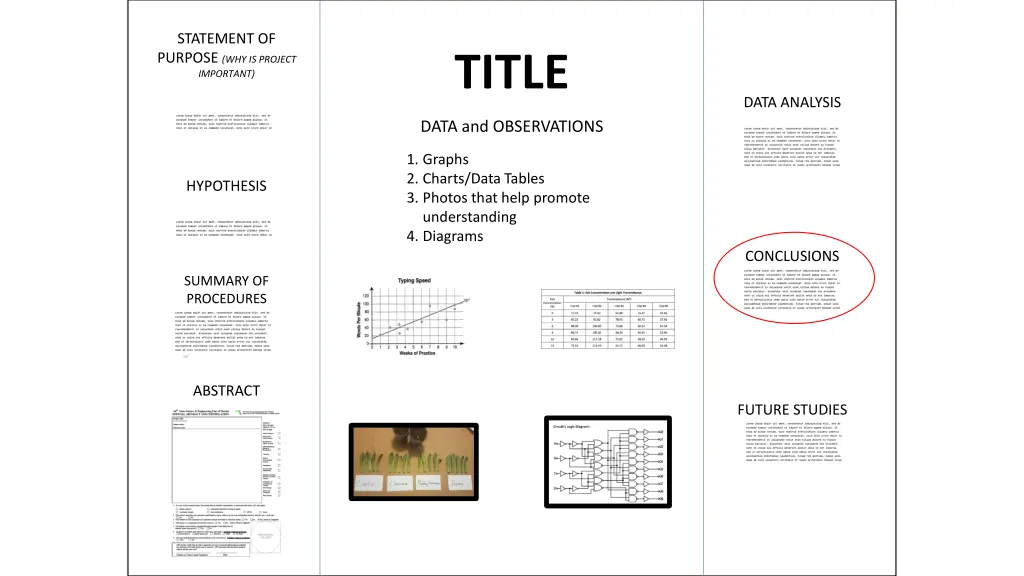
ALL Students will complete their final project by EDITING THIS SLIDE. STATEMENT OF PURPOSE (WHY IS PROJECT IMPORTANT) TITLE DATA ANALYSIS DATA and OBSERVATIONS 1. Graphs 2. Charts/Data Tables 3. Photos that help promote understanding 4. Diagrams Click View and Zoom to insert your information. HYPOTHESIS CONCLUSIONS SUMMARY OF PROCEDURES Due Monday, Jan. 4th NO EXCEPTIONS! ABSTRACT FUTURE STUDIES (OPTIONAL) Project will be sent to judges prior to judging.
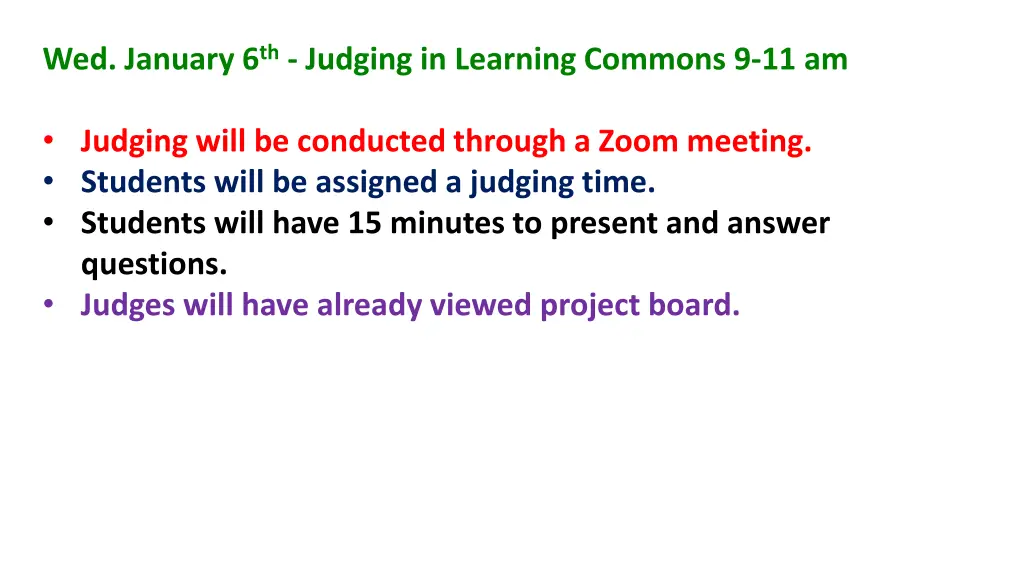
Wed. January 6th - Judging in Learning Commons 9-11 am Judging will be conducted through a Zoom meeting. Students will be assigned a judging time. Students will have 15 minutes to present and answer questions. Judges will have already viewed project board.
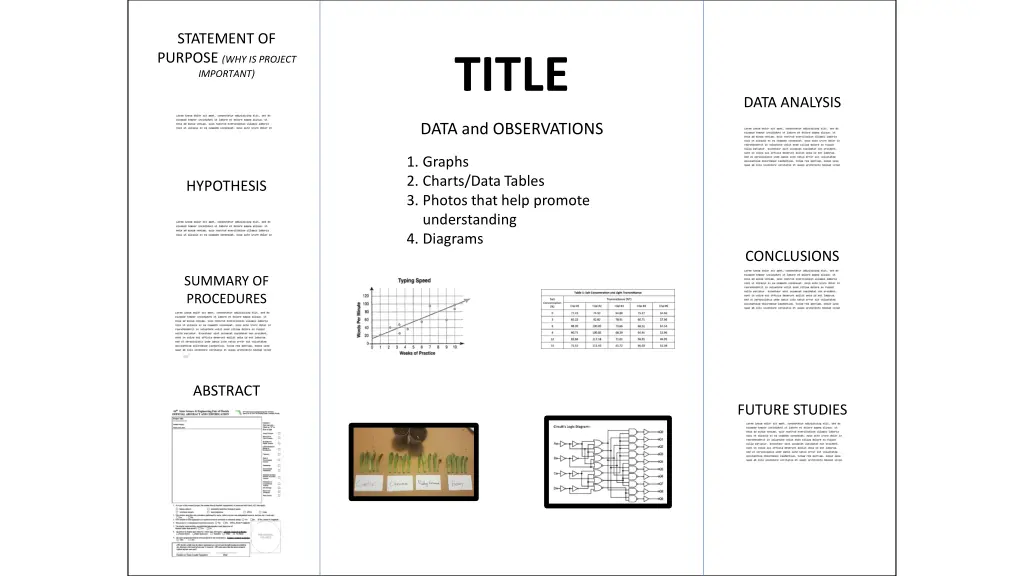
STATEMENT OF PURPOSE (WHY IS PROJECT IMPORTANT) TITLE DATA ANALYSIS DATA and OBSERVATIONS 1. Graphs 2. Charts/Data Tables 3. Photos that help promote understanding 4. Diagrams HYPOTHESIS CONCLUSIONS SUMMARY OF PROCEDURES ABSTRACT FUTURE STUDIES (OPTIONAL)
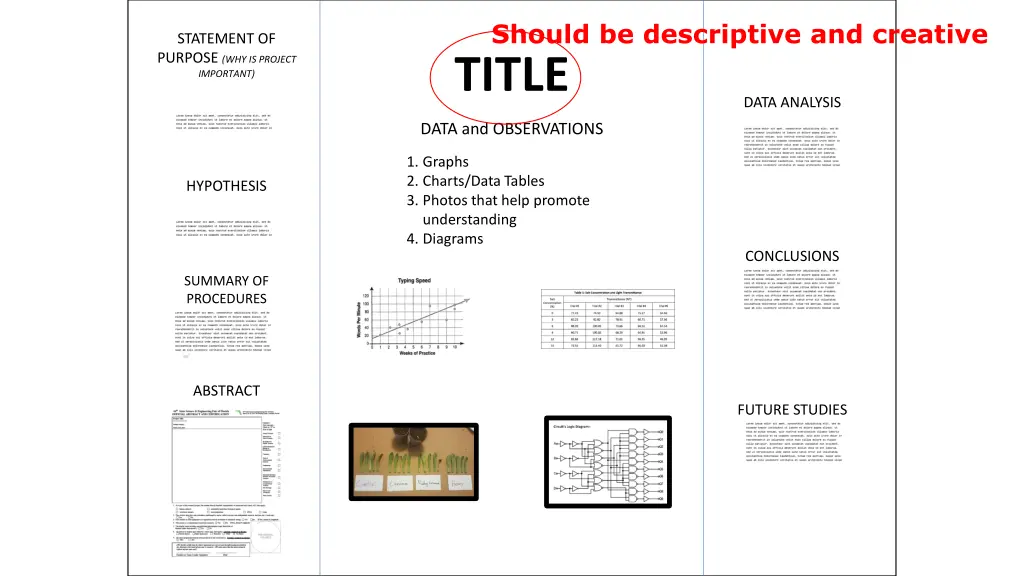
Should be descriptive and creative STATEMENT OF PURPOSE (WHY IS PROJECT IMPORTANT) TITLE DATA ANALYSIS DATA and OBSERVATIONS 1. Graphs 2. Charts/Data Tables 3. Photos that help promote understanding 4. Diagrams HYPOTHESIS CONCLUSIONS SUMMARY OF PROCEDURES ABSTRACT FUTURE STUDIES (OPTIONAL)
STATEMENT OF PURPOSE (WHY IS PROJECT IMPORTANT) TITLE DATA ANALYSIS DATA and OBSERVATIONS 1. Graphs 2. Charts/Data Tables 3. Photos that help promote understanding 4. Diagrams HYPOTHESIS CONCLUSIONS Should be clear, concise, and well worded. Should include your independent and dependent variables. Try if, then, because . SUMMARY OF PROCEDURES ABSTRACT FUTURE STUDIES (OPTIONAL)
Identifies the purpose of the experiment or the problem the experiment was designed to solve. STATEMENT OF PURPOSE (WHY IS PROJECT IMPORTANT) TITLE DATA ANALYSIS DATA and OBSERVATIONS 1. Graphs 2. Charts/Data Tables 3. Photos that help promote understanding 4. Diagrams HYPOTHESIS CONCLUSIONS SUMMARY OF PROCEDURES ABSTRACT FUTURE STUDIES (OPTIONAL)
STATEMENT OF PURPOSE (WHY IS PROJECT IMPORTANT) TITLE DATA ANALYSIS DATA and OBSERVATIONS 1. Graphs 2. Charts/Data Tables 3. Photos that help promote understanding 4. Diagrams Experimental procedures should be outlined in chronological order. Be clear. HYPOTHESIS CONCLUSIONS SUMMARY OF PROCEDURES ABSTRACT FUTURE STUDIES (OPTIONAL)
STATEMENT OF PURPOSE (WHY IS PROJECT IMPORTANT) TITLE DATA ANALYSIS DATA and OBSERVATIONS 1. Graphs 2. Charts/Data Tables 3. Photos that help promote understanding 4. Diagrams HYPOTHESIS Rows and columns should have headings. Data should be totaled and averaged. Tables should be computer generated. CONCLUSIONS SUMMARY OF PROCEDURES ABSTRACT FUTURE STUDIES (OPTIONAL)
STATEMENT OF PURPOSE (WHY IS PROJECT IMPORTANT) TITLE DATA ANALYSIS DATA and OBSERVATIONS 1. Graphs 2. Charts/Data Tables 3. Photos that help promote understanding 4. Diagrams HYPOTHESIS Should include a descriptive title, labels on x and y axis, units of measurement. Graphs should be computer generated. CONCLUSIONS SUMMARY OF PROCEDURES ABSTRACT FUTURE STUDIES (OPTIONAL)
STATEMENT OF PURPOSE (WHY IS PROJECT IMPORTANT) TITLE DATA ANALYSIS DATA and OBSERVATIONS 1. Graphs 2. Charts/Data Tables 3. Photos that help promote understanding 4. Diagrams HYPOTHESIS CONCLUSIONS SUMMARY OF PROCEDURES ABSTRACT FUTURE STUDIES (OPTIONAL)
Data Analysis and Discussion Any calculations done with the data (such as finding rates of change) should be included here. Graphs presented should be discussed. Identify the strength of relationship between your variables. What trends exist in your data? Apply your background research to experimental findings. Did you get the result you expected? Discuss. Are there other explanations for your results that you had not considered or observed? Were there experimental errors in your data collection, experimental design or observations? Did experimental results display accuracy and precision? How were your results affected by uncontrolled events? NOTICE: Understanding errors is a key skill scientists must develop. In addition, reporting that there was no apparent relationship between the variables tested can be valuable information. This is just as much a discovery as if there was a relationship between variables
STATEMENT OF PURPOSE (WHY IS PROJECT IMPORTANT) TITLE DATA ANALYSIS DATA and OBSERVATIONS 1. Graphs 2. Charts/Data Tables 3. Photos that help promote understanding 4. Diagrams HYPOTHESIS CONCLUSIONS SUMMARY OF PROCEDURES ABSTRACT FUTURE STUDIES (OPTIONAL)
Conclusion The conclusion summarizes what you discovered based on your experimental results. The conclusion re-states the hypothesis and indicates whether the data supports it. Be specific, do not generalize. Never introduce anything in the conclusion that has not already been discussed. Discuss the real world applications of your experimental results.
STATEMENT OF PURPOSE (WHY IS PROJECT IMPORTANT) TITLE DATA ANALYSIS DATA and OBSERVATIONS 1. Graphs 2. Charts/Data Tables 3. Photos that help promote understanding 4. Diagrams HYPOTHESIS CONCLUSIONS SUMMARY OF PROCEDURES Include a description of plans for exploring ideas for future experiments. Explain how methods could be improved. What would you do differently if you repeated this project? ABSTRACT FUTURE STUDIES (OPTIONAL)
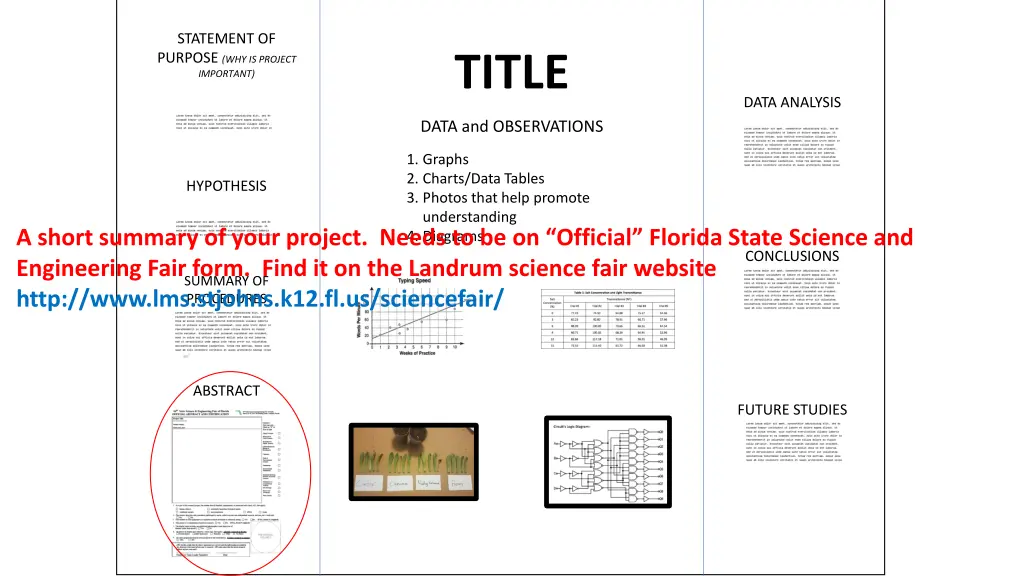
STATEMENT OF PURPOSE (WHY IS PROJECT IMPORTANT) TITLE DATA ANALYSIS DATA and OBSERVATIONS 1. Graphs 2. Charts/Data Tables 3. Photos that help promote understanding 4. Diagrams HYPOTHESIS A short summary of your project. Needs to be on Official Florida State Science and Engineering Fair form. Find it on the Landrum science fair website http://www.lms.stjohns.k12.fl.us/sciencefair/ CONCLUSIONS SUMMARY OF PROCEDURES ABSTRACT FUTURE STUDIES (OPTIONAL)
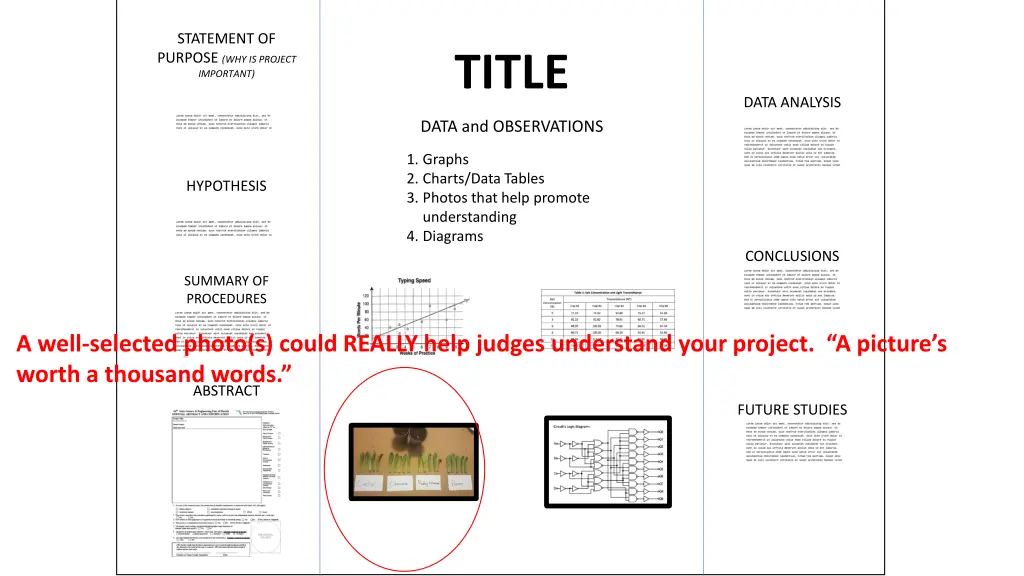
STATEMENT OF PURPOSE (WHY IS PROJECT IMPORTANT) TITLE DATA ANALYSIS DATA and OBSERVATIONS 1. Graphs 2. Charts/Data Tables 3. Photos that help promote understanding 4. Diagrams HYPOTHESIS CONCLUSIONS SUMMARY OF PROCEDURES A well-selected photo(s) could REALLY help judges understand your project. A picture s worth a thousand words. ABSTRACT FUTURE STUDIES (OPTIONAL)
STATEMENT OF PURPOSE (WHY IS PROJECT IMPORTANT) TITLE DATA ANALYSIS DATA and OBSERVATIONS 1. Graphs 2. Charts/Data Tables 3. Photos that help promote understanding 4. Diagrams HYPOTHESIS CONCLUSIONS SUMMARY OF PROCEDURES ABSTRACT FUTURE STUDIES (OPTIONAL)














![Project Initiation Document for [Insert.Project.name] [Insert.Project.number]](/thumb/226757/project-initiation-document-for-insert-project-name-insert-project-number.jpg)