Materials Management: Organizing and Coordinating Functions
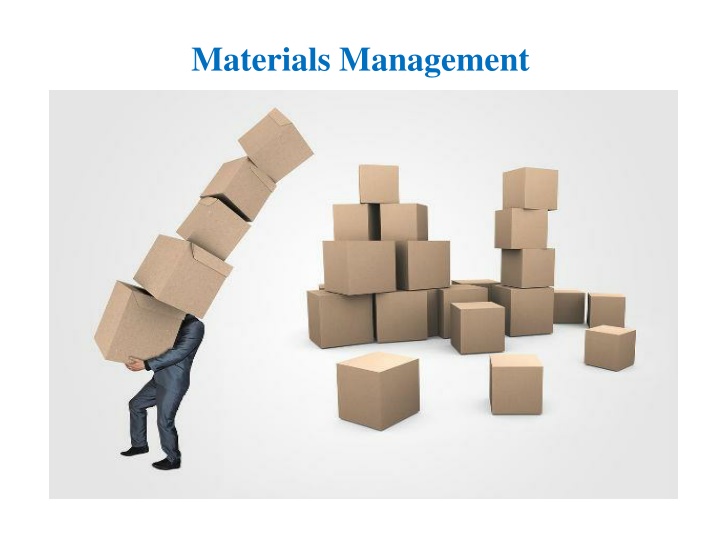
Materials management involves organizing, coordinating all management functions related to materials, storage, and transformation. It is essential for controlling costs, optimizing results, and achieving maximum return on working capital. Learn about the importance, definition, and strategies for effective materials management.

Download Presentation

Please find below an Image/Link to download the presentation.
The content on the website is provided AS IS for your information and personal use only. It may not be sold, licensed, or shared on other websites without obtaining consent from the author.If you encounter any issues during the download, it is possible that the publisher has removed the file from their server.
You are allowed to download the files provided on this website for personal or commercial use, subject to the condition that they are used lawfully. All files are the property of their respective owners.
The content on the website is provided AS IS for your information and personal use only. It may not be sold, licensed, or shared on other websites without obtaining consent from the author.
E N D
Presentation Transcript
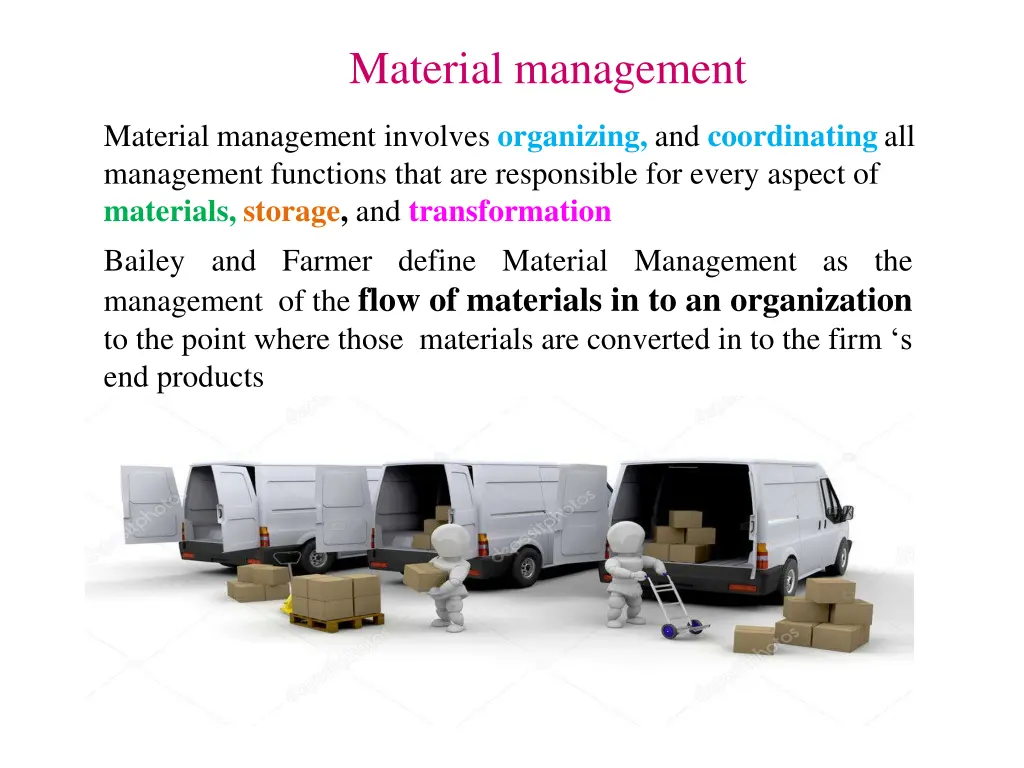
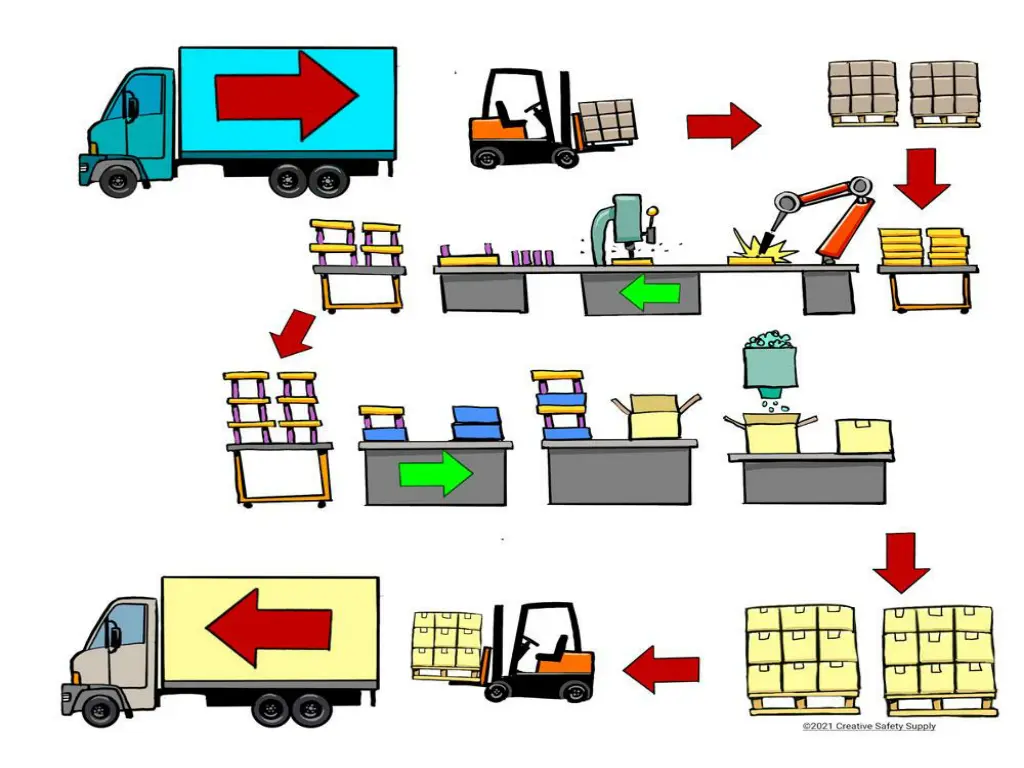
Material management Material management involves organizing, and coordinatingall management functions that are responsible for every aspect of materials, storage, and transformation Bailey and Farmer define Material Management as the management of the flow of materials in to an organization to the point where those materials are converted in to the firm s end products
Materials Management Meaning The need for materials management was first felt in manufacturing undertakings. The servicing organizations also started feeling the need for this control. And now even non-trading organizations like hospitals, universities etc. have realized the importance of materials management. Every organization uses a number of materials. It is necessary that these materials are properly purchased, stored and used.
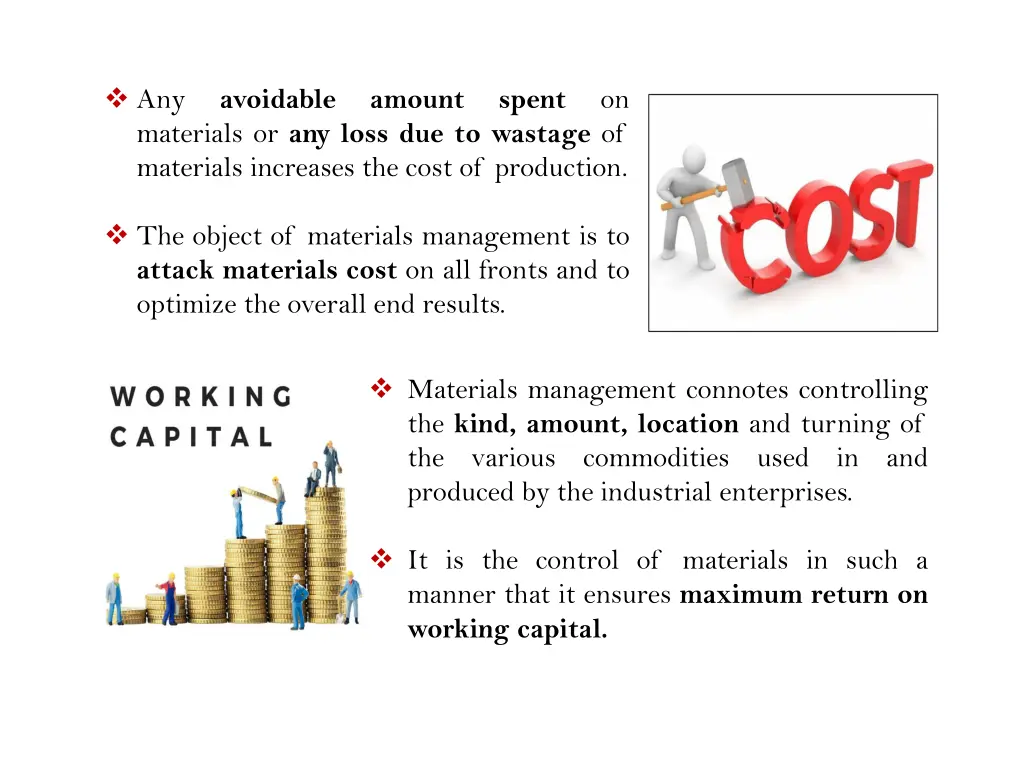
Any materials or any loss due to wastage of materials increases the cost of production. avoidable amount spent on The object of materials management is to attack materials cost on all fronts and to optimize the overall end results. Materials management connotes controlling the kind, amount, location and turning of the various commodities used in and produced by the industrial enterprises. It is the control of materials in such a manner that it ensures maximum return on working capital.
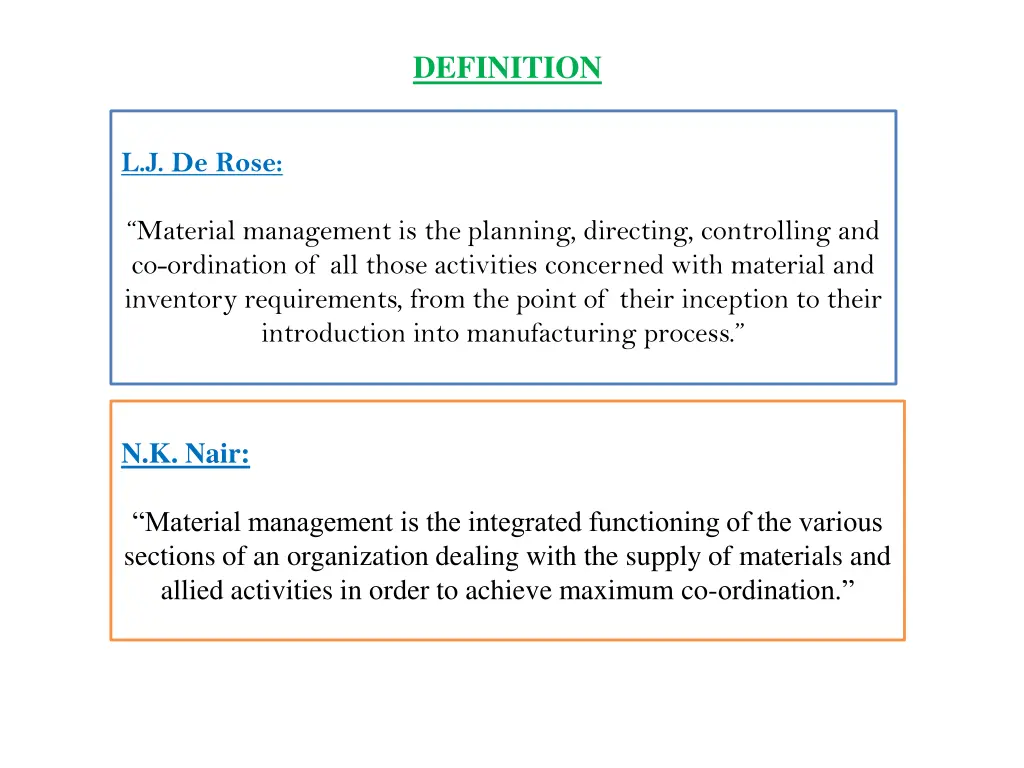
DEFINITION L.J. De Rose: Material management is the planning, directing, controlling and co-ordination of all those activities concerned with material and inventory requirements, from the point of their inception to their introduction into manufacturing process. N.K. Nair: Material management is the integrated functioning of the various sections of an organization dealing with the supply of materials and allied activities in order to achieve maximum co-ordination.
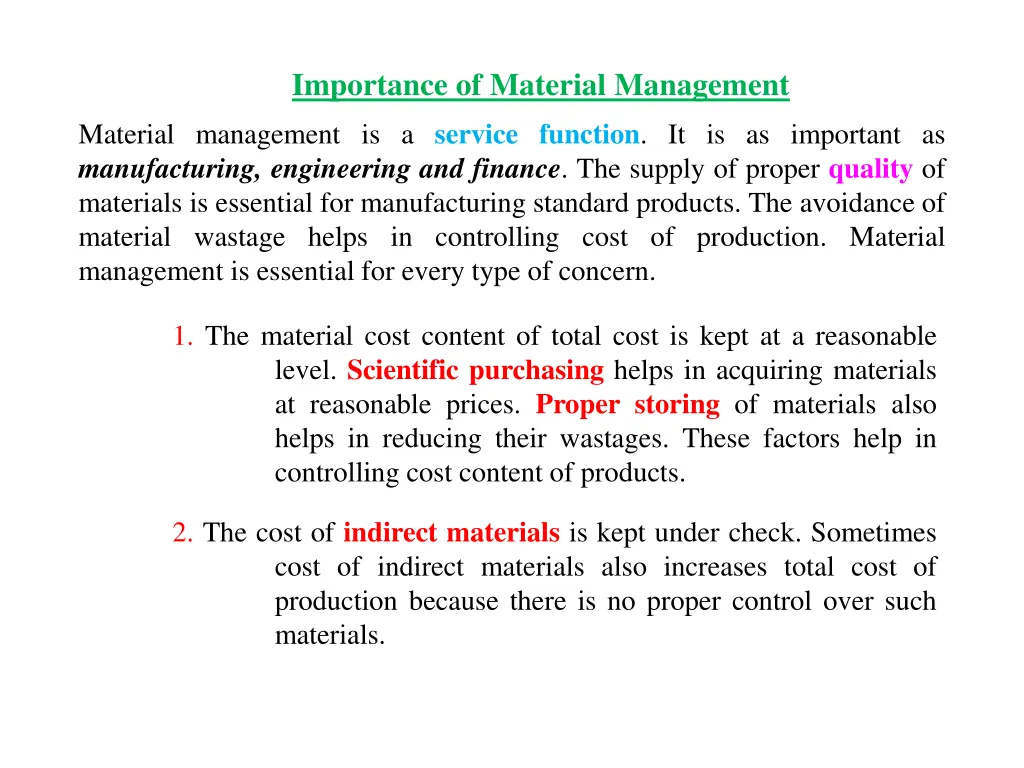
Importance of Material Management Material management is a service function. It is as important as manufacturing, engineering and finance. The supply of proper quality of materials is essential for manufacturing standard products. The avoidance of material wastage helps in controlling cost of production. Material management is essential for every type of concern. 1. The material cost content of total cost is kept at a reasonable level. Scientific purchasing helps in acquiring materials at reasonable prices. Proper storing of materials also helps in reducing their wastages. These factors help in controlling cost content of products. 2. The cost of indirect materials is kept under check. Sometimes cost of indirect materials also increases total cost of production because there is no proper control over such materials.
3. The equipment is properly utilized because there are no break downs due to late supply of materials. 4. The loss of direct labour is avoided. 5. The wastages of materials at the stage of storage as well as their movement is kept under control. 6. The supply of materials is prompt and late delivery instances are only few. 7. The investments on materials are kept under control as under and over stocking is avoided. 8. Congestion in the stores and at different stages of manufacturing is avoided.
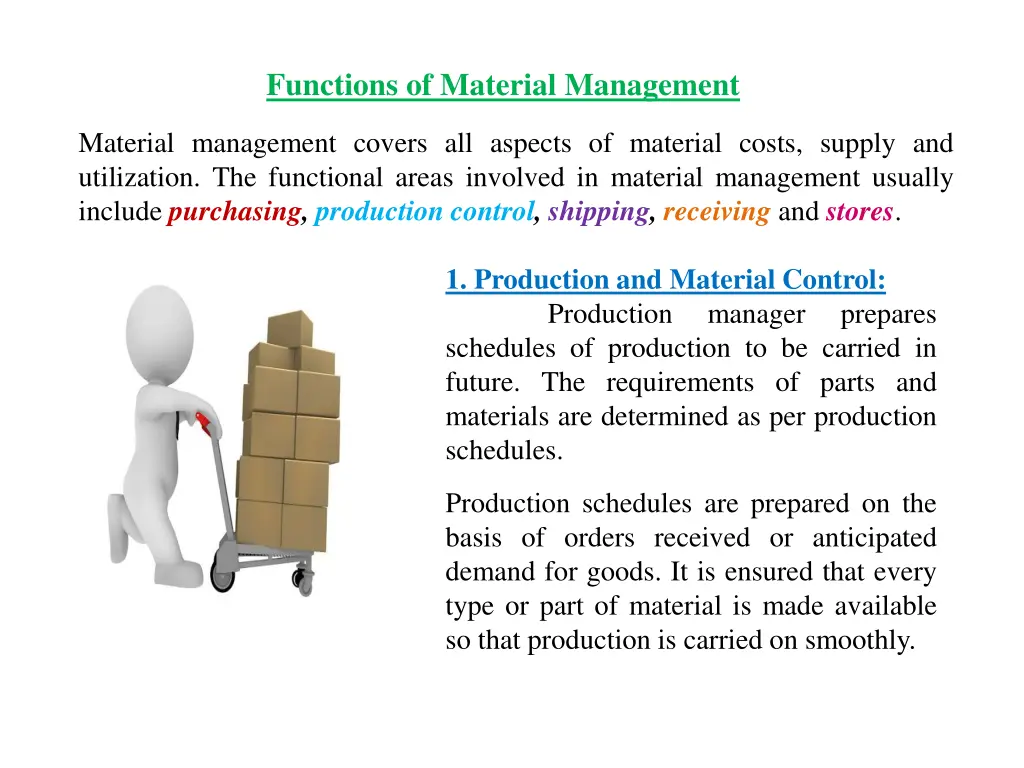
Functions of Material Management Material management covers all aspects of material costs, supply and utilization. The functional areas involved in material management usually include purchasing, production control, shipping, receivingand stores. 1. Production and Material Control: Production schedules of production to be carried in future. The requirements of parts and materials are determined as per production schedules. manager prepares Production schedules are prepared on the basis of orders received or anticipated demand for goods. It is ensured that every type or part of material is made available so that production is carried on smoothly.
2. Purchasing: Purchasing department is authorized to make buying arrangements on the basis of requisitions issued by other departments. This department keeps contracts with suppliers and collects quotations etc. at regular intervals. The effort by this department is to purchase proper quality goods at reasonable prices. Purchasing is a managerial activity that goes beyond the simple act of buying and includes the planning and policy activities covering a wide range of related and complementary activities. 3. Non-Production Stores: Non-production materials like office supplies, perishable tools and maintenance, repair and operating supplies are maintained as per the needs of the business. These stores may not be required daily but their availability in stores is essential. The non-availability of such stores may lead to stoppage of work.
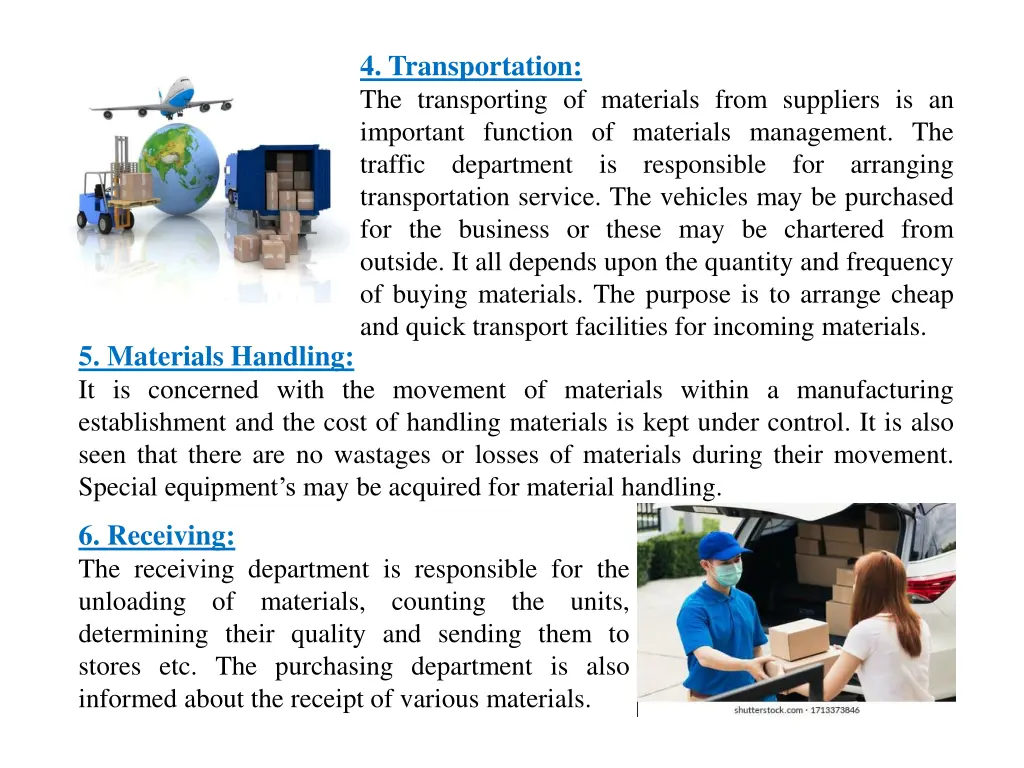
4. Transportation: The transporting of materials from suppliers is an important function of materials management. The traffic department is responsible for arranging transportation service. The vehicles may be purchased for the business or these may be chartered from outside. It all depends upon the quantity and frequency of buying materials. The purpose is to arrange cheap and quick transport facilities for incoming materials. 5. Materials Handling: It is concerned with the movement of materials within a manufacturing establishment and the cost of handling materials is kept under control. It is also seen that there are no wastages or losses of materials during their movement. Special equipment s may be acquired for material handling. 6. Receiving: The receiving department is responsible for the unloading of materials, counting the units, determining their quality and sending them to stores etc. The purchasing department is also informed about the receipt of various materials.
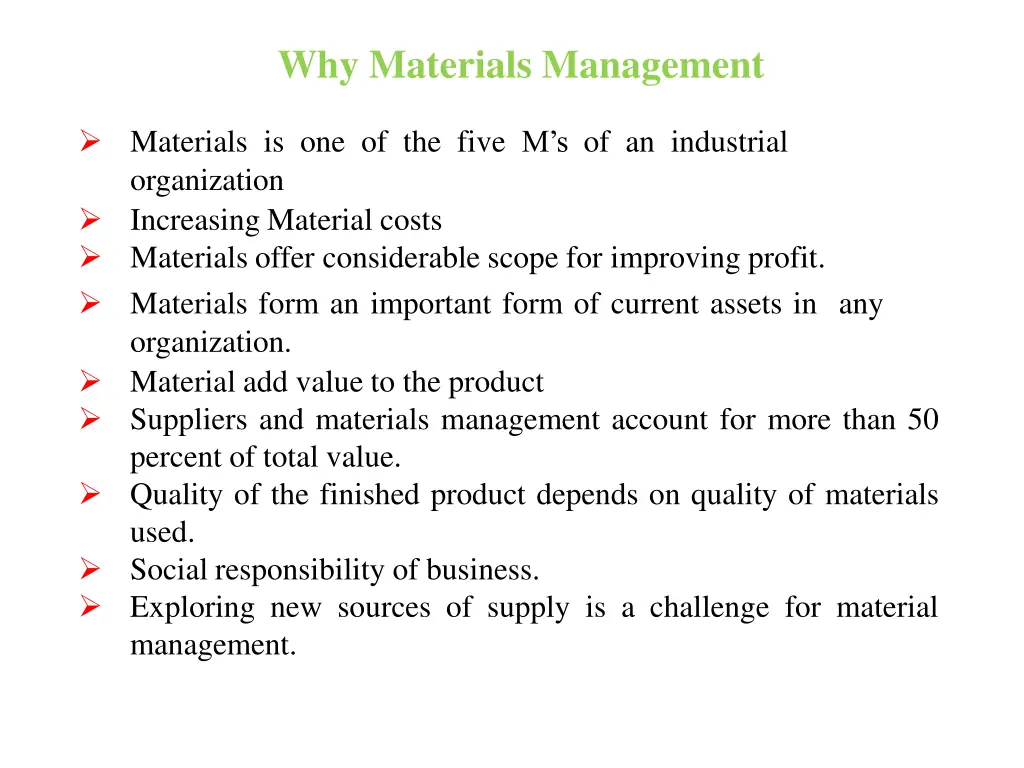
Why Materials Management Materials is one of the five M s of an industrial organization Increasing Material costs Materials offer considerable scope for improving profit. Materials form an important form of current assets in any organization. Material add value to the product Suppliers and materials management account for more than 50 percent of total value. Quality of the finished product depends on quality of materials used. Social responsibility of business. Exploring new sources of supply is a challenge for material management.
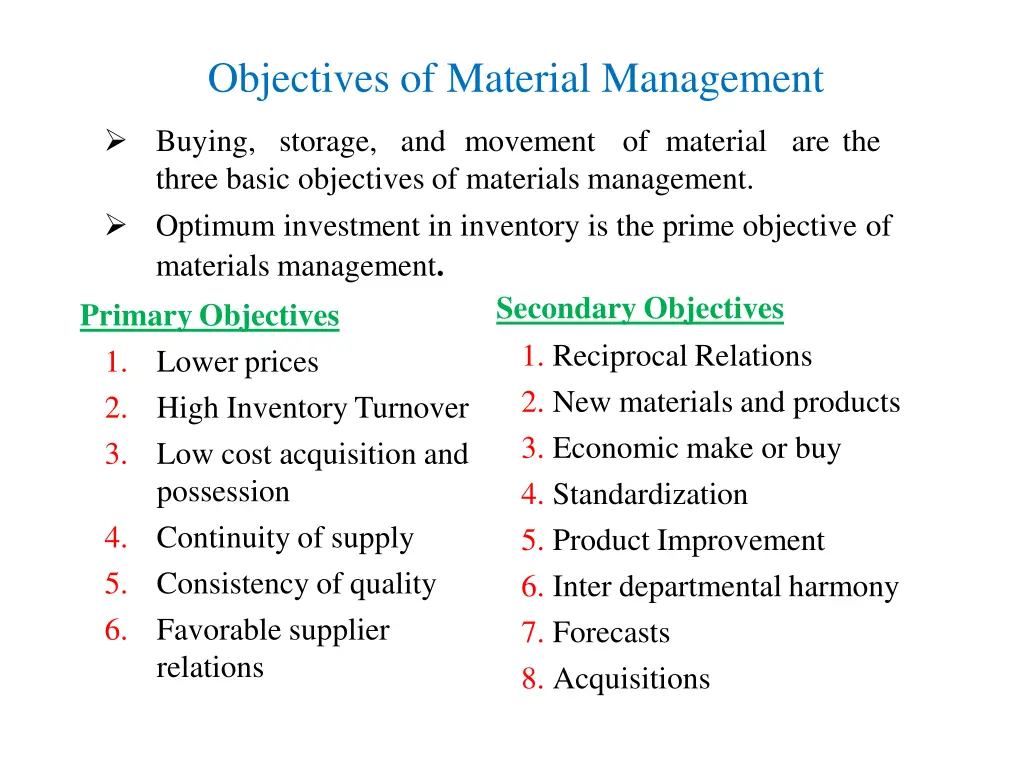
Objectives of Material Management Buying, storage, and movement of material are the three basic objectives of materials management. Optimum investment in inventory is the prime objective of materials management. Primary Objectives 1. Lower prices 2. High Inventory Turnover 3. Low cost acquisition and possession 4. Continuity of supply 5. Consistency of quality 6. Favorable supplier relations Secondary Objectives 1. Reciprocal Relations 2. New materials and products 3. Economic make or buy 4. Standardization 5. Product Improvement 6. Inter departmental harmony 7. Forecasts 8. Acquisitions
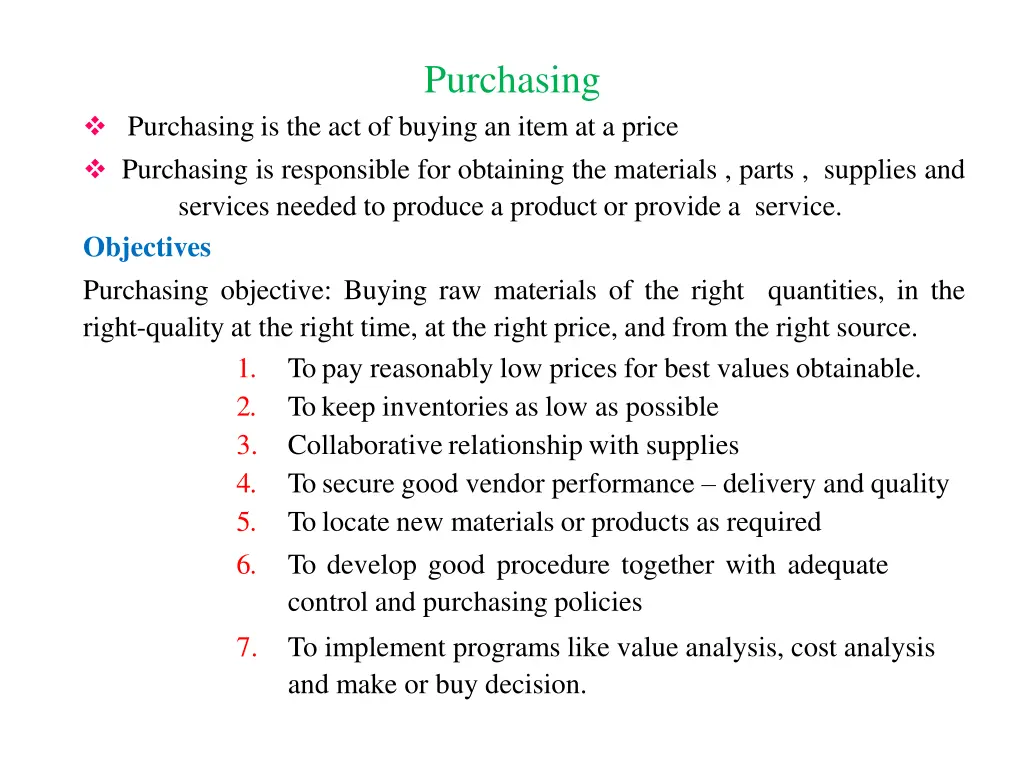
Purchasing Purchasing is the act of buying an item at a price Purchasing is responsible for obtaining the materials , parts , supplies and services needed to produce a product or provide a service. Objectives Purchasing objective: Buying raw materials of the right quantities, in the right-quality at the right time, at the right price, and from the right source. 1. To pay reasonably low prices for best values obtainable. 2. Tokeep inventories as low as possible 3. Collaborativerelationship with supplies 4. To secure good vendor performance delivery and quality 5. To locate new materials or products as required 6. To develop good procedure together with adequate control and purchasing policies 7. To implement programs like value analysis, cost analysis and make or buy decision.
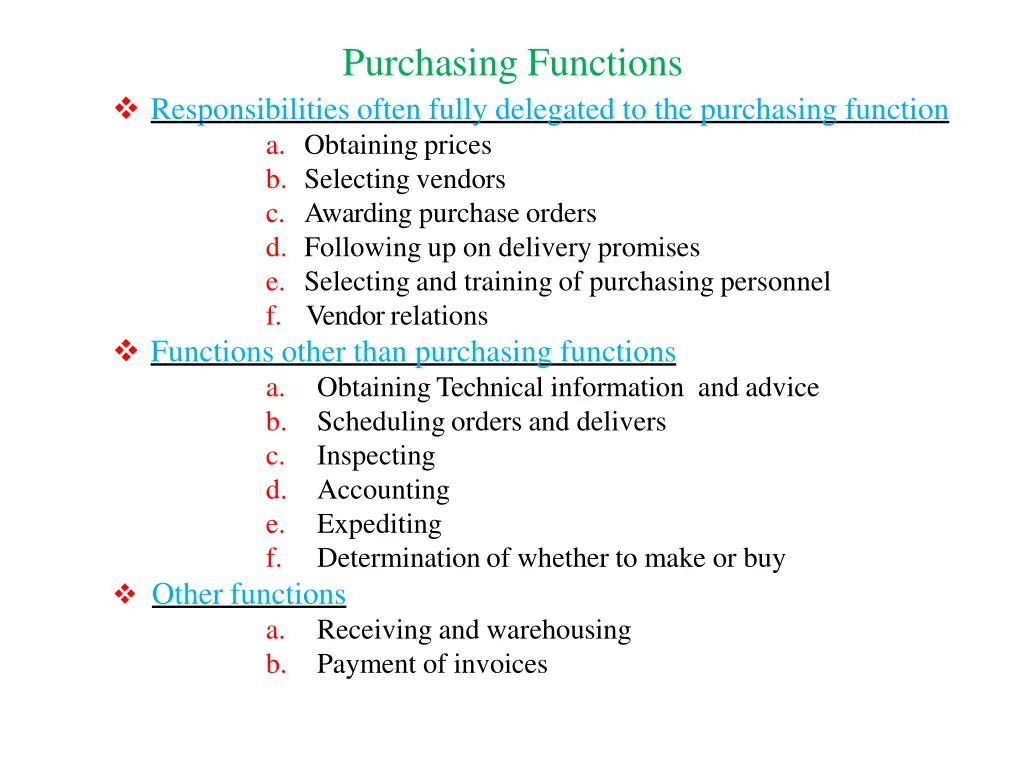
Purchasing Functions Responsibilities often fully delegated to the purchasing function a. Obtainingprices b. Selecting vendors c. Awarding purchase orders d. Following up on delivery promises e. Selecting and training of purchasing personnel f. Vendorrelations Functions other than purchasing functions a. ObtainingTechnical information and advice b. Scheduling orders and delivers c. Inspecting d. Accounting e. Expediting f. Determination of whether to make or buy Other functions a. Receiving and warehousing b. Payment of invoices
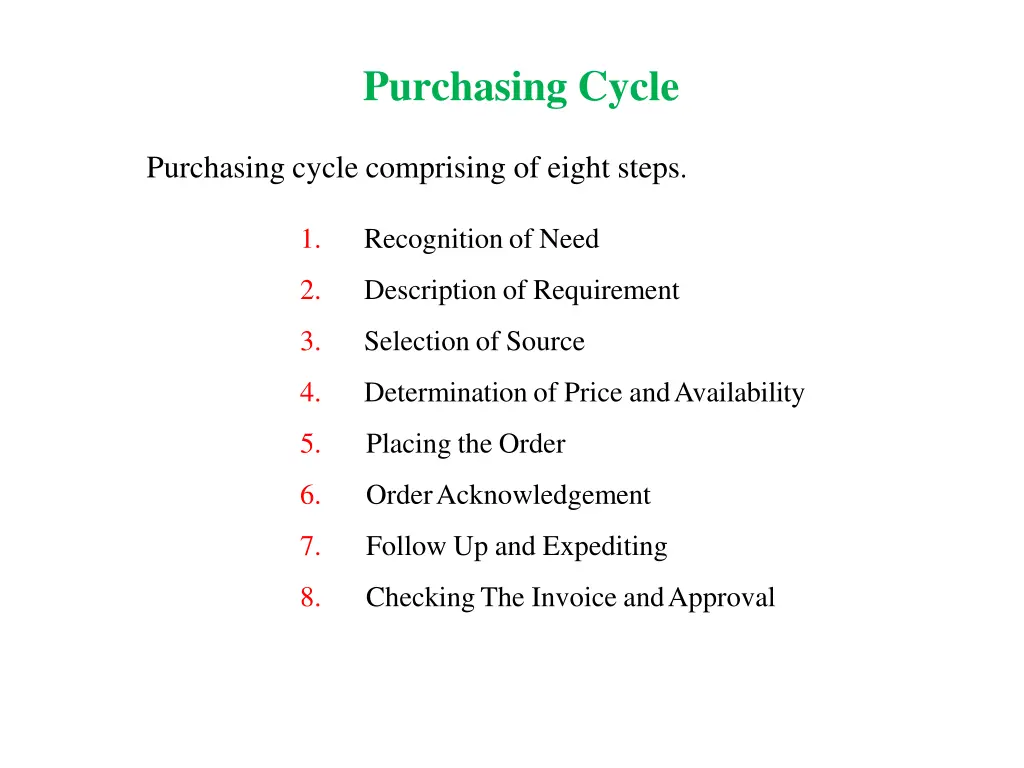
Purchasing Cycle Purchasing cycle comprising of eight steps. 1. Recognition of Need 2. Description of Requirement 3. Selection of Source 4. Determination of Price andAvailability 5. Placing the Order 6. OrderAcknowledgement 7. Follow Up and Expediting 8. CheckingThe Invoice andApproval
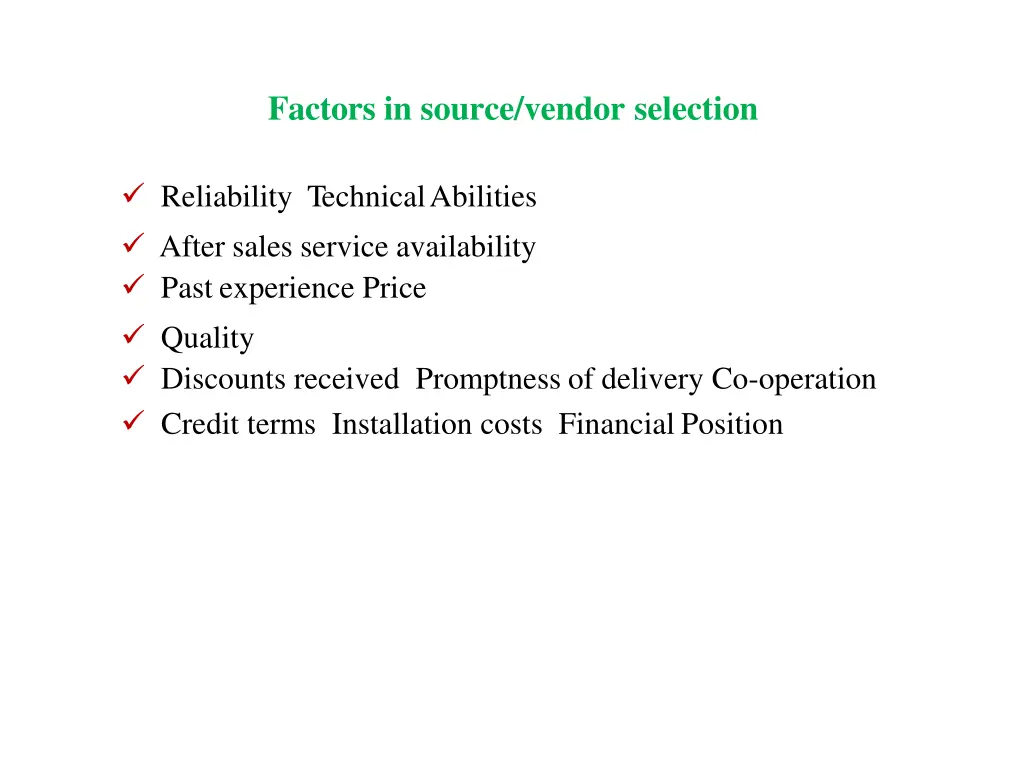
Factors in source/vendor selection Reliability TechnicalAbilities After sales service availability Past experience Price Quality Discounts received Promptness of delivery Co-operation Credit terms Installation costs Financial Position
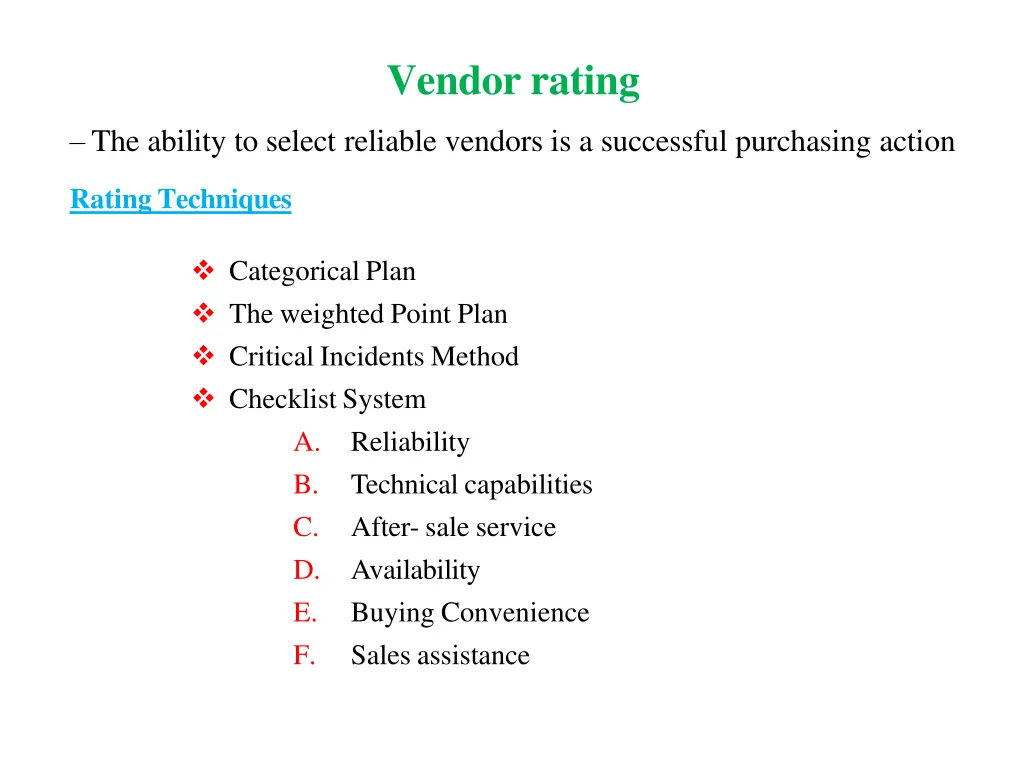
Vendor rating The ability to select reliable vendors is a successful purchasing action Rating Techniques Categorical Plan The weighted Point Plan Critical Incidents Method Checklist System A. Reliability B. Technical capabilities C. After- sale service D. Availability E. Buying Convenience F. Sales assistance
Ethics in Purchasing Ethics is segment of philosophy concerned with values of human conduct. the term ethics refers to a code of conduct that guides an individual in dealing with others. Ways to achieving Ethical Behaviour Definite polices on all matters involving ethics should be formulated An attempt should be environment,where unethical temptations seldom become realities made to create a working
Meaning of Material Handling: Material handling may be considered a specialized activity for modern manufacturing units. From the time, the input material or raw materials enter the industrial unit and go out of the unit in the form of finished products, these are handled at all stages in between, no matter, on the shop floor or in the stores. It has been estimated that the average material handling cost is roughly 30 to 60% of the cost of production. This is so since majority of production time is consumed in handling materials before, manufacture. during and after the However, this cost can be reduced byproper selection, operation, maintenance and layout of material handling devices but cannot be totally eliminated.
The material handling problem must be analyzed thoroughly at the time planning of various machines and tools needed before erection of factory building. While designing new plants, materials handling is a prime consideration and several existing plants can be modified by the utilization of modem material handling devices. The cost of production is decreased by the use of these devices since these devices increase output, improve the quality and speed up the deliveries.
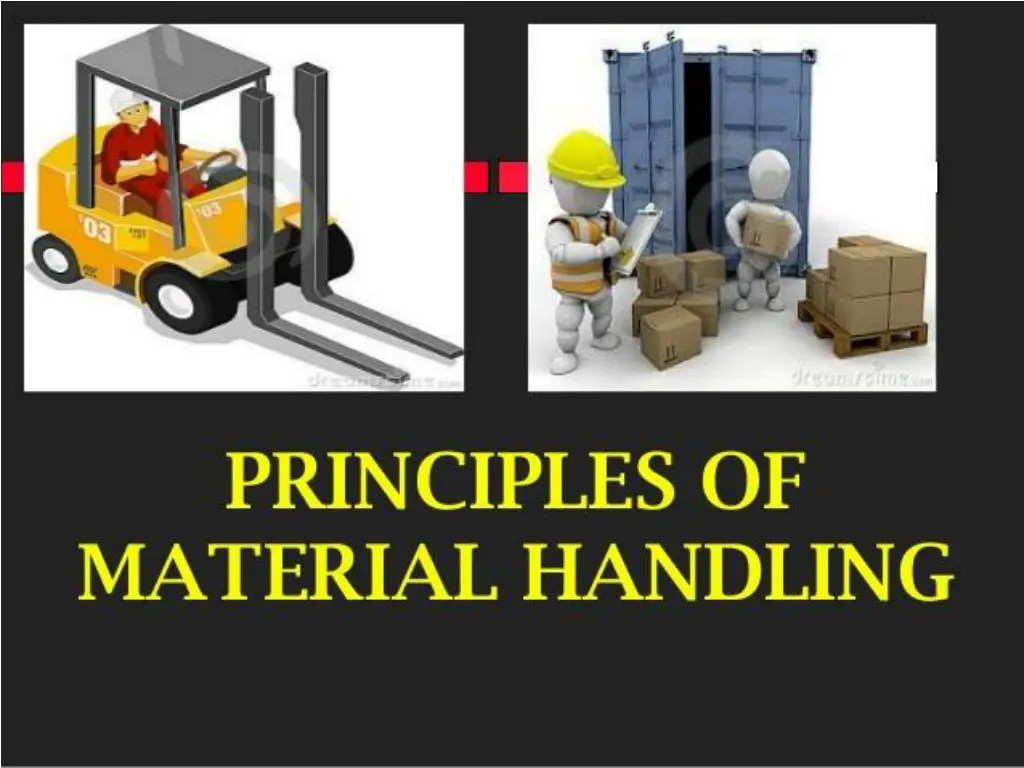
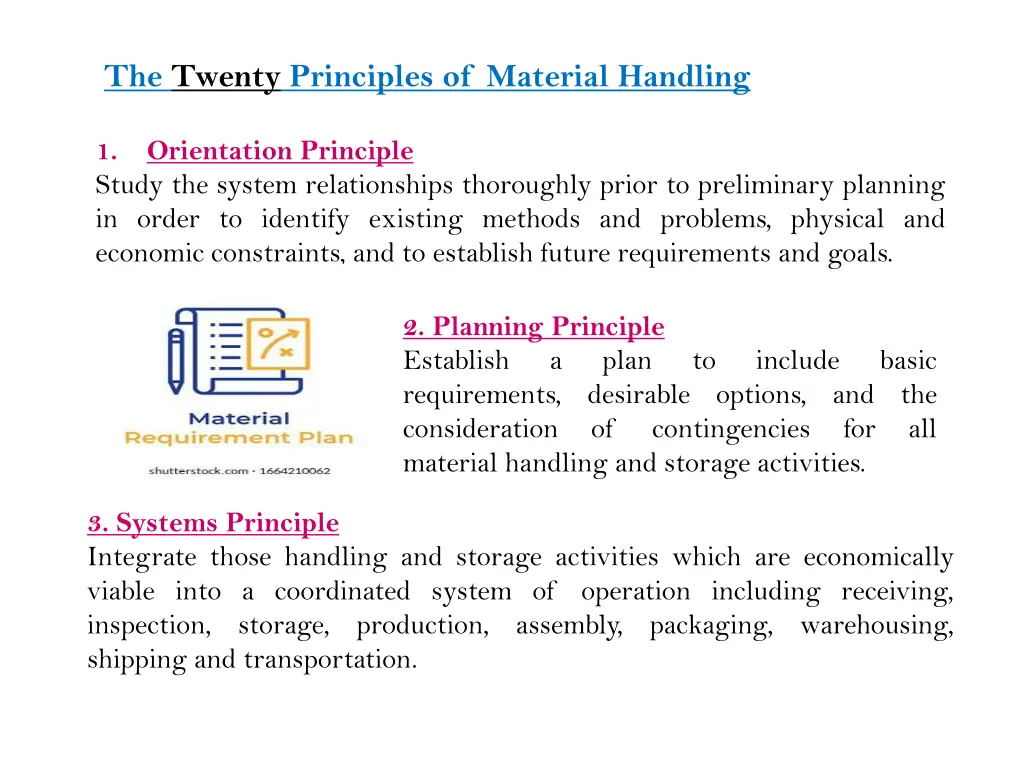
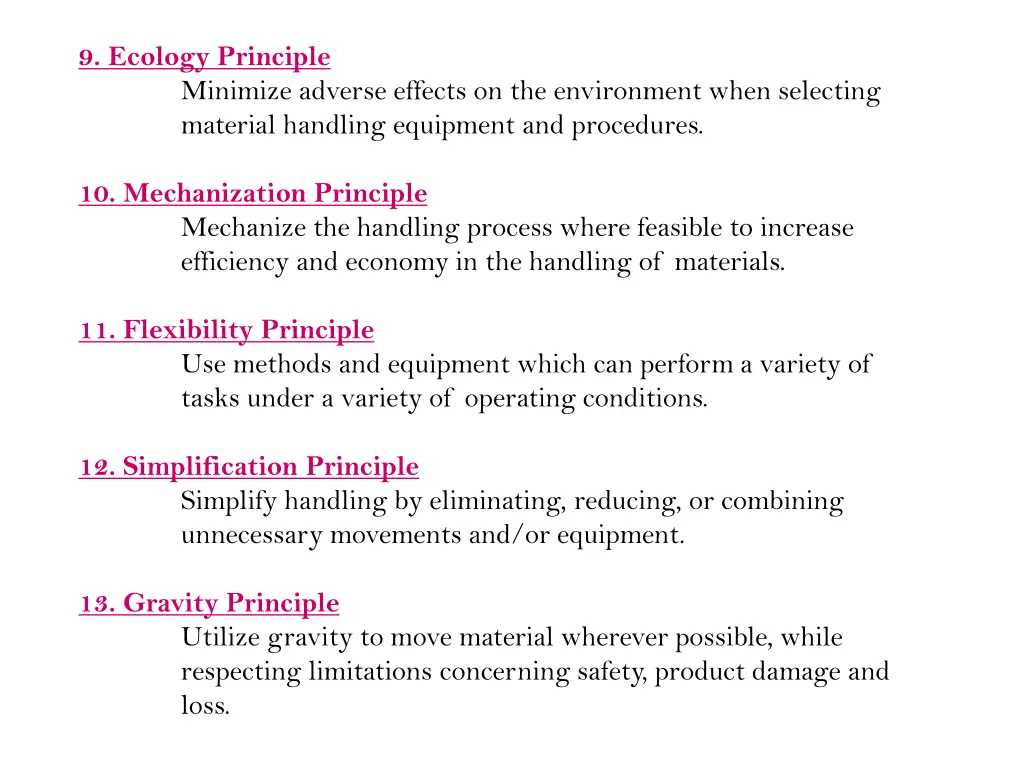
The Twenty Principles of Material Handling 1. Study the system relationships thoroughly prior to preliminary planning in order to identify existing methods and problems, physical and economic constraints, and to establish future requirements and goals. Orientation Principle 2. Planning Principle Establish requirements, desirable options, and the consideration of contingencies for all material handling and storage activities. a plan to include basic 3. Systems Principle Integrate those handling and storage activities which are economically viable into a coordinated system of operation including receiving, inspection, storage, production, assembly, packaging, warehousing, shipping and transportation.
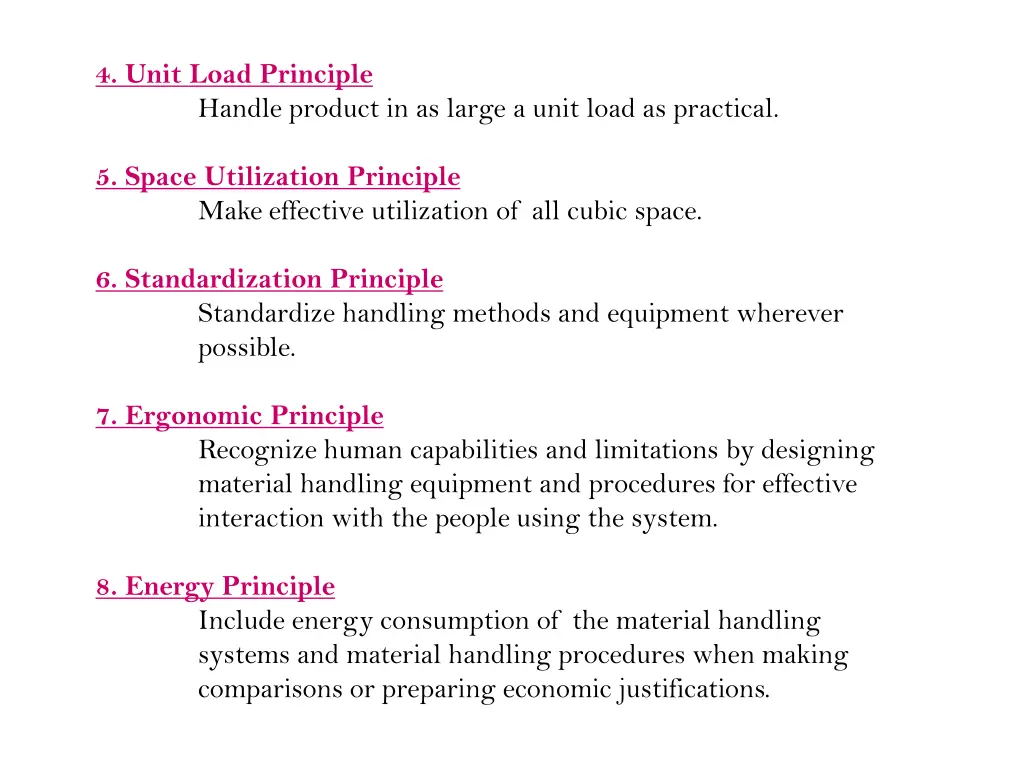
4. Unit Load Principle Handle product in as large a unit load as practical. 5. Space Utilization Principle Make effective utilization of all cubic space. 6. Standardization Principle Standardize handling methods and equipment wherever possible. 7. Ergonomic Principle Recognize human capabilities and limitations by designing material handling equipment and procedures for effective interaction with the people using the system. 8. Energy Principle Include energy consumption of the material handling systems and material handling procedures when making comparisons or preparing economic justifications.
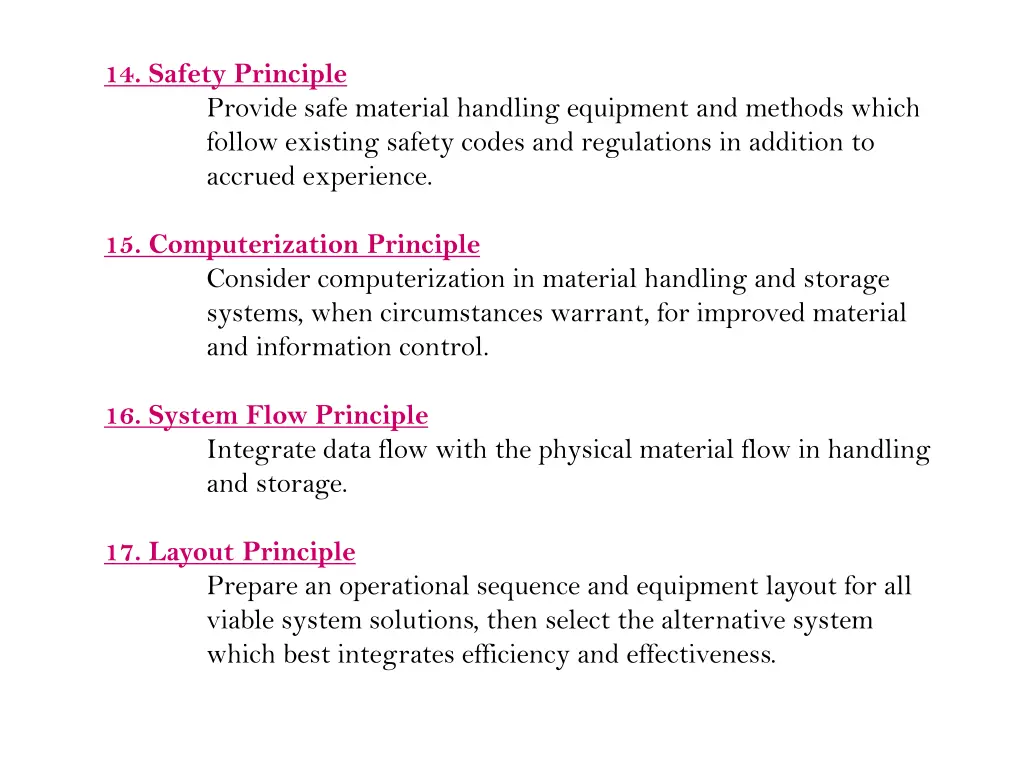
9. Ecology Principle Minimize adverse effects on the environment when selecting material handling equipment and procedures. 10. Mechanization Principle Mechanize the handling process where feasible to increase efficiency and economy in the handling of materials. 11. Flexibility Principle Use methods and equipment which can perform a variety of tasks under a variety of operating conditions. 12. Simplification Principle Simplify handling by eliminating, reducing, or combining unnecessary movements and/or equipment. 13. Gravity Principle Utilize gravity to move material wherever possible, while respecting limitations concerning safety, product damage and loss.
14. Safety Principle Provide safe material handling equipment and methods which follow existing safety codes and regulations in addition to accrued experience. 15. Computerization Principle Consider computerization in material handling and storage systems, when circumstances warrant, for improved material and information control. 16. System Flow Principle Integrate data flow with the physical material flow in handling and storage. 17. Layout Principle Prepare an operational sequence and equipment layout for all viable system solutions, then select the alternative system which best integrates efficiency and effectiveness.
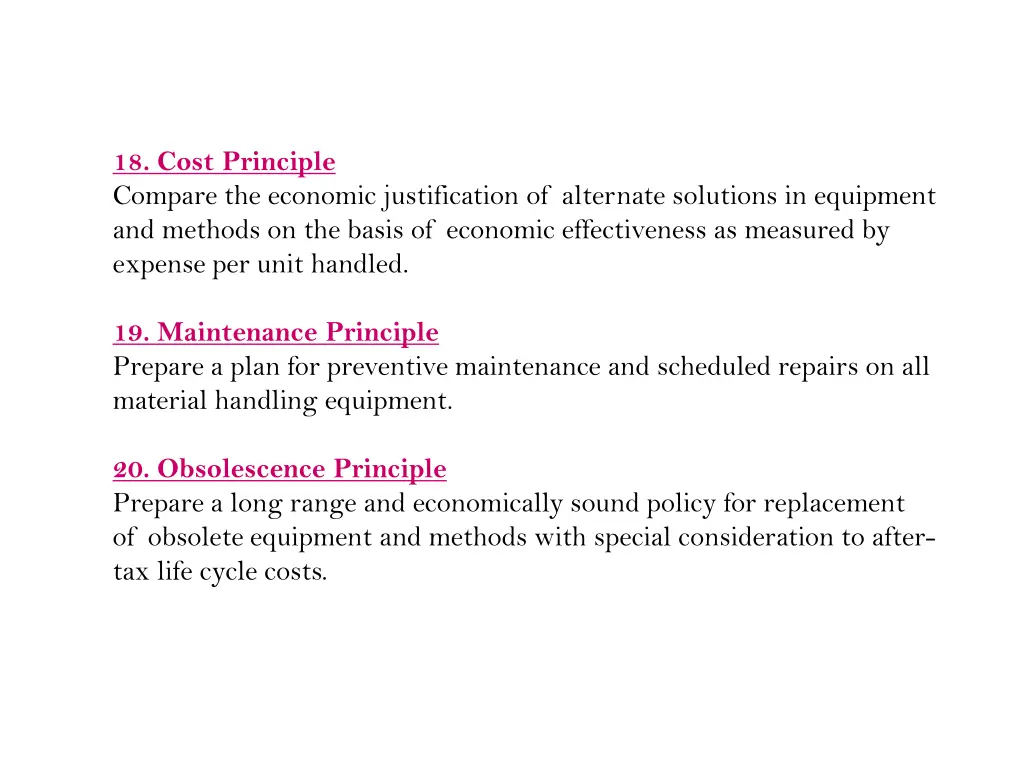
18. Cost Principle Compare the economic justification of alternate solutions in equipment and methods on the basis of economic effectiveness as measured by expense per unit handled. 19. Maintenance Principle Prepare a plan for preventive maintenance and scheduled repairs on all material handling equipment. 20. Obsolescence Principle Prepare a long range and economically sound policy for replacement of obsolete equipment and methods with special consideration to after- tax life cycle costs.