Mathematics in Virus Modelling During COVID-19
Explore the pivotal role of mathematics in understanding and controlling the spread of viruses, particularly during the COVID-19 pandemic. Delve into topics like indices, geometric and arithmetic series, modeling virus spread, social distancing, and the significance of the R number.

Download Presentation

Please find below an Image/Link to download the presentation.
The content on the website is provided AS IS for your information and personal use only. It may not be sold, licensed, or shared on other websites without obtaining consent from the author. If you encounter any issues during the download, it is possible that the publisher has removed the file from their server.
You are allowed to download the files provided on this website for personal or commercial use, subject to the condition that they are used lawfully. All files are the property of their respective owners.
The content on the website is provided AS IS for your information and personal use only. It may not be sold, licensed, or shared on other websites without obtaining consent from the author.
E N D
Presentation Transcript
THE MATHEMATICS OF VIRUS MODELLING
UNDERSTANDING HOW MATHS IS BEING USED DURING THE COVID 19 PANDEMIC We will look at how lockdown helps to control the spread of the virus using a mathematical perspective. We will look at different ways of visually representing this type of information.
LESSONS 1 AND 2 Maths Learning Intention 1 Indices - MTH 3-06a I can understand indices and how they can be used when describing the spread of a virus Maths Learning Intention 2 Geometric and Arithmetic Series - MTH 4-13a, Higher I know the difference between Arithmetic and Geometric Series and can identify examples of each. I can produce sets of numbers that represent both types of series.
LESSONS 3 AND 4 Maths Learning Intention 3 - Geometric Series - Higher I can model the spread of the Coronavirus, with and without Social Distancing, using the standard equation for a Geometric Series Maths Learning Intention 4 Drawing and Interpreting Graphs - MTH 4-21a I can choose an appropriate visual method to represent data
Maths Learning Intention 1 I can understand indices and how they can be used when describing the spread of a virus.
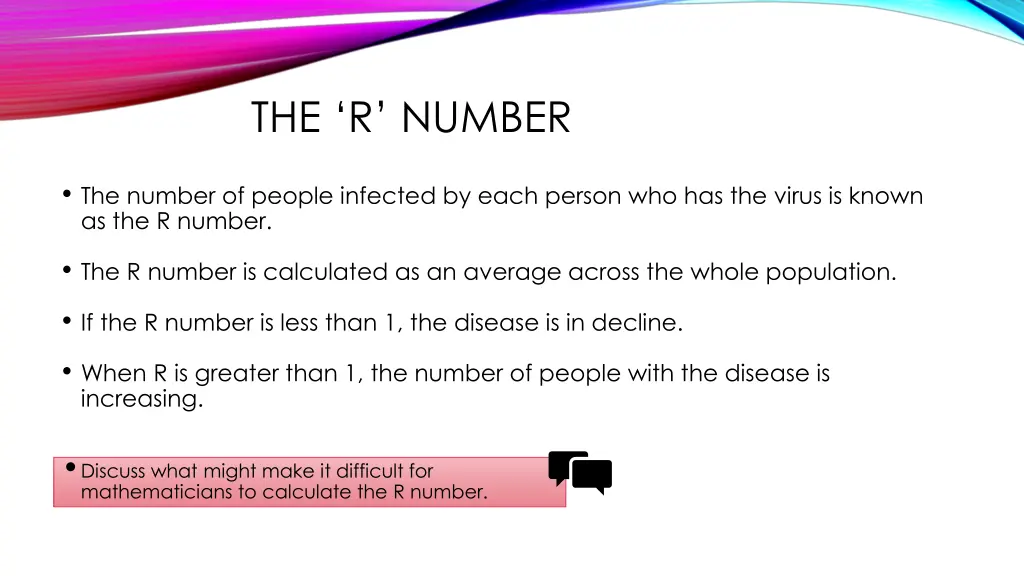
THE R NUMBER The number of people infected by each person who has the virus is known as the R number. The R number is calculated as an average across the whole population. If the R number is less than 1, the disease is in decline. When R is greater than 1, the number of people with the disease is increasing. Discuss what might make it difficult for mathematicians to calculate the R number.
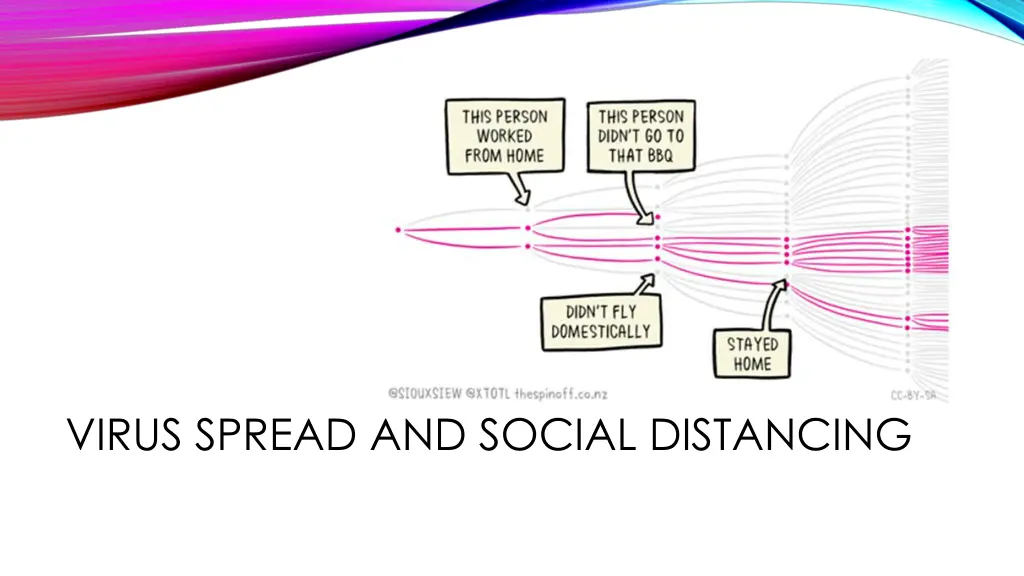
WHAT DOES THIS GRAPHIC MEAN IN NUMBERS? Without social isolation If each individual infected person gives it to another 3 people per week, after 5 weeks how many people in total, will have been infected? With some social isolation If each infected person gives it to another 2 people instead of 3, how many people will have contracted the virus? 5min task have a go at working this out.
ANSWERS We can write these numbers using indices Without social isolation 1 + 3 + 9 + 27 + 81 + 243 = 364 1 + 3 + (3x3) + (3x3x3) + (3x3x3x3) + (3x3x3x3x3) = 30 + 31 + 32 + 33 + 34 + 35 = 364 With some social isolation 1 + 2 + 4 + 8 + 16 + 32 = 63 1 + 2 + (2x2) + (2x2x2) + (2x2x2x2) + (2x2x2x2x2) = 20 + 21 + 22 + 23 + 24 + 25 = 63
We say: 32 - 3 squared = 3 x 3 = 9 23 - 2 cubed = 2 x 2 x 2 = 8 56 - 5 to the power of 6 = 5 x 5 x 5 x 5 x 5 x 5 = 15625 INDICES 44 - 4 to the power of 4 = 4 x 4 x 4 x 4 = 256 40 - 4 to the power of 0 = 1 N.B. anything to the power of 0 is always 1
INDICES DICE ACTIVITY 10MINS Roll a dice twice. Calculate the first number you roll to the power of the second number. Example: First roll Second roll Write down: 3 to the power of 4 = 34 = 3 x 3 x 3 x 3 = 81
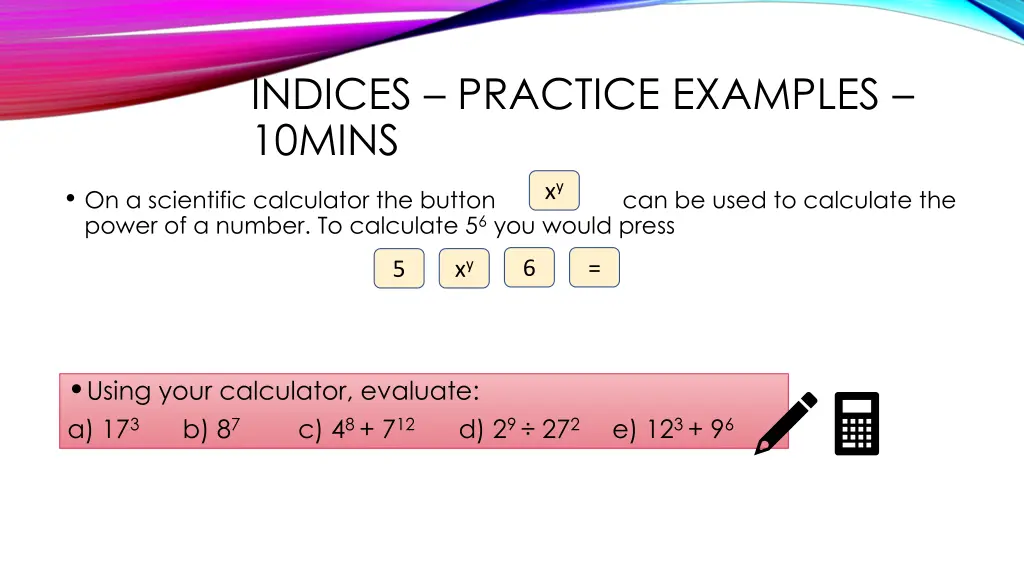
INDICES PRACTICE EXAMPLES 10MINS xy On a scientific calculator the button power of a number. To calculate 56 you would press can be used to calculate the xy 6 = 5 Using your calculator, evaluate: a) 173 b) 87 c) 48 + 712 d) 29 272 e) 123 + 96
STEPS FOR SUCCESS I understand what is meant by the R number Starting with 1 infected person, I can predict how many people will catch the virus with different levels of Social Distancing. I can show my calculations using indices I know how to use the button on my calculator xy
I know the difference between Arithmetic and Geometric Series and can identify examples of each. MATHS LEARNING INTENTION 2 I know how disease spread is modelled. I can produce sets of numbers that represent both types of series.
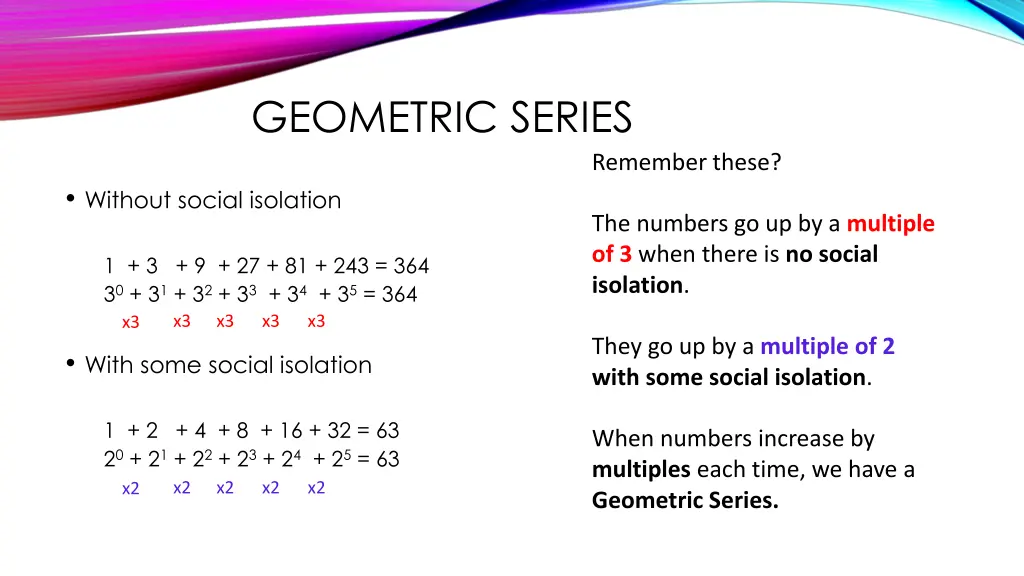
GEOMETRIC SERIES Remember these? Without social isolation The numbers go up by a multiple of 3 when there is no social isolation. 1 + 3 + 9 + 27 + 81 + 243 = 364 30 + 31 + 32 + 33 + 34 + 35 = 364 x3 x3 x3 x3 x3 They go up by a multiple of 2 with some social isolation. With some social isolation 1 + 2 + 4 + 8 + 16 + 32 = 63 20 + 21 + 22 + 23 + 24 + 25 = 63 x2 x2 x2 When numbers increase by multiples each time, we have a Geometric Series. x2 x2
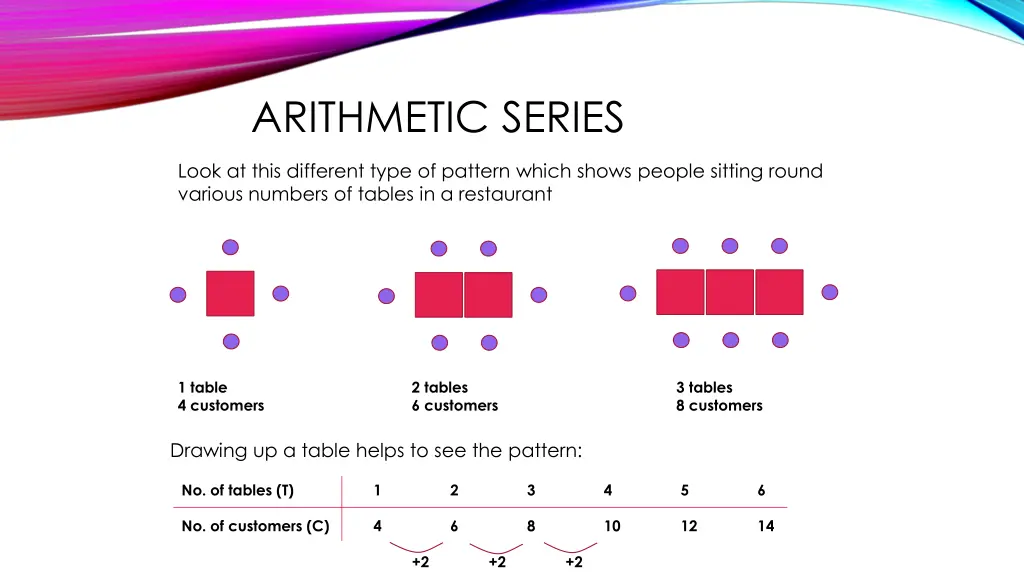
ARITHMETIC SERIES Look at this different type of pattern which shows people sitting round various numbers of tables in a restaurant 1 table 4 customers 2 tables 6 customers 3 tables 8 customers Drawing up a table helps to see the pattern: No. of tables (T) 1 2 3 4 5 6 No. of customers (C) 4 6 8 10 12 14 +2 +2 +2
ARITHMETIC AND GEOMETRIC SERIES In an arithmetic series the numbers go up by a constant amount each time 4, 6, 8, 10, 12, 14, +2 +2 +2 +2 +2 In a geometric series the numbers go up by a multiple each time 4, 8, 16, 32, 64, x2 x2 x2 x2 10 min task: Create an example of each type of series starting with the number 3.
ARITHMETIC AND GEOMETRIC SERIES When numbers increase by multiples each time, we use a Geometric Series to model them. This is how COVID 19 spread. An Arithmetic Series is used to when things are increasing/ decreasing in a linear way, i.e. by adding or subtracting a constant value each time.
STEPS FOR SUCCESS I know that an arithmetic series increases by adding a value each time I know that a geometric series increases by multiplying by a value each time I know that the spread of disease can be modelled using a geometric series
MATHS LEARNING INTENTION 3 I can understand the spread of disease using the standard equation for a Geometric Series.
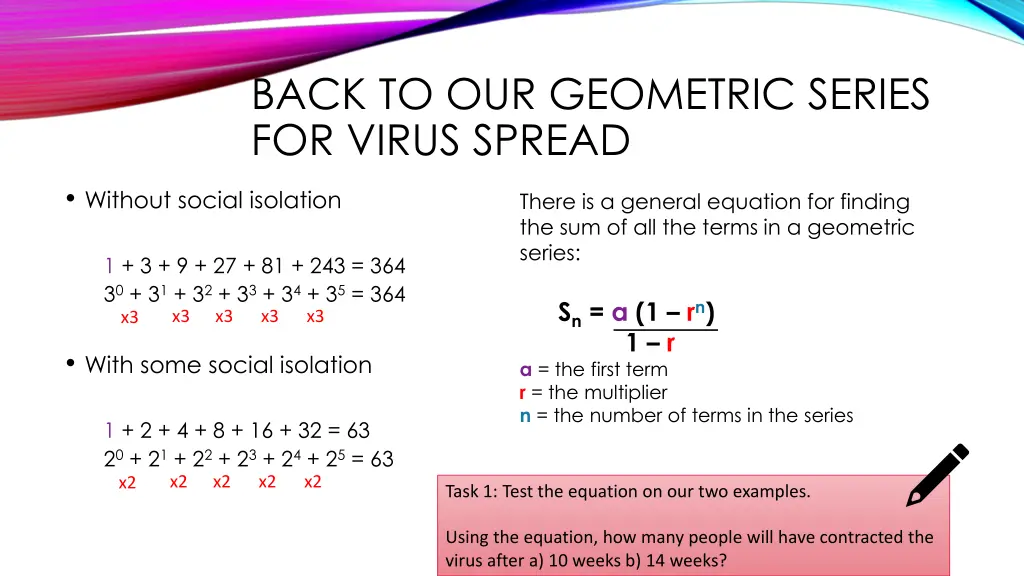
BACK TO OUR GEOMETRIC SERIES FOR VIRUS SPREAD Without social isolation There is a general equation for finding the sum of all the terms in a geometric series: 1 + 3 + 9 + 27 + 81 + 243 = 364 30 + 31 + 32 + 33 + 34 + 35 = 364 x3 x3 x3 a = the first term r = the multiplier n = the number of terms in the series Sn = a (1 rn) 1 r x3 x3 With some social isolation 1 + 2 + 4 + 8 + 16 + 32 = 63 20 + 21 + 22 + 23 + 24 + 25 = 63 x2 x2 x2 x2 x2 Task 1: Test the equation on our two examples. Using the equation, how many people will have contracted the virus after a) 10 weeks b) 14 weeks?
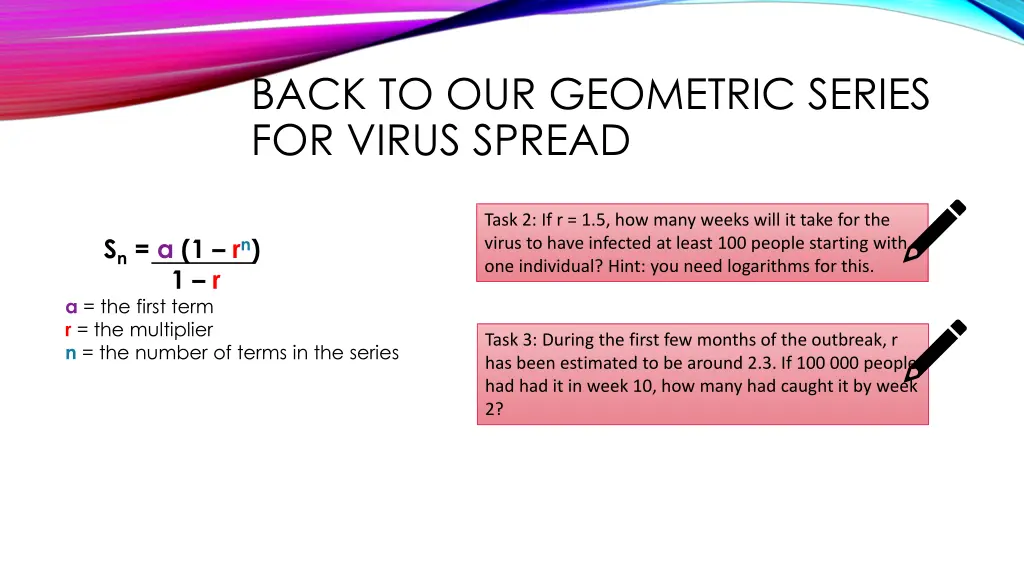
BACK TO OUR GEOMETRIC SERIES FOR VIRUS SPREAD Task 2: If r = 1.5, how many weeks will it take for the virus to have infected at least 100 people starting with one individual? Hint: you need logarithms for this. a = the first term r = the multiplier n = the number of terms in the series Sn = a (1 rn) 1 r Task 3: During the first few months of the outbreak, r has been estimated to be around 2.3. If 100 000 people had had it in week 10, how many had caught it by week 2?
MORE ON THE R NUMBER You may have heard about the R number in the news? This is the number of people each infected person passes the disease on to (r in our equation). For the virus to be in decline, the R number must be less than 1. So if 10 people have the virus and R is 0.6, they will pass it on to 6 other people. Task 4: 100 people have a virus. Work out how many cycles it will take for the virus to die out if a) R is 0.7. b) Repeat for R = 0.5? Hint: The virus has died out when the number of people catching it in that week is less than 1
ANSWERS Slide 22 1. Slide 23 2. 3. Slide 24 4. a) With r = 3: At 10 weeks 59050, at 14 weeks 2 391 484 b) With r = 2: At 10 weeks 1023 people, at 14 weeks 16 383 people 9.59 weeks 166.2 people a)13 weeks b) 7 weeks
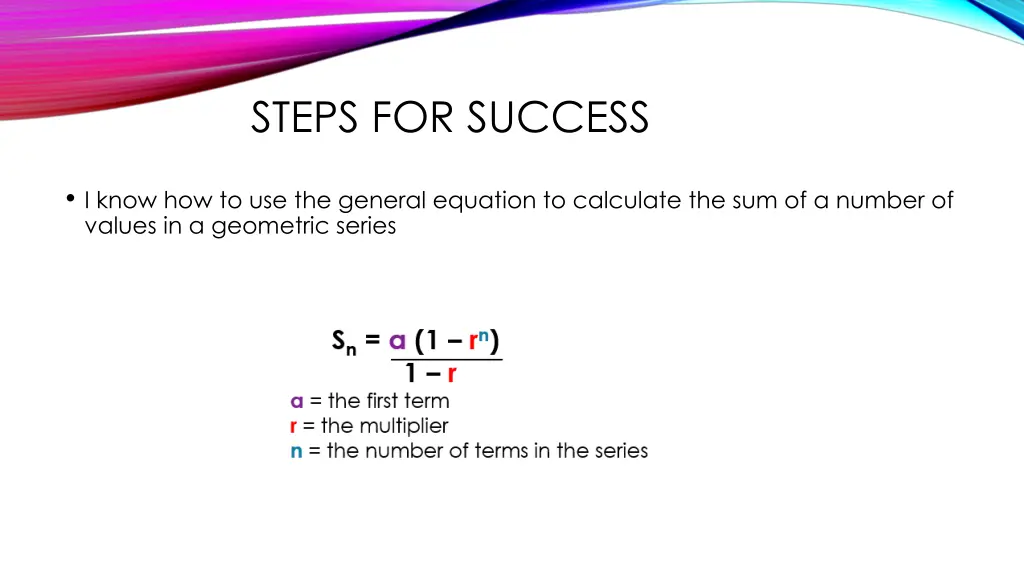
STEPS FOR SUCCESS I know how to use the general equation to calculate the sum of a number of values in a geometric series
MATHS LEARNING INTENTION 4 I can choose an appropriate visual method to represent data.
WAYS OF REPRESENTING DATA 0 1 2 3 New cases - without social distancing 1 3 Total 1 4 New cases - with some social distancing 1 2 Total 1 3 Which is the best way to display this data? Pie chart, bar graph, line graph, scatter graph, other. Week 4 5 9 13 40 121 364 4 8 7 15 31 63 27 81 243 16 32 5min discussion - With a partner, discuss the best way to display the data showing the difference that Social Distancing can make in the spread of a virus. Task 15min. Using your chosen method, use it to display the data in the table. Be ready to justify your decisions.
LINE GRAPH OF THE DATA WITH/WITHOUT SOCIAL DISTANCING Week New cases - without social distancing Total New cases - with some social distancing Total 0 1 1 1 1 1 3 4 2 3 2 9 13 4 7 3 27 40 8 15 4 81 121 16 31 5 243 364 32 63
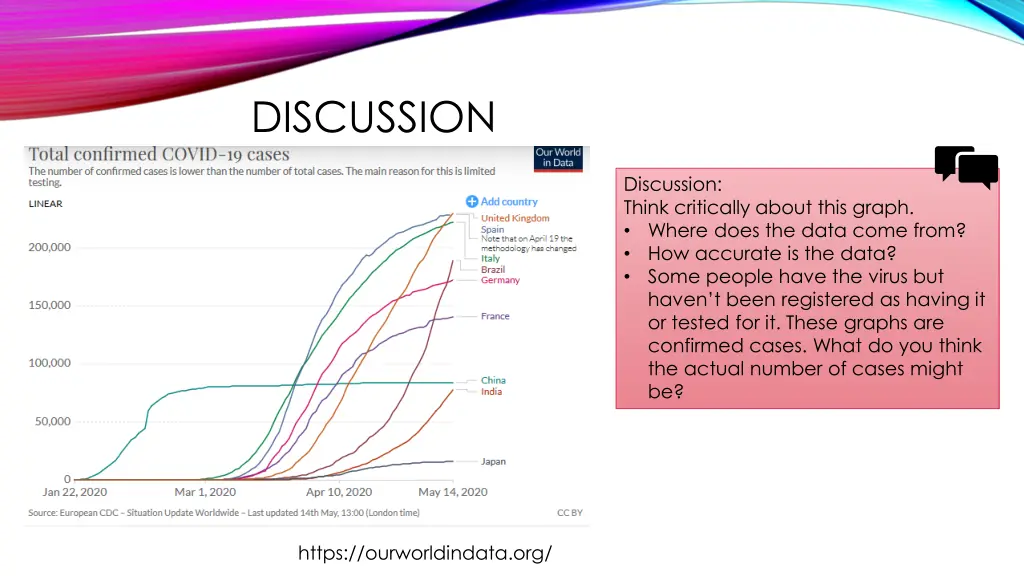
DISCUSSION Discussion: Think critically about this graph. Where does the data come from? How accurate is the data? Some people have the virus but haven t been registered as having it or tested for it. These graphs are confirmed cases. What do you think the actual number of cases might be? https://ourworldindata.org/
STEPS FOR SUCCESS I can choose the best way to represent data and justify my decision I can interpret graphs I am aware that numbers/graphs can be used in a biased way and that it is important to think critically about sources of data
FURTHER INFORMATION More or Less - Radio 4 https://www.bbc.co.uk/programmes/m000j2r7 Vitamin D, Explaining R and the 2 metre rule Data and graph plotting of global data including carbon footprints, COVID, Health, greenhouse gas emissions, etc https://ourworldindata.org/ This page goes into a lot more detail on R and some of the topics discussed in these lessons. It also looks at how the decline of COVID 19 can be modelled. https://ncase.me/covid-19/?fbclid=IwAR2E8lBzjkRn8RdbtjuDjaSQGIKa- lVvKW5XSf14E_LChSrRuFpqpGeUMRs This page has some good graphs showing the COVID 19 data for Scotland https://www.travellingtabby.com/scotland-coronavirus-tracker/