MCQ on Denture Base Resin: Properties and Characteristics
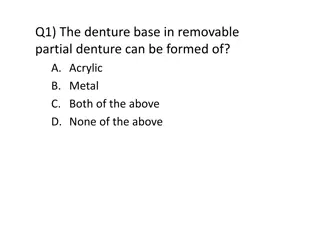
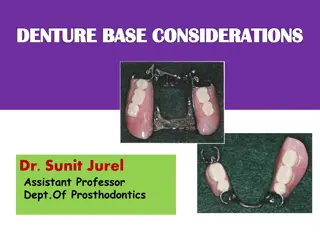
This multiple-choice quiz covers various aspects of denture base resins, including monomer composition, porosity formation, shrinkage properties, additives, cross-linking agents, and common issues like porosity and disadvantages of acrylic denture bases. Test your knowledge and enhance your understanding of denture materials and fabrication processes.

Download Presentation

Please find below an Image/Link to download the presentation.
The content on the website is provided AS IS for your information and personal use only. It may not be sold, licensed, or shared on other websites without obtaining consent from the author.If you encounter any issues during the download, it is possible that the publisher has removed the file from their server.
You are allowed to download the files provided on this website for personal or commercial use, subject to the condition that they are used lawfully. All files are the property of their respective owners.
The content on the website is provided AS IS for your information and personal use only. It may not be sold, licensed, or shared on other websites without obtaining consent from the author.
E N D
Presentation Transcript
1) In heat cure denture base resins the monomer is a) methacrylate b) ethylmethacrylate c) metyl ethyl methacrylate d) polymethylmethacrylate
2)If curing occurs at temperature more than 100 degree celsius porosity results in which are of denture a)hard thick central area b) thin palatal area c)thin area of flanges d) porosity is uniformly distributed
3)What is the shrinkage if 3:1 powder:liquid ratio is used a) 6% b) 8% c) 10% d) 21%
4) Hydroquinone is added to methyl methacrylate monomer a) to prevent polymerization during storage b)to initiate release of free radicles c) to enable polymerisation reaction at room temperature d)all of the above
5) cross linking of denture base is contributed by a)gylcol dimethacrylate b) benzoyl peroxide c) N para toluidine d) methyl methacrylate
6) use of dimethyl P toluidine is indicated for a) thermal polymerization of acrylic b) chemical polymerization c) retarding the polymerizing reaction d) to inhibit the action of benzoyl peroxide
7)Porosity present in acrylic denture is usually the result of a) prolonged curing cycle b) lack of sufficient pressure applied to flask c) insufficient acrylic resin monomer d) prolonged bench cooling after curing
8)The most important disadvantage of acrylic denture base is a) porosity b)shrinkage c)tooth breakage d)water absorption
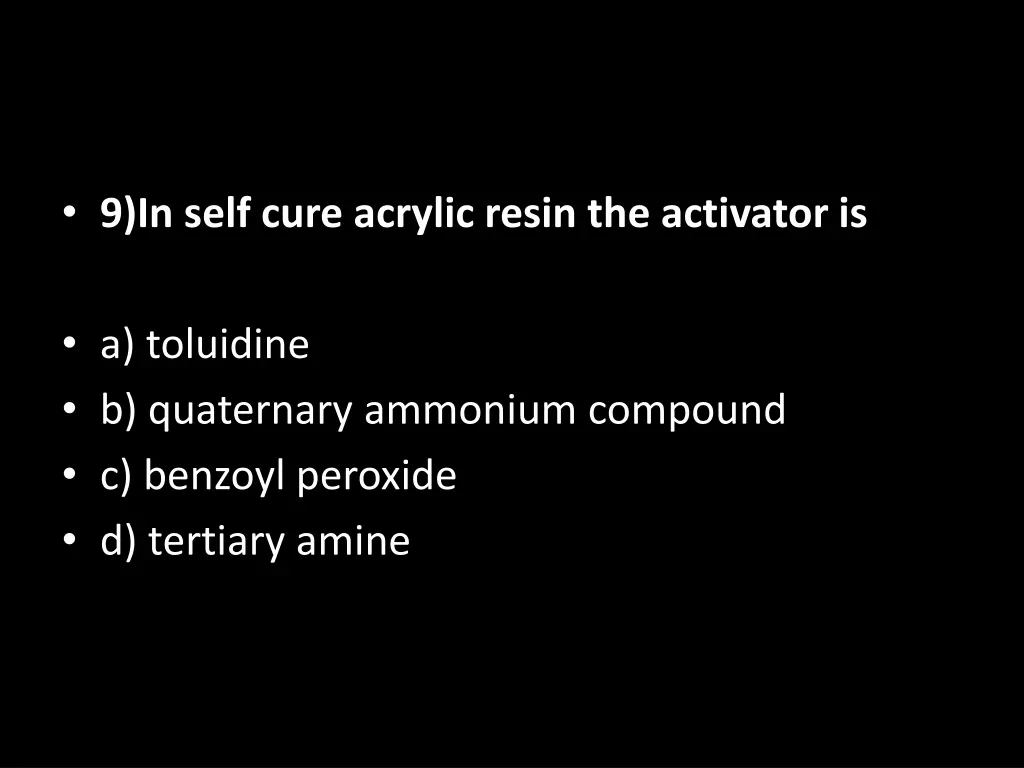
9)In self cure acrylic resin the activator is a) toluidine b) quaternary ammonium compound c) benzoyl peroxide d) tertiary amine
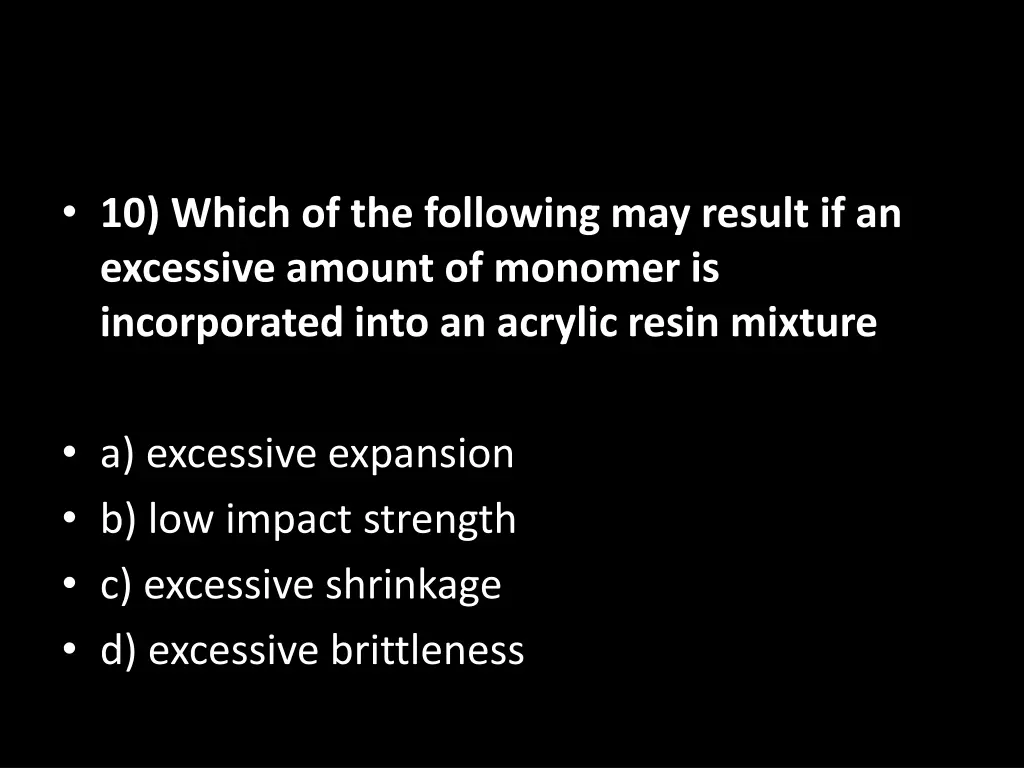
10) Which of the following may result if an excessive amount of monomer is incorporated into an acrylic resin mixture a) excessive expansion b) low impact strength c) excessive shrinkage d) excessive brittleness