ME.345 Heat Transfer Volumetric Heat Generation Overview
This lecture covers volumetric heat generation, including Ohmic, resistance, and Joule heating, as well as contributions from chemical reactions and nuclear processes. The focus extends to the heat equation for a 1D steady-state plane wall with heat generation. The presentation details temperature distributions under various boundary conditions and explores scenarios of symmetry and asymmetry, providing vital insights into the behavior of thermal systems subjected to internal heat generation.

Download Presentation

Please find below an Image/Link to download the presentation.
The content on the website is provided AS IS for your information and personal use only. It may not be sold, licensed, or shared on other websites without obtaining consent from the author.If you encounter any issues during the download, it is possible that the publisher has removed the file from their server.
You are allowed to download the files provided on this website for personal or commercial use, subject to the condition that they are used lawfully. All files are the property of their respective owners.
The content on the website is provided AS IS for your information and personal use only. It may not be sold, licensed, or shared on other websites without obtaining consent from the author.
E N D
Presentation Transcript
ME 345 Heat Transfer (HTx) Professor: Dr. Dan Cordon (AKA Dr. Dan)
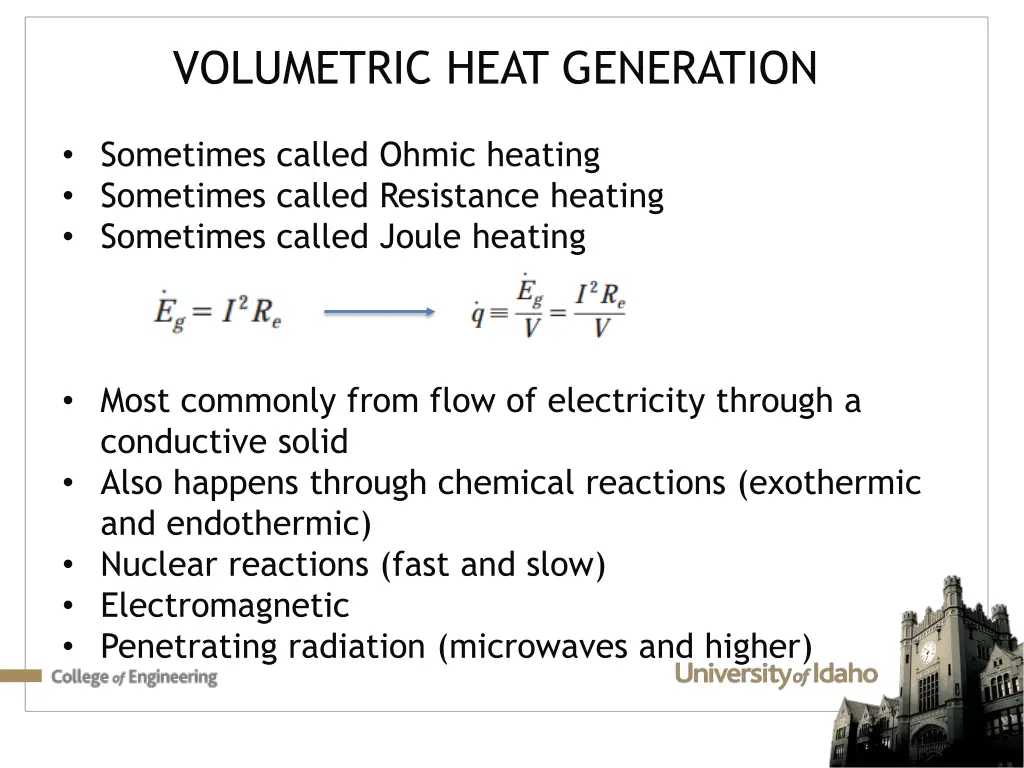
VOLUMETRIC HEAT GENERATION Sometimes called Ohmic heating Sometimes called Resistance heating Sometimes called Joule heating Most commonly from flow of electricity through a conductive solid Also happens through chemical reactions (exothermic and endothermic) Nuclear reactions (fast and slow) Electromagnetic Penetrating radiation (microwaves and higher)
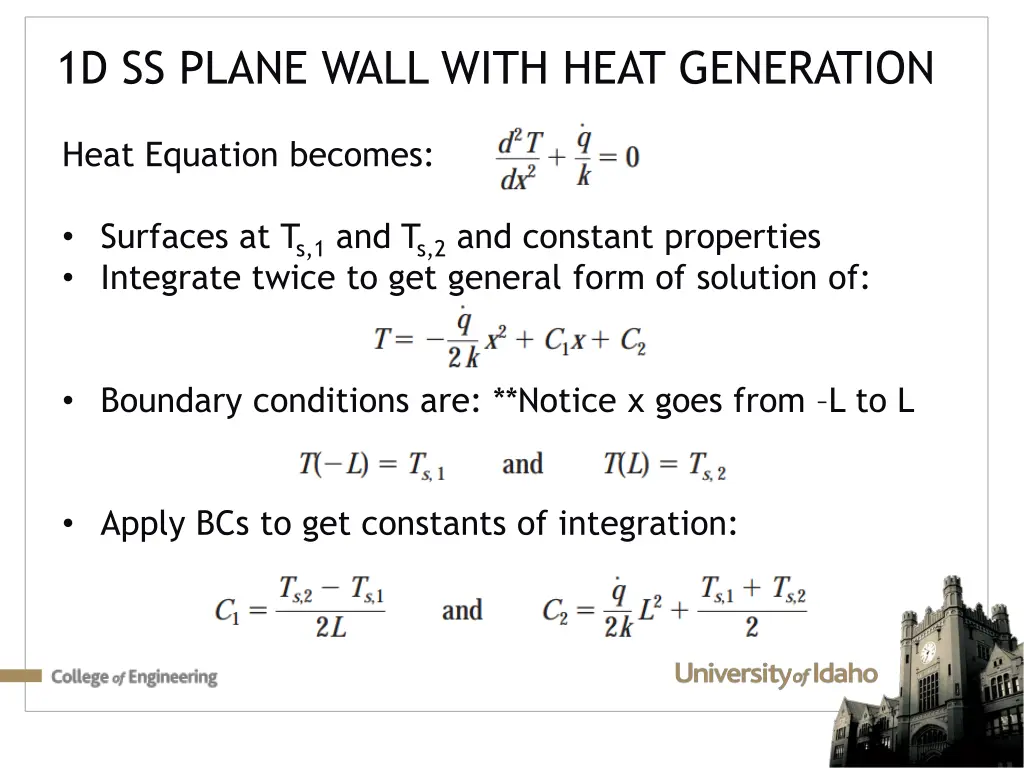
1D SS PLANE WALL WITH HEAT GENERATION Heat Equation becomes: Surfaces at Ts,1 and Ts,2 and constant properties Integrate twice to get general form of solution of: Boundary conditions are: **Notice x goes from L to L Apply BCs to get constants of integration:
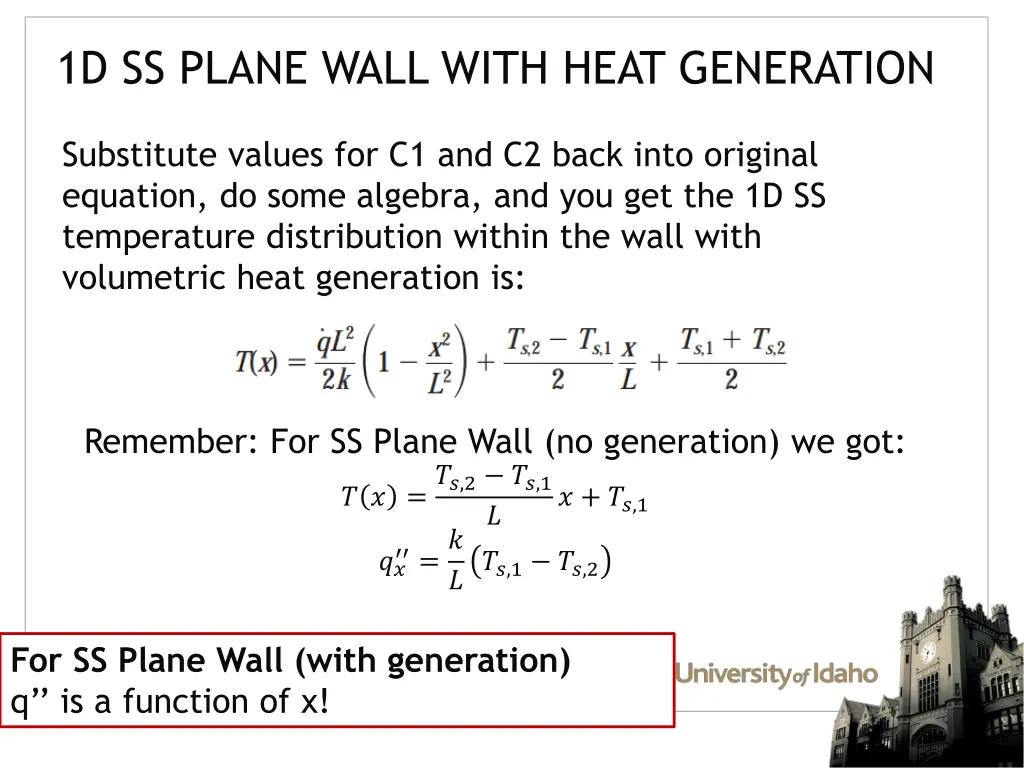
1D SS PLANE WALL WITH HEAT GENERATION Substitute values for C1 and C2 back into original equation, do some algebra, and you get the 1D SS temperature distribution within the wall with volumetric heat generation is: Remember: For SS Plane Wall (no generation) we got: ? ? =??,2 ??,1 ? =? ? ? + ??,1 ?? ??,1 ??,2 For SS Plane Wall (with generation) q is a function of x!
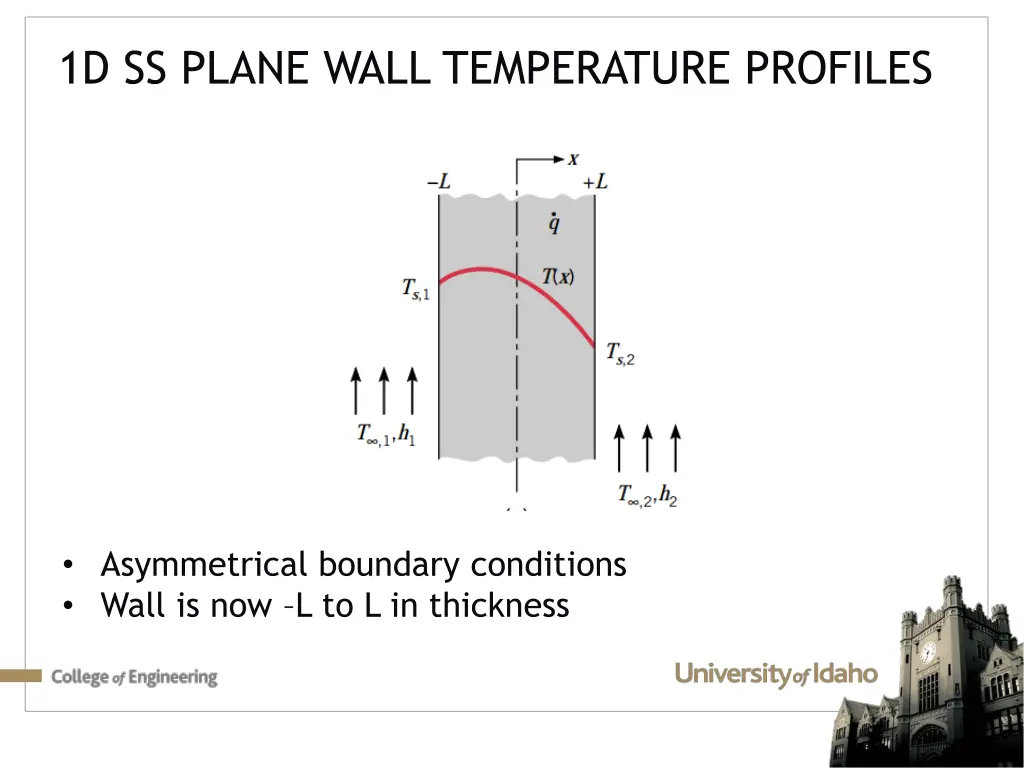
1D SS PLANE WALL TEMPERATURE PROFILES Asymmetrical boundary conditions Wall is now L to L in thickness
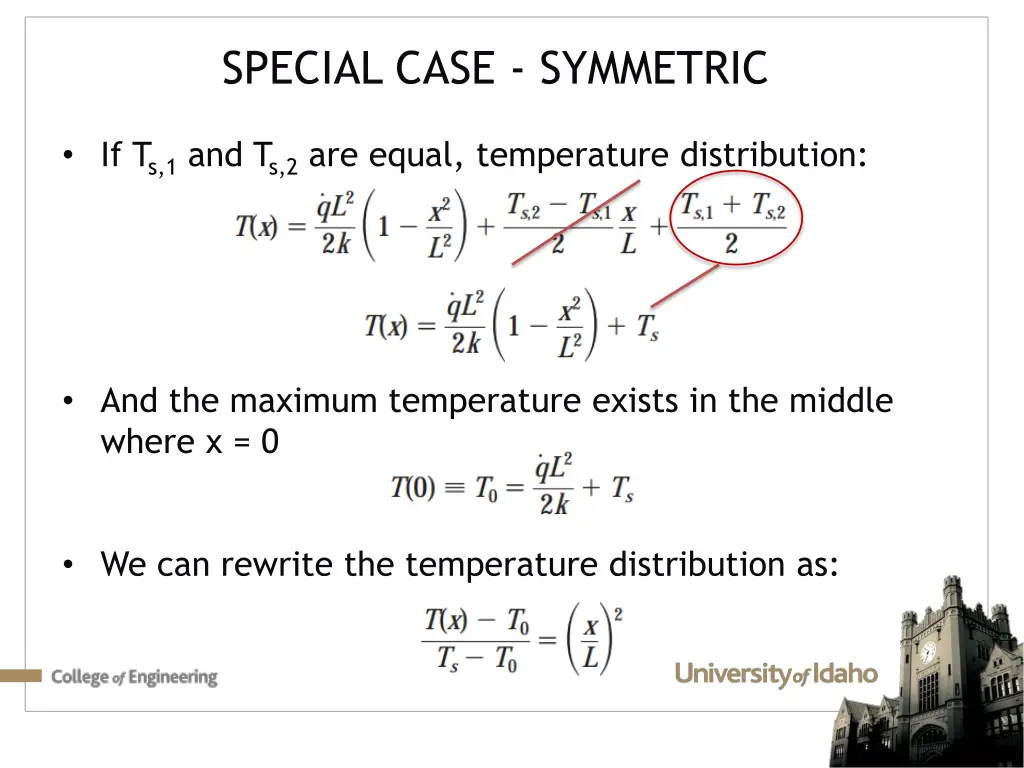
SPECIAL CASE - SYMMETRIC If Ts,1 and Ts,2 are equal, temperature distribution: And the maximum temperature exists in the middle where x = 0 We can rewrite the temperature distribution as:
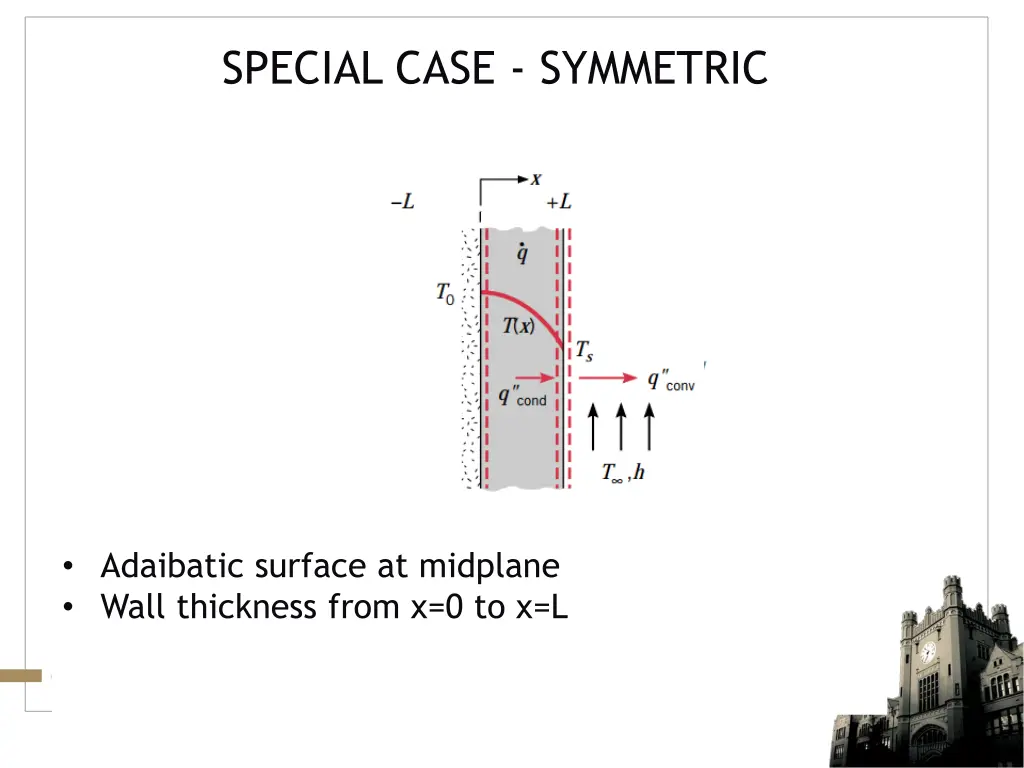
SPECIAL CASE - SYMMETRIC Symmetrical boundary conditions Draw me a bunch of heat flux vectors (x-direction) within the wall (vary length of arrow according to magnitude) Adaibatic surface at midplane Wall thickness from x=0 to x=L
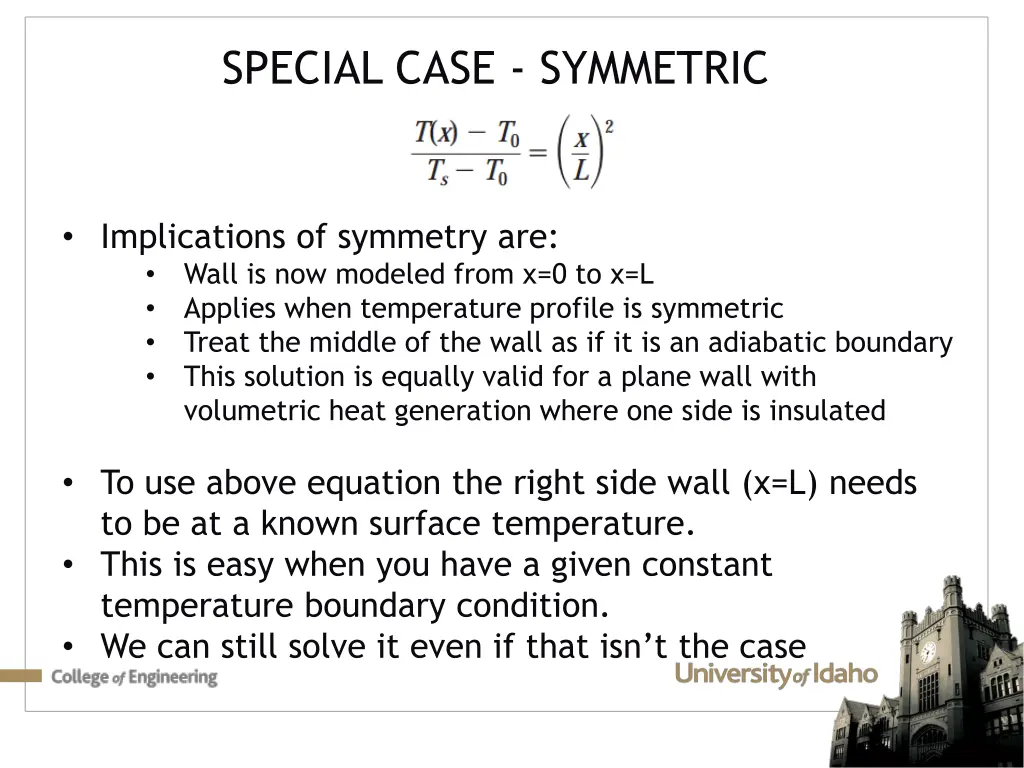
SPECIAL CASE - SYMMETRIC Implications of symmetry are: Wall is now modeled from x=0 to x=L Applies when temperature profile is symmetric Treat the middle of the wall as if it is an adiabatic boundary This solution is equally valid for a plane wall with volumetric heat generation where one side is insulated To use above equation the right side wall (x=L) needs to be at a known surface temperature. This is easy when you have a given constant temperature boundary condition. We can still solve it even if that isn t the case
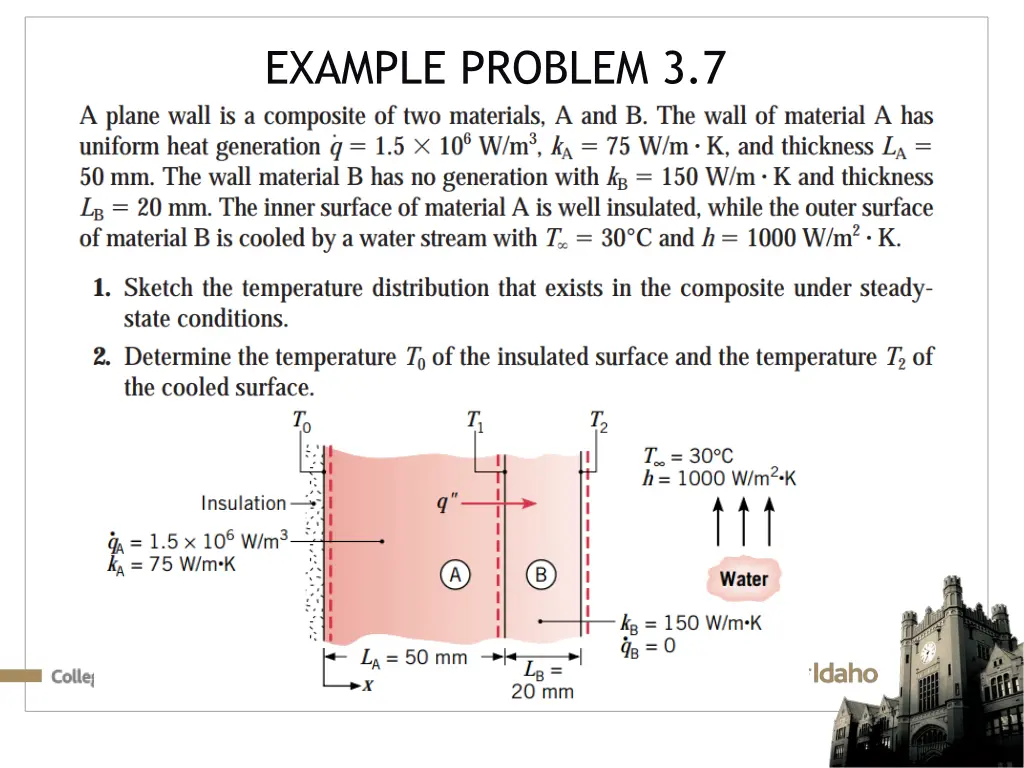
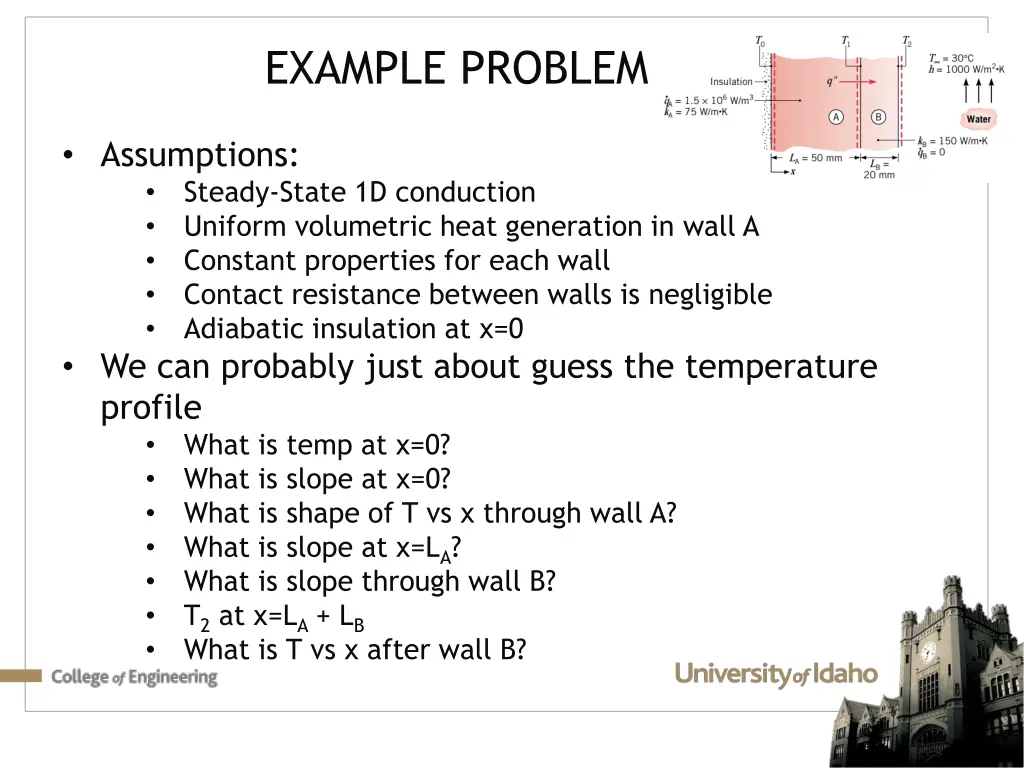
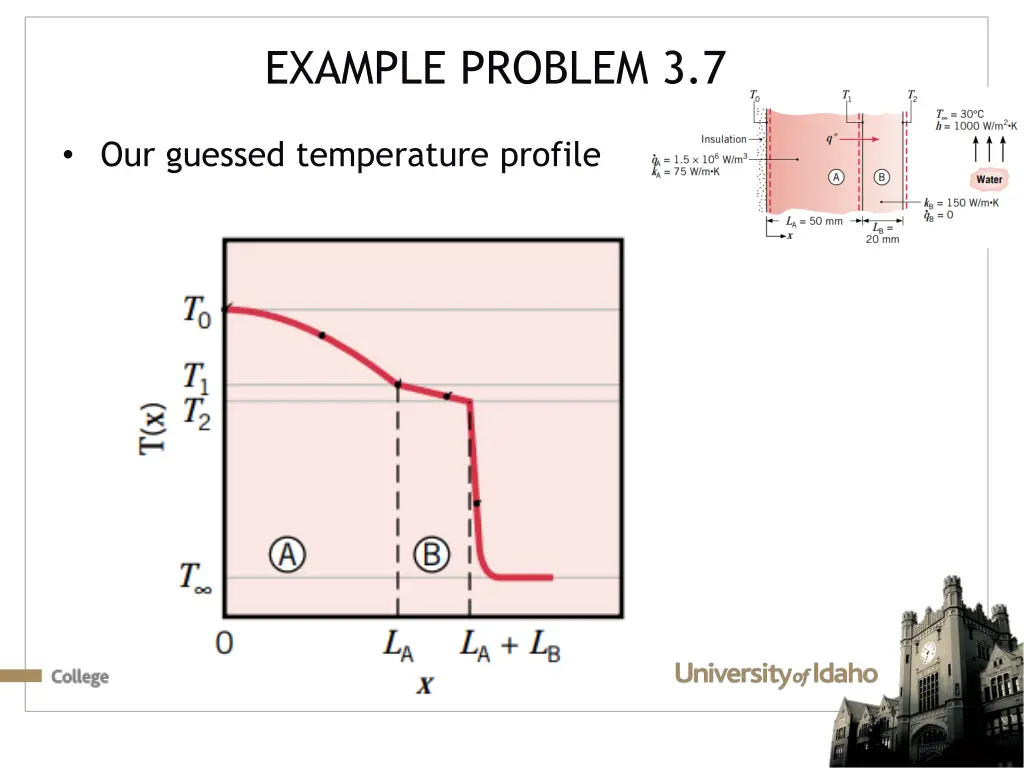
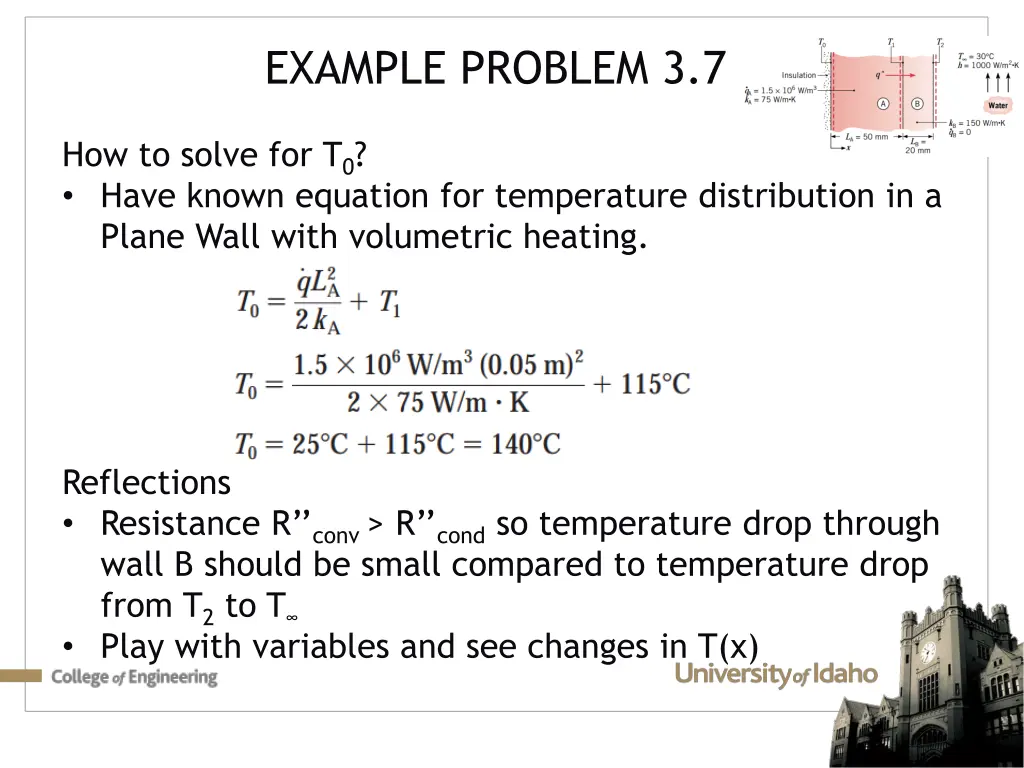
EXAMPLE PROBLEM 3.7 Assumptions: We can probably just about guess the temperature profile What is temp at x=0? What is slope at x=0? What is shape of T vs x through wall A? What is slope at x=LA? What is slope through wall B? T2 at x=LA + LB What is T vs x after wall B? Steady-State 1D conduction Uniform volumetric heat generation in wall A Constant properties for each wall Contact resistance between walls is negligible Adiabatic insulation at x=0
EXAMPLE PROBLEM 3.7 Our guessed temperature profile
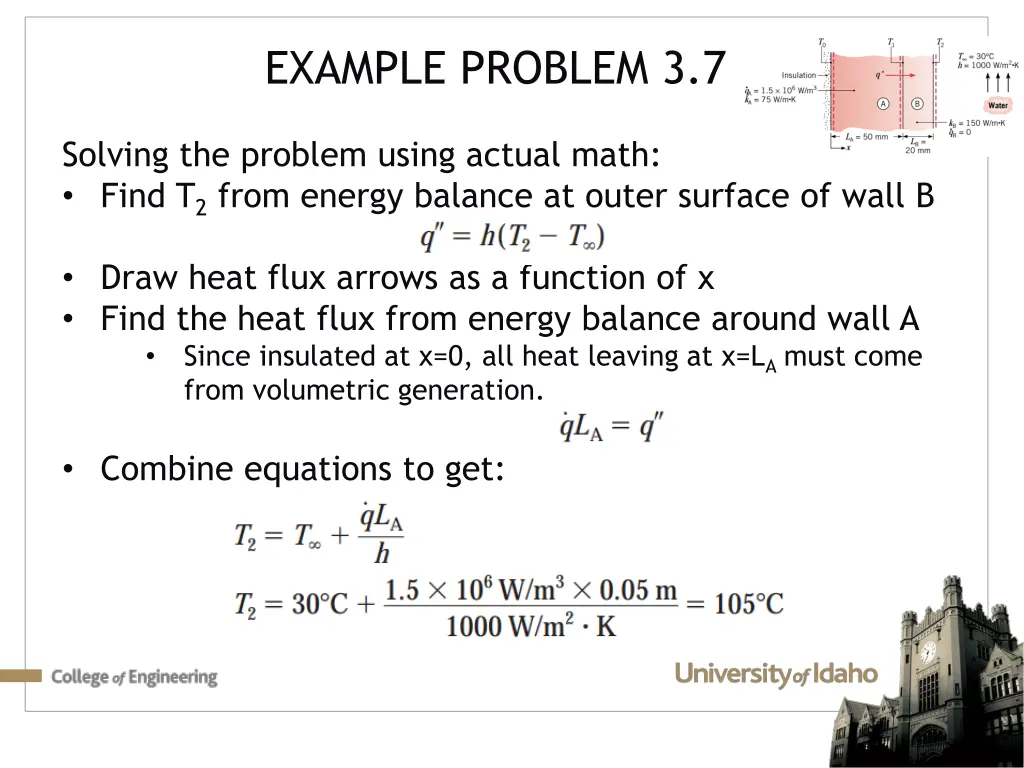
EXAMPLE PROBLEM 3.7 Solving the problem using actual math: Find T2 from energy balance at outer surface of wall B Draw heat flux arrows as a function of x Find the heat flux from energy balance around wall A Since insulated at x=0, all heat leaving at x=LA must come from volumetric generation. Combine equations to get:
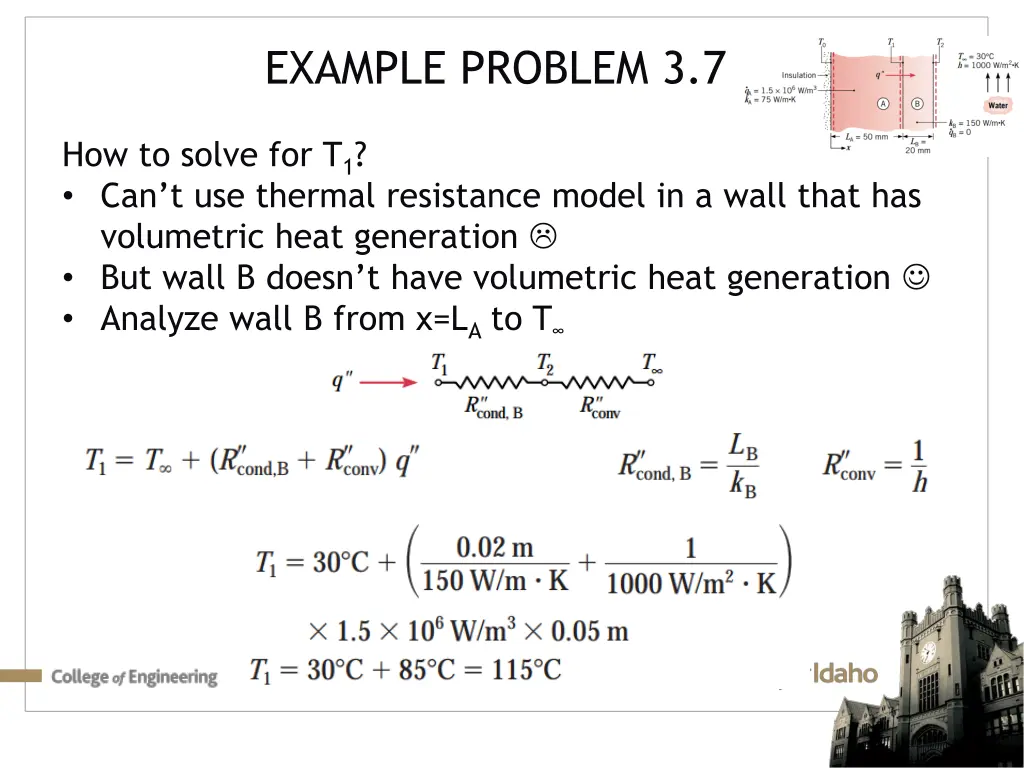
EXAMPLE PROBLEM 3.7 How to solve for T1? Can t use thermal resistance model in a wall that has volumetric heat generation But wall B doesn t have volumetric heat generation Analyze wall B from x=LA to T
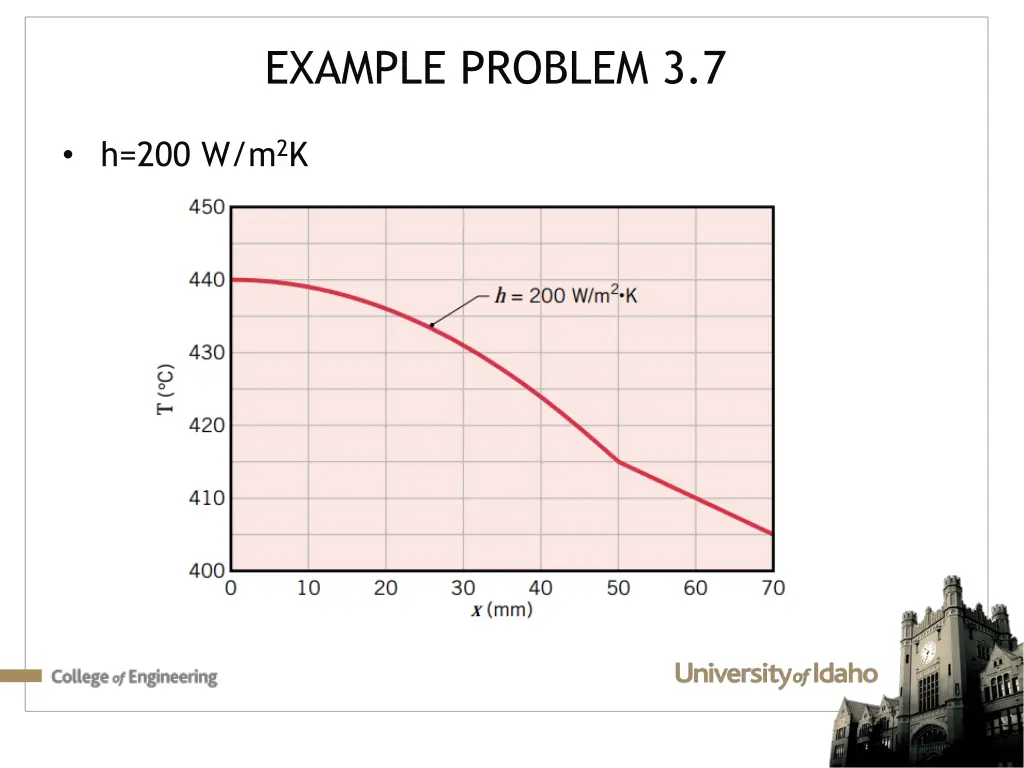
EXAMPLE PROBLEM 3.7 How to solve for T0? Have known equation for temperature distribution in a Plane Wall with volumetric heating. Reflections Resistance R conv > R cond so temperature drop through wall B should be small compared to temperature drop from T2 to T Play with variables and see changes in T(x)
EXAMPLE PROBLEM 3.7 h=1000 W/m2K h=200 W/m2K