Mechanics, Forces, and Motion: Understanding Concepts with Visuals

Dive into the world of mechanics, forces, and motion with practical examples, calculations, and diagrams. Explore the concepts of velocity, acceleration, and force diagrams. Practice exercises and deepen your understanding in an interactive learning environment.

Download Presentation

Please find below an Image/Link to download the presentation.
The content on the website is provided AS IS for your information and personal use only. It may not be sold, licensed, or shared on other websites without obtaining consent from the author.If you encounter any issues during the download, it is possible that the publisher has removed the file from their server.
You are allowed to download the files provided on this website for personal or commercial use, subject to the condition that they are used lawfully. All files are the property of their respective owners.
The content on the website is provided AS IS for your information and personal use only. It may not be sold, licensed, or shared on other websites without obtaining consent from the author.
E N D
Presentation Transcript
Mechanics Mechanics Forces and motion Forces and motion Twitter: @Owen134866 www.mathsfreeresourcelibrary.com
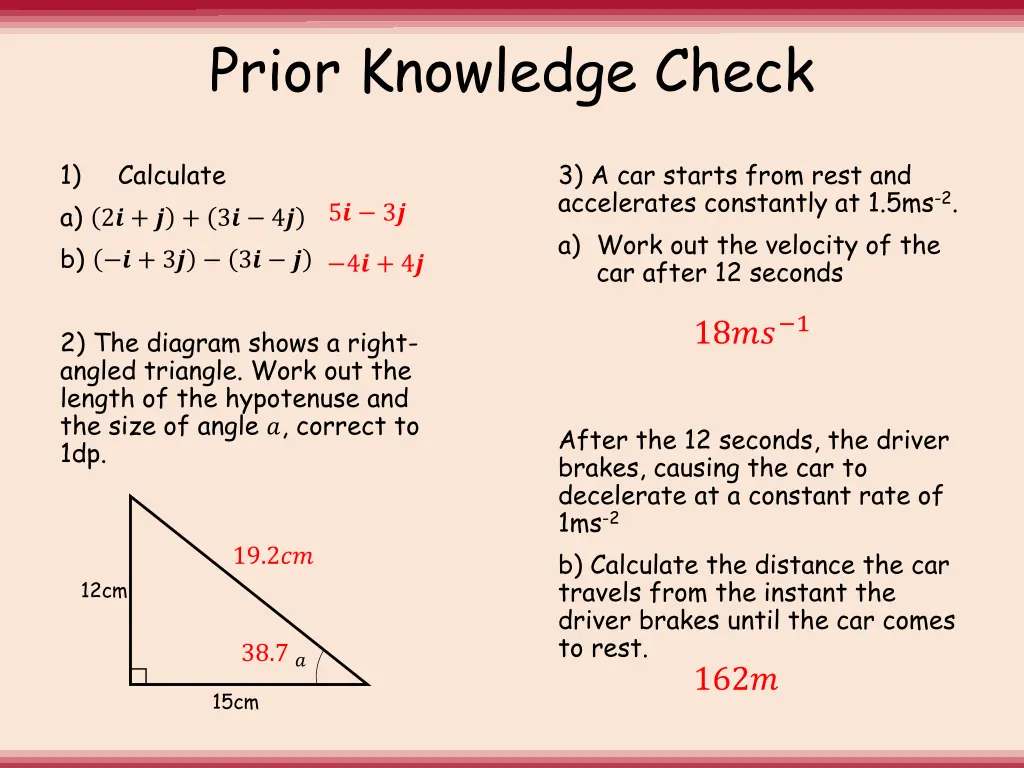
Prior Knowledge Check 1) a) 2? + ? + 3? 4? b) ? + 3? 3? ? Calculate 3) A car starts from rest and accelerates constantly at 1.5ms-2. a) Work out the velocity of the car after 12 seconds 5? 3? 4? + 4? 18?? 1 2) The diagram shows a right- angled triangle. Work out the length of the hypotenuse and the size of angle ?, correct to 1dp. After the 12 seconds, the driver brakes, causing the car to decelerate at a constant rate of 1ms-2 b) Calculate the distance the car travels from the instant the driver brakes until the car comes to rest. 162? 19.2?? 12cm 38.7 ? 15cm
Teachings For Teachings For Exercise 10A Exercise 10A
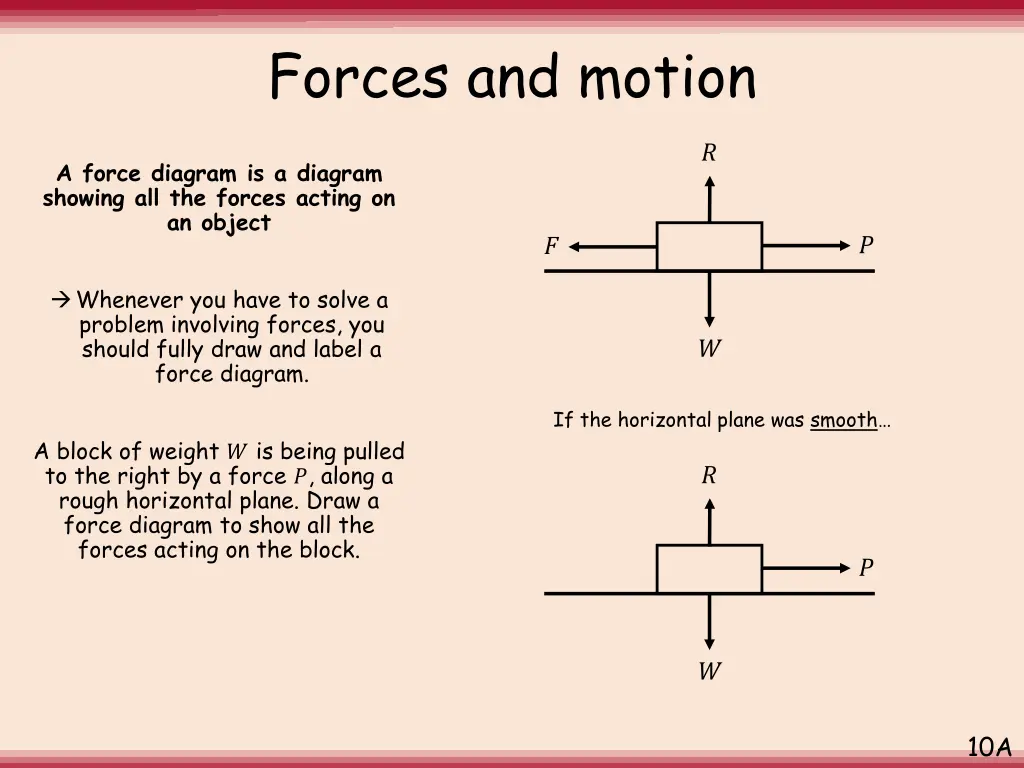
Forces and motion ? A force diagram is a diagram showing all the forces acting on an object ? ? Whenever you have to solve a problem involving forces, you should fully draw and label a force diagram. ? If the horizontal plane was smooth A block of weight ? is being pulled to the right by a force ?, along a rough horizontal plane. Draw a force diagram to show all the forces acting on the block. ? ? ? 10A
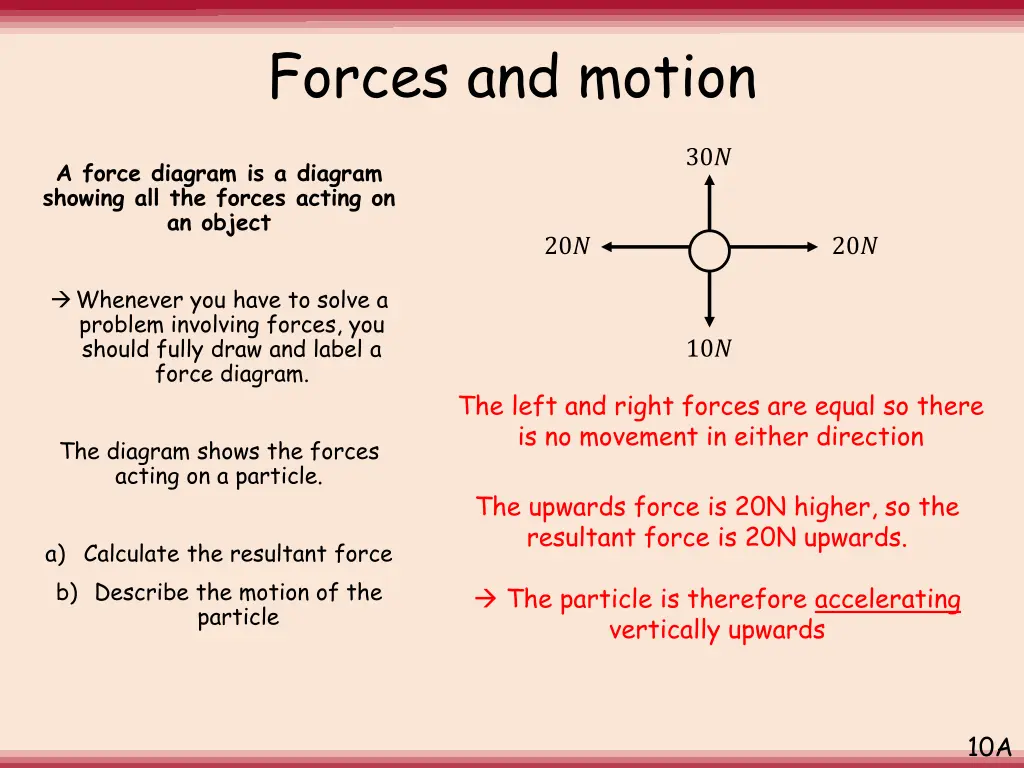
Forces and motion 30? A force diagram is a diagram showing all the forces acting on an object 20? 20? Whenever you have to solve a problem involving forces, you should fully draw and label a force diagram. 10? The left and right forces are equal so there is no movement in either direction The diagram shows the forces acting on a particle. The upwards force is 20N higher, so the resultant force is 20N upwards. a) Calculate the resultant force b) Describe the motion of the particle The particle is therefore accelerating vertically upwards 10A
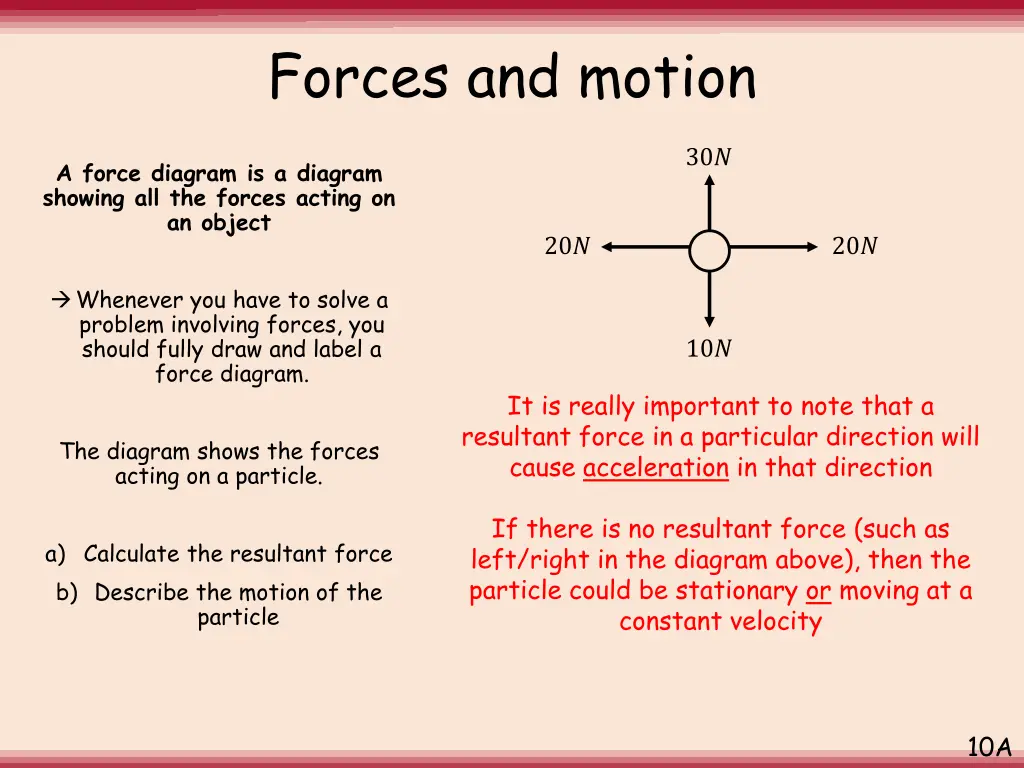
Forces and motion 30? A force diagram is a diagram showing all the forces acting on an object 20? 20? Whenever you have to solve a problem involving forces, you should fully draw and label a force diagram. 10? It is really important to note that a resultant force in a particular direction will cause acceleration in that direction The diagram shows the forces acting on a particle. If there is no resultant force (such as left/right in the diagram above), then the particle could be stationary or moving at a constant velocity a) Calculate the resultant force b) Describe the motion of the particle 10A
Teachings For Teachings For Exercise 10B Exercise 10B
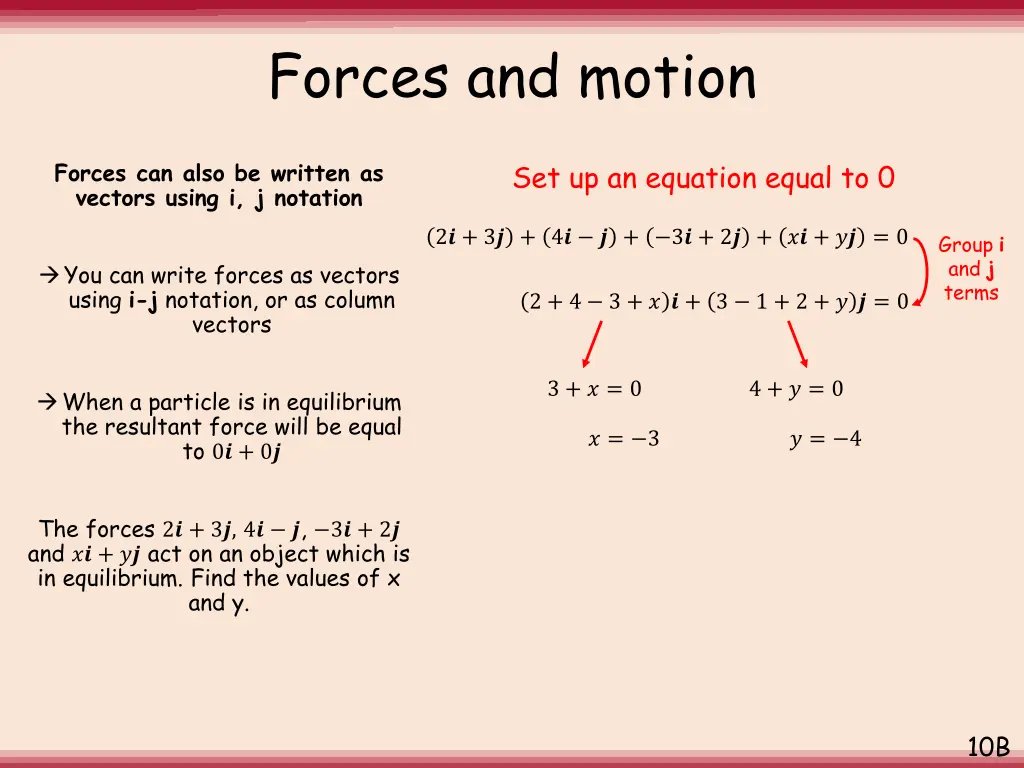
Forces and motion Forces can also be written as vectors using i, j notation Set up an equation equal to 0 2? + 3? + 4? ? + 3? + 2? + ?? + ?? = 0 Group i and j terms You can write forces as vectors using i-j notation, or as column vectors 2 + 4 3 + ? ? + 3 1 + 2 + ? ? = 0 3 + ? = 0 4 + ? = 0 When a particle is in equilibrium the resultant force will be equal to 0? + 0? ? = 3 ? = 4 The forces 2? + 3?,4? ?, 3? + 2? and ?? + ?? act on an object which is in equilibrium. Find the values of x and y. 10B
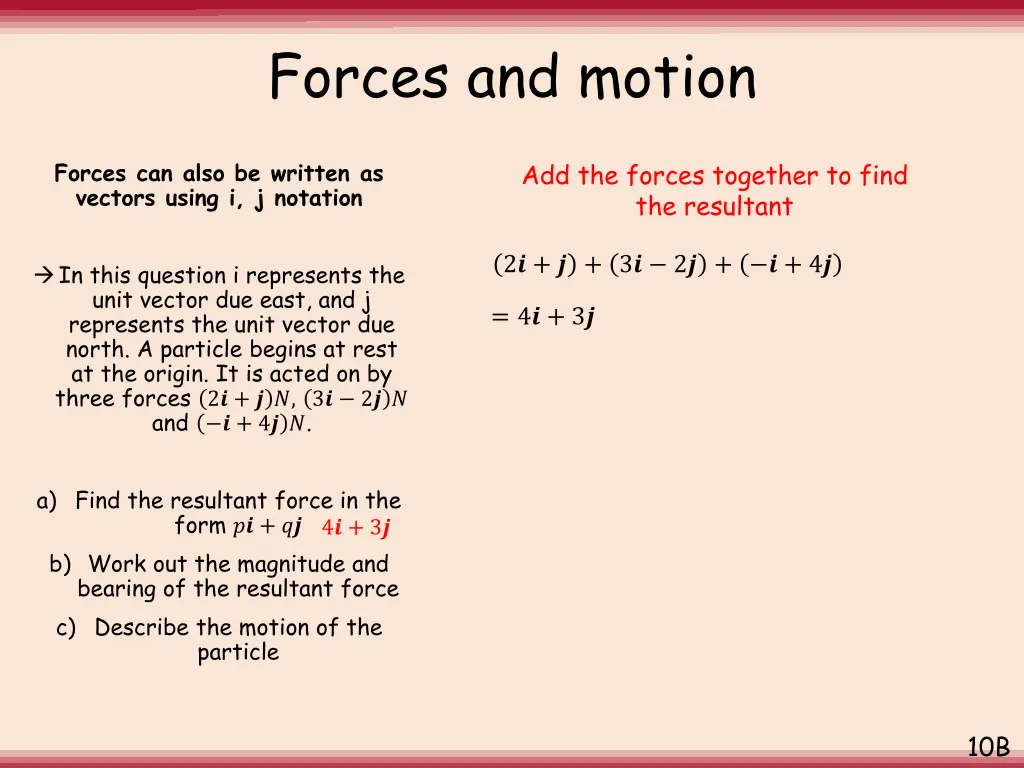
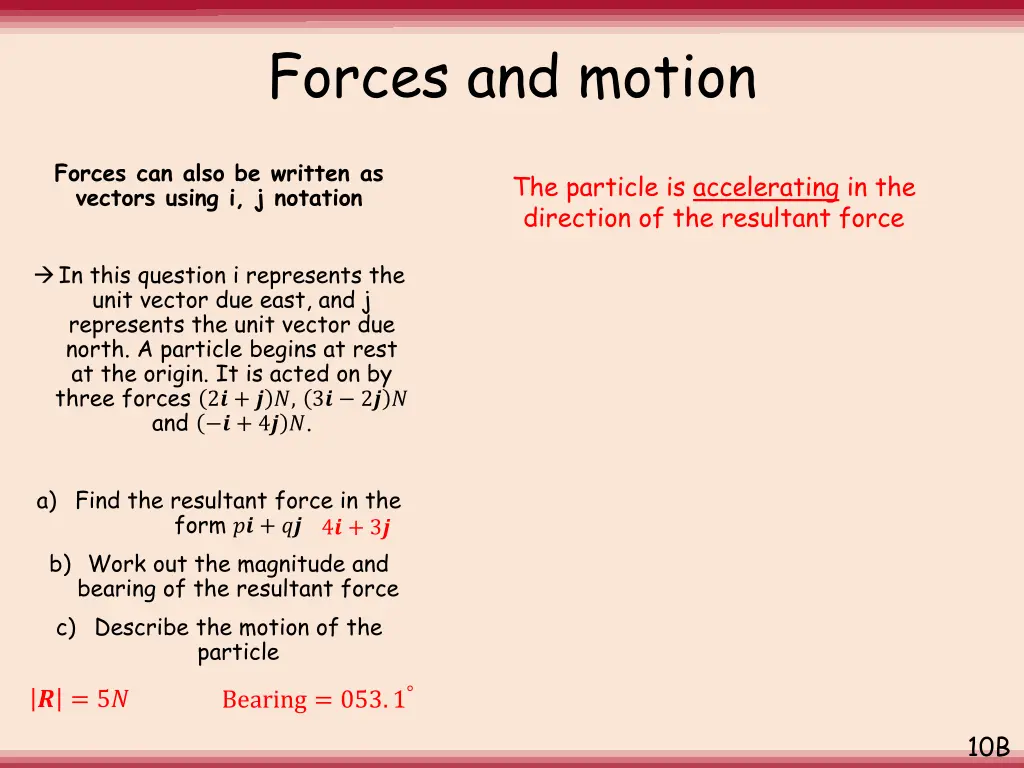
Forces and motion Forces can also be written as vectors using i, j notation Add the forces together to find the resultant 2? + ? + 3? 2? + ? + 4? In this question i represents the unit vector due east, and j represents the unit vector due north. A particle begins at rest at the origin. It is acted on by three forces 2? + ? ?, 3? 2? ? and ? + 4? ?. = 4? + 3? a) Find the resultant force in the form ?? + ?? b) Work out the magnitude and bearing of the resultant force c) Describe the motion of the particle 4? + 3? 10B
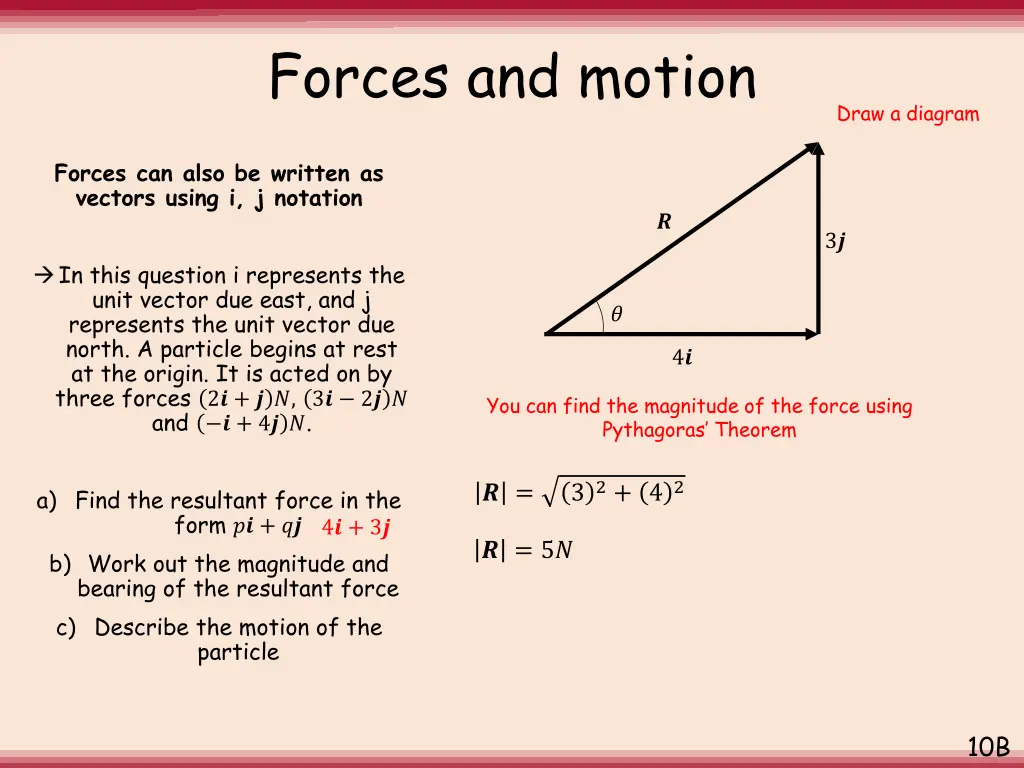
Forces and motion Draw a diagram Forces can also be written as vectors using i, j notation ? 3? In this question i represents the unit vector due east, and j represents the unit vector due north. A particle begins at rest at the origin. It is acted on by three forces 2? + ? ?, 3? 2? ? and ? + 4? ?. ? 4? You can find the magnitude of the force using Pythagoras Theorem 32+ 42 ? = a) Find the resultant force in the form ?? + ?? b) Work out the magnitude and bearing of the resultant force c) Describe the motion of the particle 4? + 3? ? = 5? 10B
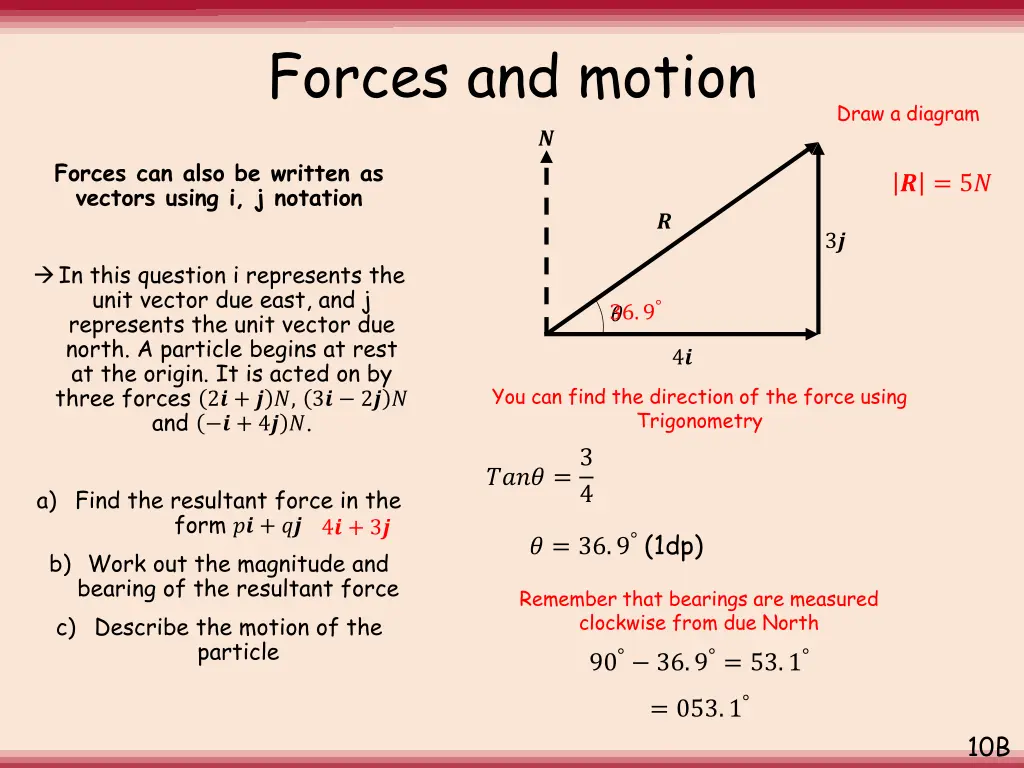
Forces and motion Draw a diagram ? Forces can also be written as vectors using i, j notation ? = 5? ? 3? In this question i represents the unit vector due east, and j represents the unit vector due north. A particle begins at rest at the origin. It is acted on by three forces 2? + ? ?, 3? 2? ? and ? + 4? ?. ? 36.9 4? You can find the direction of the force using Trigonometry ???? =3 4 a) Find the resultant force in the form ?? + ?? b) Work out the magnitude and bearing of the resultant force c) Describe the motion of the particle 4? + 3? ? = 36.9 (1dp) Remember that bearings are measured clockwise from due North 90 36.9 = 53.1 = 053.1 10B
Forces and motion Forces can also be written as vectors using i, j notation The particle is accelerating in the direction of the resultant force In this question i represents the unit vector due east, and j represents the unit vector due north. A particle begins at rest at the origin. It is acted on by three forces 2? + ? ?, 3? 2? ? and ? + 4? ?. a) Find the resultant force in the form ?? + ?? b) Work out the magnitude and bearing of the resultant force c) Describe the motion of the particle 4? + 3? Bearing = 053.1 ? = 5? 10B
Teachings For Teachings For Exercise 10C Exercise 10C
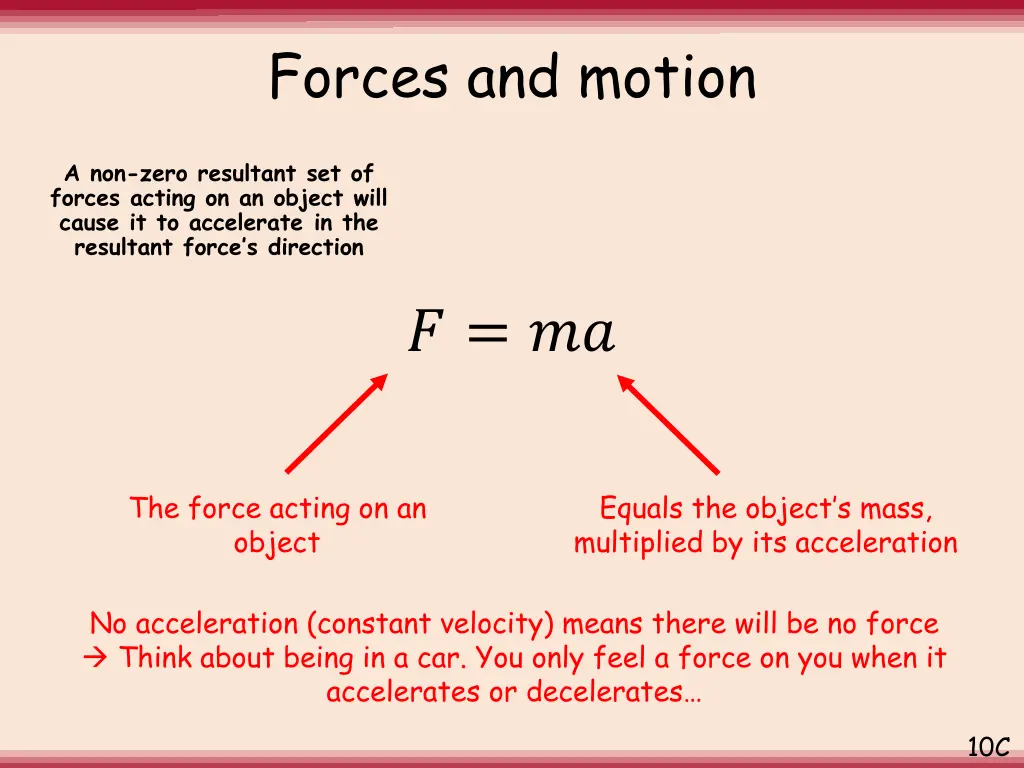
Forces and motion A non-zero resultant set of forces acting on an object will cause it to accelerate in the resultant force s direction ? = ?? The force acting on an object Equals the object s mass, multiplied by its acceleration No acceleration (constant velocity) means there will be no force Think about being in a car. You only feel a force on you when it accelerates or decelerates 10C
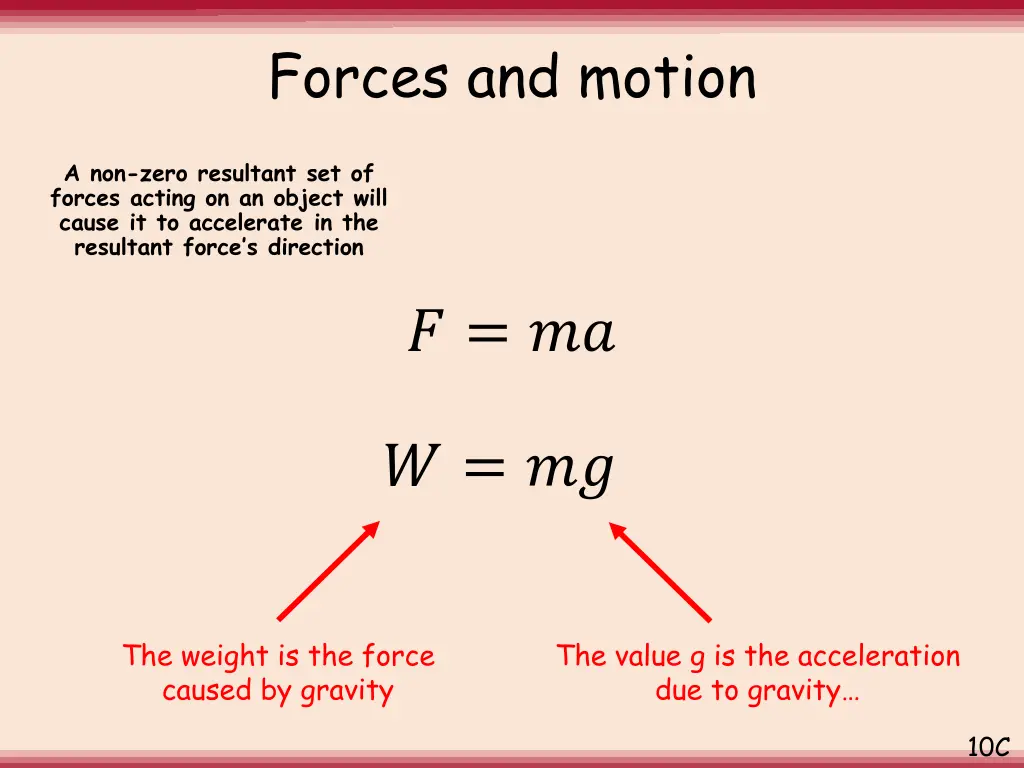
Forces and motion A non-zero resultant set of forces acting on an object will cause it to accelerate in the resultant force s direction ? = ?? ? = ?? The weight is the force caused by gravity The value g is the acceleration due to gravity 10C
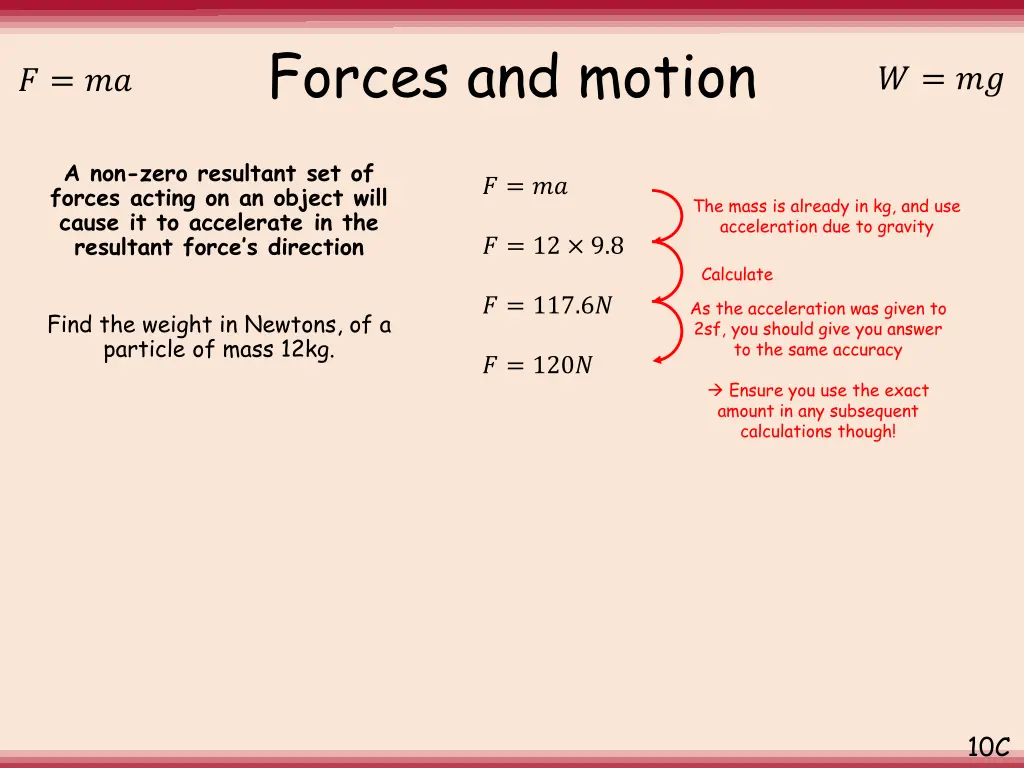
Forces and motion ? = ?? ? = ?? A non-zero resultant set of forces acting on an object will cause it to accelerate in the resultant force s direction ? = ?? The mass is already in kg, and use acceleration due to gravity ? = 12 9.8 Calculate ? = 117.6? As the acceleration was given to 2sf, you should give you answer to the same accuracy Find the weight in Newtons, of a particle of mass 12kg. ? = 120? Ensure you use the exact amount in any subsequent calculations though! 10C
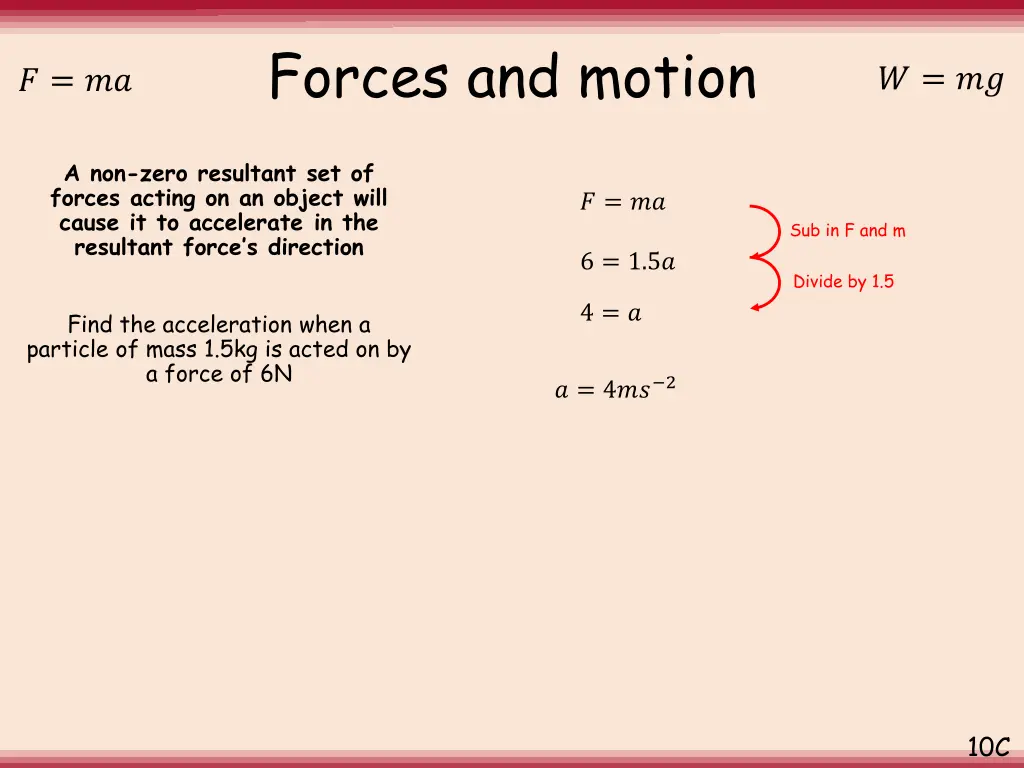
Forces and motion ? = ?? ? = ?? A non-zero resultant set of forces acting on an object will cause it to accelerate in the resultant force s direction ? = ?? Sub in F and m 6 = 1.5? Divide by 1.5 4 = ? Find the acceleration when a particle of mass 1.5kg is acted on by a force of 6N ? = 4?? 2 10C
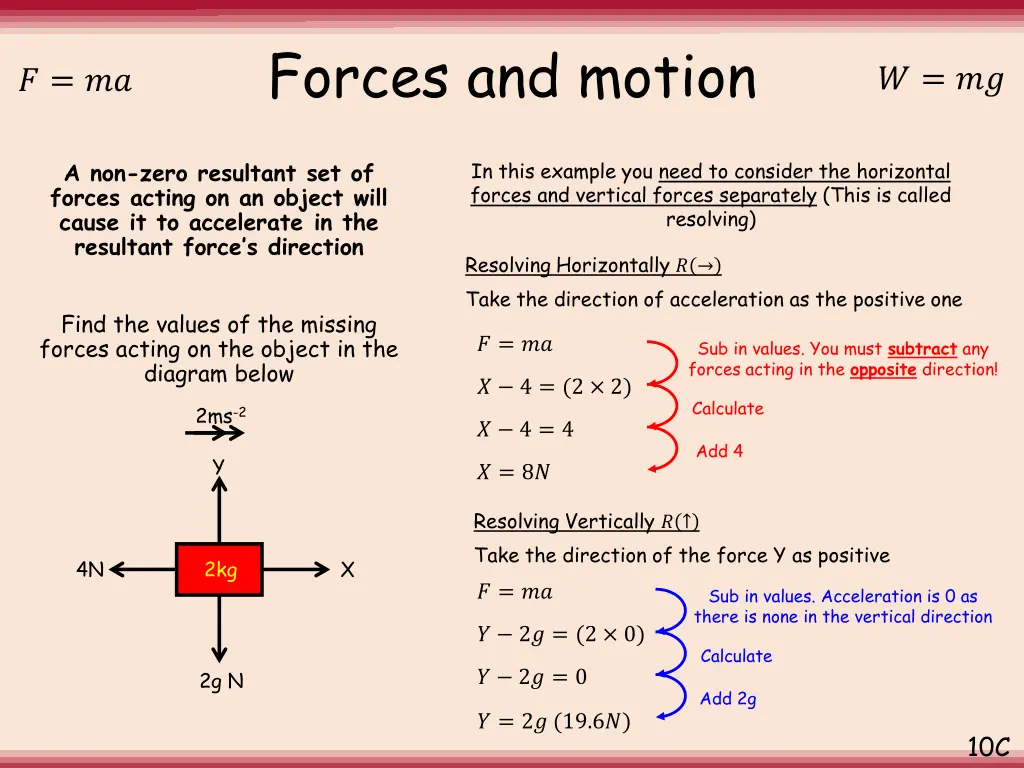
Forces and motion ? = ?? ? = ?? A non-zero resultant set of forces acting on an object will cause it to accelerate in the resultant force s direction In this example you need to consider the horizontal forces and vertical forces separately (This is called resolving) Resolving Horizontally ? Take the direction of acceleration as the positive one Find the values of the missing forces acting on the object in the diagram below ? = ?? Sub in values. You must subtract any forces acting in the opposite direction! ? 4 = (2 2) Calculate 2ms-2 ? 4 = 4 Add 4 Y ? = 8? Resolving Vertically ? Take the direction of the force Y as positive 4N 2kg X ? = ?? Sub in values. Acceleration is 0 as there is none in the vertical direction ? 2? = (2 0) Calculate 2g N ? 2? = 0 Add 2g ? = 2? (19.6?) 10C
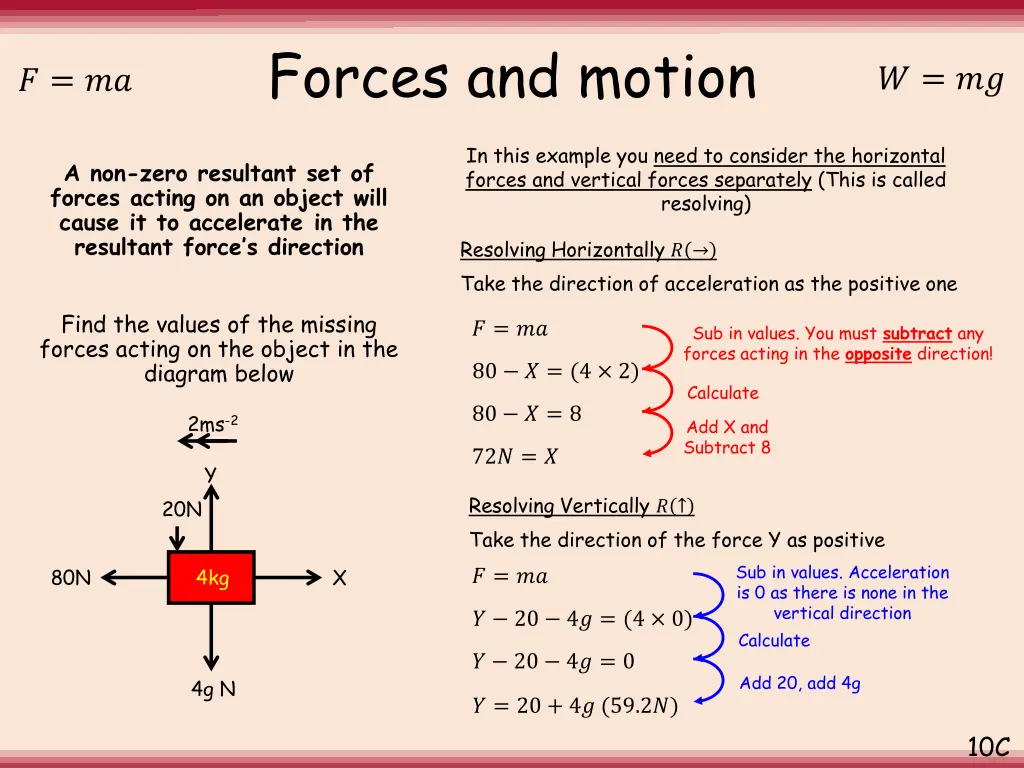
Forces and motion ? = ?? ? = ?? In this example you need to consider the horizontal forces and vertical forces separately (This is called resolving) A non-zero resultant set of forces acting on an object will cause it to accelerate in the resultant force s direction Resolving Horizontally ? Take the direction of acceleration as the positive one Find the values of the missing forces acting on the object in the diagram below ? = ?? Sub in values. You must subtract any forces acting in the opposite direction! 80 ? = (4 2) Calculate 80 ? = 8 2ms-2 Add X and Subtract 8 72? = ? Y Resolving Vertically ? Take the direction of the force Y as positive 20N Sub in values. Acceleration is 0 as there is none in the vertical direction Calculate 80N 4kg X ? = ?? ? 20 4? = (4 0) ? 20 4? = 0 Add 20, add 4g 4g N ? = 20 + 4? (59.2?) 10C
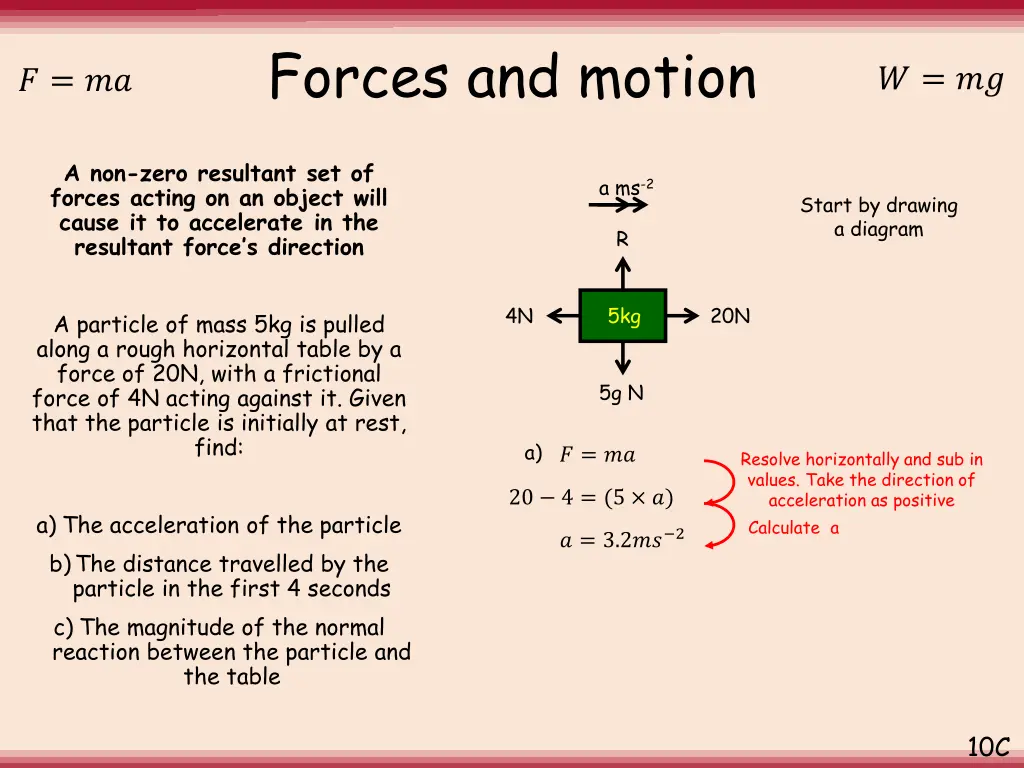
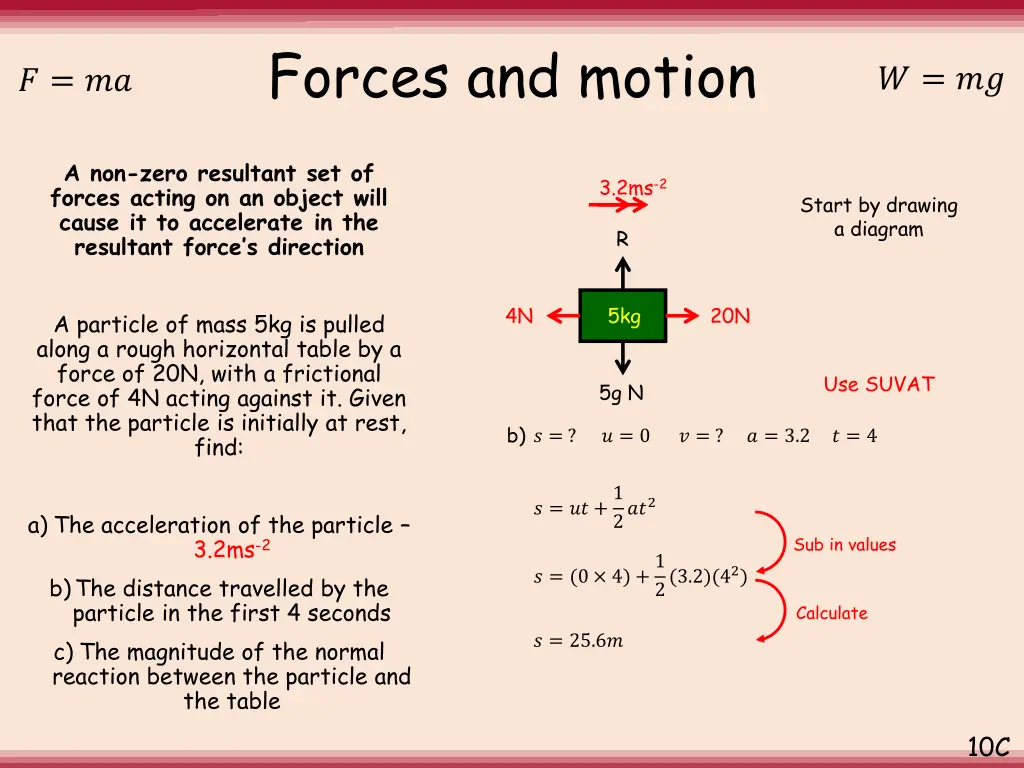
Forces and motion ? = ?? ? = ?? A non-zero resultant set of forces acting on an object will cause it to accelerate in the resultant force s direction a ms-2 Start by drawing a diagram R 4N 5kg 20N A particle of mass 5kg is pulled along a rough horizontal table by a force of 20N, with a frictional force of 4N acting against it. Given that the particle is initially at rest, find: 5g N a) ? = ?? Resolve horizontally and sub in values. Take the direction of acceleration as positive Calculate a 20 4 = (5 ?) a) The acceleration of the particle b)The distance travelled by the particle in the first 4 seconds c) The magnitude of the normal reaction between the particle and the table ? = 3.2?? 2 10C
Forces and motion ? = ?? ? = ?? A non-zero resultant set of forces acting on an object will cause it to accelerate in the resultant force s direction 3.2ms-2 Start by drawing a diagram R 4N 5kg 20N A particle of mass 5kg is pulled along a rough horizontal table by a force of 20N, with a frictional force of 4N acting against it. Given that the particle is initially at rest, find: Use SUVAT 5g N b) ? = ? ? = 0 ? = ? ? = 3.2 ? = 4 ? = ?? +1 2??2 a) The acceleration of the particle 3.2ms-2 b)The distance travelled by the particle in the first 4 seconds c) The magnitude of the normal reaction between the particle and the table Sub in values ? = (0 4) +1 2(3.2)(42) Calculate ? = 25.6? 10C
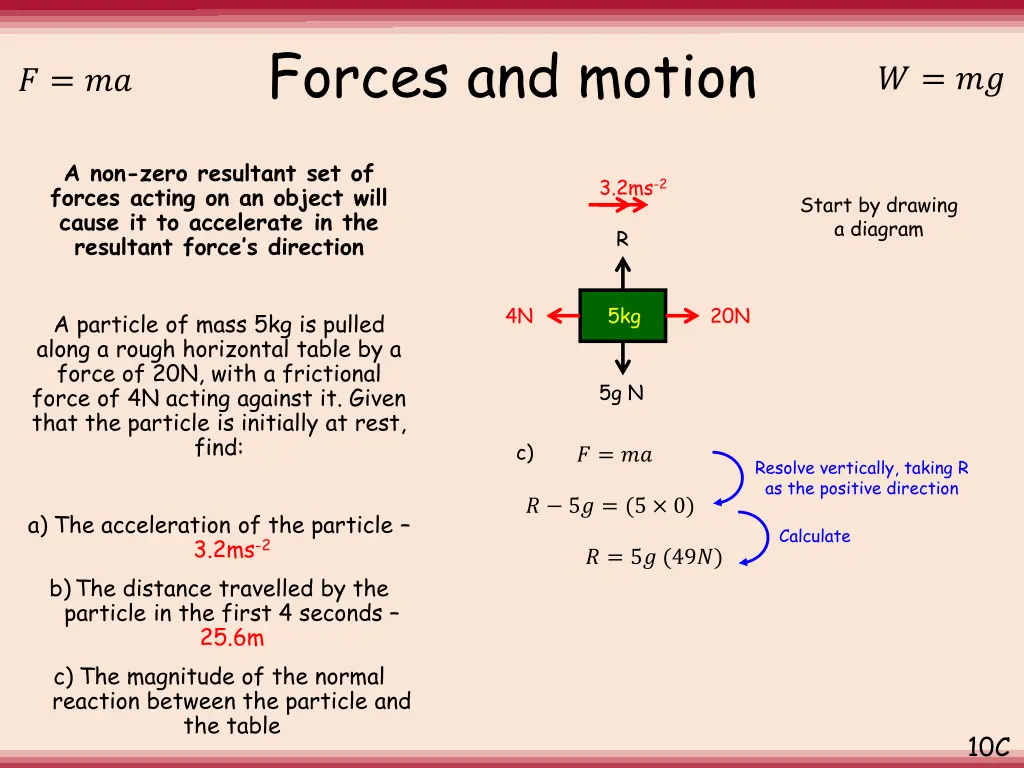
Forces and motion ? = ?? ? = ?? A non-zero resultant set of forces acting on an object will cause it to accelerate in the resultant force s direction 3.2ms-2 Start by drawing a diagram R 4N 5kg 20N A particle of mass 5kg is pulled along a rough horizontal table by a force of 20N, with a frictional force of 4N acting against it. Given that the particle is initially at rest, find: 5g N c) ? = ?? Resolve vertically, taking R as the positive direction ? 5? = (5 0) a) The acceleration of the particle 3.2ms-2 b)The distance travelled by the particle in the first 4 seconds 25.6m c) The magnitude of the normal reaction between the particle and the table Calculate ? = 5? (49?) 10C
Teachings For Teachings For Exercise 10D Exercise 10D
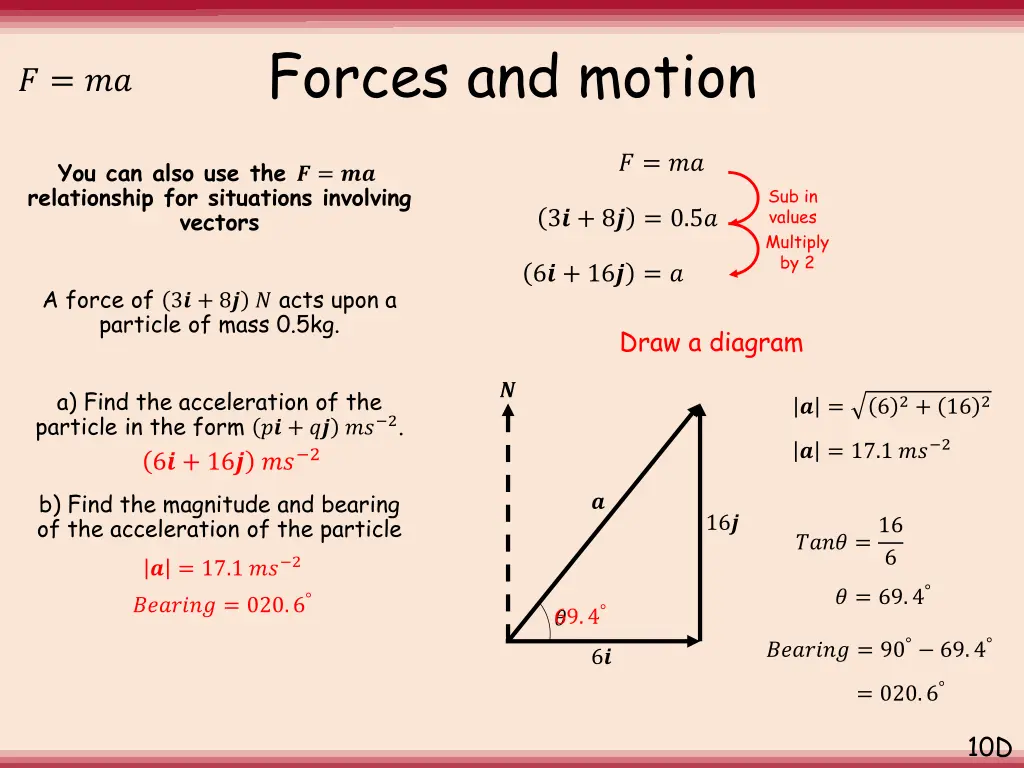
Forces and motion ? = ?? ? = ?? You can also use the ? = ?? relationship for situations involving vectors Sub in values Multiply by 2 3? + 8? = 0.5? 6? + 16? = ? A force of 3? + 8? ? acts upon a particle of mass 0.5kg. Draw a diagram ? a) Find the acceleration of the particle in the form ?? + ?? ?? 2. 6? + 16? ?? 2 62+ 162 ? = ? = 17.1 ?? 2 b) Find the magnitude and bearing of the acceleration of the particle ? = 17.1 ?? 2 ??????? = 020.6 ? 16? ???? =16 6 ? = 69.4 ? 69.4 ??????? = 90 69.4 6? = 020.6 10D
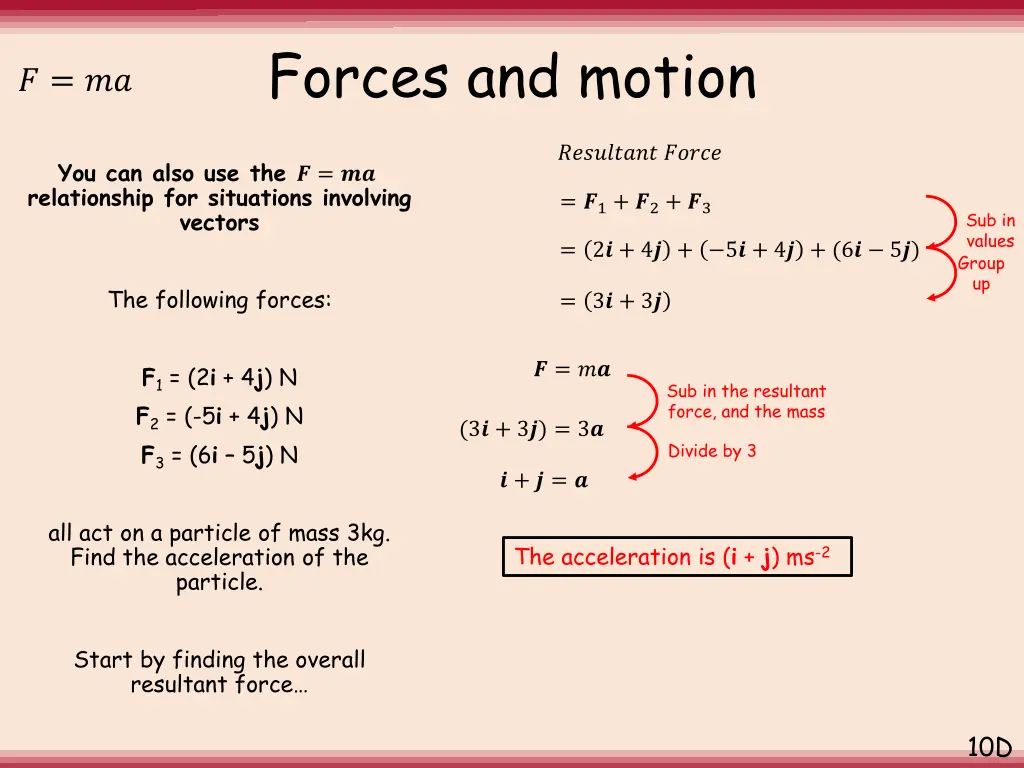
Forces and motion ? = ?? ????????? ????? You can also use the ? = ?? relationship for situations involving vectors = ?1+ ?2+ ?3 Sub in values Group up = 2? + 4? + 5? + 4? + (6? 5?) The following forces: = 3? + 3? ? = ?? F1 = (2i + 4j) N F2 = (-5i + 4j) N F3 = (6i 5j) N Sub in the resultant force, and the mass (3? + 3?) = 3? Divide by 3 ? + ? = ? all act on a particle of mass 3kg. Find the acceleration of the particle. The acceleration is (i + j) ms-2 Start by finding the overall resultant force 10D
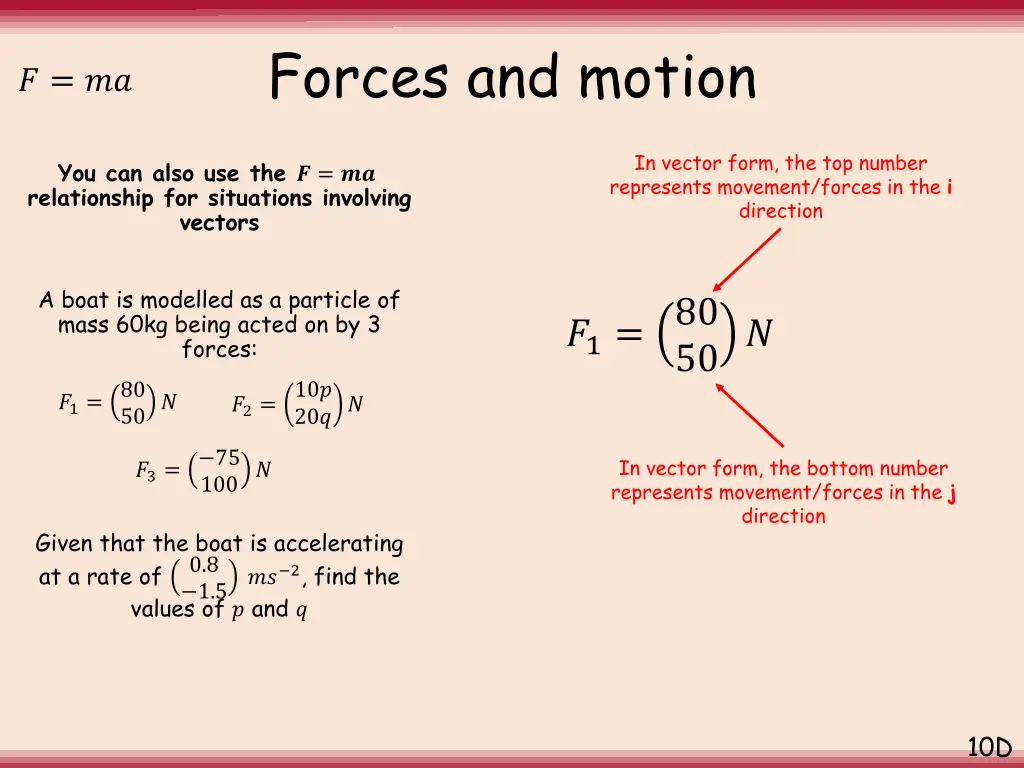
Forces and motion ? = ?? In vector form, the top number represents movement/forces in the i direction You can also use the ? = ?? relationship for situations involving vectors A boat is modelled as a particle of mass 60kg being acted on by 3 forces: 80 50 ?1= ? 10? 20?? 80 50 ?1= ? ?2= 75 100 In vector form, the bottom number represents movement/forces in the j direction ?3= ? Given that the boat is accelerating at a rate of 1.5 ?? 2, find the values of ? and ? 0.8 10D
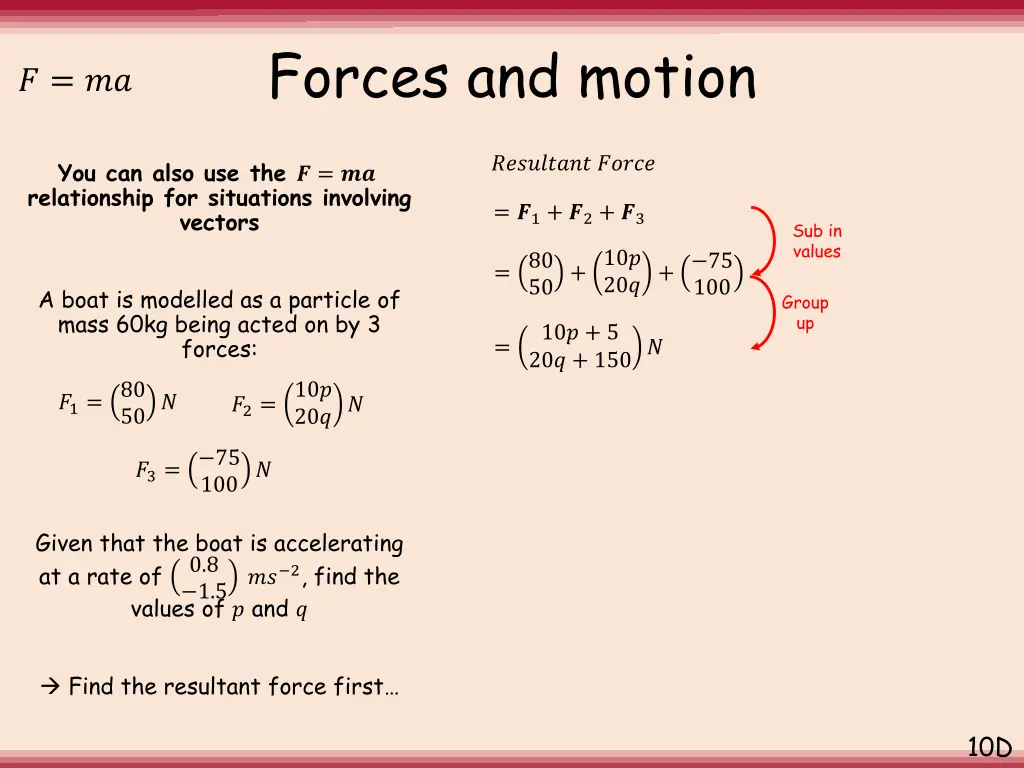
Forces and motion ? = ?? ????????? ????? You can also use the ? = ?? relationship for situations involving vectors = ?1+ ?2+ ?3 Sub in values 10? 20? 80 50 + 75 100 = + A boat is modelled as a particle of mass 60kg being acted on by 3 forces: Group up 10? + 5 20? + 150? = 10? 20?? 80 50 ?1= ? ?2= 75 100 ?3= ? Given that the boat is accelerating at a rate of 1.5 ?? 2, find the values of ? and ? 0.8 Find the resultant force first 10D
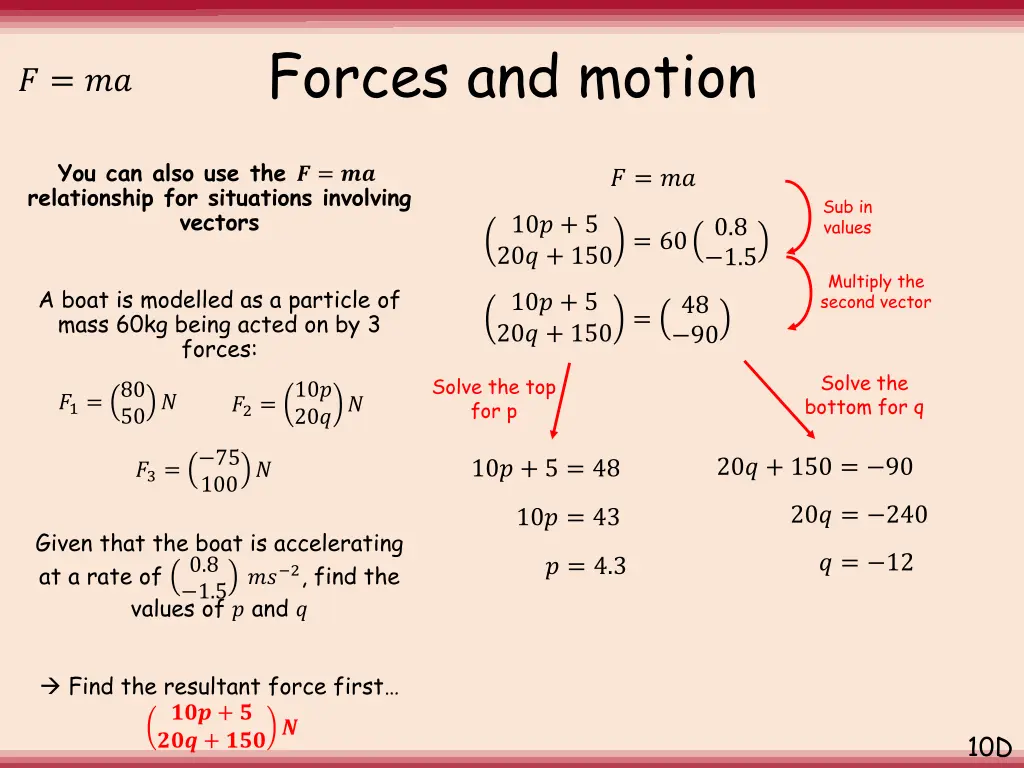
Forces and motion ? = ?? You can also use the ? = ?? relationship for situations involving vectors ? = ?? Sub in values 10? + 5 20? + 150 0.8 1.5 = 60 Multiply the second vector A boat is modelled as a particle of mass 60kg being acted on by 3 forces: 10? + 5 20? + 150 48 90 = Solve the bottom for q Solve the top for p 10? 20?? 80 50 ?1= ? ?2= 75 100 20? + 150 = 90 10? + 5 = 48 ?3= ? 20? = 240 10? = 43 Given that the boat is accelerating at a rate of 1.5 ?? 2, find the values of ? and ? ? = 12 0.8 ? = 4.3 Find the resultant force first ??? + ? ??? + ???? 10D
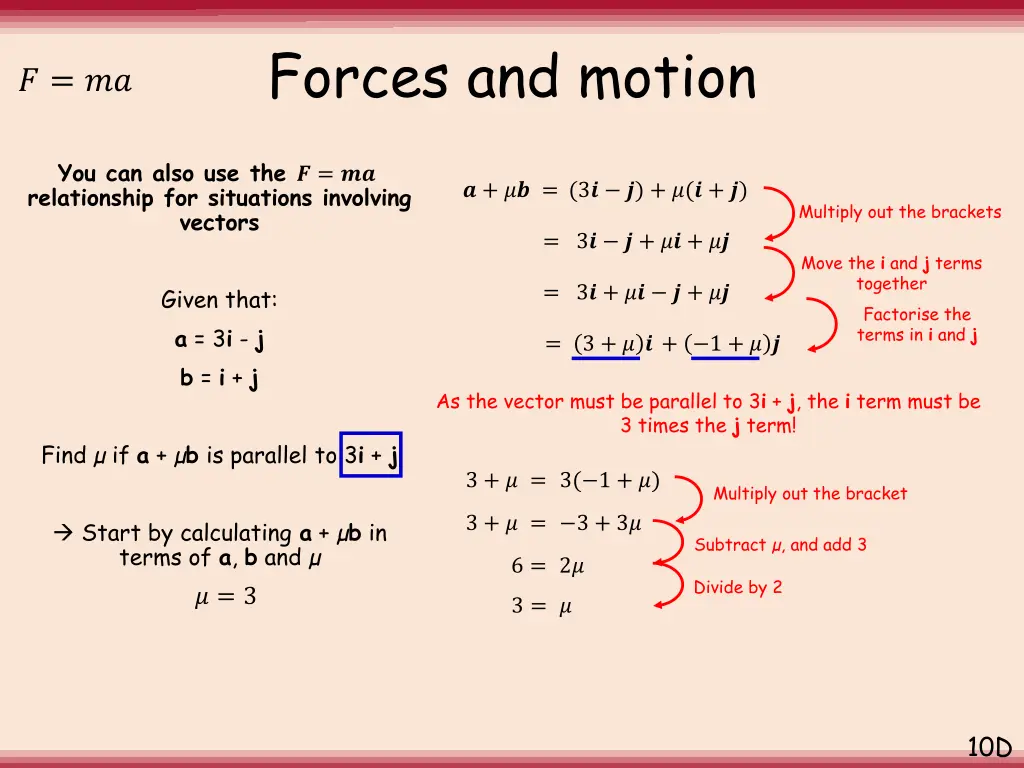
Forces and motion ? = ?? You can also use the ? = ?? relationship for situations involving vectors ? + ?? = (3? ?) + ?(? + ?) Multiply out the brackets = 3? ? + ?? + ?? Move the i and j terms together Factorise the terms in i and j = 3? + ?? ? + ?? Given that: a = 3i - j b = i + j = 3 + ? ? + 1 + ? ? As the vector must be parallel to 3i + j, the i term must be 3 times the j term! Find if a + b is parallel to 3i + j 3 + ? = 3( 1 + ?) Multiply out the bracket 3 + ? = 3 + 3? Start by calculating a + b in terms of a, b and ? = 3 Subtract , and add 3 6 = 2? Divide by 2 3 = ? 10D
Teachings For Teachings For Exercise 10E Exercise 10E
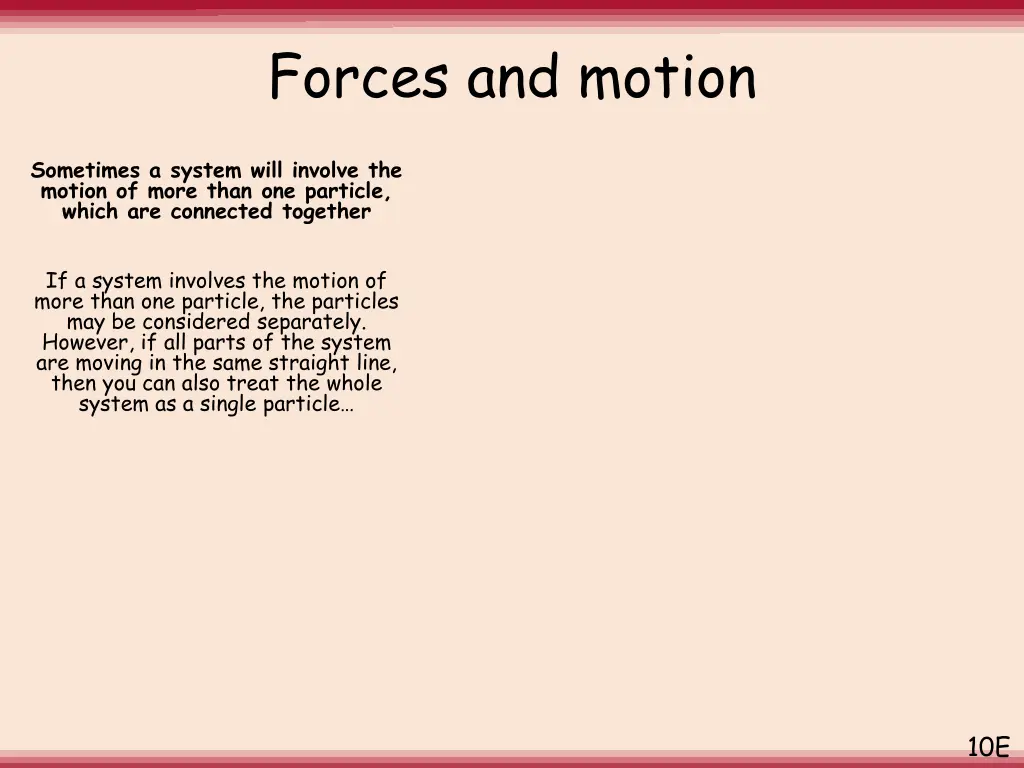
Forces and motion Sometimes a system will involve the motion of more than one particle, which are connected together If a system involves the motion of more than one particle, the particles may be considered separately. However, if all parts of the system are moving in the same straight line, then you can also treat the whole system as a single particle 10E
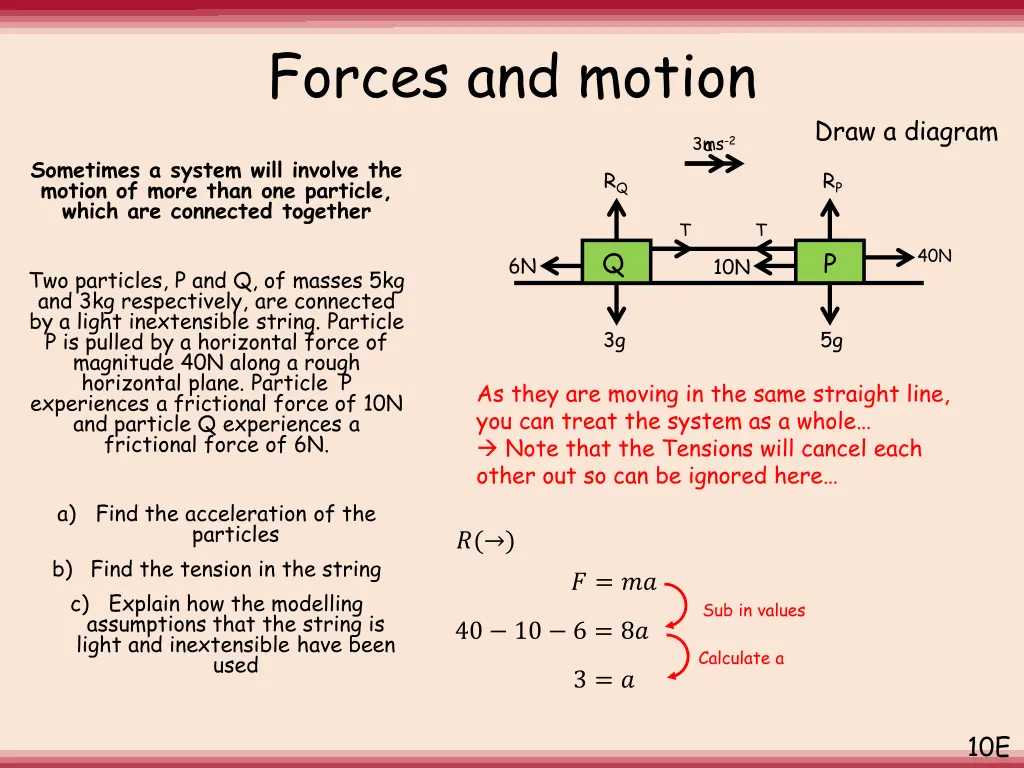
Forces and motion Draw a diagram 3ms-2 a Sometimes a system will involve the motion of more than one particle, which are connected together RQ RP T T 40N Q P 6N 10N Two particles, P and Q, of masses 5kg and 3kg respectively, are connected by a light inextensible string. Particle P is pulled by a horizontal force of magnitude 40N along a rough horizontal plane. Particle P experiences a frictional force of 10N and particle Q experiences a frictional force of 6N. 3g 5g As they are moving in the same straight line, you can treat the system as a whole Note that the Tensions will cancel each other out so can be ignored here Find the acceleration of the particles b) Find the tension in the string c) Explain how the modelling assumptions that the string is light and inextensible have been used a) ?( ) ? = ?? Sub in values 40 10 6 = 8? Calculate a 3 = ? 10E
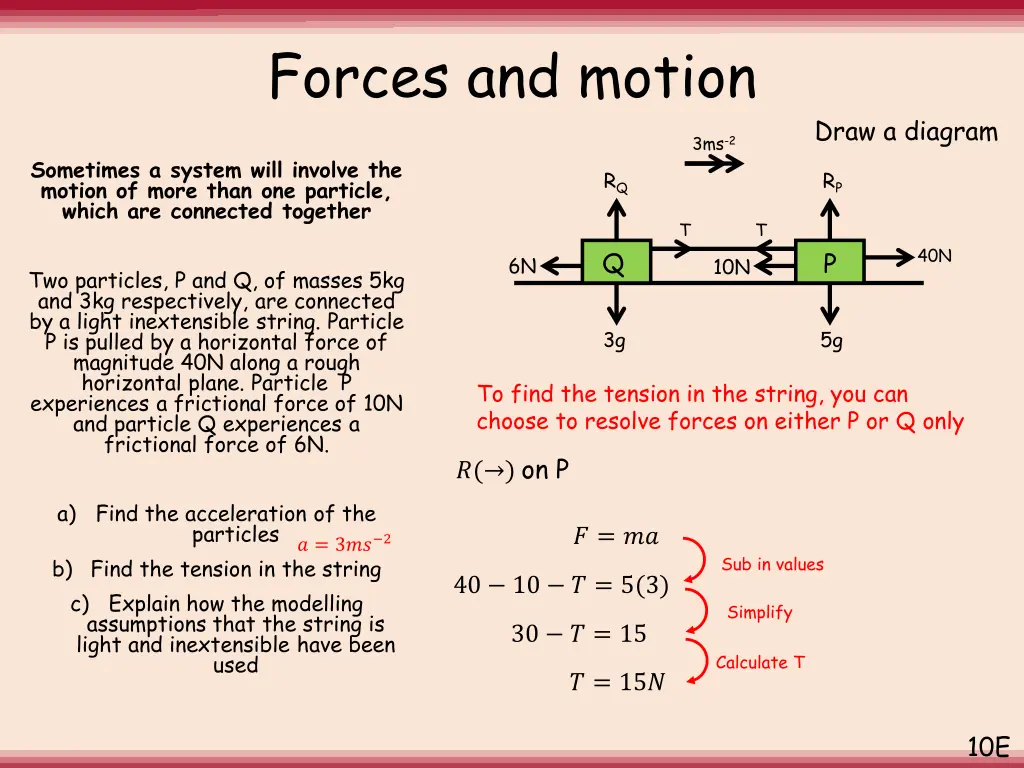
Forces and motion Draw a diagram 3ms-2 Sometimes a system will involve the motion of more than one particle, which are connected together RQ RP T T 40N Q P 6N 10N Two particles, P and Q, of masses 5kg and 3kg respectively, are connected by a light inextensible string. Particle P is pulled by a horizontal force of magnitude 40N along a rough horizontal plane. Particle P experiences a frictional force of 10N and particle Q experiences a frictional force of 6N. 3g 5g To find the tension in the string, you can choose to resolve forces on either P or Q only ?( )on P Find the acceleration of the particles b) Find the tension in the string c) Explain how the modelling assumptions that the string is light and inextensible have been used a) ? = ?? ? = 3?? 2 Sub in values 40 10 ? = 5(3) Simplify 30 ? = 15 Calculate T ? = 15? 10E
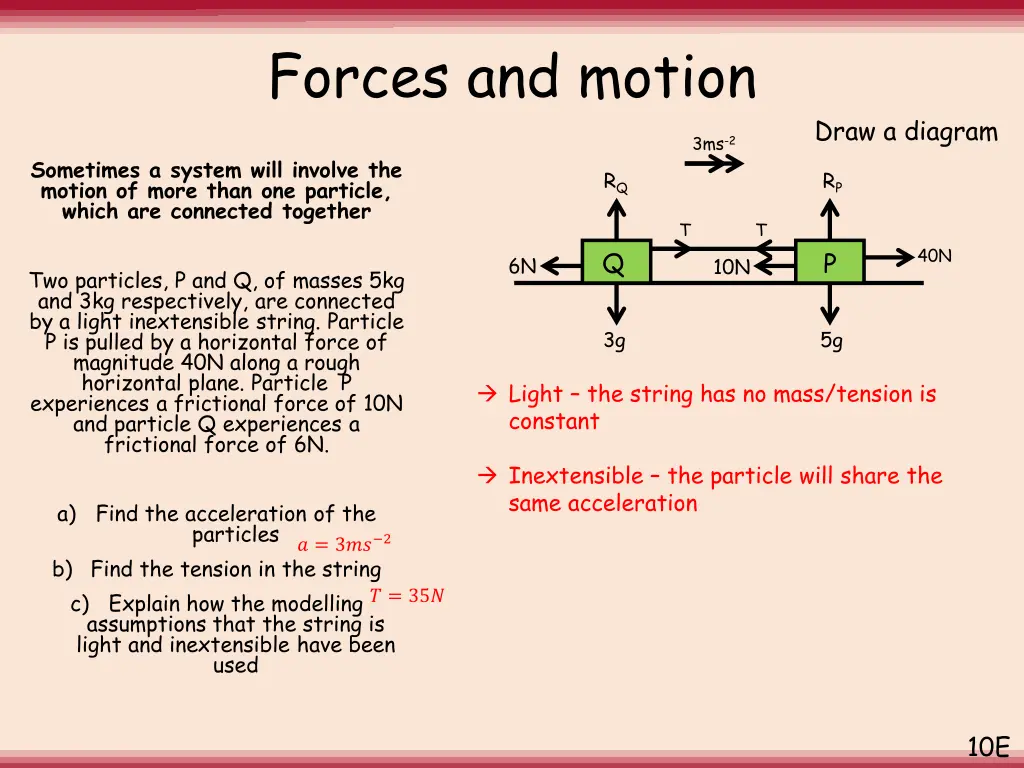
Forces and motion Draw a diagram 3ms-2 Sometimes a system will involve the motion of more than one particle, which are connected together RQ RP T T 40N Q P 6N 10N Two particles, P and Q, of masses 5kg and 3kg respectively, are connected by a light inextensible string. Particle P is pulled by a horizontal force of magnitude 40N along a rough horizontal plane. Particle P experiences a frictional force of 10N and particle Q experiences a frictional force of 6N. 3g 5g Light the string has no mass/tension is constant Inextensible the particle will share the same acceleration Find the acceleration of the particles b) Find the tension in the string c) Explain how the modelling assumptions that the string is light and inextensible have been used a) ? = 3?? 2 ? = 35? 10E
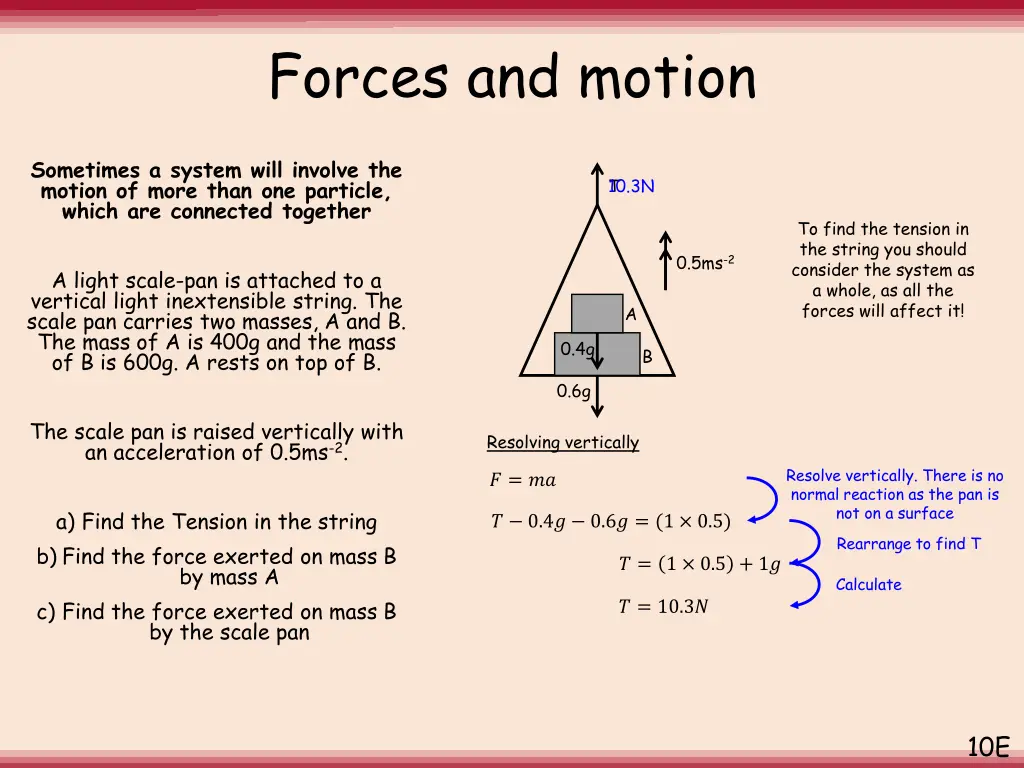
Forces and motion Sometimes a system will involve the motion of more than one particle, which are connected together T 10.3N To find the tension in the string you should consider the system as a whole, as all the forces will affect it! 0.5ms-2 A light scale-pan is attached to a vertical light inextensible string. The scale pan carries two masses, A and B. The mass of A is 400g and the mass of B is 600g. A rests on top of B. A 0.4g B 0.6g The scale pan is raised vertically with an acceleration of 0.5ms-2. Resolving vertically Resolve vertically. There is no normal reaction as the pan is not on a surface ? = ?? a) Find the Tension in the string b) Find the force exerted on mass B by mass A c) Find the force exerted on mass B by the scale pan ? 0.4? 0.6? = (1 0.5) Rearrange to find T ? = 1 0.5 + 1? Calculate ? = 10.3? 10E
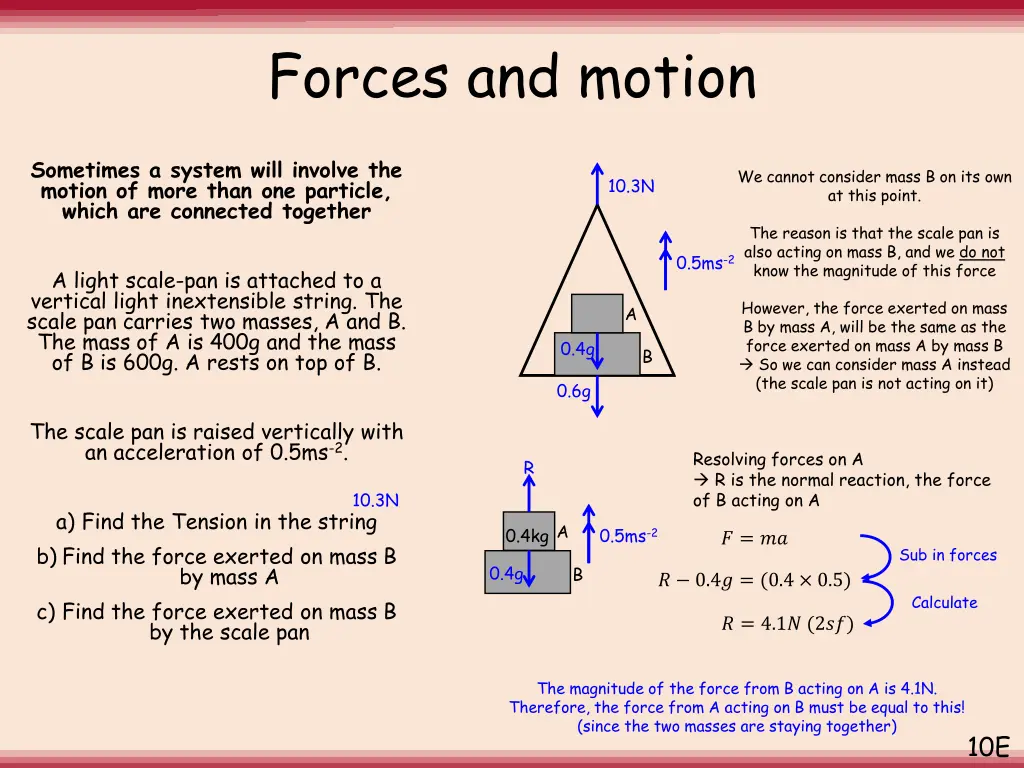
Forces and motion Sometimes a system will involve the motion of more than one particle, which are connected together We cannot consider mass B on its own at this point. 10.3N The reason is that the scale pan is also acting on mass B, and we do not know the magnitude of this force 0.5ms-2 A light scale-pan is attached to a vertical light inextensible string. The scale pan carries two masses, A and B. The mass of A is 400g and the mass of B is 600g. A rests on top of B. However, the force exerted on mass B by mass A, will be the same as the force exerted on mass A by mass B So we can consider mass A instead (the scale pan is not acting on it) A 0.4g B 0.6g The scale pan is raised vertically with an acceleration of 0.5ms-2. Resolving forces on A R is the normal reaction, the force of B acting on A R 10.3N a) Find the Tension in the string b) Find the force exerted on mass B by mass A c) Find the force exerted on mass B by the scale pan A 0.4kg 0.5ms-2 ? = ?? Sub in forces 0.4g B ? 0.4? = (0.4 0.5) Calculate ? = 4.1? (2??) The magnitude of the force from B acting on A is 4.1N. Therefore, the force from A acting on B must be equal to this! (since the two masses are staying together) 10E
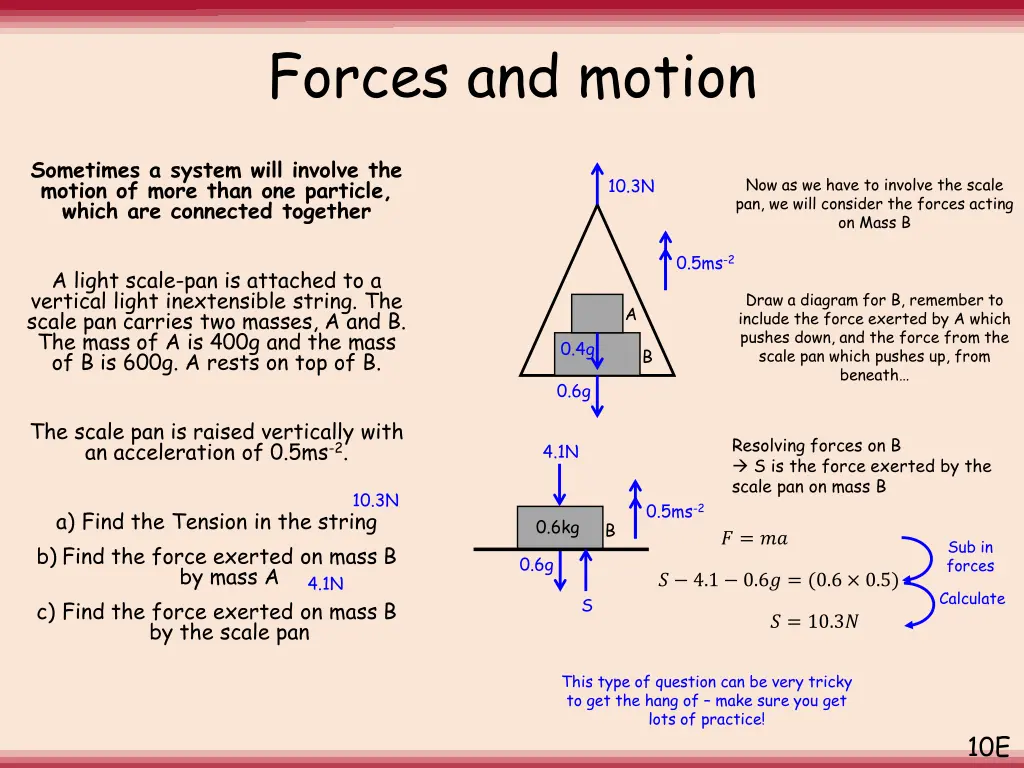
Forces and motion Sometimes a system will involve the motion of more than one particle, which are connected together Now as we have to involve the scale pan, we will consider the forces acting on Mass B 10.3N 0.5ms-2 A light scale-pan is attached to a vertical light inextensible string. The scale pan carries two masses, A and B. The mass of A is 400g and the mass of B is 600g. A rests on top of B. Draw a diagram for B, remember to include the force exerted by A which pushes down, and the force from the scale pan which pushes up, from beneath A 0.4g B 0.6g The scale pan is raised vertically with an acceleration of 0.5ms-2. Resolving forces on B S is the force exerted by the scale pan on mass B 4.1N 10.3N 0.5ms-2 a) Find the Tension in the string b) Find the force exerted on mass B by mass A c) Find the force exerted on mass B by the scale pan 0.6kg B ? = ?? Sub in forces 0.6g ? 4.1 0.6? = (0.6 0.5) 4.1N Calculate S ? = 10.3? This type of question can be very tricky to get the hang of make sure you get lots of practice! 10E
Teachings For Teachings For Exercise 10F Exercise 10F
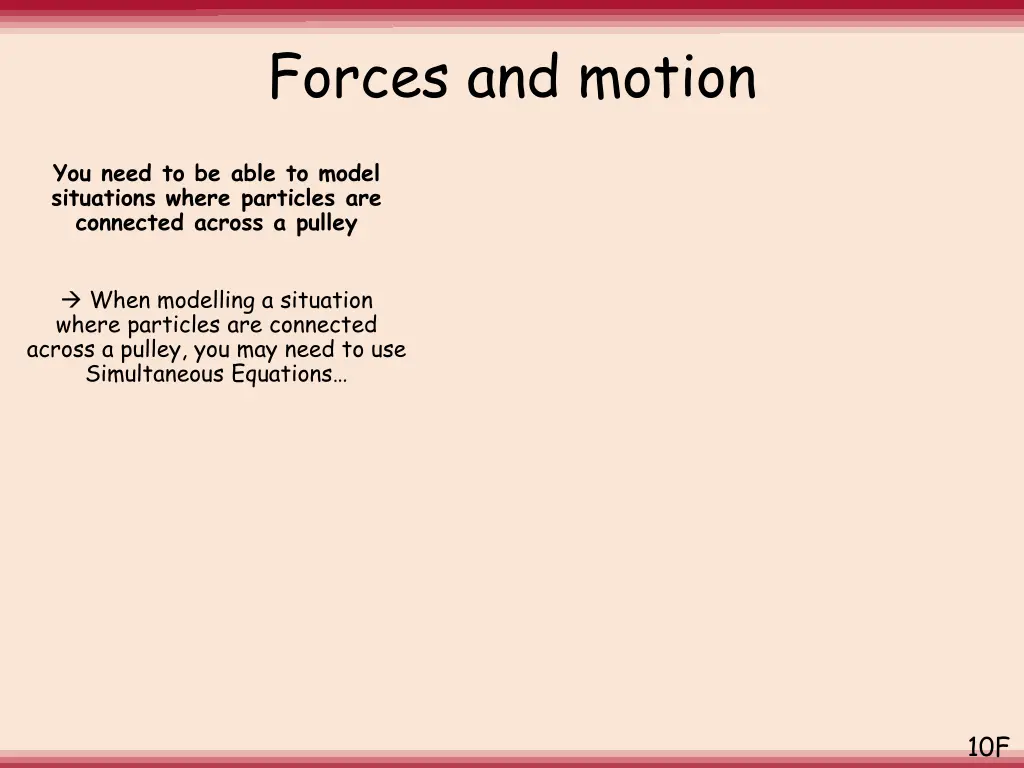
Forces and motion You need to be able to model situations where particles are connected across a pulley When modelling a situation where particles are connected across a pulley, you may need to use Simultaneous Equations 10F
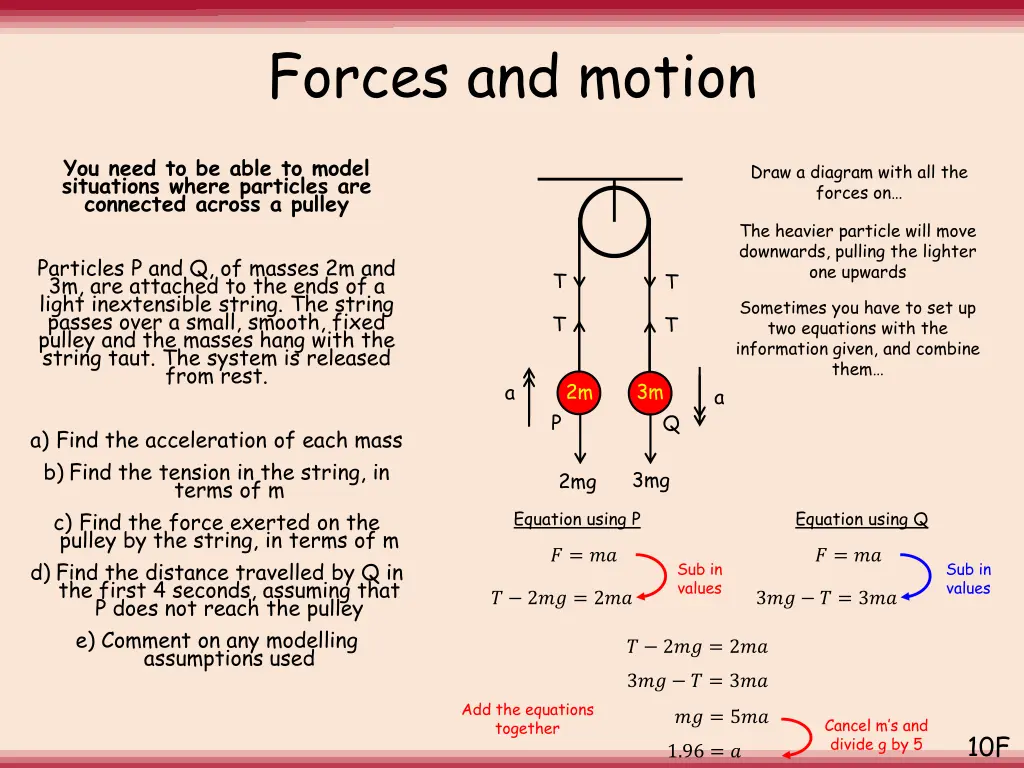
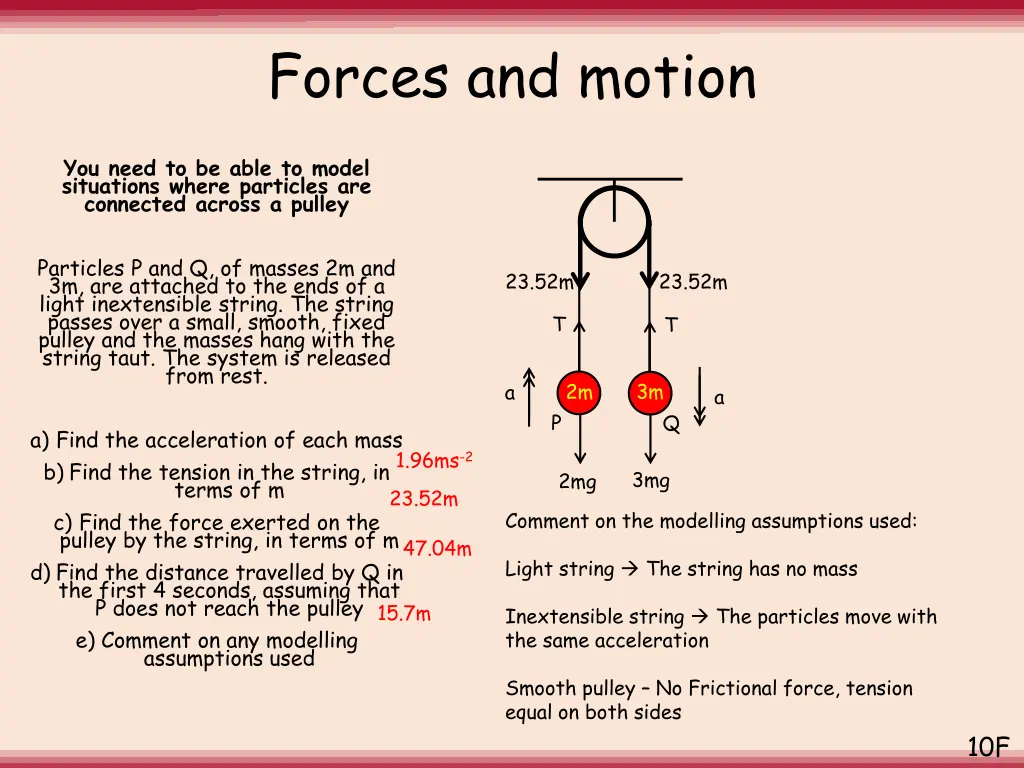
Forces and motion You need to be able to model situations where particles are connected across a pulley Draw a diagram with all the forces on The heavier particle will move downwards, pulling the lighter one upwards Particles P and Q, of masses 2m and 3m, are attached to the ends of a light inextensible string. The string passes over a small, smooth, fixed pulley and the masses hang with the string taut. The system is released from rest. T T Sometimes you have to set up two equations with the information given, and combine them T T 3m 2m a a P Q a) Find the acceleration of each mass b) Find the tension in the string, in terms of m c) Find the force exerted on the pulley by the string, in terms of m d) Find the distance travelled by Q in the first 4 seconds, assuming that P does not reach the pulley e) Comment on any modelling assumptions used 3mg 2mg Equation using P Equation using Q ? = ?? ? = ?? Sub in values Sub in values ? 2?? = 2?? 3?? ? = 3?? ? 2?? = 2?? 3?? ? = 3?? Add the equations together ?? = 5?? Cancel m s and divide g by 5 10F 1.96 = ?
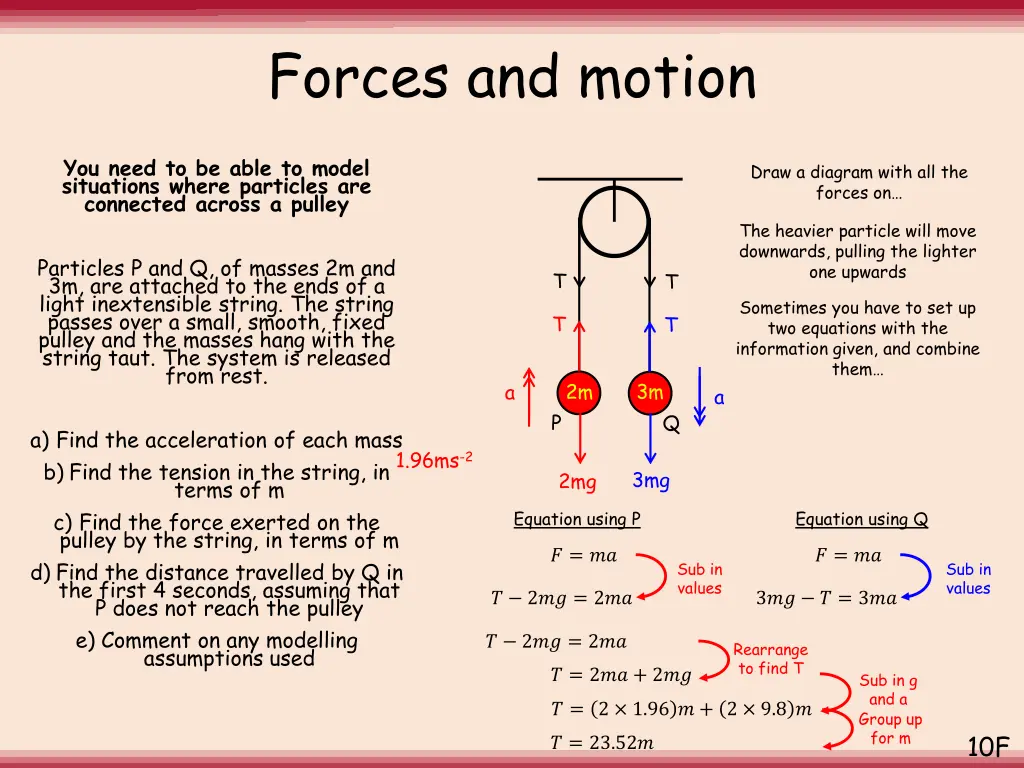
Forces and motion You need to be able to model situations where particles are connected across a pulley Draw a diagram with all the forces on The heavier particle will move downwards, pulling the lighter one upwards Particles P and Q, of masses 2m and 3m, are attached to the ends of a light inextensible string. The string passes over a small, smooth, fixed pulley and the masses hang with the string taut. The system is released from rest. T T Sometimes you have to set up two equations with the information given, and combine them T T 3m 2m a a P Q a) Find the acceleration of each mass b) Find the tension in the string, in terms of m c) Find the force exerted on the pulley by the string, in terms of m d) Find the distance travelled by Q in the first 4 seconds, assuming that P does not reach the pulley e) Comment on any modelling assumptions used 1.96ms-2 3mg 2mg Equation using P Equation using Q ? = ?? ? = ?? Sub in values Sub in values ? 2?? = 2?? 3?? ? = 3?? ? 2?? = 2?? Rearrange to find T ? = 2?? + 2?? Sub in g and a Group up for m ? = 2 1.96 ? + 2 9.8 ? 10F ? = 23.52?
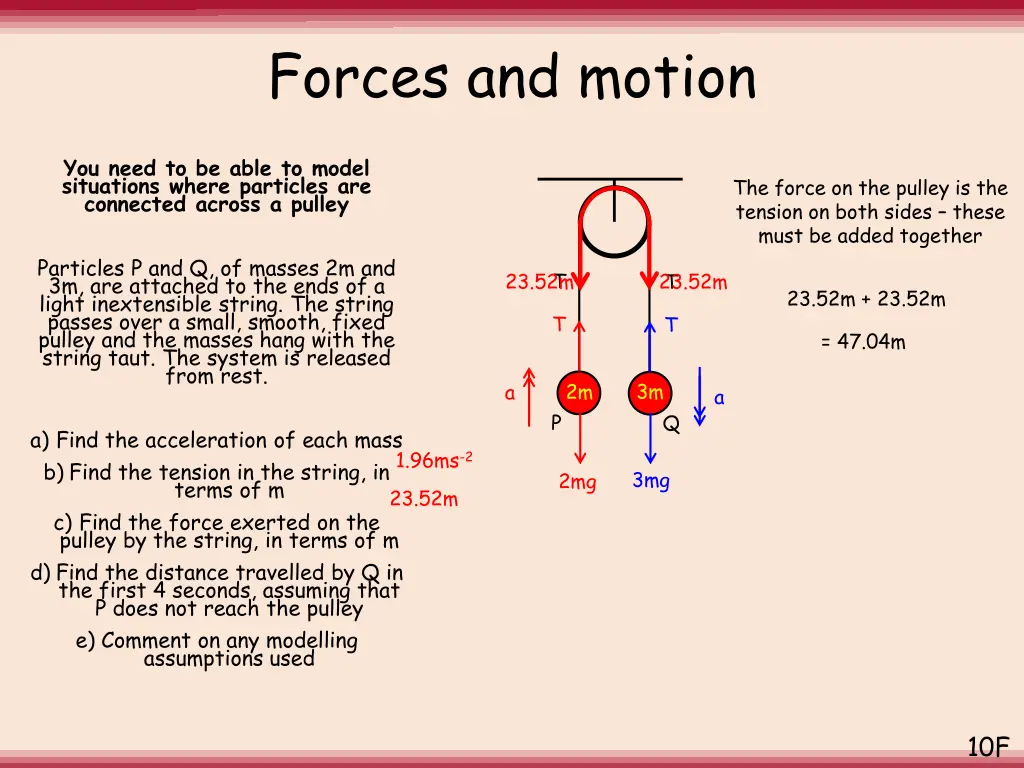
Forces and motion You need to be able to model situations where particles are connected across a pulley The force on the pulley is the tension on both sides these must be added together Particles P and Q, of masses 2m and 3m, are attached to the ends of a light inextensible string. The string passes over a small, smooth, fixed pulley and the masses hang with the string taut. The system is released from rest. T 23.52m T 23.52m 23.52m + 23.52m T T = 47.04m 3m 2m a a P Q a) Find the acceleration of each mass b) Find the tension in the string, in terms of m c) Find the force exerted on the pulley by the string, in terms of m d) Find the distance travelled by Q in the first 4 seconds, assuming that P does not reach the pulley e) Comment on any modelling assumptions used 1.96ms-2 3mg 2mg 23.52m 10F
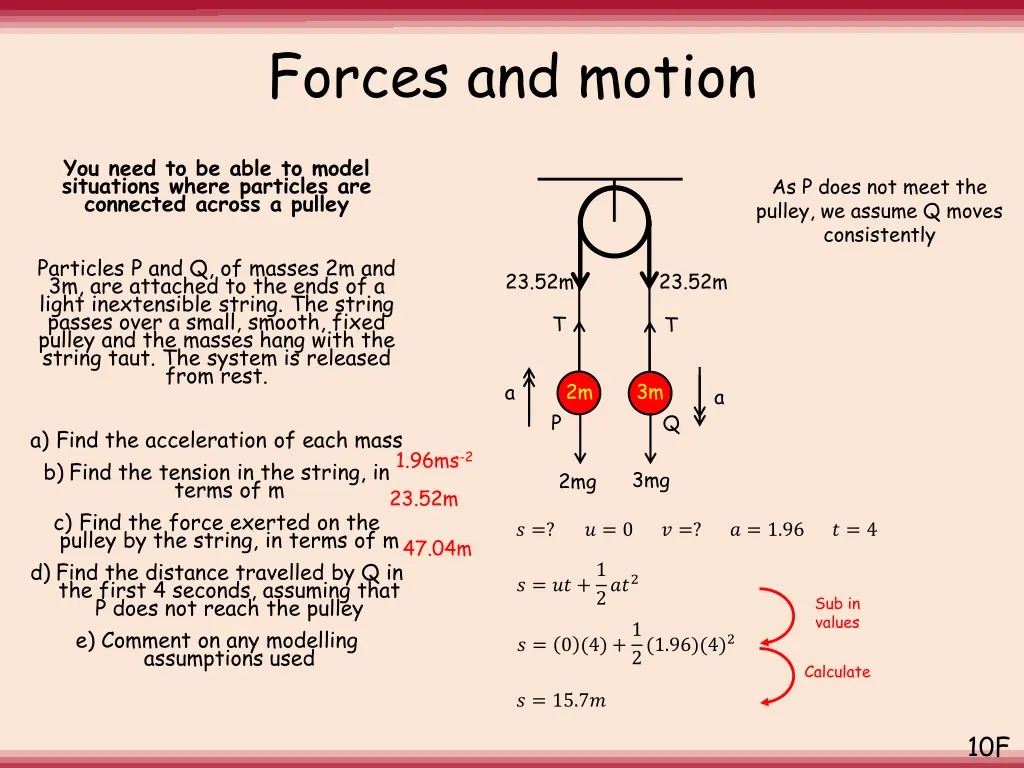
Forces and motion You need to be able to model situations where particles are connected across a pulley As P does not meet the pulley, we assume Q moves consistently Particles P and Q, of masses 2m and 3m, are attached to the ends of a light inextensible string. The string passes over a small, smooth, fixed pulley and the masses hang with the string taut. The system is released from rest. 23.52m 23.52m T T 3m 2m a a P Q a) Find the acceleration of each mass b) Find the tension in the string, in terms of m c) Find the force exerted on the pulley by the string, in terms of m d) Find the distance travelled by Q in the first 4 seconds, assuming that P does not reach the pulley e) Comment on any modelling assumptions used 1.96ms-2 3mg 2mg 23.52m ? =? ? = 0 ? =? ? = 1.96 ? = 4 47.04m ? = ?? +1 2??2 Sub in values ? = 0 (4) +1 2(1.96)(4)2 Calculate ? = 15.7? 10F
Forces and motion You need to be able to model situations where particles are connected across a pulley Particles P and Q, of masses 2m and 3m, are attached to the ends of a light inextensible string. The string passes over a small, smooth, fixed pulley and the masses hang with the string taut. The system is released from rest. 23.52m 23.52m T T 3m 2m a a P Q a) Find the acceleration of each mass b) Find the tension in the string, in terms of m c) Find the force exerted on the pulley by the string, in terms of m d) Find the distance travelled by Q in the first 4 seconds, assuming that P does not reach the pulley e) Comment on any modelling assumptions used 1.96ms-2 3mg 2mg 23.52m Comment on the modelling assumptions used: 47.04m Light string The string has no mass 15.7m Inextensible string The particles move with the same acceleration Smooth pulley No Frictional force, tension equal on both sides 10F
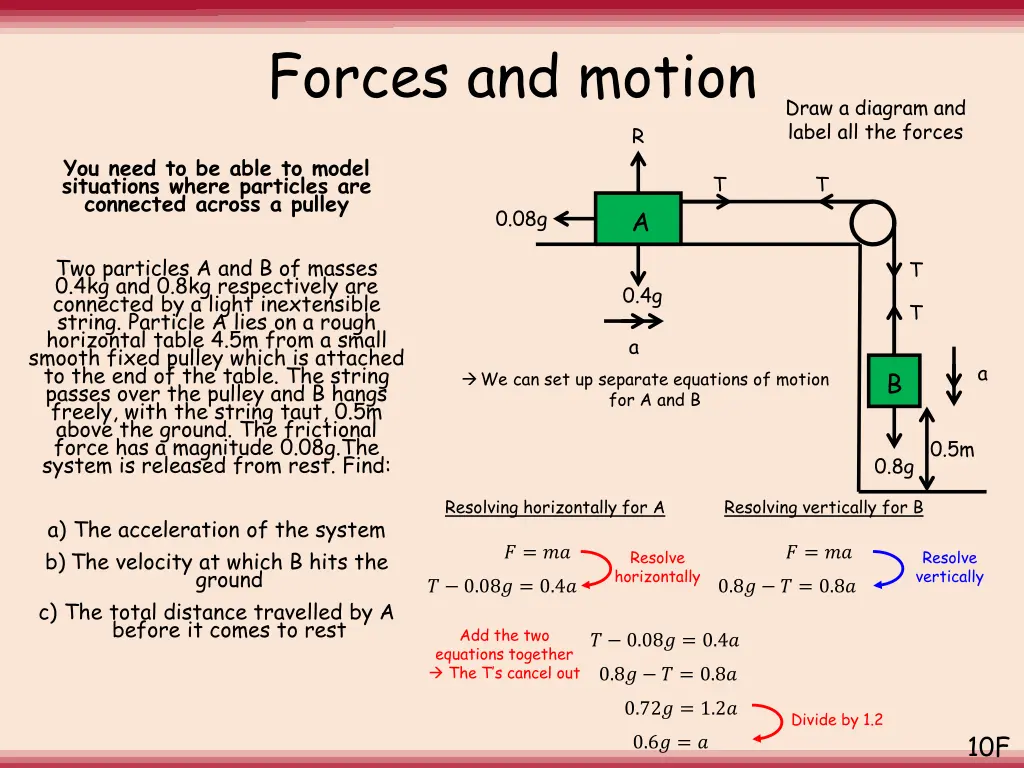
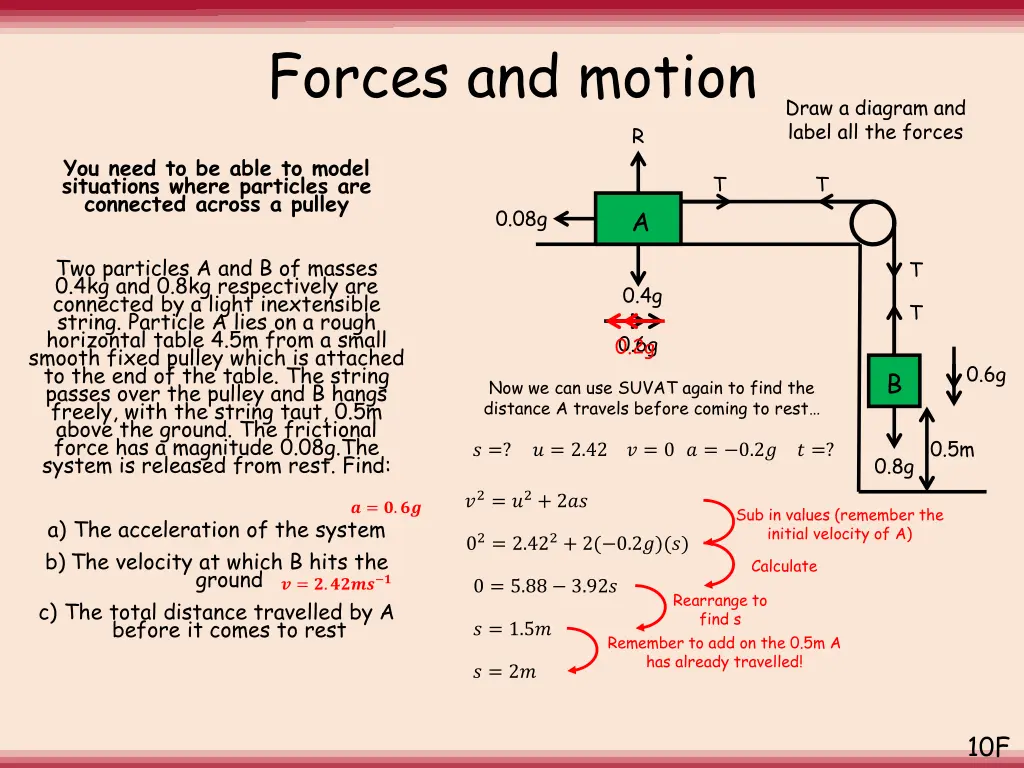
Forces and motion Draw a diagram and label all the forces R You need to be able to model situations where particles are connected across a pulley T T A 0.08g Two particles A and B of masses 0.4kg and 0.8kg respectively are connected by a light inextensible string. Particle A lies on a rough horizontal table 4.5m from a small smooth fixed pulley which is attached to the end of the table. The string passes over the pulley and B hangs freely, with the string taut, 0.5m above the ground. The frictional force has a magnitude 0.08g.The system is released from rest. Find: T 0.4g T a a B We can set up separate equations of motion for A and B 0.5m 0.8g Resolving horizontally for A Resolving vertically for B a) The acceleration of the system b) The velocity at which B hits the ground c) The total distance travelled by A before it comes to rest ? = ?? ? = ?? Resolve horizontally Resolve vertically ? 0.08? = 0.4? 0.8? ? = 0.8? Add the two equations together The T s cancel out ? 0.08? = 0.4? 0.8? ? = 0.8? 0.72? = 1.2? Divide by 1.2 10F 0.6? = ?
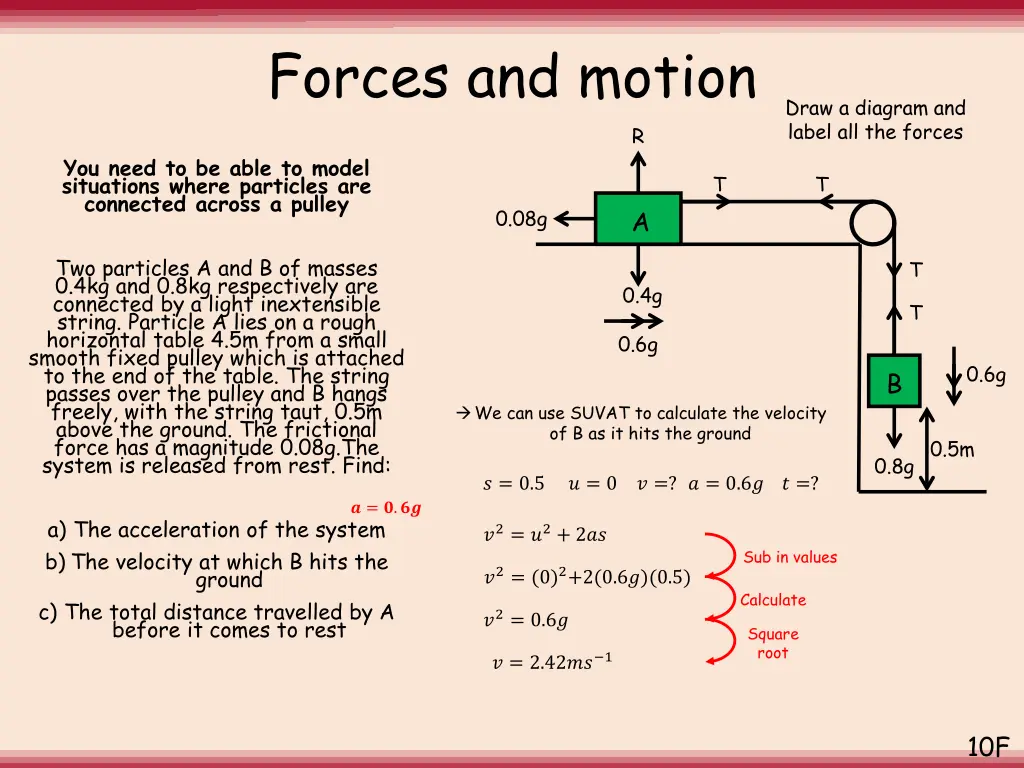
Forces and motion Draw a diagram and label all the forces R You need to be able to model situations where particles are connected across a pulley T T A 0.08g Two particles A and B of masses 0.4kg and 0.8kg respectively are connected by a light inextensible string. Particle A lies on a rough horizontal table 4.5m from a small smooth fixed pulley which is attached to the end of the table. The string passes over the pulley and B hangs freely, with the string taut, 0.5m above the ground. The frictional force has a magnitude 0.08g.The system is released from rest. Find: T 0.4g T 0.6g 0.6g B We can use SUVAT to calculate the velocity of B as it hits the ground 0.5m 0.8g ? = 0.5 ? = 0 ? =? ? = 0.6? ? =? ? = ?.?? a) The acceleration of the system b) The velocity at which B hits the ground c) The total distance travelled by A before it comes to rest ?2= ?2+ 2?? Sub in values ?2= (0)2+2(0.6?)(0.5) Calculate ?2= 0.6? Square root ? = 2.42?? 1 10F
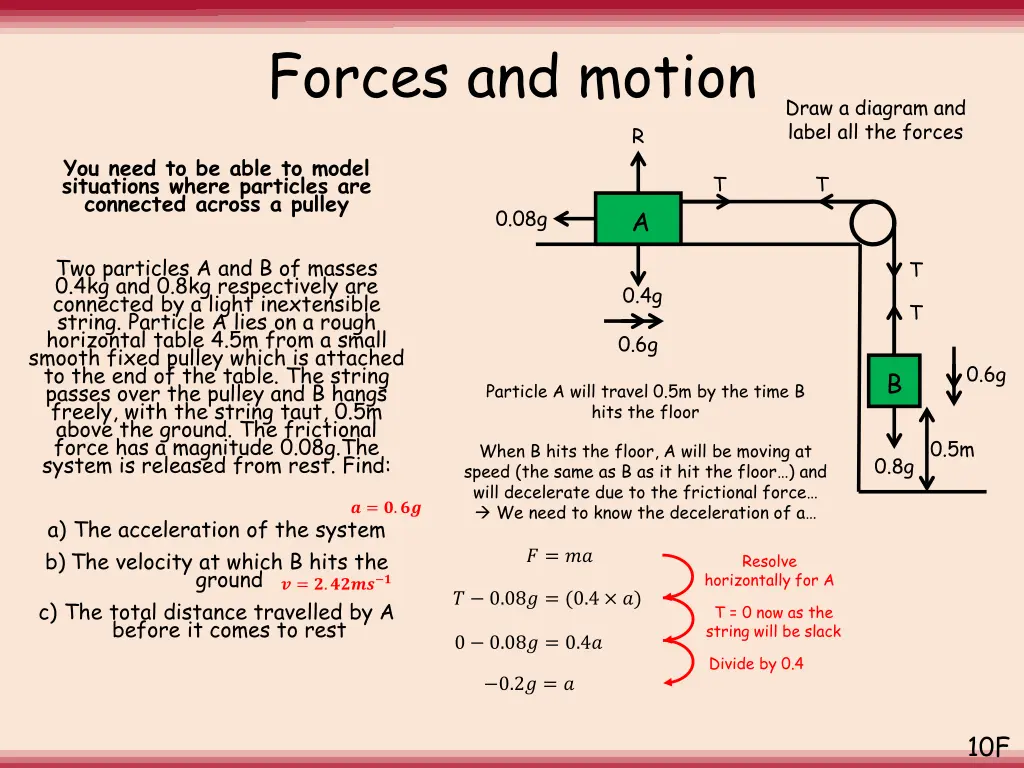
Forces and motion Draw a diagram and label all the forces R You need to be able to model situations where particles are connected across a pulley T T A 0.08g Two particles A and B of masses 0.4kg and 0.8kg respectively are connected by a light inextensible string. Particle A lies on a rough horizontal table 4.5m from a small smooth fixed pulley which is attached to the end of the table. The string passes over the pulley and B hangs freely, with the string taut, 0.5m above the ground. The frictional force has a magnitude 0.08g.The system is released from rest. Find: T 0.4g T 0.6g 0.6g B Particle A will travel 0.5m by the time B hits the floor 0.5m When B hits the floor, A will be moving at speed (the same as B as it hit the floor ) and will decelerate due to the frictional force We need to know the deceleration of a 0.8g ? = ?.?? a) The acceleration of the system b) The velocity at which B hits the ground c) The total distance travelled by A before it comes to rest ? = ?? Resolve horizontally for A ? = ?.???? ? ? 0.08? = (0.4 ?) T = 0 now as the string will be slack 0 0.08? = 0.4? Divide by 0.4 0.2? = ? 10F
Forces and motion Draw a diagram and label all the forces R You need to be able to model situations where particles are connected across a pulley T T A 0.08g Two particles A and B of masses 0.4kg and 0.8kg respectively are connected by a light inextensible string. Particle A lies on a rough horizontal table 4.5m from a small smooth fixed pulley which is attached to the end of the table. The string passes over the pulley and B hangs freely, with the string taut, 0.5m above the ground. The frictional force has a magnitude 0.08g.The system is released from rest. Find: T 0.4g T 0.6g 0.2g 0.6g B Now we can use SUVAT again to find the distance A travels before coming to rest 0.5m ? =? ? = 2.42 ? = 0 ? = 0.2? ? =? 0.8g ?2= ?2+ 2?? ? = ?.?? Sub in values (remember the initial velocity of A) a) The acceleration of the system b) The velocity at which B hits the ground c) The total distance travelled by A before it comes to rest 02= 2.422+ 2( 0.2?)(?) Calculate ? = ?.???? ? 0 = 5.88 3.92? Rearrange to find s ? = 1.5? Remember to add on the 0.5m A has already travelled! ? = 2? 10F