Medical Informatics Overview: Key Concepts and Applications
Explore the diverse field of medical informatics, encompassing terminology, biomedical informatics history, and the future of integrated clinical information systems. Discover the significance of clinical informatics, public health informatics, pharmacogenomics, and more in modern healthcare practices.

Download Presentation

Please find below an Image/Link to download the presentation.
The content on the website is provided AS IS for your information and personal use only. It may not be sold, licensed, or shared on other websites without obtaining consent from the author. If you encounter any issues during the download, it is possible that the publisher has removed the file from their server.
You are allowed to download the files provided on this website for personal or commercial use, subject to the condition that they are used lawfully. All files are the property of their respective owners.
The content on the website is provided AS IS for your information and personal use only. It may not be sold, licensed, or shared on other websites without obtaining consent from the author.
E N D
Presentation Transcript
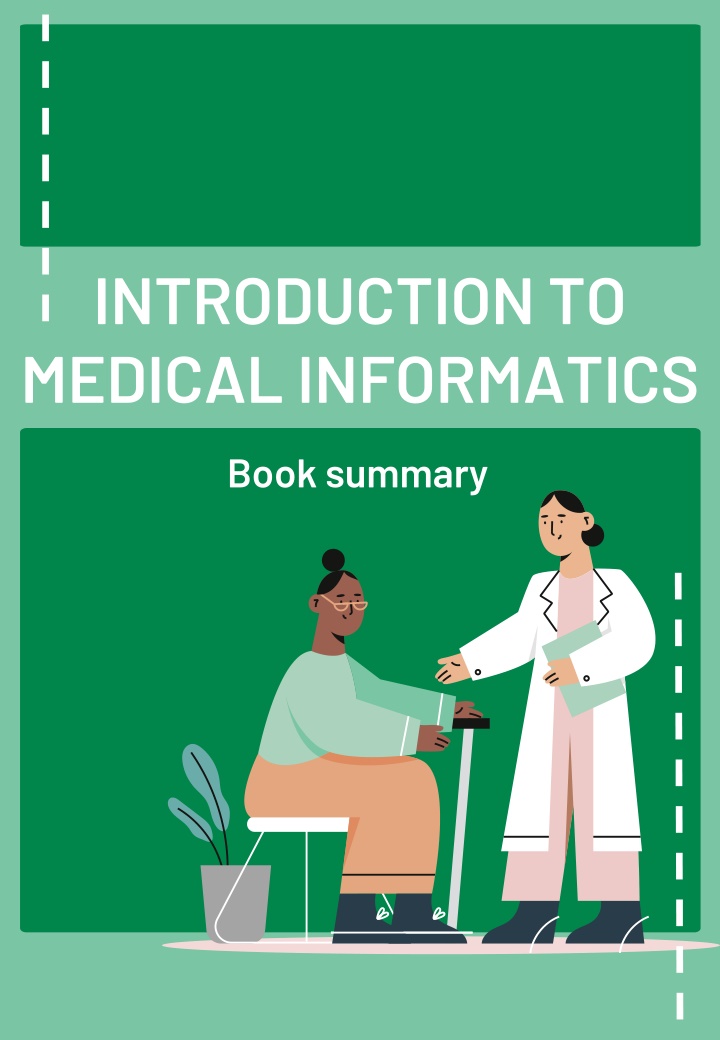
INTRODUCTION TO MEDICAL INFORMATICS Book summary
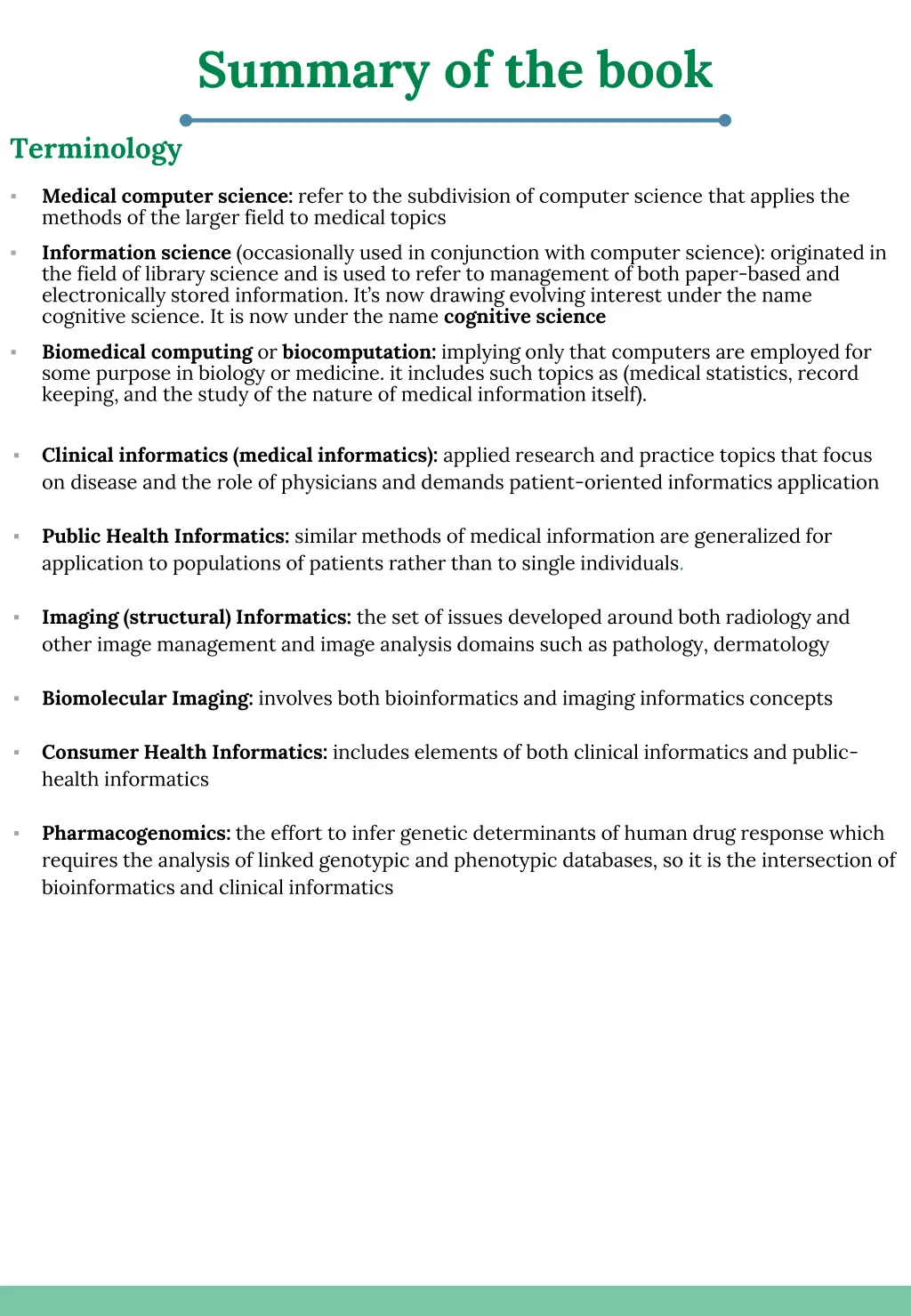
Summary of the book Terminology Medical computer science: refer to the subdivision of computer science that applies the methods of the larger field to medical topics Information science (occasionally used in conjunction with computer science): originated in the field of library science and is used to refer to management of both paper-based and electronically stored information. It s now drawing evolving interest under the name cognitive science. It is now under the name cognitive science Biomedical computing or biocomputation: implying only that computers are employed for some purpose in biology or medicine. it includes such topics as (medical statistics, record keeping, and the study of the nature of medical information itself). Clinical informatics (medical informatics): applied research and practice topics that focus on disease and the role of physicians and demands patient-oriented informatics application Public Health Informatics: similar methods of medical information are generalized for application to populations of patients rather than to single individuals. Imaging (structural) Informatics: the set of issues developed around both radiology and other image management and image analysis domains such as pathology, dermatology Biomolecular Imaging: involves both bioinformatics and imaging informatics concepts Consumer Health Informatics: includes elements of both clinical informatics and public- health informatics Pharmacogenomics: the effort to infer genetic determinants of human drug response which requires the analysis of linked genotypic and phenotypic databases, so it is the intersection of bioinformatics and clinical informatics
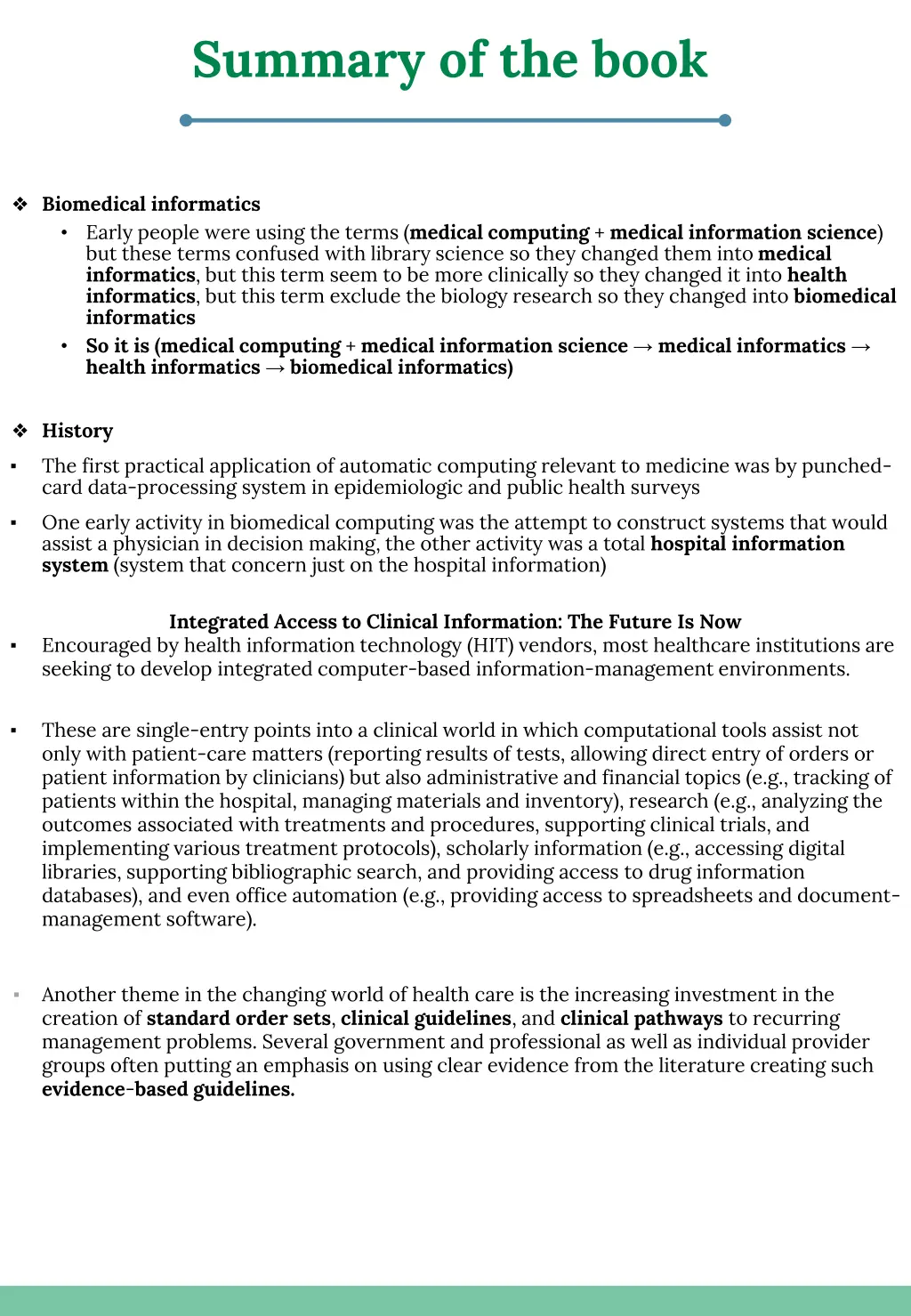
Summary of the book Biomedical informatics Early people were using the terms (medical computing + medical information science) but these terms confused with library science so they changed them into medical informatics, but this term seem to be more clinically so they changed it into health informatics, but this term exclude the biology research so they changed into biomedical informatics So it is (medical computing + medical information science medical informatics health informatics biomedical informatics) History The first practical application of automatic computing relevant to medicine was by punched- card data-processing system in epidemiologic and public health surveys One early activity in biomedical computing was the attempt to construct systems that would assist a physician in decision making, the other activity was a total hospital information system (system that concern just on the hospital information) Integrated Access to Clinical Information: The Future Is Now Encouraged by health information technology (HIT) vendors, most healthcare institutions are seeking to develop integrated computer-based information-management environments. These are single-entry points into a clinical world in which computational tools assist not only with patient-care matters (reporting results of tests, allowing direct entry of orders or patient information by clinicians) but also administrative and financial topics (e.g., tracking of patients within the hospital, managing materials and inventory), research (e.g., analyzing the outcomes associated with treatments and procedures, supporting clinical trials, and implementing various treatment protocols), scholarly information (e.g., accessing digital libraries, supporting bibliographic search, and providing access to drug information databases), and even office automation (e.g., providing access to spreadsheets and document- management software). Another theme in the changing world of health care is the increasing investment in the creation of standard order sets, clinical guidelines, and clinical pathways to recurring management problems. Several government and professional as well as individual provider groups often putting an emphasis on using clear evidence from the literature creating such evidence-based guidelines.
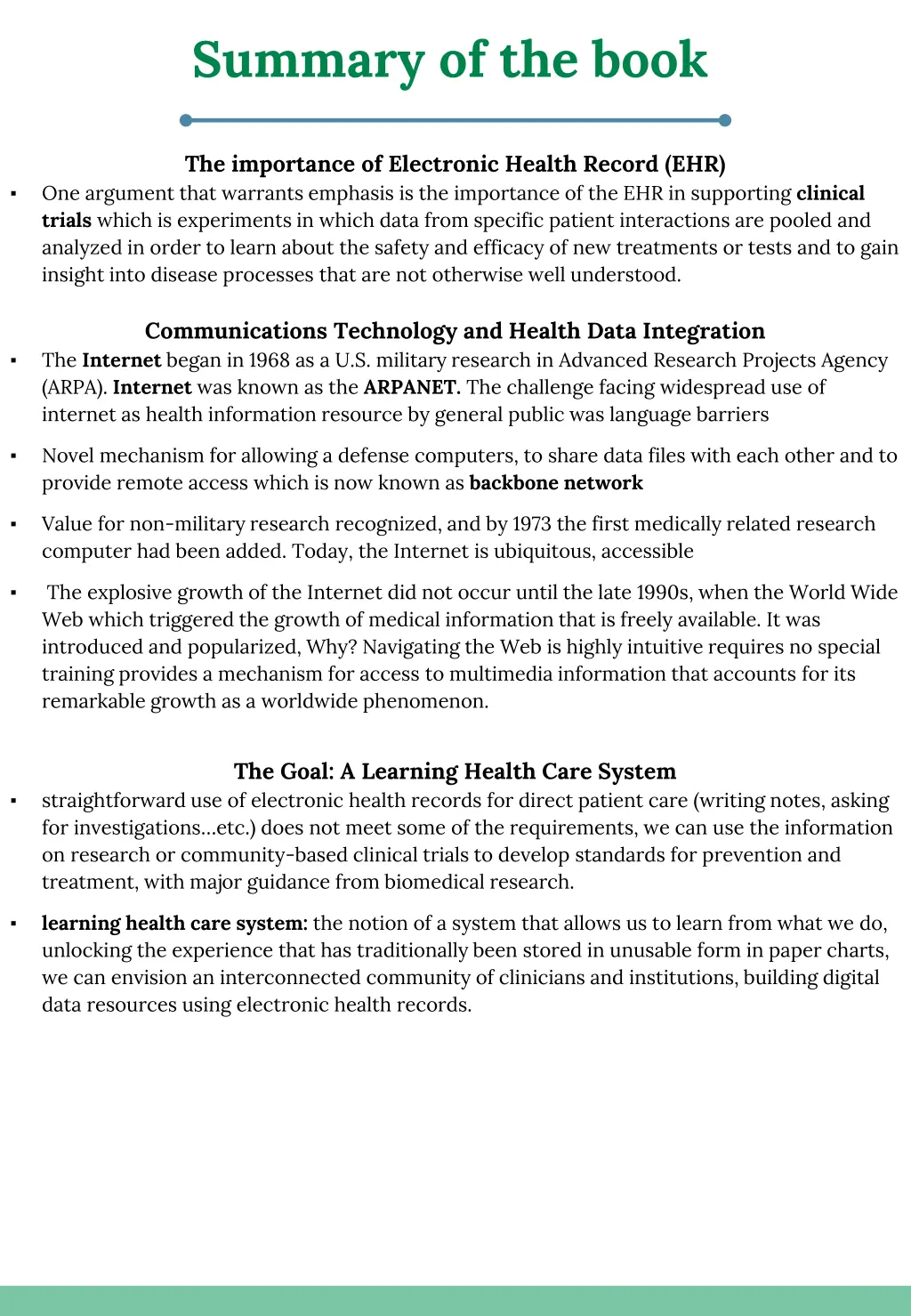
Summary of the book The importance of Electronic Health Record (EHR) One argument that warrants emphasis is the importance of the EHR in supporting clinical trials which is experiments in which data from specific patient interactions are pooled and analyzed in order to learn about the safety and efficacy of new treatments or tests and to gain insight into disease processes that are not otherwise well understood. Communications Technology and Health Data Integration The Internet began in 1968 as a U.S. military research in Advanced Research Projects Agency (ARPA). Internet was known as the ARPANET. The challenge facing widespread use of internet as health information resource by general public was language barriers Novel mechanism for allowing a defense computers, to share data files with each other and to provide remote access which is now known as backbone network Value for non-military research recognized, and by 1973 the first medically related research computer had been added. Today, the Internet is ubiquitous, accessible The explosive growth of the Internet did not occur until the late 1990s, when the World Wide Web which triggered the growth of medical information that is freely available. It was introduced and popularized, Why? Navigating the Web is highly intuitive requires no special training provides a mechanism for access to multimedia information that accounts for its remarkable growth as a worldwide phenomenon. The Goal: A Learning Health Care System straightforward use of electronic health records for direct patient care (writing notes, asking for investigations etc.) does not meet some of the requirements, we can use the information on research or community-based clinical trials to develop standards for prevention and treatment, with major guidance from biomedical research. learning health care system: the notion of a system that allows us to learn from what we do, unlocking the experience that has traditionally been stored in unusable form in paper charts, we can envision an interconnected community of clinicians and institutions, building digital data resources using electronic health records.
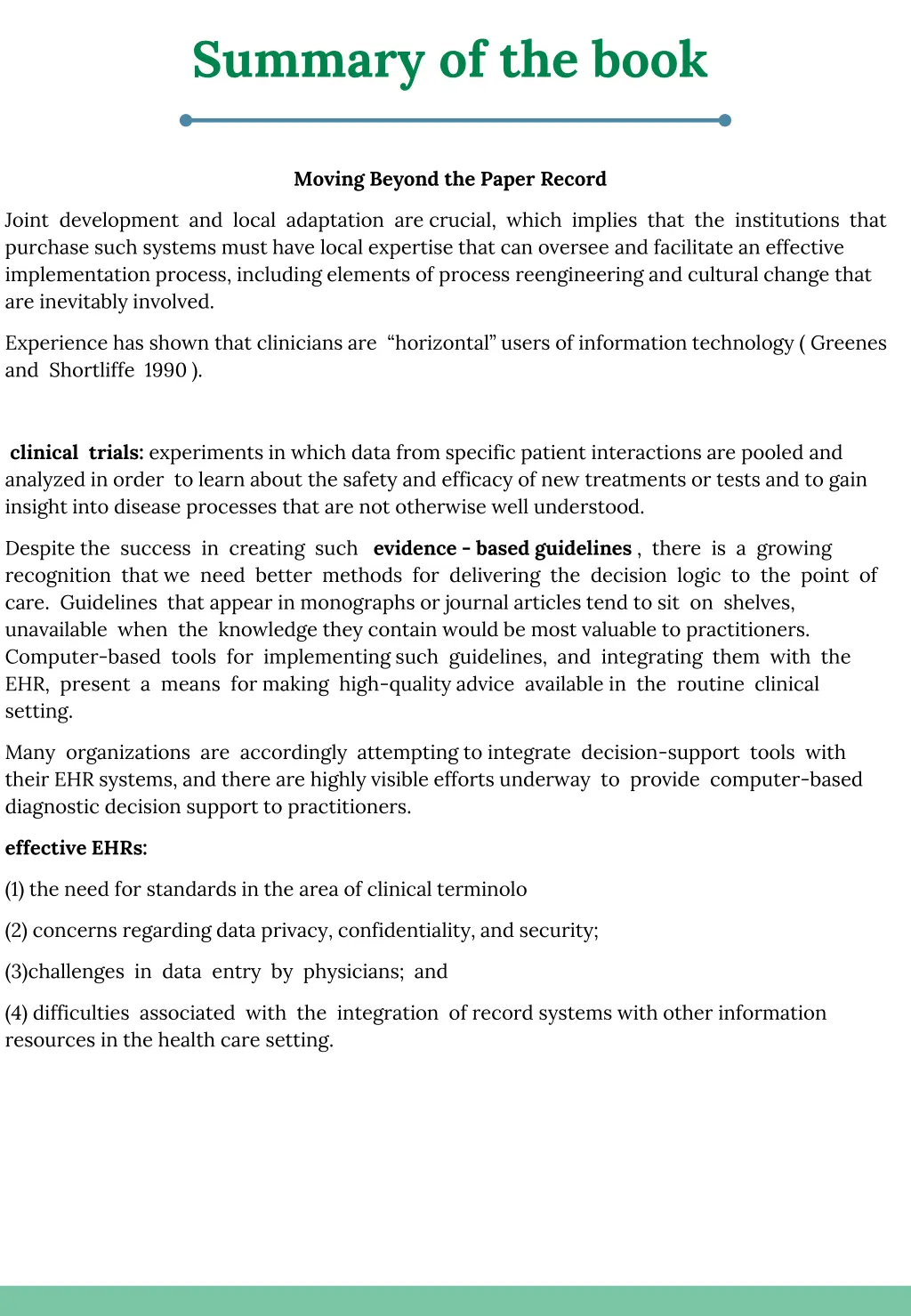
Summary of the book Moving Beyond the Paper Record Joint development and local adaptation are crucial, which implies that the institutions that purchase such systems must have local expertise that can oversee and facilitate an effective implementation process, including elements of process reengineering and cultural change that are inevitably involved. Experience has shown that clinicians are horizontal users of information technology ( Greenes and Shortliffe 1990 ). clinical trials: experiments in which data from specific patient interactions are pooled and analyzed in order to learn about the safety and efficacy of new treatments or tests and to gain insight into disease processes that are not otherwise well understood. Despite the success in creating such evidence - based guidelines , there is a growing recognition that we need better methods for delivering the decision logic to the point of care. Guidelines that appear in monographs or journal articles tend to sit on shelves, unavailable when the knowledge they contain would be most valuable to practitioners. Computer-based tools for implementing such guidelines, and integrating them with the EHR, present a means for making high-quality advice available in the routine clinical setting. Many organizations are accordingly attempting to integrate decision-support tools with their EHR systems, and there are highly visible efforts underway to provide computer-based diagnostic decision support to practitioners. effective EHRs: (1) the need for standards in the area of clinical terminolo (2) concerns regarding data privacy, confidentiality, and security; (3)challenges in data entry by physicians; and (4) difficulties associated with the integration of record systems with other information resources in the health care setting.
Summary of the book Anticipating the Future of Electronic Health Records Once the software version has been developed, however, human ingenuity and creativity often lead to an evolution that extends the software version far beyond what was initially contemplated. The computer can thus facilitate paradigm shifts in how we think about such familiar concepts. powerful desktop-publishing facilities, integration of figures, spelling correction, grammar aids, publishing on the Web, use of color, etc. Similarly, today s spreadsheet programs bear little resemblance to the tables of numbers that we once created on graph paper. To take an example from the financial world, consider automatic teller machines (ATMs) and their facilitation of today s worldwide banking in ways that were never contemplated when the industry depended on human bank tellers. Communications Technology and Health Data Integration An obvious opportunity for changing the role and functionality of clinical-care records in the digital age is the power and ubiquity of the Internet. A Model of Integrated Disease Surveillance Encryption of data : Concerns regarding privacy and data protection require that Internet transmission of clinical information occur only if those data are encrypted, with an established mechanism for identifying and authenticating individuals before they are allowed to decrypt the information for surveillance or research use. Standards for data transmission and sharing : Sharing data over networks requires that all developers of EHRs and clinical databases adopt a single set of standards for communicating and exchanging information. The de facto standard for such sharing, Health Level 7 (HL7). A uniform envelope for digital communication, such as HL7, does not assure that the contents of such messages will be understood or standardized. The pooling and integration of data requires the adoption of standards for clinical termi- nology and potentially for the schemas.
Summary of the book Implications of the Internet for Patients The penetration of the Internet continues to grow, it is not surprising that increasing numbers of patients, as well as healthy individuals, are turning to the Internet for health information. In a positive light, the new communications technologies offer clinicians creative ways to interact with their patients and to provide higher quality care. Years ago medicine adopted the telephone as a standard vehicle for facilitating patient care, and we now take this kind of interaction with patients for granted. If we extend the audio channel to include our visual sense as well, typically relying on the Internet as our communication mechanism, the notion of telemedicine emerges . This notion of medicine at a distance arose early in the twentieth century ,but the technology was too limited for much penetration of the idea beyond telephone conversations until the last 30 40 years. The use of telemedicine has subsequently grown rapidly, and there are specialized settings in which it is already proving to be successful and cost-effective (e.g., rural care, international medicine, teleradiology , and video-based care of patients in prisons). Education and Training Computer science training alone is not adequate. Fortunately, we have begun to see the creation of formal training programs in what has become known as biomedical informatics that provide custom tailored educational opportunities. The criteria that are required for successful EHR implementation are sensitive to the need for data integration, public- health support, and a learning health care system.