Meeting Regulatory Challenges: U.S. Nuclear Regulatory Commission Vision
U.S. Nuclear Regulatory Commission's initiative in building a strong service organization to address current and future regulatory challenges discussed at the conference in Beijing.

Download Presentation

Please find below an Image/Link to download the presentation.
The content on the website is provided AS IS for your information and personal use only. It may not be sold, licensed, or shared on other websites without obtaining consent from the author. If you encounter any issues during the download, it is possible that the publisher has removed the file from their server.
You are allowed to download the files provided on this website for personal or commercial use, subject to the condition that they are used lawfully. All files are the property of their respective owners.
The content on the website is provided AS IS for your information and personal use only. It may not be sold, licensed, or shared on other websites without obtaining consent from the author.
E N D
Presentation Transcript
A Strong and Viable Technical Service Organization to Meet Current and Future Regulatory Challenges: The U.S. Nuclear Regulatory Commission s Vision and Perspectives October 27-31, 2014, Beijing, CPR K. Steven West and Brian Thomas U.S. Nuclear Regulatory Commission IAEA Symposium on Challenges Faced By Technical and Scientific Support Organizations (TSOs) in Enhancing Nuclear Safety and Security: Strengthening Cooperation and Improving Capabilities
Purpose Discuss the USNRC Office of Nuclear Regulatory Research (RES) in its role as a TSO-like Organization Discuss RES functions; expertise and capabilities; maintenance of these expertise and capabilities; knowledge management Discuss future challenges envisioned for RES The views expressed herein are those of the author. They do not constitute an official position of the USNRC. 2
Topics NRC s Authorities and Responsibilities as Provided by Statute NRC s Mission RES Organization Role of RES and Focus Types of Research RES Products and Quality Assurance Domestic and International Collaboration Key Research Knowledge Management Future Challenges Summary 3
NRCs Authorities and Responsibilities as Provided by Statute The Energy Reorganization Act of 1974 established an independent regulatory commission to regulate commercial uses of nuclear material Recognized the necessity for continuous improvement in our knowledge of a complex technology and technically challenging endeavor 42 USC 5845 Established the Office of Nuclear Regulatory Research within the NRC and established the following requirements Developing recommendations for research deemed necessary for performance by the Commission of its licensing and related regulatory functions Engaging in or contracting for research which the Commission deems necessary for the performance of its licensing and related regulatory functions The Commission shall develop a long-term plan for projects for the development of new or improved safety systems for nuclear power plants 4
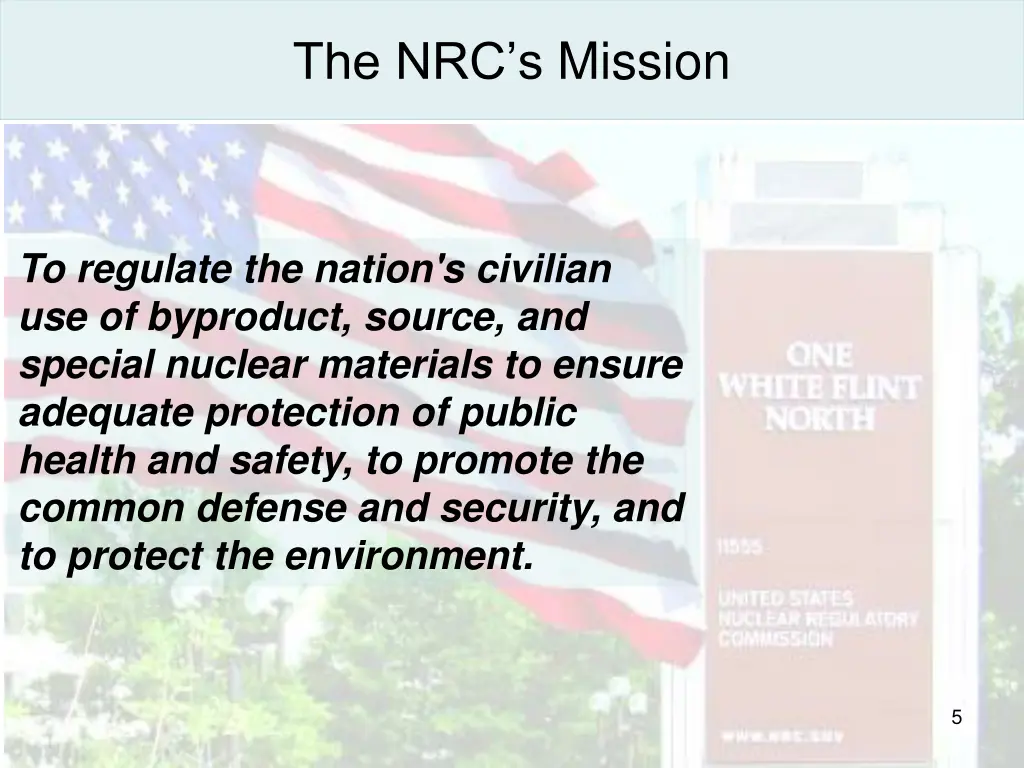
The NRCs Mission To regulate the nation's civilian use of byproduct, source, and special nuclear materials to ensure adequate protection of public health and safety, to promote the common defense and security, and to protect the environment. 5
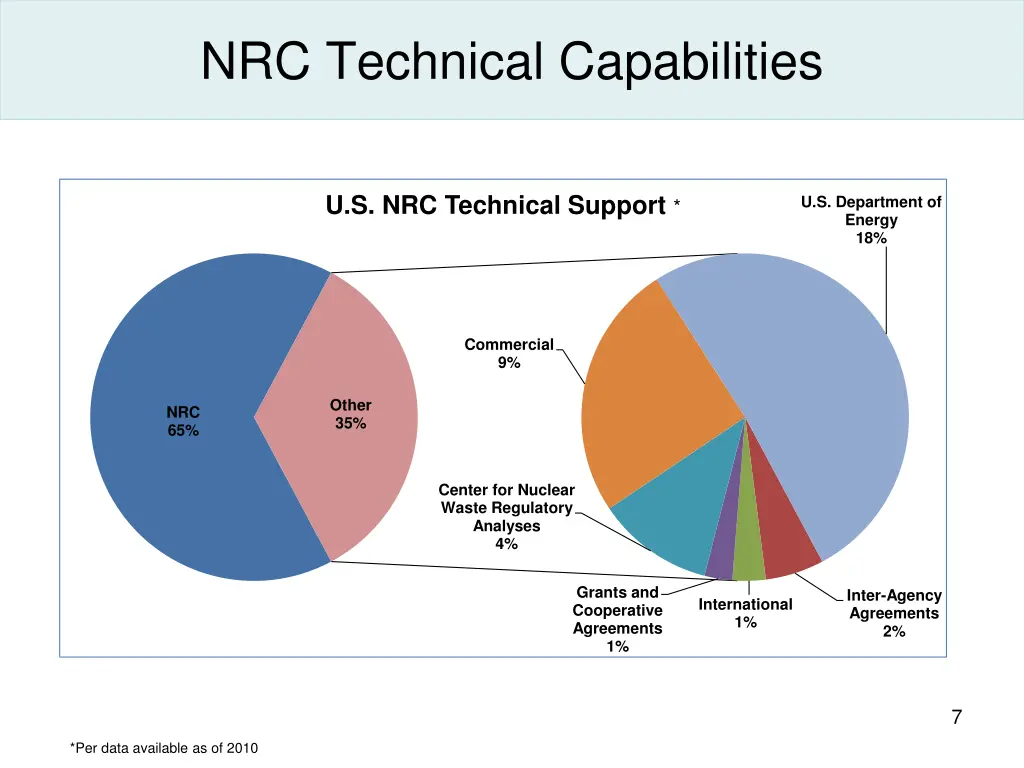
NRC Technical Capabilities U.S. NRC Technical Support * U.S. Department of Energy 18% Commercial 9% Other 35% NRC 65% Center for Nuclear Waste Regulatory Analyses 4% Grants and Cooperative Agreements 1% Inter-Agency Agreements 2% International 1% 7 *Per data available as of 2010
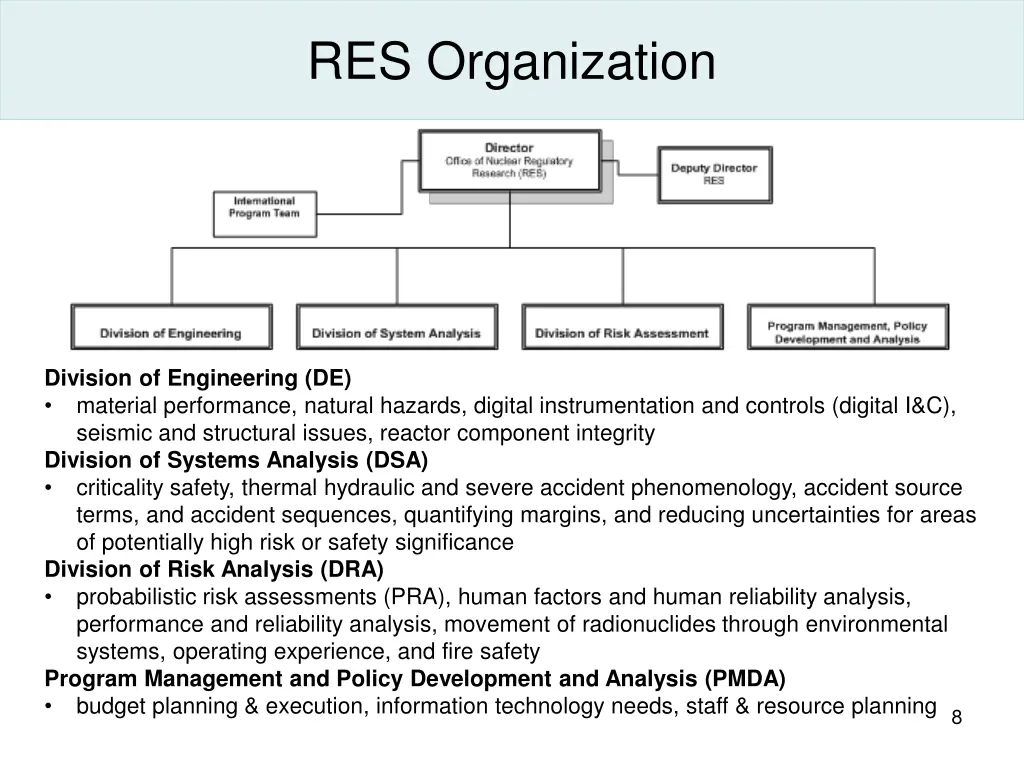
RES Organization Division of Engineering (DE) material performance, natural hazards, digital instrumentation and controls (digital I&C), seismic and structural issues, reactor component integrity Division of Systems Analysis (DSA) criticality safety, thermal hydraulic and severe accident phenomenology, accident source terms, and accident sequences, quantifying margins, and reducing uncertainties for areas of potentially high risk or safety significance Division of Risk Analysis (DRA) probabilistic risk assessments (PRA), human factors and human reliability analysis, performance and reliability analysis, movement of radionuclides through environmental systems, operating experience, and fire safety Program Management and Policy Development and Analysis (PMDA) budget planning & execution, information technology needs, staff & resource planning8
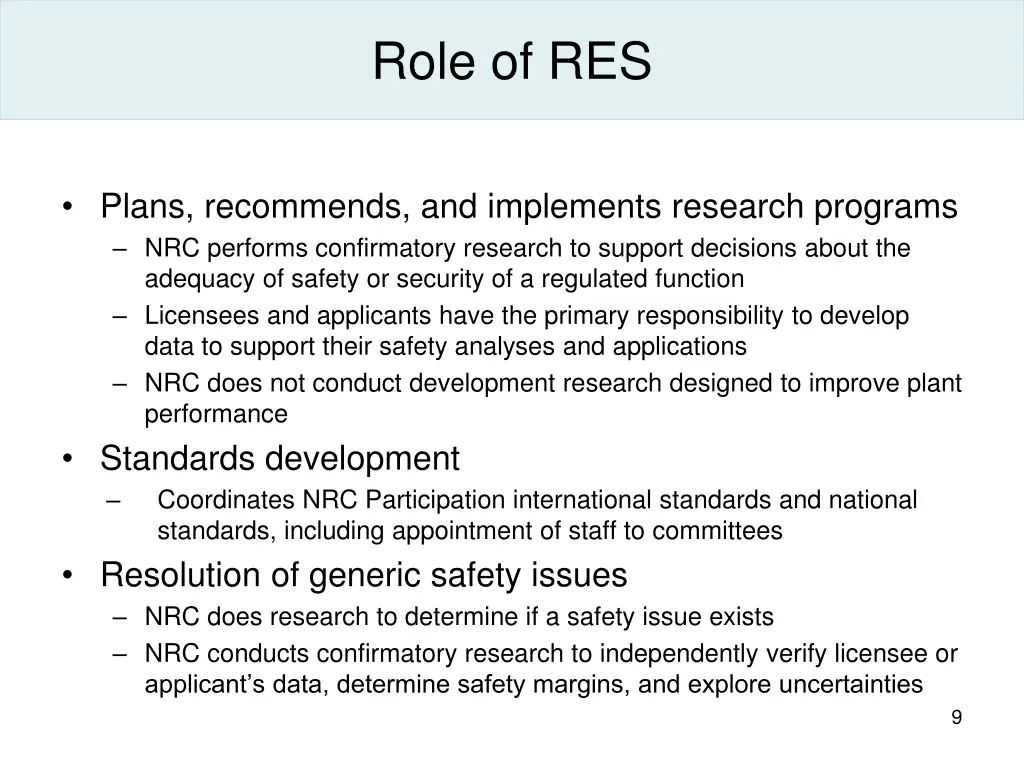
Role of RES Plans, recommends, and implements research programs NRC performs confirmatory research to support decisions about the adequacy of safety or security of a regulated function Licensees and applicants have the primary responsibility to develop data to support their safety analyses and applications NRC does not conduct development research designed to improve plant performance Standards development Coordinates NRC Participation international standards and national standards, including appointment of staff to committees Resolution of generic safety issues NRC does research to determine if a safety issue exists NRC conducts confirmatory research to independently verify licensee or applicant s data, determine safety margins, and explore uncertainties 9
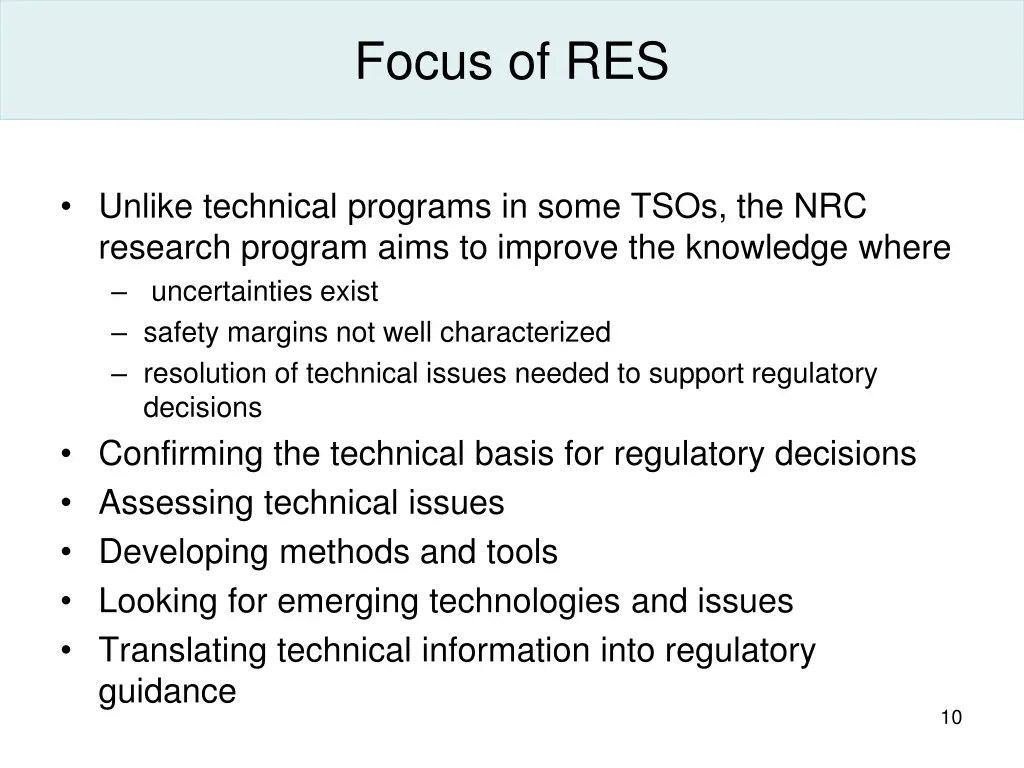
Focus of RES Unlike technical programs in some TSOs, the NRC research program aims to improve the knowledge where uncertainties exist safety margins not well characterized resolution of technical issues needed to support regulatory decisions Confirming the technical basis for regulatory decisions Assessing technical issues Developing methods and tools Looking for emerging technologies and issues Translating technical information into regulatory guidance 10
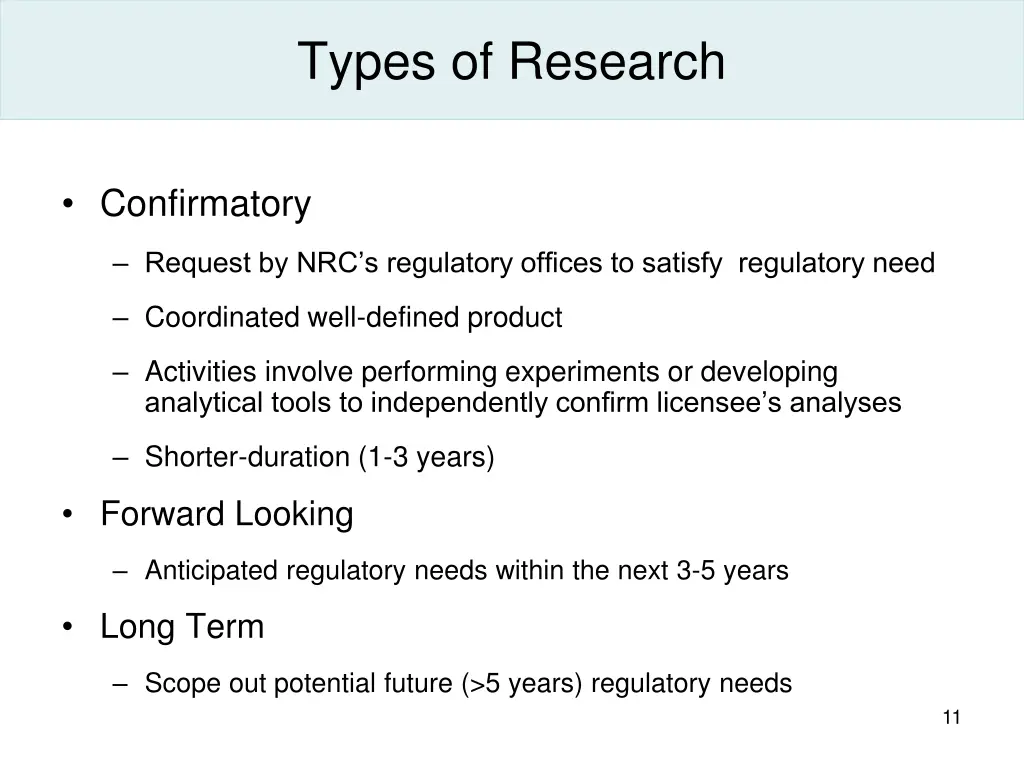
Types of Research Confirmatory Request by NRC s regulatory offices to satisfy regulatory need Coordinated well-defined product Activities involve performing experiments or developing analytical tools to independently confirm licensee s analyses Shorter-duration (1-3 years) Forward Looking Anticipated regulatory needs within the next 3-5 years Long Term Scope out potential future (>5 years) regulatory needs 11
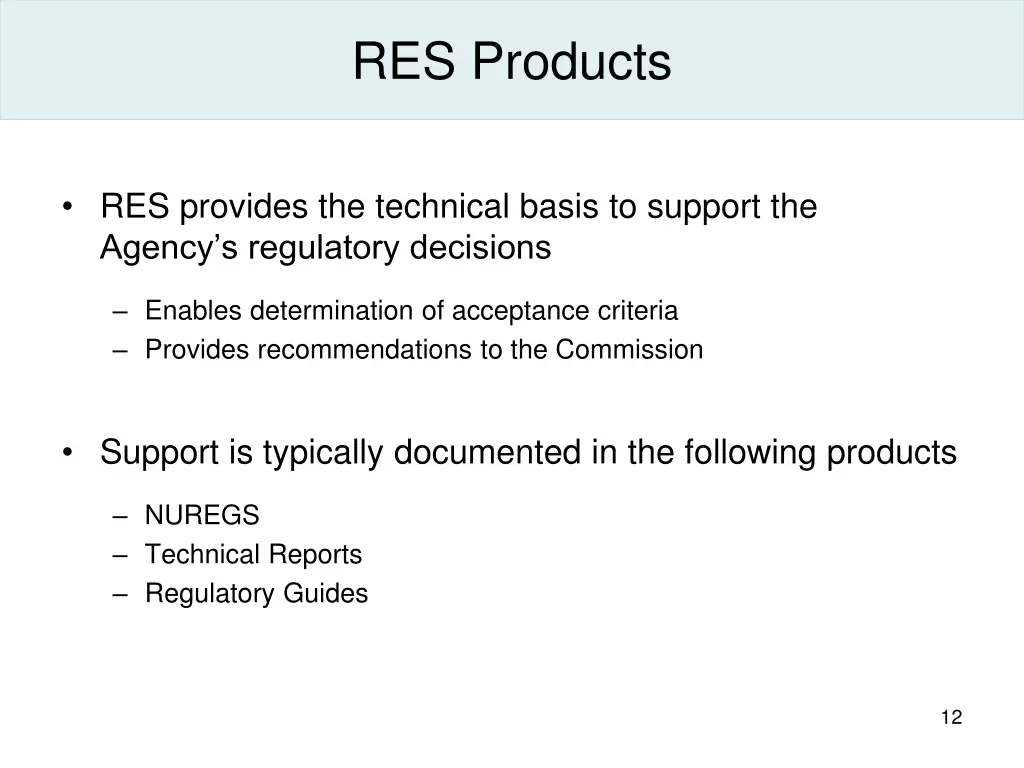
RES Products RES provides the technical basis to support the Agency s regulatory decisions Enables determination of acceptance criteria Provides recommendations to the Commission Support is typically documented in the following products NUREGS Technical Reports Regulatory Guides 12 12
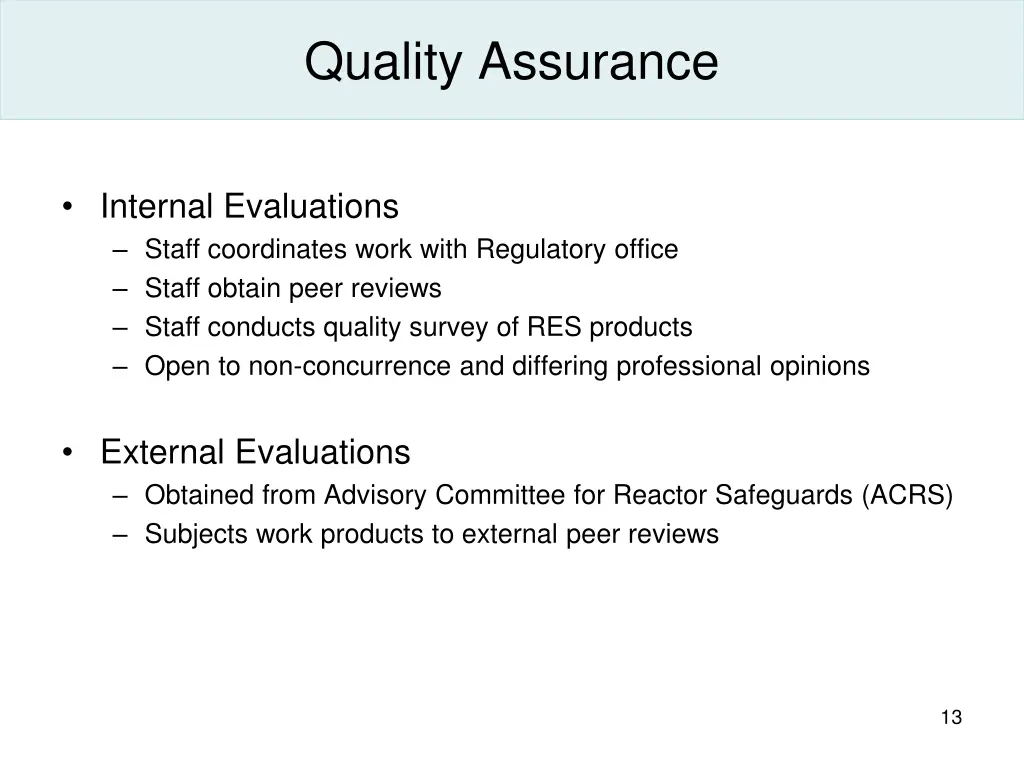
Quality Assurance Internal Evaluations Staff coordinates work with Regulatory office Staff obtain peer reviews Staff conducts quality survey of RES products Open to non-concurrence and differing professional opinions External Evaluations Obtained from Advisory Committee for Reactor Safeguards (ACRS) Subjects work products to external peer reviews 13 13 DOE NE-7 FY 2014 Nuclear Reactor Technologies Program Review Germantown, MD. U.S.A. March 26, 2014
Domestic & International Collaborations Leverage expertise and resources on key topics of common interest Performed under shared financial responsibility Includes a wide range of technical activities Fukushima Activities Halden Reactor Project Zirconium Fire during Loss-of-coolant Accident Fire Safety Research 14
Domestic & International Collaborations Domestic Collaborations US Department of Energy (Memorandum of Understanding (MOU)) Long term operation of light water reactors Center for Radiation Protection Knowledge Electric Power Research Institute, Inc. (EPRI) advanced computational tools for assessing reactor component safety aging and qualification of electrical cables interface of digital instrumentation & controls and human factors probabilistic research assessment non destructive examination 15
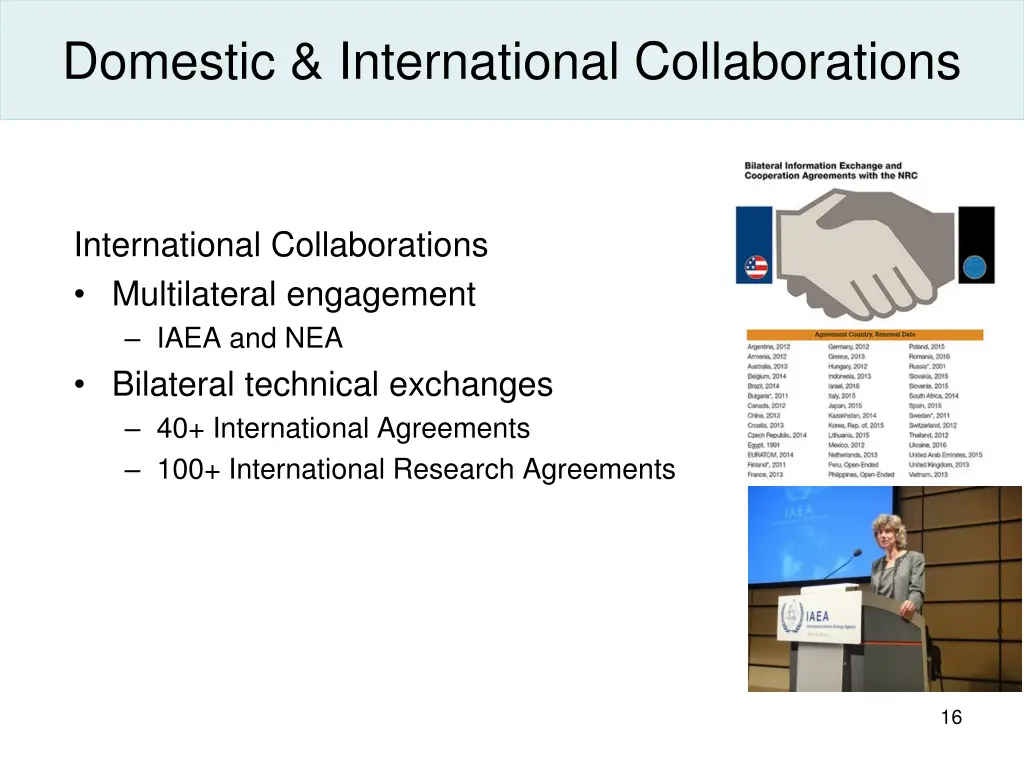
Domestic & International Collaborations International Collaborations Multilateral engagement IAEA and NEA Bilateral technical exchanges 40+ International Agreements 100+ International Research Agreements 16
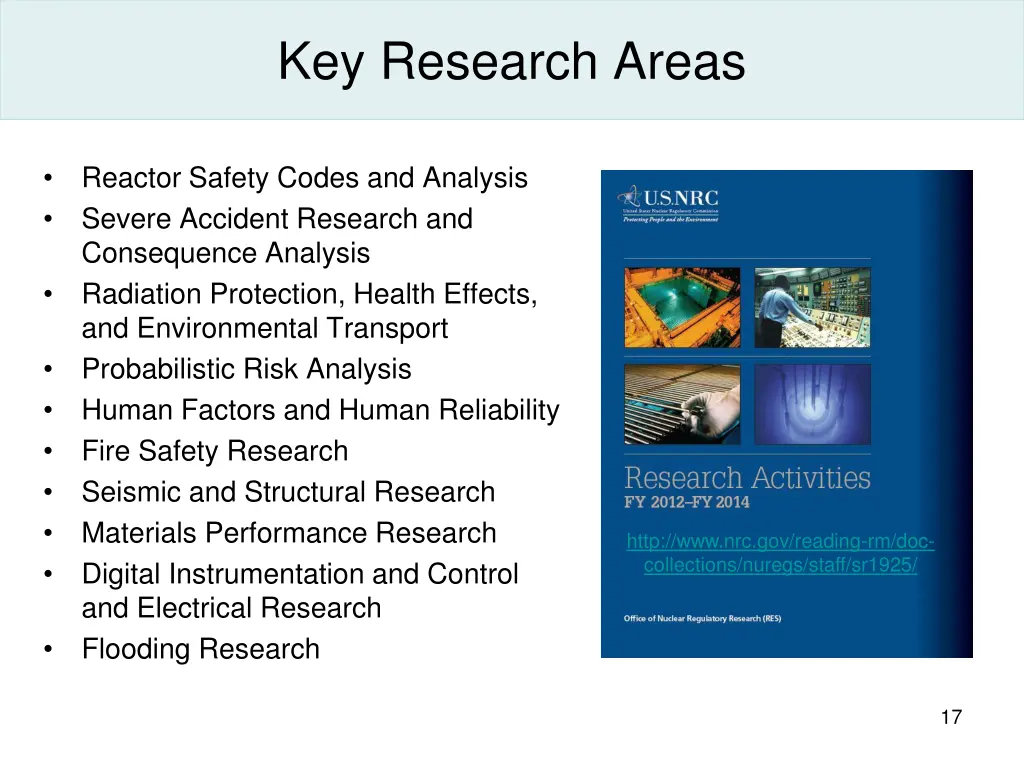
Key Research Areas Reactor Safety Codes and Analysis Severe Accident Research and Consequence Analysis Radiation Protection, Health Effects, and Environmental Transport Probabilistic Risk Analysis Human Factors and Human Reliability Fire Safety Research Seismic and Structural Research Materials Performance Research Digital Instrumentation and Control and Electrical Research Flooding Research http://www.nrc.gov/reading-rm/doc- collections/nuregs/staff/sr1925/ 17
Knowledge Management Staff understand knowledge management is a fundamental part of the RES mission The NRC knowledge base requires continuing maintenance and extension Qualified staff are the key to maintaining the NRC knowledge base Transferring knowledge into regulatory practice is a desired outcome of research Develops NUREG/KM-series documents that capture historical events and highly significant technical and safety information Holds technical exchanges through seminars and dissemination of technical information to stakeholders 18
Future Challenges Enhancements based on lessons learned from the Fukushima Dai-ichi accident Review of applications involving new technologies such as small modular reactors and advanced reactors Improved understanding of rapidly evolving digital instrumentation and control systems Materials degradation issues with aging nuclear fleet 19
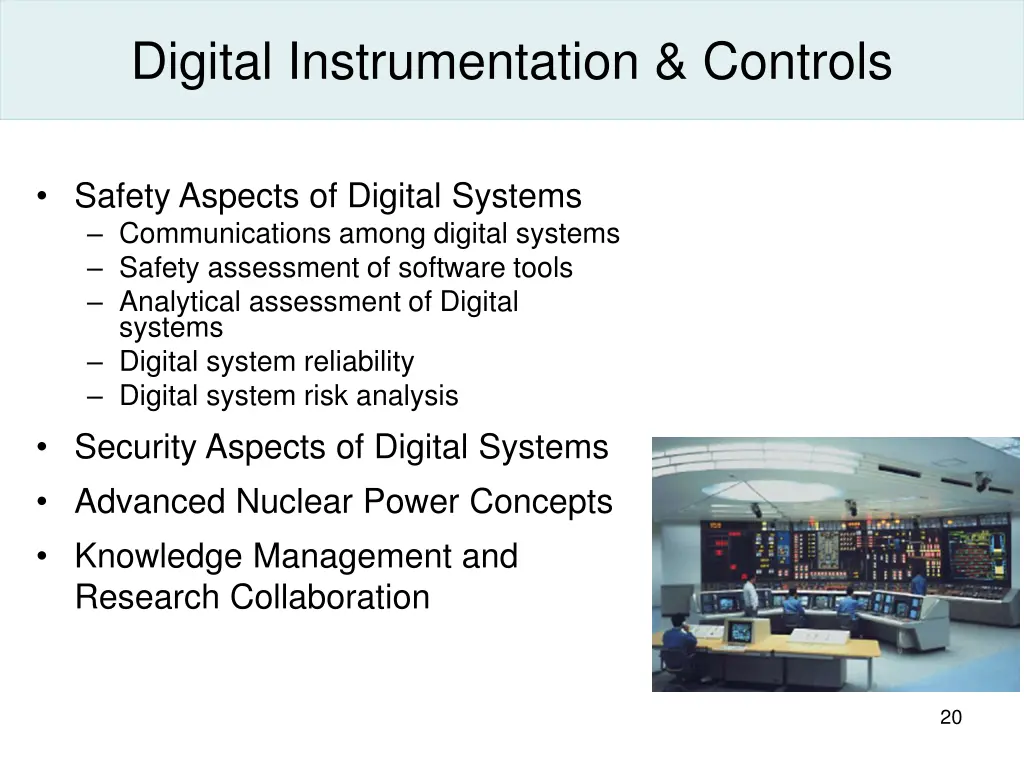
Digital Instrumentation & Controls Safety Aspects of Digital Systems Communications among digital systems Safety assessment of software tools Analytical assessment of Digital systems Digital system reliability Digital system risk analysis Security Aspects of Digital Systems Advanced Nuclear Power Concepts Knowledge Management and Research Collaboration 20
Materials Degradation Issues Understanding of materials degradation enables sound technical basis for regulatory decisions NRC has approved renewed license for 73 U.S. plants to operate 20 years beyond the initial 40 year operation NRC is reviewing additional 11 applications for 19 units 34 units have entered the operating period beyond 40 years Research focus (metallic): Environmentally-assisted degradation and cracking (EAC) Primary water stress corrosion cracking (PWSCC) Irradiation-assisted stress corrosion cracking (IASCC) Fatigue cracking Thermal and radiation-induced embrittlement Steam generator tube degradation and integrity assessment Flaw Evaluation and Structural Integrity Assessment 21
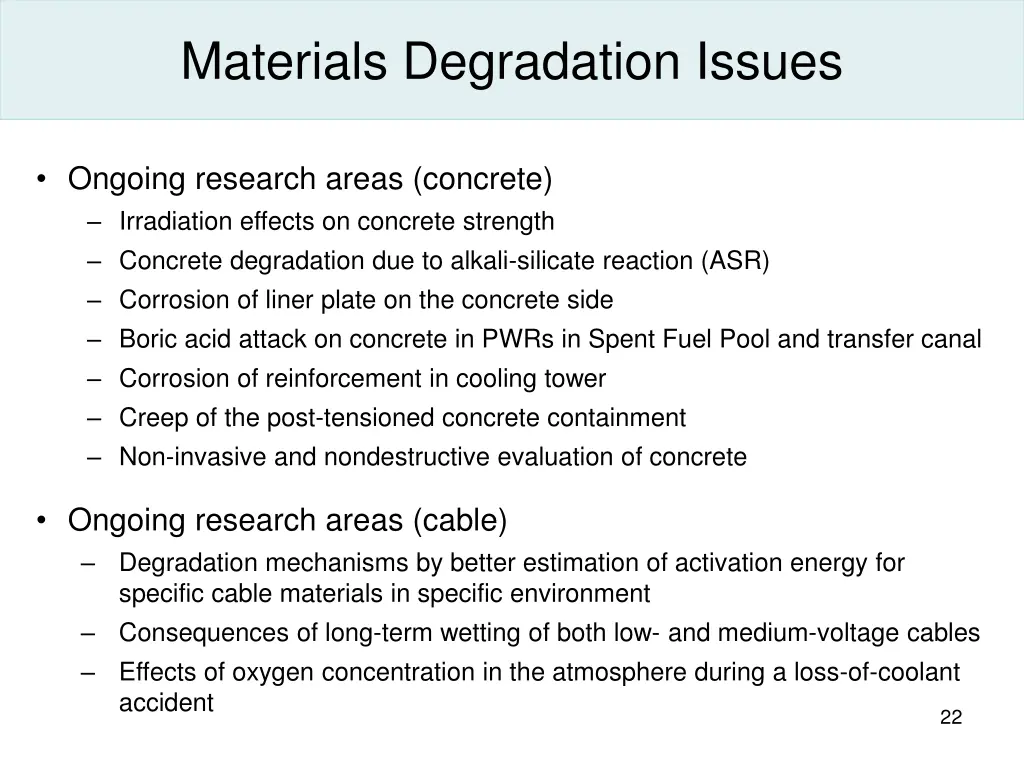
Materials Degradation Issues Ongoing research areas (concrete) Irradiation effects on concrete strength Concrete degradation due to alkali-silicate reaction (ASR) Corrosion of liner plate on the concrete side Boric acid attack on concrete in PWRs in Spent Fuel Pool and transfer canal Corrosion of reinforcement in cooling tower Creep of the post-tensioned concrete containment Non-invasive and nondestructive evaluation of concrete Ongoing research areas (cable) Degradation mechanisms by better estimation of activation energy for specific cable materials in specific environment Consequences of long-term wetting of both low- and medium-voltage cables Effects of oxygen concentration in the atmosphere during a loss-of-coolant accident 22
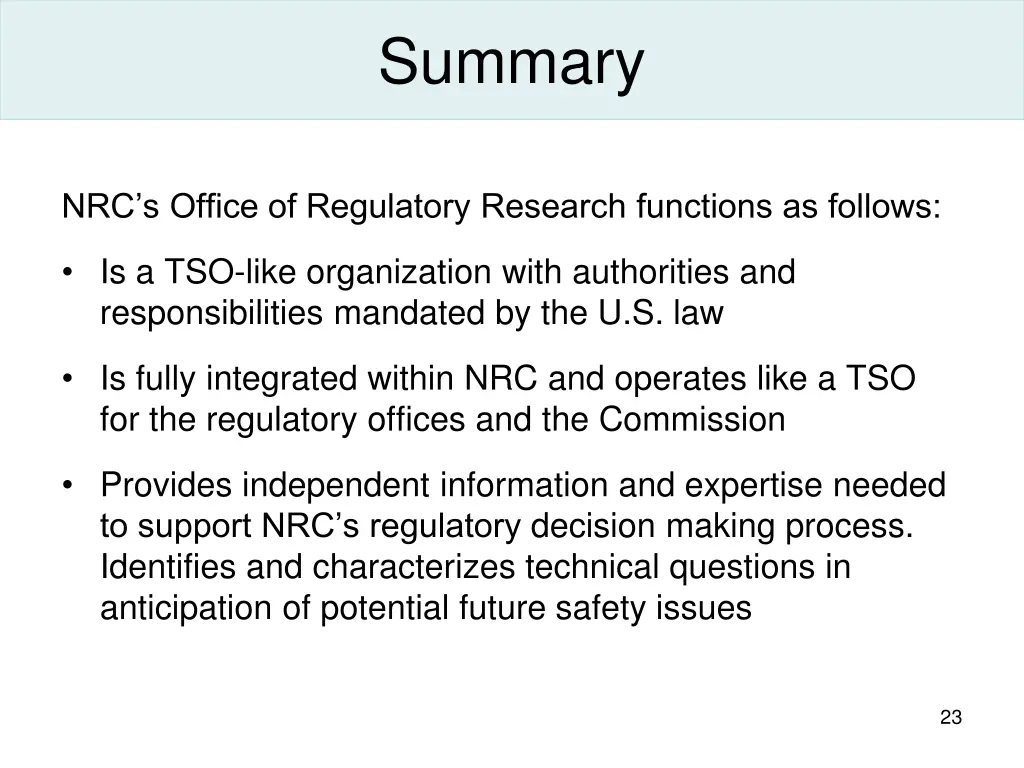
Summary NRC s Office of Regulatory Research functions as follows: Is a TSO-like organization with authorities and responsibilities mandated by the U.S. law Is fully integrated within NRC and operates like a TSO for the regulatory offices and the Commission Provides independent information and expertise needed to support NRC s regulatory decision making process. Identifies and characterizes technical questions in anticipation of potential future safety issues 23
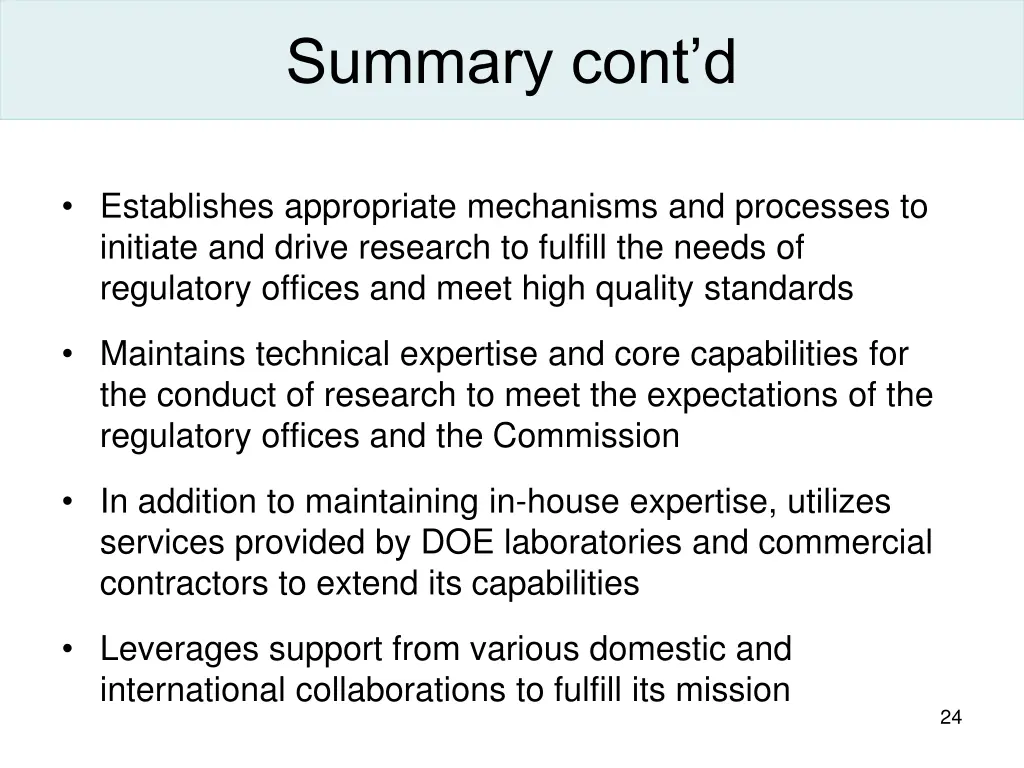
Summary contd Establishes appropriate mechanisms and processes to initiate and drive research to fulfill the needs of regulatory offices and meet high quality standards Maintains technical expertise and core capabilities for the conduct of research to meet the expectations of the regulatory offices and the Commission In addition to maintaining in-house expertise, utilizes services provided by DOE laboratories and commercial contractors to extend its capabilities Leverages support from various domestic and international collaborations to fulfill its mission 24
Thank You Questions?