Memory Management in Computing
The content delves into memory management concepts crucial for operating systems. It discusses the importance of managing memory for program execution, particularly in multiprogramming systems. Key topics include distinguishing logical and physical address spaces, allocation methods like paging and segmentation, and implementing memory protection techniques using base and limit registers. It highlights the critical role of these mechanisms in ensuring efficient and secure process management.

Download Presentation

Please find below an Image/Link to download the presentation.
The content on the website is provided AS IS for your information and personal use only. It may not be sold, licensed, or shared on other websites without obtaining consent from the author.If you encounter any issues during the download, it is possible that the publisher has removed the file from their server.
You are allowed to download the files provided on this website for personal or commercial use, subject to the condition that they are used lawfully. All files are the property of their respective owners.
The content on the website is provided AS IS for your information and personal use only. It may not be sold, licensed, or shared on other websites without obtaining consent from the author.
E N D
Presentation Transcript
Chapter Chapter 3 3 memory management memory management 3/2/2025 Ambo University || Woliso Campus 1
2.1 2.1 Main memory Main memory 3/2/2025 Ambo University || Woliso Campus 2
Content Content o Background o Logical versus Physical Address Space o Swapping o Contiguous Allocation o Paging o Segmentation o Segmentation with Paging 3/2/2025 Ambo University || Woliso Campus 3
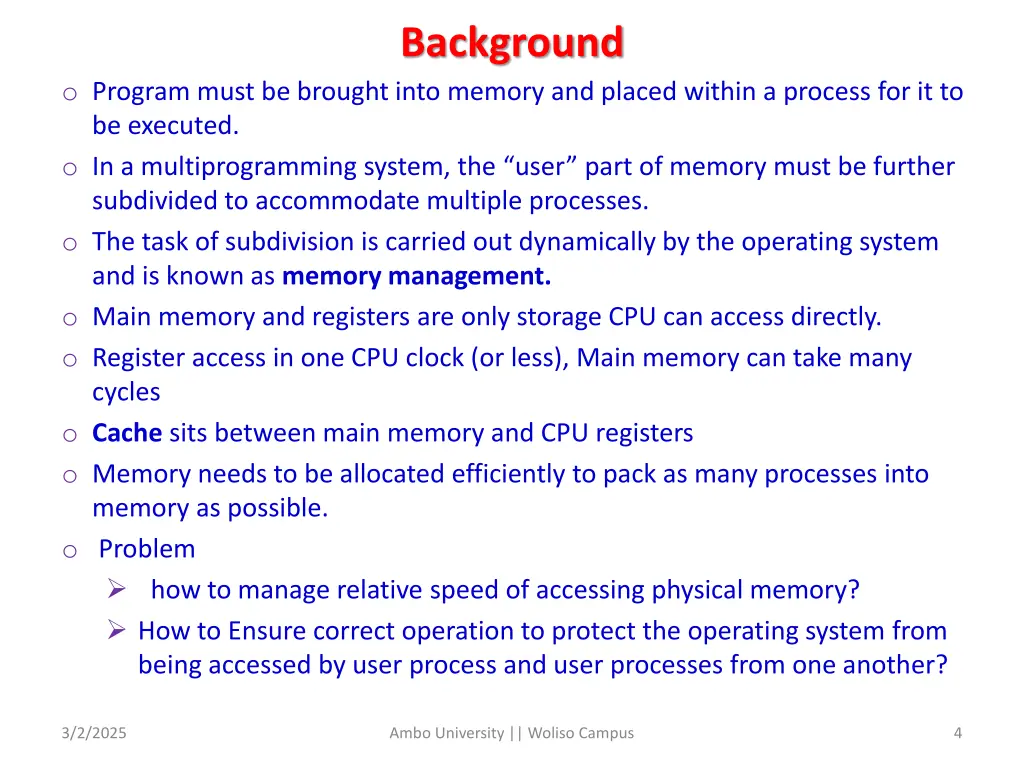
Background o Program must be brought into memory and placed within a process for it to be executed. o In a multiprogramming system, the user part of memory must be further subdivided to accommodate multiple processes. o The task of subdivision is carried out dynamically by the operating system and is known as memory management. o Main memory and registers are only storage CPU can access directly. o Register access in one CPU clock (or less), Main memory can take many cycles o Cache sits between main memory and CPU registers o Memory needs to be allocated efficiently to pack as many processes into memory as possible. o Problem how to manage relative speed of accessing physical memory? How to Ensure correct operation to protect the operating system from being accessed by user process and user processes from one another? 3/2/2025 Ambo University || Woliso Campus 4
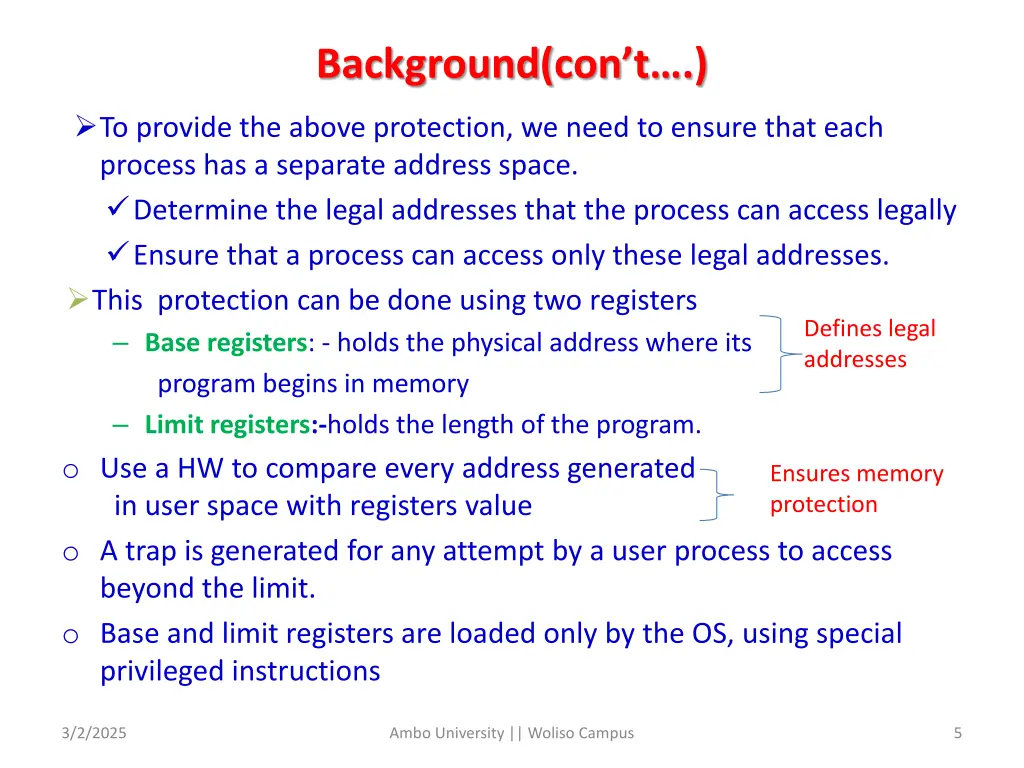
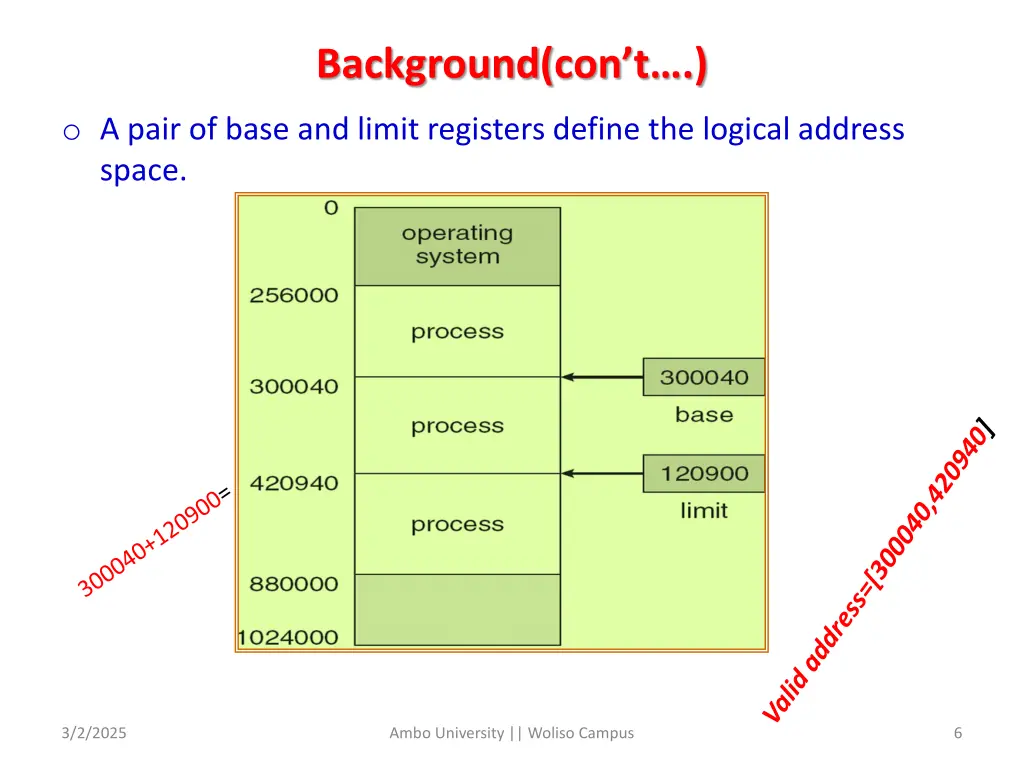
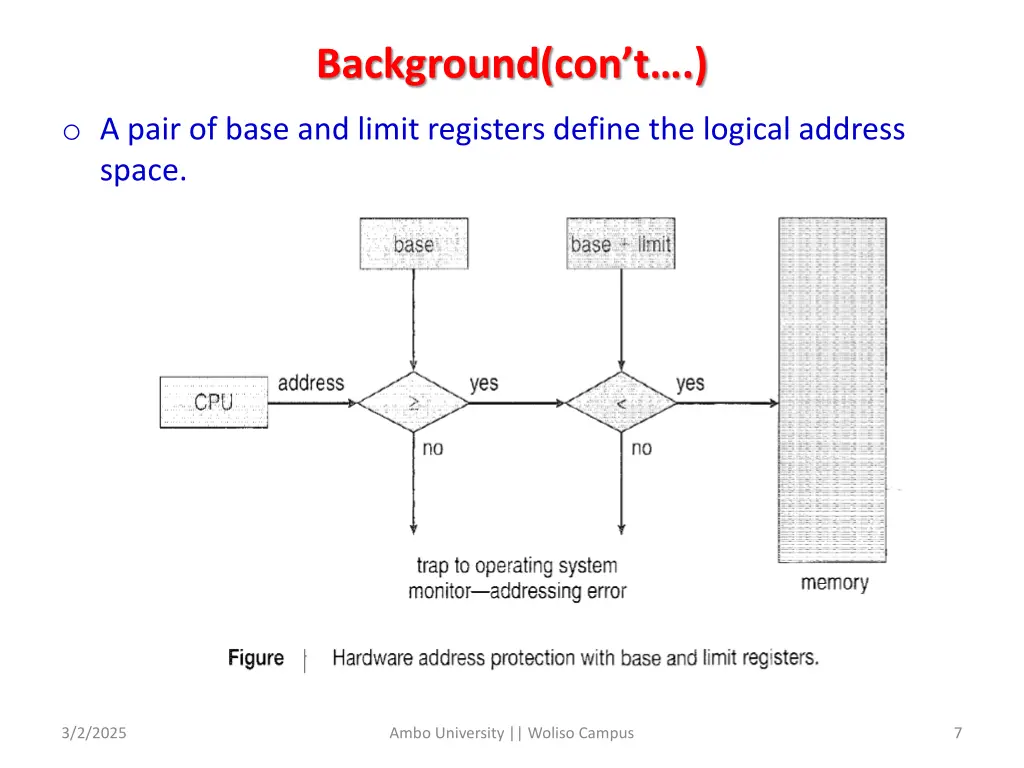
Background(cont.) To provide the above protection, we need to ensure that each process has a separate address space. Determine the legal addresses that the process can access legally Ensure that a process can access only these legal addresses. This protection can be done using two registers Base registers: - holds the physical address where its program begins in memory Limit registers:-holdsthe length of the program. o Use a HW to compare every address generated in user space with registers value o A trap is generated for any attempt by a user process to access beyond the limit. o Base and limit registers are loaded only by the OS, using special privileged instructions Defines legal addresses Ensures memory protection 3/2/2025 Ambo University || Woliso Campus 5
Background(cont.) o A pair of base andlimit registers define the logical address space. 3/2/2025 Ambo University || Woliso Campus 6
Background(cont.) o A pair of base and limit registers define the logical address space. 3/2/2025 Ambo University || Woliso Campus 7
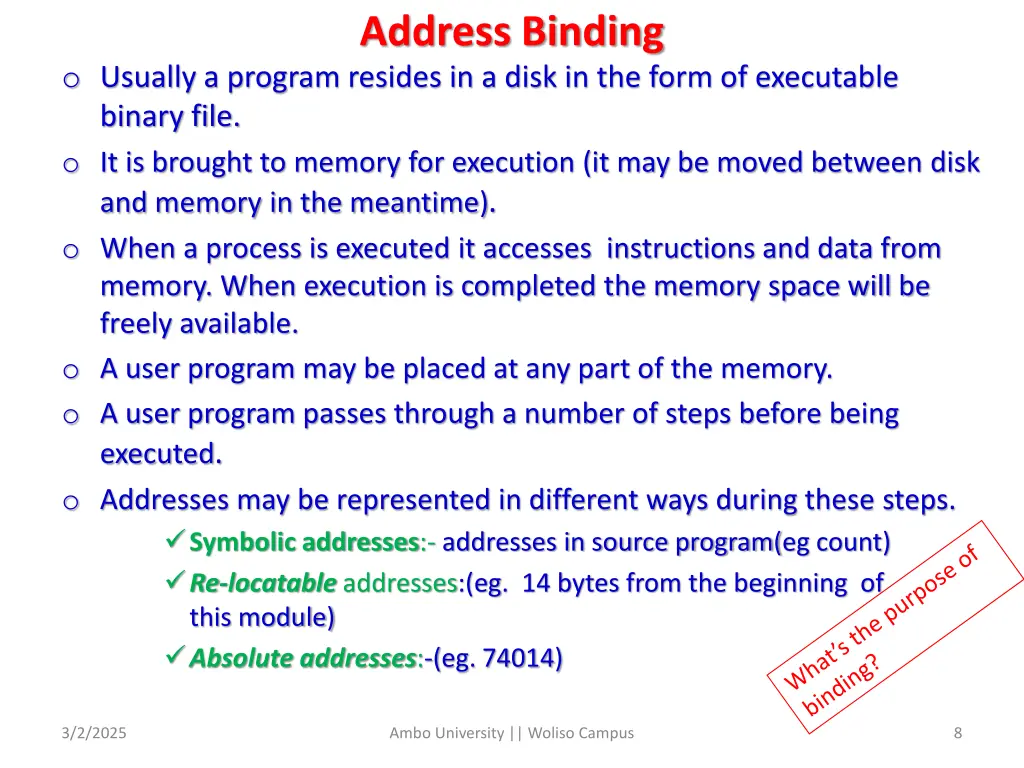
Address Binding o Usually a program resides in a disk in the form of executable binary file. o It is brought to memory for execution (it may be moved between disk and memory in the meantime). o When a process is executed it accesses instructions and data from memory. When execution is completed the memory space will be freely available. o A user program may be placed at any part of the memory. o A user program passes through a number of steps before being executed. o Addresses may be represented in different ways during these steps. Symbolic addresses:- addresses in source program(eg count) Re-locatable addresses:(eg. 14 bytes from the beginning of this module) Absolute addresses:-(eg. 74014) 3/2/2025 Ambo University || Woliso Campus 8
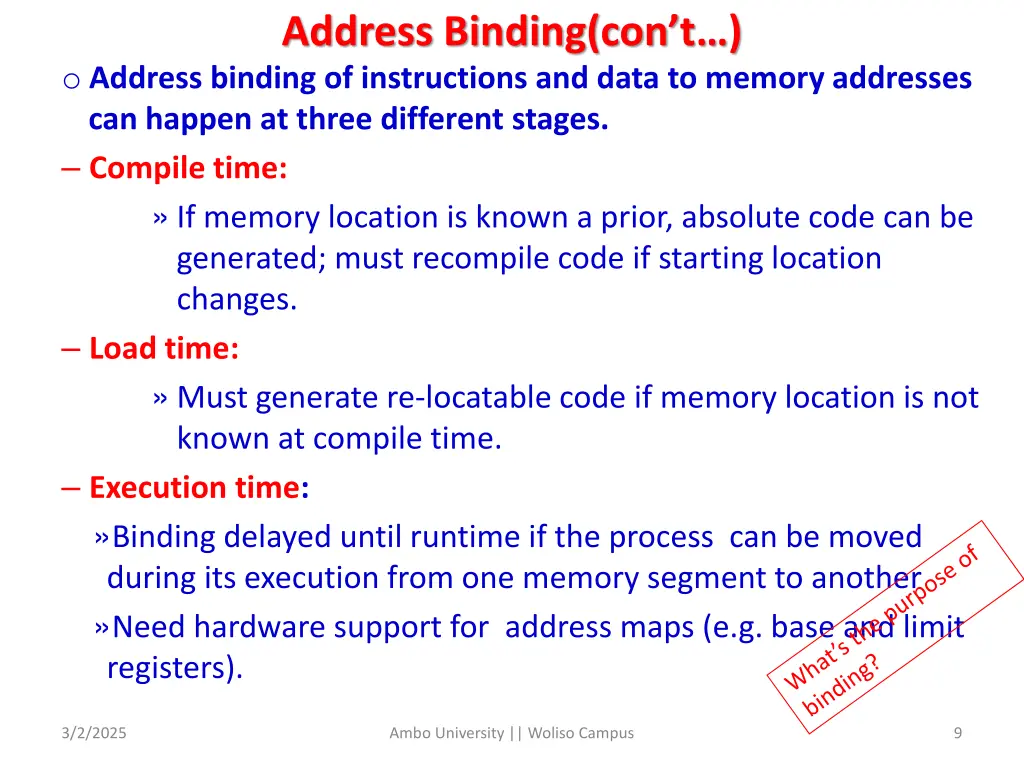
Address Binding(cont) o Address binding of instructions and data to memory addresses can happen at three different stages. Compile time: If memory location is known a prior, absolute code can be generated; must recompile code if starting location changes. Load time: Must generate re-locatable code if memory location is not known at compile time. Execution time: Binding delayed until runtime if the process can be moved during its execution from one memory segment to another Need hardware support for address maps (e.g. base and limit registers). 3/2/2025 Ambo University || Woliso Campus 9
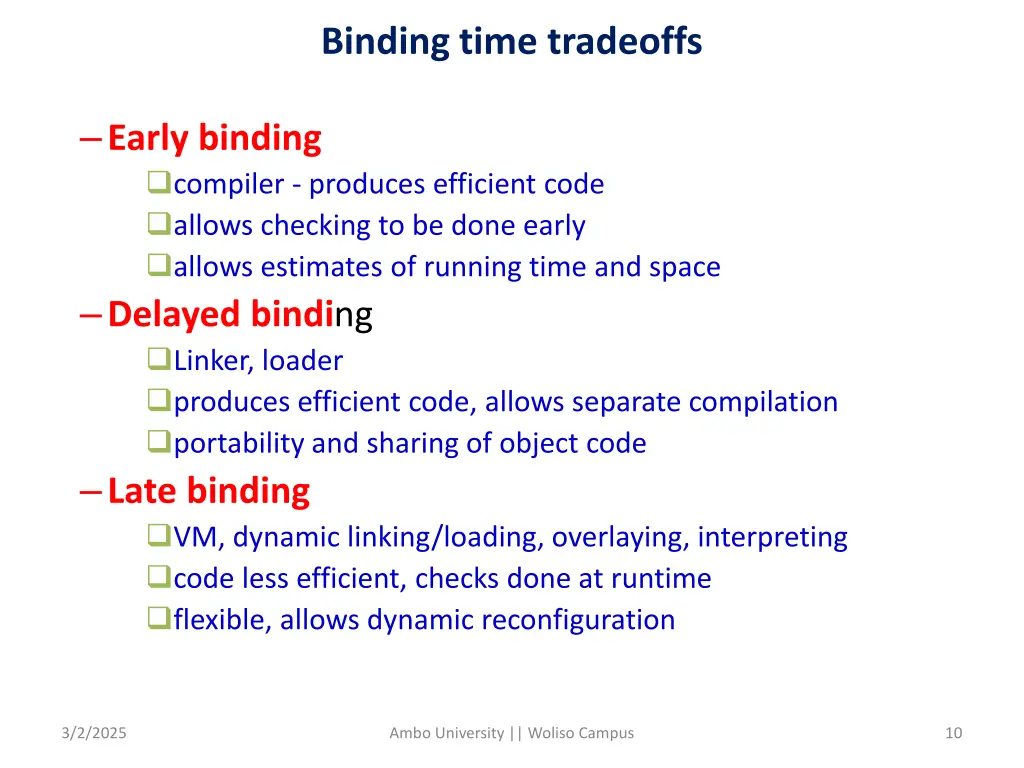
Binding time tradeoffs Early binding compiler - produces efficient code allows checking to be done early allows estimates of running time and space Delayed binding Linker, loader produces efficient code, allows separate compilation portability and sharing of object code Late binding VM, dynamic linking/loading, overlaying, interpreting code less efficient, checks done at runtime flexible, allows dynamic reconfiguration 3/2/2025 Ambo University || Woliso Campus 10
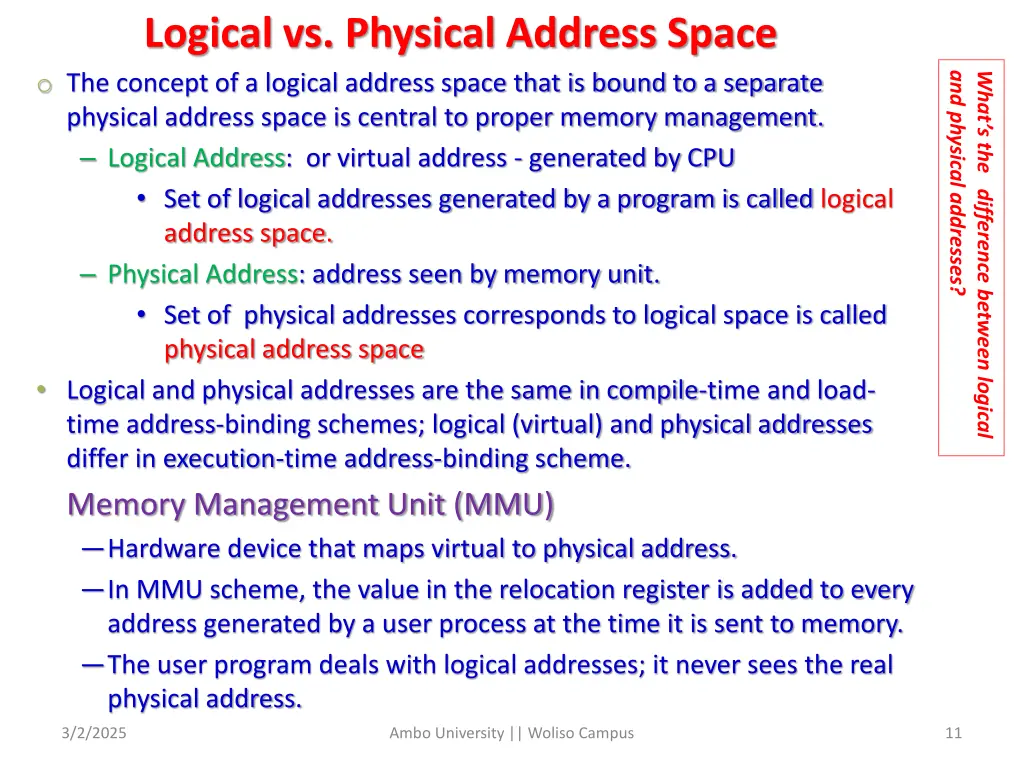
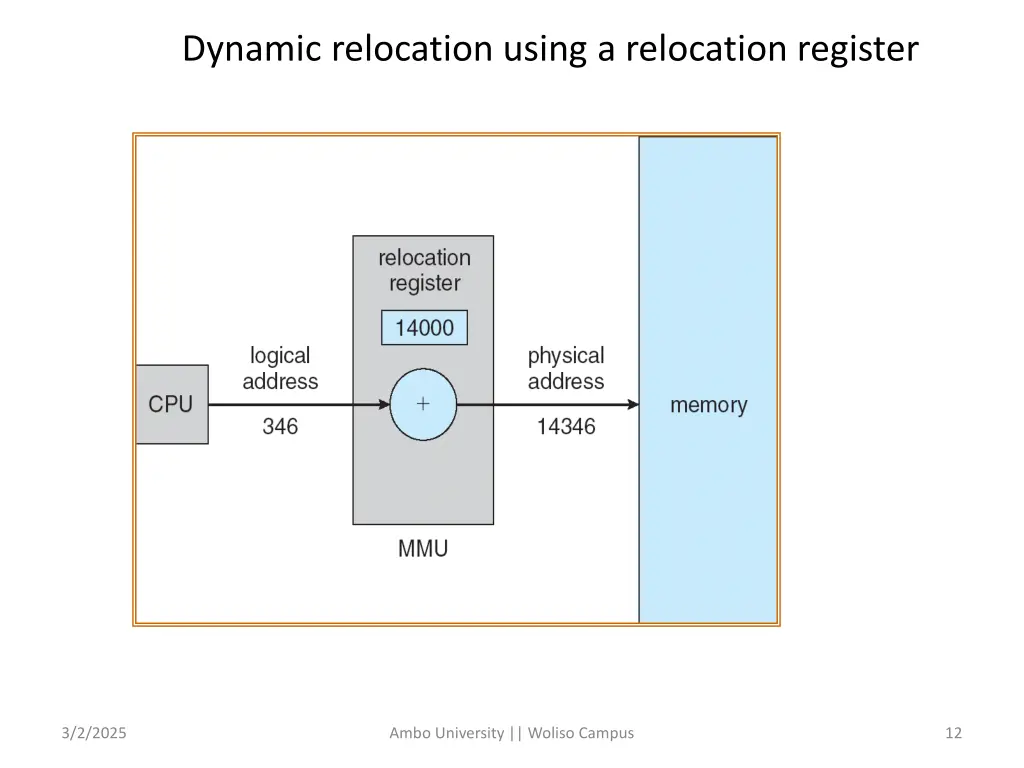
Logical vs. Physical Address Space o The concept of a logical address space that is bound to a separate physical address space is central to proper memory management. Logical Address: or virtual address - generated by CPU Set of logical addresses generated by a program is called logical address space. Physical Address: address seen by memory unit. Set of physical addresses corresponds to logical space is called physical address space Logical and physical addresses are the same in compile-time and load- time address-binding schemes; logical (virtual) and physical addresses differ in execution-time address-binding scheme. Memory Management Unit (MMU) Hardware device that maps virtual to physical address. In MMU scheme, the value in the relocation register is added to every address generated by a user process at the time it is sent to memory. The user program deals with logical addresses; it never sees the real physical address. and physical addresses? What s the difference between logical 3/2/2025 Ambo University || Woliso Campus 11
Dynamic relocation using a relocation register 3/2/2025 Ambo University || Woliso Campus 12
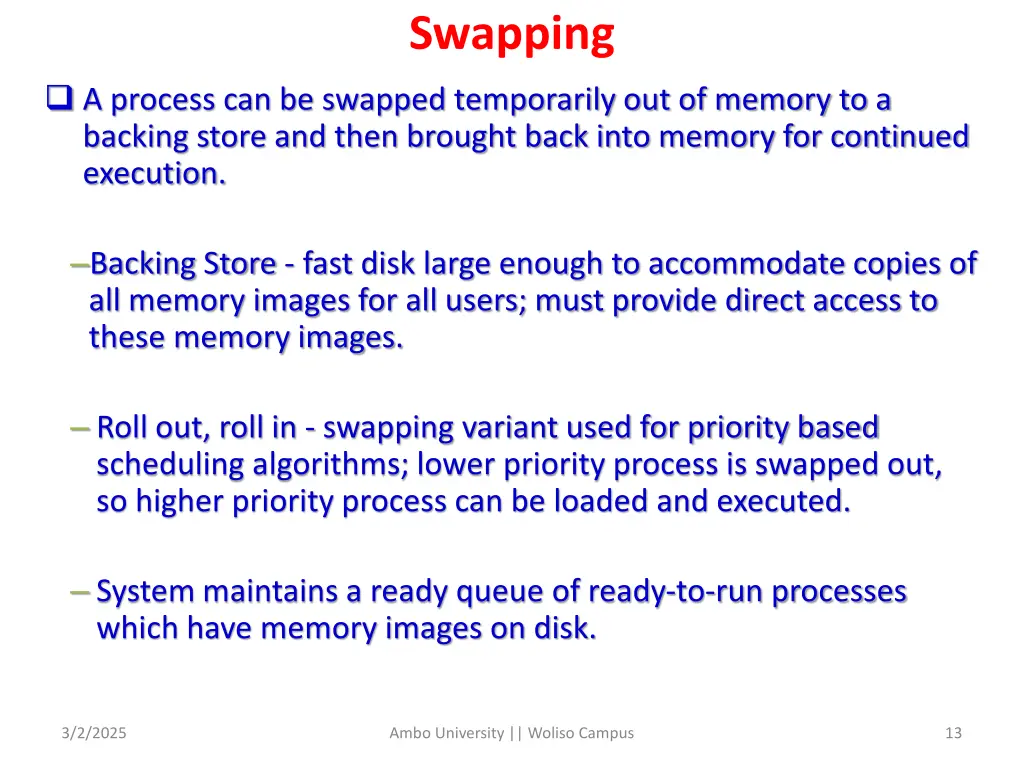
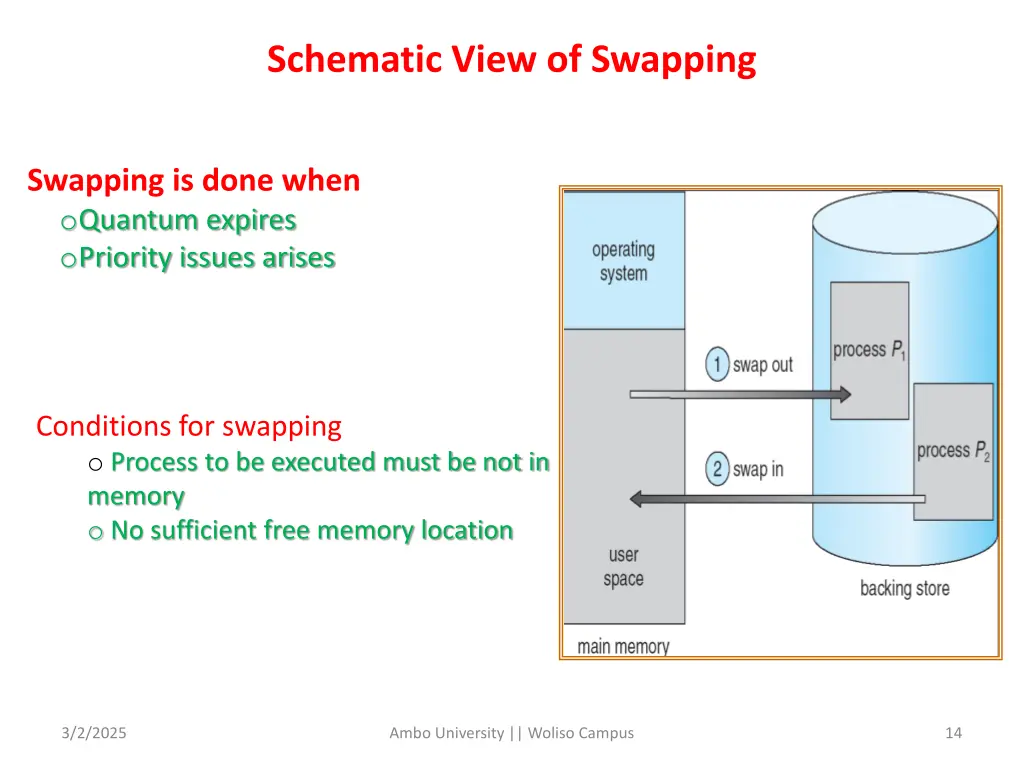
Swapping A process can be swapped temporarily out of memory to a backing store and then brought back into memory for continued execution. Backing Store - fast disk large enough to accommodate copies of all memory images for all users; must provide direct access to these memory images. Roll out, roll in - swapping variant used for priority based scheduling algorithms; lower priority process is swapped out, so higher priority process can be loaded and executed. System maintains a ready queue of ready-to-run processes which have memory images on disk. 3/2/2025 Ambo University || Woliso Campus 13
Schematic View of Swapping Swapping is done when oQuantum expires oPriority issues arises Conditions for swapping o Process to be executed must be not in memory o No sufficient free memory location 3/2/2025 Ambo University || Woliso Campus 14
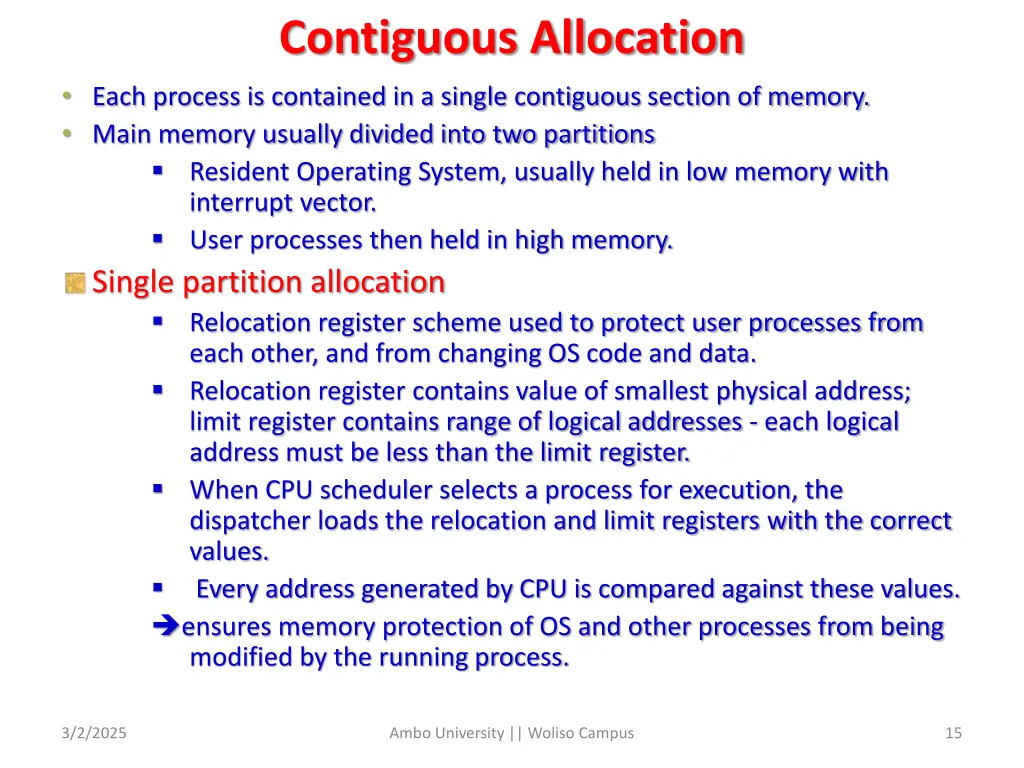
Contiguous Allocation Each process is contained in a single contiguous section of memory. Main memory usually divided into two partitions Resident Operating System, usually held in low memory with interrupt vector. User processes then held in high memory. Single partition allocation Relocation register scheme used to protect user processes from each other, and from changing OS code and data. Relocation register contains value of smallest physical address; limit register contains range of logical addresses - each logical address must be less than the limit register. When CPU scheduler selects a process for execution, the dispatcher loads the relocation and limit registers with the correct values. Every address generated by CPU is compared against these values. ensures memory protection of OS and other processes from being modified by the running process. 3/2/2025 Ambo University || Woliso Campus 15
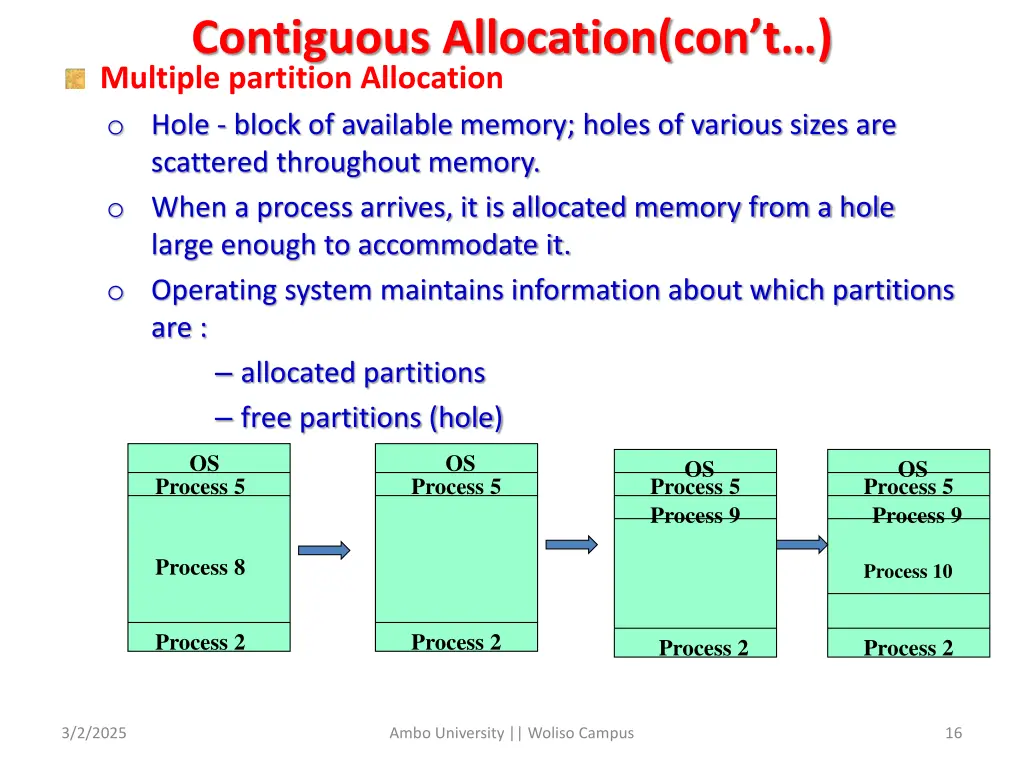
Contiguous Allocation(cont) Multiple partition Allocation o Hole - block of available memory; holes of various sizes are scattered throughout memory. o When a process arrives, it is allocated memory from a hole large enough to accommodate it. o Operating system maintains information about which partitions are : allocated partitions free partitions (hole) OS OS OS OS Process 5 Process 5 Process 5 Process 9 Process 5 Process 9 Process 8 Process 10 Process 2 Process 2 Process 2 Process 2 3/2/2025 Ambo University || Woliso Campus 16
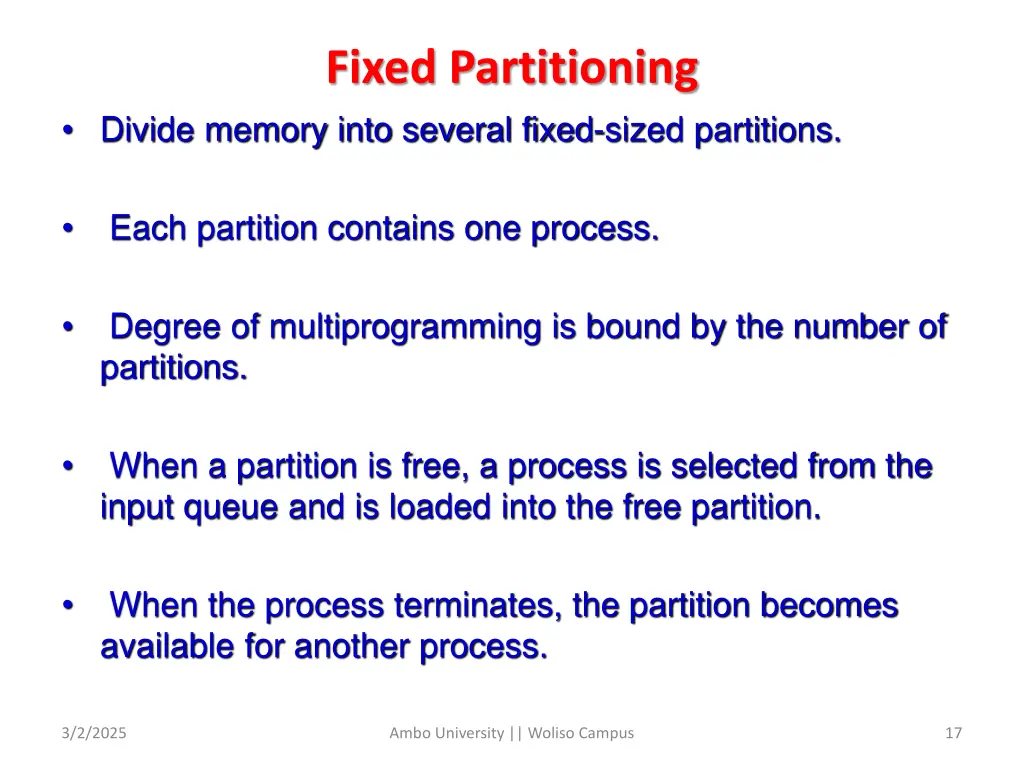
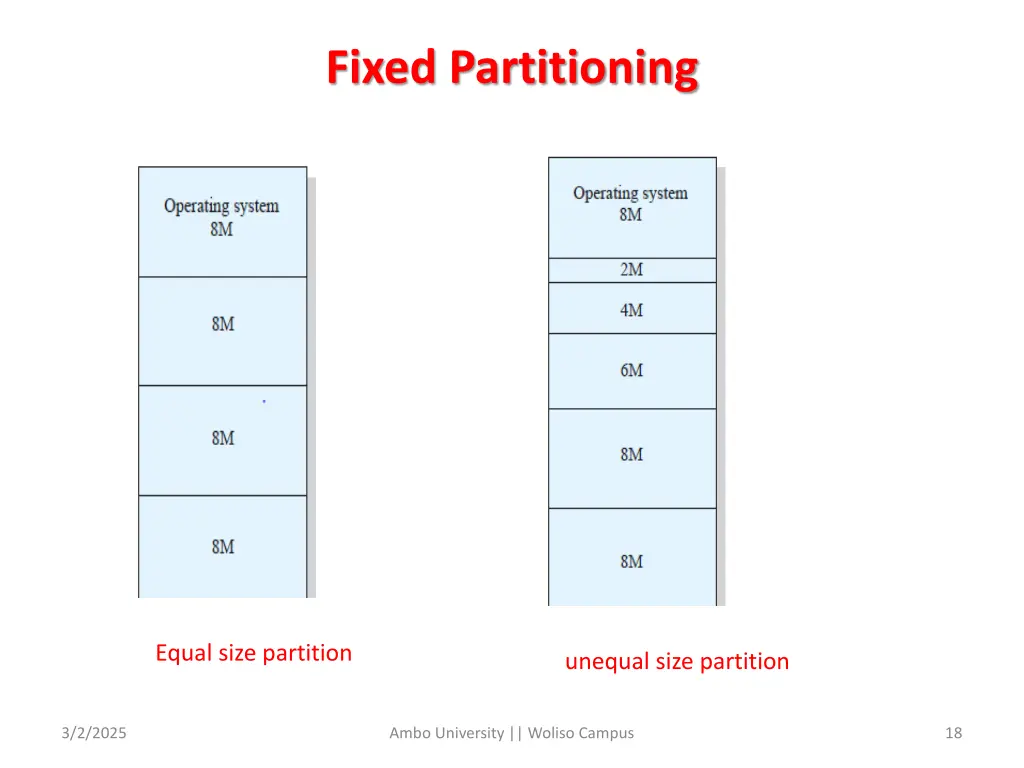
Fixed Partitioning Divide memory into several fixed-sized partitions. Each partition contains one process. Degree of multiprogramming is bound by the number of partitions. When a partition is free, a process is selected from the input queue and is loaded into the free partition. When the process terminates, the partition becomes available for another process. 3/2/2025 Ambo University || Woliso Campus 17
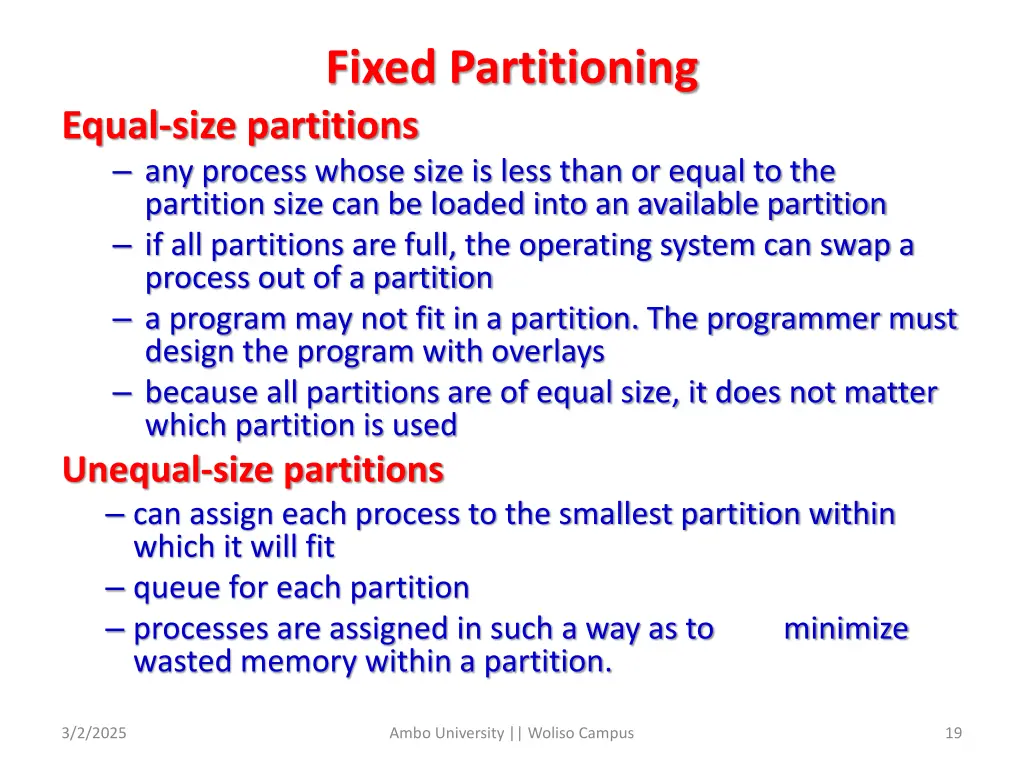
Fixed Partitioning Equal size partition unequal size partition 3/2/2025 Ambo University || Woliso Campus 18
Fixed Partitioning Equal-size partitions any process whose size is less than or equal to the partition size can be loaded into an available partition if all partitions are full, the operating system can swap a process out of a partition a program may not fit in a partition. The programmer must design the program with overlays because all partitions are of equal size, it does not matter which partition is used Unequal-size partitions can assign each process to the smallest partition within which it will fit queue for each partition processes are assigned in such a way as to minimize wasted memory within a partition. 3/2/2025 Ambo University || Woliso Campus 19
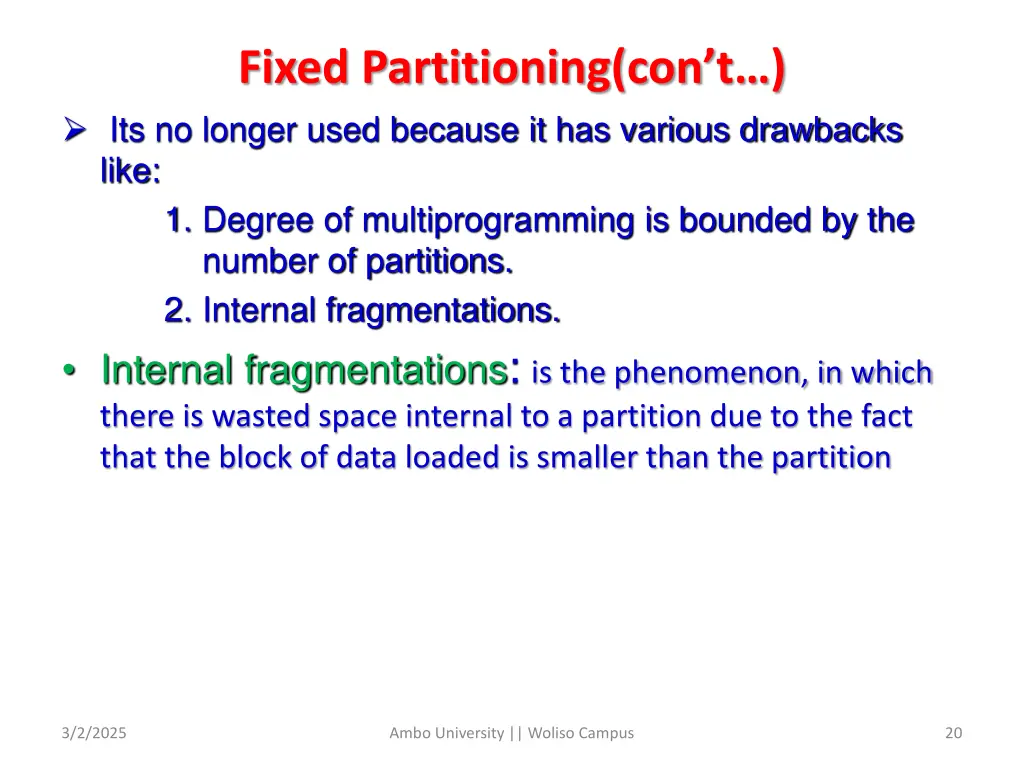
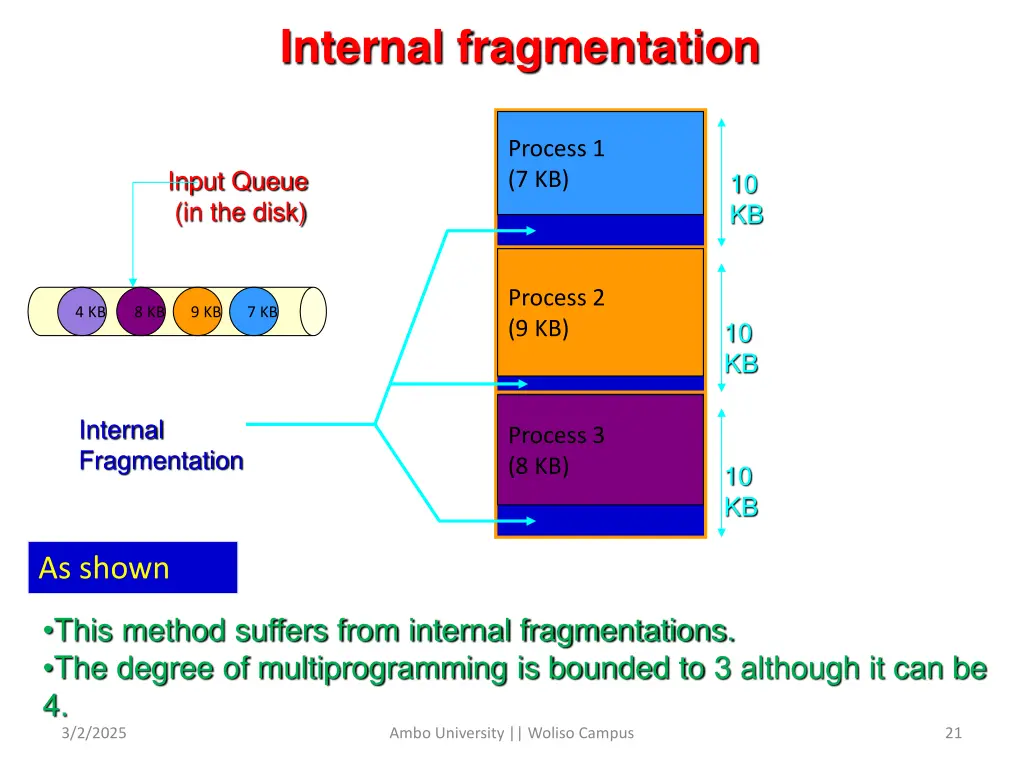
Fixed Partitioning(cont) Its no longer used because it has various drawbacks like: 1. Degree of multiprogramming is bounded by the number of partitions. 2. Internal fragmentations. Internal fragmentations:is the phenomenon, in which there is wasted space internal to a partition due to the fact that the block of data loaded is smaller than the partition 3/2/2025 Ambo University || Woliso Campus 20
Internal fragmentation Process 1 (7 KB) Input Queue (in the disk) 10 KB Process 2 (9 KB) 4 KB 8 KB 9 KB 7 KB 10 KB Internal Fragmentation Process 3 (8 KB) 10 KB As shown This method suffers from internal fragmentations. The degree of multiprogramming is bounded to 3 although it can be 4. 3/2/2025 Ambo University || Woliso Campus 21
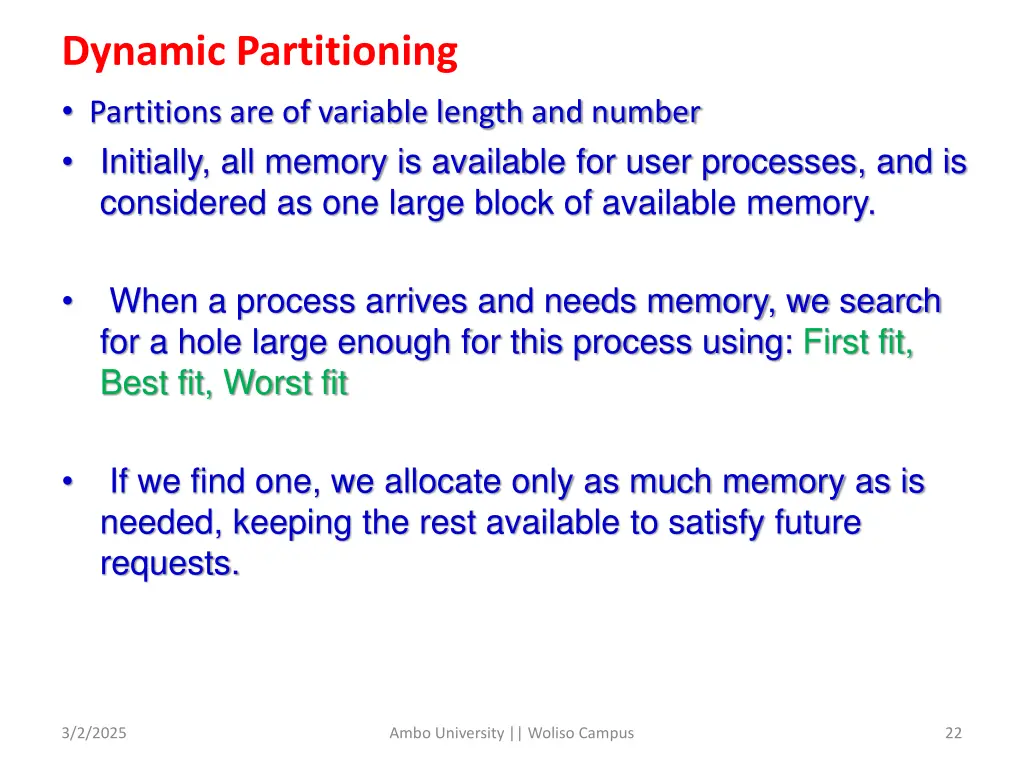
Dynamic Partitioning Partitions are of variable length and number Initially, all memory is available for user processes, and is considered as one large block of available memory. When a process arrives and needs memory, we search for a hole large enough for this process using: First fit, Best fit, Worst fit If we find one, we allocate only as much memory as is needed, keeping the rest available to satisfy future requests. 3/2/2025 Ambo University || Woliso Campus 22
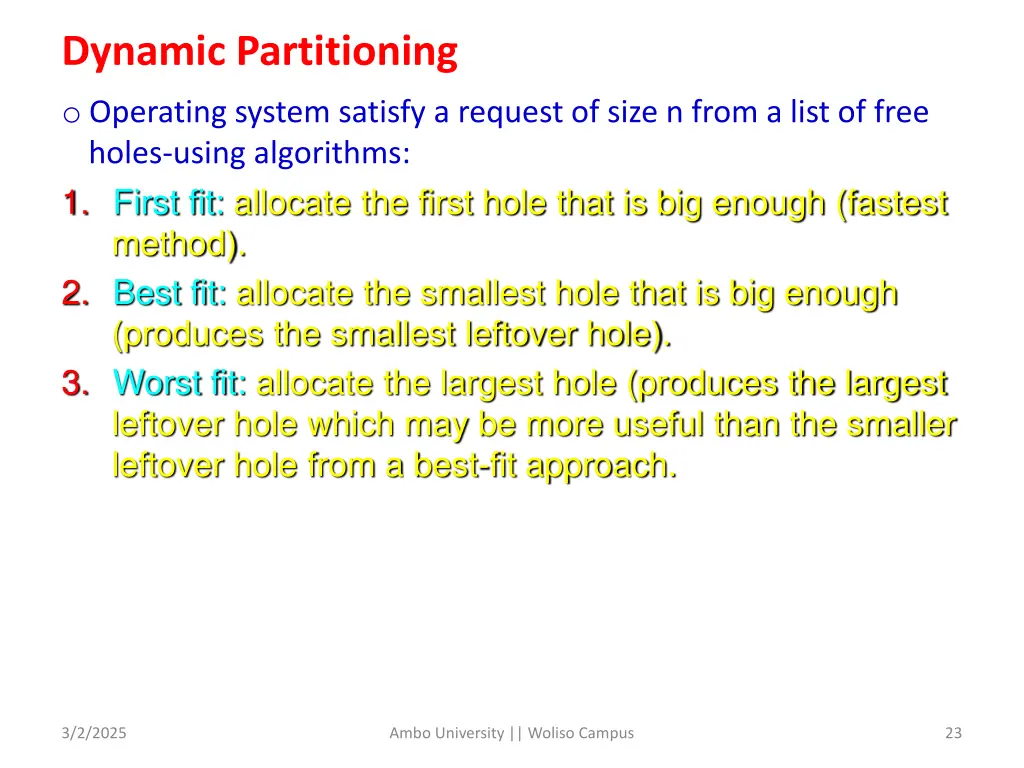
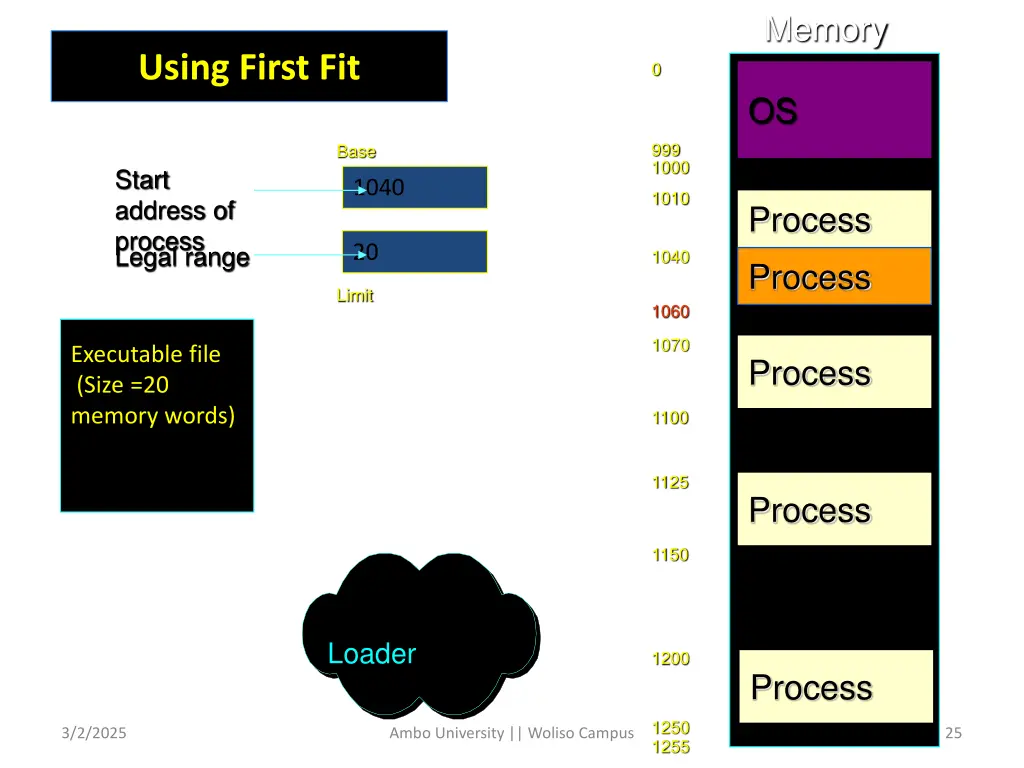
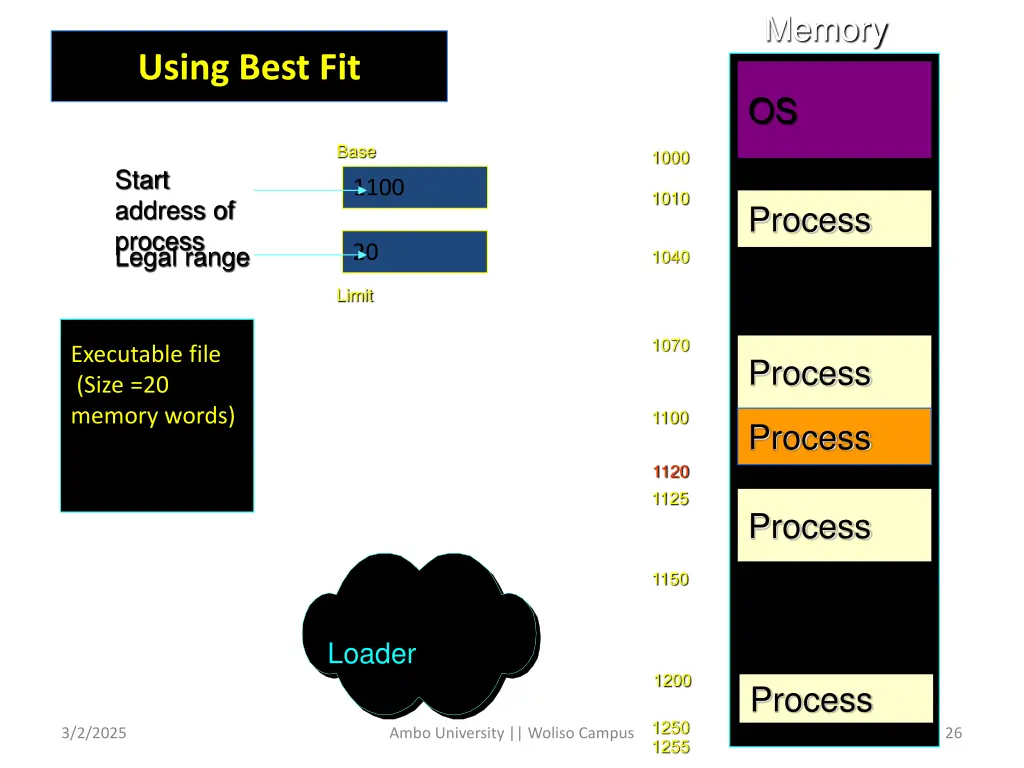
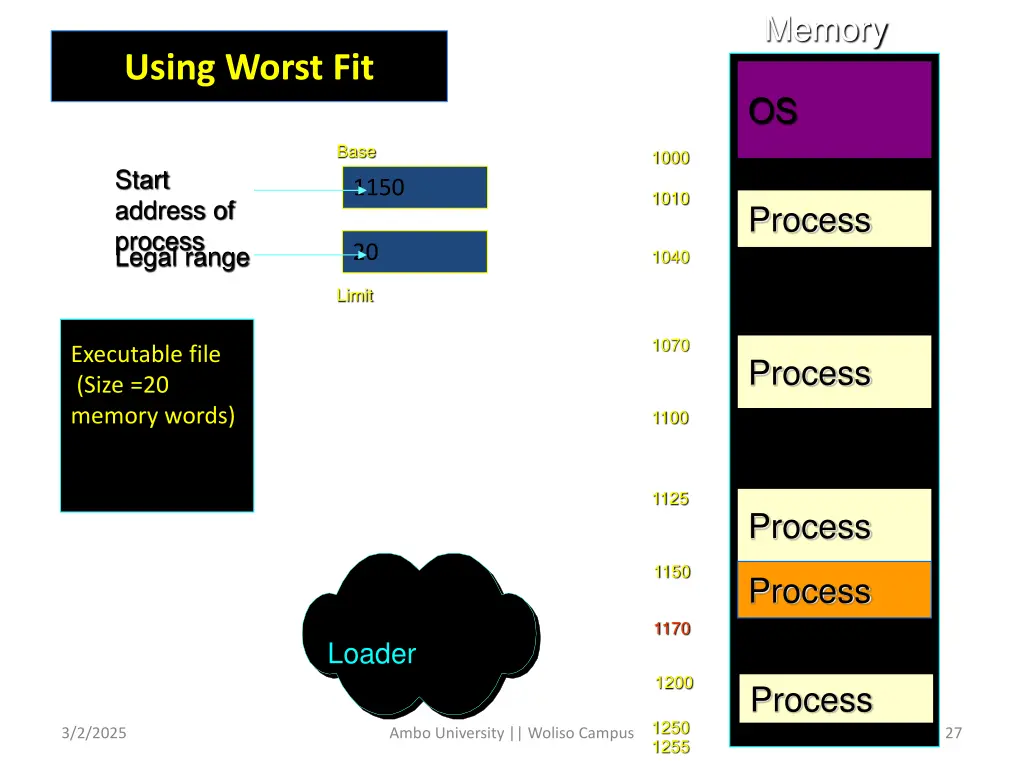
Dynamic Partitioning o Operating system satisfy a request of size n from a list of free holes-using algorithms: 1. First fit: allocate the first hole that is big enough (fastest method). 2. Best fit: allocate the smallest hole that is big enough (produces the smallest leftover hole). 3. Worst fit: allocate the largest hole (produces the largest leftover hole which may be more useful than the smaller leftover hole from a best-fit approach. 3/2/2025 Ambo University || Woliso Campus 23
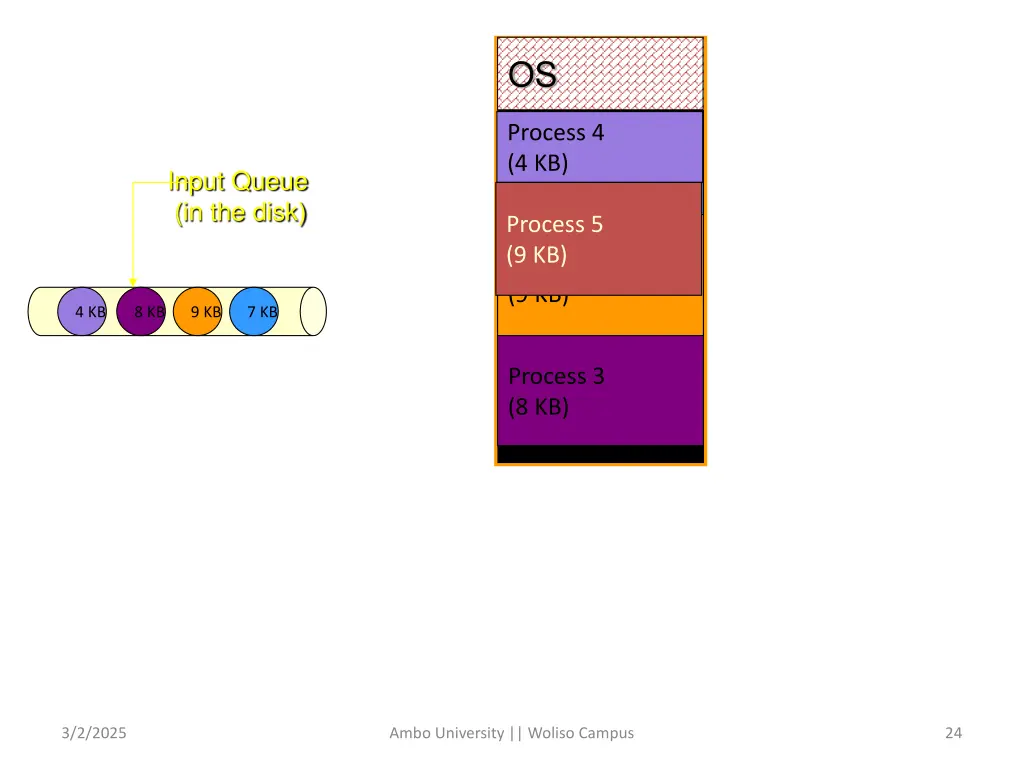
OS Process 4 (4 KB) Process 1 (7 KB) Input Queue (in the disk) Process 5 (9 KB) Process 2 (9 KB) 4 KB 8 KB 9 KB 7 KB Process 3 (8 KB) 3/2/2025 Ambo University || Woliso Campus 24
Memory Using First Fit 0 OS 999 Base 1000 Start address of process Legal range 1040 1010 Process 20 1040 Process Limit 1060 1070 Executable file (Size =20 memory words) Process 1100 1125 Process 1150 Loader 1200 Process 1250 1255 3/2/2025 Ambo University || Woliso Campus 25
Memory Using Best Fit OS Base 1000 Start address of process Legal range 1100 1010 Process 20 1040 Limit 1070 Executable file (Size =20 memory words) Process 1100 Process 1120 1125 Process 1150 Loader 1200 Process 1250 1255 3/2/2025 Ambo University || Woliso Campus 26
Memory Using Worst Fit OS Base 1000 Start address of process Legal range 1150 1010 Process 20 1040 Limit 1070 Executable file (Size =20 memory words) Process 1100 1125 Process 1150 Process 1170 Loader 1200 Process 1250 1255 3/2/2025 Ambo University || Woliso Campus 27
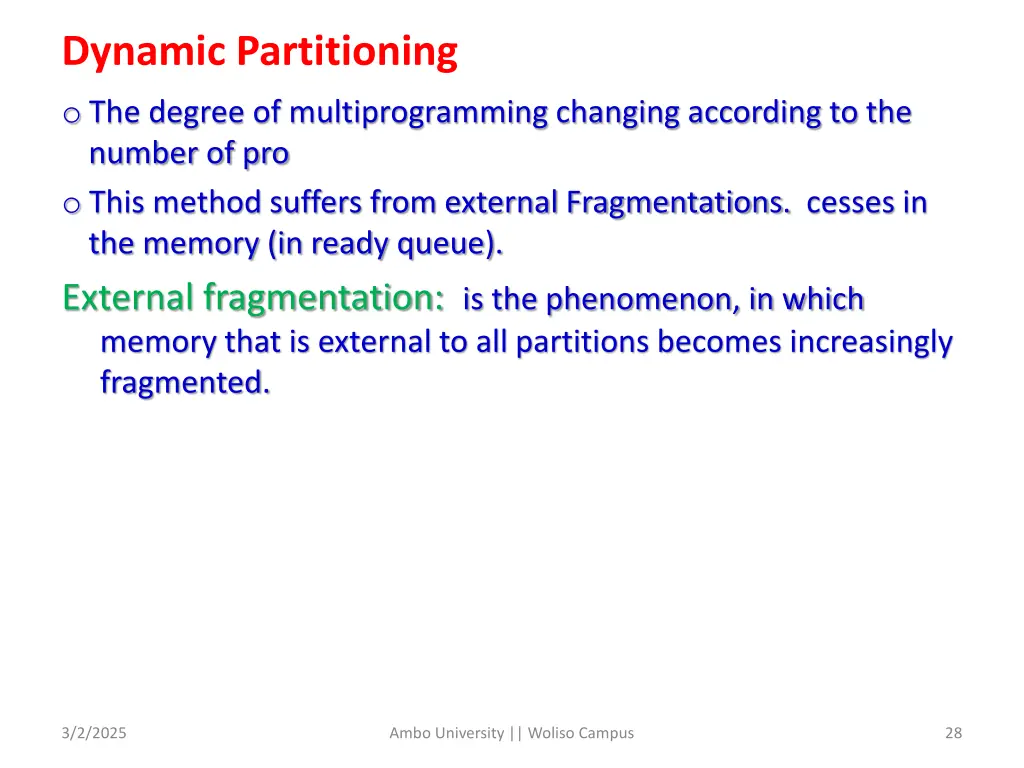
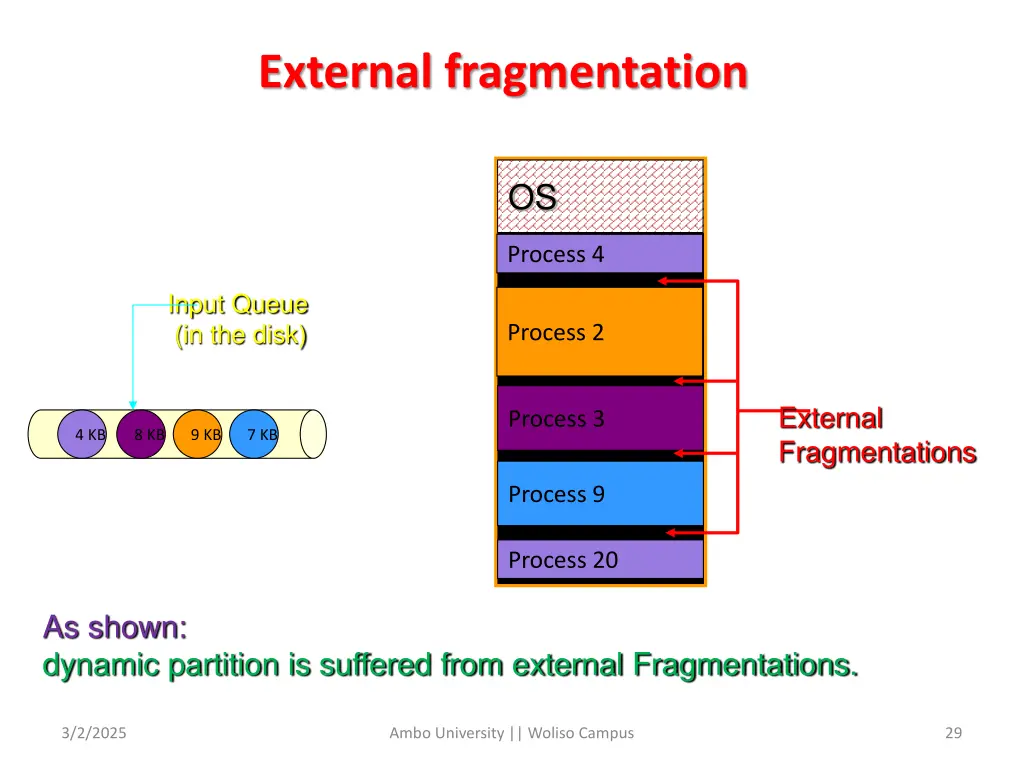
Dynamic Partitioning o The degree of multiprogramming changing according to the number of pro o This method suffers from external Fragmentations. cesses in the memory (in ready queue). External fragmentation: is the phenomenon, in which memory that is external to all partitions becomes increasingly fragmented. 3/2/2025 Ambo University || Woliso Campus 28
External fragmentation OS Process 4 Input Queue (in the disk) Process 2 External Fragmentations Process 3 4 KB 8 KB 9 KB 7 KB Process 9 Process 20 As shown: dynamic partition is suffered from external Fragmentations. 3/2/2025 Ambo University || Woliso Campus 29
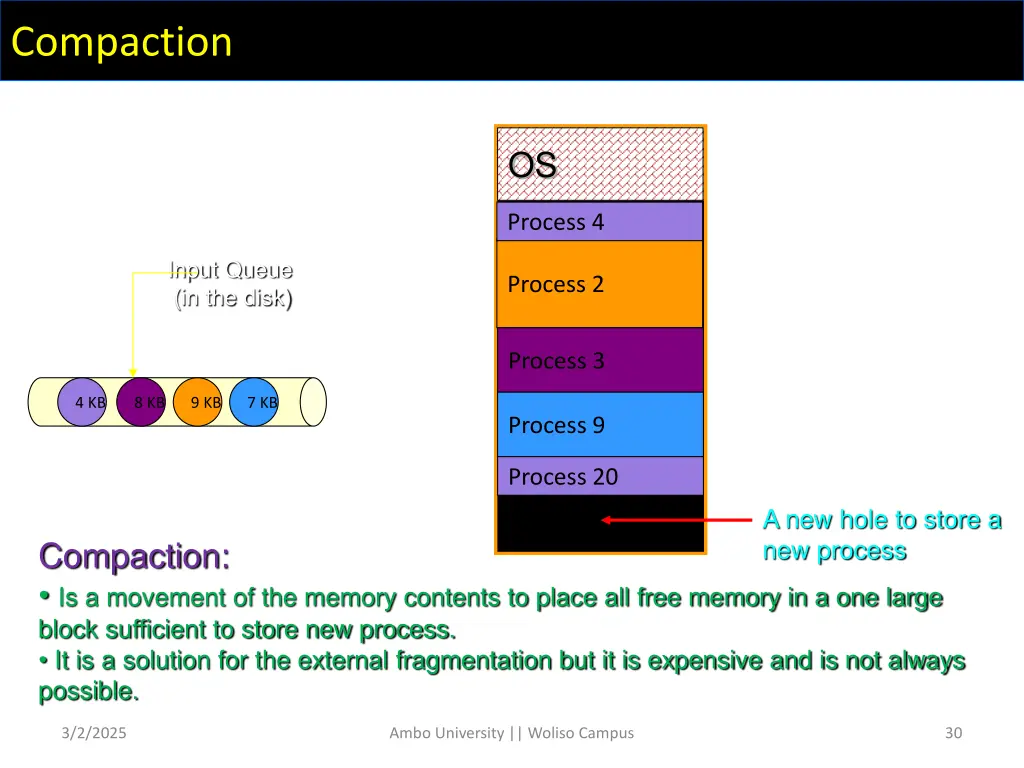
Compaction OS OS Process 4 Process 4 Input Queue (in the disk) Process 2 Process 2 Process 3 Process 3 4 KB 8 KB 9 KB 7 KB Process 9 Process 9 Process 20 A new hole to store a new process Process 20 Compaction: Is a movement of the memory contents to place all free memory in a one large block sufficient to store new process. It is a solution for the external fragmentation but it is expensive and is not always possible. 3/2/2025 Ambo University || Woliso Campus 30
End NEXT SECTION PAGING AND SEGMENTATION 3/2/2025 Ambo University || Woliso Campus 31