Memory Management: Memory Management:
This presentation provides a comprehensive overview of the x86 instruction set architecture (ISA), detailing its lineage from the 8-bit 8080 microprocessor to modern 64-bit Intel processors like Core i3, i5, and i7. It highlights core features of the x86 ISA, including its complex instruction set computing (CISC) nature, the use of segmented memory, and the role of registers in various bit architectures. Key sections include integer instructions, branch instructions, and advanced memory operations.

Download Presentation

Please find below an Image/Link to download the presentation.
The content on the website is provided AS IS for your information and personal use only. It may not be sold, licensed, or shared on other websites without obtaining consent from the author.If you encounter any issues during the download, it is possible that the publisher has removed the file from their server.
You are allowed to download the files provided on this website for personal or commercial use, subject to the condition that they are used lawfully. All files are the property of their respective owners.
The content on the website is provided AS IS for your information and personal use only. It may not be sold, licensed, or shared on other websites without obtaining consent from the author.
E N D
Presentation Transcript
Memory Management: Memory Management: Basic Memory Management Basic Memory Management
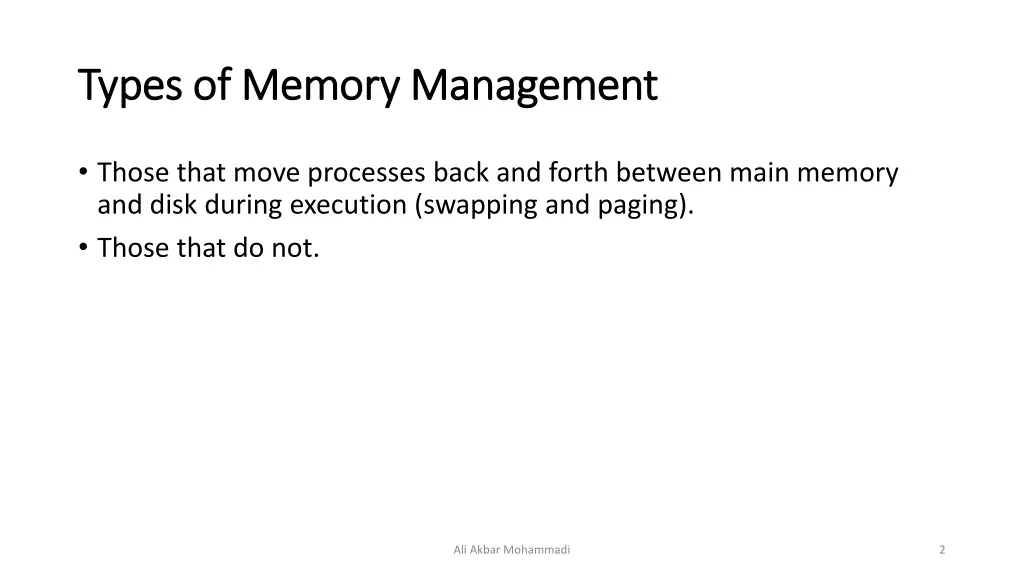
Types of Memory Management Types of Memory Management Those that move processes back and forth between main memory and disk during execution (swapping and paging). Those that do not. Ali Akbar Mohammadi 2
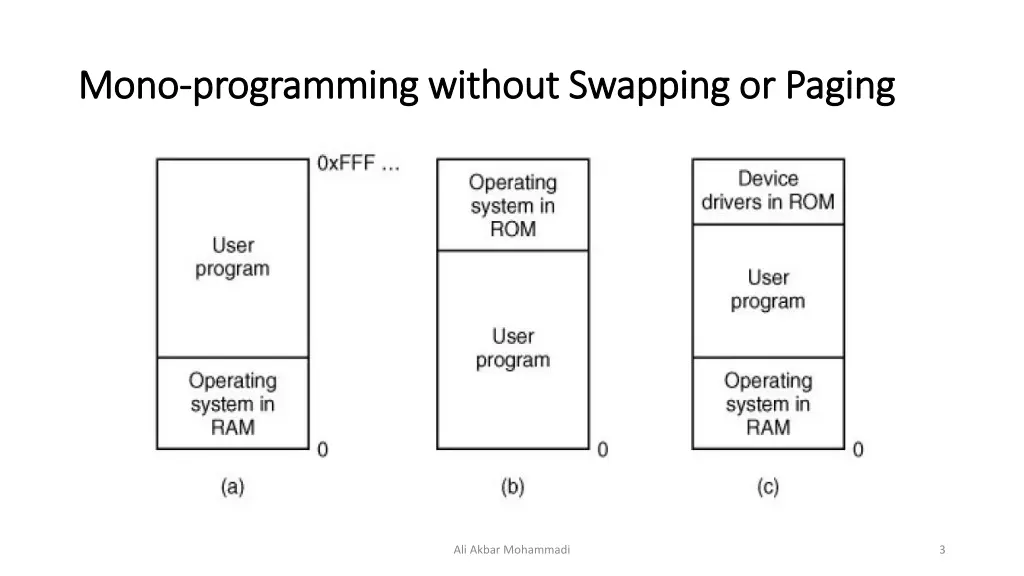
Mono Mono- -programming programming without Swapping or Paging without Swapping or Paging Ali Akbar Mohammadi 3
Multiprogramming with Fixed Partitions Multiprogramming with Fixed Partitions The easiest way to achieve multiprogramming is simply to divide memory up into n (possibly unequal) partitions. This partitioning can, for example, be done manually when the system is started up. When a job arrives, it can be put into the input queue for the smallest partition large enough to hold it. Since the partitions are fixed in this scheme, any space in a partition not used by a job is wasted while that job runs. Ali Akbar Mohammadi 4
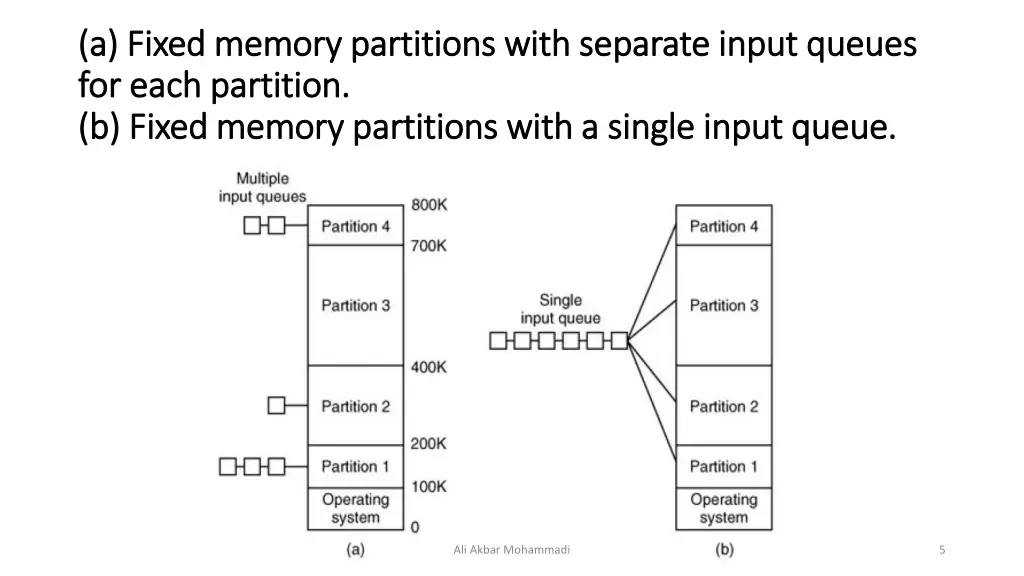
(a) Fixed memory partitions with separate input queues (a) Fixed memory partitions with separate input queues for each for each partition. partition. ( (b) Fixed memory partitions with a single input queue. b) Fixed memory partitions with a single input queue. Ali Akbar Mohammadi 5
Disadvantage Disadvantage The disadvantage of sorting the incoming jobs into separate queues becomes apparent when the queue for a large partition is empty but the queue for a small partition is full. Ali Akbar Mohammadi 6
Multiprogramming with a Fixed number of Multiprogramming with a Fixed number of Tasks or Tasks or OS/MFT OS/MFT incoming jobs are queued until a suitable partition is available, at which time the job is loaded into that partition and run until it terminates. Ali Akbar Mohammadi 7
Relocation and Protection Relocation and Protection suppose that the first instruction is a call to a procedure at absolute address 100 within the binary file produced by the linker. If this program is loaded in partition 1 (at address 100K), that instruction will jump to absolute address 100, which is inside the operating system. What is needed is a call to 100K + 100. If the program is loaded into partition 2, it must be carried out as a call to 200K + 100, and so on. This problem is known as the relocation problem. Ali Akbar Mohammadi 8
Solution Solution One possible solution is to actually modify the instructions as the program is loaded into memory. Programs loaded into partition 1 have 100K added to each address, programs loaded into partition 2 have 200K added to addresses, and so forth. Ali Akbar Mohammadi 9
The Protection Problem The Protection Problem Relocation during loading does not solve the protection problem. A malicious program can always construct a new instruction and jump to it. Ali Akbar Mohammadi 10
A Solution for Both Relocation and Protection A Solution for Both Relocation and Protection Equip the machine with two special hardware registers, called the base and limit registers. When a process is scheduled, the base register is loaded with the address of the start of its partition, and the limit register is loaded with the length of the partition. Every memory address generated automatically has the base register contents added to it before being sent to memory. Ali Akbar Mohammadi 11
Disadvantage Disadvantage The need to perform an addition and a comparison on every memory reference. Comparisons can be done fast, but additions are slow due to carry propagation time unless special addition circuits are used. Ali Akbar Mohammadi 12