Methodological Individualism in Economics
Explore the concept of methodological individualism in economics through a critical examination of its pillars, limitations, and contemporary economic theories. Discover how individual behaviors shape macroeconomic phenomena and the ongoing quest for completeness in economic models.

Download Presentation

Please find below an Image/Link to download the presentation.
The content on the website is provided AS IS for your information and personal use only. It may not be sold, licensed, or shared on other websites without obtaining consent from the author. If you encounter any issues during the download, it is possible that the publisher has removed the file from their server.
You are allowed to download the files provided on this website for personal or commercial use, subject to the condition that they are used lawfully. All files are the property of their respective owners.
The content on the website is provided AS IS for your information and personal use only. It may not be sold, licensed, or shared on other websites without obtaining consent from the author.
E N D
Presentation Transcript
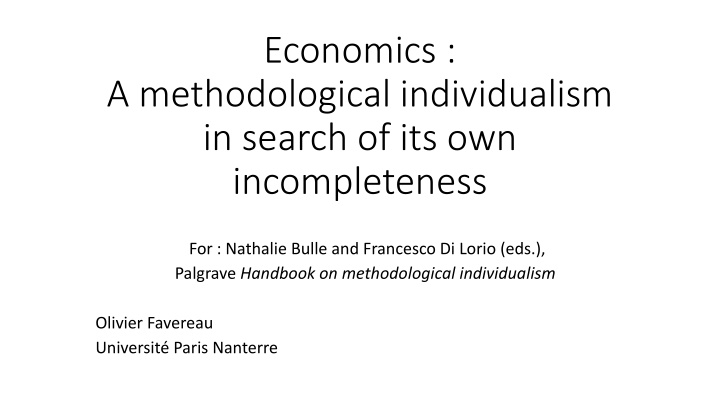
Economics : A methodological individualism in search of its own incompleteness For : Nathalie Bulle and Francesco Di Lorio (eds.), Palgrave Handbook on methodological individualism Olivier Favereau Universit Paris Nanterre
PLAN /1/ Economics (mainstream) is the kingdom of Methodological Individualism /2/ The king is dead /3/ Long live the king 2
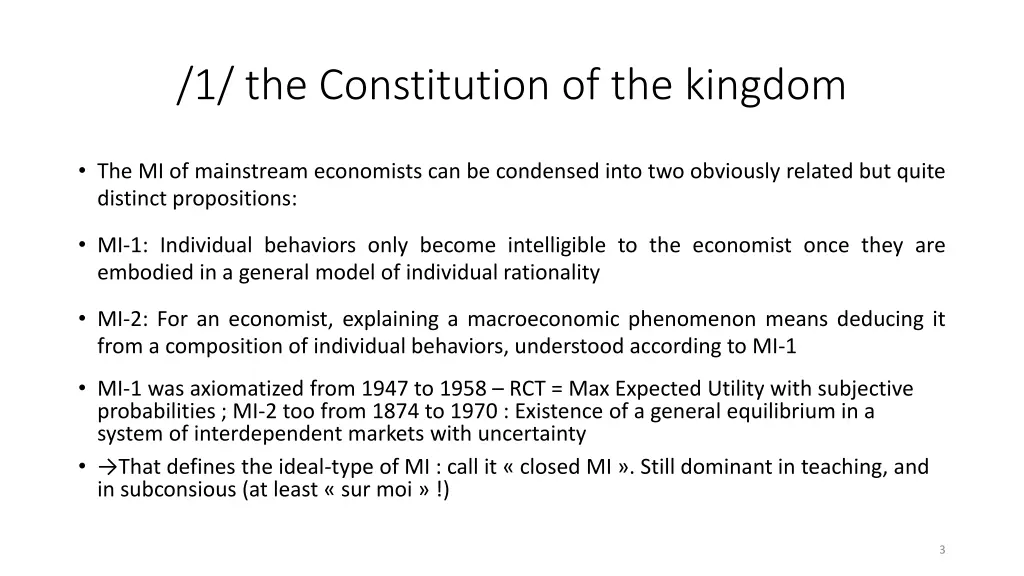
/1/ the Constitution of the kingdom The MI of mainstream economists can be condensed into two obviously related but quite distinct propositions: MI-1: Individual behaviors only become intelligible to the economist once they are embodied in a general model of individual rationality MI-2: For an economist, explaining a macroeconomic phenomenon means deducing it from a composition of individual behaviors, understood according to MI-1 MI-1 was axiomatized from 1947 to 1958 RCT = Max Expected Utility with subjective probabilities ; MI-2 too from 1874 to 1970 : Existence of a general equilibrium in a system of interdependent markets with uncertainty That defines the ideal-type of MI : call it closed MI . Still dominant in teaching, and in subconsious (at least sur moi !) 3
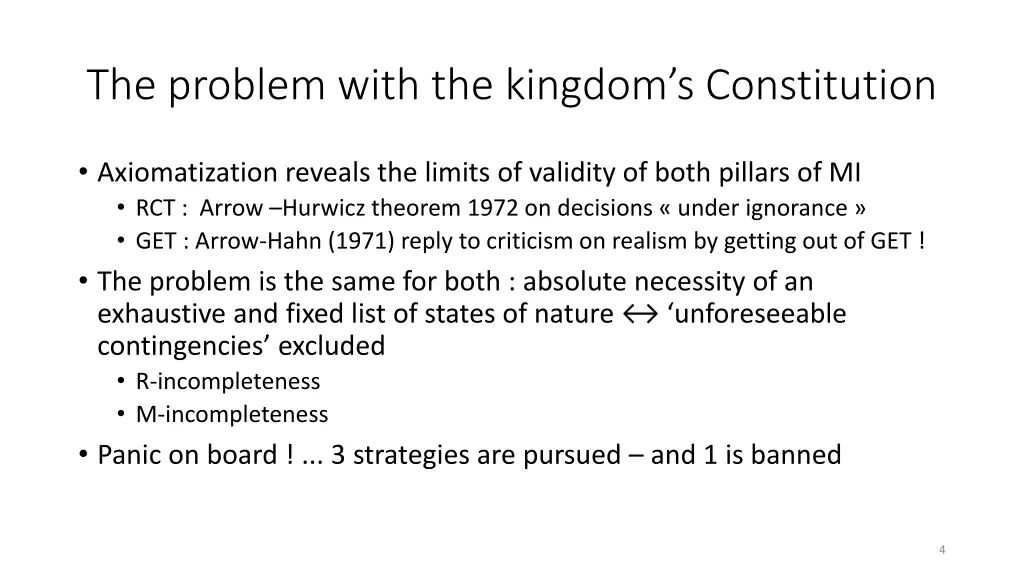
The problem with the kingdoms Constitution Axiomatization reveals the limits of validity of both pillars of MI RCT : Arrow Hurwicz theorem 1972 on decisions under ignorance GET : Arrow-Hahn (1971) reply to criticism on realism by getting out of GET ! The problem is the same for both : absolute necessity of an exhaustive and fixed list of states of nature contingencies excluded R-incompleteness M-incompleteness Panic on board ! ... 3 strategies are pursued and 1 is banned unforeseeable 4
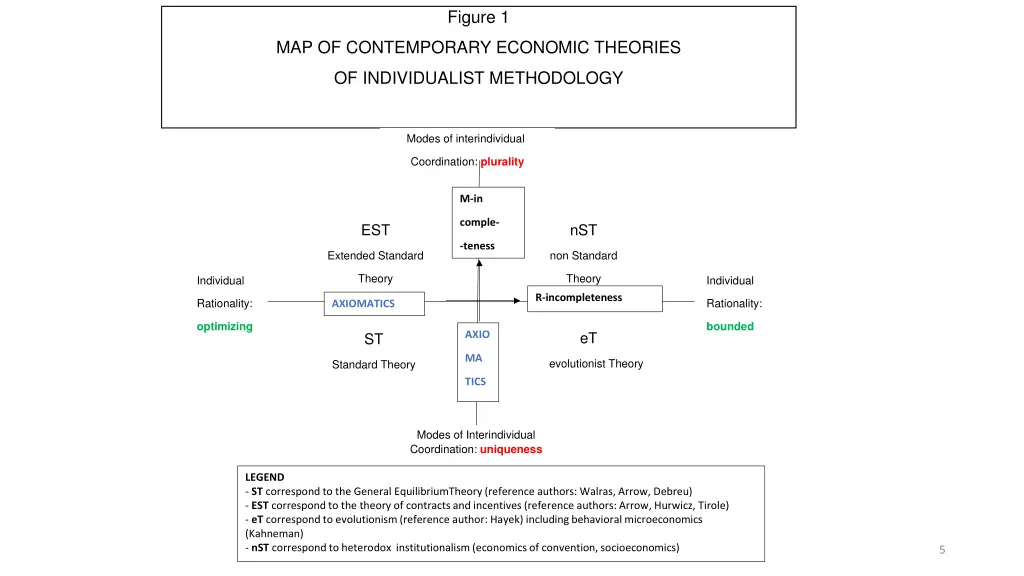
Figure 1 MAP OF CONTEMPORARY ECONOMIC THEORIES OF INDIVIDUALIST METHODOLOGY Modes of interindividual Coordination: plurality M-in comple- EST nST -teness Extended Standard non Standard Theory Theory Individual Individual R-incompleteness Rationality: Rationality: AXIOMATICS optimizing bounded eT AXIO ST MA evolutionist Theory Standard Theory TICS Modes of Interindividual Coordination: uniqueness LEGEND - ST correspond to the General EquilibriumTheory (reference authors: Walras, Arrow, Debreu) - EST correspond to the theory of contracts and incentives (reference authors: Arrow, Hurwicz, Tirole) - eT correspond to evolutionism (reference author: Hayek) including behavioral microeconomics (Kahneman) - nST correspond to heterodox institutionalism (economics of convention, socioeconomics) 5
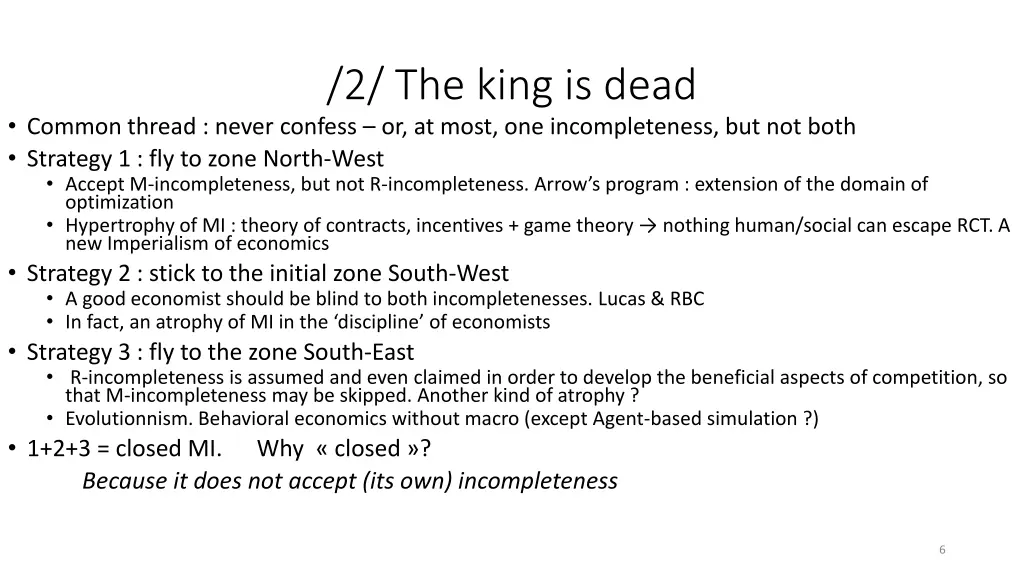
/2/ The king is dead Common thread : never confess or, at most, one incompleteness, but not both Strategy 1 : fly to zone North-West Accept M-incompleteness, but not R-incompleteness. Arrow s program : extension of the domain of optimization Hypertrophy of MI : theory of contracts, incentives + game theory nothing human/social can escape RCT. A new Imperialism of economics Strategy 2 : stick to the initial zone South-West A good economist should be blind to both incompletenesses. Lucas & RBC In fact, an atrophy of MI in the discipline of economists Strategy 3 : fly to the zone South-East R-incompleteness is assumed and even claimed in order to develop the beneficial aspects of competition, so that M-incompleteness may be skipped. Another kind of atrophy ? Evolutionnism. Behavioral economics without macro (except Agent-based simulation ?) 1+2+3 = closed MI. Why closed ? Because it does not accept (its own) incompleteness 6
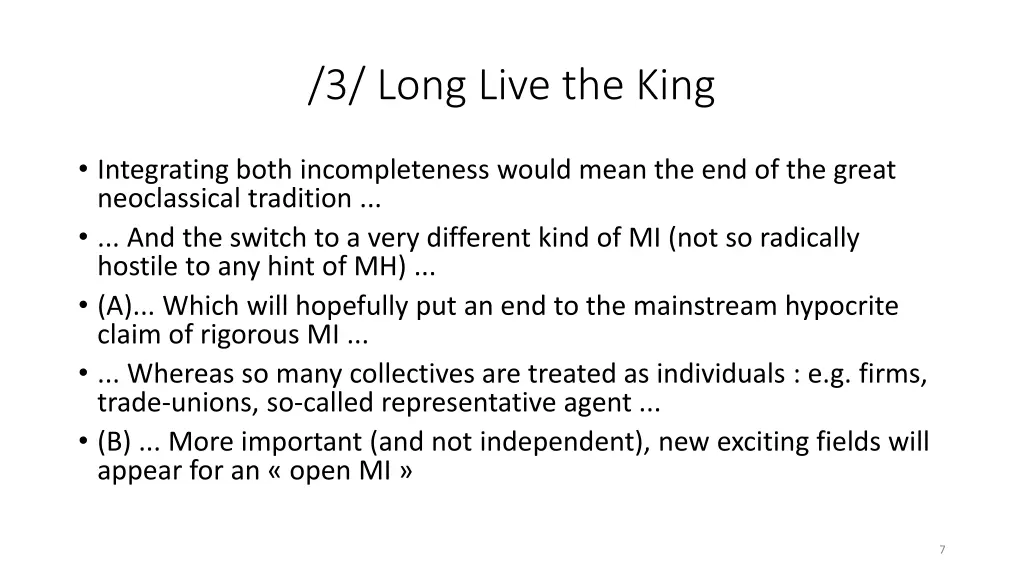
/3/ Long Live the King Integrating both incompleteness would mean the end of the great neoclassical tradition ... ... And the switch to a very different kind of MI (not so radically hostile to any hint of MH) ... (A)... Which will hopefully put an end to the mainstream hypocrite claim of rigorous MI ... ... Whereas so many collectives are treated as individuals : e.g. firms, trade-unions, so-called representative agent ... (B) ... More important (and not independent), new exciting fields will appear for an open MI 7
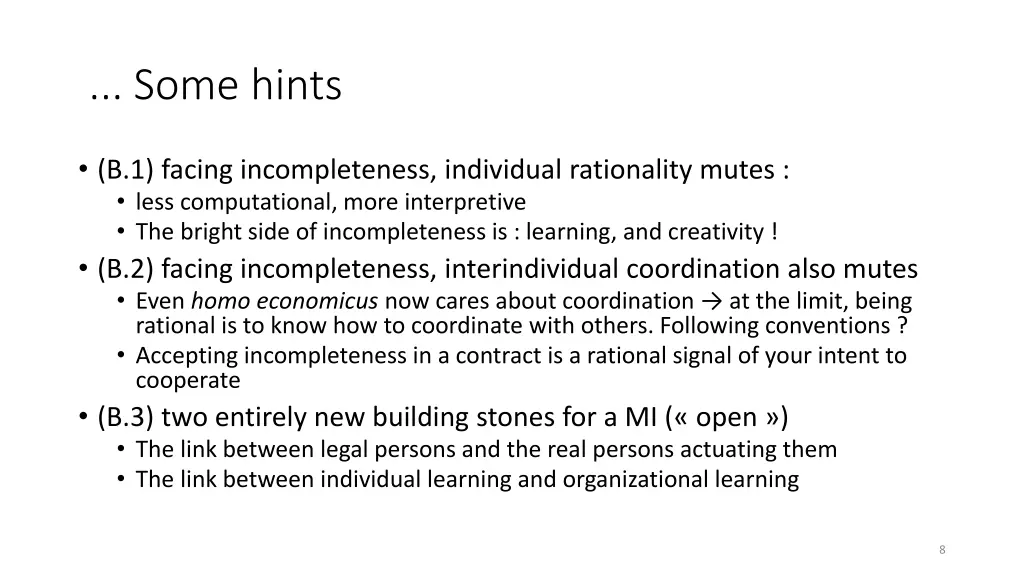
... Some hints (B.1) facing incompleteness, individual rationality mutes : less computational, more interpretive The bright side of incompleteness is : learning, and creativity ! (B.2) facing incompleteness, interindividual coordination also mutes Even homo economicus now cares about coordination at the limit, being rational is to know how to coordinate with others. Following conventions ? Accepting incompleteness in a contract is a rational signal of your intent to cooperate (B.3) two entirely new building stones for a MI ( open ) The link between legal persons and the real persons actuating them The link between individual learning and organizational learning 8