Explore methodological considerations in publishing engineering education research, focusing on survey development, threats to experimental validity, external validity, survey sample representation, and data sources analysis.
Please find below an Image/Link to download the presentation.
The content on the website is provided AS IS for your information and personal use only. It may not be sold, licensed, or shared on other websites without obtaining consent from the author. If you encounter any issues during the download, it is possible that the publisher has removed the file from their server.
You are allowed to download the files provided on this website for personal or commercial use, subject to the condition that they are used lawfully. All files are the property of their respective owners.
The content on the website is provided AS IS for your information and personal use only. It may not be sold, licensed, or shared on other websites without obtaining consent from the author.
E N D
Presentation Transcript
Some Methodological Considerations for Publishing Engineering Education Research A Focus on Survey Development
Threats to Experimental Validity Internal Validity - the degree to which observed differences on the dependent variable are a result of manipulation of the independent variable and not some other extraneous variable. External Validity - degree to which results are generalizable to other groups and environments outside the experiment. (Ecological validity).
Engineering Leadership: Faculty Perceptions and Profiles (Schell & Kauffmann) Schell & Kauffmann (2016) reported that of the 154 participants of which 123 or 80% completed the survey. Was the sample representative of the population? How precise are the results? Creative Research Systems can Sample Size Calculator help us answer these questions.
External Validity for Survey Research : Sampling Representativeness or generalizability of results Confidence Level - is the probability that a value in the population is within a specific, numeric range from the corresponding value computed from a sample (Alreck & Settle, 2004) Confidence Interval - also called margin of error is the plus-or-minus figure usually reported in survey research (Rea & Parker, 2005).
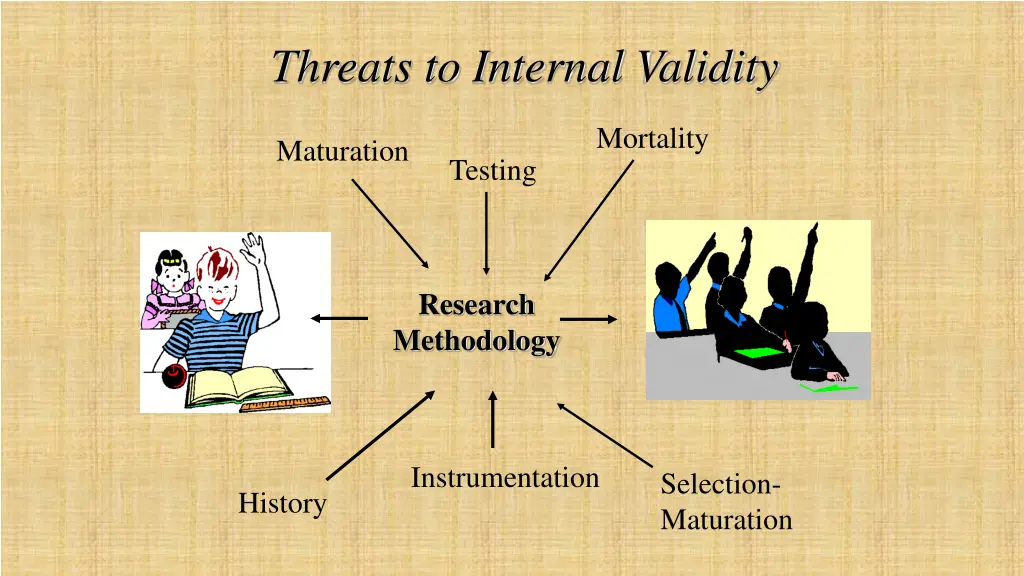
Threats to Internal Validity Mortality Maturation Testing Research Methodology Instrumentation Selection- Maturation History
Engineering Leadership: Faculty Perceptions and Profiles (Schell & Kauffmann) This study sought to test the hypothesis that the faculty engaged in EL development come from a different background than those of the larger engineering faculty. Descriptive Research Survey Research
Data Sources The first source involved analysis of biographical information of authors actively publishing in the LEAD division of ASEE. These findings are augmented through the results of the study s national survey of engineering faculty.
Analysis of Biographical Information Descriptive Results: Categories were well-defined. Similar to a content analysis usually have two researchers code the information and check for consistency in demographic classifications (see Data and Findings , Data Demographics LEAD Authors. Use of tables would help to summarize the descriptive information for efficient presentation of results
National Survey To augment these findings, a survey was developed and deployed to examine faculty perceptions about the role engineering education should play in the development of engineering leadership skills in undergraduate students. What is missing?
National Survey: Instrument Validation or Establishing Validity Evidence Face Validity does the instrument look like it measures the construct(s) of interest. Does the instrument look legitimate? Content Validity- Content validity considers whether or not the items on a given test accurately reflect the theoretical domain of the construct it claims to measure. Items should be representative of all the possible questions that could have been derived from the construct (Crocker & Algina, 1986; DeVellis, 2003).
Criterion Related Validity Criterion validity refers to the ability to draw accurate inferences from test scores to a related behavioral criterion of interest. This validity measure can be pursued in one of two contexts: predictive validity or concurrent validity. In criterion-oriented validity, the investigator is primarily interested in some criterion which he wants to predict. (DeVellis, 2003)
Construct Validity Construct validity is the degree to which a test measures what it claims, or purports, to be measuring" (Crocker & Algina, 1986)
Consequential Validity Consequential validity refers to the notion that the social consequences of test scores and their subsequent interpretation should be considered not only with the original intention of the test, but also cultural norms (Messick, 1995).
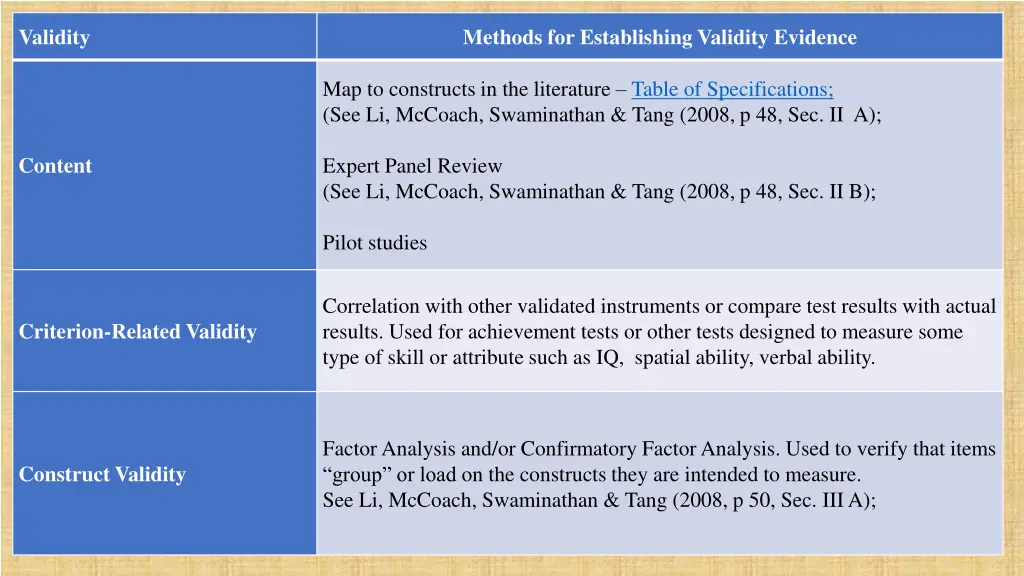
Validity Methods for Establishing Validity Evidence Map to constructs in the literature Table of Specifications; (See Li, McCoach, Swaminathan & Tang (2008, p 48, Sec. II A); Content Expert Panel Review (See Li, McCoach, Swaminathan & Tang (2008, p 48, Sec. II B); Pilot studies Correlation with other validated instruments or compare test results with actual results. Used for achievement tests or other tests designed to measure some type of skill or attribute such as IQ, spatial ability, verbal ability. Criterion-Related Validity Factor Analysis and/or Confirmatory Factor Analysis. Used to verify that items group or load on the constructs they are intended to measure. See Li, McCoach, Swaminathan & Tang (2008, p 50, Sec. III A); Construct Validity
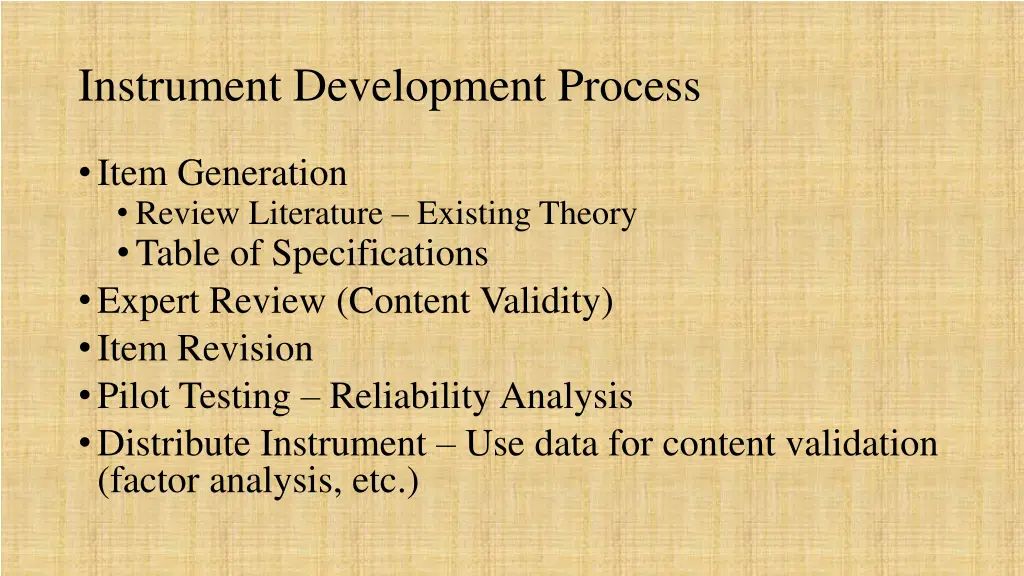
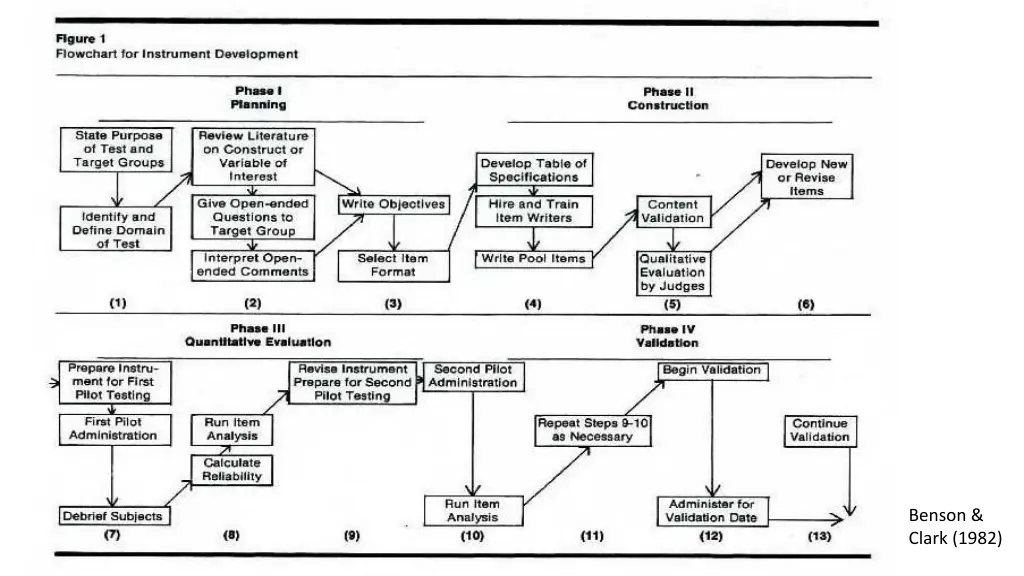
Instrument Development Process Item Generation Review Literature Existing Theory Table of Specifications Expert Review (Content Validity) Item Revision Pilot Testing Reliability Analysis Distribute Instrument Use data for content validation (factor analysis, etc.)
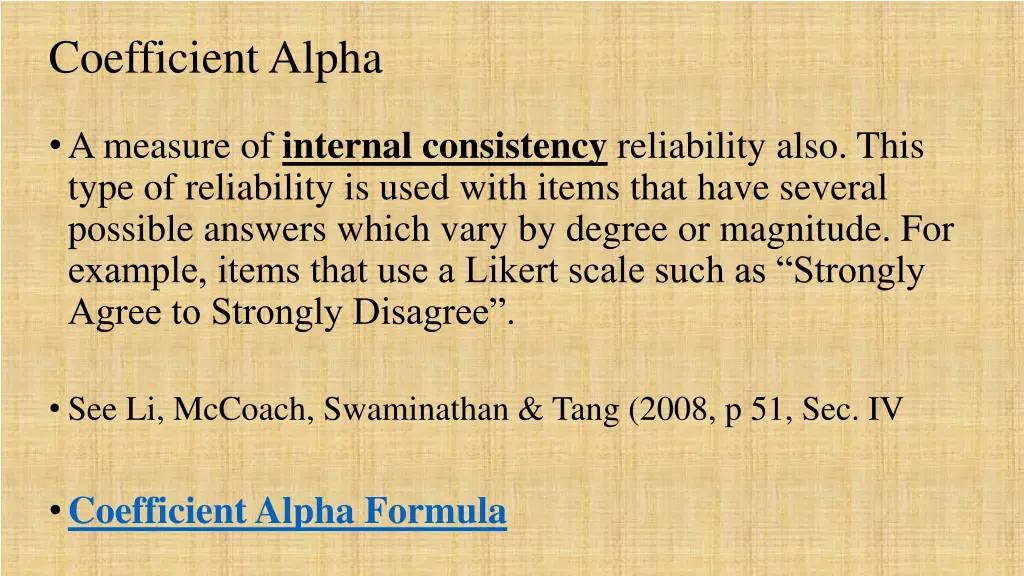
Coefficient Alpha A measure of internal consistency reliability also. This type of reliability is used with items that have several possible answers which vary by degree or magnitude. For example, items that use a Likert scale such as Strongly Agree to Strongly Disagree . See Li, McCoach, Swaminathan & Tang (2008, p 51, Sec. IV Coefficient Alpha Formula
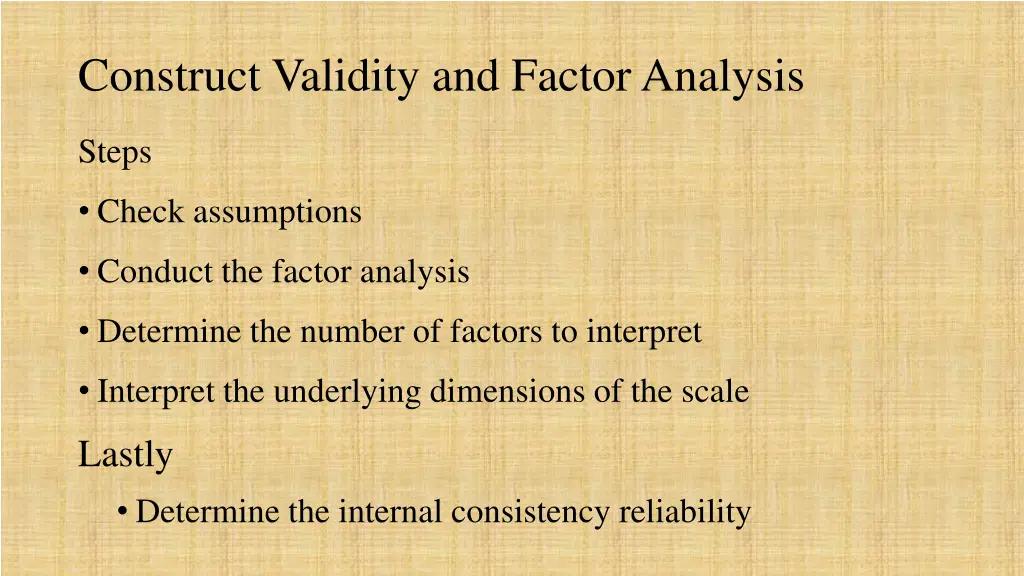
Construct Validity and Factor Analysis Steps Check assumptions Conduct the factor analysis Determine the number of factors to interpret Interpret the underlying dimensions of the scale Lastly Determine the internal consistency reliability
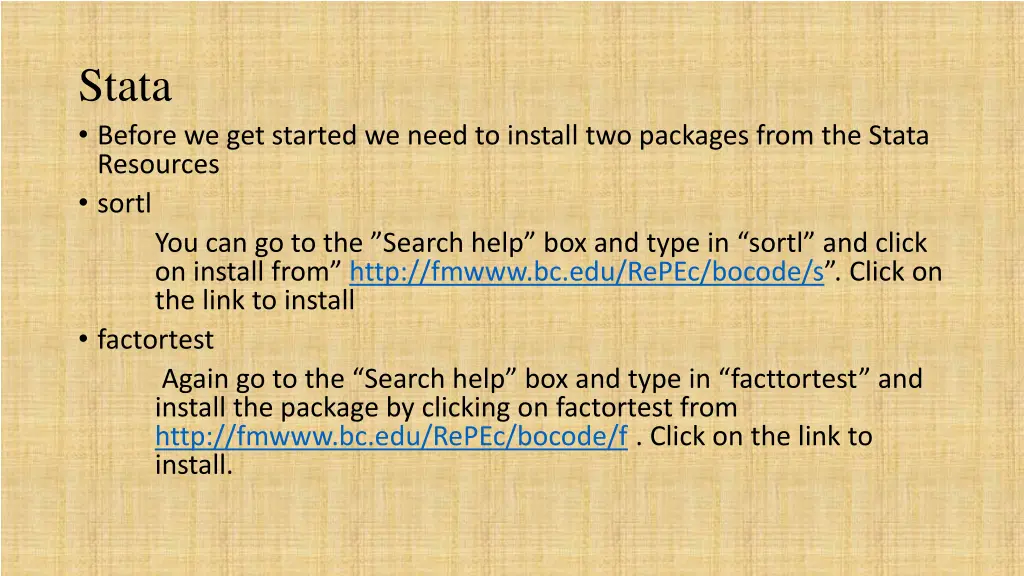
Stata Before we get started we need to install two packages from the Stata Resources sortl You can go to the Search help box and type in sortl and click on install from http://fmwww.bc.edu/RePEc/bocode/s . Click on the link to install factortest Again go to the Search help box and type in facttortest and install the package by clicking on factortest from http://fmwww.bc.edu/RePEc/bocode/f . Click on the link to install.
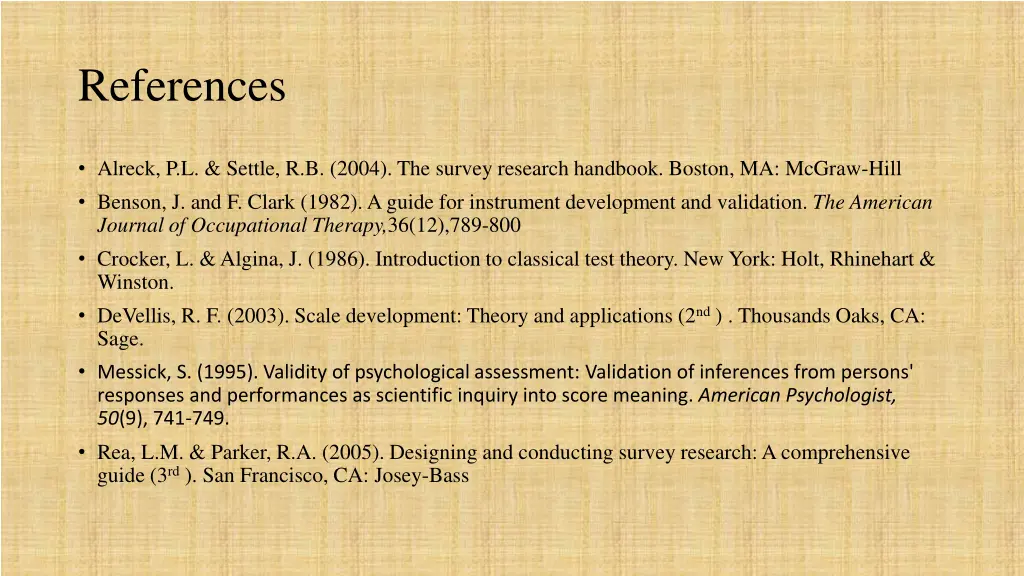
References Alreck, P.L. & Settle, R.B. (2004). The survey research handbook. Boston, MA: McGraw-Hill Benson, J. and F. Clark (1982). A guide for instrument development and validation. The American Journal of Occupational Therapy,36(12),789-800 Crocker, L. & Algina, J. (1986). Introduction to classical test theory. New York: Holt, Rhinehart & Winston. DeVellis, R. F. (2003). Scale development: Theory and applications (2nd ) . Thousands Oaks, CA: Sage. Messick, S. (1995). Validity of psychological assessment: Validation of inferences from persons' responses and performances as scientific inquiry into score meaning. American Psychologist, 50(9), 741-749. Rea, L.M. & Parker, R.A. (2005). Designing and conducting survey research: A comprehensive guide (3rd ). San Francisco, CA: Josey-Bass