Explore the direct write-off method and allowance method for accounting for uncollectible accounts receivable, including the percentage-of-sales and percentage-of-receivables approaches. Understand how these methods impact financial statements and cash realizable value.
Please find below an Image/Link to download the presentation.
The content on the website is provided AS IS for your information and personal use only. It may not be sold, licensed, or shared on other websites without obtaining consent from the author. If you encounter any issues during the download, it is possible that the publisher has removed the file from their server.
You are allowed to download the files provided on this website for personal or commercial use, subject to the condition that they are used lawfully. All files are the property of their respective owners.
The content on the website is provided AS IS for your information and personal use only. It may not be sold, licensed, or shared on other websites without obtaining consent from the author.
E N D
Presentation Transcript
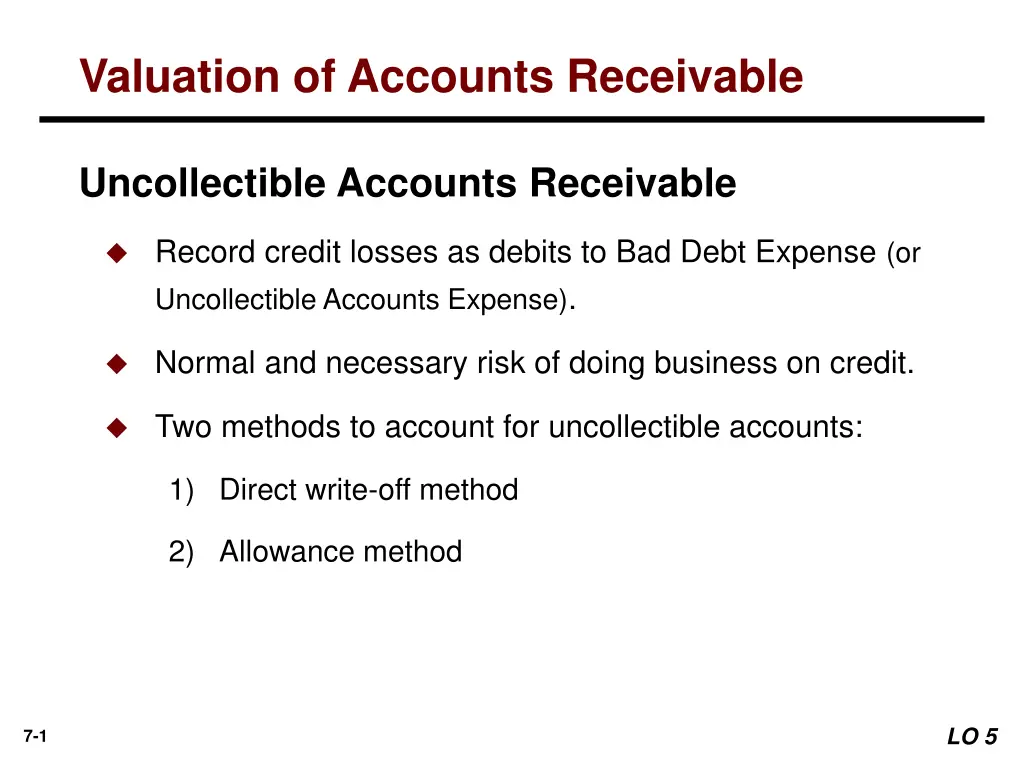
Valuation of Accounts Receivable Uncollectible Accounts Receivable Record credit losses as debits to Bad Debt Expense (or Uncollectible Accounts Expense). Normal and necessary risk of doing business on credit. Two methods to account for uncollectible accounts: 1) Direct write-off method 2) Allowance method LO 5 7-1
Valuation of Accounts Receivable Methods of Accounting for Uncollectible Accounts Direct Write-Off Allowance Method Theoretically deficient: Losses are estimated: No matching. Percentage-of-sales. Receivable not stated at cash realizable value. Percentage-of-receivables. IFRS requires when bad debts are material in amount. Not appropriate when amount uncollectible is material. LO 5 7-2
Allowance Method ILLUSTRATION 7-7 Comparison of Bases for Estimating Uncollectibles The percentage-of-sales basis results in a better matching of expenses with revenues The percentage-of-receivables basis produces the better estimate of cash realizable value LO 5 7-3
Allowance Method Percentage-of-Sales Approach Percentage based upon past experience and anticipate credit policy. Achieves better matching of cost and revenues. Any balance in Allowance for Doubtful Accounts is ignored. Method frequently referred to as the income statement approach. LO 5 7-4
Percentage-of-Sales Approach Illustration: Gonzalez Company estimates that about 1% of net credit sales will become uncollectible. If net credit sales are R$800,000 for the year, it records bad debt expense as follows. Bad Debt Expense (1% x R$800,000) 8,000 Allowance for Doubtful Accounts 8,000 ILLUSTRATION 7-8 LO 5 7-5
Allowance Method Percentage-of-Receivables Approach Not matching. Estimate of the receivables realizable value. Companies may apply this method using one composite rate, or an aging schedule using different rates. LO 5 7-6
Percentage-of-Receivables Approach ILLUSTRATION 7-9 Accounts Receivable Aging Schedule What entry would Wilson make assuming that the allowance account had a zero balance? Bad Debt Expense 37,650 Allowance for Doubtful Accounts 37,650 LO 5 7-7
Percentage-of-Receivables Approach ILLUSTRATION 7-9 Accounts Receivable Aging Schedule What entry would Wilson make assuming the allowance account had a credit balance of 800 before adjustment? Bad Debt Expense ( 37,650 800) 36,850 Allowance for Doubtful Accounts 36,850 LO 5 7-8