Methods of Expressing Concentration in Chemistry
Explore the different methods of expressing concentration in chemistry, including Normality, Molarity, Molality, Formality, and more. Learn about primary and secondary standards, standard solutions, test solutions, and the process of standardization. Presented by Ms. Rohini S. Kavalapure, Assistant Professor at KLE College of Pharmacy-Belagavi.

Download Presentation

Please find below an Image/Link to download the presentation.
The content on the website is provided AS IS for your information and personal use only. It may not be sold, licensed, or shared on other websites without obtaining consent from the author. If you encounter any issues during the download, it is possible that the publisher has removed the file from their server.
You are allowed to download the files provided on this website for personal or commercial use, subject to the condition that they are used lawfully. All files are the property of their respective owners.
The content on the website is provided AS IS for your information and personal use only. It may not be sold, licensed, or shared on other websites without obtaining consent from the author.
E N D
Presentation Transcript
METHODS OF EXPRESSING CONCENTRATION , PRIMARY STANDARDS AND SECONDARY CONCENTRATION Presented by Ms. Rohini S. Kavalapure Assistant Professor Department of Pharmaceutical Chemistry KLE College of Pharmacy-Belagavi 1 6/16/2025 Ms.Rohini S.K 1
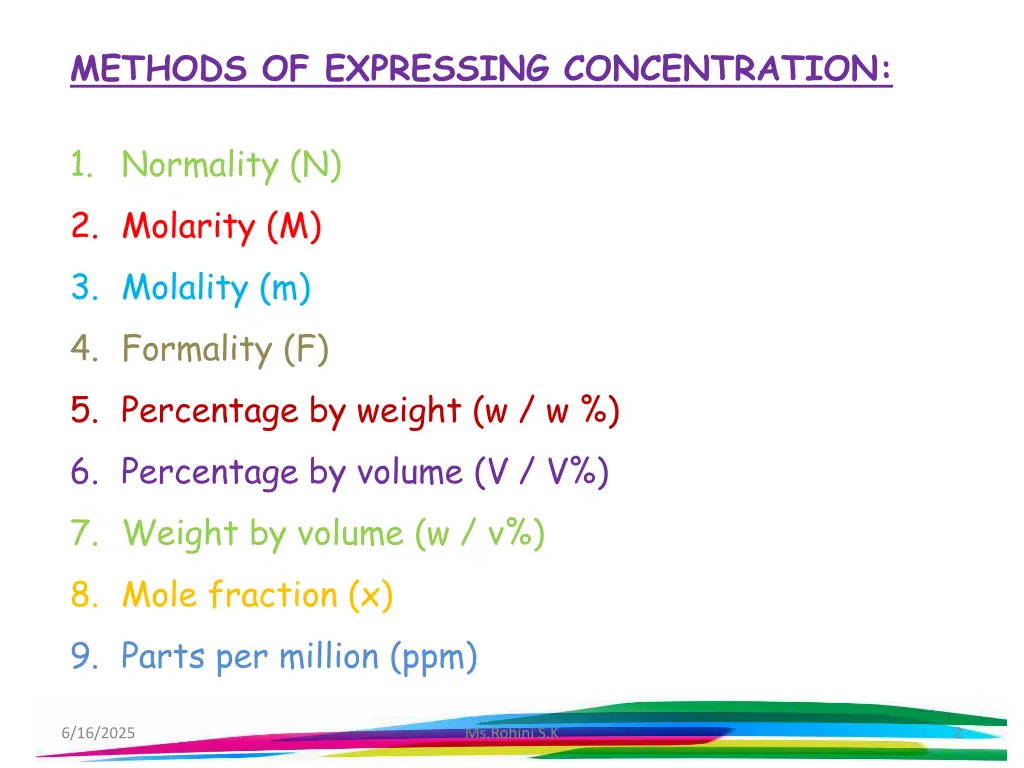
METHODS OF EXPRESSING CONCENTRATION: 1. Normality (N) 2. Molarity (M) 3. Molality (m) 4. Formality (F) 5. Percentage by weight (w / w %) 6. Percentage by volume (V / V%) 7. Weight by volume (w / v%) 8. Mole fraction (x) 9. Parts per million (ppm) 6/16/2025 Ms.Rohini S.K 2
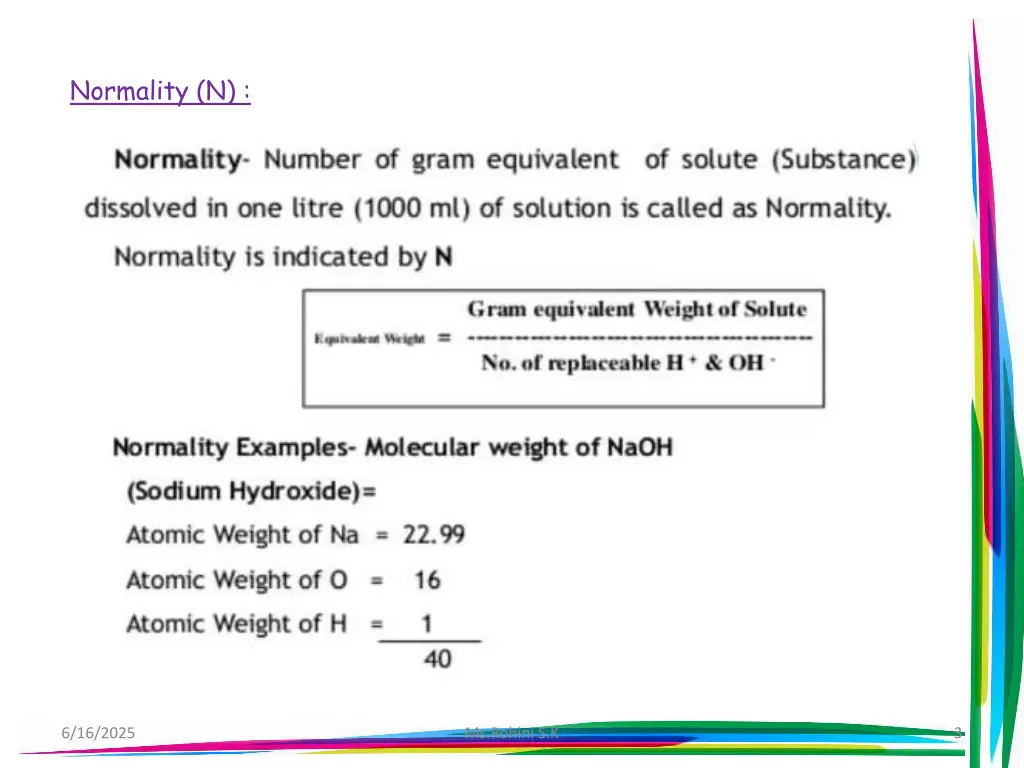
Normality (N) : 6/16/2025 Ms.Rohini S.K 3
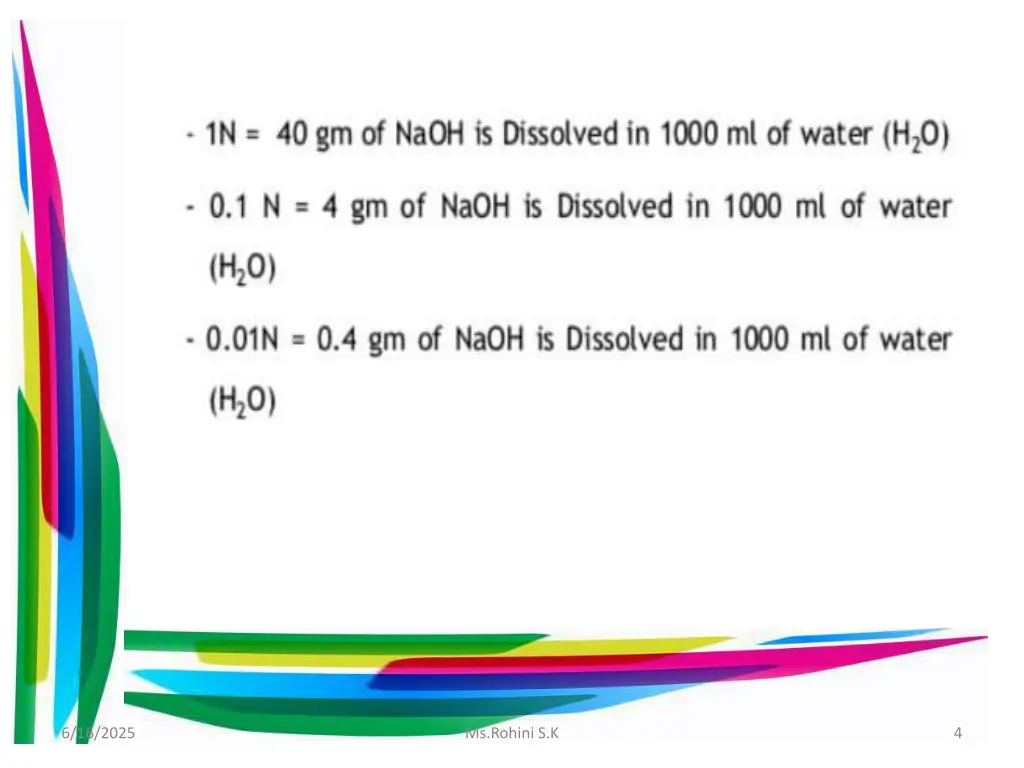
6/16/2025 Ms.Rohini S.K 4
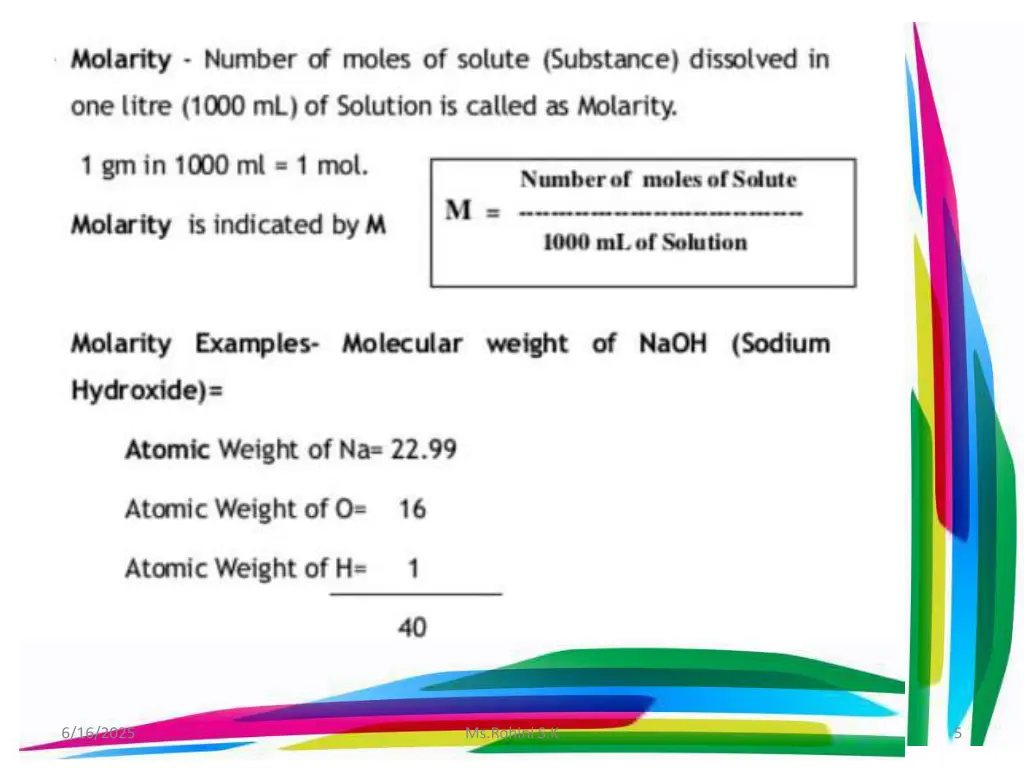
6/16/2025 Ms.Rohini S.K 5
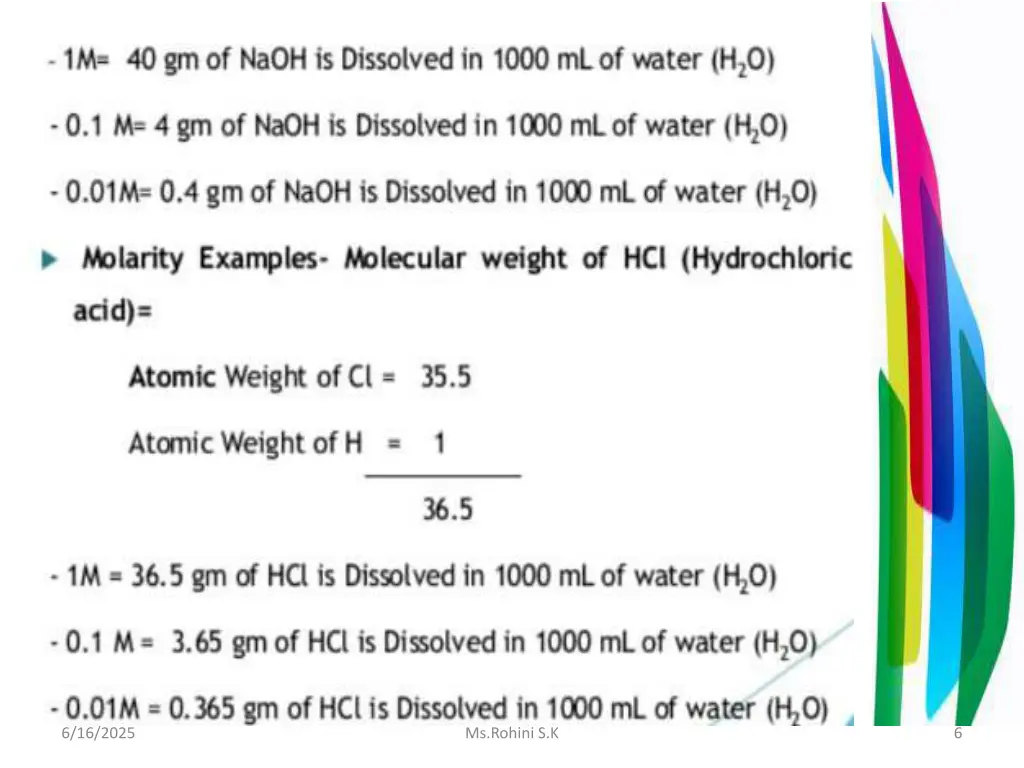
6/16/2025 Ms.Rohini S.K 6
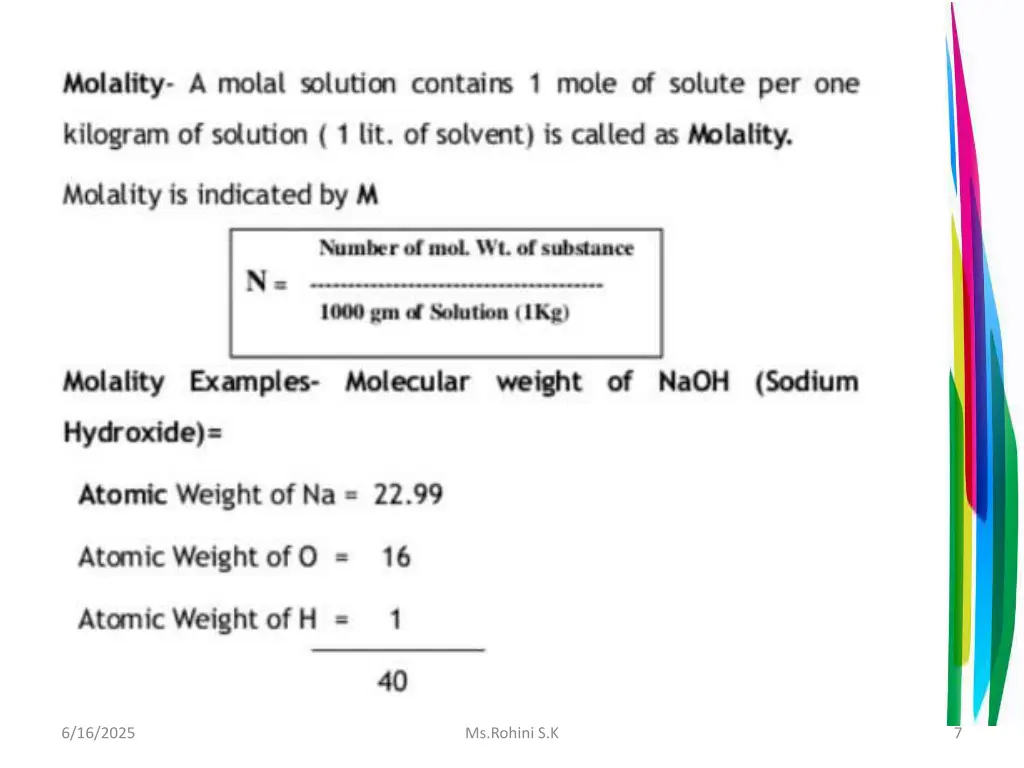
6/16/2025 Ms.Rohini S.K 7
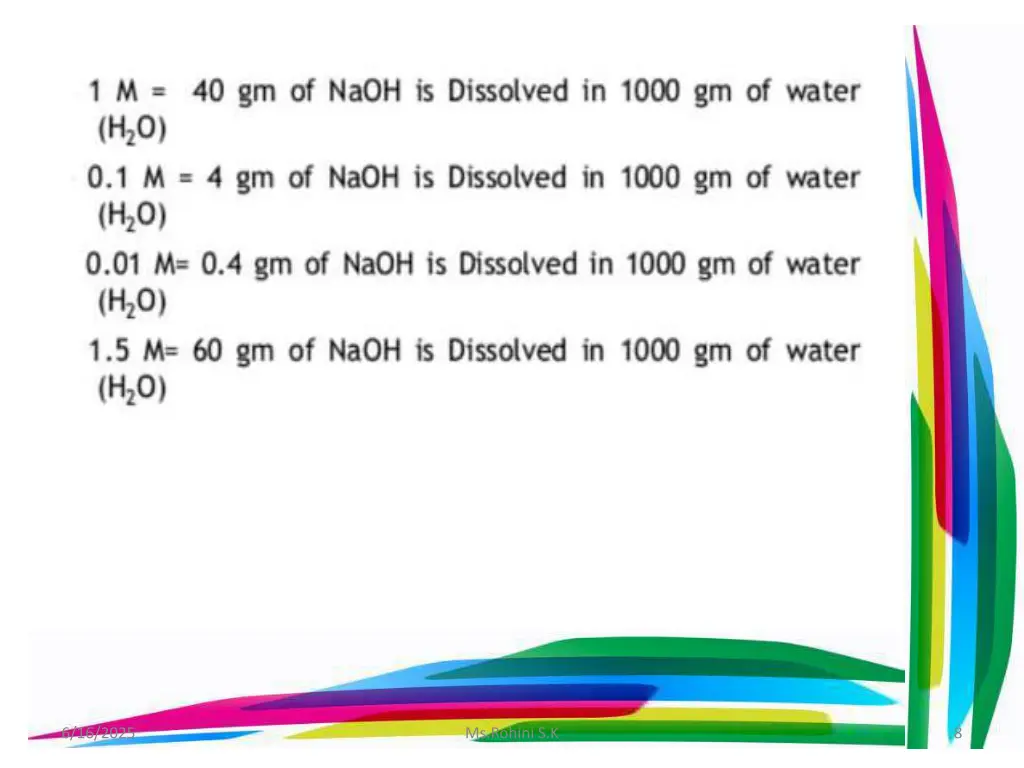
6/16/2025 Ms.Rohini S.K 8
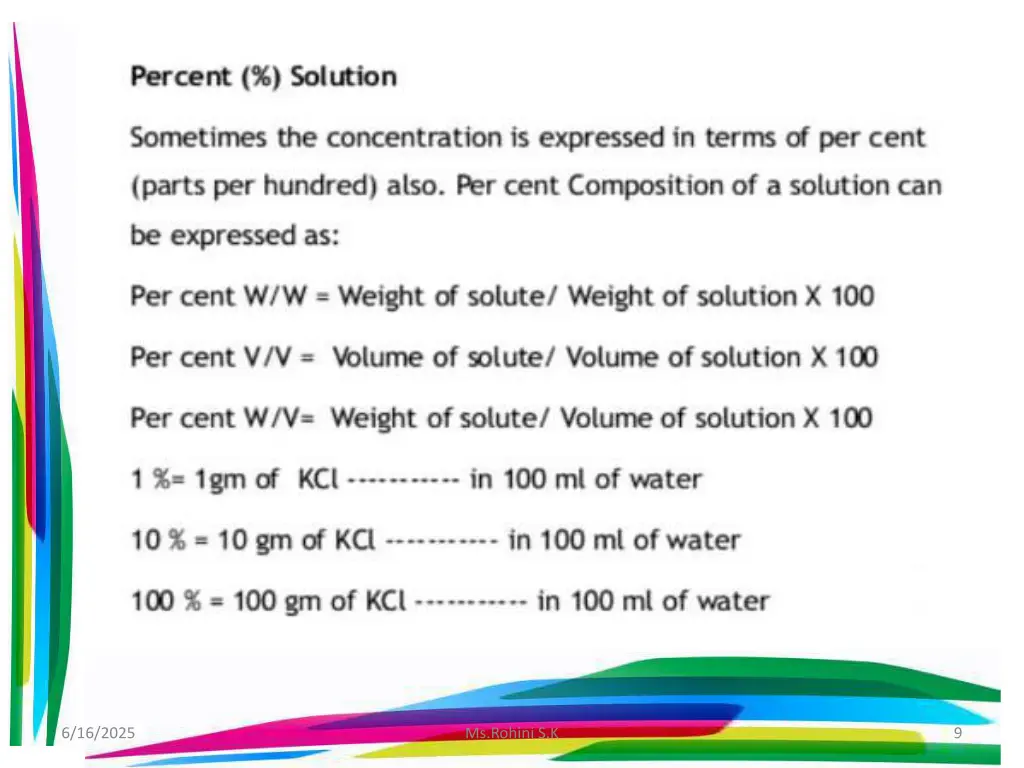
6/16/2025 Ms.Rohini S.K 9
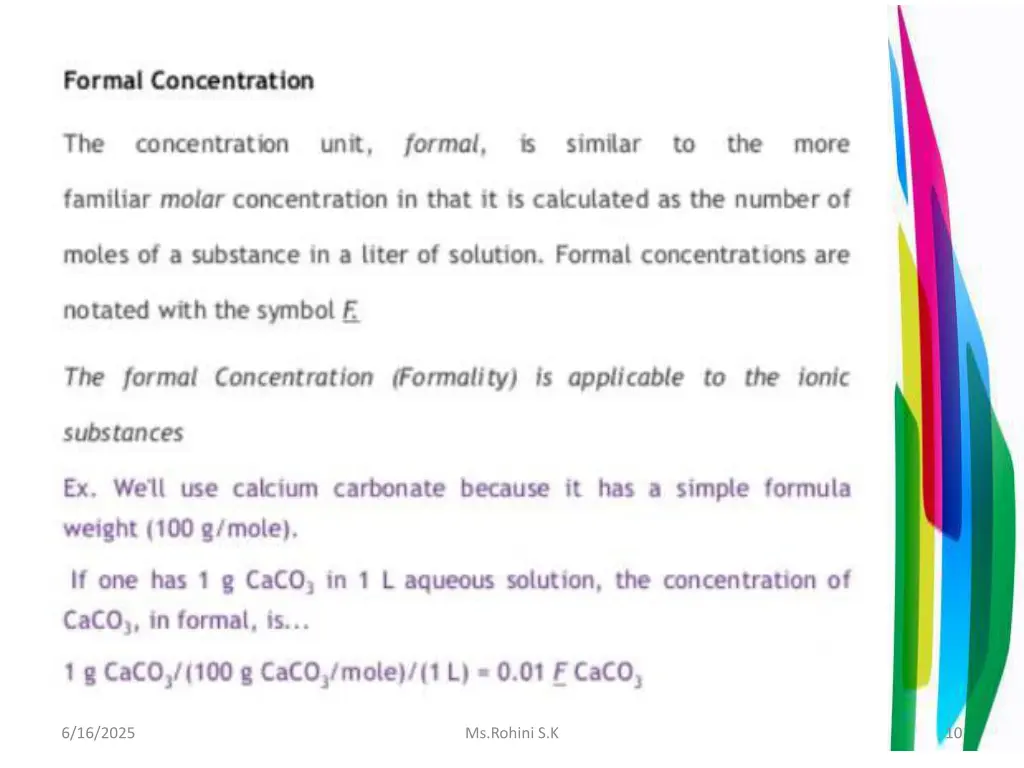
6/16/2025 Ms.Rohini S.K 10
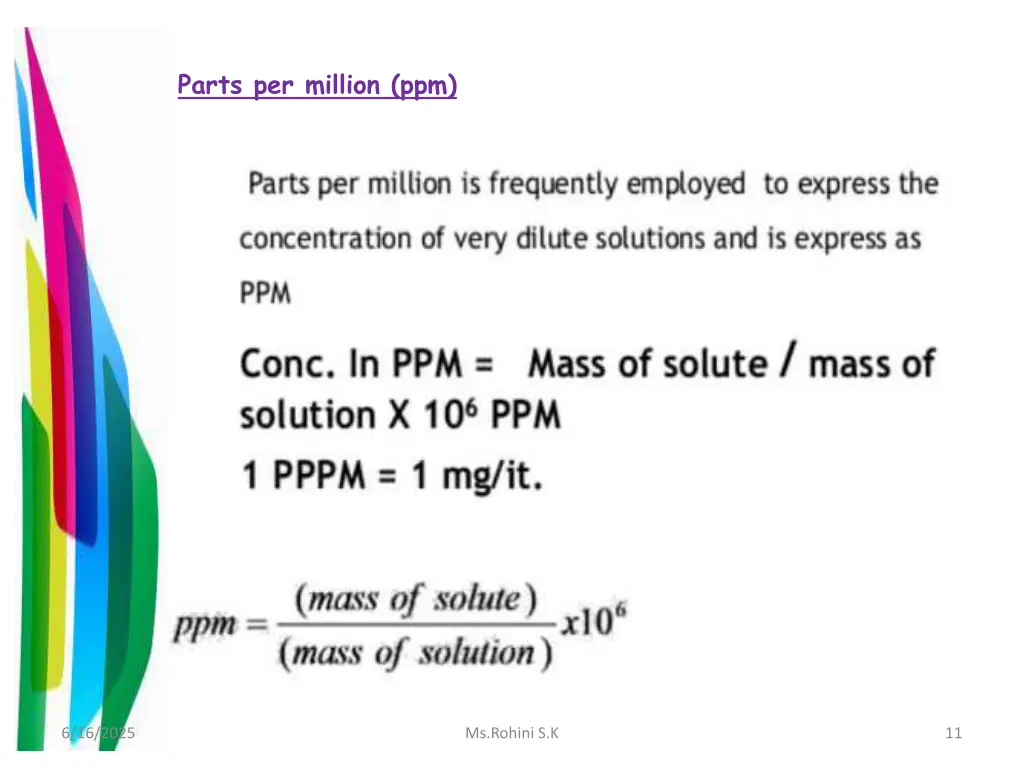
Parts per million (ppm) 6/16/2025 Ms.Rohini S.K 11
PRIMARY AND SECONDARY STANDARDS Presented by Ms. Rohini S. Kavalapure Assistant Professor Department of Pharmaceutical Chemistry KLE College of Pharmacy-Belagavi 6/16/2025 Ms.Rohini S.K 12
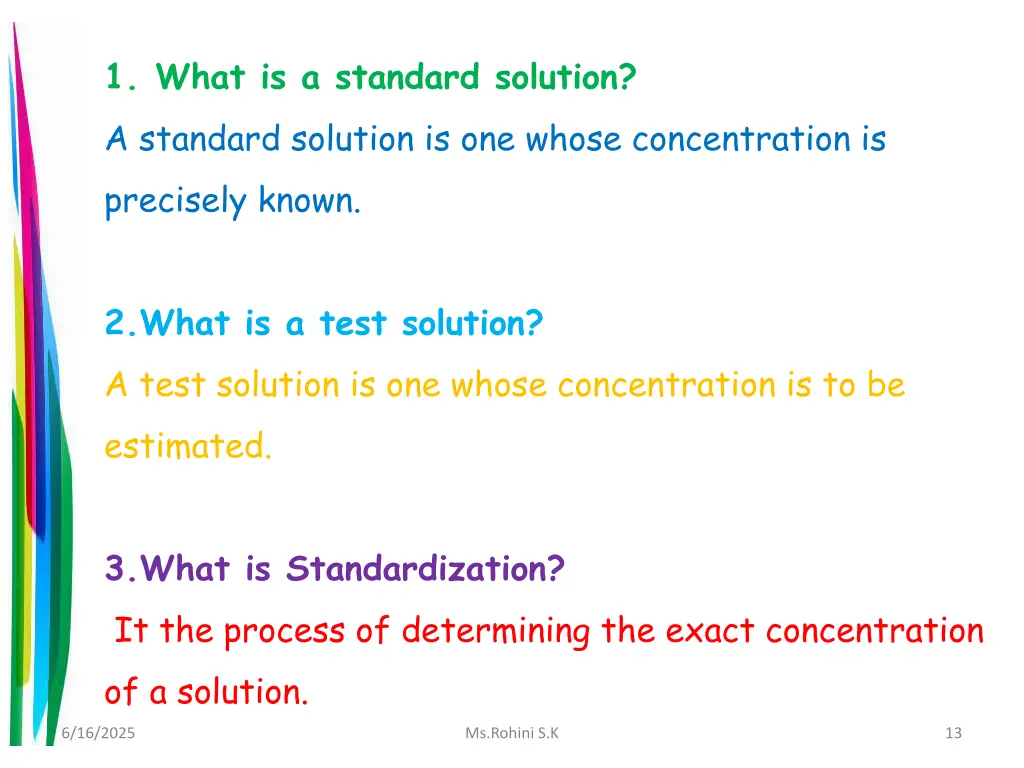
1. What is a standard solution? A standard solution is one whose concentration is precisely known. 2.What is a test solution? A test solution is one whose concentration is to be estimated. 3.What is Standardization? It the process of determining the exact concentration of a solution. 6/16/2025 Ms.Rohini S.K 13
Standardmeans a material containing a substance of our interest with a known concentration. We can express this with definite numbers with proper units. Functions: To provide a reference using which we can determine unknown concentration of solution. To standardization of volumetric solutions. Preparation of secondary standard. To calibrate an instrument. 6/16/2025 Ms.Rohini S.K 14
WHAT IS PRIMARY STANDARD? Primary standard is a reagent which is very pure, generally representative of the number of moles the substance contains and easily weighed. CHARACTERISTICS: That's stable, It's not a hydrate /has no water of hydration, High molecular weight. 6/16/2025 Ms.Rohini S.K 15
WHY PRIMARY STANDARDS ARE USED? Determination unknown concentration and in other analytical techniques. High level of purity. Low reactivity (high stability). High equivalent weight (to reduce error from mass measurements). Not hygroscopic (to reduce changes in mass in humid versus dry environments). Non-toxic. Inexpensive and readily available. 6/16/2025 Ms.Rohini S.K 16
CHARACTERISTICS: It should have a high relative molecular weight so that weighing errors may be negligible. The substance should be readily soluble under the conditions in which it is employed. 6/16/2025 Ms.Rohini S.K 17
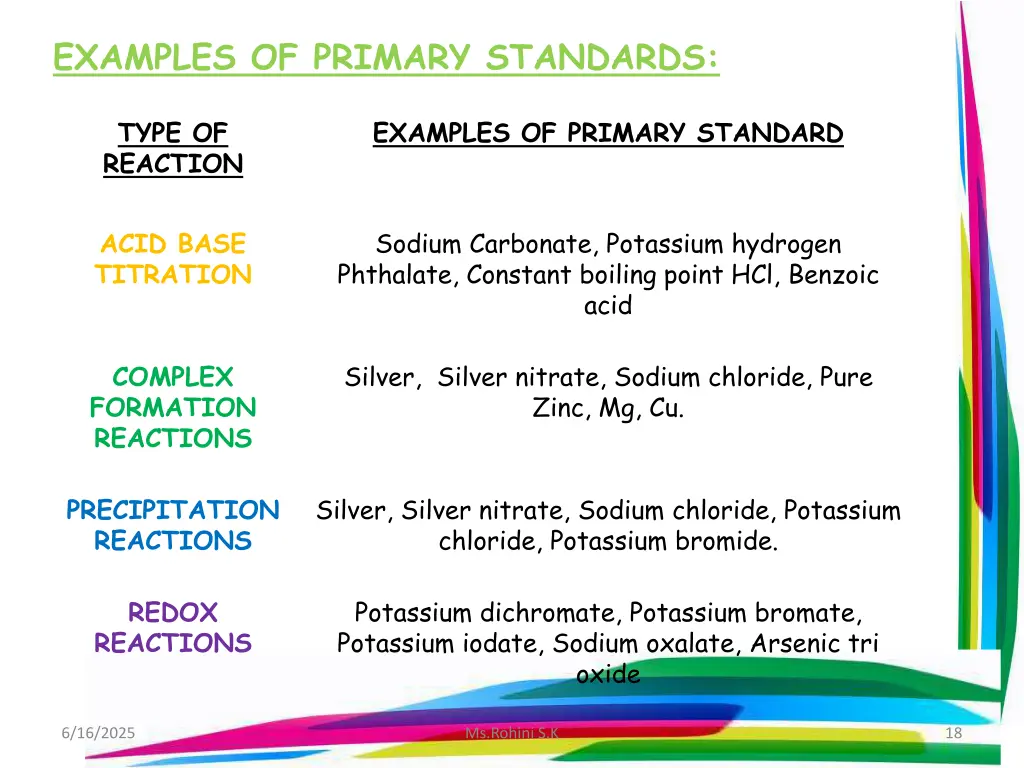
EXAMPLES OF PRIMARY STANDARDS: TYPE OF REACTION EXAMPLES OF PRIMARY STANDARD ACID BASE TITRATION Sodium Carbonate, Potassium hydrogen Phthalate, Constant boiling point HCl, Benzoic acid COMPLEX FORMATION REACTIONS Silver, Silver nitrate, Sodium chloride, Pure Zinc, Mg, Cu. PRECIPITATION REACTIONS Silver, Silver nitrate, Sodium chloride, Potassium chloride, Potassium bromide. REDOX REACTIONS Potassium dichromate, Potassium bromate, Potassium iodate, Sodium oxalate, Arsenic tri oxide 6/16/2025 Ms.Rohini S.K 18
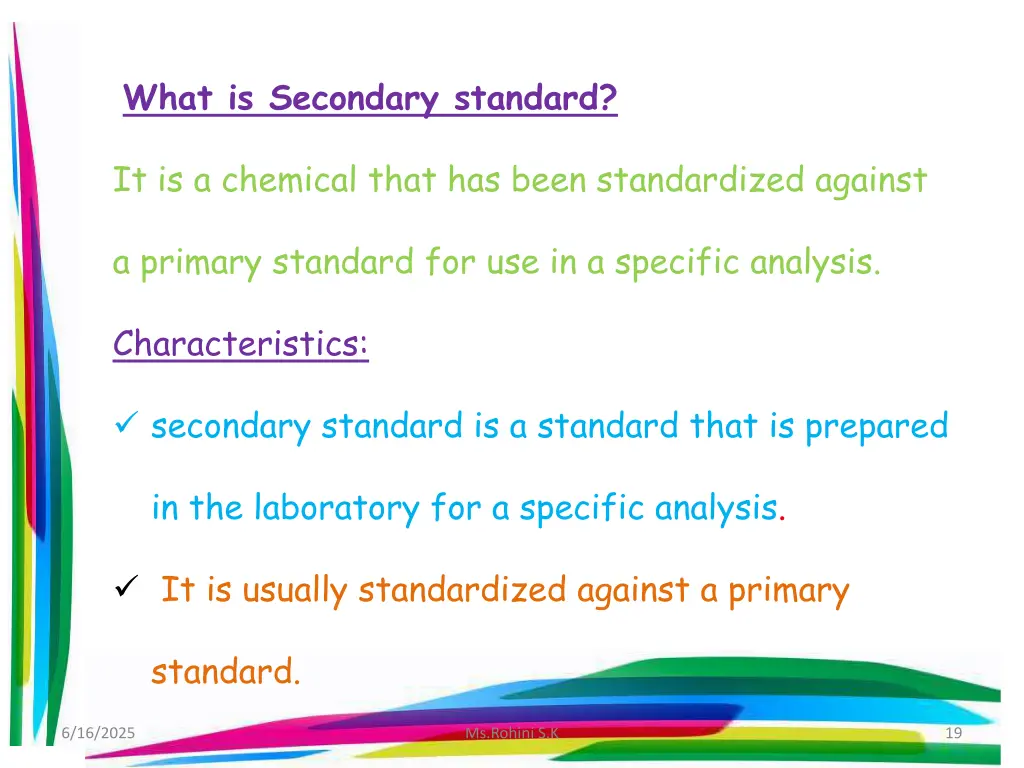
What is Secondary standard? It is a chemical that has been standardized against a primary standard for use in a specific analysis. Characteristics: secondary standard is a standard that is prepared in the laboratory for a specific analysis. It is usually standardized against a primary standard. 6/16/2025 Ms.Rohini S.K 19
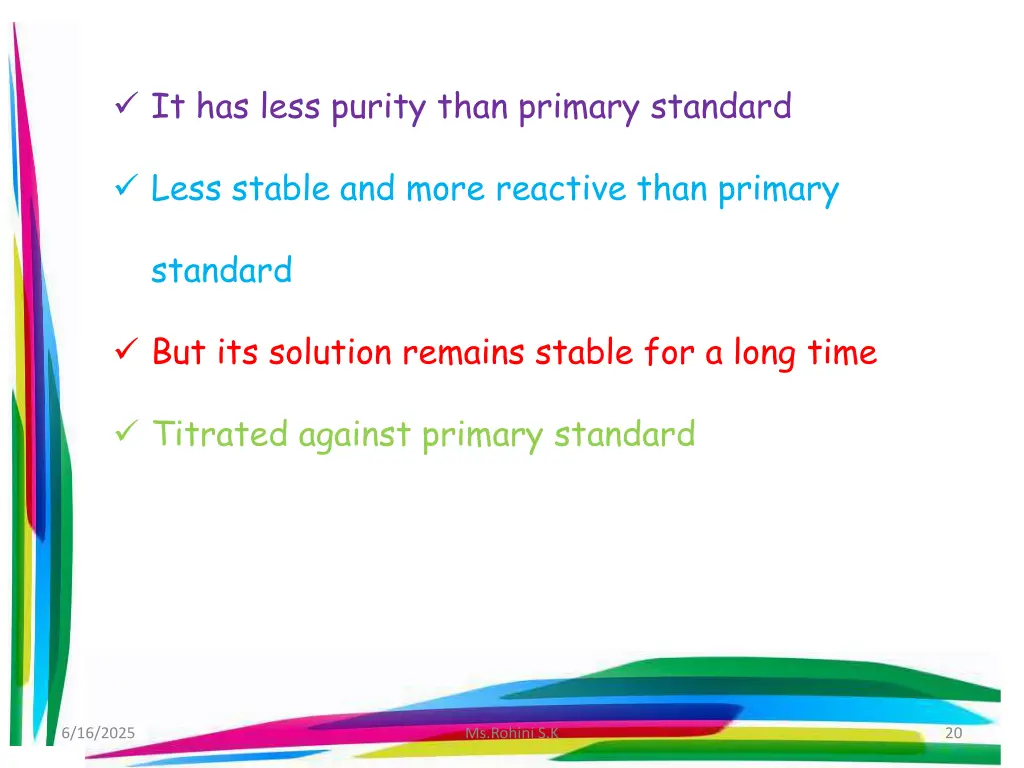
It has less purity than primary standard Less stable and more reactive than primary standard But its solution remains stable for a long time Titrated against primary standard 6/16/2025 Ms.Rohini S.K 20
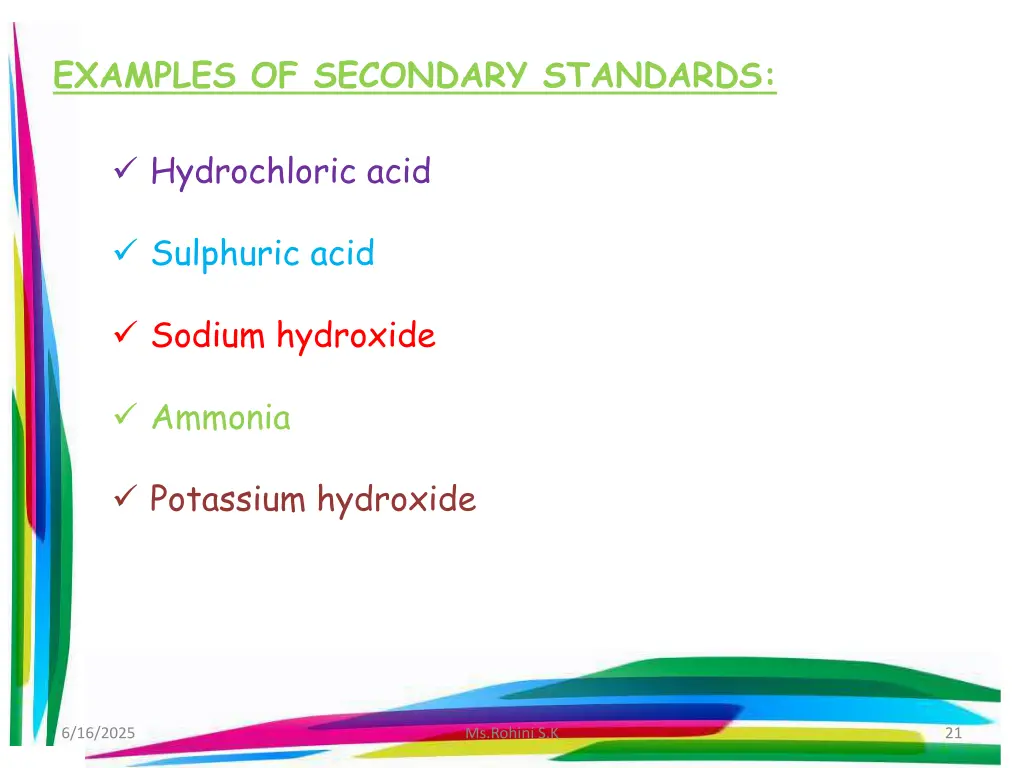
EXAMPLES OF SECONDARY STANDARDS: Hydrochloric acid Sulphuric acid Sodium hydroxide Ammonia Potassium hydroxide 6/16/2025 Ms.Rohini S.K 21
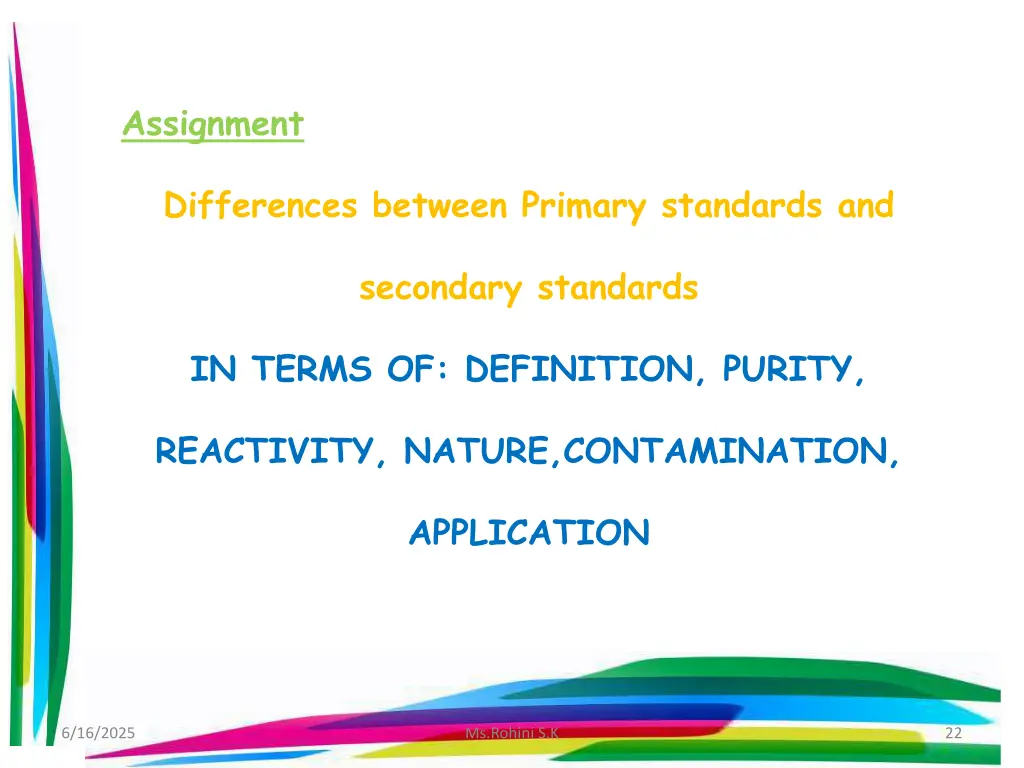
Assignment Differences between Primary standards and secondary standards IN TERMS OF: DEFINITION, PURITY, REACTIVITY, NATURE,CONTAMINATION, APPLICATION 6/16/2025 Ms.Rohini S.K 22