Microbiology of Meat and Meat Products
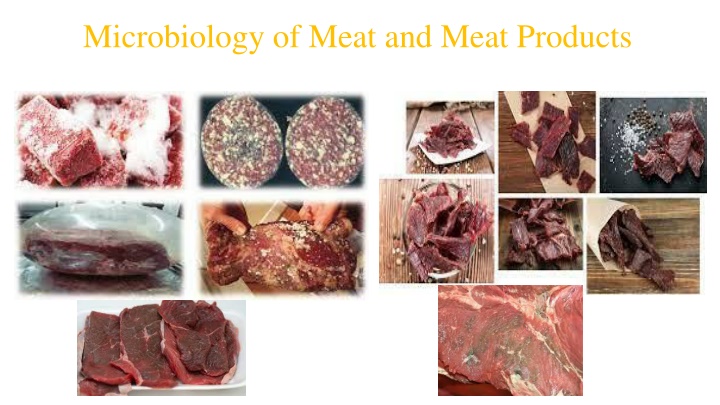
Spoilage in meat products is caused by various microorganisms leading to undesirable changes in the food, making it unsuitable for consumption. Factors like contamination, enzymatic actions, and environmental conditions play a role in meat spoilage.

Download Presentation

Please find below an Image/Link to download the presentation.
The content on the website is provided AS IS for your information and personal use only. It may not be sold, licensed, or shared on other websites without obtaining consent from the author.If you encounter any issues during the download, it is possible that the publisher has removed the file from their server.
You are allowed to download the files provided on this website for personal or commercial use, subject to the condition that they are used lawfully. All files are the property of their respective owners.
The content on the website is provided AS IS for your information and personal use only. It may not be sold, licensed, or shared on other websites without obtaining consent from the author.
E N D
Presentation Transcript
What is Spoilage? Spoilage is the process in which food deteriorates and produced undesirable changes in the product and becomes unsuitable for human consumption. What is microbial spoilage? A number of different types of microorganisms are responsible for the spoilages of meat. When they breaks different components of any food items, acids and other waste products are created. Sometimes the microbes itself may or may not be harmful but the metabolites or waste items produced may impart unpleasant taste and colour to our food which is harmful to human's health.
How it occurs? Normal slaughtering techniques External sources during bleeding, handling, skinning, cutting and processing. Intestinal tract of animals, exterior of animals (hide, hooves and hairs) Knives, cloths, air, and hands and clothing of workers. Depends on methods of slaughtering methods such as mechanical, chemical, electrical etc.
Meat and meat products category as highly spoilage food due to the following o High nutritive content that can support rapid microbial growth o High water activity of 0.85 or greater o pH of 5.0 or greater o Presence of autolytic enzymes o Presence of a significant amount of fat and lipids favoring oxidation and spoilage
MEAT SPOILAGE Raw meat starts deteriorating by its own enzymes and microorganism and chemically oxidize the fat. Autolysis changes include some proteolytic action on muscles and tissues resulted in hydrolysis of fats. Defects caused by autolysis called souring . Invasion (attack) of tissue by micro organism Invasion of tissue by contaminating micro organism takes place after death of animals. Factors affecting the invasion includes :- Microbial load of the gut of slaughtered animal Health and Physical condition of the animal before slaughter Method used for slaughtering and bleeding Rate of cooling
Growth of micro organism in Meat Meat is an ideal food for a number of microorganism because its high moisture content, richness in nitrogenous components in meat with various degree of complexity, high amount of minerals and various growth factors. It also contains fermentable carbohydrate( glycogen) and favorable pH range which suits most of the contaminating micro-organism. Factors influence growth of microorganism The kind & amount of contamination with microorganism and the spread of these microorganism in the meat. The physical properties of the meat Chemical properties of the meat Availability of oxygen Temperature
Types of Spoilage of Meats Spoilage under 1-Aerobic conditions 2-An aerobic conditions Under aerobic conditions bacteria may cause the following - Surface slime which may be caused by species of Pseudomonas, Acinetobacter, Moraxella, Alcaligenes, streptococcus, Bacillus, and Micrococcus, It is an indication of spoilage, often observed before expiry date. 1-Changes in colour of meat pigment- The red color of meat, called bloom , may be changed to shades of green, brown, gray as result of the production of oxidizing compound . e.g. hydrogen peroxides, hydrogen sulfide. Lactobacillus and Leuconostoc are basically responsible.
2- Changes in fats:- The oxidation of unsaturated fats may takes place chemically in air and may be catalyzed by light and copper. e.g. oxidative rancidity. Pseudomonas and Achromobacter are responsible for oxidative rancidity or by yeast. Surface colour discoloration due to pigment forming bacteria:- red spot may be caused by Serratia marcescens or other bacteria with red pigment. Pseudomonas syncyanea can impart blue colour to the surface, Micrococcus or flavobacterium imparts yellow colour 3-Off odours and off taste:- Taints or undesirable odours and off taste that appear in a meat . souring that gives the sour odour that may be due to volatile acids. e.g. formic, butyric, propionic acids by the action of mos. Sometimes Cold storage flavour or taint observed in meat and its nothing but stale flavour. In case of musty or earthy flavour, meat contaminated with Actinomycetes are the causative agent for the same.
Spoilage under anaerobic conditions Facultative and anaerobic bacteria can able to grow within the meat under anaerobic conditions and cause spoilage. Following changes occurs in such conditions 1- Souring -- It imparts sour taste to meat due to acids such as formic, propionic, acetic etc. meat s own enzymes are responsible for it . 2-Putrefacation -- True putrefaction is the anaerobic decomposition of protein with the production of foul smelling compound such as hydrogen sulfide, indole, ammonia, amines due to Clostridium species. 3-Taint --- Taints or undesirable odors and tastes, that appear in a meat
Detection of microbial spoilage in meat Enumeration (counting) o Direct methods to detect microbial spoilage of meat are based on quantifying bacterial populations such as total viable count or the specific microbial count. time-consuming and only assistance in estimating the viable bacterial load in a meat at the time of sampling
Plates are incubated at Total aerobic count - Plate Count Agar 32 C for 72 h Enterobacteriaceae on Violet Red Bile Glucose Agar Lactic acid bacteria - Man, Rogosa and Sharpe Agar Pseudomonas spp. - Cetrimide Agar Plates are incubated at 25 C for 72 h Spoilage occurs when the levels of total count bacteria count reach 7 8 log cfu /g meat. 11